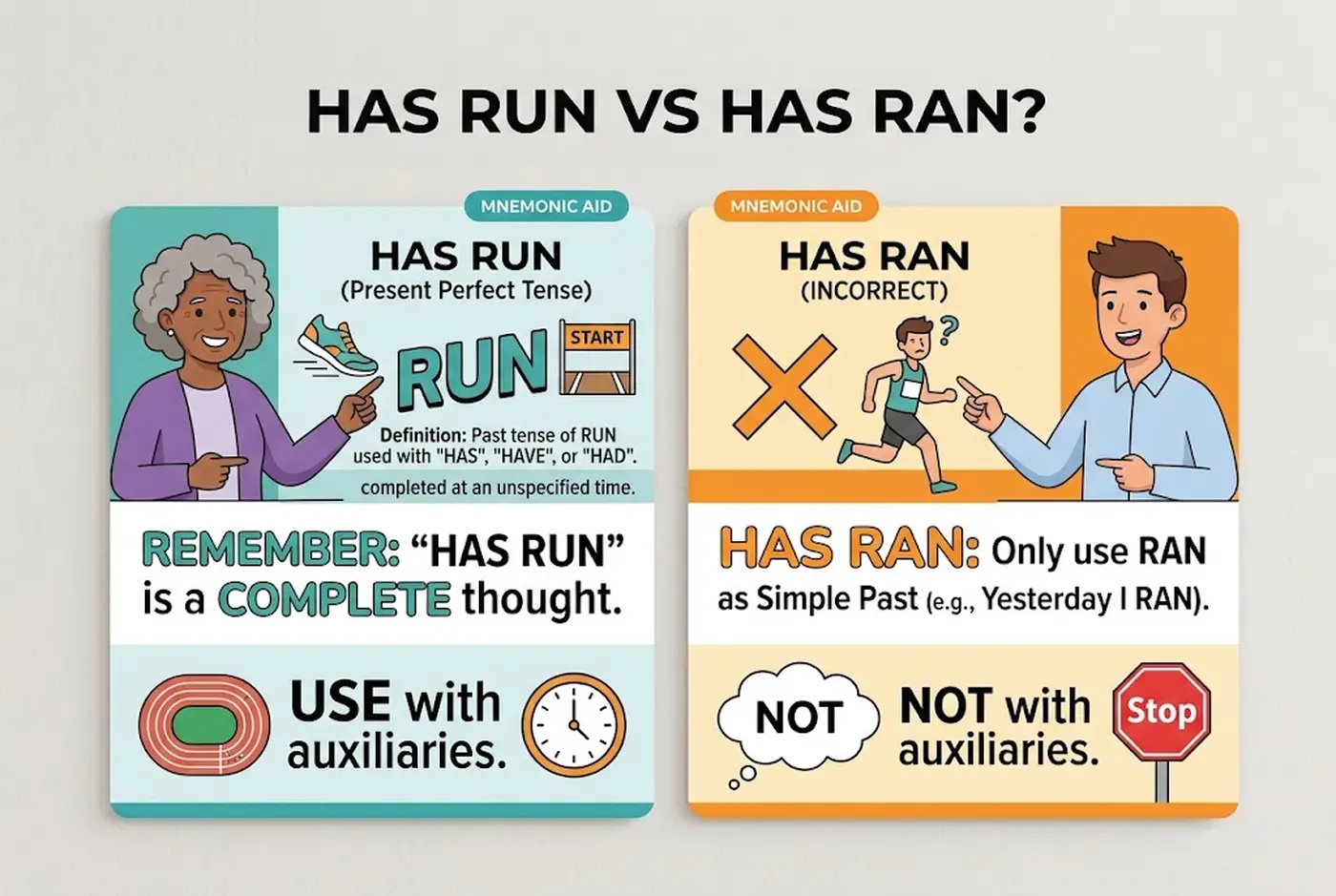
Have you ever written an email or school assignment and stopped to think about which expression sounds correct: has run vs has ran? Both may sound natural when spoken quickly, but only one follows standard English grammar.
The confusion happens because run and ran are different forms of the same verb. They describe actions that have already happened, but they do not work in the same grammatical structures. Choosing the wrong form can make a sentence sound incorrect, especially in formal writing.
Has run is the grammatically correct expression in standard English. It uses the present perfect tense, while has ran is considered incorrect because ran is the simple past form, not the past participle.
Understanding this difference will help you write more confidently. In this guide, you’ll learn the grammar rule, the history of both words, their meanings, useful alternatives, common mistakes, and examples from everyday situations.
What Is the Difference Between Has Run and Has Ran?
The main difference comes down to verb tense and verb form. Has run is correct because the present perfect tense requires the past participle of a verb. Has ran does not follow this rule because ran is the simple past form.
Here is a quick comparison:
| Expression | Correct or Incorrect | Explanation |
|---|---|---|
| Has run | Correct | Uses the correct past participle. |
| Has ran | Incorrect | Uses the simple past form instead of the past participle. |
What Does Has Run Mean?
Has run is the present perfect form of the verb run. It describes an action that happened in the past but has a connection to the present.
For example:
- She has run five miles today.
- The company has run several successful campaigns.
- He has run out of money.
What Does Has Ran Mean?
Has ran is a nonstandard grammatical construction in modern standard English. It combines has, which requires a past participle, with ran, which is the simple past form.
For example:
Incorrect: She has ran five miles today.
Correct: She has run five miles today.
The problem is not with the word ran itself. Ran is a perfectly correct English word when used in the simple past tense.
For example:
- She ran five miles yesterday.
- He ran to catch the bus.
- They ran around the park.
What Are the Origins of Run and Ran?
Understanding the history of these words makes their different forms easier to remember.
Both run and ran come from the same Old English verb, rinnan, which meant to flow, move, or run. Over time, the verb developed different forms as English grammar changed.
Run is an irregular verb. Unlike regular verbs, it does not form its past tense and past participle by simply adding -ed.
Instead, it has three main forms:
| Verb Form | Word | Example |
|---|---|---|
| Base form | Run | I run every morning. |
| Simple past | Ran | I ran yesterday. |
| Past participle | Run | I have run before. |
This pattern is known as an irregular verb pattern.
The vowel changes from u to a in the simple past form, but returns to u in the past participle.
Other English verbs follow similar patterns:
| Base Form | Simple Past | Past Participle |
|---|---|---|
| Begin | Began | Begun |
| Drink | Drank | Drunk |
| Sing | Sang | Sung |
| Swim | Swam | Swum |
| Ring | Rang | Rung |
| Run | Ran | Run |
When Should You Use Has Run in a Sentence?
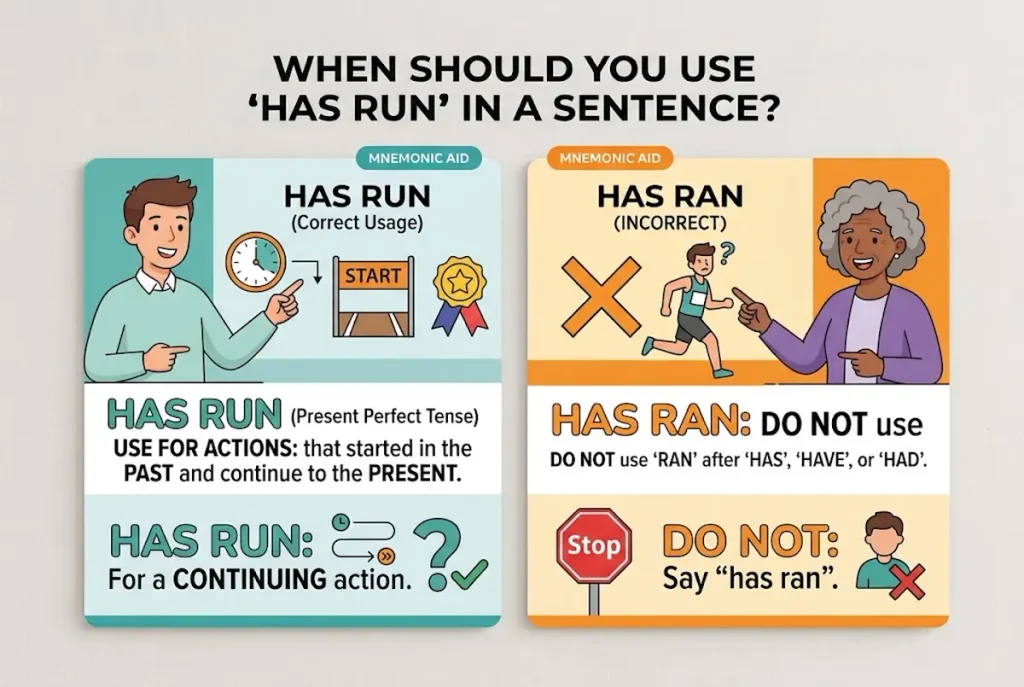
Use has run when the subject is singular and the sentence needs the present perfect tense.
The present perfect follows this basic structure:
Subject + has + past participle
Because run is the past participle of run, it fits this structure correctly.
Here are the main situations where you can use it.
When an Action Started in the Past and Continues Now
Sometimes an action began earlier and is still happening.
Examples:
- She has run this business for ten years.
- He has run the family restaurant since 2018.
- My brother has run the same training program for months.
In these sentences, the action began in the past and continues into the present.
When Talking About Life Experiences
Use the present perfect when discussing an experience without giving a specific finished time.
Examples:
- She has run in several international races.
- He has run a marathon before.
- My coach has run many successful training sessions.
These sentences describe experiences that matter now.
When Describing a Recent Action
You can also use has run to describe a completed action with a present result.
Examples:
- The printer has run out of paper.
- The engine has run for too long.
- The computer program has run successfully.
The action is complete, but its result is relevant to the current situation.
When Describing a Repeated Action
The present perfect can describe something that has happened several times.
Examples:
- The school has run this competition every year.
- She has run three workshops this month.
- The company has run several advertising campaigns.
The focus is on the repeated experience or activity.
What Is the Difference Between Has Run, Have Run, and Had Run?
These three expressions use the same past participle, but they belong to different grammatical structures.
Understanding them will help you avoid mistakes in speaking and writing.
| Expression | Tense | Example |
|---|---|---|
| Has run | Present perfect | She has run five miles. |
| Have run | Present perfect | They have run five miles. |
| Had run | Past perfect | She had run five miles before lunch. |
Has Run
Use has run with third-person singular subjects, such as he, she, it, or a singular name.
Examples:
- John has run a successful business.
- She has run three kilometers.
- The dog has run around the garden.
Have Run
Use have run with I, you, we, they, and plural subjects.
Examples:
- I have run every morning this week.
- They have run several experiments.
- We have run out of time.
Had Run
Use had run when one action happened before another action in the past.
Examples:
- She had run five miles before the rain started.
- He had run the company for years before retiring.
- They had run out of food before the guests arrived.
Remember that the past participle remains run in all three expressions.
What Are the Best Synonyms and Alternatives for Run?
The word run has several meanings. It can describe physical movement, managing a business, operating a machine, or organizing an activity.
Because of these different meanings, its alternatives depend on the context. Not every synonym can replace run in every sentence.
Here are 28 useful alternatives grouped by tone and everyday use.
Simple Words for Run
These words are easy to understand and work in common situations.
| Word | Meaning | Tone | Example |
|---|---|---|---|
| Move | Change position | Simple | She moved across the field. |
| Jog | Run slowly | Simple | He jogged around the park. |
| Walk | Move on foot | Simple | She walked to the store. |
| Travel | Go from one place to another | Simple | They traveled across the country. |
| Race | Move quickly in competition | Simple | The children raced to the finish line. |
| Operate | Make something work | Simple | He operates the machine. |
| Manage | Be responsible for something | Simple | She manages the shop. |
Everyday Alternatives for Run
These words are useful in conversations, emails, and general writing.
| Word | Meaning | Tone | Example |
|---|---|---|---|
| Sprint | Run at full speed | Everyday | He sprinted toward the bus. |
| Dash | Move quickly | Everyday | She dashed across the street. |
| Rush | Move with urgency | Everyday | They rushed to the station. |
| Race | Compete in speed | Everyday | We raced to the finish. |
| Lead | Be in charge | Everyday | She leads the department. |
| Direct | Guide or control | Everyday | He directs the project. |
| Handle | Take care of something | Everyday | She handles the daily operations. |
Formal Alternatives for Run
These words are useful in professional, academic, and business writing.
| Word | Meaning | Tone | Example |
|---|---|---|---|
| Administer | Manage or organize | Formal | She administers the program. |
| Supervise | Oversee an activity | Formal | He supervises the department. |
| Conduct | Carry out an activity | Formal | The team conducted an experiment. |
| Manage | Control or organize | Formal | She manages the organization. |
| Oversee | Monitor and direct | Formal | He oversees the entire project. |
| Execute | Carry out a plan | Formal | The company executed its strategy. |
| Facilitate | Make an activity easier | Formal | She facilitates the training session. |
Are These Synonyms Interchangeable?
No. The meaning of run changes depending on how it is used.
For example:
- She has run five miles. You could say she has jogged five miles if the speed was slow.
- She has run the company for five years. You could say she has managed the company for five years.
- The software has run successfully. You could say the software has operated successfully.
However, saying she has sprinted the company would not make sense.
Always choose an alternative that matches the original meaning.
Which Words Can Replace Run at Different Intensity Levels?
Sometimes you want to describe how fast someone moves. In these situations, choosing a word based on intensity can make your writing more accurate.
Here is a simple progression from slow movement to very fast movement.
| Intensity | Word | Meaning | Example |
|---|---|---|---|
| Very mild | Walk | Move slowly on foot | She walked through the park. |
| Mild | Jog | Run at a relaxed speed | He jogged around the track. |
| Moderate | Run | Move faster than walking | They ran toward the gate. |
| Strong | Dash | Move quickly | She dashed across the road. |
| Very strong | Sprint | Run at maximum speed | He sprinted toward the finish line. |
| Very strong | Bolt | Move suddenly and quickly | The horse bolted away. |

How Does Run Work as Different Parts of Speech?
Run is mainly used as a verb, but it can also work as a noun.
Its grammatical role affects the alternatives you can choose.
Run as a Verb
As a verb, run describes movement, management, or operation.
Examples:
- She runs every morning.
- He runs a small business.
- The machine runs quietly.
Possible alternatives include jog, manage, operate, supervise, and direct.
Run as a Noun
Run can also describe an attempt, a period of activity, or a sequence of events.
Examples:
- She went for a run.
- The team had a good run this season.
- The product had a long production run.
Possible alternatives include:
- Jog: A short period of running.
- Attempt: An effort to achieve something.
- Period: A specific length of time.
- Sequence: A series of connected events.
- Streak: A continuous series of similar results.
Run as an Adjective
Run can appear in compound expressions that describe something associated with running or operation.
Examples:
- A runny nose.
- A running engine.
- A running total.
These forms have different meanings and should not be treated as direct replacements for one another.
Is There a Difference Between American and British English?
The basic rule for run, ran, and run is the same in standard American and British English.
Both varieties use the following forms:
| Verb Form | American English | British English |
|---|---|---|
| Base form | Run | Run |
| Simple past | Ran | Ran |
| Past participle | Run | Run |
Which Form Should You Use in Emails, Essays, and Everyday Conversations?
The right form depends on your audience and the situation. The standard grammar rule stays the same, but the way you use the verb may change with the context.
Which Form Is Best for a Resume?
Use has run when describing a responsibility or experience that continues into the present.
Example:
She has run a successful customer service department for six years.
For a previous job that has ended, the simple past may be more appropriate.
Example:
She ran a customer service department for six years.
The second sentence is especially useful when describing a completed position.
Which Form Is Best for an Essay?
Use has run when discussing experiences, historical developments connected to the present, or completed actions with present relevance.
Example:
The organization has run several educational programs to support local students.
For a specific finished event, use ran.
Example:
The organization ran its first educational program in 2015.
Choose the tense that matches the time and meaning of your sentence.
Which Form Is Best for Texting?
Use has run in text messages when you need the present perfect tense.
Example:
Our car has run out of gas.
If you are talking about something that happened yesterday, use ran.
Example:
I ran to the store yesterday.
Texting is informal, but using the correct verb form makes your message easier to understand.
Which Form Is Best for Professional Emails?
Use has run when describing an ongoing responsibility or a recent result.
Example:
Our team has run several successful tests, and the results are ready for review.
You can also use have run when referring to a plural subject.
Example:
We have run the numbers and prepared the final report.
These forms sound natural and professional.
Which Form Is Best for Everyday Speaking?
Use has run when talking about experiences or actions connected to the present.
Examples:
- My brother has run three marathons.
- The washing machine has run all morning.
- She has run this store for years.
Use ran when talking about a completed action in the past.
Example:
My brother ran a marathon last year.
What Are 10 Correct Example Sentences Using Run and Ran?
Examples make grammar rules easier to remember. The following sentences show how these verb forms work in different real-life situations.
Examples With Has Run
- She has run five miles before breakfast every day this week.
- My father has run his own business for more than twenty years.
- The computer program has run without any errors.
- The school has run several activities for its students this month.
- He has run out of time to complete the assignment.
- The engine has run continuously since early morning.
- Our team has run three successful marketing campaigns this year.
- The athlete has run in several national competitions.
Examples With Have Run
- We have run out of supplies, so we need to order more.
- They have run several tests to check the machine.
Notice how the verb form changes depending on the sentence structure.
Has and have take run, while ran works independently as the simple past form.
Has Run vs Has Gone vs Has Been: What’s the Difference?
These expressions may seem similar because they all describe actions or experiences connected to the past. However, their meanings are different.
| Expression | Meaning | Example |
|---|---|---|
| Has run | Has performed the action of running or managing | She has run five miles. |
| Has gone | Has traveled to another place | She has gone to school. |
| Has been | Has visited a place or experienced something | She has been to school. |
Has Run
Use has run to describe physical movement, managing something, or operating something.
Example:
He has run the restaurant since 2020.
Has Gone
Use has gone when someone has left for another place and may still be there or on the way.
Example:
My brother has gone to the supermarket.
Has Been
Use has been when talking about a visit or experience.
Example:
My brother has been to the supermarket.
The difference between gone and been is especially useful when discussing someone’s location or travel experience.
Which One Is Correct: Has Run vs Has Runned?
Has run is correct. Has runned is incorrect in standard English.
The reason is that run is an irregular verb. It does not form its past participle by adding -ed.
Compare these forms:
| Incorrect Form | Correct Form |
|---|---|
| Runned | Run |
| Has runned | Has run |
| Have runned | Have run |
| Had runned | Had run |
What Are the Most Common Mistakes With Has Run vs Has Ran?
Even experienced English speakers sometimes confuse irregular verb forms. Knowing the most common mistakes can help you avoid them.
Using Ran After Has
Incorrect: He has ran five kilometers.
Correct: He has run five kilometers.
The present perfect requires the past participle, not the simple past form.
Using Ran After Have
Incorrect: They have ran out of money.
Correct: They have run out of money.
The same rule applies to have.
Using Run Instead of Ran in the Simple Past
Incorrect: She run to the office yesterday.
Correct: She ran to the office yesterday.
When describing a completed action at a specific time in the past, use ran.
Using Run After Had Incorrectly
Incorrect: He had ran before the competition started.
Correct: He had run before the competition started.
Had also requires the past participle.
Adding -Ed to Run
Incorrect: The athlete has runned three races.
Correct: The athlete has run three races.
Run is irregular, so adding -ed creates a nonstandard form.
Confusing Has Run With Is Running
These expressions have different grammatical structures.
- She has run five miles. Present perfect.
- She is running five miles. Present continuous.
The first describes a completed action or experience connected to the present. The second describes an action happening now or around the present time.
When Should You Avoid Using Has Run vs Has Ran?
Although has run is grammatically correct, it does not fit every situation.
Here are some situations where another form is better.
When You Mention a Specific Finished Time
Use ran when the action happened at a definite time in the past.
Incorrect: She has run five miles yesterday.
Correct: She ran five miles yesterday.
The word yesterday refers to a finished time, so the simple past is the natural choice in standard English.
When the Action Is Happening Right Now
Use is running when someone is currently performing the action.
Incorrect: He has run around the track right now.
Better: He is running around the track right now.
When the Subject Is Plural
Use have run instead of has run with plural subjects.
Incorrect: They has run several tests.
Correct: They have run several tests.
When You Are Describing a Future Action
Use will run for a future event.
Example:
She will run the company after her father retires.
The present perfect does not normally describe an action that has not happened yet.
What Are the Antonyms of Run?
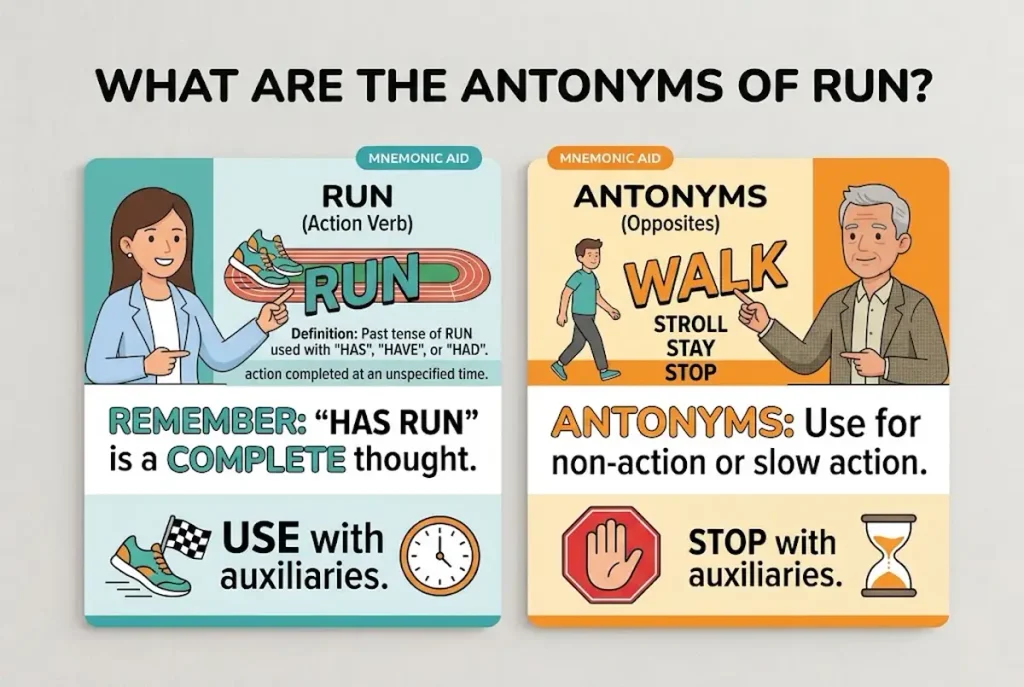
The opposite of run depends on the meaning you want to express. There is no single antonym that works in every situation.
Here are some useful opposite words.
| Word | Opposite of Run in This Context | Example |
|---|---|---|
| Stop | Move or operate | The machine stopped working. |
| Walk | Move quickly | He walked instead of running. |
| Stand still | Move physically | The children stood still. |
| Close | Operate a business | The owner closed the store. |
| Shut down | Operate a machine | The company shut down the system. |
| Follow | Lead or manage | She followed rather than led the team. |
| Remain | Leave or move away | He remained at home. |
What Are the Quick Tips for Remembering the Correct Verb Form?
If you often confuse these words, use these simple tips to remember the difference.
- After has, use run. For example, she has run five miles.
- After have, use run. For example, they have run several tests.
- After had, use run. For example, he had run before the rain started.
- Use ran for a finished action in the simple past. For example, she ran yesterday.
- Do not add -ed to run. It is an irregular verb.
Conclusion
Understanding the difference between has run and has ran comes down to learning the three forms of an irregular verb: run, ran, and run. Has run is correct because the present perfect tense requires the past participle. Ran is used for actions completed in the simple past, usually with a specific past time or context.
For example, you should write she has run five miles today, but she ran five miles yesterday. Both sentences are correct because each uses the appropriate verb form.
Once you understand this simple pattern, you’ll find it easier to use other irregular verbs correctly, too. Practice with everyday sentences, check your verb forms when writing, and remember that a small grammar correction can make your English clearer and more natural.
Frequently Asked Questions
Is has run or has ran grammatically correct?
Has run is grammatically correct in standard English. Has requires the past participle of the verb, and run is the correct past participle.
Why do people say has ran instead of has run?
People may confuse the simple past form ran with the past participle run. It is also heard in some informal or regional speech, but it is not accepted in standard formal English.
Is ran ever the correct word to use?
Yes, ran is correct when describing an action completed in the simple past. For example, she ran to school yesterday.
Should I say she has run or she has ran?
You should say she has run. The present perfect tense requires the past participle, not the simple past form.
What is the past participle of run?
The past participle of run is run. The three main forms are run, ran, and run.
Can I use has run in a professional email?
Yes, has run is correct and appropriate in professional emails. For example, our team has run several successful tests this week.
What’s another way to say someone has run a business?
You can say someone has managed, operated, supervised, or overseen a business. The best choice depends on the person’s responsibilities.
Is had ran correct or should I say had run?
Had run is correct because had must be followed by the past participle. For example, she had run five miles before the race began.

Daniel Grammarfield — The Language Learner
Age: 28Occupation: ESL Learner & Digital Professional
Bio:Daniel is a non-native English speaker who wants to communicate more confidently at work and online. He uses Synotrench to improve grammar, understand confusing words, learn correct sentence structures, and build everyday English skills. He prefers simple explanations with practical examples.
Goals:
Master English grammar rules
Avoid common language mistakes
Improve professional communication
Learn English through real-life examples
Quote:“Learning English is not about memorizing rules — it’s about expressing ideas clearly.”
1 thought on “Has Run vs Has Ran: The Best Simple Grammar (2026)”