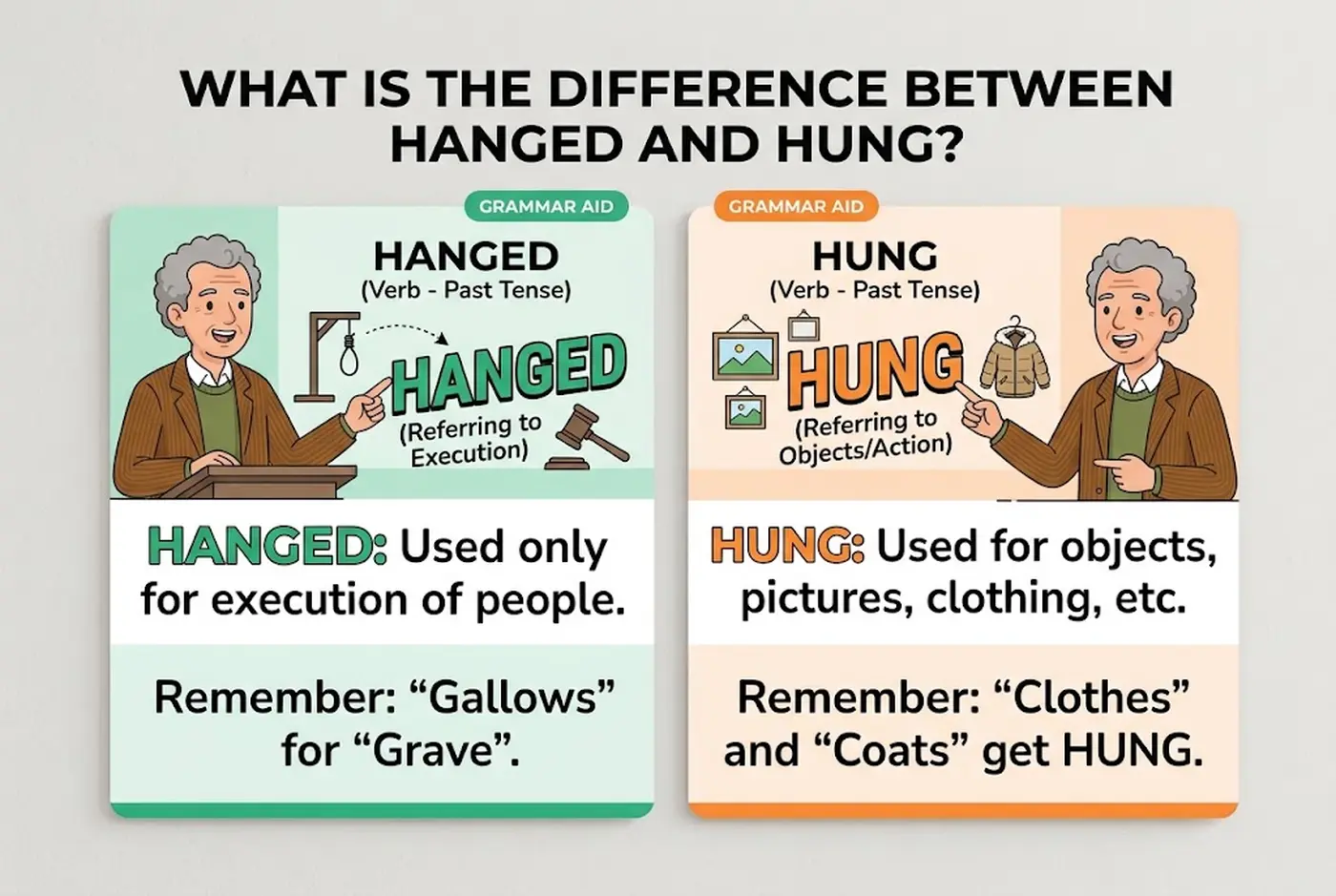
Have you ever stopped while writing an email or school assignment because you weren’t sure if you should write hanged or hung? These two words look similar, and both come from the verb hang. However, they have different uses in English. Choosing the wrong one can change the meaning of your sentence.
The difference between Hanged vs Hung is easier to understand than it might seem. Both words describe something that happened in the past, but the correct choice depends on what you mean. People mainly use one when authorities execute someone by hanging, while they use the other to describe objects or people that someone suspends from something.
The simple answer is that “hung” is the past tense and past participle of “hang” for most meanings, while people traditionally use “hanged” when describing an execution by hanging. For example, you hung a picture on the wall, but authorities hanged a person sentenced to death by hanging.
Understanding this small difference can help you avoid common grammar mistakes in everyday writing. In this guide, you’ll learn their meanings, origins, grammatical rules, examples, related words, and the best way to choose the correct form in emails, essays, conversations, and professional writing.
What Is the Difference Between Hanged and Hung?
The main difference comes from the meaning of the verb hang. English uses two past forms depending on the situation.
- Hung: People use this word when someone suspends, places, displays, or attaches something to another object. They also use it in expressions such as hung up the phone and hung around.
- Hanged: People traditionally use this word when authorities execute someone by hanging.It refers specifically to death caused by this method of execution.
Look at these examples:
| Word | Meaning | Example |
|---|---|---|
| Hung | Suspended or attached | She hung the picture in her bedroom. |
| Hung | Stayed in a place | We hung around after school. |
| Hung | Displayed something | The artist hung his paintings in the gallery. |
| Hanged | Executed by hanging | The prisoner was hanged for his crimes. |
Where Did the Words Hanged and Hung Come From?
Understanding the history of these words makes their difference easier to remember.
Both forms come from the English verb hang, which has a long history in the language.
What Is the Origin of Hang?
The verb hang comes from Old English forms such as hangian and hōn. These words were connected with suspending something, depending on the particular form and use.
Over time, the verb developed several meanings. It came to describe placing something so that it remains supported from above, allowing something to drop freely, or keeping something attached to a surface.
For example:
- She hangs her coat behind the door.
- The curtains hang beside the window.
- The children hang decorations during the holidays.
How Did Hung Become a Past Form?
Hung developed as the usual past tense and past participle of hang when referring to ordinary suspension.
For example:
- I hung my jacket in the closet.
- He hung the photograph above his desk.
- They have hung the decorations already.
Why Is Hanged Used for Execution?
Hanged became established as a separate form for describing execution by hanging.
Historically, hanging was a recognized method of capital punishment. English developed a distinction between the ordinary act of suspending something and the act of executing a person by hanging.
That distinction remains in modern standard English.
For example:
The prisoner was hanged after his trial.
In this sentence, hanged refers to an execution rather than an ordinary act of suspension.
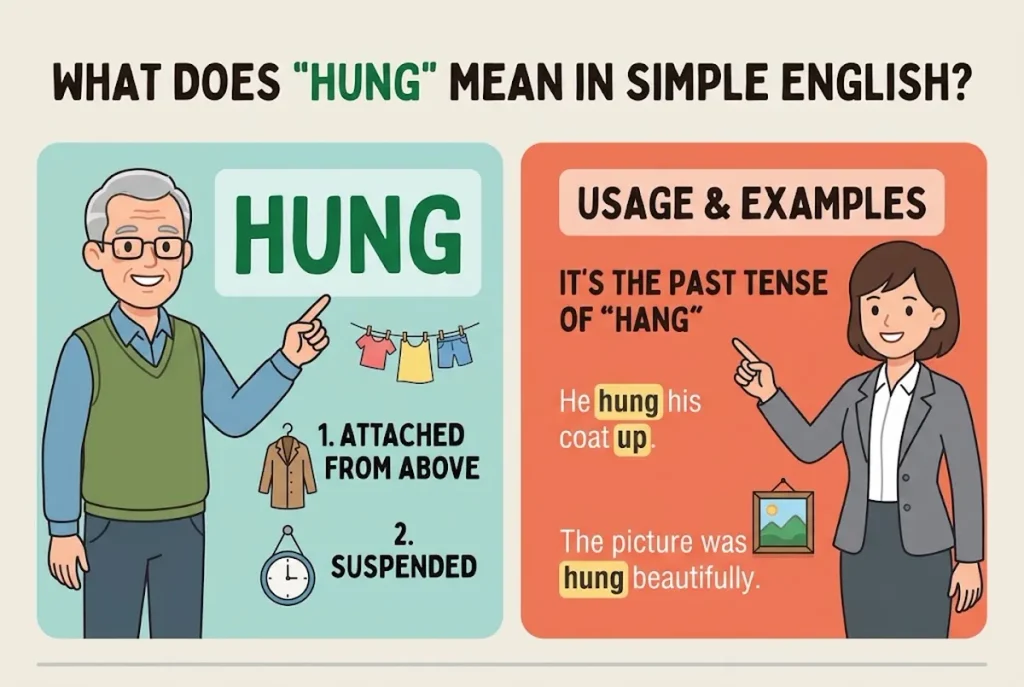
What Does Hung Mean in Simple English?
Hung is the past tense and past participle of hang when you describe something suspended, displayed, attached, or kept in a hanging position.
It is also used in many common expressions.
When Should You Use Hung?
Use hung in these situations:
- When you place something on a wall or another surface.
- When you suspend clothing, decorations, or other objects.
- When you describe something displayed in a particular place.
- When you talk about staying somewhere without a particular activity.
- When you describe ending a telephone call.
Examples of Hung in Sentences
- I hung my new coat in the closet.
- Sarah hung a beautiful painting above her bed.
- We hung colorful lights around the house.
- The teacher hung the students’ artwork on the classroom wall.
- He hung his head after hearing the disappointing news.
Can Hung Be Used for People?
Yes. Hung can describe a person who is suspended from something or positioned in a hanging way.
For example:
- The climber hung from the rope.
- He hung his head in disappointment.
- The gymnast hung from the horizontal bar.
What Does Hanged Mean in Simple English?
Hanged is the past tense and past participle traditionally used when someone is executed by hanging.
It describes a specific method of putting a person to death. The word often appears in historical accounts, legal discussions, books, documentaries, and stories about past punishments.
When Should You Use Hanged?
Use hanged when a sentence describes:
- A person executed by hanging.
- A historical execution involving a rope or gallows.
- A fictional execution described in a novel, play, or story.
Examples of Hanged in Sentences
- The authorities hanged the prisoner for his crimes.
- The historical document explained how officials hanged the criminal.
- The king ordered the executioners to hang the convicted man.
Is Hanged Still Used in Modern English?
Yes. Hanged remains correct in modern English when referring to execution by hanging.
However, you may see it less often in everyday conversations because hanging is no longer a common method of execution in many countries.
It remains useful when discussing history, law, literature, and historical events.
Master Synonym List for Hung and Hanged
There is no single synonym that works for every use of hung or hanged. The best alternative depends on the action and the context.
For example, suspended can replace hung in some sentences, but it cannot replace hung in the expression hung up the phone.
Similarly, executed may replace hanged in some sentences about capital punishment, but it does not describe the specific method of execution.
The following table groups related words by tone and common usage.
Simple Words Related to Hung and Hanged
| Word | Meaning | Tone | Example |
|---|---|---|---|
| Placed | Put something somewhere | Simple | She placed the picture on the wall. |
| Put | Moved something into position | Simple | He put his coat on the hook. |
| Fixed | Attached something securely | Simple | They fixed the sign to the wall. |
| Held | Kept something in position | Simple | The rope held the object above the floor. |
| Attached | Connected one thing to another | Simple | She attached the decoration to the door. |
| Lifted | Raised something upward | Simple | He lifted the bag onto the hook. |
Everyday Words Related to Hung and Hanged
| Word | Meaning | Tone | Example |
|---|---|---|---|
| Suspended | Held up from above | Everyday | The lamp was suspended from the ceiling. |
| Displayed | Shown for people to see | Everyday | The paintings were displayed in the gallery. |
| Mounted | Fixed onto a surface | Everyday | The television was mounted on the wall. |
| Draped | Arranged loosely over something | Everyday | She draped the scarf over the chair. |
| Hooked | Attached using a hook | Everyday | He hooked his jacket behind the door. |
| Strung | Stretched or arranged along something | Everyday | They strung lights across the garden. |
| Fastened | Secured firmly | Everyday | The banner was fastened to the fence. |
Formal Words Related to Hung and Hanged
| Word | Meaning | Tone | Example |
|---|---|---|---|
| Executed | Put to death as a legal punishment | Formal | The convicted criminal was executed. |
| Put to death | Killed as a form of punishment | Formal | The prisoner was put to death after the trial. |
| Affixed | Attached firmly to something | Formal | The notice was affixed to the door. |
| Installed | Put equipment or an object in place | Formal | The display was installed in the main hall. |
| Suspended | Supported from above | Formal | The equipment was suspended from the ceiling. |
| Exhibited | Presented publicly | Formal | The artwork was exhibited at the museum. |
| Appended | Added to the end of something | Formal | The document was appended to the report. |
Which Words Can Replace Hung or Hanged by Intensity?
Some alternatives sound neutral, while others sound more serious or formal.
Choosing the right word can help readers understand the action more clearly.
Mild or Neutral Words
These words describe ordinary actions without adding strong emotion or seriousness.
- Placed: Put something in a particular position.
- Put: Moved something to a location.
- Attached: Connected one object to another.
- Fixed: Secured something in place.
- Displayed: Showed something publicly.
Moderate or Descriptive Words
These words provide more information about how something is positioned.
- Suspended: Held up from above.
- Draped: Loosely arranged over something.
- Mounted: Attached to a wall or surface.
- Fastened: Secured firmly.
- Strung: Arranged along a line or between points.
Strong or Serious Words
These words are more closely connected with punishment, death, or a serious event.
- Executed: Put to death as a punishment.
- Put to death: Killed through an official punishment.
- Hanged: Executed by hanging.
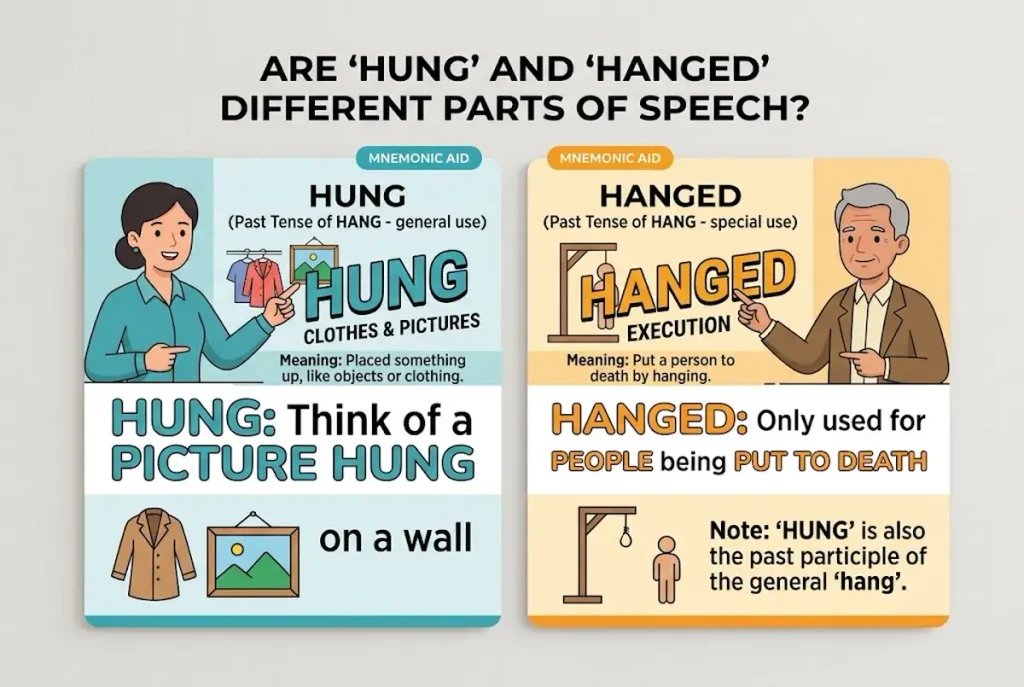
Are Hung and Hanged Different Parts of Speech?
No. Both are forms of the same verb, hang. They are not different parts of speech.
However, understanding their grammatical forms helps you use them correctly.
Hang as the Base Form
Hang is the present tense and base form of the verb.
Examples:
- I hang my jacket behind the door.
- They hang decorations every December.
- Please hang the picture carefully.
Hung as the Past Tense
Hung is the past tense when describing ordinary suspension or related expressions.
Examples:
- I hung the picture yesterday.
- She hung her dress in the closet.
- We hung around after the meeting.
Hung as the Past Participle
Hung is also the past participle used with helping verbs such as has, have, and had.
Examples:
- She has hung the curtains.
- They have hung the decorations.
- I had hung my coat before leaving.
Hanged as the Past Tense
Hanged is the past tense when describing execution by hanging.
Example:
Authorities hanged the criminal many years ago.
Hanged as the Past Participle
Writers also use “hanged” with helping verbs in this meaning.
Examples:
- Authorities had hanged the prisoner.
- The executioners hanged the criminal after the trial.
- The historical record confirms that authorities had hanged the man.
| Verb Form | Ordinary Meaning of Hang | Execution Meaning |
|---|---|---|
| Base form | Hang | Hang |
| Present tense | Hangs | Hangs |
| Past tense | Hung | Hanged |
| Past participle | Hung | Hanged |
| Present participle | Hanging | Hanging |
Do American and British English Use Hung and Hanged Differently?
American and British English generally follow the same traditional distinction.
Both varieties use hung for ordinary suspension and hanged for execution by hanging.
American English Usage
In American English, hung is the normal past form when someone suspends an object.
Examples:
- I hung my jacket in the closet.
- She hung the picture above the fireplace.
- We hung the decorations before the party.
British English Usage
British English follows the same general pattern.
Examples:
- He hung his coat on the hook.
- They hung new curtains in the bedroom.
- Authorities hanged the convicted man for his crimes.
Is There a Regional Difference?
You may occasionally encounter people using hung when discussing executions, particularly in informal speech or less carefully edited writing.
However, hanged remains the preferred traditional form in standard English when referring specifically to execution by hanging.
For school assignments, professional writing, historical articles, and formal documents, follow the standard distinction.
Which Word Should You Use in Different Writing Situations?
The correct choice depends on what you are trying to communicate. The following examples show how to use these words in different situations.
Which Word Is Better for a Resume?
Use hung when describing ordinary actions involving arranging or displaying objects.
However, most resumes benefit from stronger action verbs that explain your actual responsibilities and achievements.
Instead of writing:
Hung promotional materials throughout the office.
You could write:
Displayed promotional materials throughout the office.
Or:
Installed promotional displays across multiple office locations.
These alternatives sound more specific and professional.
Which Word Is Better for an Essay?
Use hung when describing ordinary suspension and hanged when discussing historical executions.
For example:
The artist hung several portraits in the exhibition room.
The historical account explains why authorities hanged the prisoner.
If you are writing an academic essay, choose words that accurately describe the historical event or action.
Which Word Should You Use in Text Messages?
Use hung in everyday messages.
Examples:
- I hung the new curtains today.
- We hung out at the coffee shop.
- I hung up because my phone battery died.
Which Word Is Better for Emails?
Use “hung” when you describe someone suspending decorations, documents, pictures, or other objects.
Examples:
- I hung the new notice near the entrance.
- The team has hung the event banner in the main hall.
- We hung the artwork before the visitors arrived.
Which Word Should You Use While Speaking?
In everyday conversations, hung is the correct choice for most meanings of hang.
Examples:
- I hung my keys by the door.
- We hung out at the park.
- She hung her bag on the chair.
What Are Some Real Examples of Hanged and Hung?
The best way to understand the difference is to see how these words work in everyday situations.
Here are original examples from different contexts.
Examples of Hung in Everyday Life
- At home: I hung the family photograph above the fireplace.
- At school: The teacher hung our science projects on the classroom wall.
- At work: The manager hung the new schedule beside the office entrance.
- During a celebration: We hung colorful balloons around the party room.
- While traveling: She hung her wet clothes outside the hotel room.
- On the phone: I hung up when the conversation ended.
- With friends: We hung out at the shopping center after lunch.
- During a renovation: The workers hung new curtains in every bedroom.
- In an art gallery: The museum hung several paintings by local artists.
- During a sports activity: The gymnast hung from the bar for several seconds.
Examples of Hanged in Historical and Serious Situations
- In a history book: Authorities hanged the prisoner after convicting him of treason.
- In a historical documentary: The narrator explained why authorities hanged the soldier.
- In a novel: The story described how authorities hanged a criminal in the town square.
- In a legal discussion: The court records stated that officials hanged the convicted man.
- In a historical account: Authorities hanged several people during that period.
What’s the Difference: Hung vs Suspended?
Hung and suspended can have similar meanings, but they are not always interchangeable.
Hung
It is the common past form of hang.
Example:
She hung the curtains in the bedroom.
This sentence sounds natural in everyday English.
Suspended
Something suspends an object when it supports or holds the object up, often without letting it touch the ground.
Example:
The light was suspended from the ceiling.
This word sounds more formal or technical.
Side by Side Comparison
| Hung | Suspended |
|---|---|
| Common in everyday English | Often more formal |
| Used for pictures and clothes | Used for objects and equipment |
| Can appear in phrasal verbs | Usually describes a physical position |
| She hung the picture. | The picture was suspended from a wire. |
What’s the Difference: Hanged vs Executed?
Hanged and executed are closely related, but they do not have exactly the same meaning.
Hanged
It describes a specific method of execution.
Example:
The prisoner was hanged after the trial.
Executed
Executed is a broader term. It describes putting someone to death as an official punishment, regardless of the method used.
Example:
The convicted criminal was executed.
An execution could involve hanging or another method, depending on the historical period and legal system.
Side by Side Comparison
| Hanged | Executed |
|---|---|
| Describes death by hanging | Describes an official death sentence being carried out |
| Refers to a specific method | Can refer to different methods |
| More specific | More general |
| The prisoner was hanged. | The prisoner was executed. |
What Are the Most Common Mistakes When Using Hanged and Hung?
Many English learners confuse these words because they both come from the same verb.
Here are common mistakes and their corrections.
Using Hanged for Ordinary Objects
Incorrect: She hanged the picture on the wall.
Correct: She hung the picture on the wall.
Why?
The sentence describes placing a picture on a wall. It does not describe an execution.
Using Hung for an Execution
Incorrect: The prisoner was hung for his crimes.
Correct: The prisoner was hanged for his crimes.
Why?
The sentence describes a person being executed by hanging. Hanged is the traditional standard form.
Thinking Hung Is Always the Past Form
Incorrect rule: Hung is the only correct past form of hang.
Correct rule: Hung is used for ordinary meanings, while hanged is used for execution by hanging.
Why?
English has retained two different past forms for these meanings.
Confusing Hanging With Hanged
Incorrect: The criminal was hanging for his crimes.
Correct: The criminal was hanged for his crimes.
Why?
Hanging describes an ongoing action or position. Hanged describes a completed execution.
Using Hanged in Everyday Expressions
Incorrect: We hanged out at the beach.
Correct: We hung out at the beach.
Why?
English speakers commonly use “hung out” to mean spent time together.
Forgetting the Helping Verb
Incorrect: She has hanged the curtains.
Correct: She has hung the curtains.
Why?
The sentence describes ordinary suspension. People use “hung” as the correct past participle.
When Should You Avoid Using Hanged?
Hanged is not a general replacement for hung. Using it in the wrong situation can make a sentence sound incorrect or change its meaning.
Avoid hanged when:
- You are describing pictures placed on walls.
- You are talking about clothes placed on hooks.
- You are describing decorations.
- You are discussing curtains or banners.
- You are using expressions such as hung out or hung up.
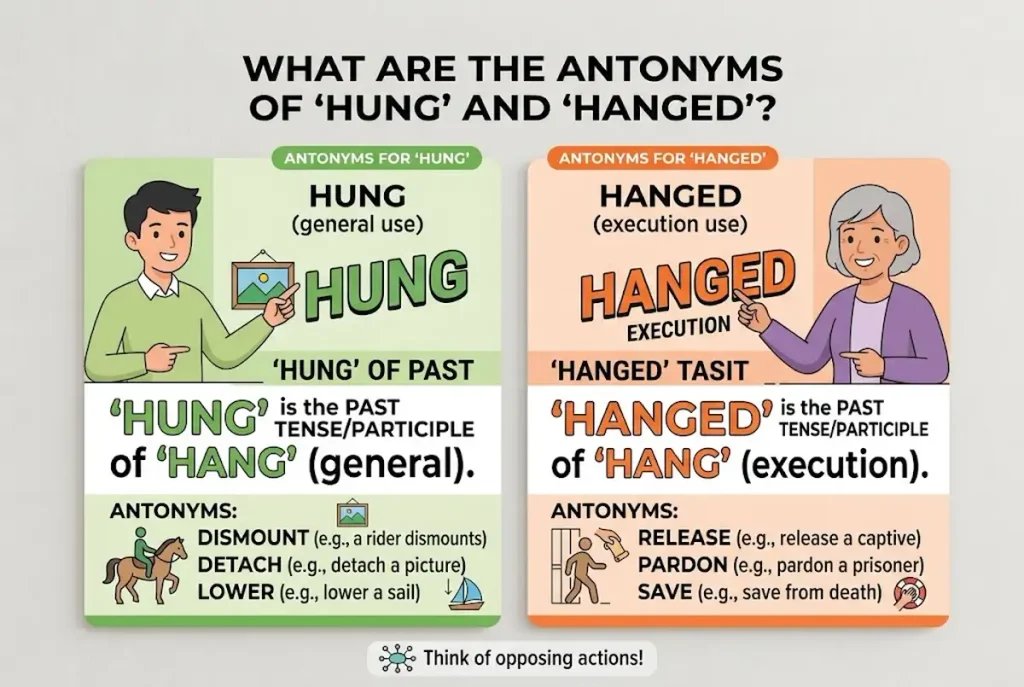
What Are the Antonyms of Hung and Hanged?
An antonym is a word with an opposite meaning. The best opposite depends on the action described.
There is no single antonym that works for every use of hung or hanged.
Opposite Words for Hung
| Word | Opposite Meaning | Example |
|---|---|---|
| Removed | Taken away | She removed the picture from the wall. |
| Detached | Separated from something | He detached the banner from the frame. |
| Lowered | Moved downward | They lowered the flag. |
| Taken down | Removed from a high position | We took down the decorations. |
| Unfastened | Released from an attachment | She unfastened the curtain. |
Opposite Words for Hanged
There is no direct grammatical antonym for hanged when it refers to execution.
However, depending on the sentence, you might use:
- Pardoned: Officially forgiven or released from punishment.
- Released: Set free from confinement.
- Acquitted: Declared not guilty in a legal case.
What Are the Quick Tips for Choosing Hanged or Hung?
If you still find these words confusing, use the following tips whenever you write.
- Think about the action first. Ask yourself what is happening in the sentence.
- Use hung for ordinary suspension. Pictures, curtains, clothing, decorations, and similar objects usually take hung in the past tense.
- Remember common expressions. Expressions such as hung out, hung up, and hung around use hung.
- Check the sentence meaning. The same verb can describe very different actions.
- Use the same rule in American and British English. Both varieties generally follow this distinction.
Conclusion
Understanding Hanged vs Hung comes down to one simple grammatical distinction. Hung is the correct past tense and past participle for most ordinary meanings of hang, including suspending objects, displaying pictures, and spending time together. Traditionally, people use “hanged” when describing someone they executed by hanging.
Both words are correct, but they serve different purposes. Using the right form makes your sentences clearer and prevents readers from misunderstanding your meaning. When writing, focus on the action rather than simply choosing the word that sounds familiar.
Remember the examples in this guide, practice using both forms, and you’ll find it much easier to choose the correct word in everyday conversations, school assignments, emails, and professional writing.
Frequently Asked Questions
Is it hanged or hung?
Both words are correct, but they have different meanings. Use hung for ordinary suspension and hanged when referring to execution by hanging.
Is hung the past tense of hang?
Yes. Hung is the past tense and past participle of hang for most meanings, such as suspending objects or spending time together.
Is it hung out or hanged out?
Hung out is correct. It is an informal expression meaning to spend time with someone or relax somewhere.
What’s another way to say hung?
Depending on the context, you can use suspended, displayed, mounted, attached, or draped. Each word has a slightly different meaning.
Is it has hung or has hanged?
Use has hung when describing ordinary suspension, such as placing a picture on a wall. Use has hanged when describing an execution by hanging.

Daniel Grammarfield — The Language Learner
Age: 28Occupation: ESL Learner & Digital Professional
Bio:Daniel is a non-native English speaker who wants to communicate more confidently at work and online. He uses Synotrench to improve grammar, understand confusing words, learn correct sentence structures, and build everyday English skills. He prefers simple explanations with practical examples.
Goals:
Master English grammar rules
Avoid common language mistakes
Improve professional communication
Learn English through real-life examples
Quote:“Learning English is not about memorizing rules — it’s about expressing ideas clearly.”
3 thoughts on “Hanged vs Hung: The Best Guide to Using Them Correctly”