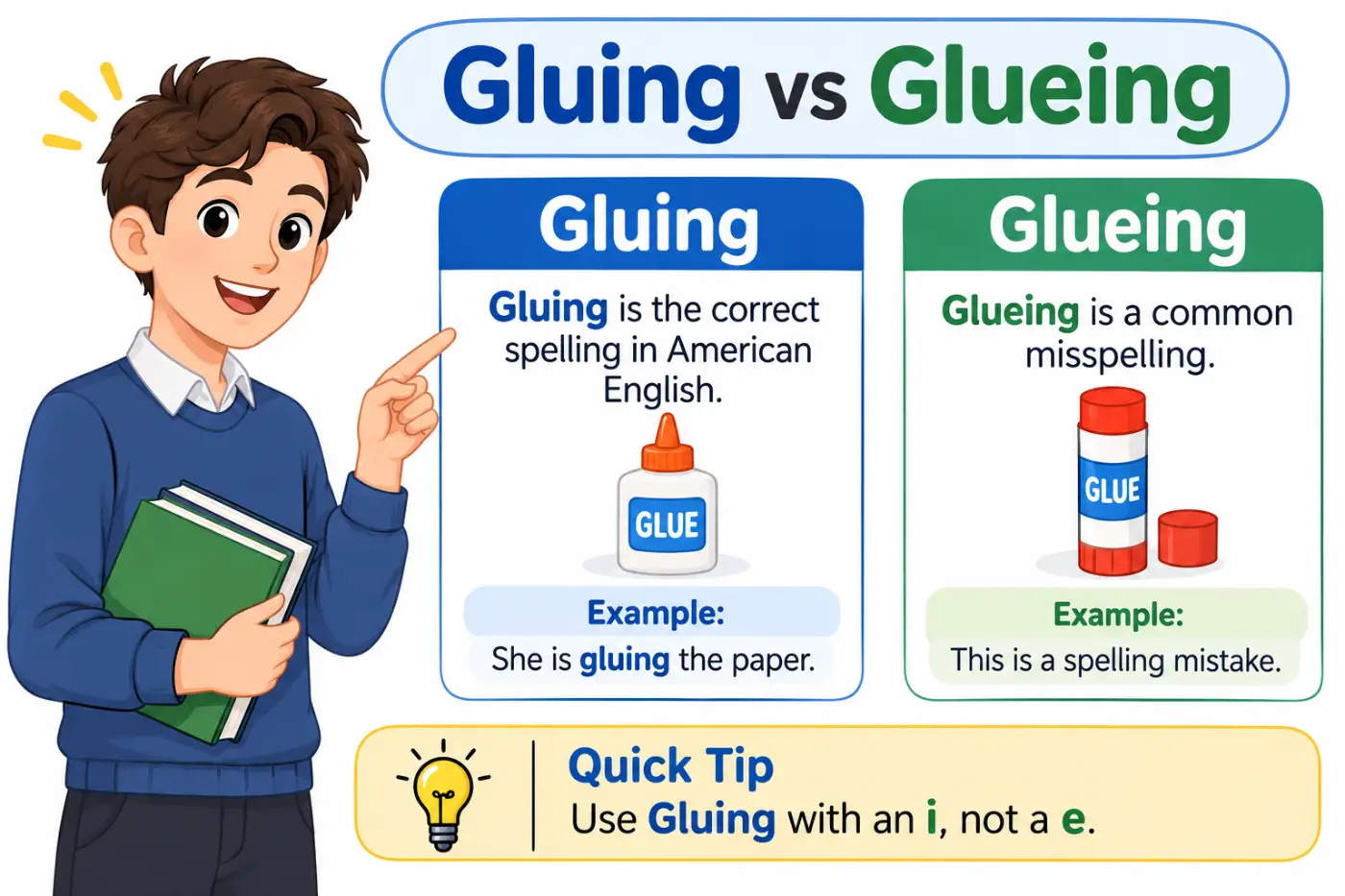
Have you ever stopped while writing an email or school assignment because you weren’t sure how to spell the word for attaching two things with glue? You might type gluing, delete it, and replace it with glueing. Both spellings gluing vs glueing look reasonable, but only one is the standard choice in modern American English.
Gluing is the correct and preferred spelling in American English. Glueing is a less common variant, but gluing is the spelling you should use in everyday writing, schoolwork, professional emails, and formal documents.
The confusion comes from the way English words change when we add endings such as -ing. Some words keep their final letter, while others drop it or double it. The word glue follows a spelling pattern that can seem unusual at first.
This guide explains the difference between the two spellings, their word origins, the grammar rule behind them, and the best ways to use them. You’ll also find examples, common mistakes, related words, and answers to frequently asked questions.
What Is the Difference Between Gluing and Glueing?
The main difference is spelling. Gluing is the standard present participle and gerund form of the verb glue. Glueing is an uncommon alternative spelling.
| Spelling | Status | Explanation |
|---|---|---|
| Gluing | Preferred | Standard spelling in modern American English |
| Glueing | Less common variant | An alternative spelling that is rarely needed |
The word gluing describes the action of joining, attaching, or fixing something with glue.
For example:
- I am gluing the broken pieces together.
- She is gluing pictures into her scrapbook.
- The workers are gluing the wooden panels.
In each sentence, gluing describes an action that involves using an adhesive.
Glueing may appear in older texts, informal writing, or sources that follow different spelling preferences. However, it isn’t the best choice for standard American English.
If you’re writing for a US audience, choose gluing. It’s shorter, more widely accepted, and follows the usual spelling convention for this word.
Why Is Gluing Spelled Without an Extra E?
The spelling becomes easier to understand when you look at the base word and the ending.
The base word is glue. When you add the suffix -ing, the final silent e is dropped.
Glue + ing = Gluing
This is a common spelling pattern in English. Many verbs ending in a silent e lose that letter when they take an ending that begins with a vowel.
Consider these examples:
| Base Word | With -ing | Example |
|---|---|---|
| Make | Making | She is making a cake. |
| Write | Writing | He is writing a letter. |
| Dance | Dancing | They are dancing together. |
| Bake | Baking | I am baking bread. |
| Use | Using | We are using a new computer. |
| Drive | Driving | She is driving home. |
| Glue | Gluing | He is gluing the pieces together. |
What Does Gluing Mean in Simple English?
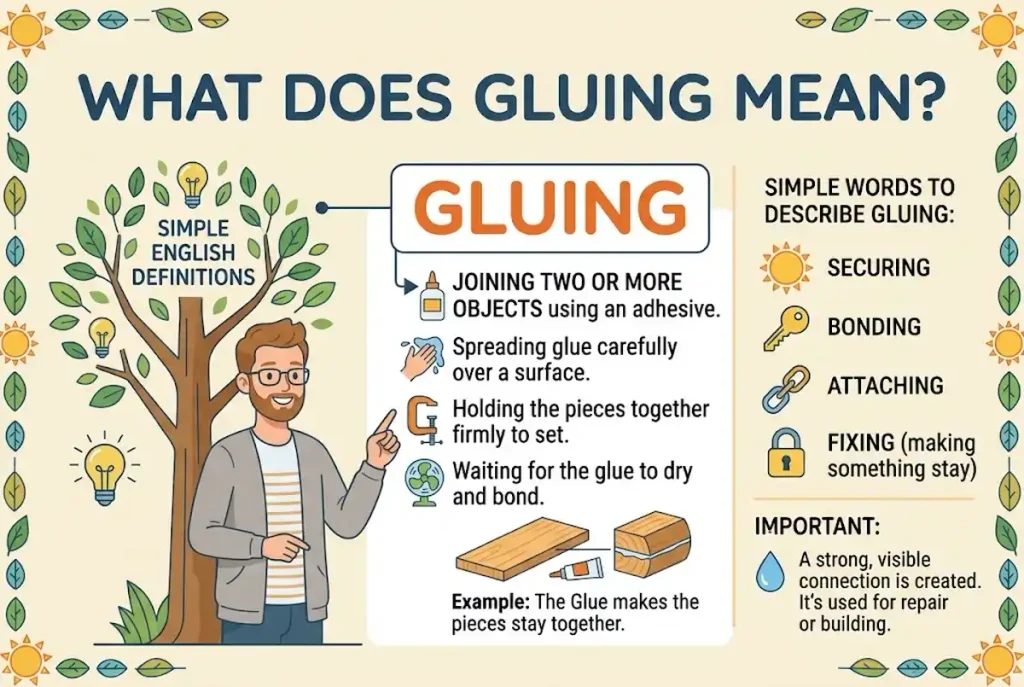
Gluing means joining two or more things by using glue or another adhesive.
It comes from the verb glue, which describes attaching objects with a sticky substance.
For example, imagine that a child’s toy breaks into two pieces. An adult applies glue to the broken edges and presses them together. That action is called gluing.
The word can describe many activities, including:
- Attaching paper to cardboard.
- Fixing a broken ceramic object.
- Joining two pieces of wood.
- Adding photographs to a scrapbook.
- Attaching labels to packages.
Gluing can also describe a figurative action in certain expressions. For example, a person might say that a shared goal is gluing a team together. In this case, the word means bringing people together rather than using actual adhesive.
Where Does the Word Glue Come From?
The English word glue has historical roots in Latin and older European languages.
It is connected to the Latin word gluten, which referred to glue or a sticky substance. The word entered English through historical language changes and was used to describe substances that hold materials together.
Over time, glue became a common English noun and verb.
Today, glue can refer to the adhesive itself or the action of attaching things with it.
Examples:
- Noun: This glue is strong enough for wood.
- Verb: Please glue the two pieces together.
- Gerund: Gluing takes patience and care.
- Present participle: She is gluing the paper flowers.
The spelling gluing comes from the base verb glue combined with the suffix -ing.
What Grammar Rule Explains Gluing?
The spelling of gluing follows the silent e rule in English grammar.
When a verb ends in a silent e and you add a suffix that begins with a vowel, you usually remove the final e.
The suffix -ing begins with the vowel i. Therefore, the final e in glue is removed before adding -ing.
The pattern looks like this:
- Start with the base verb: glue.
- Remove the final silent e: glu.
- Add the suffix -ing: gluing.
This gives you the standard spelling.
When Do You Drop the Final E?
You generally drop the final silent e when adding -ing, -ed, or certain other vowel beginning suffixes.
Here are some examples:
| Base Word | Correct Form | Example |
|---|---|---|
| Hope | Hoping | I am hoping for good news. |
| Smile | Smiling | The baby is smiling. |
| Care | Caring | She is caring for her grandmother. |
| Save | Saving | He is saving money. |
| Close | Closing | They are closing the shop. |
| Move | Moving | We are moving next week. |
| Glue | Gluing | I am gluing the broken handle. |
Are There Exceptions to the Silent E Rule?
Yes. English spelling has exceptions, so you shouldn’t remove the final e automatically in every situation.
For example, some words keep their final e to protect their pronunciation or meaning.
Consider these words:
| Base Word | Correct Form | Reason |
|---|---|---|
| Dye | Dyeing | Keeps the word distinct from dying. |
| Singe | Singeing | Keeps the soft g sound. |
| Age | Ageing | An accepted spelling, especially in British English. |
| Glue | Gluing | Drops the final silent e. |
Is Gluing a Verb, Noun, or Adjective?
Gluing is mainly used as a gerund or present participle. Its grammatical role depends on how it appears in a sentence.
Understanding these forms helps you use the word correctly.
Gluing as a Gerund
A gerund is a verb ending in -ing that works as a noun.
It names an activity or action.
Examples:
- Gluing requires a steady hand.
- I enjoy gluing paper decorations.
- Gluing is an important part of this craft project.
- She learned gluing techniques at school.
In these sentences, gluing names an activity rather than describing what someone is doing at that exact moment.
Gluing as a Present Participle
A present participle is a verb form ending in -ing. It can help form continuous verb tenses or describe an action.
Examples:
- He is gluing the broken chair.
- They were gluing labels onto the boxes.
- She has been gluing pictures into her notebook.
- The children are gluing colorful shapes onto paper.
Here, gluing is part of a verb phrase that describes an ongoing action.
Gluing as a Descriptive Word
An -ing form can also help describe a noun, although gluing is less common in this role than many other participles.
For example:
- The gluing process takes several minutes.
- The gluing stage comes after cutting the material.
In these examples, gluing helps describe a process or stage.
Is Gluing vs Glueing Correct in American English?
Gluing is the preferred spelling in American English.
If you’re writing a school assignment, college essay, business email, resume, or website article for an American audience, use gluing.
The spelling follows the standard practice of removing the silent e before adding -ing.
Glueing may appear in some dictionaries or older publications as a variant. However, that doesn’t make it the better choice for everyday American writing.
A simple comparison makes the difference clear:
| Situation | Recommended Spelling |
|---|---|
| American school assignment | Gluing |
| Professional email | Gluing |
| College essay | Gluing |
| Business report | Gluing |
| Online article | Gluing |
| Everyday conversation | Gluing |
Is There a Difference Between American and British English?
There is no major American versus British spelling difference that requires you to change gluing to glueing.
Both American and British writers commonly use gluing.
However, some related words do have regional spelling differences.
For example:
| American English | British English |
|---|---|
| Aging | Ageing |
| Traveling | Travelling |
| Canceling | Cancelling |
| Labeling | Labelling |
| Gluing | Gluing |
What Are the Best Synonyms for Gluing?
The best synonym depends on what you’re attaching and how you’re attaching it.
For example, sticking may work for paper, while bonding is more suitable for technical or industrial situations. Attaching is a broader word that doesn’t always involve glue.
Here are 28 useful alternatives grouped by tone and everyday use.
Simple Words for Gluing
These words are easy to understand and work well in everyday communication.
| Word | Meaning | Tone | Example |
|---|---|---|---|
| Sticking | Joining with an adhesive | Simple | I am sticking the label onto the box. |
| Joining | Connecting two things | Simple | She is joining the paper pieces. |
| Fixing | Repairing something | Simple | He is fixing the broken toy. |
| Attaching | Connecting one object to another | Simple | I am attaching the photo to the card. |
| Holding | Keeping things together | Simple | The adhesive is holding the pieces together. |
| Pasting | Attaching with paste | Simple | She is pasting pictures into her book. |
| Connecting | Bringing things together | Simple | The glue is connecting the two surfaces. |
Everyday Words for Gluing
These alternatives are useful in regular conversations, instructions, and general writing.
| Word | Meaning | Tone | Example |
|---|---|---|---|
| Securing | Keeping something firmly in place | Everyday | He is securing the loose panel. |
| Fastening | Joining or closing something | Everyday | She is fastening the decorations to the board. |
| Mending | Repairing something damaged | Everyday | I am mending the torn paper. |
| Repairing | Making something work again | Everyday | They are repairing the broken furniture. |
| Patching | Covering or fixing a damaged area | Everyday | He is patching the damaged material. |
| Sealing | Closing an opening tightly | Everyday | She is sealing the envelope. |
| Mounting | Fixing something onto a surface | Everyday | We are mounting the picture on cardboard. |
Formal Words for Gluing
These words are more appropriate for technical documents, professional writing, and specialized situations.
| Word | Meaning | Tone | Example |
|---|---|---|---|
| Bonding | Creating a strong connection | Formal | The process involves bonding two metal surfaces. |
| Adhering | Sticking firmly to a surface | Formal | The label is adhering to the container. |
| Affixing | Attaching something securely | Formal | The technician is affixing the component. |
| Laminating | Covering something with a protective layer | Formal | The company is laminating the printed sheets. |
| Cementing | Joining materials with a binding substance | Formal | Workers are cementing the stone pieces. |
| Integrating | Combining parts into a whole | Formal | The process involves integrating separate materials. |
| Adjoining | Placing or connecting things next to each other | Formal | The two sections are adjoining one another. |
Which Words Are Similar to Gluing by Intensity?
Some words describe a light connection, while others suggest a strong or permanent bond.
Choosing the right word helps readers understand how firmly two things are attached.
| Intensity | Word | Meaning | Example |
|---|---|---|---|
| Mild | Touching | Making contact | The two pieces are touching. |
| Mild | Placing | Putting something in position | She is placing the label on the box. |
| Mild | Attaching | Connecting two objects | He is attaching the paper to the card. |
| Moderate | Sticking | Joining with an adhesive | I am sticking the pictures together. |
| Moderate | Pasting | Joining with paste | She is pasting the paper shapes. |
| Moderate | Securing | Keeping something in place | They are securing the loose material. |
| Strong | Bonding | Creating a firm connection | The adhesive is bonding the surfaces. |
| Strong | Cementing | Joining with a binding material | Workers are cementing the blocks. |
| Strong | Sealing | Closing an opening tightly | He is sealing the container. |
| Strong | Permanently fastening | Creating a lasting connection | The technician is permanently fastening the parts. |
What Is the Difference Between Gluing, Sticking, and Bonding?
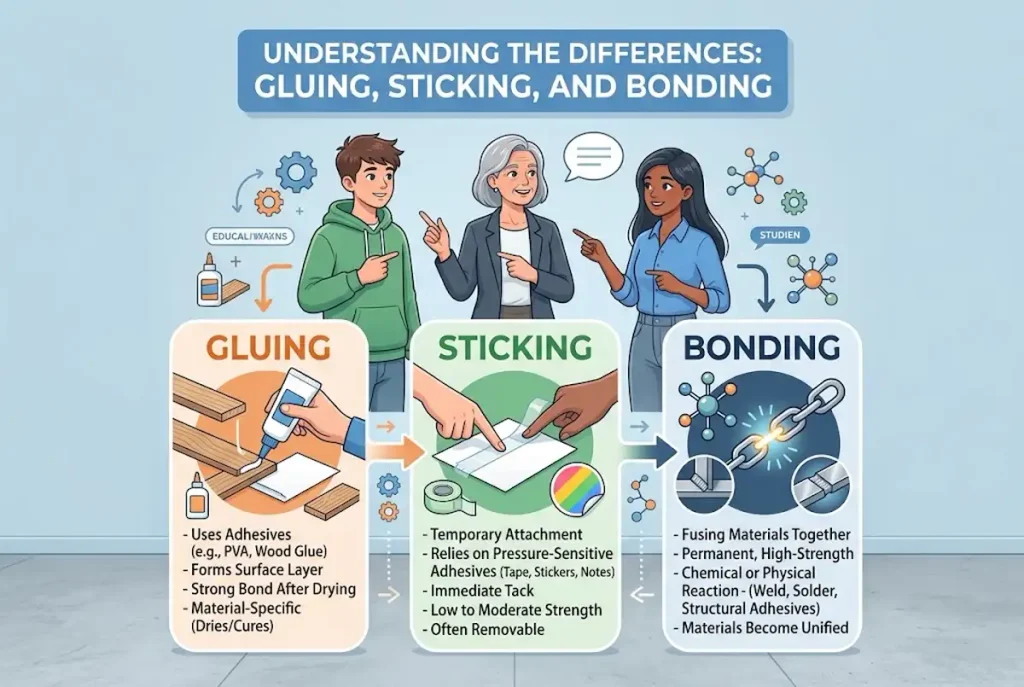
These three words are related, but they don’t have exactly the same meaning.
Gluing vs Sticking
Gluing specifically describes using glue to attach something.
Sticking is broader. It can describe attaching something with an adhesive, tape, or another sticky material.
| Gluing | Sticking |
|---|---|
| Usually involves glue | Can involve different sticky materials |
| More specific | More general |
| Often used in crafts and repairs | Common in everyday conversation |
Gluing vs Bonding
Gluing usually refers to attaching objects with glue.
Bonding describes the connection created between materials. It is often used in science, manufacturing, construction, and technical writing.
| Gluing | Bonding |
|---|---|
| Describes the action of using glue | Describes creating a connection |
| Common in everyday English | Common in technical English |
| Can describe simple craft activities | Often describes material connections |
Gluing vs Pasting
Gluing and pasting both describe attaching things with sticky substances.
However, pasting often refers to using paste, especially when working with paper.
Examples:
- Gluing: He is gluing a wooden handle to the frame.
- Pasting: She is pasting newspaper cuttings into her scrapbook.
The words sometimes overlap, but the material and context help determine the better choice.
Which Word Should You Use in a Resume, Essay, Text, Email, or Conversation?
The word you choose depends on your audience and the purpose of your writing.
Gluing is a correct spelling, but it may not always be the most professional or natural word for every situation.
What Should You Write in a Resume?
Use specific action verbs that explain your work clearly.
If you are describing a job involving crafts, packaging, construction, or manufacturing, words such as assembling, attaching, bonding, and securing may sound more professional.
Examples:
- Assembled product components using industrial adhesives.
- Attached packaging labels to finished products.
- Applied adhesive materials during the production process.
Gluing isn’t incorrect in a resume, but a more specific verb can explain your responsibilities better.
How Should You Use Gluing in an Essay?
Gluing is suitable when your essay discusses crafts, construction, repairs, science projects, or everyday activities.
Examples:
- Gluing different materials together can help students understand basic construction methods.
- The experiment involved gluing two surfaces to test the strength of an adhesive.
- Gluing paper shapes is a simple activity for young children.
If you’re writing an academic essay about materials, bonding or adhesion may be more suitable, depending on the subject.
Can You Use Gluing in Text Messages?
Yes. Gluing is perfectly natural in informal messages.
Examples:
- I’m gluing the pieces together now.
- Can you help me with gluing this model?
- The kids are gluing pictures for their school project.
- I’m almost done gluing the decorations.
You don’t need a formal alternative when talking with friends or family.
What Are Some Examples of Gluing in Everyday English?
Seeing the word in different situations makes its meaning and spelling easier to remember.
Here are 10 original example sentences from everyday life, school, work, and creative activities.
Examples at Home
- My father is gluing the broken handle back onto the drawer.
- She is gluing a small decoration to the wooden frame.
- I spent an hour gluing the loose pieces of the photo frame.
- He is gluing the cardboard box before packing the gifts.
- We are gluing the torn pages of the old notebook.
Examples at School
- The students are gluing colorful shapes onto their art projects.
- My younger brother enjoys gluing pictures into his scrapbook.
- The teacher showed us the correct method for gluing paper.
- She finished gluing the model before the science exhibition.
- The children were gluing leaves onto a large poster.
All these sentences use the standard spelling gluing. Notice how the word describes an action in different situations.
What Are the Common Mistakes When Using Gluing?
Even though the spelling rule is simple, writers sometimes make mistakes when adding -ing to words ending in silent e.
Here are some common problems to avoid.
Mistake 1: Using Glueing in Standard American Writing
Incorrect or less preferred: I am glueing the broken pieces together.
Recommended: I am gluing the broken pieces together.
The first spelling appears as a variant, but gluing is the standard choice for modern American English.
Mistake 2: Writing Gluening
Incorrect: She is gluening the paper decorations.
Correct: She is gluing the paper decorations.
You don’t need to add an extra vowel before -ing. Remove the final e and add the suffix.
Mistake 3: Writing Gluings
Incorrect: He is gluings the cardboard pieces.
Correct: He is gluing the cardboard pieces.
The word doesn’t need an additional s when used with a subject such as he, she, or it in a continuous tense.
Mistake 4: Confusing Glue and Gluing
Glue and gluing have different grammatical uses.
- Glue is the base verb or a noun.
- Gluing is the gerund or present participle.
Examples:
- Please bring some glue.
- I need to glue these pieces together.
- She is gluing the paper decorations.
Use the form that matches your sentence.
Mistake 5: Using Gluing When Another Word Is More Accurate
Gluing isn’t suitable for every type of attachment.
For example:
- Incorrect: I am gluing the two files together.
- Better: I am combining the two files.
If you’re joining digital documents, combining is more accurate because no adhesive is involved.
Similarly, use sewing for joining fabric with thread and welding for joining certain metal parts through heat or pressure.
When Should You Not Use Gluing?
Gluing is useful, but it doesn’t describe every action that brings two things together.
Choose another word when the method or situation is different.
| Situation | Better Word | Example |
|---|---|---|
| Joining fabric with thread | Sewing | She is sewing the two pieces of cloth. |
| Joining metal with heat | Welding | The workers are welding metal parts. |
| Connecting digital files | Combining | I am combining two documents. |
| Joining objects with screws | Fastening | He is fastening the wooden boards. |
| Joining objects with nails | Nailing | They are nailing the wooden pieces together. |
| Connecting electrical wires | Connecting | The technician is connecting the wires. |
| Covering something with a protective layer | Laminating | She is laminating the certificate. |
| Joining pieces with tape | Taping | He is taping the two boxes together. |

What Are the Antonyms of Gluing?
An antonym is a word with an opposite or contrasting meaning.
Gluing describes joining or attaching things, so its opposite usually involves separating or removing them.
Here are some useful contrasting words:
| Word | Meaning | Example |
|---|---|---|
| Separating | Moving things apart | She is separating the two pieces. |
| Detaching | Removing something attached | He is detaching the label. |
| Disconnecting | Breaking a connection | The technician is disconnecting the wires. |
| Unfastening | Releasing something secured | I am unfastening the metal clip. |
| Removing | Taking something away | She is removing the sticker. |
| Peeling | Taking off a thin attached layer | He is peeling the label away. |
| Unsticking | Making stuck objects come apart | I am unsticking the two paper sheets. |
What Are the Quick Tips for Choosing the Correct Spelling?
Remembering a few simple rules can help you avoid spelling mistakes.
- Use gluing in standard American English.
- Remember that glue is the base word.
- Drop the final silent e before adding -ing.
- Don’t add another vowel before the suffix.
- Use gluing when describing the action of attaching things with glue.
- Use bonding when discussing the connection between materials.
- Use pasting when describing the attachment of paper with paste.
- Check your sentence to make sure the word works grammatically.
- Keep gluing consistent throughout your writing.
- When writing for a US audience, choose the spelling most familiar to American readers.
Conclusion
The correct spelling for everyday American English is gluing. It comes from the base word glue, with the final silent e removed before adding the suffix -ing. Although glueing appears as a less common spelling variant, gluing is the better choice for school assignments, professional documents, emails, and online content.
Remember that spelling and word choice are two different things. Gluing describes attaching objects with glue, while words such as sticking, bonding, and fastening describe related actions in different situations.
Once you understand the silent e rule, this spelling becomes easy to remember. Use gluing confidently in your writing, and you’ll avoid a common English spelling mistake.
Frequently Asked Questions
Is gluing vs glueing the correct spelling?
Gluing is the standard and preferred spelling in American English. Glueing is a less common variant, but gluing is the better choice for everyday and professional writing.
Why does gluing not have an extra e?
Gluing drops the final silent e from glue before adding the suffix -ing. This follows the common English spelling rule for verbs ending in silent e.
Is glueing ever acceptable?
Glueing appears as an alternative spelling in some English sources and older publications. However, gluing is much more common and is the recommended spelling for modern American English.
What is the past tense of glue?
The past tense of glue is glued. For example, she glued the broken pieces together yesterday.
What is the present participle of glue?
The present participle is gluing. For example, he is gluing the paper decorations onto the card.
What’s another way to say gluing?
You can use sticking, attaching, pasting, bonding, or fastening, depending on the situation. Sticking is common in everyday conversation, while bonding is useful in technical writing.
Is gluing the same in American and British English?
Yes. Gluing is the standard spelling in both American and British English. Unlike words such as traveling and travelling, it doesn’t have a common regional spelling difference.
How do you remember the spelling of gluing?
Remember the words making, writing, and gluing. They all follow the silent e rule, which removes the final e before adding -ing.

Daniel Grammarfield — The Language Learner
Age: 28Occupation: ESL Learner & Digital Professional
Bio:Daniel is a non-native English speaker who wants to communicate more confidently at work and online. He uses Synotrench to improve grammar, understand confusing words, learn correct sentence structures, and build everyday English skills. He prefers simple explanations with practical examples.
Goals:
Master English grammar rules
Avoid common language mistakes
Improve professional communication
Learn English through real-life examples
Quote:“Learning English is not about memorizing rules — it’s about expressing ideas clearly.”
3 thoughts on “Gluing vs Glueing: The Simple Spelling Guide (2026)”