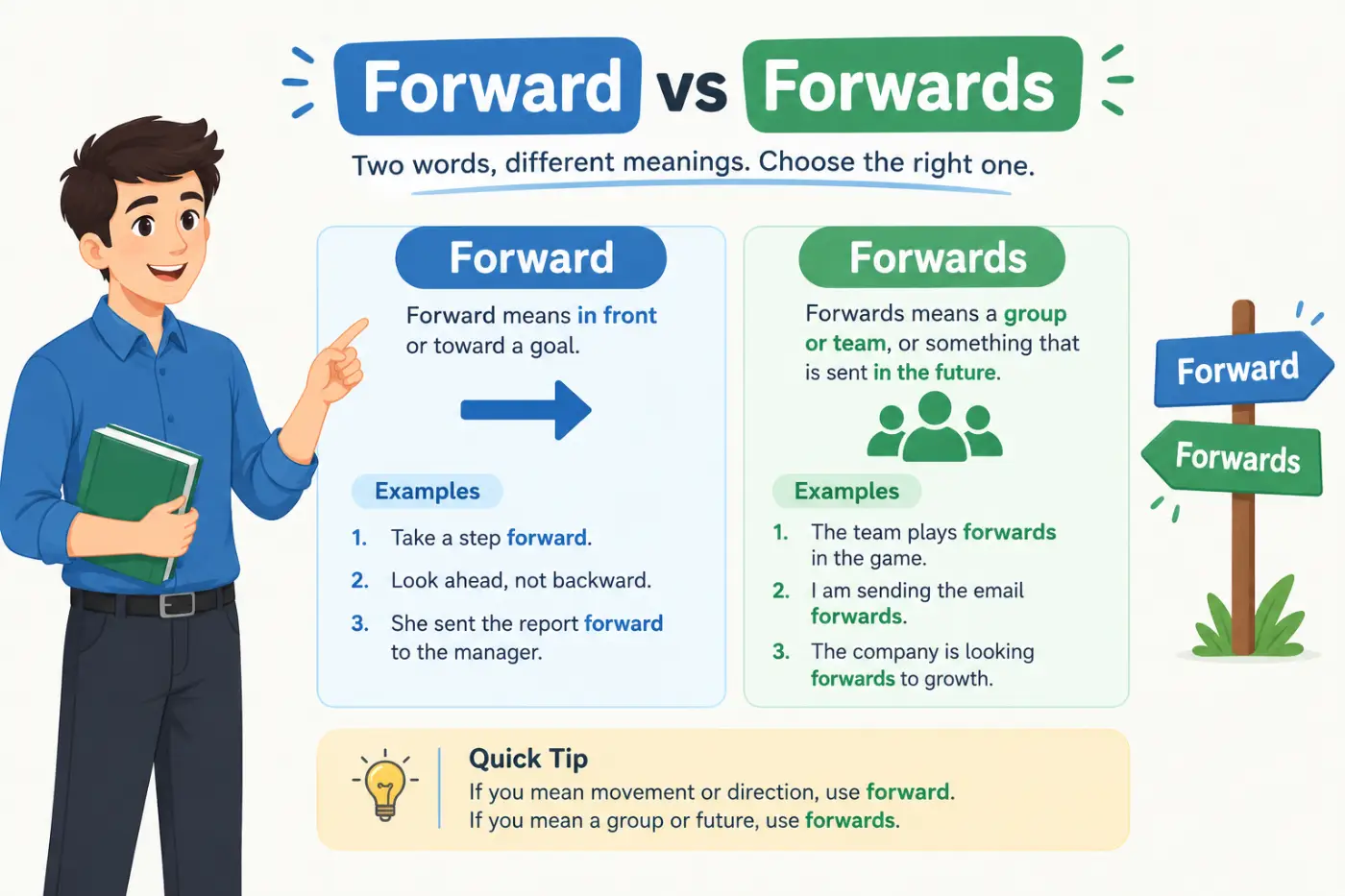
The confusion around Forward vs Forwards is common because both words can describe movement, progress, or direction. However, they aren’t always interchangeable. Their meaning, grammar, and use can change depending on the sentence and the type of English you’re writing.
Forward and forwards both mean toward the front or in the direction of progress when used as adverbs. Forward is more common in American English, while forwards is more common in British English. Only forward can normally function as an adjective or verb.
This guide explains their origins, meanings, grammar rules, regional differences, synonyms, and real examples. You’ll also learn which form works best in emails, essays, resumes, conversations, and everyday writing.
What Do Forward and Forwards Mean in Simple English?
Forward and forwards usually describe movement toward the front, a future point, or a more advanced position.
Think about someone walking toward a door. You could say the person moved forward or moved forwards. Both sentences describe movement in the same direction.
The difference becomes clearer when we look at how each word works in a sentence.
What Does Forward Mean?
Forward is a flexible English word. It can work as an adverb, adjective, verb, and sometimes a noun.
As an adverb, it describes movement or progress toward the front or a future point.
Examples:
- Please move forward so everyone has enough space.
- We need to look forward instead of focusing on past mistakes.
- The company is moving forward with its expansion plans.
- She took one step forward.
- The meeting has been moved forward to Monday.
As an adjective, forward describes something positioned toward the front, directed ahead, or unusually bold.
Examples:
- The forward section of the airplane has additional seating.
- She made a forward suggestion during the discussion.
As a verb, forward means to send something to another person or destination.
Example: Please forward the document to the finance department.
What Does Forwards Mean?
Forwards is an adverb that describes movement toward the front or ahead in a particular direction.
It often appears in British English, although American speakers also understand and sometimes use it.
Examples:
- The child leaned forwards to see the screen.
- She walked forwards without looking down.
- Move the chair forwards a little.
- The vehicle slowly rolled forwards.
- He stepped forwards when his name was called.
In these examples, replacing forwards with forward would preserve the basic meaning.
However, forwards doesn’t normally work as an adjective or verb.
You can say a forward movement, but not a forwards movement.
Similarly, you can forward an email, but you cannot forwards an email as the base form of the verb.

Where Do Forward and Forwards Come From?
Both words have roots in Old English.
Forward developed from the Old English word foreweard, which expressed the idea of being directed toward the front.
The first part, fore, relates to being before or in front. The second part, weard, expresses direction.
Over time, the word developed into the modern form forward.
Forwards came from the same basic word with an added s ending.
This ending also appears in several other English direction words:
- Backward and backwards.
- Toward and towards.
- Upward and upwards.
- Downward and downwards.
- Onward and onwards.
The final s doesn’t automatically make these words plural.
Instead, it forms an alternative adverb, often associated with British English.
Understanding this history makes the spelling difference easier to remember. Both forms developed from the same idea of direction, but their modern grammatical uses aren’t identical.
What Is the Main Difference Between Forward and Forwards?
The most useful distinction is grammatical.
Both words can function as adverbs, but forward has additional uses that forwards generally doesn’t have.
| Feature | Forward | Forwards |
|---|---|---|
| Basic meaning | Toward the front or ahead | Toward the front or ahead |
| Adverb | Yes | Yes |
| Adjective | Yes | No |
| Verb | Yes | No |
| Noun | Yes | No |
| Common in American English | Very common | Less common |
| Common in British English | Common | Common |
| Example | Move forward. | Move forwards. |
Consider these sentences:
- The team moved forward with the project.
- The team moved forwards with the project.
Both are understandable, although the first sounds more natural in American business writing.
Now compare:
- Please forward the message.
- Please forwards the message.
The first sentence is correct because forward is the base form of the verb.
The second is incorrect in this context.
One useful detail: forwards can also be the third-person singular form of the verb forward.
For example: She forwards customer complaints to her manager.
Here, forwards is a verb form meaning sends, not the directional adverb.
What Are the Best Synonyms for Forward and Forwards?
The right synonym depends on your intended meaning.
Sometimes you’re describing physical movement. Other times, you’re discussing progress, sending information, or preparing for the future.
There isn’t one replacement that works in every situation.
The following tables group more than 30 related words and expressions by tone and use. Some are close synonyms, while others work only in particular contexts.
Simple Synonyms
These choices are easy to understand and useful in everyday English.
| Word | Meaning | Tone | Example |
|---|---|---|---|
| Ahead | Toward the front | Simple | Keep looking ahead. |
| Onward | Continuing ahead | Simple | The group traveled onward. |
| Frontward | Toward the front | Uncommon | The seat shifted frontward. |
| Along | Continuing a route | Casual | Keep moving along. |
| Next | Following in order | Simple | Move to the next step. |
| Further | To a greater distance or extent | Neutral | We need to go further. |
| Upward | Toward a higher position | Neutral | The balloon moved upward. |
| Straight ahead | Directly toward the front | Simple | Walk straight ahead. |
Ahead and onward are often the easiest alternatives when you’re describing direction.
However, next and further usually require changes to the sentence structure.
Everyday Synonyms
These expressions sound natural in conversations, instructions, and informal writing.
| Word or Phrase | Meaning | Tone | Example |
|---|---|---|---|
| Moving ahead | Continuing toward a goal | Everyday | We’re moving ahead with the plan. |
| Going on | Continuing an activity | Casual | The discussion went on. |
| Pressing on | Continuing despite difficulty | Everyday | We kept pressing on. |
| Carrying on | Continuing an activity | Casual | They carried on working. |
| Heading ahead | Traveling in front | Everyday | The guide was heading ahead. |
| Making progress | Improving or advancing | Neutral | We’re making progress. |
| Moving along | Continuing steadily | Casual | The project is moving along. |
| Looking ahead | Thinking about the future | Neutral | We’re looking ahead to next year. |
These expressions are especially useful when the original sentence describes progress rather than physical direction.
Formal Synonyms
Formal alternatives work well in reports, academic writing, resumes, and professional communication.
| Word or Phrase | Meaning | Tone | Example |
|---|---|---|---|
| Advance | Move or develop ahead | Formal | The research continues to advance. |
| Proceed | Continue to the next stage | Formal | Please proceed with the application. |
| Progress | Develop toward completion | Professional | The project continues to progress. |
| Transmit | Send information | Technical | The system transmits the data. |
| Refer | Direct someone or something elsewhere | Professional | Refer the request to management. |
| Expedite | Make a process happen faster | Formal | We must expedite the review. |
| Propel | Push something ahead | Formal | Innovation can propel growth. |
| Facilitate | Help a process develop | Professional | The policy will facilitate progress. |
| Pursue | Continue working toward something | Formal | We plan to pursue new opportunities. |
Not every formal alternative is a direct substitute.
For example, expedite means to speed something up. It doesn’t simply mean to move ahead.
Likewise, transmit can replace forward when discussing information, but it wouldn’t describe someone walking.
Slang and Informal Alternatives
These expressions are useful in relaxed conversations, social media, and friendly messages.
| Word or Phrase | Meaning | Tone | Example |
|---|---|---|---|
| Keep going | Continue moving or working | Casual | Keep going. You’re almost there. |
| Push ahead | Continue with determination | Informal | Let’s push ahead with the idea. |
| Roll on | Continue moving or happening | Casual | The good times roll on. |
| Get moving | Start making progress | Informal | Come on, let’s get moving. |
| Power through | Continue despite difficulty | Informal | We’ll power through the final tasks. |
| Move it | Start moving faster | Very casual | Move it! We’re running late. |
| Go for it | Take action confidently | Informal | You’ve got a chance, so go for it. |
| Keep at it | Continue making an effort | Casual | Keep at it until you’re finished. |
These alternatives add personality, but they don’t all express literal direction.
For professional writing, choose a more precise word unless the informal tone fits your audience.
Which Synonyms Show Mild or Strong Movement?
Some alternatives simply describe direction. Others suggest effort, speed, or determination.
Compare these expressions:
| Intensity | Expression | What It Suggests |
|---|---|---|
| Mild | Look ahead | Think about what comes next |
| Mild | Move ahead | Make ordinary progress |
| Moderate | Continue | Keep doing something |
| Moderate | Advance | Reach a further stage |
| Moderate | Press on | Continue despite difficulty |
| Strong | Push ahead | Make determined progress |
| Strong | Power through | Overcome a difficult situation |
| Very strong | Forge ahead | Advance confidently despite obstacles |
For example:
The team continued with the project.
This sounds neutral.
The team pushed ahead with the project.
This suggests stronger determination.
The team forged ahead despite several setbacks.
This adds the idea of confidence and persistence.
Choose stronger expressions only when the situation supports that meaning. Otherwise, simple words usually communicate your message more clearly.
How Do Forward and Forwards Work in Different Parts of Speech?
Part of speech means the job a word performs in a sentence.
This is where the two forms differ most.
Forward as an Adverb
An adverb can describe how or where an action happens.
Example: The driver moved forward slowly.
You can also use forwards here.
Forward as an Adjective
An adjective describes a noun.
Examples:
- The forward cabin is reserved for passengers.
- The company needs forward planning.
You cannot replace forward with forwards in these sentences.
Forward as a Verb
As a verb, forward means to send something onward.
Examples:
- I will forward your email.
- Please forward the invoice.
- She forwarded the documents yesterday.
The verb has normal grammatical forms:
| Verb Form | Example |
|---|---|
| Base form | Forward the email. |
| Third-person singular | He forwards the email. |
| Past tense | She forwarded the email. |
| Present participle | We’re forwarding the request. |
Forward as a Noun
Forward can also name an attacking player in sports such as soccer or basketball.
Example: The coach selected a new forward for the team.
Forwards is the regular plural noun in this meaning.
Example: Both forwards scored during the match.
This is different from using forwards as a directional adverb.
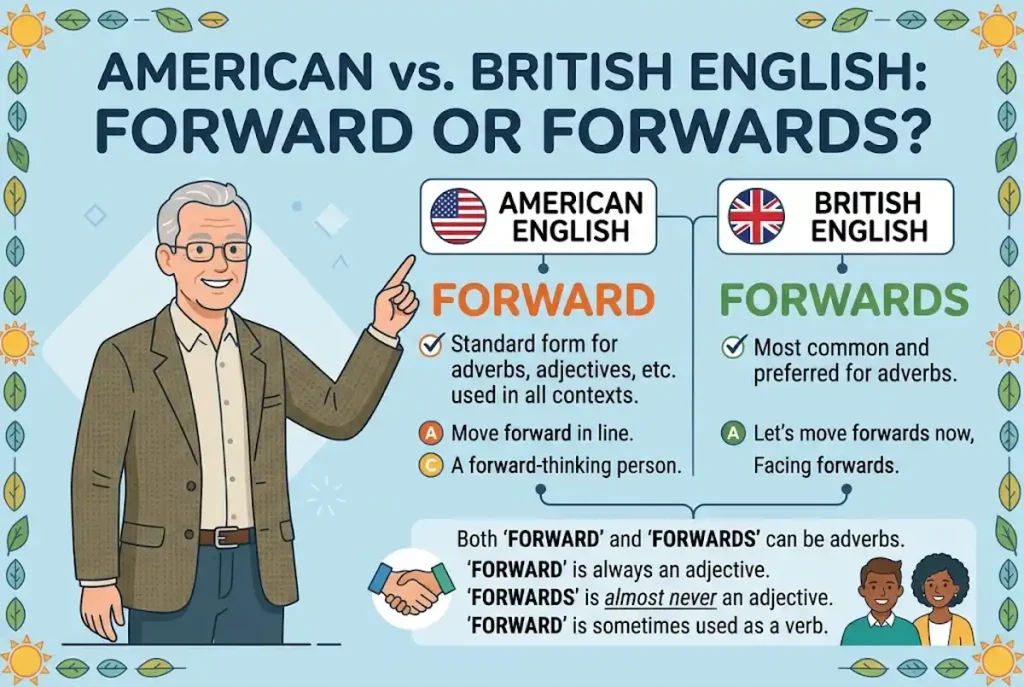
Is Forward American English and Forwards British English?
Both spellings are correct in standard English, but regional preferences differ.
American English generally favors forward when describing direction.
British English uses both forward and forwards, with forwards particularly familiar in everyday directional language.
Consider these examples:
| American English | British English |
|---|---|
| Take two steps forward. | Take two steps forwards. |
| The car moved forward. | The car moved forwards. |
| She leaned forward. | She leaned forwards. |
| Move the chair forward. | Move the chair forwards. |
| We walked forward. | We walked forwards. |
These are preferences rather than strict national rules.
British speakers regularly use forward, and American speakers sometimes use forwards.
The important rule remains the same across both varieties: use forward when you need the adjective or the base form of the verb.
For American websites, academic assignments, and business communication, forward is generally the safer default.
Consistency also matters. If you’re preparing a formal document, follow one regional style rather than switching unnecessarily between forms.
Which Word Should You Use in Different Writing Situations?
The Forward vs Forwards choice becomes easier when you consider the purpose of your sentence.
A professional email has different expectations from a friendly text. A resume also needs different wording from a casual conversation.
Which Word Is Better for a Resume?
Use forward when discussing progress, leadership, or future goals.
However, stronger action verbs often make resume statements more specific.
Compare:
I helped move the company forward.
A stronger version:
I improved team efficiency by introducing a new reporting process.
Other useful resume expressions include:
- Advanced project goals.
- Improved daily operations.
- Supported business growth.
- Led process improvements.
- Developed future strategies.
Example sentence:
I helped move the department forward by improving communication between teams.
The word works naturally, but measurable achievements usually make a resume more convincing.
Which Word Is Better for an Essay?
Forward is a safe choice for American academic writing.
It works when discussing movement, development, social progress, or future events.
Example:
Technological advances continue to move society forward.
For a more formal tone, you could write:
Technological advances continue to drive social progress.
Use forwards only when it fits your chosen regional style and functions as an adverb.
Which Word Is Better for Texting?
Both forms work in informal messages.
Examples:
- Move forward a little so I can see you.
- Take two steps forwards.
- Looking forward to seeing you!
- Can you forward me that photo?
In American texting, forward usually sounds more familiar.
When asking someone to send a message or picture, use the verb forward.
Which Word Is Better for an Email?
Forward is the standard choice when discussing email sharing.
Example:
Could you please forward the meeting details to everyone?
The phrase looking forward to is also extremely common in professional communication.
Examples:
- I look forward to hearing from you.
- We’re looking forward to working together.
- I look forward to receiving your feedback.
Forwards can be grammatically possible in the directional expression, but forward is the established preference in American professional writing.
Which Word Sounds Better When Speaking?
Both forms sound natural in conversation.
Your regional background often influences which one you choose.
Examples:
- Please step forward.
- Move forwards until you reach the entrance.
- Don’t look back. Keep moving forward.
In everyday American speech, forward is more common.
If you’re learning American English, using forward consistently will usually sound natural.
Forward vs Forwards in Real Life Examples
Seeing the words in different situations helps you understand how they work beyond dictionary definitions.
The following examples cover movement, work, travel, technology, and everyday communication.
| Situation | Example Sentence | Explanation |
|---|---|---|
| Walking | She stepped forward to introduce herself. | Physical movement |
| Driving | The truck moved forwards slowly. | Directional adverb |
| Workplace | We’re moving forward with the proposal. | Progress |
| Please forward the attachment. | Verb meaning send | |
| School | The teacher asked everyone to come forward. | Movement toward the front |
| Sports | The forward scored twice. | Noun |
| Travel | The passenger leaned forwards. | Physical direction |
| Planning | We should look forward to new opportunities. | Future focus |
| Technology | The software update moves the project forward. | Development |
| Family | His father encouraged him to keep moving forward. | Personal progress |
| Instructions | Take three steps forward and turn left. | Physical direction |
| Business | The manager forwarded the report. | Past tense verb |
| Conversation | I’m looking forward to the weekend. | Anticipation |
| Engineering | The machine tilted forwards. | Physical movement |
| Education | Her confidence improved as she moved forward in her studies. | Personal development |
Notice that forward appears in more grammatical roles, while forwards mainly describes direction.
This is why learning the sentence structure matters more than memorizing a spelling preference.
What Is the Difference: Forward vs Ahead?
Forward and ahead are close in meaning, but they don’t always work in the same places.
Forward often emphasizes movement or direction.
Ahead commonly describes a position in front, future events, or being further along.
| Forward | Ahead |
|---|---|
| Take one step forward. | Look at the road ahead. |
| Move forward with the plan. | Plan for the months ahead. |
| The chair moved forward. | The runner was far ahead. |
Consider:
She moved forward.
This describes movement.
She was ahead.
This describes her position compared with something or someone else.
You can also say:
We need to move ahead with the project.
Here, ahead and forward have nearly identical meanings.
However, ahead cannot replace forward as a verb.
Correct: Please forward the message.
Incorrect: Please ahead the message.
Forward vs Onward What Is the Difference?
Forward emphasizes direction or advancement.
Onward emphasizes continuing a journey, process, or activity.
| Forward | Onward |
|---|---|
| The car moved forward. | The travelers continued onward. |
| We need to move forward. | The journey must continue onward. |
| She stepped forward. | They marched onward. |
Onward often has a slightly more expressive tone.
For example:
After the setback, the team moved forward.
This describes progress.
After the setback, the team pressed onward.
This emphasizes continuing despite the difficulty.
Both words are useful, but onward doesn’t replace forward in every grammatical situation.
Forward vs Advance What Is the Difference?
Forward commonly describes direction or progress.
Advance often means reaching a higher, further, or more developed stage.
Compare:
The workers moved forward.
This may describe physical movement.
The workers advanced their skills.
This describes improvement.
Advance also works as a noun and verb, making it useful in formal writing.
Examples:
- The soldiers advanced toward the bridge.
- Medical advances have improved patient care.
- The company plans to advance its research.
Choose advance when you want to emphasize development or reaching a new stage.
Choose forward when simple direction is enough.
What Are the Most Common Mistakes With Forward and Forwards?
Most errors happen when someone uses forwards in a grammatical position that requires forward.
Here are the mistakes worth checking before publishing or sending your writing.
Using Forwards as an Adjective
Incorrect: We need a forwards plan.
Correct: We need a forward plan.
Forward can describe a noun. The directional adverb forwards cannot normally perform that job.
Using Forwards as the Base Form of a Verb
Incorrect: Please forwards this email.
Correct: Please forward this email.
Remember that forwards is correct as a third-person singular verb.
Correct: She forwards the email every morning.
Confusing Forward With Foreword
These words have different meanings.
Forward describes direction, progress, or sending something.
Foreword is an introductory section in a book, usually written by someone other than the main author.
Examples:
- The train moved forward.
- The author invited a professor to write the foreword.
They sound alike, but their spelling and meaning are different.
Confusing Forward With Future
Forward can suggest movement toward the future, but it doesn’t directly replace the noun future.
Incorrect: We need to prepare for the forward.
Correct: We need to prepare for the future.
Correct: We need to plan for the years ahead.
Using Forwards in Every Sentence
Adding s isn’t always necessary.
For example:
- Looking forward to meeting you.
- Moving forward with our plans.
- Please come forward.
These are natural expressions in American English.
Using forwards throughout a formal American document may make the writing sound less consistent.
Assuming Forward Always Means Progress
Forward can describe movement without suggesting improvement.
A person can move forward physically while making no progress toward a goal.
Similarly, moving a meeting forward can mean scheduling it earlier.
Always consider the surrounding sentence.
When Should You Avoid Using Forward or Forwards?
Sometimes neither word is the clearest choice.
If you’re writing about a specific action, a more precise verb may help readers understand your meaning immediately.
For example:
Less specific: We moved forward with the application.
More specific: We submitted the application.
Less specific: The team made forward progress.
More specific: The team completed three project stages.
Less specific: Please forward the issue.
More specific: Please refer the issue to customer support.
You should also avoid replacing forward with forwards when the word is part of a fixed grammatical structure.
Examples include:
- Forward planning.
- Forward movement.
- Forward thinking.
- Forward an email.
- A forward position.
In these expressions, the final s would either be incorrect or change the grammatical meaning.

What Are the Opposites of Forward and Forwards?
The most common opposites are backward and backwards.
Like the original pair, these forms show a regional preference.
American English generally favors backward, while British English commonly uses both.
Other related opposites depend on context.
| Word | Opposite | Example |
|---|---|---|
| Forward | Backward | Take one step backward. |
| Forwards | Backwards | The bicycle rolled backwards. |
| Advance | Retreat | The soldiers began to retreat. |
| Progress | Regress | The patient’s condition began to regress. |
| Proceed | Stop | Please stop at the entrance. |
| Ahead | Behind | The other runner fell behind. |
| Send onward | Hold back | The office decided to hold back the report. |
Backward is the clearest opposite when discussing physical direction.
Retreat and regress are more suitable when discussing withdrawal or a loss of progress.
Quick Tips for Choosing Forward or Forwards
You don’t need to memorize every possible sentence. A few simple checks will help you choose correctly.
- Use forward as your default in American English.
- Use either form as a directional adverb when the sentence allows it.
- Choose forward when the word describes a noun.
- Use forward as the base verb when asking someone to send information.
- Remember that forwards can be a correct third-person singular verb.
You can also use this short decision table.
| Your Intended Meaning | Recommended Choice |
|---|---|
| Moving toward the front | Forward |
| British-style directional movement | Forwards or forward |
| Sending an email | Forward |
| Describing a front position | Forward |
| Talking about future plans | Forward |
| Describing progress in American writing | Forward |
| Referring to multiple attacking players | Forwards |
| Describing what someone regularly sends onward | Forwards |
Conclusion
Understanding Forward vs Forwards comes down to recognizing grammar, meaning, and regional preference. Both forms can describe movement toward the front, and neither is automatically wrong when used as a directional adverb.
Forward is the more flexible word because it also works as an adjective, verb, and noun. It’s generally the preferred spelling in American English, especially in academic assignments, business communication, and professional writing.
Forwards remains a correct alternative in directional expressions and is particularly familiar in British English. It also appears as a normal plural noun or third-person singular verb in other contexts.
Before choosing, check what job the word performs in your sentence. Once you understand that simple distinction, you’ll be able to use both forms naturally and confidently.
Frequently Asked Questions
Is It Correct to Say Forward or Forwards?
Both are correct when used as directional adverbs. Forward is generally preferred in American English, while forwards is also common in British English.
What Is the Difference Between Forward vs Forwards?
The main difference is grammatical flexibility and regional preference. Both describe direction, but forward also works as an adjective, verb, and noun.
Is Looking Forward or Looking Forwards Correct?
Both are grammatically acceptable, but looking forward is more common in American English. It’s also the safer choice for professional emails and formal writing.
Do Americans Say Forward or Forwards?
Americans generally prefer forward. However, forwards is still understood and sometimes appears in everyday speech.
Can I Say Please Forwards This Email?
No. Use please forward this email because the base form of the verb is forward. However, she forwards the email is correct.
What’s Another Way to Say Moving Forward?
You can say moving ahead, making progress, advancing, or proceeding. The best alternative depends on the sentence and its intended meaning.
Is Forwards More Formal Than Forward?
No. Forwards isn’t automatically more formal. It’s simply a common directional variant, particularly in British English.
Should I Use Forward or Forwards in Academic Writing?
For the Forward vs Forwards choice in American academic writing, forward is generally the better default. It follows common US usage and helps maintain consistency throughout your work.

Daniel Grammarfield — The Language Learner
Age: 28Occupation: ESL Learner & Digital Professional
Bio:Daniel is a non-native English speaker who wants to communicate more confidently at work and online. He uses Synotrench to improve grammar, understand confusing words, learn correct sentence structures, and build everyday English skills. He prefers simple explanations with practical examples.
Goals:
Master English grammar rules
Avoid common language mistakes
Improve professional communication
Learn English through real-life examples
Quote:“Learning English is not about memorizing rules — it’s about expressing ideas clearly.”
2 thoughts on “Forward vs Forwards Simple Guide With Examples (2026)”