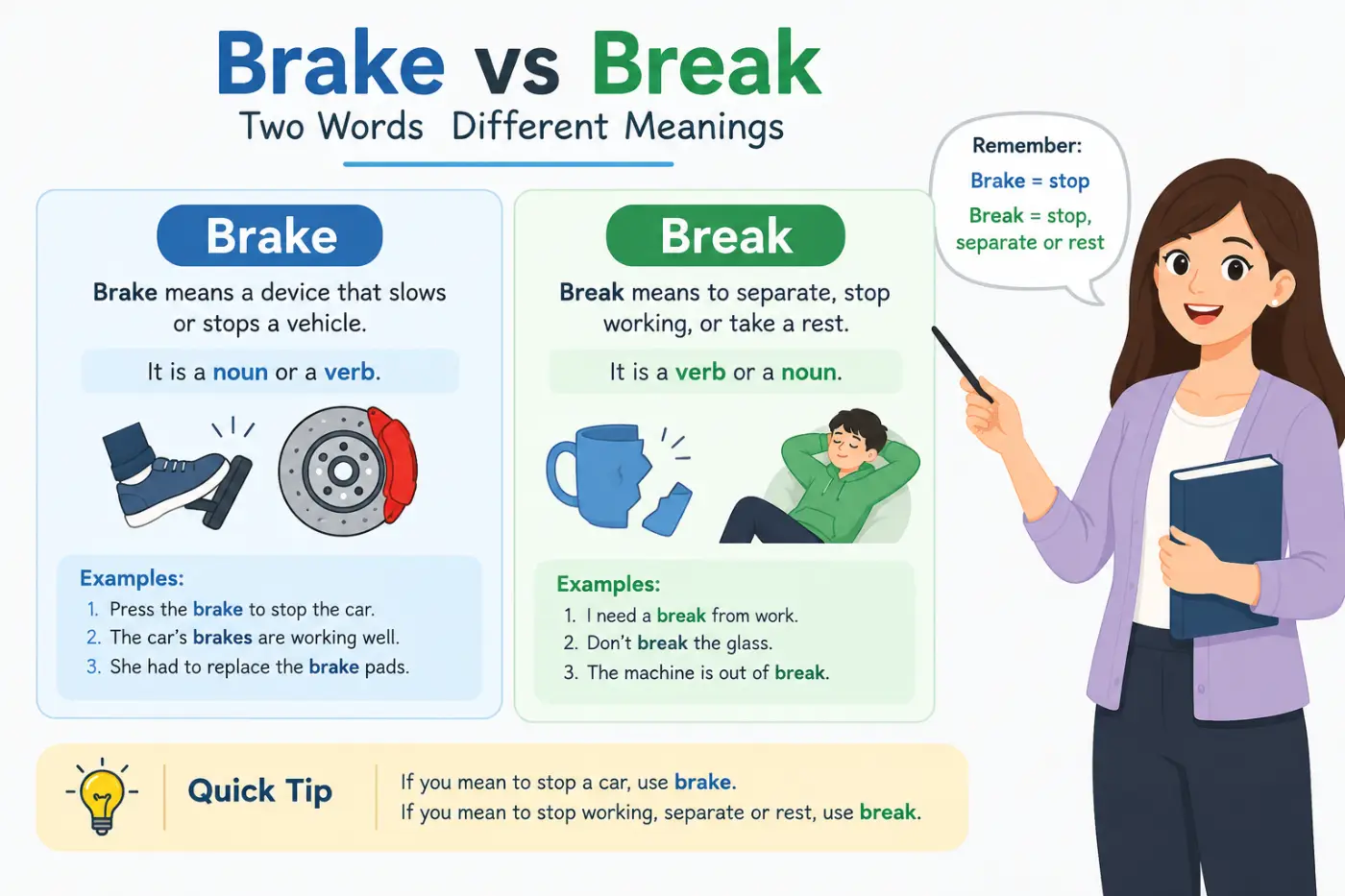
You’re writing an email, finishing an essay, or sending a quick text when you suddenly stop and wonder: should you write brake or break? The two words sound the same, but they have completely different meanings. That makes brake vs break one of those small English problems that can cause surprisingly big mistakes.
Brake means a device or action used to slow down or stop a vehicle or moving object. Break means to damage something, separate something, interrupt something, or stop following a rule or pattern. The right choice depends on what you mean.
Brake is connected to stopping or slowing movement. Break has many meanings, including damage, interruption, separation, rest, and failure. Once you connect each word with its main idea, the difference becomes much easier to remember.
This guide explains their meanings, origins, related words, pronunciation, grammar, common mistakes, real world examples, and the best choice for emails, resumes, essays, texts, and everyday speech.
What does brake mean?
Brake is a word connected with stopping or slowing movement.
As a noun, a brake is a mechanical device used to slow down or stop a vehicle, bicycle, machine, or other moving object.
For example:
The driver pressed the brake.
The bicycle has new brakes.
The car’s brakes need to be checked.
As a verb, brake means to slow down or stop a moving vehicle or object by using a braking system.
For example:
She braked suddenly when the dog ran into the street.
The driver braked before reaching the red light.
The cyclist braked at the bottom of the hill.
The key idea is simple: brake is about controlling movement by slowing or stopping it.
Where did the word brake come from?
The word brake has a long history connected to controlling movement. It developed from older words associated with a device used for stopping or restraining motion.
The modern meaning became especially important as transportation developed. Brakes were used on vehicles, carts, bicycles, trains, and eventually automobiles.
Today, the word can describe both the physical device and the action of using it.
You can remember it through this simple connection:
Brake = stop or slow.
That connection works in most everyday situations.
What does break mean?
Break has many more meanings than brake.
As a verb, break can mean to damage something so that it no longer works or remains whole.
For example:
I broke my phone.
He broke the glass.
The child broke the toy.
Break can also mean to separate something into pieces.
She broke the cookie in half.
The waves broke against the rocks.
The stick broke when he stepped on it.
Another common meaning is to interrupt something.
The loud noise broke the silence.
Someone broke the meeting with an unexpected announcement.
Break can also mean to stop doing something for a short period.
Let’s take a break.
I need a short break from studying.
The employees took a lunch break.
The word can also describe violating a rule, promise, law, or agreement.
He broke the rules.
She broke her promise.
They broke the law.
Break can even describe ending a record or reaching a new level.
The athlete broke the world record.
The company broke its previous sales record.
The main idea is that break is a flexible word involving damage, separation, interruption, rest, violation, or change.

Brake vs break in simple English
The easiest way to understand words are to connect each word with one central idea.
| Word | Basic meaning | Example |
|---|---|---|
| Brake | Slow or stop movement | Press the brake. |
| Break | Damage, separate, interrupt, or stop | Be careful not to break the glass. |
Think about a car.
You use the brake to stop the car.
You could break the car if you hit something.
Those sentences show the difference clearly.
The words sound alike in standard English, but their meanings and spellings are different. This makes them homophones.
A homophone is a word that sounds the same as another word but has a different meaning or spelling.
Why do brake and break sound the same?
Brake and break are pronounced the same in standard American English.
That is why spelling can become confusing. When you hear someone say the word, you cannot always tell which spelling they mean.
You have to understand the meaning from context.
For example:
Please brake before the corner.
Please break the chocolate into pieces.
The pronunciation is the same, but the meanings are completely different.
This is similar to other common English pairs such as:
| Word pair | Main difference |
|---|---|
| Brake / break | Stop movement / damage or separate |
| Right / write | Correct / put words on paper |
| Their / there | Belonging to them / a place |
| Here / hear | A location / receive sound |
| To / too | Direction or infinitive / also or excessively |
When spelling these words, focus on meaning rather than sound.
What are the main related words for brake and break?
Because brake and break have different meanings, their related words also belong to different groups. Some can act as close alternatives in specific situations, while others describe connected ideas rather than exact replacements.
Simple alternatives and related words
| Word | Meaning | Tone | Example |
|---|---|---|---|
| Stop | Make something cease moving | Simple | Stop the car. |
| Slow | Reduce speed | Simple | Slow the vehicle down. |
| Halt | Stop movement | Simple | The train halted. |
| Rest | Stop activity for a while | Simple | I need to rest. |
| Damage | Harm something | Simple | The fall damaged the phone. |
| Split | Separate into parts | Simple | Split the apple in half. |
| Crack | Develop a break or opening | Simple | The glass cracked. |
| Pause | Stop temporarily | Everyday | Pause the video. |
Everyday alternatives and related words
| Word | Meaning | Tone | Example |
|---|---|---|---|
| Stopper | Something that prevents movement | Everyday | The stopper kept the door closed. |
| Slowdown | A reduction in speed | Everyday | There was a slowdown in traffic. |
| Rest period | A period away from activity | Everyday | We had a short rest period. |
| Interruption | Something that stops an activity | Everyday | The call caused an interruption. |
| Damage | Physical or functional harm | Everyday | The storm caused damage. |
| Ruin | Seriously damage something | Everyday | Water can ruin the furniture. |
| Divide | Separate into parts | Everyday | Divide the cake equally. |
| Interrupt | Stop something temporarily | Everyday | Please don’t interrupt me. |
Formal alternatives and related words
| Word | Meaning | Tone | Example |
|---|---|---|---|
| Decelerate | Reduce speed | Formal | The vehicle began to decelerate. |
| Restrain | Hold back or control | Formal | The system restrained the movement. |
| Terminate | Bring something to an end | Formal | The agreement was terminated. |
| Discontinue | Stop an activity or service | Formal | The company discontinued the product. |
| Fragment | Break into smaller pieces | Formal | The material fragmented under pressure. |
| Violate | Break a rule or law | Formal | The company violated the regulation. |
| Interrupt | Stop an ongoing process | Formal | The signal interrupted the transmission. |
| Deteriorate | Become worse or damaged | Formal | The structure began to deteriorate. |
Informal and slang related words
| Word | Meaning | Tone | Example |
|---|---|---|---|
| Chill | Relax or take it easy | Slang | Let’s chill for a while. |
| Crash | Fail, break down, or stop working | Informal | My computer crashed. |
| Cut out | Stop working or disappear | Informal | The sound cut out. |
| Knock off | Stop working for the day | Informal | We knocked off at six. |
| Mess up | Damage or handle badly | Slang | I messed up the project. |
| Blow | Fail or damage an opportunity | Slang | He blew his chance. |
| Split | Leave or separate | Informal | We should split after dinner. |
| Shut down | Stop operating | Informal | The machine shut down. |
These words are not interchangeable with brake or break in every sentence. They simply show the wider vocabulary surrounding stopping, damage, separation, interruption, and rest.
What are synonyms for brake from mild to strong?
The best replacement for brake depends on the type of action you mean.
For slowing movement, the scale might look like this:
| Intensity | Word | Example |
|---|---|---|
| Mild | Slow | Slow down near the school. |
| Mild | Ease off | Ease off the accelerator. |
| Moderate | Decelerate | The vehicle decelerated quickly. |
| Strong | Stop | Stop the car immediately. |
| Very strong | Halt | The vehicle came to a halt. |
In normal conversation, slow down and stop are usually more natural than decelerate or halt.
In technical writing, however, decelerate may be more precise.
What are synonyms for break from mild to strong?
Break has several meanings, so its alternatives change with context.
For physical damage:
| Intensity | Word | Example |
|---|---|---|
| Mild | Crack | The screen cracked. |
| Moderate | Damage | The fall damaged the device. |
| Strong | Break | He broke the chair. |
| Very strong | Shatter | The glass shattered. |
| Extreme | Destroy | The explosion destroyed the building. |
For stopping an activity:
| Intensity | Word | Example |
|---|---|---|
| Mild | Pause | Pause the video. |
| Moderate | Interrupt | The call interrupted the meeting. |
| Strong | Stop | Stop the discussion. |
| Formal | Terminate | The company terminated the service. |
This is why break is difficult for learners. One word can represent several different ideas.
How do brake and break work as different parts of speech?
Both words can function as nouns and verbs, but their meanings remain different.
Brake as a noun
A brake is a device used to slow or stop movement.
Example:
The mechanic replaced the front brake.
Brake as a verb
To brake means to slow or stop a moving vehicle or object.
Example:
The driver braked when the light changed.
Break as a noun
A break can mean a period of rest, an interruption, damage, or a separation.
Examples:
We took a short break.
There was a break in the pipe.
The teacher gave us a ten minute break.
Break as a verb
To break can mean to damage, separate, interrupt, violate, or end something.
Examples:
Be careful not to break the plate.
She broke the chocolate into pieces.
He broke the agreement.
The noise broke the silence.
Is it different in American and British English?
The basic difference between brake and break is the same in American and British English.
Brake refers to stopping or slowing movement.
Break has its wider set of meanings.
The pronunciation is also generally the same for the two words in both varieties of English.
Some transportation vocabulary can differ between the United States and the United Kingdom, but that does not change the spelling rule for these two words.
For example, both American and British writers can say:
Press the brake.
The car needs new brakes.
Be careful not to break the glass.
One regional difference worth knowing is that British English commonly uses break in expressions such as a tea break, while American English more often uses terms such as coffee break or lunch break depending on the situation. The word itself does not change.
Which word is best for a resume?
Use brake only when you are talking about vehicles, machinery, mechanical systems, or work involving stopping movement.
Use break when describing something you repaired, changed, interrupted, damaged, or improved, depending on the sentence.
For example:
I inspected vehicle brake systems.
I repaired broken machine parts.
Be careful with phrases such as brake down. The correct expression is break down when you mean something stops working.
For example:
The machine broke down during testing.
A resume should use precise technical language. If you work with automotive systems, brake is the correct spelling for the stopping mechanism.
Which word is best for texting?
In texting, context usually makes the choice easy.
Use brake when talking about driving:
Don’t forget to check your brake lights.
Use break when talking about rest:
I need a break.
Use break when talking about damage:
I hope I didn’t break your charger.
Use break when talking about interruption:
Sorry to break the conversation, but I have to leave.
Because texting is informal, people sometimes make spelling mistakes. The correct spelling still depends on meaning.
Which word is best for email?
Use brake for professional messages involving vehicles, driving, repairs, or mechanical systems.
For example:
The vehicle needs a brake inspection before delivery.
Use break for interruptions, rest periods, damaged items, or changes.
For example:
I’ll take a short break and finish the report afterward.
The equipment broke during testing.
The meeting will resume after a short break.
In workplace writing, choosing the right spelling makes your message clearer and more professional.
Which word is best for speaking?
When speaking, you do not have to choose a spelling because brake and break sound the same.
The listener uses context to understand your meaning.
If you say:
I need to brake.
The listener understands that you mean slowing or stopping a vehicle.
If you say:
I need a break.
The listener understands that you want to rest.
This is a good reminder that spelling problems often appear in writing even when there is no problem in speech.

What are some real examples of brake vs break?
Here are examples from everyday situations.
- The driver pressed the brake before the intersection.
- Please don’t break the glass.
- The mechanic checked the brakes before returning the car.
- I need a short break after studying for three hours.
- She braked when the traffic suddenly stopped.
- He accidentally broke his phone screen.
- The cyclist used the brake while going downhill.
- The teacher gave the students a ten minute break.
- The loud alarm broke the silence.
- The driver forgot to release the parking brake.
- The child broke the toy while playing.
- We stopped for a short break during the road trip.
- The car has a problem with its rear brakes.
- The company broke its previous sales record.
- Please brake before entering the narrow driveway.
- The storm broke several branches from the tree.
- The workers took a lunch break at noon.
- The machine broke down during the test.
- She broke her promise to her friend.
- The driver braked hard to avoid the bicycle.
- The glass will break if you drop it.
- The athlete broke the national record.
- The mechanic said the brake pads were worn.
- The speaker paused after the interruption and took a break.
These examples show why context matters more than sound.
what is the difference Brake vs stop: ?
Brake and stop are related, but they are not always exact synonyms.
Brake usually describes the action or system used to reduce speed or bring something to a stop.
Stop describes the final condition or action of ending movement.
Compare these sentences:
The driver braked before the corner.
The driver stopped before the corner.
The first sentence focuses on slowing the vehicle using the braking system.
The second sentence focuses on the vehicle no longer moving.
You can brake without coming to a complete stop.
For example:
The driver braked slightly to reduce speed.
You can also stop without using a vehicle brake in some situations.
For example:
The train stopped at the station.
So brake is more specific, while stop is broader.
Break vs pause: what is the difference?
Break and pause can both describe stopping temporarily, but they often have different uses.
A pause is usually short and temporary.
For example:
The speaker paused before answering.
A break is often a period when you leave an activity and rest.
For example:
We took a break after two hours.
A pause can happen inside an activity.
A break often separates one period of activity from another.
Compare:
The teacher paused to answer a question.
The teacher took a break after the lesson.
Both involve stopping, but the purpose and length are different.
Break vs damage: what is the difference?
Damage is a broad word for harm.
Break is more specific in many physical situations.
You can damage a car without breaking it.
For example:
The storm damaged the car.
You can also break a specific part.
For example:
The storm broke the side mirror.
Damage does not always mean that something is separated or no longer whole.
Break often suggests that something has cracked, separated, stopped working, or lost its original form.
What are common mistakes with brake and break?
One of the most common mistakes is writing brake when you mean rest.
Incorrect:
I need a brake after work.
Correct:
I need a break after work.
Another common mistake is using break when you mean the stopping system of a vehicle.
Incorrect:
The car needs new breaks.
Correct:
The car needs new brakes.
A third mistake is writing brake down when you mean that a machine stopped working.
Incorrect:
My computer braked down.
Correct:
My computer broke down.
Another common mistake happens with brake lights.
Incorrect:
Check your break lights.
Correct:
Check your brake lights.
Remember that brake lights are connected to the braking system.
When should you not use brake?
Do not use brake when you mean rest, damage, separation, interruption, or violation.
For example, these expressions require break:
Take a break.
Break the glass.
Break a promise.
Brake is mainly appropriate when something is being slowed or stopped through braking.
For example:
Brake before the turn.
The brakes are worn.
The driver braked suddenly.
When should you not use break?
Do not use break when you mean the mechanical device used to slow or stop a vehicle.
For example:
The brake pedal feels soft.
The brakes need repair.
Press the brake.
You also should not use break in place of brake in technical descriptions of braking systems.
If you are writing about brake pads, brake fluid, brake lights, brake pedals, or braking systems, brake is the correct spelling.
What are the antonyms of brake and break?
The opposite of brake depends on the meaning.
For brake as a verb, possible opposites include:
Accelerate.
Speed up.
Advance.
Move.
For break meaning damage, possible opposites include:
Repair.
Fix.
Restore.
Protect.
For break meaning separate, possible opposites include:
Join.
Connect.
Combine.
Unite.
For break meaning interrupt, possible opposites include:
Continue.
Resume.
Maintain.
For break meaning rest, the opposite may be:
Work.
Continue.
Stay active.
There is no single antonym that works for every meaning of break.
Why are words so easy to confuse?
The main reason is pronunciation.
When two words sound the same, your brain cannot rely on sound to select the spelling. You need to connect the word with its meaning.
English contains many homophones, and brake and break are especially confusing because both words are common.
Another reason is that break has many meanings.
A learner may know break as the opposite of fix, but the same word can also mean rest, interrupt, violate, separate, or end a record.
Brake has a narrower meaning, but it appears in many transportation expressions.
These include:
Brake pedal.
Brake pad.
Parking brake.
Emergency brake.
Knowing common word combinations can make the correct spelling easier to recognize.

What should you remember about brake and break?
Keep these two ideas in your mind:
Brake relates to stopping or slowing movement.
Break relates to damage, separation, rest, interruption, rules, records, and many other forms of change.
The pronunciation does not help because the two words sound the same.
Meaning does.
If you are talking about a car slowing down, choose brake.
If something is damaged, choose break.
Conclusion
The difference between brake and break becomes much easier once you connect each word with its main meaning. Brake is used for slowing or stopping movement, especially when you are talking about a vehicle or mechanical system. Break has many meanings, including damage, separation, rest, interruption, rule violations, and records.
When choosing between brake vs break, don’t depend on sound because both words are pronounced the same. Look at the meaning of the sentence instead. If you can connect the word with a car, braking system, or slowing motion, brake is probably correct.
If you mean damage, rest, interruption, separation, or another change, break is usually the right choice. With a little practice, this common spelling problem becomes easy to handle.
Frequently Asked Questions
Is brake or break correct when talking about a car?
Brake is correct when you mean the device or action used to slow or stop a car. For example, Press the brake before the turn.
Is it take a brake or take a break?
The correct expression is take a break. It means to stop working or studying for a short period of rest.
What is the difference between brake and break?
Brake relates to slowing or stopping movement, while break can mean damage, separation, rest, interruption, or violation of a rule.
How do you remember brake vs break?
Remember that brake has an A, like the word automobile. A brake helps an automobile slow down or stop.
Is it break lights or brake lights?
Brake lights is correct because the lights are connected to the vehicle’s braking system.
What’s another way to say take a break?
You can say rest, pause, take some time off, or step away for a while. The best choice depends on the situation and level of formality.

Daniel Grammarfield — The Language Learner
Age: 28Occupation: ESL Learner & Digital Professional
Bio:Daniel is a non-native English speaker who wants to communicate more confidently at work and online. He uses Synotrench to improve grammar, understand confusing words, learn correct sentence structures, and build everyday English skills. He prefers simple explanations with practical examples.
Goals:
Master English grammar rules
Avoid common language mistakes
Improve professional communication
Learn English through real-life examples
Quote:“Learning English is not about memorizing rules — it’s about expressing ideas clearly.”
2 thoughts on “Brake vs Break Best Simple Guide (2026)”