You’re finishing an essay, report, research paper, or business document, and you reach the final pages. You want to add charts, survey results, source material, or extra details that support your main work without interrupting the flow. Then you stop at one small question: should you write appendices or appendixes?
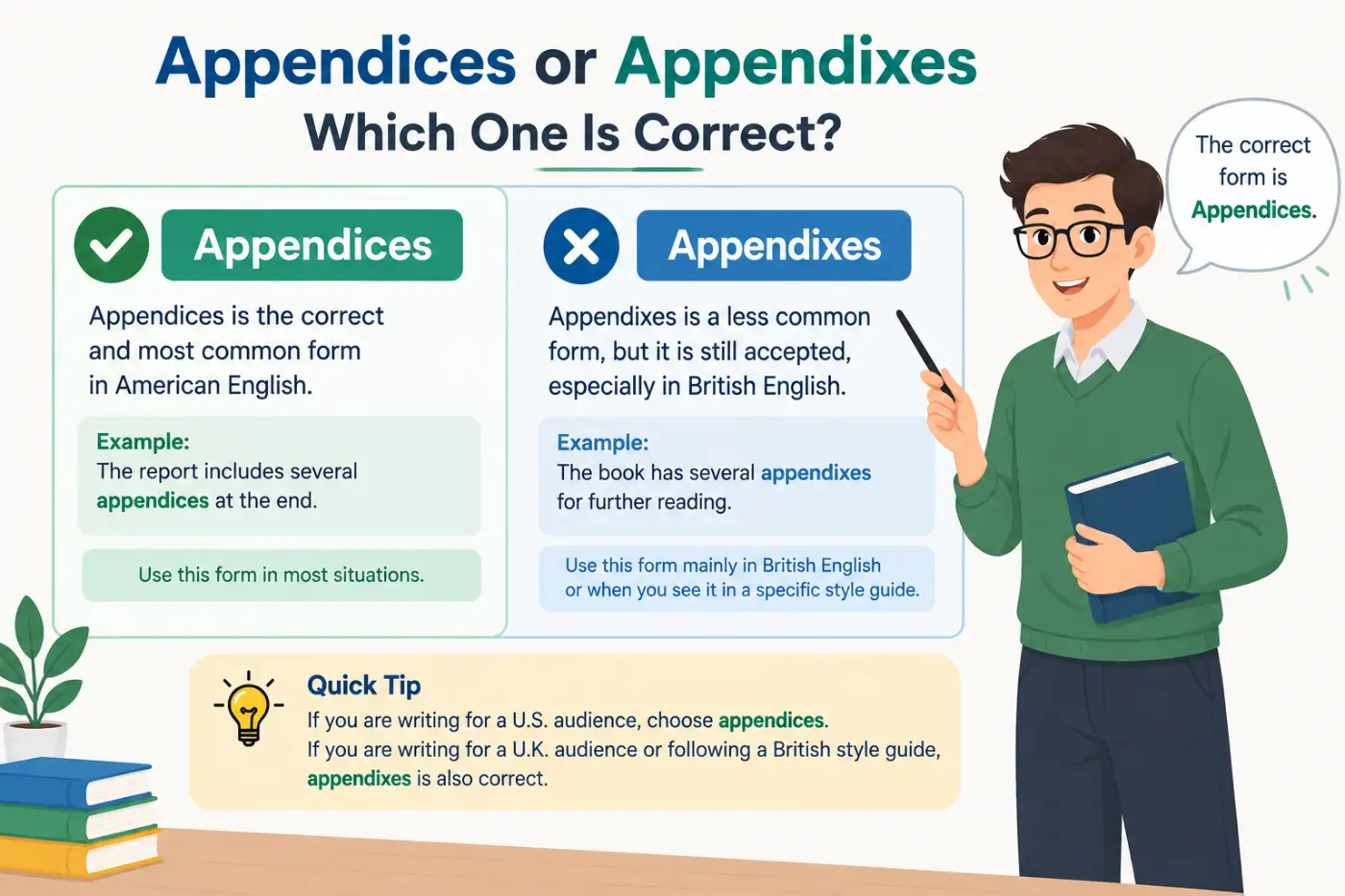
Both forms are correct plural forms of appendix. Appendices is the more traditional and more widely used form, especially in academic and formal writing. Appendixes is also accepted, particularly in general American English.
Answer box: Both correct plurals of appendix. Use appendices for the safest choice in academic and formal writing, while appendixes is also grammatically correct.
The choice usually depends on style, audience, and context rather than grammar. In this guide, you’ll learn where the two forms come from, how they differ in use, which alternatives work in different types of writing, and how to choose the clearest term for your document.
What do appendices and appendixes mean?
It refer to extra sections placed at the end of a book, report, paper, thesis, or other longer document. These sections contain supporting information that is useful but not necessary for understanding the main text.
For example, a research report might explain its findings in the main chapters. At the end, it might include:
- A copy of the survey.
- Detailed statistical tables.
- Interview questions.
- Extra charts.
- Technical calculations.
- A list of supporting data.
These materials can be placed in an appendix.
The singular form is appendix.
| Number | Correct form | Example |
|---|---|---|
| One | appendix | See the appendix for the full survey. |
| More than one | appendices | The report includes three appendices. |
| More than one | appendixes | The report includes three appendixes. |
The important point is simple: both plural forms are standard English.
Where does the word appendix come from?
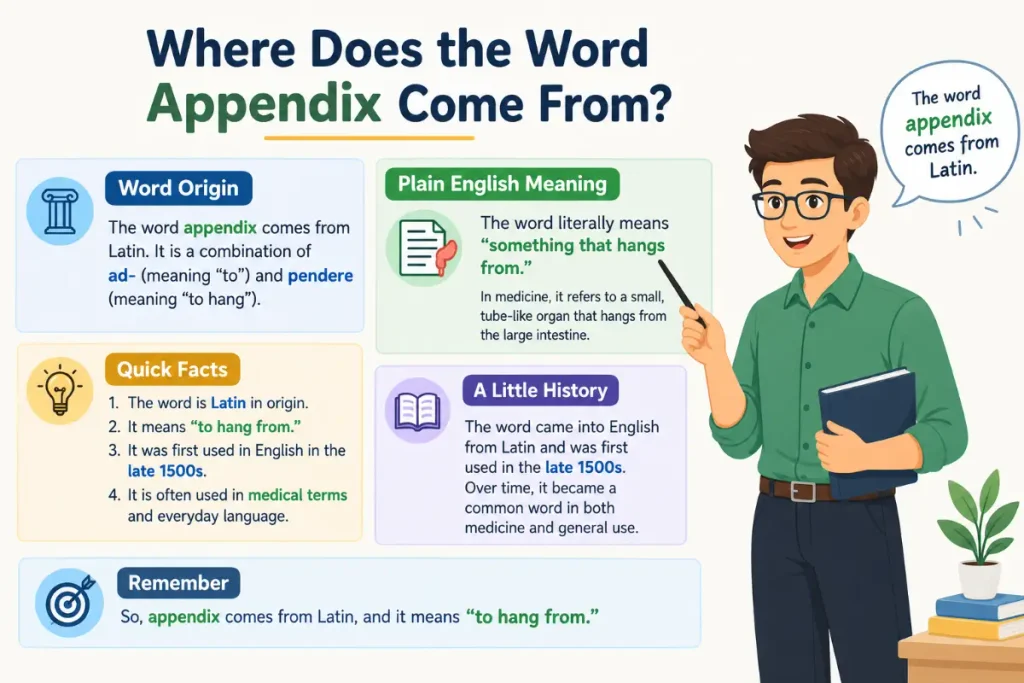
The word appendix comes from Latin.
The Latin noun appendix means something attached or something added. It comes from the Latin verb appendere, meaning to hang upon or attach to something.
That original idea still makes sense today. An appendix is material attached to the main body of a document.
The plural appendices follows the traditional Latin plural pattern. This is similar to other English words that entered English from Latin and kept an older plural ending.
For example:
| Singular | Traditional plural |
|---|---|
| appendix | appendices |
| index | indices |
| matrix | matrices |
| analysis | analyses |
English also has a long history of adopting words from other languages and gradually giving them English plural forms.
That is why appendixes exists too. English speakers often make a borrowed noun plural by adding s or es. Over time, both forms became accepted.
So the difference isn’t about one word being grammatical and the other being wrong. It reflects two ways English handles borrowed vocabulary.
Is appendices or appendixes more common?
Appendices is generally the more familiar choice in academic, scientific, legal, and formal writing.
You’ll often see it in research papers, university documents, books, technical reports, and professional publications.
Appendixes is also correct. It tends to feel more fully anglicized because it uses the ordinary English plural ending.
If you’re writing for a teacher, university, journal, researcher, or professional organization and no style guide gives you a different instruction, appendices is a safe choice.
That doesn’t make appendixes incorrect.
A useful rule is:
| Situation | Natural choice |
|---|---|
| Academic paper | appendices |
| Thesis or dissertation | appendices |
| Scientific report | appendices |
| Formal report | appendices |
| General American writing | appendices or appendixes |
| Informal writing | appendixes can work |
| Following a house style | Use the required style |
Consistency matters too. If your document uses appendices in one section, don’t switch to appendixes later without a reason.
What are the best synonyms for appendices?
There isn’t a perfect synonym for appendices in every situation. An appendix is a specific part of a document, so replacing it with another word can slightly change the meaning.
Still, many related terms can describe supporting or additional material.
These words aren’t interchangeable in every sentence. For example, an attachment is usually a separate file sent with an email, while an appendix is normally part of a larger document.
What are the alternatives from mild to strong?
Words related to appendices can also differ in how much additional information they suggest.
For a small amount of extra information, simple terms work well:
- Notes.
- Details.
- Extras.
- Additions.
For a moderate amount of supporting information, these terms are useful:
- Supporting material.
- Additional material.
- Reference material.
- Supplementary material.
- Resources.
The right term depends on what you’re actually adding. Don’t choose a formal word simply because it sounds more impressive.
Are words nouns?
Yes. Appendix is a noun, and both are plural nouns.
They name additional sections or pieces of material.
Examples include:
- The appendix contains the original questionnaire.
- The appendices contain the interview transcripts.
- The appendixes provide extra technical information.
The word does not normally function as a verb or adjective in ordinary English.
Related words can appear in different grammatical roles. For example, supplementary is an adjective:
- supplementary information
- supplementary data
- supplementary material
But appendix itself remains a noun.
Is appendices or appendixes preferred in American English?
American English accepts both forms.
Appendices is widely recognized and often preferred in formal and academic contexts. Appendixes follows the regular English plural pattern and is also legitimate.
In US writing, the safest approach is to follow the style guide connected with your assignment, publication, employer, or organization.
For example, a university may have its own formatting rules. A scientific journal may require a particular style manual. A company may use a house style.
If no style guide is available, appendices is a strong default for formal documents.
This isn’t a rule that says appendixes is wrong. It simply reflects common formal usage.
What is the UK form?
British English also uses appendices, and this traditional form is very common in formal writing.
You may also encounter appendixes in British English, although it is less likely to be the form chosen in highly formal academic contexts.
The broader point is that neither spelling belongs exclusively to one country.
| Form | US English | UK English | Formal writing |
|---|---|---|---|
| appendices | Common | Very common | Very common |
| appendixes | Correct | Correct | Acceptable |
If you’re writing for an international audience, appendices may be easier for readers to recognize because it is the traditional form used across many varieties of English.
Which form should you use in a resume?
A resume usually doesn’t need an appendix.
Most resumes should be concise and focused on experience, skills, education, and achievements. Adding several pages of supporting material can make the document harder to scan.
If an application specifically requests supporting documents, use the terminology in the instructions.
For example:
The requested certifications are included as attachments.
If you’re preparing a longer professional portfolio, appendix may make sense.
Example:
The portfolio includes an appendix with selected project specifications.
For a standard resume, supporting documents or attachments may be clearer than appendices.
Which form should you use in an essay?
Use appendices when you have extra material that supports the essay but would interrupt the main argument.
Example:
The full interview questions are provided in Appendix A.
For several sections:
The survey results are provided in Appendices A and B.
An appendix shouldn’t become a place to hide information that readers need to understand your main argument. Important evidence and reasoning usually belong in the main body.
An appendix works best for useful supporting material.
Which form should you use in academic writing?
Appendices is usually the safest choice in academic writing unless your institution specifies another form.
Academic documents often contain large amounts of supporting material. Examples include:
- Survey forms.
- Interview transcripts.
- Detailed calculations.
- Research instruments.
- Extra statistical tables.
- Technical diagrams.
- Extended data.
- Permission documents.
Example:
The complete survey instrument appears in Appendix A.
If you have several sections:
The interview transcripts are included in Appendices B and C.
Check your required style guide before finalizing the document. Academic formatting rules can differ between institutions and publications.
Which form should you use in an email?
Email usually calls for attachments rather than appendices.
If you’re sending a report as a file, you might write:
Please see the attached report for the complete findings.
If the report itself contains additional sections, you can use appendix within the report:
The detailed calculations are included in Appendix B of the attached report.
This distinction makes your writing more precise. The email has an attachment. The report inside that attachment may have an appendix.
Which form should you use in texting?
In casual texting, you probably don’t need either form.
The word appendix sounds formal, so simpler expressions may feel more natural.
Instead of:
The information is available in the appendix.
You might say:
I added the extra details at the end.
Or:
Check the extra section at the bottom.
Use the formal term when you’re actually discussing a formal document.
Example:
The full results are in the appendix of the report.
Which form should you use when speaking?
If you’re speaking in an academic or professional setting, appendices will usually sound natural:
The full data are listed in the appendices.
In casual conversation, you can simply say:
The extra information is at the end of the report.
Clear language is often better than forcing a formal term into an informal situation.
Examples of appendices and appendixes in real sentences
Here are original examples showing how the words work in different situations.
- The research paper includes two appendices with additional survey data.
- Please review Appendix A before completing the final section.
- The report’s appendices contain the complete interview transcripts.
- The technical manual includes three appendixes with detailed diagrams.
- The professor asked us to place our survey questions in an appendix.
- The financial report includes appendices showing the detailed calculations.
- Appendix B contains the raw data used in the study.
- The book has several appendices that explain the research methods.
- The committee reviewed the appendices before approving the report.
- The author moved the lengthy tables to an appendix to keep the chapter easier to read.
- The final report contains appendices with photographs and measurement records.
- The researcher placed the complete questionnaire in Appendix C.
- The contract includes several appendices describing technical requirements.
- The student added an appendix with copies of the interview questions.
- The manual’s appendixes provide additional troubleshooting information.
- The report refers readers to the appendices for detailed statistics.
- The publisher asked the author to shorten the appendices.
- The complete calculation appears in Appendix A.
- The thesis contains four appendices covering research materials and supporting data.
- The instructor said the appendices were useful but not required for the main argument.
Appendices vs annexes: what’s the difference?
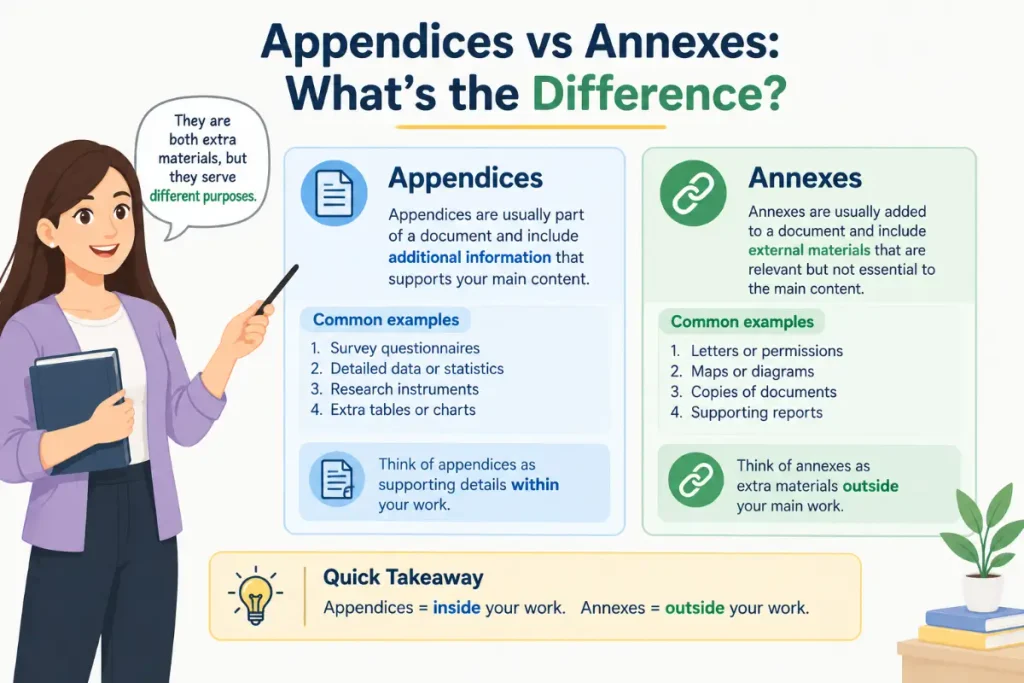
Appendices and annexes can look similar because both refer to additional material attached to a main document.
The difference often depends on context and publishing tradition.
An appendix usually provides supporting information that expands on the main document.
An annex can also be a separate supporting section, especially in government, legal, military, international, or technical documents.
| Term | Typical meaning | Common setting |
|---|---|---|
| Appendix | Supporting information added to a document | Academic and general |
| Annex | Additional attached section | Legal, government, technical |
| Addendum | Material added after the original document | Formal documents |
| Supplement | Material that adds information | Books, publications |
There can be overlap, so don’t assume that one word always replaces another.
If a style guide uses annex for a specific kind of supporting section, follow that convention.
Appendices vs attachments: what’s different?
Appendices and attachments are not the same thing.
An appendix is normally part of a larger document.
An attachment is usually a separate file or item sent with another message or document.
Compare these examples:
| Term | Example |
|---|---|
| Appendix | The report includes an appendix with survey questions. |
| Attachment | I sent the survey questions as an attachment. |
The same material could be both.
For example, a report might contain an appendix, while the entire report is attached to an email.
This distinction is especially useful in workplace communication.
Appendices vs addenda: what’s different?
Addenda is another plural form that can sometimes be confused with appendices.
An addendum is something added to a document after the main document has already been prepared or issued.
An appendix is usually planned as part of the document and placed at the end.
For example:
The report includes an appendix containing raw data.
The publisher issued an addendum correcting information in the original report.
An addendum can be additional information, but it often has the sense of a later addition.
Common mistakes with appendices and appendixes
The biggest mistake is assuming that appendixes is always wrong.
It isn’t.
Both forms are grammatically acceptable plural forms of appendix.
Another mistake is using the plural when you mean one section.
Incorrect:
The report contains one appendices.
Correct:
The report contains one appendix.
For more than one:
The report contains three appendices.
You can also write:
The report contains three appendixes.
A third mistake is changing the spelling inconsistently.
For example:
The report includes two appendices. The second appendix provides survey data.
This is consistent.
When should you not use appendix?
Don’t use appendix simply because you have extra information.
If the information is essential to your argument, it usually belongs in the main text.
An appendix is better for supporting details that interested readers may want to inspect.
For example, a research paper might summarize survey results in the main text and place the complete questionnaire in an appendix.
Also avoid using appendix as a fancy substitute for ordinary words.
In an email, attachment is usually clearer.
In a short essay, a separate appendix may be unnecessary.
The goal is clarity, not formality.
What are the antonyms of appendix?
Appendix doesn’t have a perfect grammatical antonym.
However, several words can express the opposite idea of supporting material or additional content.
Examples include:
- Main text.
- Main section.
- Core content.
- Body.
- Primary material.
- Main argument.
- Central section.
These terms describe the material that belongs to the main document rather than the supporting material added at the end.
For example:
The main text presents the argument, while the appendix provides supporting data.
How should appendices be labeled?
When a document has multiple appendices, letters are often used to identify them.
For example:
Appendix A: Survey Questions
Appendix B: Interview Data
This system makes cross references much easier.
Instead of writing:
See the section at the end that contains the survey.
You can write:
See Appendix A for the complete survey.
For several sections, clear labels help readers find the right material quickly.
Some documents may number appendices instead of using letters. Follow the formatting rules for the document or institution.
How do you refer to an appendix in the main text?
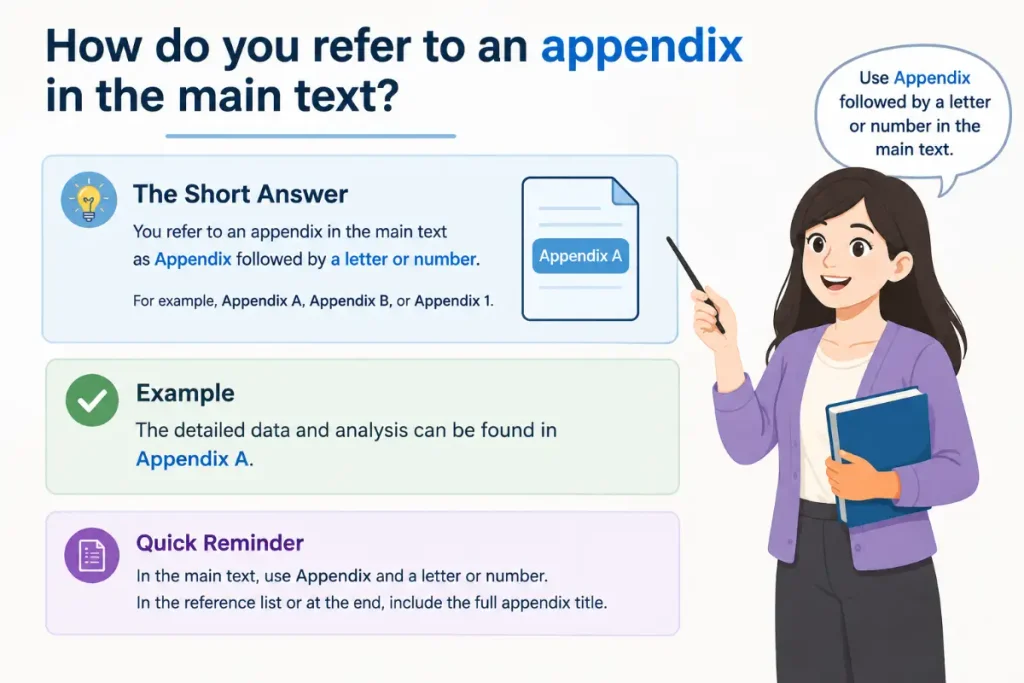
Use a clear cross reference.
Good examples include:
- See Appendix A for the full questionnaire.
- The complete data are provided in Appendix B.
- Additional calculations appear in Appendix C.
- See the appendices for detailed survey results.
Capitalization can depend on the style guide. If you are naming a specific section, capitalization is commonly used:
See Appendix A.
When referring to the concept generally, lowercase may be appropriate:
The report includes an appendix.
Follow your required style guide if it provides specific capitalization rules.
Conclusion
Appendices and appendixes are both correct plural forms of appendix. The main difference is usage and style, not basic grammar. Appendices is the traditional form and is a common choice for academic papers, research reports, books, and other formal documents. Appendixes is also accepted and can be used in American English and other varieties of English.
Remember the simple pattern: one appendix. Choose the form that matches your required style guide, audience, and document type. For formal writing, appendices is usually the safest default.
For emails, attachments may be clearer, while annexes or addenda may fit specialized documents. Most importantly, use supporting sections for information that adds value without taking attention away from your main message.
Frequently Asked Questions
Is it correct?
Both are correct plural forms of appendix. Appendices is the more traditional choice and is especially common in formal and academic writing.
What is the plural of appendix?
The plural of appendix can be used. Both forms are accepted in standard English.
Is appendixes wrong in American English?
No, appendixes is not wrong in American English. It is a regular English plural form, although appendices is often preferred in formal writing.
Should I use appendices in a research paper?
Yes, appendices is a common choice for research papers, theses, dissertations, and formal reports. Still, you should follow the style guide required by your school, publisher, or organization.
What’s another way to say appendices?
Other terms include supplements, annexes, addenda, supporting material, supporting documents, attachments, exhibits, and additional material. The best alternative depends on what the extra material contains.
Is appendix singular or plural?
Appendix is singular
What is the difference between an appendix and an attachment?
An appendix is usually a supporting section within a larger document, while an attachment is usually a separate file or item sent with an email or other message.
Which is more formal?
Appendices is generally the more traditional formal choice. Appendixes is also correct, but it may feel more like a regular English plural.

Daniel Grammarfield — The Language Learner
Age: 28Occupation: ESL Learner & Digital Professional
Bio:Daniel is a non-native English speaker who wants to communicate more confidently at work and online. He uses Synotrench to improve grammar, understand confusing words, learn correct sentence structures, and build everyday English skills. He prefers simple explanations with practical examples.
Goals:
Master English grammar rules
Avoid common language mistakes
Improve professional communication
Learn English through real-life examples
Quote:“Learning English is not about memorizing rules — it’s about expressing ideas clearly.”
2 thoughts on “Appendices or Appendixes: Best Usage Guide (2026)”