You’re writing an email, finishing an essay, or checking a resume, and you stop at one small question: Should you write Analyze or Analyse? Both spellings are real English words, and both have the same meaning. The difference mainly comes from the variety of English you’re using.
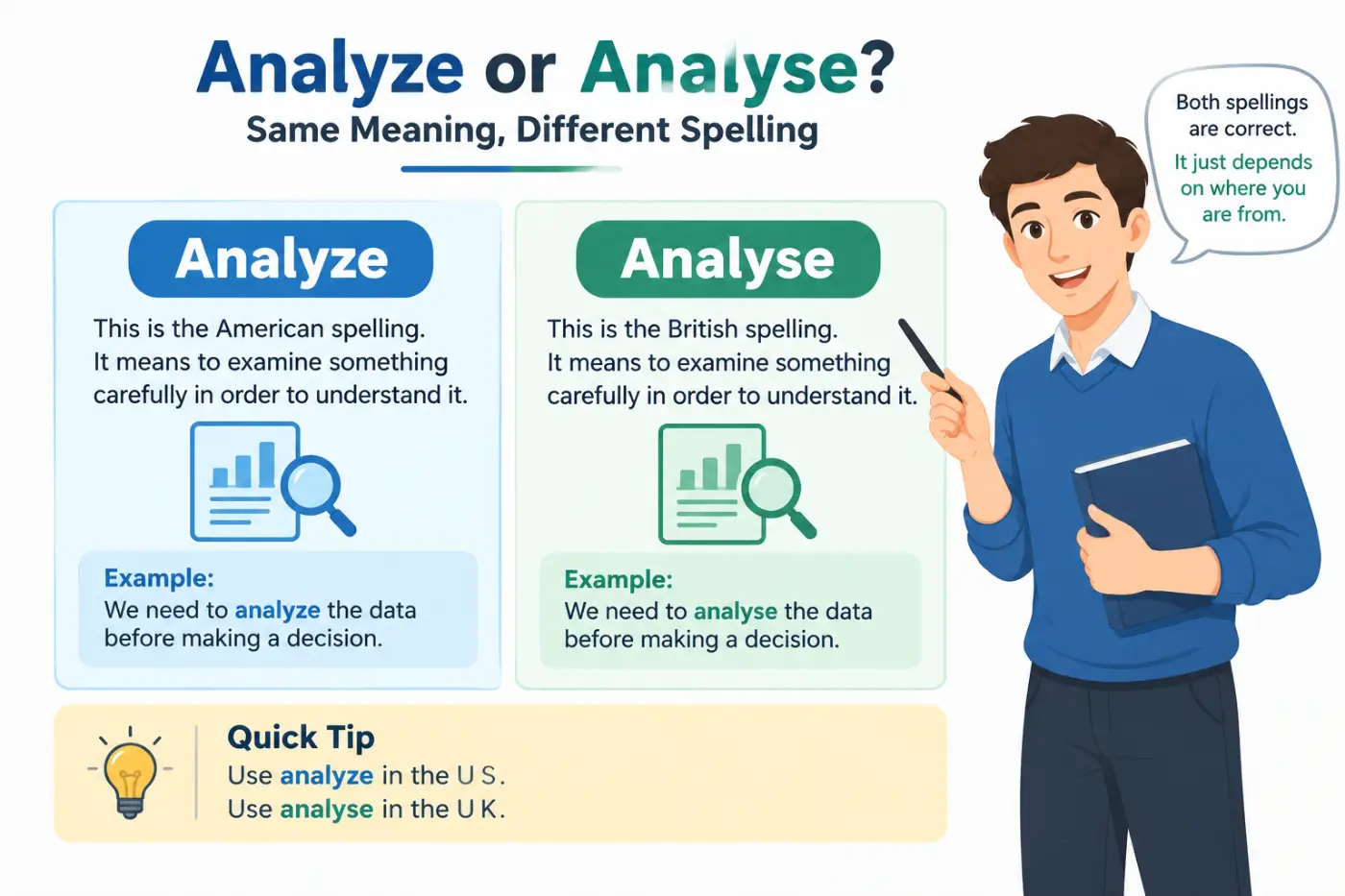
In American English, analyze is the standard spelling. In British English and several other varieties that follow British spelling, analyse is commonly used. The meaning does not change. The main difference is regional spelling.
It means to examine something carefully so you can understand its parts, meaning, structure, or importance.
This guide explains the meaning, history, spelling difference, synonyms, levels of intensity, common mistakes, and the best word to use in emails, essays, resumes, texts, and everyday conversations. You’ll also see practical examples that make the difference easy to remember.
What does both words mean?
The basic meaning is simple: to examine something carefully.
When you analyze something, you do more than simply look at it. You study its details and relationships to understand what they mean or how they work.
For example:
The teacher asked students to analyze the poem.
This means the students should examine the poem closely. They might study its message, word choice, images, structure, and other details.
You can analyze many different things:
| What you analyze | What you might examine |
|---|---|
| A poem | Meaning, language, imagery, theme |
| A report | Facts, results, patterns |
| A problem | Causes, details, possible solutions |
| Data | Numbers, trends, relationships |
| A movie | Story, characters, themes |
| A speech | Arguments, language, purpose |
| A business | Sales, costs, performance |
| A situation | Facts, causes, risks |
| A sentence | Grammar, structure, meaning |
| A resume | Skills, experience, wording |
The word can describe both simple and highly detailed examination.
You might analyze a text message to understand what someone meant. A scientist might analyze laboratory data to identify a pattern. The basic idea is the same: careful examination.
Where did words come from?
The history of this word helps explain why English has two common spellings.
The English verb developed from the idea behind the Greek word analysis, which means breaking something apart or examining it closely. The Greek verb analyein carried the sense of breaking up, loosening, or resolving something.
The word moved through other languages and eventually became part of English vocabulary.
The noun analysis and the verb analyze are closely related. When you perform an analysis, you examine something carefully. When you analyze something, you perform that examination.
English spelling developed differently in different regions. American English generally adopted analyze with a z. British English commonly uses analyse with an s.
This is not a difference in meaning or quality. It is a spelling difference connected to regional English conventions.
Other related forms show the same pattern:
| American English | British English |
|---|---|
| analyze | analyse |
| analyzed | analysed |
| analyzing | analysing |
| analyzer | analyser |
| analysis | analysis |
Notice something important: analysis does not change to analysiz in American English. The noun keeps the same spelling in both major varieties.
Is it correct?
Both spellings are correct.
For a US audience, use analyze.
For a British audience, analyse is generally the expected spelling.
The same regional pattern continues with related verb forms.
| Form | American English | British English |
|---|---|---|
| Present | analyze | analyse |
| Past | analyzed | analysed |
| Present participle | analyzing | analysing |
| Third person | analyzes | analyses |
| Noun | analysis | analysis |
| Person or tool | analyzer | analyser |
For example:
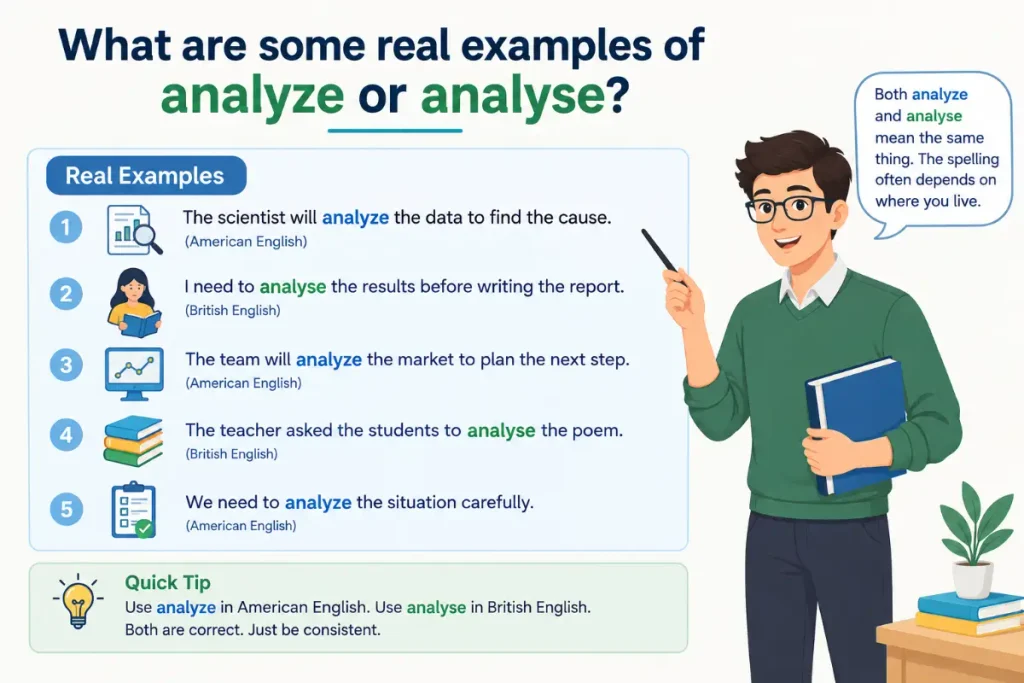
American English: The researcher will analyze the results.
British English: The researcher will analyse the results.
Both sentences communicate exactly the same idea.
In American English
If you are writing for readers in the United States, analyze is the standard spelling.
This applies to schoolwork, professional writing, websites, business documents, reports, resumes, and most general communication intended for an American audience.
Examples include:
The manager will analyze the sales data.
Students must analyze the author’s argument.
We need to analyze the problem before making a decision.
The software can analyze thousands of records.
She analyzed the results carefully.
The spelling with z is especially useful when your website or publication follows American English throughout its content.
Consistency matters. If one article uses American spelling and another uses British spelling, readers may notice the difference.
In British English
British English commonly uses analyse with an s.
Examples include:
The researcher will analyse the results.
Students must analyse the author’s argument.
We need to analyse the problem.
The team analysed the data before writing the report.
The company is analysing customer feedback.
British spelling is also common in many countries whose English traditions are influenced by British English, although local usage can vary.
The important point is that analyse is not a misspelling. It is a standard British spelling.
What are the best synonyms for analyze and analyse?
The best synonym depends on what you are trying to communicate.
Some alternatives are very simple. Others sound more formal or technical. Some suggest careful thought, while others suggest breaking something into parts.
These words overlap with analyze, but they are not always interchangeable.
For example, verify means checking whether something is correct. It does not necessarily mean studying its structure or meaning.
Compare focuses on similarities and differences.
Interpret focuses on meaning.
Evaluate focuses on value, quality, effectiveness, or importance.
Choosing the right alternative makes your writing more precise.
Which synonyms are mild and which are strong?
Not every synonym carries the same level of intensity.
Some words suggest a quick or ordinary examination. Others suggest deep investigation.
Mild alternatives
These work well when you simply want to say that someone looked at or thought about something.
- Look at
- Review
- Consider
- Study
- Examine
Example:
Please review the report before the meeting.
This does not necessarily suggest a highly detailed investigation.
Moderate alternatives
These suggest a more careful process.
- Assess
- Evaluate
- Investigate
- Compare
- Interpret
- Examine closely
Example:
The team evaluated the results before choosing a solution.
Strong alternatives
These suggest deep, detailed, or critical examination.
- Scrutinize
- Probe
- Dissect
- Deconstruct
- Audit
Example:
The legal team scrutinized every detail of the contract.
Using a stronger synonym can change the feeling of a sentence.
Compare:
She reviewed the evidence.
She scrutinized the evidence.
The first sounds neutral. The second suggests very close attention.
What part of speech is analyze or analyse?
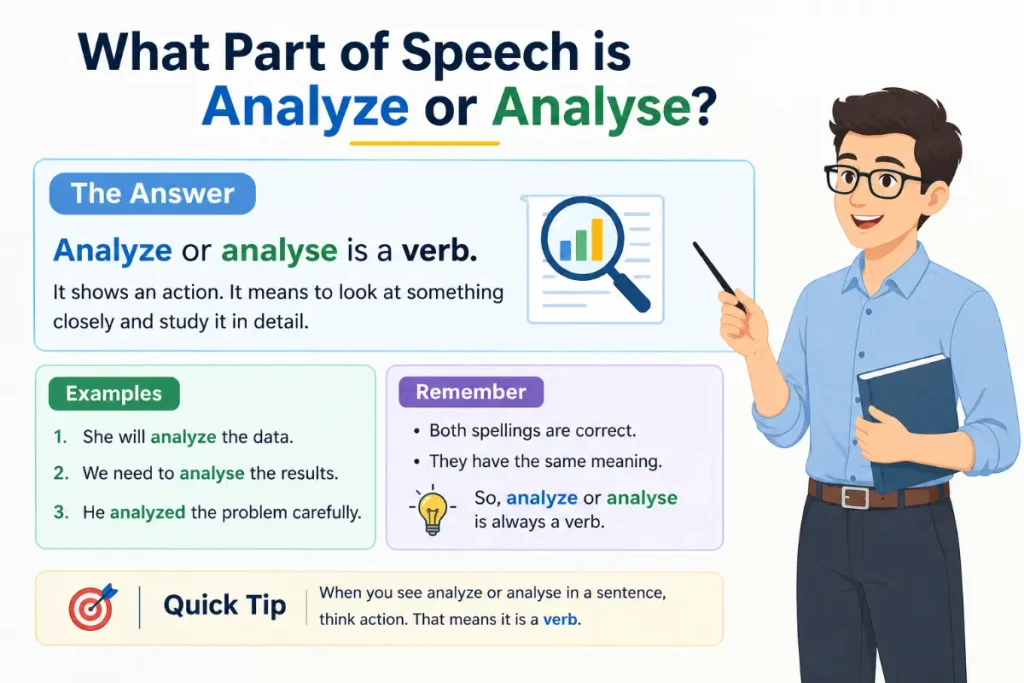
Both are verbs.
They describe an action.
For example:
The students analyze the poem.
Here, analyze tells us what the students do.
The noun is analysis.
Example:
The students wrote an analysis of the poem.
The plural noun is analyses.
Example:
The researchers compared several analyses.
This form can confuse learners because analyses looks unusual.
| Word | Part of speech | Example |
|---|---|---|
| Analyze | Verb | We analyze the data. |
| Analyse | Verb | We analyse the data. |
| Analysis | Noun | The analysis was detailed. |
| Analyses | Plural noun | Several analyses were completed. |
| Analytical | Adjective | She has strong analytical skills. |
| Analyst | Noun | The analyst reviewed the report. |
A useful pattern is:
analyze → analysis → analytical → analyst
The spelling of analysis stays the same in American and British English.
What is the best word for a resume?
For a US resume, analyze is usually the natural choice when describing your ability to examine information.
Example:
I analyze sales data to identify customer trends.
You can also use more specific verbs when they better describe your work.
Examples:
I evaluate financial reports.
I examine customer data.
Strong resumes often benefit from specific action verbs. Instead of repeating analyze, choose a verb that describes exactly what you did.
If you examined numbers, analyzed may work well.
If you judged effectiveness, evaluated may be better.
What is the best word for an essay?
In an academic essay, analyze works well in American English.
Example:
This essay will analyze the main causes of climate migration.
However, you should avoid repeating the same verb throughout a long paper.
You can use alternatives based on your meaning:
The essay examines the character’s development.
The next section evaluates the author’s argument.
The study compares two approaches.
The final section interprets the findings.
In academic writing, precision is more useful than simply choosing a complicated word.
A common mistake is thinking that a longer synonym automatically sounds more academic. It doesn’t. A clear word that accurately describes your point is usually stronger.
What is the best word for an email?
For a professional email, analyze is clear and normal in American English.
Example:
I’ll analyze the numbers and send you an update tomorrow.
You could also write:
I’ll review the numbers and send you an update tomorrow.
In many everyday emails, review may sound more natural because it can suggest a practical check rather than a deep investigation.
Compare these:
I’ll analyze the document.
I’ll review the document.
The first suggests detailed examination. The second can simply mean looking over the document.
What is the best word for texting?
Text messages usually favor simple language.
Instead of using a formal word like scrutinize, you might say:
I’ll look at it.
Let me check it.
I’ll go through it.
I’ll break it down.
For example:
I need to look at these numbers first.
This sounds more natural in casual conversation than:
I need to scrutinize these numbers first.
The second sentence is grammatically correct, but it may sound unnecessarily formal for a text.
What is the best word for speaking?
In everyday American speech, analyze is common and easy to understand.
For example:
Let me analyze what happened.
We need to analyze the problem.
I’m trying to analyze the situation.
Still, speakers often choose simpler expressions such as look at, think about, or figure out.
For example:
Let’s look at the problem.
Let’s figure out what went wrong.
These expressions sound relaxed and natural.
The best choice depends on the situation and the relationship between the speakers.
What are some real examples of analyze or analyse?
Seeing the word in different situations makes its meaning easier to remember.
School
The students analyzed the poem for its central theme.
The teacher asked the class to analyze the author’s argument.
Business
The company analyzed its sales data before changing its marketing strategy.
Our team is analyzing customer feedback to identify common problems.
Science
Scientists analyzed the samples in the laboratory.
The researchers analyzed the results from the experiment.
Technology
The program can analyze large amounts of data in seconds.
The system analyzes user behavior to identify unusual activity.
Everyday life
I analyzed the situation before deciding what to do.
She spent the evening analyzing the conversation.
News
The journalist analyzed the new policy and explained its possible effects.
Sports
The coach analyzed the team’s performance after the game.
Finance
The investor analyzed the company’s financial statements.
Writing
The editor analyzed the article before approving it.
Personal decision
He analyzed his options before accepting the offer.
These examples show that the verb can be used for information, language, events, decisions, and situations.
Analyze vs examine: what’s the difference?
Analyze usually suggests breaking information down and understanding how its parts work together. Examine is broader and can simply mean looking at something carefully.
| Analyze | Examine |
|---|---|
| Focuses on detailed understanding | Focuses on careful inspection |
| Often involves parts or relationships | Can involve simple observation |
| Common in academic and technical contexts | Common in almost every context |
| Often asks how or why | Often asks what is there |
Example:
The scientist examined the sample.
This tells us the scientist looked at it carefully.
The scientist analyzed the sample.
This suggests the scientist studied its composition, properties, or data in greater detail.
The words overlap, but analyze often carries a stronger sense of breaking information down.
Analyze vs evaluate: what’s the difference?
Analyze means to examine something carefully. Evaluate means to judge its quality, value, effectiveness, or importance.
For example:
We analyzed the proposal.
This means we studied its details.
We evaluated the proposal.
This means we judged how good, useful, effective, or suitable it was.
You can do both:
First, we analyzed the proposal. Then, we evaluated its strengths and weaknesses.
That sentence shows the difference clearly.
Analysis helps you understand something. Evaluation helps you make a judgment about it.
Analyze vs interpret: what’s the difference?
Analyze focuses on detailed examination. Interpret focuses on explaining meaning.
For example:
The researcher analyzed the survey responses.
The researcher interpreted the survey responses.
The first sentence emphasizes examination of the data.
The second emphasizes what the responses mean.
These actions often happen together.
A researcher may analyze a collection of responses and then interpret the pattern they reveal.
Analyze vs investigate: what’s the difference?
Analyze means carefully examining information. Investigate usually means trying to discover facts, causes, or answers.
For example:
The team analyzed the accident report.
The police investigated the accident.
The first focuses on studying the report. The second describes a broader effort to discover what happened.
An investigation can include analysis, but the two words are not identical.
Common mistakes with analyze vs analyse
Several mistakes appear frequently when people use these words.
Mixing regional spellings
If you are writing American English, use analyze.
If you are following British English, analyse is commonly used.
Avoid switching between the two styles in the same document without a reason.
Treating analyse as incorrect
Analyse is not an incorrect spelling.
It is a standard spelling in British English and other varieties influenced by British usage.
Treating analyze as incorrect
Analyze is also correct.
It is the standard American English spelling.
Confusing analysis and analyses
The singular noun is analysis.
Example:
The analysis was useful.
The plural noun is analyses.
Example:
The researchers completed several analyses.
Do not use analysis as the plural when you are talking about more than one separate examination.
Using a synonym that changes the meaning
Not every synonym works in every sentence.
For example:
We verified the report.
This means we checked its accuracy.
We analyzed the report.
This means we studied its details.
Those sentences are not identical.
Using overly formal words in casual writing
Words such as scrutinize, deconstruct, and dissect can sound too formal in a casual text.
A simpler phrase may be better:
I’ll look at it.
I’ll think about it.
When should you not use?
There are situations where another word is more accurate.
Do not use analyze simply because you want your writing to sound academic.
Use check when you only need to make sure something is correct.
Please check the spelling.
Use compare when you are focusing on similarities and differences.
Compare the two plans.
Use interpret when you are explaining meaning.
How do you interpret this result?
Use evaluate when you are judging value or effectiveness.
We need to evaluate the new system.
Use investigate when you are trying to discover facts or a cause.
The company is investigating the complaint.
Use summarize when you are giving the main points in a shorter form.
Please summarize the report.
These distinctions make writing more exact.
What are the antonyms of analyze or analyse?
An antonym is a word with an opposite or contrasting meaning.
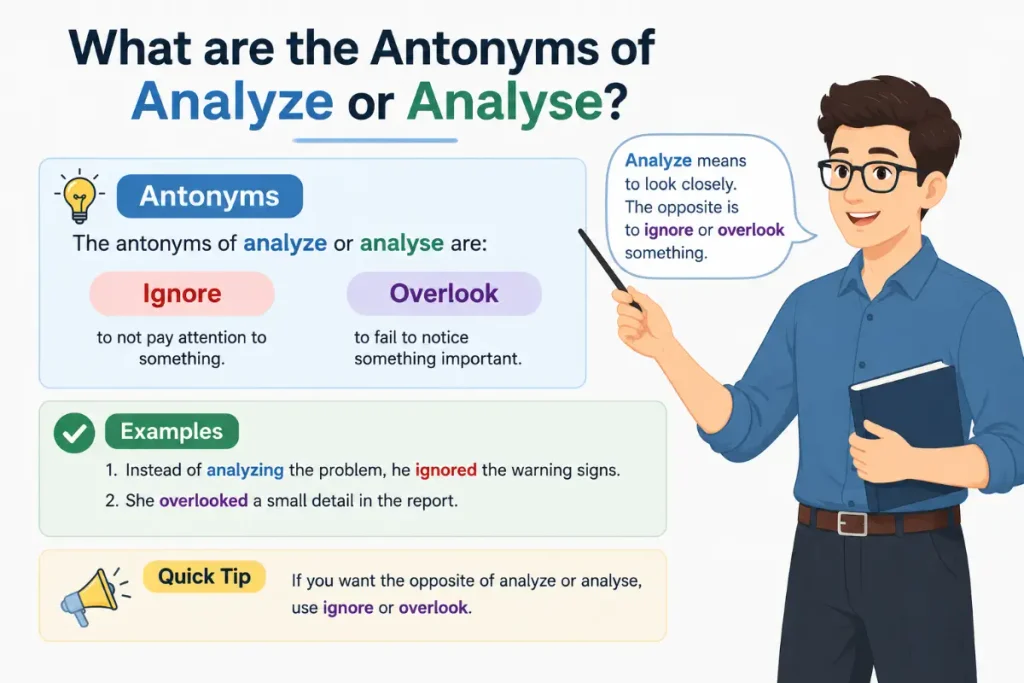
There is no single perfect opposite of analyze, because the meaning can change with context. However, several words express the opposite idea in particular situations.
| Word | Opposite idea |
|---|---|
| Ignore | Give no attention |
| Overlook | Fail to notice |
| Neglect | Fail to give proper attention |
| Guess | Decide without careful examination |
| Assume | Accept something without checking |
| Generalize | Focus on broad ideas instead of details |
| Simplify | Reduce complexity |
| Skim | Read quickly without close examination |
For example:
He analyzed the report carefully.
He ignored the report completely.
Those actions contrast clearly.
You could also say:
She guessed the answer instead of examining the evidence.
The important point is that the best opposite depends on the situation.
What should you remember about words?
The easiest rule is this:
Analyze is the standard American English spelling.
Analyse is the common British English spelling.
Both words mean to examine something carefully.
If your audience is in the United States, choose analyze. If your publication follows British English conventions, choose analyse.
Keep related spellings consistent as well:
American English uses analyzed and analyzing.
British English commonly uses analysed and analysing.
The noun analysis stays the same in both varieties.
Once you know the regional difference, the choice is straightforward.
Conclusion
The choice between words comes down mainly to regional spelling. American English uses analyze, while British English commonly uses analyse. Both forms describe the same action: examining something carefully to understand its details, meaning, structure, or relationships.
The best synonym depends on your purpose. Use examine for careful inspection, evaluate for judging quality, investigate for finding facts, and interpret for explaining meaning. In casual writing, simpler choices such as look at or review may sound more natural.
For US readers, the safest choice is analyze. Once you match the spelling to your audience and keep your document consistent, this word is easy to use correctly.
Frequently Asked Questions
Should Americans use both words?
Americans should normally use analyze. It is the standard spelling in American English.
Is analyse British or American?
Analyse is primarily associated with British English and other varieties that follow British spelling conventions.
What’s another way to say analyze?
Another way to say analyze is examine, study, evaluate, assess, investigate, or review, depending on the context.
What is the past tense?
The American past tense is analyzed, while the British spelling is commonly analysed. Both forms mean that someone examined something carefully in the past.
What is the difference between analysis and analyze?
Analyze is a verb that describes the action of examining something. Analysis is a noun that describes the examination itself.

Daniel Grammarfield — The Language Learner
Age: 28Occupation: ESL Learner & Digital Professional
Bio:Daniel is a non-native English speaker who wants to communicate more confidently at work and online. He uses Synotrench to improve grammar, understand confusing words, learn correct sentence structures, and build everyday English skills. He prefers simple explanations with practical examples.
Goals:
Master English grammar rules
Avoid common language mistakes
Improve professional communication
Learn English through real-life examples
Quote:“Learning English is not about memorizing rules — it’s about expressing ideas clearly.”
2 thoughts on “Analyze or Analyse: Best Guide to the Difference (2026)”