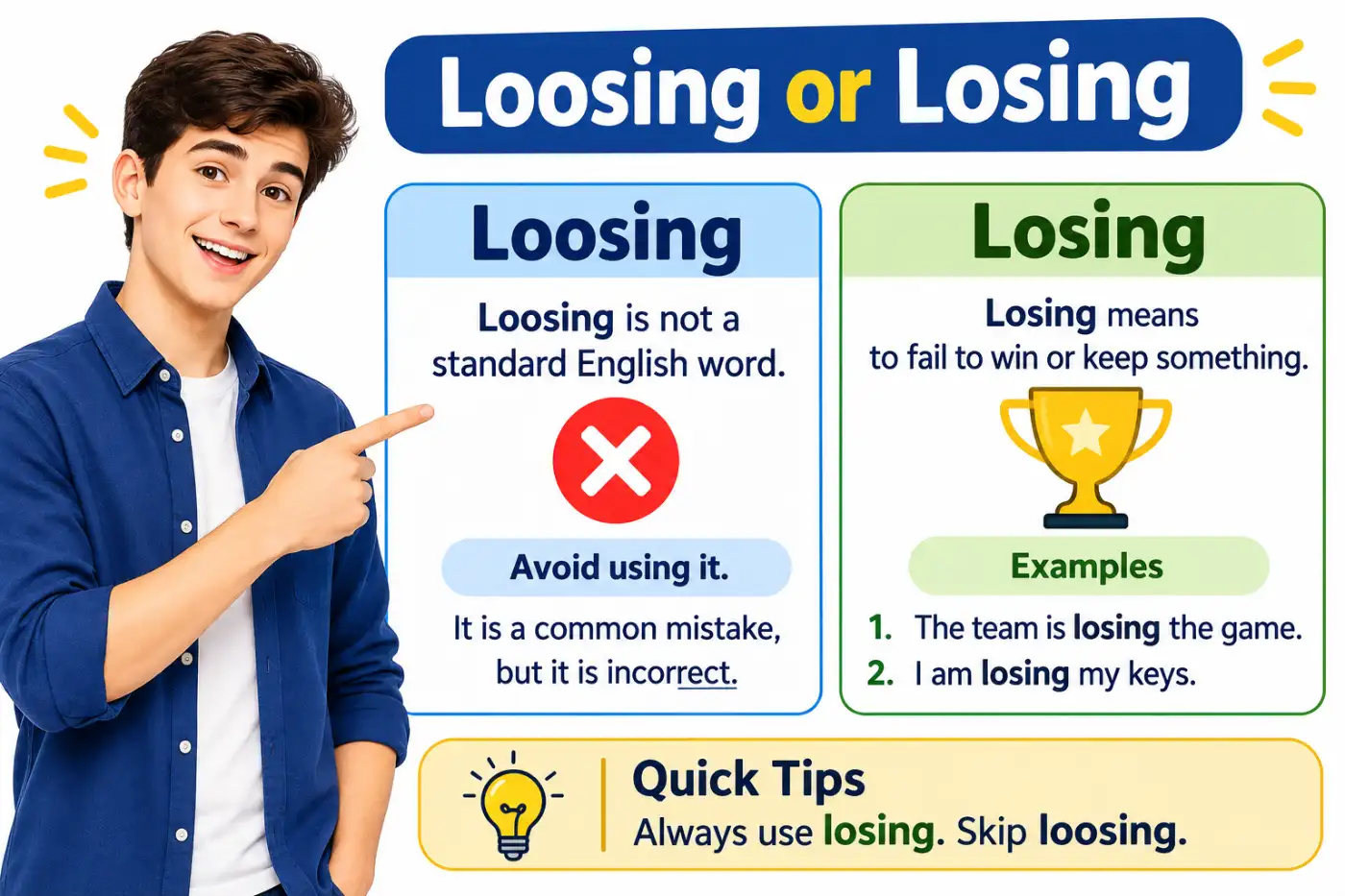
You’re writing an email, school assignment, or text message when you pause over a familiar word. Should you write loosing or losing? Both spellings look correct at first glance, but only one works when you mean misplacing something, failing to win, or no longer having something.
Losing is the correct spelling when you mean misplacing something, failing to win, or experiencing a loss. Loosing is also a real English word, but it means releasing something or setting it free. It is much less common in everyday writing.
The confusion usually happens because people know the word loose and assume that adding the ending -ing creates loosing. However, the verb lose follows a different spelling pattern.
This guide explains the meanings, origins, grammar rules, synonyms, and common mistakes. You’ll also find practical examples for resumes, essays, emails, texts, and everyday conversations.
What Is the Difference Between Loosing and Losing?
The main difference is the verb each word comes from.
| Word | Base Word | Part of Speech | Meaning | Example |
|---|---|---|---|---|
| Losing | Lose | Verb form | Misplacing, failing to win, or no longer having something | I am losing my patience. |
| Loosing | Loose | Verb form | Releasing or setting something free | The farmer is loosing the horses. |
When Should You Use Losing?
Use losing when you describe an action involving loss. It is the present participle of lose and can appear in continuous verb forms or as a gerund.
Examples:
- I am losing my keys too often.
- Our team is losing the championship game.
- She is losing interest in the project.
- The company is losing money.
- He is losing confidence in his decision.
When Should You Use Loosing?
Use loosing when you mean releasing, freeing, or setting something loose. It is the present participle of the verb loose.
Examples:
- The farmer is loosing the horses into the field.
- The guard was loosing the dogs from their cages.
- The ancient story describes an archer loosing an arrow.
This form is grammatically correct, but it sounds formal, literary, or old-fashioned in many situations. In everyday conversation, people usually say releasing or setting free instead.
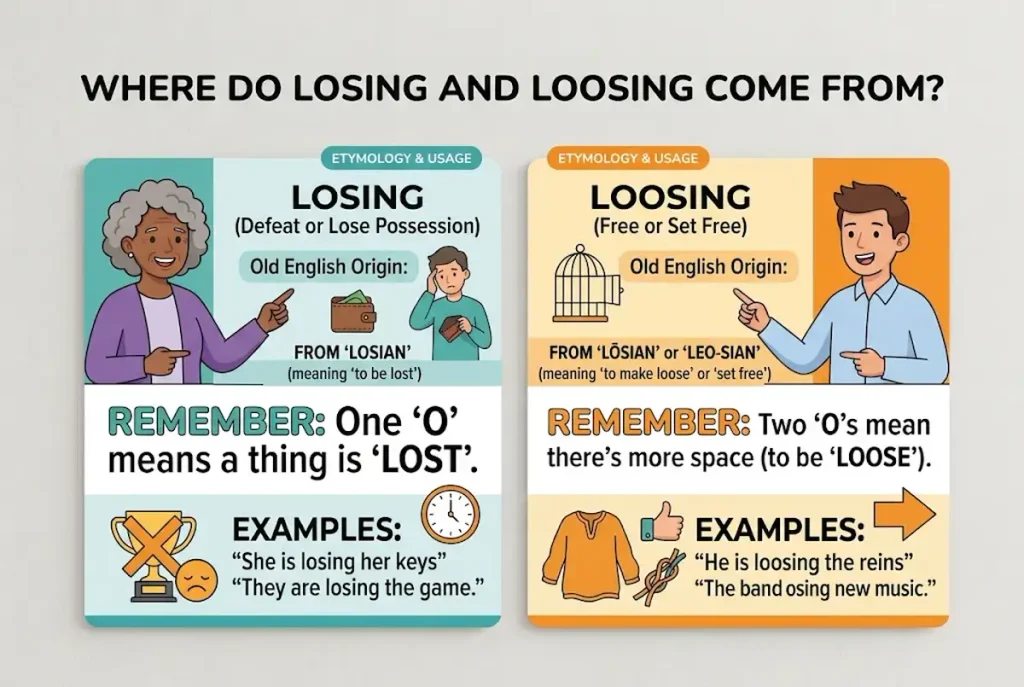
Where Do Losing and Loosing Come From?
Understanding the history of each word helps explain why their spellings differ.
What Is the Origin of Losing?
Losing comes from the verb lose, which developed from the Old English word losian. This older word carried meanings connected to perishing, becoming lost, or being destroyed.
Over time, lose developed its modern meanings. It can describe misplacing an object, failing to win, giving something up, or no longer having something.
The ending -ing forms the present participle of the verb.
For example:
- Lose becomes losing.
- Win becomes winning.
- Forget becomes forgetting.
What Is the Origin of Loosing?
Loosing comes from the verb loose, which has a different history. Loose developed from older Germanic and Norse word forms connected to freedom and being free from restraint.
The adjective loose describes something that is not tight, fixed, or firmly attached. Its verb form means to release or set free.
When you add -ing to the verb loose, you drop the final e and add -ing.
For example:
- Loose becomes loosing.
- Close becomes closing.
- Choose becomes choosing.
What Are the Best Synonyms for both words?
Synonyms help you express an idea in different ways. However, you should choose a replacement based on the exact meaning of the sentence.
The following tables group useful alternatives by tone and situation.
What Are Common Synonyms for Losing?
These words describe misplacing something, failing to win, or experiencing a loss.
| Word | Meaning | Tone | Example |
|---|---|---|---|
| Misplacing | Putting something somewhere and forgetting its location | Simple | I keep misplacing my glasses. |
| Missing | Being unable to find something | Simple | She is missing her notebook. |
| Forgetting | Failing to remember something | Simple | He is forgetting important details. |
| Dropping | Letting something fall | Everyday | The child is dropping his toys. |
| Failing | Not reaching a goal | Everyday | The team is failing to score. |
| Falling behind | Not keeping up with others | Everyday | We are falling behind in the race. |
| Missing out | Failing to enjoy an opportunity | Everyday | You’re missing out on a great event. |
| Wasting | Using something carelessly | Everyday | They are wasting valuable time. |
| Squandering | Wasting something valuable | Formal | The company is squandering its resources. |
| Forfeiting | Giving something up as a penalty | Formal | The player is forfeiting the match. |
| Surrendering | Giving up resistance or control | Formal | The army is surrendering its position. |
| Relinquishing | Giving up possession or authority | Formal | She is relinquishing control of the project. |
| Sacrificing | Giving something up for a purpose | Everyday | He is sacrificing his free time. |
| Diminishing | Becoming smaller or weaker | Formal | Their influence is diminishing. |
| Declining | Becoming lower or weaker | Formal | Sales are declining this month. |
| Shrinking | Becoming smaller | Everyday | The business is shrinking. |
| Losing ground | Becoming less successful | Everyday | The company is losing ground to competitors. |
| Being defeated | Failing to win | Everyday | Our team is being defeated. |
| Taking an L | Experiencing a loss | Slang | We are taking an L today. |
| Blowing a chance | Wasting an opportunity | Slang | He is blowing his chance. |
What Are Common Synonyms for Loosing?
Loosing means releasing or setting something free. These alternatives can help express that action more naturally.
| Word | Meaning | Tone | Example |
|---|---|---|---|
| Releasing | Letting something go | Simple | She is releasing the bird. |
| Freeing | Removing restrictions | Simple | They are freeing the trapped animal. |
| Unleashing | Releasing something powerful | Everyday | The coach is unleashing the team’s energy. |
| Letting go | Allowing something to move freely | Everyday | He is letting go of the rope. |
| Unfastening | Opening something secured | Everyday | She is unfastening the strap. |
| Untying | Removing a knot | Simple | He is untying the horse. |
| Unbinding | Removing something that holds or ties | Formal | The worker is unbinding the package. |
| Liberating | Setting someone free | Formal | The soldiers are liberating the prisoners. |
| Discharging | Releasing or sending something out | Formal | The device is discharging its contents. |
| Launching | Sending something into motion | Everyday | The archer is launching an arrow. |
| Setting free | Allowing someone or something to leave | Simple | They are setting the animals free. |
| Letting loose | Allowing free movement or expression | Everyday | The children are letting loose their excitement. |
Which Synonyms for Losing Show Different Levels of Meaning?
The best alternative depends on how serious the loss is and what kind of situation you’re describing.
Mild Words for Losing
Use these words when the loss is small, temporary, or related to a simple mistake.
- Misplacing: Putting an item somewhere and forgetting where it is.
- Missing: Being unable to find something.
- Forgetting: Failing to remember information.
- Dropping: Accidentally letting something fall.
- Overlooking: Failing to notice something.
Moderate Words for Losing
These words describe a more noticeable setback or failure.
- Falling behind: Failing to keep up.
- Missing out: Failing to experience an opportunity.
- Declining: Becoming lower in quality or amount.
- Wasting: Using something without a useful result.
- Coming up short: Failing to reach a goal.
Strong Words for Losing
Use these words when the situation involves a serious defeat, major loss, or giving up something valuable.
- Surrendering: Giving up resistance.
- Forfeiting: Losing something because of a rule or decision.
- Relinquishing: Giving up possession or authority.
- Squandering: Wasting something valuable.
- Being defeated: Losing a serious competition or struggle.
Which Synonyms for Loosing Show Different Levels of Action?
The alternatives for loosing describe different ways of releasing or freeing something.
Mild Words for Loosing
- Untying: Removing a knot.
- Unfastening: Opening something secured.
- Releasing: Letting something go.
- Letting go: Stopping holding something.
- Loosening: Making something less tight.
Moderate Words for Loosing
- Freeing: Removing a restriction.
- Uncaging: Letting an animal out of a cage.
- Unchaining: Removing a chain.
- Unbinding: Removing something that holds an object together.
- Setting free: Allowing someone or something to leave.
Strong Words for Loosing
- Unleashing: Releasing something powerful.
- Liberating: Freeing someone from control.
- Unshackling: Removing strong restrictions.
- Breaking free: Escaping from control or restraint.
- Turning loose: Releasing something to move freely.
What Part of Speech Are both words?
Both words are verb forms, but they come from different base verbs.
Is Losing a Verb or a Noun?
Losing is the present participle and gerund form of the verb lose.
As part of a continuous verb phrase, it describes an action in progress.
Examples:
- She is losing her patience.
- They were losing the match.
- We are losing valuable time.
As a gerund, losing works like a noun.
Examples:
- Losing a friend can be painful.
- Losing the competition taught us a lesson.
- Losing money is a serious concern.
In these examples, losing names an action or experience.
Is Loosing a Verb or an Adjective?
Loosing is the present participle of the verb loose. It is not the standard adjective form.
Examples:
- The farmer is loosing the horses.
- The guard was loosing the dogs.
- The archer is loosing an arrow.
The adjective is loose.
Examples:
- The horses are loose.
- The dog has a loose collar.
- The screw is loose.
Do not use loosing when you simply want to describe something that is not tight. In that case, use loose.
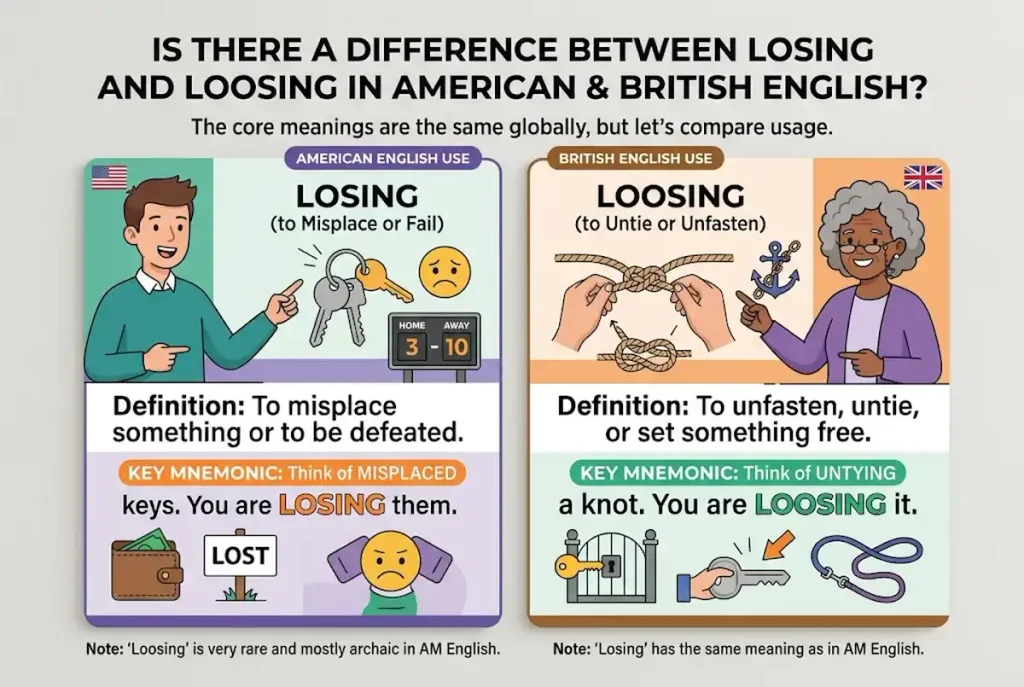
Is There a Difference Between Losing and Loosing in American and British English?
No major regional spelling difference separates these forms in American and British English.
| Meaning | American English | British English |
|---|---|---|
| Failing to win | Losing | Losing |
| Misplacing an item | Losing | Losing |
| Releasing an animal | Loosing | Loosing |
| Setting something free | Loosing | Loosing |
| Past tense of lose | Lost | Lost |
Which Word Should You Use in a Resume?
Use losing when describing a business risk, missed result, or reduction in performance. Use loosing only if your sentence genuinely describes releasing something, which is rare in most resumes.
Examples:
- Developed a system that reduced the risk of losing customer data.
- Helped the company avoid losing important clients.
- Created a process that prevented the team from losing valuable time.
Which Word Should You Use in an Essay?
Use losing when you discuss failure, change, or something that is no longer available. Use loosing when you describe an actual release, usually in historical, literary, or descriptive writing.
Examples:
- People may be losing trust in public institutions.
- The team is losing confidence after several defeats.
- The farmer is loosing the animals into an open field.
Which Word Should You Use in Texting?
Use losing in ordinary text messages when talking about a missing item, a competition, or a change in a situation.
Examples:
- I’m losing my phone again.
- We’re losing the game.
- Don’t keep losing your keys.
- I’m losing interest in this show.
- I think I’m losing my wallet.
Loosing is rarely needed in casual messages. If you mean setting something free, write letting go or releasing instead.
For example:
- Natural: I’m letting the dog go.
- Less common: I’m loosing the dog.
Which Word Should You Use in an Email?
In professional emails, losing is the right choice when discussing risks, missed targets, or resources that may disappear. Loosing is only suitable when you mean releasing something.
Examples:
- We are losing valuable time because of the delay.
- The department is losing important customer records.
- We cannot risk losing another client.
Which Word Sounds Correct in Everyday Speaking?
Losing is common in daily conversations. People use it to talk about objects, games, money, time, patience, and opportunities.
Examples:
- I’m losing my patience.
- You’re losing your keys again.
- Our team is losing by two points.
- He’s losing interest in the conversation.
- We’re losing too much time.
What Are 15 Correct Example Sentences?
These examples show how both forms work in real situations.
| No. | Sentence | Correct Word | Explanation |
|---|---|---|---|
| 1 | I am losing my favorite pen. | Losing | It describes misplacing an item. |
| 2 | The farmer is loosing the horses. | Loosing | It describes releasing animals. |
| 3 | Our team is losing the final match. | Losing | It describes failing to win. |
| 4 | She is losing interest in the book. | Losing | It describes a decrease in interest. |
| 5 | The guard was loosing the dogs. | Loosing | It describes setting the dogs free. |
| 6 | He is losing confidence in himself. | Losing | It describes a reduction in confidence. |
| 7 | The archer is loosing an arrow. | Loosing | It describes releasing an arrow. |
| 8 | We are losing valuable time. | Losing | It describes wasting or no longer having time. |
| 9 | The company is losing customers. | Losing | It describes a decline in customers. |
| 10 | The keeper is loosing the birds. | Loosing | It describes releasing birds. |
| 11 | I keep losing my glasses. | Losing | It describes repeatedly misplacing something. |
| 12 | The player is losing focus. | Losing | It describes a decline in concentration. |
| 13 | The farmer is loosing the cattle into the field. | Loosing | It describes releasing cattle. |
| 14 | She is losing money on the investment. | Losing | It describes a financial loss. |
| 15 | The hunter was loosing the hounds. | Loosing | It describes releasing hunting dogs. |
What Are Some Examples in Questions?
- Are you losing interest in the course?
- Why are we losing so much time?
- Is the team losing the match?
- Is the farmer loosing the horses?
- Why is the company losing customers?
What Are Some Examples in Negative Sentences?
- I’m not losing hope.
- We aren’t losing the competition yet.
- She isn’t losing her confidence.
- The farmer isn’t loosing the animals today.
- The guard wasn’t loosing the dogs.
Losing vs Missing: What’s the Difference?
Losing and missing can both describe an item that you cannot find. However, missing often describes the condition of something that is not present, while losing focuses on the action of misplacing it.
| Losing | Missing |
|---|---|
| I am losing my keys. | My keys are missing. |
| She is losing her notebook. | Her notebook is missing. |
| He is losing his phone. | His phone is missing. |
Loosing vs Releasing: What’s the Difference?
Loosing and releasing can both describe setting something free. However, releasing is much more common in modern everyday English.
| Loosing | Releasing |
|---|---|
| The farmer is loosing the horses. | The farmer is releasing the horses. |
| The guard is loosing the dogs. | The guard is releasing the dogs. |
| The archer is loosing an arrow. | The archer is releasing an arrow. |
What Are the Most Common Mistakes With These Words?
The spelling difference is small, but choosing the wrong form can change the meaning of your sentence.
Writing Loosing When You Mean Losing
Incorrect: I am loosing my phone.
Correct: I am losing my phone.
The sentence describes misplacing a phone, so losing is correct.
Writing Losing When You Mean Loosing
Incorrect: The farmer is losing the horses into the field.
Correct: The farmer is loosing the horses into the field.
The intended meaning is releasing the horses. Loosing is the correct verb, although releasing may sound more natural.
Using Loosing Instead of Loosening
Incorrect: She is loosing the knot.
Correct: She is loosening the knot.
Loosening means making something less tight. Loosing means releasing or setting something free. These verbs are related to loose but have different uses.
Using Lose Instead of Losing
Incorrect: I am lose my patience.
Correct: I am losing my patience.
After am, is, are, was, or were in a continuous verb phrase, use the -ing form.
Using Losing Instead of Lost
Incorrect: I have losing my wallet.
Correct: I have lost my wallet.
After have or has, use the past participle lost in this sentence.
Confusing Losing With Loss
Losing is a verb form, while loss is a noun.
Examples:
- Losing: Losing the match was disappointing.
- Loss: The team suffered a painful loss.
When Should You Avoid Using Losing or Loosing?
Both forms are useful, but sometimes another word communicates your meaning more clearly.
Avoid Losing When You Mean Wasting
Losing and wasting can overlap in some situations, but they are not always interchangeable.
Unclear: We are losing time by waiting.
Clearer: We are wasting time by waiting.
Use wasting when you mean using time, money, or resources carelessly. Use losing when you mean no longer having something or experiencing a decline.
Avoid Losing When You Mean Declining
If you are describing a number or level that is becoming lower, declining may be more precise.
Example:
- General: The company’s sales are losing.
- Clearer: The company’s sales are declining.
The second sentence communicates the change more naturally.
Avoid Loosing When You Mean Making Something Less Tight
Incorrect: He is loosing the screw.
Better: He is loosening the screw.
Loosening means reducing tightness. Loosing means releasing something.
Avoid Loosing When You Mean Publishing or Sending Something
Unnatural: The company is loosing a new product.
Better: The company is releasing a new product.
Releasing is the natural choice for products, announcements, reports, and other published materials.
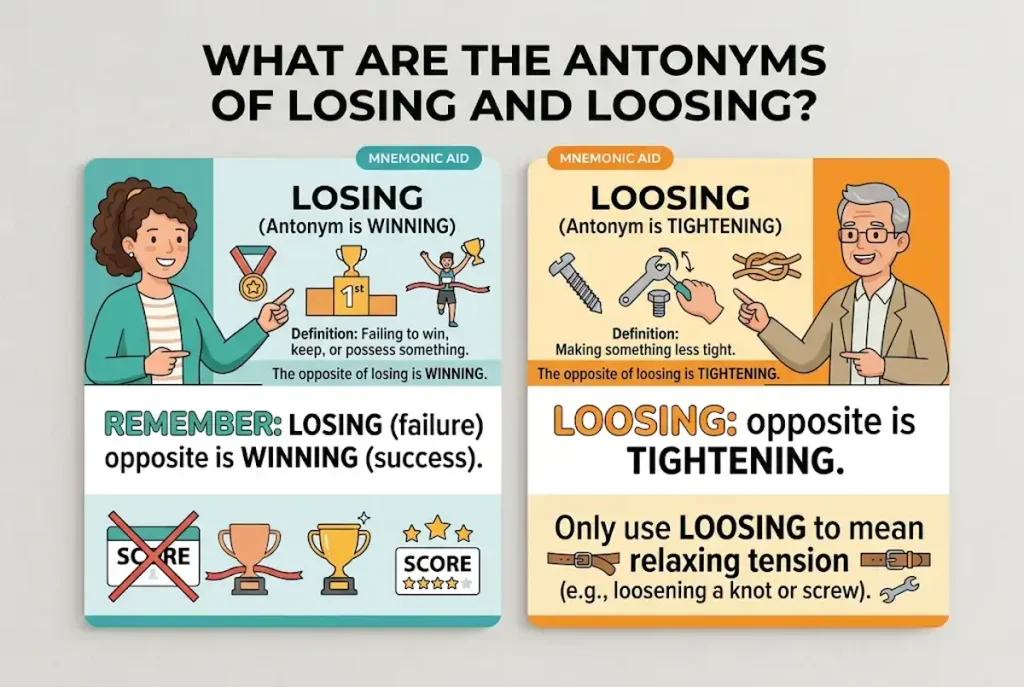
What Are the Antonyms of Losing and Loosing?
Antonyms are words with opposite meanings. The best opposite depends on the situation.
What Are the Opposite Words of Losing?
| Losing Meaning | Antonym | Example |
|---|---|---|
| Misplacing | Finding | I am finding my missing keys. |
| Failing to win | Winning | Our team is winning the match. |
| No longer having | Keeping | She is keeping her money. |
| Declining | Increasing | Sales are increasing. |
| Falling behind | Advancing | The team is advancing. |
| Giving up | Retaining | He is retaining control. |
What Are the Opposite Words of Loosing?
| Loosing Meaning | Antonym | Example |
|---|---|---|
| Releasing | Holding | She is holding the bird. |
| Freeing | Restraining | The guard is restraining the animal. |
| Untying | Tying | He is tying the rope. |
| Unfastening | Fastening | She is fastening the belt. |
| Unchaining | Chaining | The worker is chaining the gate. |
| Letting go | Gripping | He is gripping the handle. |
Conclusion
The difference between loosing and losing comes from their base verbs. Losing is the present participle of lose and describes misplacing something, failing to win, or experiencing a decline. Loosing comes from loose and means releasing or setting something free. Although both spellings are correct, losing appears far more often in everyday English.
Remember the purpose of your sentence before choosing a spelling. If you’re talking about a missing item, a lost game, or a reduction in something, use losing. If you’re describing the release of an animal or object, loosing may fit.
For most modern writing, releasing is a clearer alternative. With these simple rules and examples, you can avoid this spelling mistake in schoolwork, emails, and daily conversations.
Frequently Asked Questions
Is loosing a real word in English?
Yes, loosing is a real English word. It is the present participle of the verb loose, which means to release or set free.
Why is losing spelled with one O?
Losing comes from the verb lose. When you add -ing, you remove the final e and add the ending, creating losing.
What’s another word for losing?
Other words for losing include misplacing, missing, declining, failing, and being defeated. The best synonym depends on the situation.
What is the past tense of lose?
The past tense of lose is lost. For example, I lost my wallet yesterday. Losing is the present participle, not the past tense.
Is loosing the same as loosening?
No, loosing means releasing or setting something free, while loosening means making something less tight. For example, you can loosen a knot or loose an animal from its enclosure.

Daniel Grammarfield — The Language Learner
Age: 28Occupation: ESL Learner & Digital Professional
Bio:Daniel is a non-native English speaker who wants to communicate more confidently at work and online. He uses Synotrench to improve grammar, understand confusing words, learn correct sentence structures, and build everyday English skills. He prefers simple explanations with practical examples.
Goals:
Master English grammar rules
Avoid common language mistakes
Improve professional communication
Learn English through real-life examples
Quote:“Learning English is not about memorizing rules — it’s about expressing ideas clearly.”
1 thought on “Loosing or Losing: The Ultimate Spelling Guide”