Imagine you’re writing Listen to Music vs Listen to the Music an email about your favorite hobby. You type, “I like to listen to music while I work.” Then you wonder if you should write, “I like to listen to the music while I work.” Both sentences look correct, but do they mean exactly the same thing?
The difference comes down to one small word: “the.” In English, articles help readers understand if you’re talking about something in general or a particular thing. This rule also applies when you talk about songs, albums, background sounds, or music playing in a room.
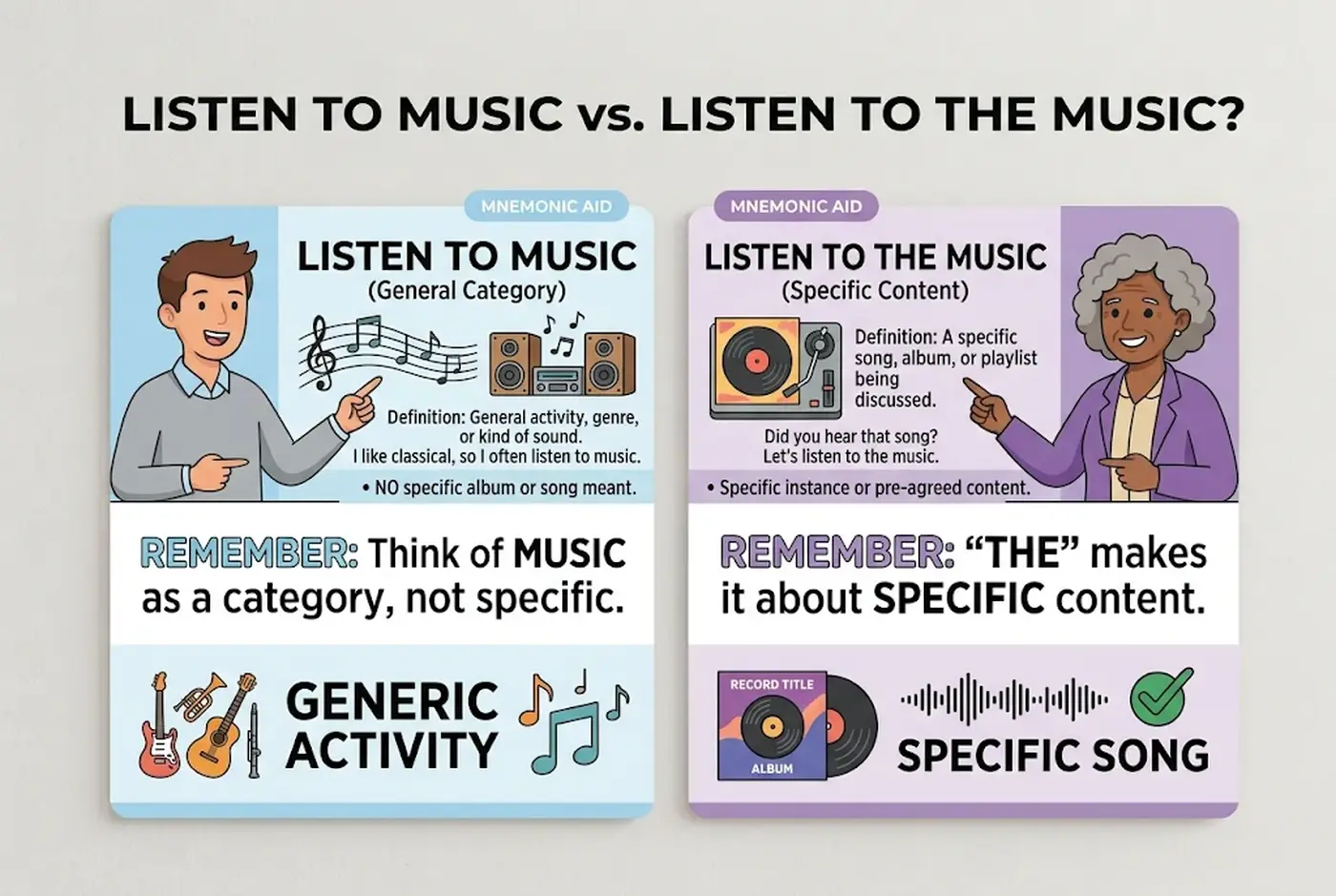
The short answer is that “listen to music” means enjoying music in general, while “listen to the music” usually means paying attention to particular music that the speaker and listener can identify. Both expressions are grammatically correct, but they fit different situations.
In this guide, you’ll learn why the two expressions differ, where their wording comes from, and how to use them in everyday conversations, school assignments, emails, and professional writing. You’ll also find practical examples, related expressions, common mistakes, and answers to frequently asked questions.
What Is the Difference Between These Two Expressions?
The main difference is the use of the definite article “the.” Without it, “music” usually refers to music as a general activity or form of entertainment. With it, the phrase points to specific music.
Consider these examples:
| Expression | Meaning | Example |
|---|---|---|
| Listen to music | Enjoy music in general | I listen to music every evening. |
| Listen to the music | Pay attention to particular music | Listen to the music coming from that room. |
When Should You Say Listen to Music?
Use this expression when you talk about music as a general interest, habit, or activity. You don’t need to identify a particular song, artist, or recording.
Examples:
- I listen to music while studying.
- She loves to listen to music during long drives.
- My brother listens to music before going to sleep.
- We listen to music to relax after work.
In these sentences, the speakers aren’t talking about one specific song or recording. They’re describing a general activity.
When Should You Say Listen to the Music?
Use this expression when the music is specific or clear from the situation. The listener can usually identify which music you’re talking about.
Examples:
- Listen to the music coming from the next room.
- I love the music in this movie.
- They listened to the music that the teacher played.
- Please listen to the music before you judge the performance.
Here, the word “the” points to particular music. The speaker expects the listener to know which music is being discussed or can identify it from the context.
What Are the Origins of Listen and Music?
Understanding the history of these words can make their meanings easier to remember.
Where Does the Word Listen Come From?
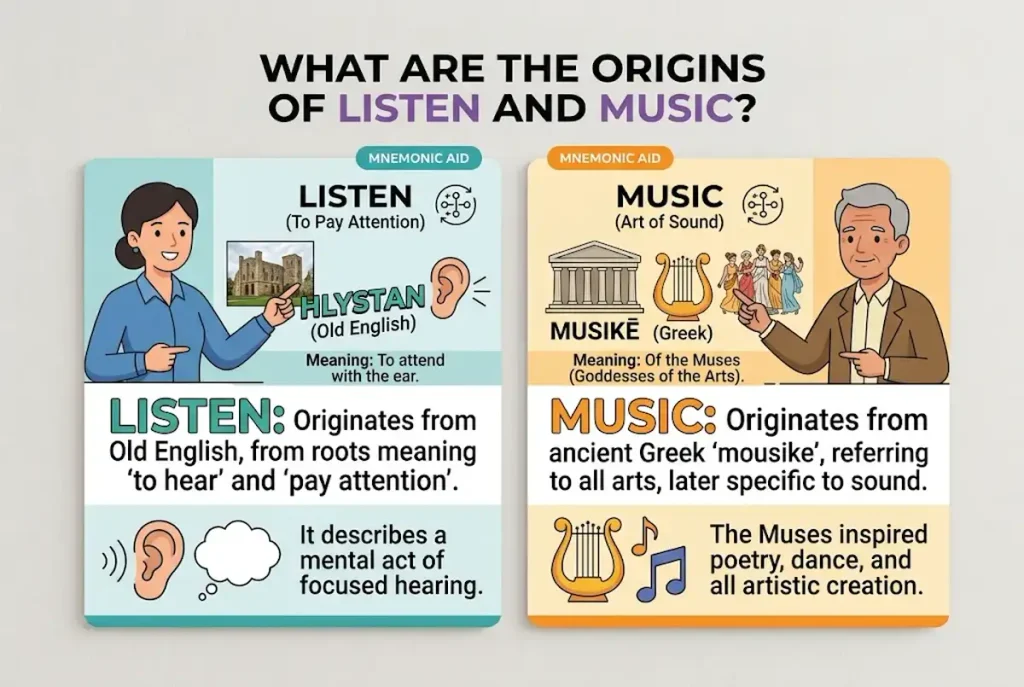
The word “listen” comes from Old English “hlysnan,” which meant to hear or pay attention. Over time, its spelling and pronunciation changed into the modern English word we use today.
Listen is a verb. It describes the action of paying attention to sounds.
For example:
- Please listen carefully to the instructions.
- I listen to podcasts on my way to work.
- The students listened to their teacher.
Notice that English normally uses “to” after “listen” when you identify the sound or person receiving attention.
You listen to music, listen to a speaker, or listen to a conversation. You don’t normally say “listen music” in standard English.
Where Does the Word Music Come From?
The word “music” comes from the Greek word “mousikē,” which referred to the art of the Muses. It passed into Latin and later Old French before entering English.
Today, music means an organized combination of sounds, often involving rhythm, melody, harmony, and instruments. It can include songs, instrumental pieces, classical compositions, and many other forms.
Music is generally an uncountable noun.
That means we usually don’t say “a music” when referring to music as a general subject. Instead, we say:
- I enjoy music.
- She studies music.
- They play music at the party.
However, we can use countable words to identify individual pieces, such as “a song,” “a track,” or “a musical composition.”
Why Does the Word The Change the Meaning?
“The” is called the definite article. It helps identify a particular person, place, object, or thing.
Compare these sentences:
- I enjoy music.
This refers to music in general. - I enjoy the music.
This refers to particular music, perhaps music playing nearby or music already mentioned.
The word “the” doesn’t change the meaning of “music” itself. It changes how the listener understands the noun in the sentence.
What Are Some Related Words and Expressions?
These expressions can help you describe how people enjoy, hear, or respond to music. They aren’t all exact replacements, so choose one that matches your intended meaning.
| Word or Expression | Meaning | Tone | Example |
|---|---|---|---|
| Hear | Notice a sound | Simple | I can hear music outside. |
| Enjoy | Take pleasure in something | Simple | I enjoy music in the morning. |
| Play | Produce music using an instrument or device | Simple | They play music at home. |
| Sing | Produce musical sounds with your voice | Simple | We sing along to our favorite songs. |
| Dance | Move to music | Simple | The children dance to music. |
| Follow | Pay attention to a musical part | Everyday | Follow the beat carefully. |
| Appreciate | Recognize the value of something | Everyday | I appreciate the music in this film. |
| Explore | Discover different types of music | Everyday | She explores music from different countries. |
| Enjoy listening | Take pleasure in hearing something | Everyday | I enjoy listening to jazz. |
| Tune in | Start listening to a broadcast or program | Everyday | Tune in to the radio at eight. |
| Vibe to | Enjoy the mood or feeling of music | Slang | I vibe to relaxing playlists. |
| Rock out to | Enjoy loud or energetic music | Slang | We rocked out to the band’s latest song. |
| Chill to | Relax while listening | Slang | She chills to soft music after class. |
| Crank up | Turn the volume higher | Informal | Crank up the music for the party. |
Which Expression Fits Different Levels of Attention?
The best expression depends on how much attention you give the sound.
Mild Attention
Use these expressions when music is simply part of your surroundings or daily routine.
- Hear music.
- Have music playing.
- Enjoy music.
- Listen casually.
- Play music in the background.
Example: I enjoy having soft music playing while I cook.
Everyday Attention
Use these expressions when you actively listen for enjoyment.
- Listen to music.
- Listen to a song.
- Tune in to the radio.
- Follow the melody.
- Enjoy listening to a playlist.
Example: I listen to music during my evening walk.
Strong Attention
Use these expressions when you focus closely on the sounds, lyrics, or performance.
- Pay close attention to the music.
- Focus on the melody.
- Study the composition.
- Analyze the arrangement.
- Listen carefully to every note.
Example: The music teacher asked the students to pay close attention to the rhythm.
Are Listen and Music Nouns or Verbs?
The two expressions contain different parts of speech. Knowing their roles can help you build correct sentences.
Listen Is a Verb
“Listen” is a verb that describes the act of paying attention to sound.
It can appear in different forms:
| Verb Form | Example |
|---|---|
| Base form | I listen to music. |
| Third person | She listens to music. |
| Past tense | We listened to music. |
| Present participle | He is listening to music. |
| Past participle | They have listened to the song. |
The word “listen” can also appear in commands.
For example:
- Listen to this song.
- Listen carefully.
- Please listen to the teacher.
Music Is an Uncountable Noun
“Music” is usually an uncountable noun. It names a general art form or collection of sounds.
Examples:
- Music makes me happy.
- Music helps some people relax.
- The music was beautiful.
Because it is usually uncountable, we don’t normally add “s” to make “musics” when talking about music in general.
To discuss separate pieces, use words such as:
- Songs.
- Tracks.
- Albums.
- Compositions.
- Recordings.
For example, instead of saying “I like three musics,” say “I like three songs.”
Is Music Ever Used as an Adjective?
Yes. “Music” can work as a noun modifier when it describes another noun.
Examples:
- Music lessons.
- Music industry.
- Music teacher.
- Music festival.
In these examples, “music” helps explain the type of lesson, industry, teacher, or festival.
Is There a Difference in American and British English?
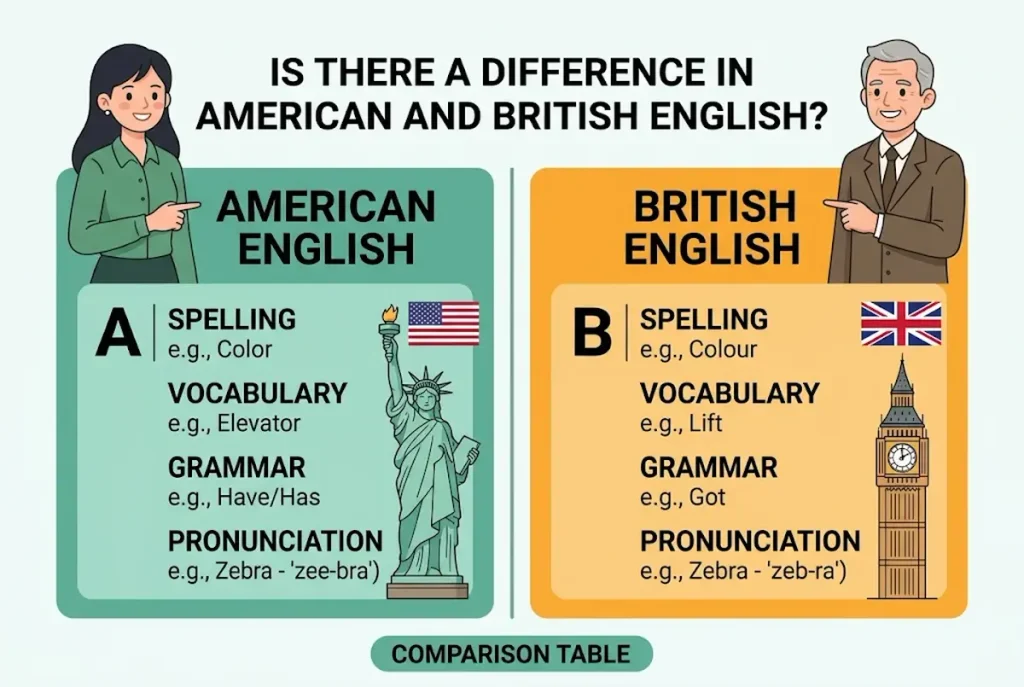
No major difference exists between American and British English in these expressions. Both varieties use the same basic grammar rule.
Speakers in the United States and the United Kingdom normally say “listen to music” when discussing music in general. They use “listen to the music” when referring to particular music.
Examples in American English:
- I listen to music on my way to work.
- Listen to the music playing in the kitchen.
Examples in British English:
- I listen to music on the train.
- Listen to the music coming from next door.
Some vocabulary and everyday expressions may differ by region, but the article rule stays the same.
Which Expression Should You Use in Different Situations?
The right wording depends on your purpose and audience. A casual conversation may need a simple phrase, while a school essay or professional email may need more detail.
What Should You Write on a Resume?
A resume should focus on skills, experience, and professional interests. If music is relevant to a job or personal profile, describe it clearly.
Use “listen to music” when you mean a general hobby.
Example:
“I enjoy listening to music and exploring different creative interests.”
If you’re applying for a music-related position, be more specific.
Example:
“I regularly study different musical styles to improve my understanding of sound and composition.”
Avoid adding personal hobbies that don’t support your application.
Which Expression Works Best in an Essay?
In an essay, use the general expression when discussing music as an activity or subject. Use the definite article when referring to a particular performance, recording, or piece.
Examples:
- Listening to music can make a long study session feel more enjoyable.
- The music in the documentary supports its emotional message.
For academic writing, explain the exact role of music in your argument. Don’t use a general expression when your point concerns one specific musical work.
What Should You Say in a Text Message?
In a casual text, the shorter general expression is often natural.
Examples:
- I listen to music every night.
- What kind of music do you like?
- I’m listening to music right now.
Use the specific form when you and the other person know which music you’re discussing.
Example:
“Listen to the music I sent you yesterday.”
The message points to a particular recording that the recipient can identify.
How Should You Use These Expressions in an Email?
In an email, choose the phrase that matches your message.
For a general statement:
“I usually listen to music while completing routine tasks.”
For a specific recording:
“Please listen to the music attached to this email and share your feedback.”
The second sentence refers to a particular file. The reader knows which music needs attention.
What Sounds Natural in Everyday Speaking?
In everyday conversations, both expressions are common.
Use the general form to talk about habits and interests.
Example: “I like to listen to music when I exercise.”
Use the specific form to direct someone’s attention.
Example: “Listen to the music in the background. It’s coming from the café.”
The surrounding conversation usually makes your meaning clear.
What Are Some Examples of These Expressions in Real Life?
The following examples show how the two forms work in different situations.
Examples About Daily Habits
- I listen to music while getting ready for work.
- My sister listens to music before she goes to bed.
- We often listen to music during family road trips.
- He listens to music when he needs a break.
These sentences describe regular activities. No particular song or recording needs to be identified.
Examples About Specific Songs and Recordings
- Listen to the music playing through those speakers.
- I really like the music in this video.
- The children listened to the music their teacher selected.
- We enjoyed the music at the wedding reception.
Each sentence points to music that the listener can identify from the situation.
Examples About Studying and Working
- Some students listen to music while doing homework.
- I can’t concentrate when I listen to music with lyrics.
- The manager asked everyone to listen to the music in the advertisement.
- She listened to the music carefully before approving the project.
The first two examples describe general listening habits. The last two refer to particular music.
Examples About Entertainment and Travel
- I like to listen to music when I travel by bus.
- Tourists stopped to listen to the music played by street performers.
- We listened to music throughout the journey.
- The music in the concert hall sounded wonderful.
These examples show how the expressions fit hobbies, public performances, and travel.
Examples About Family and Friends
- My parents listen to music while cooking dinner.
- Listen to the music your friend recommended.
- We listened to music together during the weekend.
- Everyone enjoyed the music at the birthday party.
The exact form depends on the meaning, not the setting.
What Is the Difference Between Hear and Listen?
“Hear” and “listen” are related, but they don’t describe exactly the same action.
“Hear” means noticing or receiving a sound. It can happen without trying. “Listen” means giving attention to a sound.
| Hear | Listen |
|---|---|
| Often happens naturally | Usually involves attention |
| Focuses on receiving sound | Focuses on paying attention |
| Doesn’t always require effort | Often requires an active choice |
| I heard music outside. | I listened to music outside. |
For example:
- I heard the music from my bedroom.
You noticed the sound. - I listened to the music from my bedroom.
You paid attention to it.
You can hear something without listening carefully, but listening usually involves hearing.
What Is the Difference Between Listen to Music and Play Music?
“Listen to music” and “play music” describe different actions.
“Listen to music” means paying attention to sounds produced by a person, instrument, or device.
“Play music” can mean performing music with an instrument or playing a recording through a speaker.
Examples:
- I listen to music while cleaning.
- My brother plays music on his guitar.
- The café plays music throughout the day.
A person can do both at once. For example, a guitarist may play an instrument while listening to the other musicians in a band.
What Common Mistakes Should You Avoid?
A small grammar mistake can make a sentence sound unnatural. Keep these points in mind.
Forgetting To Use To After Listen
In standard English, “listen” normally takes “to” before the sound or person receiving attention.
Incorrect: I listen music every morning.
Correct: I listen to music every morning.
The preposition is part of the usual structure. Remember the pattern: listen to something.
Adding The When You Mean Music in General
You don’t need “the” when you’re describing a general habit or interest.
Less natural for a general habit: I listen to the music every day.
Natural: I listen to music every day.
The first sentence can still be correct if it refers to particular music, such as a playlist or recording already mentioned. The problem is using it without a clear reason.
Leaving Out The When You Mean Specific Music
If you refer to particular music, the definite article may be needed.
Less clear: Listen to music coming from that room.
Clearer: Listen to the music coming from that room.
The second sentence points to the identifiable sound coming from the room.
Treating Music as a Countable Noun
“Music” is usually uncountable when it refers to the art form or sound in general.
Incorrect: I downloaded three musics.
Correct: I downloaded three songs.
Use “song,” “track,” or “recording” when you mean separate pieces.
Confusing Listen With Hear
These verbs are not always interchangeable.
Incorrect for an instruction: Hear carefully to the teacher.
Correct: Listen carefully to the teacher.
“Hear” describes receiving sound. “Listen” describes paying attention to it.
Using The Without a Clear Reference
“The” works best when the reader can identify the music.
Unclear: I enjoyed the music.
Clearer in a general context: I enjoy music.
Clearer in a specific context: I enjoyed the music at the concert.
The first sentence isn’t automatically wrong. It simply needs a situation where the particular music is understood.
What Are the Opposites of Listen and Music?
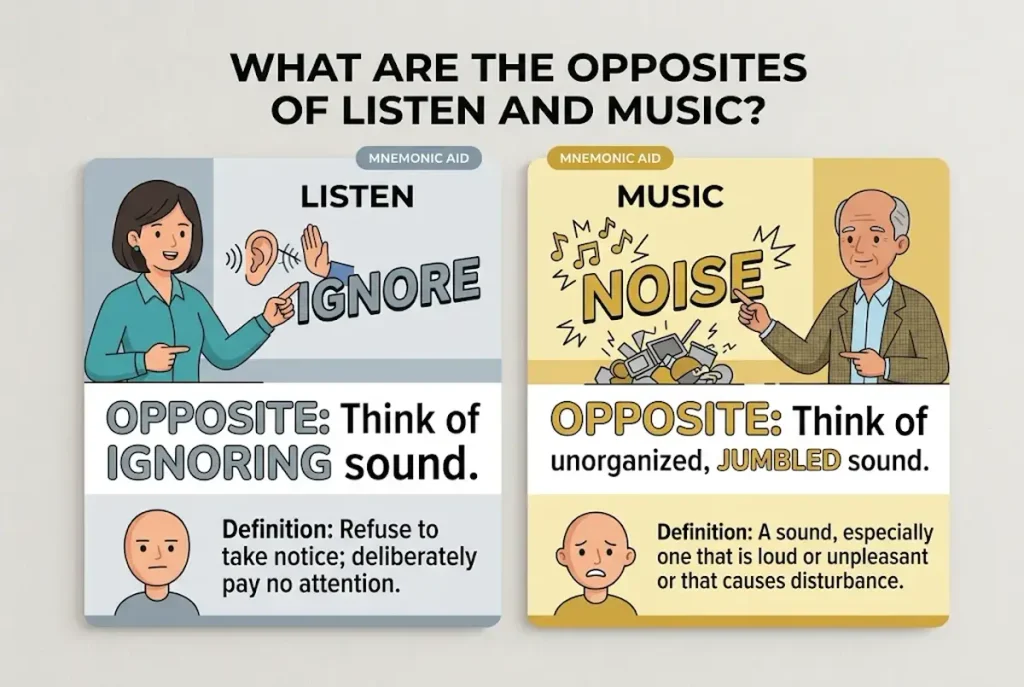
There isn’t one perfect antonym for the full expression. However, several words describe the opposite action or a contrasting experience.
| Word or Expression | Meaning | Example |
|---|---|---|
| Ignore | Pay no attention to something | He ignored the music outside. |
| Tune out | Stop paying attention to a sound | She tuned out the background music. |
| Mute | Turn off sound | Please mute the television. |
| Silence | Make something quiet | They silenced the speakers. |
| Avoid | Stay away from something | I avoid loud music when studying. |
| Noise | Unwanted or unpleasant sound | The noise made it hard to concentrate. |
| Quiet | A state with little or no sound | I prefer quiet while reading. |
These words don’t all mean the direct opposite of listening. They describe different ways to avoid, reduce, or contrast with sound.
How Can You Choose the Correct Expression Quickly?
Use these simple tips whenever you’re unsure which form to write.
- Think about the meaning. If you’re talking about music as a general activity, leave out “the.”
- Look for a specific reference. If you mean a particular song, recording, performance, or background sound, “the” may be appropriate.
- Check the surrounding sentence. Words such as “playing in the room,” “from the video,” or “at the concert” often identify particular music.
- Remember the verb pattern. In standard English, use “listen to,” not “listen” directly before the sound.
- Use a countable noun for individual pieces. Say “a song,” “two tracks,” or “three recordings” instead of “a music” or “three musics.”
- Read the sentence aloud. Ask yourself if you’re describing a habit or pointing to something specific.
- Don’t add “the” just because you’re talking about a familiar subject. General subjects often use no article in English.
A quick comparison can help:
- General habit: I listen to music after dinner.
- Specific recording: I listen to the music you recommended.
- General preference: She enjoys music.
- Specific performance: She enjoyed the music at the show.
Conclusion
The choice between these two expressions depends on the kind of music you’re describing. Use “listen to music” when talking about a general habit, hobby, or interest. Choose “listen to the music” when you mean a particular song, recording, performance, or sound that people can identify.
The word “the” may look small, but it gives readers an important clue about your meaning. Also, remember to include “to” after “listen” when you name the sound you’re paying attention to.
Once you understand this simple article rule, choosing the right expression becomes much easier. Practice with everyday sentences, and you’ll start using both forms naturally.
Frequently Asked Questions
Should I say listen to music or listen to the music?
Both are correct, but they have different uses. Use the general form for music as an activity and the form with “the” for particular music.
Why do we say listen to music without the?
We leave out “the” because “music” is an uncountable noun when we discuss it generally. The sentence describes an activity rather than a specific recording.
Is listen music grammatically correct?
No, “listen music” is not standard English. The correct expression is “listen to music” because the verb “listen” normally takes the preposition “to” before the sound.
Can I say I love listening to music?
Yes, “I love listening to music” is natural and grammatically correct. It expresses a general enjoyment of music.
When should I use the word the before music?
Use “the” when you’re referring to particular music that the listener can identify. For example, “I love the music in this movie” points to the soundtrack of a specific movie.
What’s another way to say listen to music?
You can say enjoy music, hear a song, tune in to the radio, or listen to a playlist. The best choice depends on the action and the context.
Is music countable or uncountable?
“Music” is usually an uncountable noun. Use words such as “song,” “track,” or “recording” when counting individual pieces.
Do American and British speakers use the same grammar?
Yes. American and British English follow the same article rule in these expressions. Both use the general form for music as an activity and the definite article for particular music.

Daniel Grammarfield — The Language Learner
Age: 28Occupation: ESL Learner & Digital Professional
Bio:Daniel is a non-native English speaker who wants to communicate more confidently at work and online. He uses Synotrench to improve grammar, understand confusing words, learn correct sentence structures, and build everyday English skills. He prefers simple explanations with practical examples.
Goals:
Master English grammar rules
Avoid common language mistakes
Improve professional communication
Learn English through real-life examples
Quote:“Learning English is not about memorizing rules — it’s about expressing ideas clearly.”
1 thought on “Listen to Music vs Listen to the Music: Best Guide (2026)”