Have you ever written an email, school assignment, or social media post and stopped because you weren’t sure if you should use lose vs loose? These two words look almost identical, but they have different meanings and grammatical uses. A small spelling mistake can change your sentence completely.
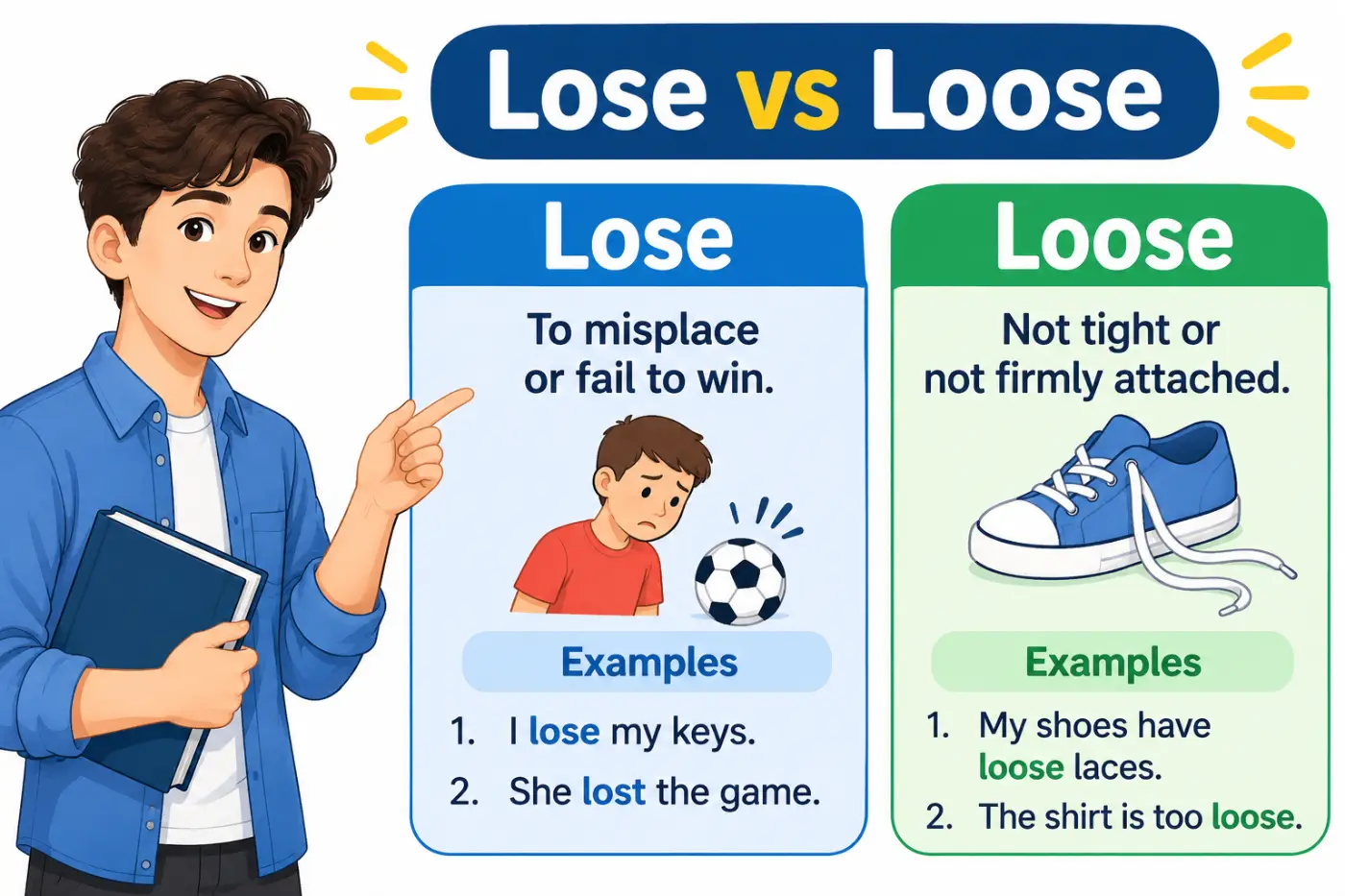
The confusion often happens because both words contain the same letters, but their pronunciation and meanings are different. Lose is a verb that means to misplace something, fail to win, or no longer have something. Loose is usually an adjective that means not tight, not firmly attached, or free from restriction.
Lose means to misplace something or fail to keep or win it. Loose means not tight, not firmly fixed, or free. For example, you might lose your house keys, but you might wear a loose shirt. You can lose a game, but you can also have a loose ball rolling across the floor.
This guide explains their meanings, origins, pronunciation, synonyms, grammar rules, and common mistakes. You’ll also find practical examples for school, work, emails, resumes, and everyday conversations.
What Is the Difference Between Lose and Loose?
The main difference is that lose is a verb, while loose is usually an adjective.
Lose describes an action or situation involving something you no longer have, cannot find, or fail to win. Loose describes something that isn’t tight, secure, or firmly attached.
| Word | Part of Speech | Meaning | Example |
|---|---|---|---|
| Lose | Verb | To misplace or fail to keep something | Don’t lose your phone. |
| Loose | Adjective | Not tight or firmly attached | My shoes feel loose. |
How Can You Remember the Difference?
Use this simple memory trick:
- Lose has one O. Think of losing something you had.
- Loose has two Os. Think of extra room in something that isn’t tight.
What Does Lose Mean in Simple English?
Lose is a verb that means to stop having something, fail to find something, or fail to win a competition, game, or contest.
It can also describe a reduction in weight, money, time, or another amount.
Here are some common meanings.
What Does Lose Mean When You Misplace Something?
Lose means you cannot find something you had before.
Examples:
- I always lose my car keys.
- Don’t lose your school notebook.
- He lost his wallet on the bus.
What Does Lose Mean When You Fail to Win?
Lose also means failing to win a game, competition, election, or other contest.
Examples:
- Our team may lose the championship.
- I don’t want to lose this match.
- The candidate lost the election.
What Does Lose Mean in Relationships?
Lose can also describe the end of a relationship or the loss of someone’s trust, support, or attention.
Examples:
- I don’t want to lose your friendship.
- He was afraid of losing his job.
- The company lost the trust of its customers.
- She doesn’t want to lose contact with her old classmates.
These examples show that losing something doesn’t always involve a physical object.
What Does Loose Mean in Simple English?
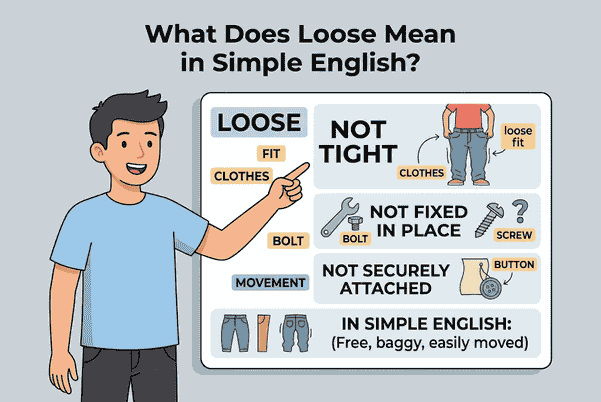
Loose is usually an adjective that describes something that isn’t tight, firmly attached, controlled, or securely held.
It can describe clothing, objects, connections, rules, and even behavior.
What Does Loose Mean When Something Isn’t Tight?
Loose describes clothing or other objects that have extra space or don’t fit closely.
Examples:
- My shirt is too loose.
- These shoes feel loose around my feet.
- He prefers loose clothing in summer.
What Does Loose Mean When Something Isn’t Attached?
Loose can describe an object that isn’t firmly fixed in place.
Examples:
- The table has a loose leg.
- One button is loose on my shirt.
- The bicycle has a loose chain.
What Does Loose Mean When Something Is Free?
Loose can also mean free from restrictions or control.
Examples:
- The dog ran loose in the garden.
- The children were allowed to play loose in the yard.
- The horse broke free and ran loose.
What Is the Origin of the Words Lose and Loose?
Although lose and loose look similar, they developed from different historical word forms.
Understanding their origins can help explain why English uses two different spellings and meanings.
Where Does the Word Lose Come From?
Lose comes from Old English losian, which meant to perish, become lost, or be destroyed.
It developed through changes in the English language and eventually became the modern verb lose.
Today, it describes situations where someone no longer has something, cannot find something, or fails to win.
Common related words include:
- Loss.
- Lost.
- Losing.
- Loser.
For example:
- I don’t want to lose my phone.
- The team suffered a painful loss.
- She lost her favorite book.
Where Does the Word Loose Come From?
Loose developed from Old Norse and Old English word forms associated with freedom, release, and being free from restrictions.
It became the modern adjective used to describe something that isn’t tight, fixed, or controlled.
Common related words include:
- Loosely.
- Loosen.
- Looseness.
- Loosening.
For example:
- The shirt fits loosely.
- Please loosen the knot.
- The looseness of the handle caused a problem.
Why Do Lose and Loose Have Similar Spellings?
Both words developed through the history of English spelling. Their similar appearance makes them easy to confuse, especially for people who learn English as a second language.
However, their pronunciation provides another useful clue.
Lose has a voiced Z sound at the end, while loose has an unvoiced S sound.
Their meanings also remain distinct. One describes losing something, and the other describes something that isn’t tight or secure.
How Do You Pronounce Lose and Loose?
Lose and loose have different pronunciations, even though their spellings are similar.
| Word | Pronunciation | Final Sound |
|---|---|---|
| Lose | /luːz/ | Z sound |
| Loose | /luːs/ | S sound |
Both words begin with the same long OO vowel sound.
The difference comes at the end:
- Lose sounds like the final sound in choose.
- Loose sounds like the final sound in juice.
Try saying these sentences aloud:
- I don’t want to lose my shoes.
- My shoes are too loose.
What Are the Best Synonyms for Lose and Loose?
Lose and loose have different meanings, so they also have different synonyms. You should choose an alternative based on the sentence rather than treating all the words as interchangeable.
Simple Synonyms for Lose
| Word | Meaning | Tone | Example |
|---|---|---|---|
| Misplace | Put something somewhere and forget where | Simple | I misplaced my keys. |
| Drop | Let something fall | Simple | Don’t drop your phone. |
| Miss | Fail to catch or reach something | Simple | She missed the bus. |
| Forget | Fail to remember something | Simple | Don’t forget your password. |
| Fail | Not succeed | Simple | We failed to win the match. |
| Waste | Use something without good results | Simple | Don’t waste your time. |
| Spend | Use money or time | Simple | He spent two hours on the task. |
| Decrease | Become smaller | Simple | The temperature decreased overnight. |
Everyday Synonyms for Lose
| Word | Meaning | Tone | Example |
|---|---|---|---|
| Forfeit | Give up something as a result of a rule or decision | Everyday | The player forfeited the match. |
| Surrender | Give up control or possession | Everyday | The army surrendered its position. |
| Relinquish | Voluntarily give something up | Everyday | She relinquished her leadership role. |
| Mislay | Put something somewhere and forget its location | Everyday | I mislaid my glasses. |
| Miss out | Fail to experience an opportunity | Everyday | Don’t miss out on the opportunity. |
| Decline | Become smaller or weaker | Everyday | Sales declined last month. |
| Reduce | Make something smaller | Everyday | We reduced our expenses. |
| Abandon | Leave something behind | Everyday | They abandoned the old plan. |
Formal Synonyms for Lose
| Word | Meaning | Tone | Example |
|---|---|---|---|
| Forfeit | Lose something because of a condition or rule | Formal | The company forfeited its deposit. |
| Relinquish | Give up a right or position | Formal | He relinquished control of the project. |
| Deprive | Prevent someone from having something | Formal | The decision deprived them of an opportunity. |
| Surrender | Give up possession or control | Formal | The organization surrendered its claim. |
| Diminish | Become smaller or less important | Formal | The incident diminished public trust. |
| Forgo | Choose not to have or use something | Formal | She decided to forgo the payment. |
| Misplace | Put something in the wrong location | Formal | The employee misplaced the document. |
| Sacrifice | Give something up for another purpose | Formal | He sacrificed his free time to finish the project. |
Simple Synonyms for Loose
| Word | Meaning | Tone | Example |
|---|---|---|---|
| Free | Not restricted | Simple | The dog was free to run. |
| Open | Not closed or secured | Simple | The gate was left open. |
| Relaxed | Not tight or strict | Simple | The rules are relaxed. |
| Slack | Not pulled tight | Simple | The rope is slack. |
| Baggy | Loose-fitting clothing | Simple | He wore baggy pants. |
| Unfixed | Not firmly attached | Simple | The shelf is unfixed. |
| Unsecured | Not safely fastened | Simple | The package was unsecured. |
| Flexible | Able to bend or change | Simple | The schedule is flexible. |
Everyday Synonyms for Loose
| Word | Meaning | Tone | Example |
|---|---|---|---|
| Relaxed | Not strict or tense | Everyday | We have a relaxed schedule. |
| Unfastened | Not properly closed or attached | Everyday | His seat belt was unfastened. |
| Detached | Separated from something | Everyday | The handle became detached. |
| Unrestrained | Free from control | Everyday | The horse ran unrestrained. |
| Baggy | Having extra room | Everyday | She prefers baggy jeans. |
| Unbound | Not tied or restricted | Everyday | The papers remained unbound. |
| Casual | Informal or not strict | Everyday | The office has a casual dress code. |
| Slack | Not stretched tightly | Everyday | The cable became slack. |
Formal Synonyms for Loose
| Word | Meaning | Tone | Example |
|---|---|---|---|
| Unsecured | Not safely fixed | Formal | The equipment remained unsecured. |
| Unfastened | Not properly fastened | Formal | The safety belt was unfastened. |
| Unattached | Not connected to something | Formal | The component was unattached. |
| Unrestricted | Not limited by rules | Formal | The policy allows unrestricted access. |
| Unregulated | Not controlled by formal rules | Formal | The activity remained unregulated. |
| Lax | Not strict enough | Formal | The company had lax security procedures. |
| Insecure | Not firmly fixed or protected | Formal | The connection was insecure. |
| Flexible | Able to change or adjust | Formal | The organization adopted a flexible policy. |
What Are the Synonyms for Lose and Loose by Intensity?
Different situations require different levels of meaning. A person who misplaces a pen hasn’t experienced the same kind of loss as someone who loses a job or an important opportunity.
Mild Alternatives for Lose
These words describe small mistakes or situations involving something that is temporarily missing.
| Word | Meaning | Example |
|---|---|---|
| Misplace | Put something in the wrong location | I misplaced my notebook. |
| Miss | Fail to catch or reach something | She missed her train. |
| Forget | Fail to remember something | I forgot my appointment. |
| Drop | Accidentally let something fall | He dropped his keys. |
Moderate Alternatives for Lose
These expressions describe a more noticeable failure, reduction, or loss.
| Word | Meaning | Example |
|---|---|---|
| Waste | Use something carelessly | Don’t waste your savings. |
| Miss out | Fail to get an opportunity | He missed out on the promotion. |
| Forfeit | Lose something because of a condition | The team forfeited the game. |
| Relinquish | Give something up | She relinquished her position. |
Strong Alternatives for Lose
These words describe major or serious losses.
| Word | Meaning | Example |
|---|---|---|
| Surrender | Give up control or possession | The army surrendered its territory. |
| Sacrifice | Give something up for a greater purpose | He sacrificed his career for his family. |
| Deprive | Take away something important | The decision deprived them of their rights. |
| Abandon | Leave something permanently or completely | They abandoned the project. |
Mild Alternatives for Loose
These words describe something that has a little extra space or flexibility.
| Word | Meaning | Example |
|---|---|---|
| Relaxed | Not tight or strict | The dress has a relaxed fit. |
| Flexible | Able to bend or adjust | The material is flexible. |
| Casual | Not formal or strict | We follow a casual dress code. |
Moderate Alternatives for Loose
These words describe a lack of attachment, tightness, or control.
| Word | Meaning | Example |
|---|---|---|
| Slack | Not pulled tight | The rope is slack. |
| Unfastened | Not properly secured | The button is unfastened. |
| Unsecured | Not safely fixed | The ladder is unsecured. |
| Detached | Separated from something | The handle is detached. |
Strong Alternatives for Loose
These words suggest a greater lack of control, security, or restriction.
| Word | Meaning | Example |
|---|---|---|
| Unrestrained | Free from control | The animal ran unrestrained. |
| Unrestricted | Without limits | The account has unrestricted access. |
| Unregulated | Without proper control | The industry remained unregulated. |
| Uncontrolled | Not managed or limited | The situation became uncontrolled. |
How Do Lose and Loose Work as Different Parts of Speech?
Understanding their grammatical roles is one of the easiest ways to avoid confusing them.
Is Lose a Verb?
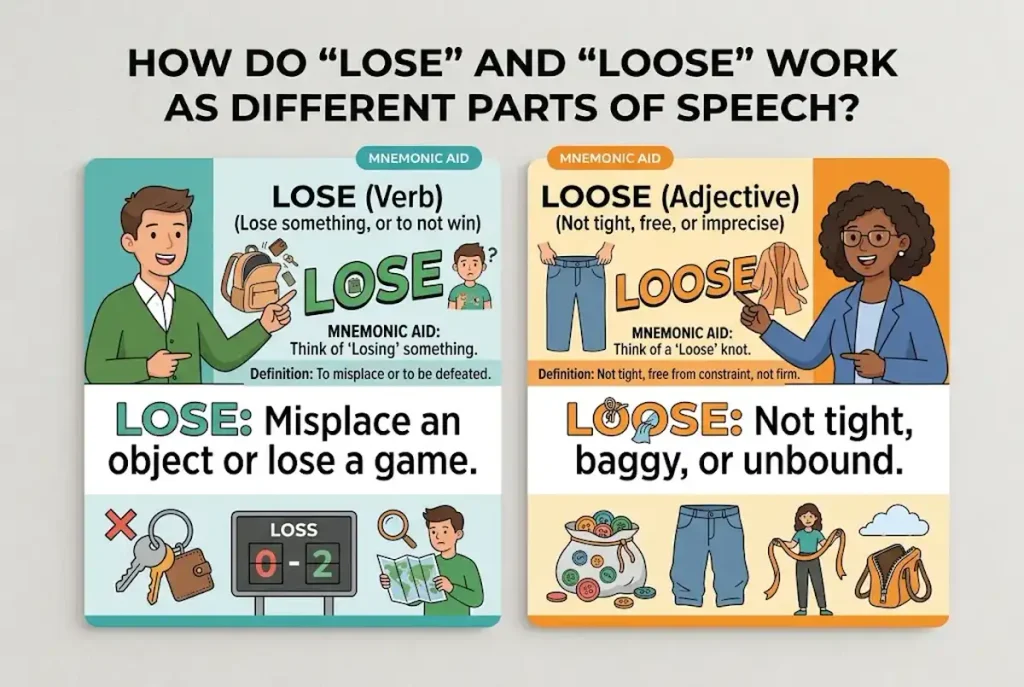
Yes. Lose is a verb that describes an action or change of condition.
Examples:
- I lose my keys frequently.
- They lose games when they don’t practice.
- She wants to lose weight.
| Verb Form | Example |
|---|---|
| Base form | I don’t want to lose. |
| Present tense | They lose sometimes. |
| Past tense | They lost yesterday. |
| Present participle | He is losing confidence. |
| Past participle | She has lost her wallet. |
Is Loose an Adjective?
Yes. Loose usually works as an adjective because it describes a person, object, or condition.
Examples:
- My shirt is loose.
- The screw is loose.
- The rules are loose.
Can Loose Be a Verb?
Yes. Loose can also function as a verb, although this use is less common in everyday conversation.
As a verb, it means to release, free, or let something go.
Examples:
- The hunter loosed an arrow.
- The soldiers loosed a series of warning shots.
- The rope was loosed from the post.
Its verb forms include:
| Verb Form | Example |
|---|---|
| Base form | Loose the rope. |
| Present tense | He looses the arrow. |
| Past tense | He loosed the arrow. |
| Present participle | The arrow is loosing from the bow. |
| Past participle | The rope has been loosed. |
Is Lose or Loose Different in American and British English?
Lose and loose have the same spelling, meaning, and basic pronunciation in American and British English.
There is no regional spelling difference between these two words.
| Word | American English | British English |
|---|---|---|
| Lose | To misplace or fail to win | Same meaning |
| Loose | Not tight or firmly attached | Same meaning |
| Lost | Past tense of lose | Same meaning |
| Loosen | To make something less tight | Same meaning |
| Loosely | In a relaxed or unrestricted way | Same meaning |
Which Word Should You Use in Different Writing Situations?
The right choice depends on what you want to communicate. Lose and loose can appear in academic, professional, and casual writing, but each has a different purpose.
Which Word Is Best for a Resume?
Use lose when discussing something that may be lost or reduced. Use loose when describing something that isn’t tight or controlled.
In most resumes, you may use lose in statements about reducing losses, improving performance, or protecting business resources.
Examples:
- Helped the company reduce financial losses.
- Improved inventory control to avoid losing valuable products.
- Maintained a flexible working schedule to support team productivity.
Which Word Is Best for an Essay?
Both words can be used in essays, but they should match the intended meaning.
Examples:
- Students should not lose confidence after making mistakes.
- Loose regulations may create problems for local businesses.
- People can lose important opportunities by ignoring education.
Which Word Is Best for Texting?
In casual messages, both words are common.
Examples:
- Don’t lose your phone!
- My new jeans are too loose.
- I don’t want to lose this game.
- Your shoelaces are loose.
- Don’t lose hope.
What Are 15 Correct Examples of Lose and Loose in Sentences?
The following examples show how both words work in different situations.
Examples of Lose in Sentences
- I don’t want to lose my phone while traveling.
- Our school team may lose the basketball final.
- She doesn’t want to lose her favorite bracelet.
- You can lose valuable time if you arrive late.
- He worked hard to lose extra weight.
- The company could lose customers if it increases prices.
- Don’t lose confidence when you make a mistake.
- I lost my wallet while shopping.
- The team doesn’t want to lose another important match.
- We might lose the opportunity if we wait too long.
Examples of Loose in Sentences
- My new shirt is too loose around the shoulders.
- The mechanic found a loose bolt in the engine.
- The dog ran loose through the park.
- She prefers loose clothing during hot weather.
- The teacher gave us a loose outline for our assignment.
What Is the Difference Between Lose and Lost?
Lose and lost are forms of the same verb, but they are used in different situations.
Lose is the base form and present tense form. Lost is the simple past tense and past participle.
| Lose | Lost |
|---|---|
| Base form of the verb | Past tense and past participle |
| Used for present or future situations | Used for completed actions and perfect tenses |
| I don’t want to lose my bag. | I lost my bag yesterday. |
| She may lose the game. | She has lost the game. |
| Don’t lose hope. | He had lost hope. |
What Is the Difference Between Loose and Loosen?
Loose and loosen are related, but they have different grammatical functions.
Loose is usually an adjective that describes something not tight. Loosen is a verb that means to make something less tight or more relaxed.
| Loose | Loosen |
|---|---|
| Usually an adjective | Verb |
| Describes a condition | Describes an action |
| The screw is loose. | Please loosen the screw. |
| My shirt is loose. | I need to loosen my shirt collar. |
| The rope is loose. | Loosen the rope slightly. |
What Are the Common Mistakes When Using Lose and Loose?
Even confident English writers sometimes confuse these words. Most mistakes happen because they look similar or because people don’t pay attention to their grammatical roles.
Using Loose Instead of Lose
Incorrect: I don’t want to loose my wallet.
Correct: I don’t want to lose my wallet.
The sentence describes misplacing something, so you need the verb lose.
Using Lose Instead of Loose
Incorrect: My shoes are too lose.
Correct: My shoes are too loose.
The sentence describes how the shoes fit, so you need the adjective loose.
Writing Loosed Instead of Lost
Incorrect: She loosed her phone yesterday.
Correct: She lost her phone yesterday.
Lost is the correct past tense of lose when something is misplaced.
Confusing Loose With Loosen
Incorrect: Please loose your belt.
Correct: Please loosen your belt.
Loosen is the verb that means to make something less tight.
Assuming Loose Always Describes Clothing
Loose can describe much more than clothing.
For example:
- A loose screw.
- A loose connection.
- Loose rules.
What Are the Antonyms of Lose vs Loose?
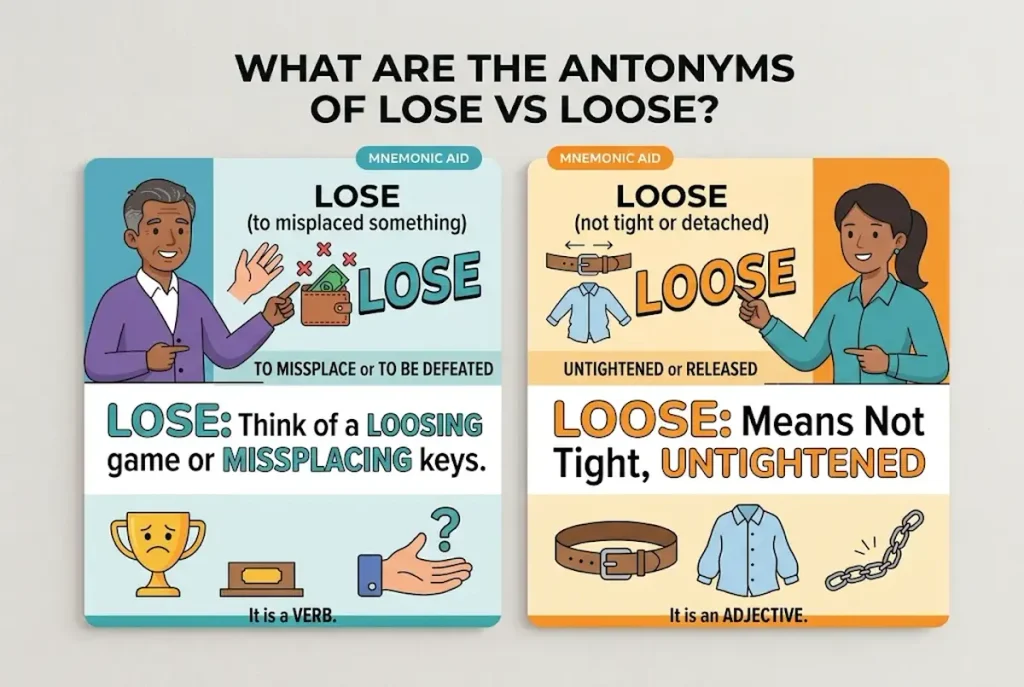
Lose and loose have different opposites because their meanings are different.
Antonyms of Lose
| Word | Meaning | Example |
|---|---|---|
| Win | Achieve victory | Our team hopes to win. |
| Find | Discover something missing | I found my wallet. |
| Gain | Obtain something | She gained experience. |
| Keep | Continue to have something | Keep your documents safe. |
| Retain | Continue to possess something | The company retained its customers. |
| Save | Prevent something from being lost | We saved valuable time. |
| Recover | Get something back | He recovered his missing phone. |
Antonyms of Loose
| Word | Meaning | Example |
|---|---|---|
| Tight | Firmly fitted or stretched | My shoes are tight. |
| Secure | Safely attached | The ladder is secure. |
| Firm | Not loose or easily moved | The handle is firm. |
| Fixed | Attached in one position | The shelf is fixed to the wall. |
| Fastened | Properly attached or closed | The seat belt is fastened. |
| Restricted | Limited by rules | Access is restricted. |
| Strict | Following firm rules | The school has strict policies. |
Conclusion
The main difference between lose and loose is their meaning and grammatical role. Lose is a verb that means to misplace something, fail to win, or stop having something. Loose is usually an adjective that describes something that isn’t tight, secure, or restricted.
For example, you can lose your keys, but your keys can also become loose on a key ring. You can lose a competition, but you can wear loose clothing.
Remember that lose has one O and ends with a Z sound, while loose has two Os and ends with an S sound. Also, lost is the past tense of lose, while loosen means to make something less tight.
Frequently Asked Questions
What is the difference between lose vs loose?
Lose is a verb meaning to misplace something or fail to win, while loose is usually an adjective meaning not tight or firmly attached. For example, you can lose your keys, but you can wear loose shoes.
Is it lose or loose weight?
The correct expression is lose weight. Lose is a verb that describes reducing body weight, while loose describes something that isn’t tight.
How do you remember lose vs loose?
Remember that lose has one O and means to misplace or fail to win. Loose has two Os and means not tight or secure.
Is loose a verb or an adjective?
Loose is usually an adjective, but it can also function as a verb meaning to release or set something free. Loosen is the more common verb used to make something less tight.
Is it lost or loosed?
Lost is the correct past tense of lose when you mean to misplace something or fail to win. Loosed is a different verb form that means released or set free.
What’s another word for lose?
Depending on the sentence, alternatives include misplace, forfeit, surrender, miss, abandon, and relinquish. Each has a slightly different meaning, so choose one that fits your context.
What’s another word for loose?
Common alternatives include slack, baggy, relaxed, unfastened, unsecured, and unrestricted. The best choice depends on whether you’re describing clothing, an object, or a lack of control.

Daniel Grammarfield — The Language Learner
Age: 28Occupation: ESL Learner & Digital Professional
Bio:Daniel is a non-native English speaker who wants to communicate more confidently at work and online. He uses Synotrench to improve grammar, understand confusing words, learn correct sentence structures, and build everyday English skills. He prefers simple explanations with practical examples.
Goals:
Master English grammar rules
Avoid common language mistakes
Improve professional communication
Learn English through real-life examples
Quote:“Learning English is not about memorizing rules — it’s about expressing ideas clearly.”
2 thoughts on “Lose vs Loose: The Ultimate Guide to the Difference (2026)”