You’re writing Assure vs Ensure vs Insure an email, polishing a resume, or finishing an essay, and you stop at three words that look almost identical: assure, ensure, and insure. They sound similar, but they don’t always do the same job. Knowing the difference can make your writing clearer and more precise.
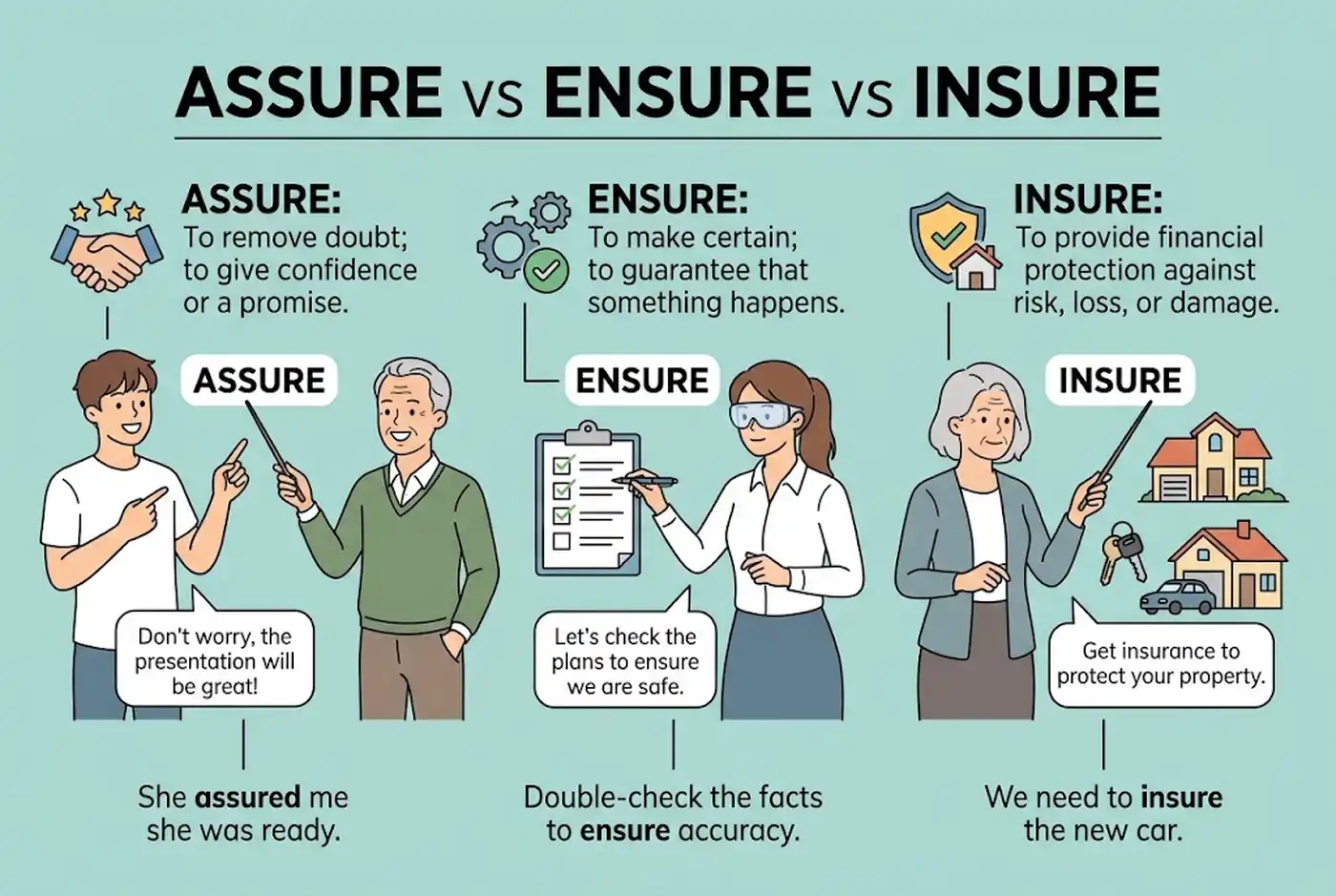
The easiest way to remember assure vs ensure vs insure is to connect each word with its main purpose. Assure usually relates to a person’s confidence or peace of mind. Ensure means to make certain that something happens. Insure usually relates to financial protection against loss, damage, or risk.
These words also have some overlap, especially in American English. This guide explains their meanings, origins, related words, intensity, grammar, regional differences, common mistakes, and the best choice for emails, resumes, essays, texts, and everyday speech.
What do assure ensure and insure mean?
The three verbs are easy to confuse because they share similar sounds and have related histories. Their modern meanings, however, are different enough to matter.
| Word | Main meaning | Usually connected with | Example |
|---|---|---|---|
| Assure | Give someone confidence or remove doubt | People | I assure you that everything is ready. |
| Ensure | Make certain that something happens | Actions or results | Please ensure that the door is locked. |
| Insure | Protect against financial loss or risk | Property, people, risks, and policies | We insure our home against damage. |
A useful memory trick is:
Assure a person.
Ensure a result.
Insure against a risk.
This is not an absolute rule for every sentence, but it works well in most everyday American English.
Consider these examples:
I assured Maria that I would call.
I ensured that Maria received the message.
The first sentence is about confidence. The second is about making an outcome certain. The third is about financial protection.
Where did assure ensure and insure come from?
These words are related, which explains why they look and sound alike.
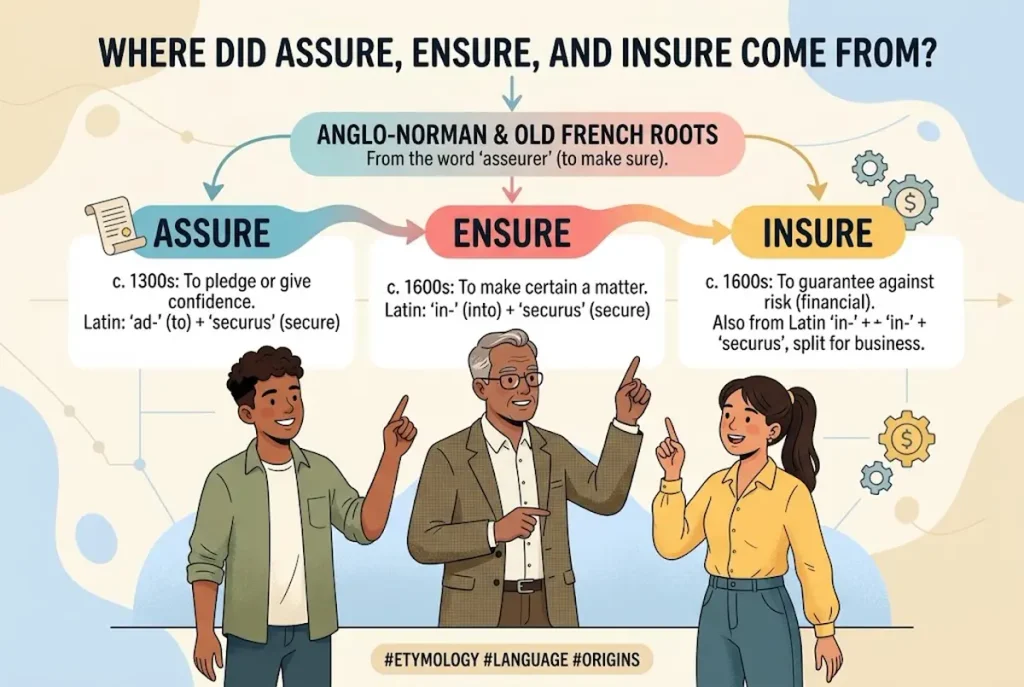
Assure entered English through Old French and is connected to the idea of making someone confident or certain. Over time, its meaning became strongly associated with giving a person confidence or removing their doubts.
Ensure developed from the same broader family of words related to making something secure or certain. Its modern use focuses on making sure that an event, condition, or result happens.
Insure also comes from this historical family. Its meaning gradually became closely associated with protection against risk and financial loss. Today, insurance is the strongest connection most people have with the word.
The three words therefore have a shared linguistic background, but English gave them different jobs.
You can think of their history as a family that developed into three related roles:
- Assure focuses on confidence.
- Ensure focuses on certainty.
- Insure focuses on protection from risk.
This historical connection is one reason learners often mix them up. The confusion is understandable. The modern meanings are what matter most when you’re choosing a word.
How can you remember the difference quickly?
If you need a fast rule, ask what comes after the verb and what you are trying to communicate.
Use assure when you are talking directly to a person and giving that person confidence.
I assure you that I understand.
Use ensure when you are talking about making an event, condition, or result certain.
Check the list to ensure that nothing is missing.
Use insure when the subject involves insurance, financial protection, or protection against a specified risk.
The company insures commercial buildings.
Another useful shortcut is:
Person = assure.
Result = ensure.
Risk = insure.
There are exceptions, especially in formal and regional usage, but this shortcut handles most common situations.
Which synonyms are mild and which are strong?
Synonyms can have different levels of force. Choosing the right strength helps your writing sound natural.
Mild expressions
These are useful when you want to sound calm and friendly.
Comfort.
Encourage.
Reassure.
Support.
Make sure.
Confirm.
For example:
I just wanted to make sure you received my email.
This sounds softer than:
I guarantee that you received my email.
Medium strength expressions
These show stronger confidence or responsibility.
Assure.
Ensure.
Verify.
Secure.
Confirm.
Protect.
For example:
Please ensure that all information is correct before submitting the form.
Strong expressions
These suggest a firm promise, official confirmation, or serious protection.
Guarantee.
Certify.
Guarantee.
Pledge.
Underwrite.
Safeguard.
For example:
The company guarantees a full refund under the stated conditions.
Guarantee is stronger than simply assure because it can suggest a firm commitment or stated obligation.
How do assure ensure and insure work as parts of speech?
Assure, ensure, and insure are verbs. Their related forms can appear in other grammatical roles.
Assure and its related forms
Assure is a verb.
I assure you that the information is correct.
Assurance is a noun.
She gave me assurance that the problem was solved.
Reassure is another verb.
The doctor reassured the patient.
Reassurance is a noun.
His explanation provided reassurance.
Ensure and its related forms
Ensure is a verb.
Please ensure that the application is complete.
There is no equally common everyday noun formed directly from ensure. Certainty, assurance, and guarantee may express related ideas depending on the sentence.
Insure and its related forms
Insure is a verb.
They insure their home against flooding.
Insurance is a noun.
We bought home insurance last year.
Insured can work as an adjective or participle.
The insured vehicle was damaged in the accident.
Insurer is a noun for the company or organization providing insurance.
The insurer approved the claim.
These forms are useful because they help you recognize the word family even when the original verb isn’t used.
Are assure ensure and insure different in American and British English?
Yes, there are some regional differences, but the basic distinction remains useful in both American and British English.
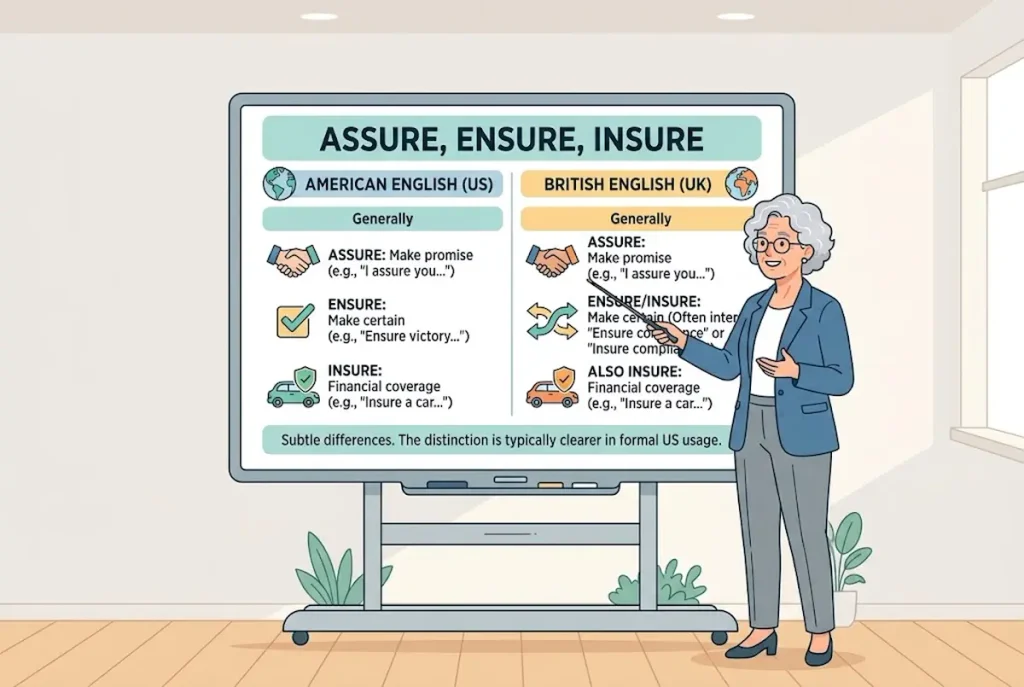
American English strongly uses insure for financial protection.
We insure our car every year.
Ensure is common for making something certain.
Please ensure that the windows are closed.
Assure is used for giving confidence to a person.
I assure you that we are working on it.
British English follows the same general distinction. However, ensure is especially common in formal British writing, and some British style guides discuss insure and ensure in slightly different ways.
There is also a related word, assure, that can appear in insurance contexts in British English. Some British insurance companies use assurance for certain long term financial products, especially life assurance.
That does not mean you should randomly replace ensure with assure. The practical rule remains the same for ordinary writing.
For most US readers, use:
Assure for people.
Ensure for results.
Insure for insurance.
Which word is best for a resume?
For a resume, ensure is often the best choice when describing a responsibility involving accuracy, quality, or completion.
Good example:
Ensured accurate data entry across multiple client accounts.
Another example:
Ensured all project documents met company requirements.
Assure is less common on resumes because resumes usually describe actions rather than conversations.
You might write:
Reassured customers during service interruptions.
That works because the action involves helping people feel confident.
Insure is appropriate when insurance is genuinely part of your work.
Managed policies and insured commercial properties against major risks.
Do not use insure simply because you mean protect in a general sense. If you are describing customer safety, you may need protect or safeguard instead.
Which word is best for an essay?
Ensure is usually the strongest choice when writing an academic essay.
Example:
Schools should ensure that students have access to reliable learning materials.
You can also use assure when the essay discusses communication or confidence.
The author assures readers that the research was conducted carefully.
Insure is mainly appropriate when the essay discusses insurance, financial risk, property, or related subjects.
For example:
Many homeowners insure their properties against natural disasters.
In academic writing, precision matters more than choosing the most complicated word. Ensure is often better than a fancy substitute because it clearly communicates the idea of making something certain.
Which word is best for a text message?
In casual texting, make sure is often more natural than ensure.
Text:
Make sure you bring your charger.
This sounds relaxed and normal.
You could write:
Please ensure that you bring your charger.
That is grammatically correct, but it sounds formal for a casual text.
Assure works well when someone is worried.
I assure you, it’s going to be okay.
Insure belongs in a text when you are actually discussing insurance.
Did you insure the car yet?
The best word depends on the subject, but casual communication usually favors simple expressions.
Which word is best for an email?
Email writing depends on the relationship and purpose.
For a professional email, ensure is useful when asking someone to check or complete something.
Please ensure that all documents are attached before sending the application.
Assure is useful when responding to a concern.
I assure you that your request is being reviewed.
Insure is appropriate for insurance matters.
Please confirm that the vehicle is insured before delivery.
If the email is casual, make sure may sound more natural.
Just make sure you send the updated file before Friday.
The key is to match the word to both the meaning and the tone.
Which word is best when speaking?
In everyday conversation, assure and make sure are very common.
I assure you, I didn’t forget.
Make sure you lock the door.
Ensure is correct but can sound more formal.
Please ensure everyone has a seat.
Insure is natural when discussing insurance.
Do you insure your car?
If you’re speaking casually, don’t choose a formal word just to sound professional. Clear language usually sounds more confident.
What are some real examples of assure ensure and insure?
Here are examples from common situations.
- I assure you that your information will remain private.
- Please ensure that your name is spelled correctly.
- We insure our house against fire and storm damage.
- She reassured her child before the first day of school.
- The manager ensured that every employee received the updated schedule.
- The company insured the delivery truck.
- I assure you that I understand your concern.
- Please make sure the windows are closed before you leave.
- The policy insures the building against certain types of damage.
- The teacher reassured the student after the mistake.
- The checklist ensures that important steps are not forgotten.
- We need to ensure that all payments are recorded.
- I assured my parents that I would arrive safely.
- The homeowner insured the property before renting it out.
- The new procedure helps ensure accurate results.
- She assured the customer that the problem would be addressed.
- The company insures vehicles used for business purposes.
- Please ensure all required documents are included.
- The coach reassured the team before the final match.
- The security system helps safeguard the building.
Notice that these sentences don’t use the three words interchangeably. Each one has a specific job.
Assure vs ensure: what’s the difference?
Assure and ensure are the pair most often confused in everyday writing.
I assured him that the package was coming.
Ensure usually has a thing, event, condition, or result as its object.
I ensured that the package was delivered.
The difference becomes clearer if you change the sentence:
I assured Sarah that the meeting would happen.
I ensured that the meeting happened.
In the first sentence, Sarah receives confidence.
In the second sentence, the speaker takes action to make the event happen.
A person can technically appear after ensure in certain structures, especially when the meaning is to make sure that something happens to that person.
We ensured that everyone received a copy.
Here, everyone is connected to the result, not the emotional reassurance.
Ensure vs insure: what’s the difference?
Ensure means to make something certain.
Insure usually means to protect financially against a risk.
Compare:
We ensured that the car was ready.
We insured the car against theft.
The first sentence says someone took steps to make sure the car was ready.
The second says someone purchased or provided insurance protection for the car.
This distinction is especially important in business, legal, and financial writing.
Consider:
The company ensured that all equipment was inspected.
The company insured all equipment against damage.
The first sentence describes an action or process.
The second describes financial protection.
Assure vs insure: what’s the difference?
Assure focuses on confidence. Insure focuses on financial protection.
I assured the customer that the product was safe.
The company insured the product against certain risks.
The customer receives confidence in the first sentence. The company receives financial protection in the second.
The words can both appear in the same situation:
I assured the customer that the insured vehicle was covered by the policy.
Here, assured describes communication, while insured describes insurance coverage.
What are the most common mistakes?
Using insure when you mean ensure
Incorrect:
Please insure that all forms are complete.
Better:
Please ensure that all forms are complete.
The sentence is about making certain that the forms are complete, not buying insurance.
Using ensure when you mean assure
Incorrect:
I ensure you that everything will be fine.
Better:
I assure you that everything will be fine.
The speaker is giving another person confidence, so assure is the natural choice.
Using assure for a process
Incorrect:
The checklist assures that every step is completed.
Better:
The checklist ensures that every step is completed.
A checklist can help make an outcome certain. It does not normally reassure someone.
Using insure for general protection
Incorrect:
This password insures your account from hackers.
Better:
This password helps protect your account from unauthorized access.
Insure is mainly connected with insurance and financial risk. Use protect or safeguard for general safety.
Assuming insure always means financial protection
Insurance is the main modern meaning, but insure can have broader historical or technical uses. For ordinary US writing, though, the insurance connection is the safest guide.
Replacing every use of make sure with ensure
Ensure is correct in many cases, but it can sound unnecessarily formal.
Casual:
Make sure you call me.
Formal:
Please ensure that you contact me.
Both work. Choose based on the audience.
When should you not use assure ensure or insure?
Don’t use these words simply because they sound more professional.
Sometimes a simpler word is better.
Instead of:
The new rule will ensure employee happiness.
You might write:
The new rule may improve employee satisfaction.
Ensure suggests a high level of certainty. If an action only has the possibility of producing a result, words like help, support, encourage, or improve may be more accurate.
Another example:
The medicine will ensure that you never get sick.
This is too absolute unless there is strong evidence for such a claim.
A better sentence might be:
The medicine may help reduce your risk of illness.
Precision matters. Ensure should not be used to make uncertain claims sound certain.
Likewise, don’t use insure when you simply mean protect.
Use:
The helmet protects your head.
Not:
The helmet insures your head.
If actual insurance is involved, insure becomes appropriate.
What are the antonyms of assure ensure and insure?
The opposite depends on the meaning.
For assure, useful opposites include:
Doubt.
Discourage.
Worry.
Alarm.
Unsettle.
For ensure, useful opposites include:
Prevent.
Block.
Hinder.
Disrupt.
Jeopardize.
For insure, useful opposites include:
Expose.
Endanger.
Risk.
Leave unprotected.
Uncover.
These are not always exact dictionary antonyms. They represent common ideas that contrast with the three verbs.
For example:
The warning unsettled the customer.
The technical problem disrupted the process.
The uninsured property was exposed to financial risk.
How can you choose the right word every time?
Use these questions before choosing a word.
Are you giving a person confidence?
Use assure.
I assure you that there is no problem.
Are you making sure something happens?
Use ensure.
Ensure that all lights are turned off.
Are you talking about an insurance policy or financial risk?
Use insure.
We insure the building against fire.
Are you writing casually?
Consider make sure instead of ensure.
Make sure you save the document.
Are you talking about general safety?
Consider protect or safeguard instead of insure.
The lock protects the door.
Are you making a very strong promise?
Consider guarantee if the context supports it.
We guarantee a full refund under these conditions.
The final choice should always match the meaning, not just the sound of the word.
What is the easiest memory trick?
Think of the first letter of the key idea.
Assure connects with a person.
Ensure connects with an event or result.
Insure connects with insurance.
You can remember the pattern as:
Assure people.
Ensure results.
Insure risks.
Try testing yourself with these sentences:
I ___ you that I understand.
The teacher ___ that every student had a worksheet.
The homeowner ___ the house against flooding.
The answers are assure, ensured, and insured.
This simple test works because each sentence has a different purpose.
Why does this distinction matter for clear writing?
Small word choices can change the meaning of a sentence.
Compare:
I assured that the report was accurate.
I ensured that the report was accurate.
The second sentence is the natural choice because the writer means that they took steps to make the report accurate.
Now compare:
I assured my manager that the report was accurate.
Here, the manager receives confidence.
Finally:
I insured the report against errors.
This sounds wrong in normal English because reports aren’t normally insured against errors.
The sentence needs a different verb:
I checked the report for errors.
The goal isn’t to memorize three dictionary definitions. The goal is to understand the situation behind each word.
Quick comparison chart for assure ensure and insure
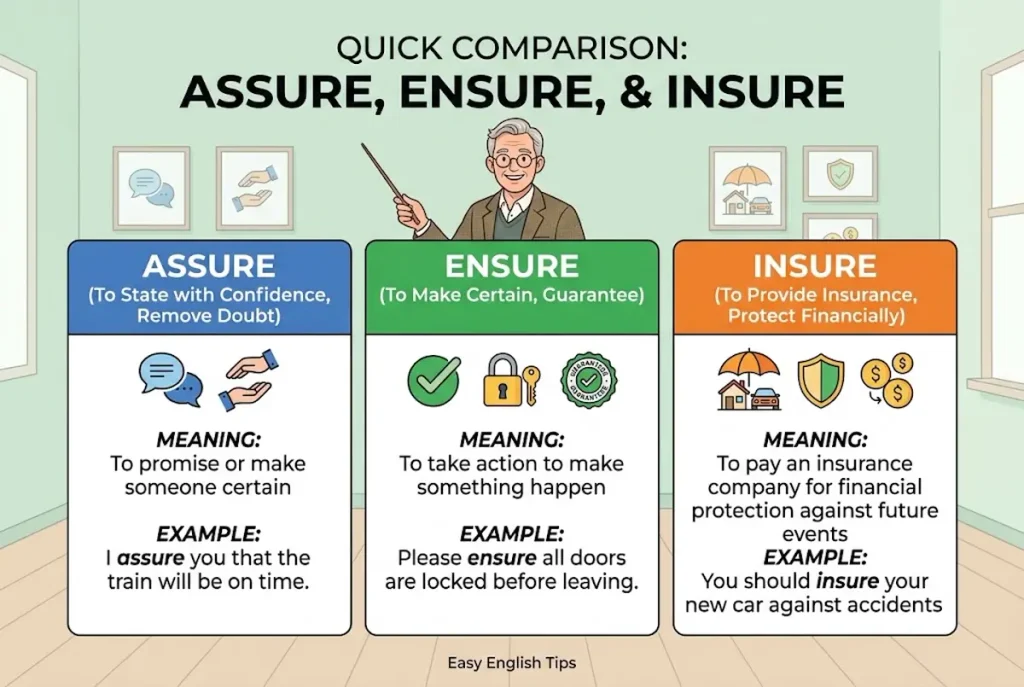
| Question | Best choice | Example |
|---|---|---|
| Am I giving a person confidence? | Assure | I assure you that it’s safe. |
| Am I making something certain? | Ensure | Ensure that the door is locked. |
| Am I talking about insurance? | Insure | We insure our home. |
| Am I speaking casually? | Make sure | Make sure you call me. |
| Am I talking about general safety? | Protect | This lock protects the door. |
| Am I making a strong promise? | Guarantee | We guarantee the service. |
| Am I checking accuracy? | Verify | Please verify the information. |
| Am I officially confirming something? | Certify | The inspector certified the equipment. |
Conclusion
Assure, ensure, and insure have similar histories and similar sounds, but their modern uses are different. Assure is mainly about giving a person confidence. Ensure is about making something certain or making sure a result happens. Insure is connected with insurance and financial protection against risk.
When you’re unsure, identify the main idea first. Are you talking to a person and removing doubt? Choose assure. Are you making an event or result certain? Choose ensure. Are you discussing an insurance policy or protection against financial loss? Choose insure.
For casual writing, make sure may be a better choice than ensure. For professional writing, choose the word that says exactly what you mean. Once you connect each word with its purpose, these three confusing verbs become much easier to use naturally.
Frequently Asked Questions
Is assure the same as ensure?
No. Assure usually means to give a person confidence, while ensure means to make something certain or make sure an outcome happens.
Is ensure the same as insure?
No. Ensure usually means make certain, while insure normally refers to providing insurance or financial protection against risk.
What is the easiest way to remember assure ensure and insure?
Remember this pattern: assure people, ensure results, and insure risks. It works for most everyday American English situations.
Can I use insure instead of ensure?
Usually no. Use ensure when you mean make certain or make sure. Use insure when you mean provide insurance or financial protection.
Should I use assure or ensure in an email?
Use assure when you are giving someone confidence, and use ensure when you are making sure something happens. For example, I assure you that we received your request, but please ensure all documents are attached.
What’s another way to say ensure?
Common alternatives include make sure, guarantee, confirm, verify, secure, and make certain. The best choice depends on how strong or formal you want the statement to sound.
Is ensure more formal than make sure?
Yes, in many situations ensure sounds more formal. Make sure is more natural in casual conversation and everyday messages.
Is insure only used for cars and homes?
No. Insure can apply to many types of financial risk, including businesses, property, vehicles, health related coverage, and other insured interests. The exact use depends on the type of insurance involved.

Daniel Grammarfield — The Language Learner
Age: 28Occupation: ESL Learner & Digital Professional
Bio:Daniel is a non-native English speaker who wants to communicate more confidently at work and online. He uses Synotrench to improve grammar, understand confusing words, learn correct sentence structures, and build everyday English skills. He prefers simple explanations with practical examples.
Goals:
Master English grammar rules
Avoid common language mistakes
Improve professional communication
Learn English through real-life examples
Quote:“Learning English is not about memorizing rules — it’s about expressing ideas clearly.”
1 thought on “Assure vs Ensure vs Insure: Simple Guide (2026)”