
Imagine writing a message about someone who told a lie. You type a sentence, but then you pause: should you write lier or liar? Both spellings look possible because they are connected to the word lie. However, only one is the standard English word for a person who tells lies.
The correct spelling is liar. A liar is someone who tells lies or makes false statements on purpose. The spelling lier is not a standard word for this meaning.
This small spelling mistake can make a sentence look less clear, especially in school assignments, work emails, and formal writing. Learning the difference will help you choose the right spelling and avoid common errors.
In this guide, you’ll learn the meaning and origin of the correct word, explore useful alternatives, compare similar terms, and see examples for everyday conversations, emails, essays, and professional writing.
What Is the Difference Between Lier and Liar?
The main difference is that liar is the standard English spelling for a person who tells lies. Lier is generally considered a misspelling when someone uses it with this meaning.
A liar is a person who knowingly says something false or tries to make another person believe something untrue.
For example:
- Correct: The liar made up a story to avoid trouble.
- Incorrect: The lier made up a story to avoid trouble.
Is Liar the Correct Spelling?
Yes. Liar is the correct spelling when you mean a person who tells lies.
It works in everyday English, school writing, business communication, books, news reports, and conversations.
Here are a few examples:
- The liar finally admitted that he had changed the story.
- Calling someone a liar is a serious accusation.
- She felt hurt when her friend called her a liar.
Is Lier Ever a Correct English Word?
In ordinary modern English, lier is not the accepted spelling for a person who tells lies.
You may find the spelling in old texts, unusual word lists, or discussions about spelling. However, it is not the form you should choose in standard American English.
If you’re writing about someone who gives false information, use liar. Do not use lier as a substitute.

What Does Liar Mean in Simple English?
A liar is someone who tells a lie or knowingly gives false information.
The word is a noun. It describes a person rather than an action.
For example, in the sentence, The liar blamed someone else, the word liar identifies the person who told an untrue story.
A liar may tell lies for different reasons, such as:
- To avoid punishment.
- To hide a mistake.
- To gain money or attention.
- To protect a secret.
- To make another person believe something false.
What Is the Difference Between a Lie and a Liar?
A lie is a false statement. A liar is the person who tells it.
| Word | Part of Speech | Meaning | Example |
|---|---|---|---|
| Lie | Noun | A false statement | His excuse was a lie. |
| Lie | Verb | To say something false | She chose to lie about the mistake. |
| Liar | Noun | A person who tells lies | The liar lost everyone’s trust. |
| Lying | Verb form or adjective | Telling something untrue | He was lying about his location. |
What Is the Origin of the Word Liar?
The word liar has a long history in English. It developed from the older verb lie, which means to make a false statement.
The verb comes from Old English lēogan, meaning to tell a falsehood. Over time, English developed related forms that described the action and the person performing it.
The noun liar appeared in Middle English. Its spelling became established as English spelling developed.
The ending -ar helps form a noun for a person connected with an action. The same general idea appears in other English words, although the endings and spelling patterns are not identical in every case.
Why Does Liar End in Ar?
The spelling liar may seem confusing because many English nouns use endings such as -er or -or to describe a person.
However, English does not follow one simple spelling rule for every person-related noun.
For example:
| Word | Related Word | Meaning |
|---|---|---|
| Liar | Lie | A person who tells false statements |
| Beggar | Beg | A person who asks for money or help |
| Scholar | School | A person who studies or has deep knowledge |
| Scholar | Scholarship | Financial support for education |
| Actor | Act | A person who performs in plays or films |
| Writer | Write | A person who writes |
How Did the Spelling Become Liar?
English spelling changed over many centuries. Older forms of words often looked different from the spellings used today.
As written English became more standardized, liar became the accepted form for a person who tells lies.
Today, dictionaries and standard writing guides recognize liar. The spelling lier does not serve as its normal replacement.
What Are the Best Synonyms for Liar?
Several English words can describe someone who tells lies. However, each word has a slightly different meaning or tone.
Some alternatives are mild and conversational. Others sound formal, emotional, humorous, or strongly critical.
The best choice depends on your sentence and the message you want to communicate.
Simple Synonyms for Liar
These words are easy to understand and work in everyday conversations.
| Word | Meaning | Tone | Example |
|---|---|---|---|
| Dishonest person | Someone who does not tell the truth | Simple | He is a dishonest person. |
| Fibber | Someone who tells small or harmless lies | Light | My little brother is a fibber. |
| Storyteller | Someone who tells stories, sometimes invented ones | Neutral | He is a talented storyteller. |
| Cheat | Someone who acts unfairly or dishonestly | Critical | The cheat changed the results. |
| Deceiver | Someone who misleads another person | Serious | The deceiver gained her trust. |
| Pretender | Someone who acts as if something is true when it is not | Critical | He was only a pretender. |
Everyday Synonyms for Liar
These expressions sound natural in ordinary speech and informal writing.
| Word | Meaning | Tone | Example |
|---|---|---|---|
| Fibber | A person who tells little lies | Playful | Don’t be a fibber. |
| Fake | Someone who is not genuine | Informal | He turned out to be a fake. |
| Phony | Someone who pretends to be honest or genuine | Informal | Everyone knew he was a phony. |
| Two-faced person | Someone who acts differently depending on the audience | Critical | I don’t trust two-faced people. |
| Trickster | Someone who tricks or deceives others | Playful or critical | The trickster fooled the villagers. |
| Manipulator | Someone who controls others through dishonest behavior | Serious | The manipulator used false promises. |
| Con artist | Someone who tricks people to get money or benefits | Strong | The con artist stole their savings. |
Formal Synonyms for Liar
Formal alternatives can help in reports, essays, and professional discussions. They often describe a person’s behavior more precisely.
| Word | Meaning | Tone | Example |
|---|---|---|---|
| Deceiver | A person who misleads others | Formal | The deceiver damaged the team’s reputation. |
| Fraudster | Someone who commits fraud | Formal and serious | The fraudster used false documents. |
| Impostor | Someone who pretends to be another person or have a false identity | Formal | The impostor claimed to be a doctor. |
| Fabricator | Someone who invents false information | Formal | The fabricator created a false report. |
| Dissembler | Someone who hides the truth or pretends | Very formal | The dissembler concealed his real intentions. |
| Perjurer | Someone who lies under oath | Legal | The witness was accused of being a perjurer. |
| Charlatan | Someone who falsely claims special knowledge or skill | Formal | The charlatan promised a miracle cure. |
| Fraud | A dishonest person or deceptive act | Formal | The fraud misled several customers. |
What Are Synonyms for Liar by Intensity?
Not every dishonest person tells lies in the same way. Someone may tell a small fib, while another person may create a serious fraud.
Choosing a word based on intensity helps you communicate the right level of criticism.
Mild Words for Someone Who Lies
Use these words when the situation is small, playful, or not very serious.
- Fibber: Someone who tells little lies.
- Exaggerator: Someone who makes things sound bigger or more impressive than they are.
- Storyteller: Someone who creates or shares stories.
- Pretender: Someone who acts as if something is true.
- Big talker: Someone who makes claims they may not support.
Moderate Words for Someone Who Lies
These words describe more serious or repeated dishonesty.
- Deceiver: Someone who misleads others.
- Dishonest person: Someone who does not act truthfully.
- Manipulator: Someone who uses dishonest methods to influence others.
- Phony: Someone who pretends to be genuine.
- Impostor: Someone who falsely claims an identity or position.
Strong Words for Someone Who Lies
Use these terms when the behavior involves serious deception or wrongdoing.
- Fraudster: Someone who commits fraud.
- Con artist: Someone who tricks people for money or personal gain.
- Charlatan: Someone who falsely claims knowledge or expertise.
- Perjurer: Someone who lies under oath.
- Swindler: Someone who cheats people out of money or property.
What Part of Speech Is Liar?
The word liar is a noun. It names a person who tells lies.
It does not work as a verb or adjective in standard English. If you want to describe the action, use the verb lie or one of its forms.
| Word | Part of Speech | Meaning | Example |
|---|---|---|---|
| Lie | Verb | To say something false | Don’t lie to your parents. |
| Liar | Noun | A person who tells lies | He is a liar. |
| Lying | Verb form | The act of telling something false | She is lying to her friend. |
| Lying | Adjective | Not truthful | He gave a lying explanation. |
| Lied | Past tense | Told something false in the past | They lied about the results. |
How Do You Use Liar as a Noun?
Use liar when you want to identify a person who tells something untrue.
Examples:
- The liar changed his story several times.
- She called him a liar during the argument.
- Nobody wanted to believe the liar again.
- A liar can damage relationships by breaking trust.
What Is the Difference Between Liar and Lying?
Liar describes a person. Lying describes the action of telling something false.
| Liar | Lying |
|---|---|
| He is a liar. | He is lying. |
| The liar made a false promise. | The man was lying about the promise. |
| She called him a liar. | She caught him lying. |
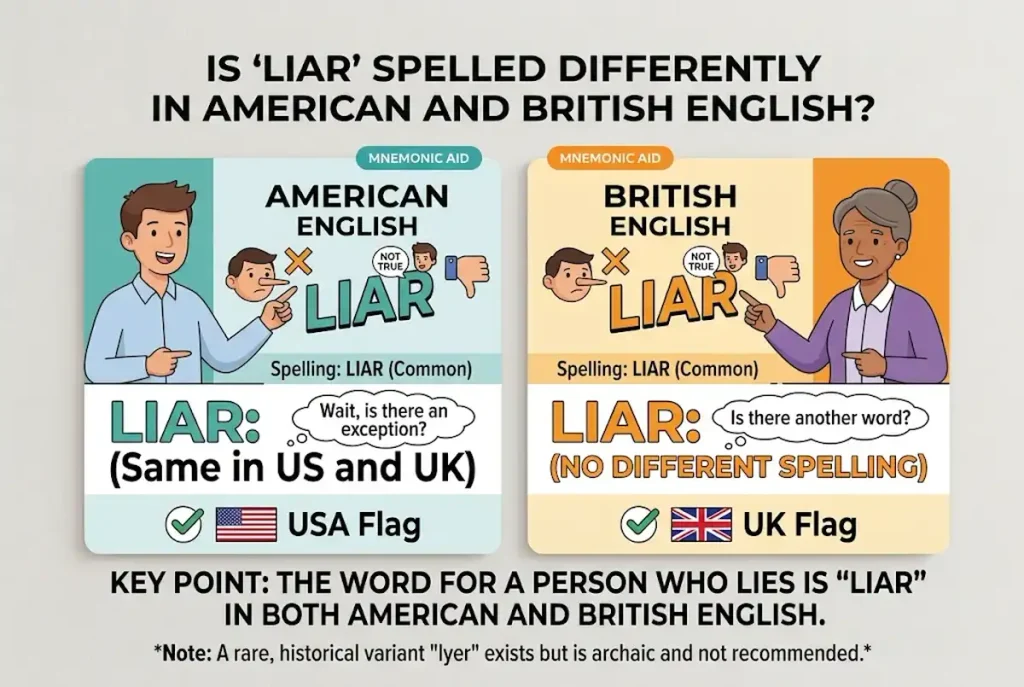
Is Liar Spelled Differently in American and British English?
No. The standard spelling is liar in both American and British English.
Unlike some words that have different regional spellings, this word does not change between the two varieties.
| English Variety | Correct Spelling | Example |
|---|---|---|
| American English | Liar | He is a liar. |
| British English | Liar | He is a liar. |
| Canadian English | Liar | She called him a liar. |
| Australian English | Liar | The liar admitted the truth. |
How Do Americans Use the Word Liar?
In American English, liar is common in everyday speech, school writing, news stories, and professional discussions.
For example:
- The witness called the statement a lie.
- Nobody wants to work with a liar.
- He was accused of lying to customers.
The word can sound direct and harsh. In a professional setting, you may want to describe the behavior instead of labeling the person.
For example, instead of writing, The employee is a liar, you could write, The employee provided information that was not accurate.
How Do British Speakers Use the Word Liar?
British speakers also use liar with the same meaning.
For example:
- He is a liar.
- She accused him of lying.
- The newspaper corrected the false statement.
Which Word Should You Use in a Resume?
A resume usually describes your own skills, experience, and achievements. You should avoid calling someone a liar in a professional resume.
If you need to explain a problem involving false information, use calm and factual language.
Better Words for a Resume
Consider these alternatives:
- Inaccurate: Information that contains mistakes.
- Misleading: Information that gives the wrong impression.
- Dishonest: Behavior that does not follow the truth.
- False: Information that is not true.
- Unverified: Information that has not been confirmed.
Which Word Should You Use in an Essay?
In an essay, choose words that match the subject and level of formality.
The word liar is suitable when you are discussing a character, a person’s behavior, or a situation involving dishonesty.
However, formal alternatives may be more accurate in academic writing.
Examples:
- The novel presents the main character as a liar who hides his past.
- The report explains how false claims can damage public trust.
- The character’s dishonesty creates conflict throughout the story.
Which Word Should You Use in Texting?
In text messages, liar is common and easy to understand.
You can use it in casual conversations with friends or family. However, remember that it can sound rude or angry.
Examples:
- You’re a liar. You said you were at home.
- Stop lying to me.
- I think that story is fake.
- Don’t be a fibber.
- I know you’re not telling me the truth.
Which Word Should You Use in an Email?
The best word depends on the purpose of your email.
In a personal email, liar may be understandable, but it can make a disagreement worse. In a business email, use neutral language and explain the issue clearly.
Examples:
- Personal: I felt hurt when I learned that you had lied to me.
- Professional: The information in your previous message appears to be inaccurate.
- Formal: We found misleading details in the submitted report.
Which Word Should You Use When Speaking?
In everyday conversation, liar is a direct way to describe someone who tells lies.
However, the word can create conflict, especially during an argument.
You can choose a softer expression if you want to discuss the problem without insulting someone.
Examples:
- You’re not being honest with me.
- That story doesn’t seem true.
- I think you’re hiding something.
- Please tell me what really happened.
- I don’t believe that explanation.
What Are Some Example Sentences With Liar?
Seeing the word in different situations makes it easier to understand and use correctly.
Here are original examples from everyday life, school, work, and social situations.
Everyday Conversation Examples
- My friend apologized after admitting that he had lied about the broken window.
- The little boy was not a liar; he had simply misunderstood the question.
- Nobody believed the liar after he changed his story for the third time.
- She called her brother a liar because he denied taking her phone.
- The man proved that he was honest by showing the original receipt.
School and Education Examples
- The teacher explained that a person who knowingly gives false answers is being dishonest.
- The student was upset when another student called him a liar.
- A good essay should explain the character’s actions instead of simply calling him a liar.
- The story follows a liar who slowly loses the trust of everyone around him.
- The class discussed why telling the truth is important.
Workplace Examples
- The manager refused to call his colleague a liar without checking the facts.
- The company investigated the employee’s false claims.
- The customer accused the salesperson of being a liar.
- The report showed that the original statement was misleading.
- The team lost confidence in the supplier after discovering repeated false promises.
What Is the Difference Between Liar and Fibber?
Both words describe someone who tells something untrue, but they do not carry the same level of seriousness.
A liar is a general term for someone who tells lies. A fibber usually tells small or less serious lies.
| Liar | Fibber |
|---|---|
| Can describe serious dishonesty | Usually describes small lies |
| Can sound harsh or accusing | Often sounds playful |
| Works in formal and informal contexts | Mostly informal |
| Can describe repeated or deliberate deception | Often describes minor exaggerations |
What Is the Difference Between Liar and Deceiver?
A liar tells false statements. A deceiver uses actions, words, or behavior to make someone believe something untrue.
The main difference is that deception can happen without a direct spoken lie.
| Liar | Deceiver |
|---|---|
| Tells false statements | Misleads someone |
| Often involves spoken or written lies | Can involve actions and hidden information |
| Common in everyday English | More formal |
| Example: He lied about his age. | Example: He hid important facts to mislead the buyer. |
What Are the Common Mistakes When Using Liar?
Writers sometimes confuse the spelling, meaning, or grammatical use of this word.
Avoid these mistakes to make your writing clearer.
Writing Lier Instead of Liar
This is the most common spelling mistake.
Incorrect: He is a lier.
Correct: He is a liar.
Remember that the standard spelling ends in -ar.
Using Liar When You Mean Lie
A lie is a false statement. A liar is a person who tells one.
Incorrect: That was a liar.
Correct: That was a lie.
Incorrect: He told a lie to his parents, so he is a lie.
Correct: He told a lie to his parents, so he is a liar.
Using Liar for Every Small Mistake
A person who gives incorrect information is not always a liar.
Sometimes people make mistakes because they forget details, misunderstand a question, or receive incorrect information.
For example:
- Incorrect information: She gave the wrong date by mistake.
- Dishonesty: She knowingly gave the wrong date to mislead the team.
Use liar when you have a reason to believe the person intentionally told something false.

What Are the Antonyms of Liar?
An antonym is a word with an opposite or contrasting meaning.
There is no single perfect opposite for every use of liar. However, several words describe honesty and truthfulness.
| Word | Meaning | Example |
|---|---|---|
| Truthful person | Someone who tells the truth | She is a truthful person. |
| Honest person | Someone who acts with honesty | He is an honest employee. |
| Truth teller | Someone who speaks honestly | The truth teller exposed the problem. |
| Straightforward person | Someone who speaks clearly and directly | I appreciate her straightforward nature. |
| Trustworthy person | Someone who can be trusted | He is a trustworthy friend. |
| Sincere person | Someone who expresses genuine feelings or beliefs | She gave a sincere apology. |
How Can You Remember the Correct Spelling?
A few simple memory tricks can help you avoid this spelling mistake.
Remember the Ar Ending
The correct word ends with the letters ar.
Think of this pattern:
- Lie: The action.
- Liar: The person who tells the lie.
The extra letters help form the noun.
Connect Liar With a Person
When you talk about someone who tells lies, use liar.
For example:
- He told a lie.
- He is a liar.
The first sentence describes what he said. The second describes the person.
Read the Sentence Aloud
Reading your sentence can help you notice when you have used the wrong word.
For example:
The liar told another lie.
Both words fit because one names the person and the other names the false statement.
Conclusion
English spelling can be confusing, especially when two forms look like they could be correct. However, the standard choice is simple. Use liar when you mean a person who tells lies, and use lie when you mean a false statement. The spelling lier is not accepted as the normal form for this meaning.
You can also choose words such as deceiver, fibber, or fraudster when they describe the situation more accurately. Each alternative has its own tone and meaning. Before calling someone dishonest, consider the facts and the seriousness of the situation. With these simple rules and examples, you’ll be able to write clearly and choose the right word with confidence.
Frequently Asked Questions
Is lier or liar the correct spelling?
Liar is the correct spelling for a person who tells lies. Lier is not the standard spelling for this meaning.
Why is liar spelled with an ar instead of an er?
The word developed from the verb lie and became established in English with the ending -ar. English has different patterns for forming nouns, so not every person-related word ends in -er.
Is lier a real word in English?
Lier is not the standard modern English word for someone who tells lies. In normal writing, use liar instead.
What is another word for someone who lies?
A deceiver, fibber, dishonest person, or fraudster may describe someone who lies. The best choice depends on the person’s actions and how serious the situation is.
What is the plural of liar?
The plural of liar is liars. For example, The liars were caught after their stories stopped matching.
What is the difference between a liar and a lying person?
A liar is a noun that names someone who tells lies. A lying person is a phrase that uses lying as an adjective to describe someone who is being dishonest.
Can I use liar in formal writing?
Yes, you can use liar in formal writing when it accurately describes the subject. In professional reports or academic work, terms such as dishonest person or deceiver may sound more neutral.
How do I remember the correct spelling?
Remember that the standard word for a person who tells lies ends in -ar. You can also connect the two forms: a person tells a lie, so that person is a liar.

Daniel Grammarfield — The Language Learner
Age: 28Occupation: ESL Learner & Digital Professional
Bio:Daniel is a non-native English speaker who wants to communicate more confidently at work and online. He uses Synotrench to improve grammar, understand confusing words, learn correct sentence structures, and build everyday English skills. He prefers simple explanations with practical examples.
Goals:
Master English grammar rules
Avoid common language mistakes
Improve professional communication
Learn English through real-life examples
Quote:“Learning English is not about memorizing rules — it’s about expressing ideas clearly.”
1 thought on “Lier or Liar: The Best Guide to the Difference (2026)”