Imagine you’re reading Imply vs Infer an email from your manager. The message says, Your recent work has been getting more attention from the team. Your manager doesn’t directly say that you’re doing a great job, but you understand that the message suggests something positive.
Now imagine you tell a coworker, Your manager thinks my work is improving. You have reached that conclusion by looking at the words in the email.
These two situations show the difference between two commonly confused English words. One describes what a person suggests through words or actions. The other describes what someone understands from the available information.
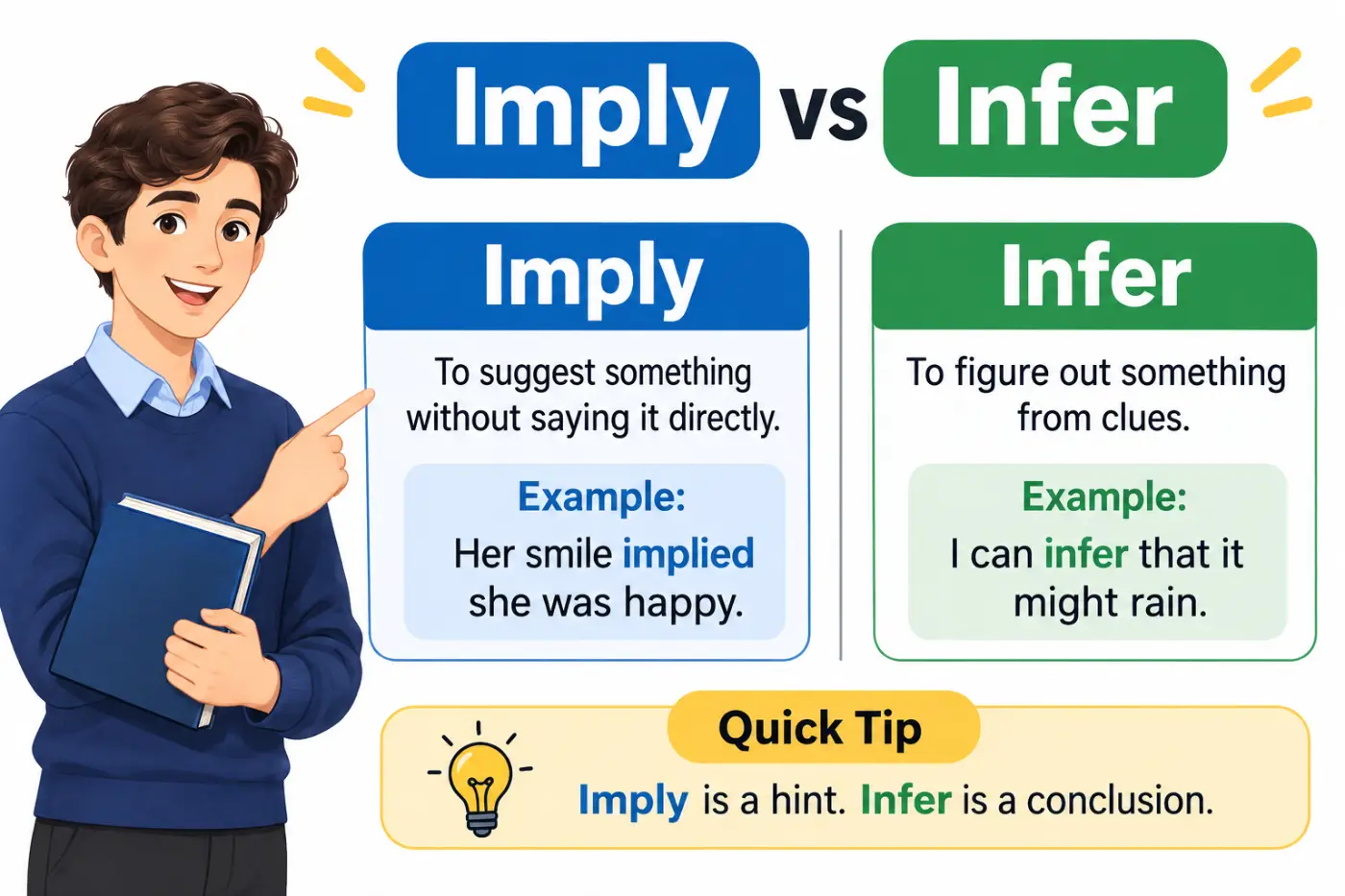
Answer Box: Imply means to suggest something without saying it directly. Infer means to understand or reach a conclusion based on clues, facts, or evidence. The speaker implies, while the listener infers.
Understanding the difference between these words can make your writing clearer and help you avoid common grammar mistakes. In this guide, you’ll learn their meanings, origins, synonyms, examples, differences, and the best ways to use them in everyday conversations, professional emails, and academic writing.
What Is the Difference Between Imply vs Infer?
The main difference comes down to who is communicating and who is understanding the message.
Imply means to communicate an idea indirectly. A person may suggest something through their choice of words, facial expressions, tone, or actions without directly expressing it.
Infer means to reach a conclusion based on information, clues, or evidence. Instead of receiving a direct statement, someone uses what they notice to understand the intended meaning.
Consider this simple example:
- The teacher implied that the students needed to study harder.
- The students inferred from the teacher’s comments that the next test would be difficult.
In the first sentence, the teacher communicates an indirect message. In the second sentence, the students understand that message by thinking about what the teacher said.
| Word | Main meaning | Person performing the action |
|---|---|---|
| Imply | Suggest something indirectly | Speaker or writer |
| Infer | Understand something from clues | Listener or reader |
Where Do Imply and Infer Come From?
Understanding the origins of words can make their meanings easier to remember. These two verbs have different Latin roots, and their original meanings help explain how we use them today.
The Origin of Imply
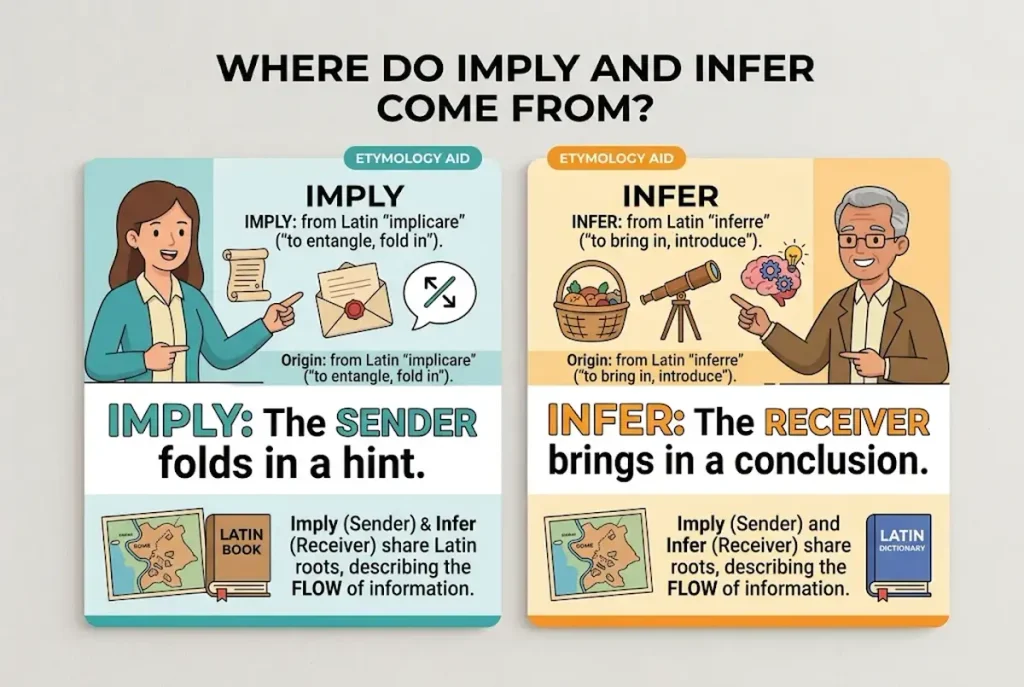
The word imply comes from the Latin word implicare, which means to involve, entangle, or connect something with something else.
It entered English through Old French and developed into the modern meaning of suggesting or expressing something indirectly.
Today, imply is commonly used when a person communicates an idea without stating it clearly.
For example:
- Her smile implied that she already knew the answer.
- The email implied that the company was considering changes.
- His silence implied that he disagreed with the decision.
The Origin of Infer
The word infer comes from the Latin word inferre, which means to bring in, carry in, or bring forward.
Over time, its English meaning developed into reaching a conclusion or understanding something through reasoning and evidence.
For example:
- I inferred from his expression that he was disappointed.
- The detective inferred that someone had entered through the back door.
- Readers can infer the character’s feelings from the story.
Why Their Origins Matter
The origins reveal an important difference.
Imply focuses on putting an idea into a message indirectly. Infer focuses on bringing meaning out of the information someone receives.
This distinction is useful in conversations, storytelling, reading comprehension, research, and professional communication.
What Does Imply Mean in Simple English?
Imply means to suggest, indicate, or communicate something without saying it directly.
When someone implies something, the listener or reader must understand the hidden or indirect meaning.
For example:
- My boss implied that I should arrive earlier.
- Her answer implied that she wasn’t interested.
- The advertisement implies that the product can save time.
How Is Imply Used in Everyday English?
People use imply in many situations where they want to communicate indirectly.
In conversations: A friend might say, I guess some people remember birthdays better than others. This could imply that you forgot their birthday.
At work: A manager might say, We need someone who can take more responsibility. This could imply that an employee should improve their performance.
In writing: An author may describe a character looking away during a conversation. This action might imply guilt, embarrassment, or dishonesty.
What Can a Person Imply?
A person can imply several things through communication.
- An opinion without directly expressing it.
- A warning without giving a direct command.
- A criticism without openly blaming someone.
- A feeling through facial expressions or tone.
- An expectation through a carefully worded message.
What Does Infer Mean in Simple English?
Infer means to reach a conclusion by using information, facts, observations, or clues.
When you infer something, you think about the available evidence and decide what it probably means.
For example:
- I inferred that she was tired because she kept yawning.
- The students inferred the answer from the passage.
- The detective inferred that the suspect had left early.
How Is Infer Used in Everyday English?
Infer is especially common when people describe reasoning, reading, observation, and problem solving.
In conversations: Your friend keeps checking the clock and looking toward the door. You infer that they need to leave soon.
At school: A student reads a story and infers that the main character feels lonely based on the character’s behavior.
At work: A supervisor notices several customer complaints about the same problem and infers that the company needs to improve its service.
In daily life: You see dark clouds and infer that it might rain.
What Can a Person Infer?
A person can infer:
- Someone’s feelings from facial expressions.
- A writer’s message from a passage.
- A possible outcome from available evidence.
- A person’s intentions from their behavior.
- A hidden fact from several connected clues.
What Are the Best Synonyms for Imply vs Infer?
Synonyms help you express ideas naturally without repeating the same words. However, not every synonym has exactly the same meaning.
Some words describe indirect communication, while others describe understanding or reasoning.
The following table groups useful alternatives by tone and gives examples of how to use them.
Simple Synonyms
These words are easy to understand and work well in everyday conversations.
| Word | Meaning | Tone | Example |
|---|---|---|---|
| Suggest | Present an idea indirectly | Simple | Her words suggest a problem. |
| Hint | Give a small clue | Simple | He hinted that he wanted help. |
| Show | Make something noticeable | Simple | Her expression showed concern. |
| Mean | Express an intended idea | Simple | I didn’t mean to offend you. |
| Guess | Form an idea without complete information | Simple | I guessed that he was busy. |
| Notice | Become aware of something | Simple | I noticed that she looked upset. |
| Understand | Know the meaning of something | Simple | I understood his message. |
| See | Recognize or realize something | Simple | I could see that he was nervous. |
Everyday Synonyms
These words are useful in normal conversations, emails, and general writing.
| Word | Meaning | Tone | Example |
|---|---|---|---|
| Indicate | Point toward an idea or fact | Everyday | The results indicate improvement. |
| Express | Communicate a thought or feeling | Everyday | She expressed her disappointment. |
| Reveal | Make something known | Everyday | His reaction revealed his feelings. |
| Signal | Give a sign or warning | Everyday | The message signaled a change. |
| Discover | Find something through investigation | Everyday | We discovered the real reason. |
| Recognize | Identify or understand something | Everyday | I recognized the hidden message. |
| Conclude | Reach a decision through reasoning | Everyday | We concluded that the plan was risky. |
| Detect | Notice something that is not obvious | Everyday | The doctor detected a small change. |
Formal Synonyms
These alternatives are suitable for academic papers, reports, business communication, and professional writing.
| Word | Meaning | Tone | Example |
|---|---|---|---|
| Convey | Communicate an idea or feeling | Formal | The report conveys serious concerns. |
| Impart | Communicate or pass on information | Formal | The speaker imparted an important message. |
| Denote | Represent or indicate something | Formal | The symbol denotes a particular value. |
| Signify | Have a particular meaning | Formal | The results signify major progress. |
| Suggest | Indicate a possible conclusion | Formal | The findings suggest a connection. |
| Deduce | Reach a conclusion through logical reasoning | Formal | Researchers deduced the likely cause. |
| Ascertain | Find out something with certainty | Formal | The team ascertained the actual cause. |
| Determine | Establish something through investigation | Formal | The evidence determined the outcome. |
Which Synonyms Are Stronger or Weaker?
Some alternatives communicate a gentle suggestion, while others express a clear indication or a strong conclusion.
Choosing the right intensity helps you avoid making a message sound stronger or weaker than you intend.
Mild Words
Mild alternatives communicate an idea gently or leave room for interpretation.
| Word | Meaning | Example |
|---|---|---|
| Hint | Give a small clue | He hinted that he needed help. |
| Suggest | Present a possible idea | Her words suggest a new plan. |
| Seem | Give an impression | The situation seems unusual. |
| Indicate | Point toward something | The chart indicates growth. |
Moderate Words
These words communicate a clearer message or a more developed understanding.
| Word | Meaning | Example |
|---|---|---|
| Signal | Communicate through a sign | His response signaled concern. |
| Show | Make something apparent | The results show improvement. |
| Reveal | Make information known | The letter revealed the truth. |
| Conclude | Reach an informed decision | We concluded that the offer was fair. |
Strong Words
These words suggest a more definite message or a conclusion supported by stronger evidence.
| Word | Meaning | Example |
|---|---|---|
| Demonstrate | Show something clearly | The experiment demonstrates the effect. |
| Establish | Prove or confirm something | The investigation established the facts. |
| Confirm | Verify that something is true | The results confirmed our suspicion. |
| Prove | Establish something with sufficient evidence | The records proved the claim. |

Can Imply and Infer Be Used as Different Parts of Speech?
Yes. Both words belong to the verb family, but they also have related noun and adjective forms.
Understanding these forms can improve your vocabulary and help you recognize them in different types of writing.
| Verb | Noun | Related adjective | Meaning |
|---|---|---|---|
| Imply | Implication | Implicit | Suggest or communicate indirectly |
| Infer | Inference | Inferential | Reach a conclusion from evidence |
Related Forms of Imply
Imply: To suggest something without stating it directly.
Example: His comment implied that the meeting was unnecessary.
Implication: An indirect meaning or possible consequence of something.
Example: The implication of her statement was clear.
Implicit: Suggested or understood without being directly expressed.
Example: There was an implicit agreement between the two teams.
Related Forms of Infer
Infer: To reach a conclusion from available information.
Example: We inferred that the road was closed.
Inference: A conclusion reached through reasoning.
Example: Her inference was based on the available evidence.
Inferential: Related to the process of drawing conclusions.
Example: The study included inferential analysis of the results.
Be careful not to confuse implicit with inferred. Implicit describes something suggested without being directly stated. Inferred describes something understood through reasoning.
Are Imply and Infer Different in American and British English?
No major difference exists between American and British English in the meanings of these two words.
Both varieties use imply for indirect communication and infer for reaching a conclusion.
The spelling is also the same in both countries.
| Feature | American English | British English |
|---|---|---|
| Imply | Imply | Imply |
| Infer | Infer | Infer |
| Implication | Implication | Implication |
| Inference | Inference | Inference |
| Meaning | Same | Same |
| Spelling | Same | Same |
Which Word Should You Use in a Resume?
Use imply when you want to describe what a statement, achievement, or professional action indirectly suggests. However, direct and specific language is usually stronger in a resume.
Use infer when describing how you understood information, identified a problem, or reached a conclusion.
Example using imply:
The company’s positive feedback implied that my customer service skills met its expectations.
Example using infer:
I inferred customer needs from feedback and recommended practical improvements.
For a professional resume, the second example is more useful because it describes a specific skill and action.
Other useful resume alternatives include:
- Identified.
- Analyzed.
- Recognized.
- Evaluated.
- Determined.
Which Word Should You Use in an Essay?
Use imply when explaining what an author suggests through a character, sentence, symbol, or literary technique.
Use infer when describing the conclusion a reader reaches after examining the text.
Example using imply:
The author’s description of the empty house implies that the family has experienced a difficult loss.
Example using infer:
Readers can infer that the main character feels isolated from the way he avoids other people.
In literary analysis, this distinction is especially important.
The author creates meaning through words and storytelling choices. The reader examines those choices and develops an interpretation.
Which Word Should You Use in Texting?
In casual text messages, imply works when someone communicates an indirect message.
Infer works when you understand what another person means without receiving a direct explanation.
Example using imply:
You implied that you wanted me to call you, but you never asked directly.
Example using infer:
I inferred from your message that you were upset with me.
In casual texting, you can also use simpler alternatives such as hinted, suggested, figured out, and picked up on.
These expressions often sound more natural in friendly conversations.
What Are 12 Examples of Imply and Infer in Real Situations?
The easiest way to understand these verbs is to see how they work in different situations.
The following original examples cover school, work, relationships, communication, and everyday activities.
Examples of Imply
1. At work: The manager implied that employees needed to improve their communication skills.
2. In a relationship: Her silence implied that she was disappointed with his decision.
3. At school: The teacher implied that the students should review the previous lesson before the exam.
4. In an email: The client’s response implied that the proposed price was too high.
5. In a conversation: His question implied that he already knew about the problem.
6. In a story: The dark clouds in the opening scene implied that something unpleasant was about to happen.
Examples of Infer
7. At work: I inferred from the manager’s comments that the project needed more attention.
8. In a relationship: She inferred from his short replies that he was upset.
9. At school: The students inferred the character’s feelings from the way she behaved.
10. In an email: I inferred that the meeting had been postponed because the invitation was removed.
11. In everyday life: We inferred that the restaurant was closed because all the lights were off.
12. During an investigation: The detective inferred that the missing documents had been removed before the office closed.
What Is the Difference Between Imply and Suggest?
Imply and suggest are closely related because both can describe indirect communication.
However, suggest is more flexible and can describe directly presenting an idea, making a recommendation, or indicating a possibility.
Imply usually focuses on an unstated meaning that someone communicates indirectly.
| Feature | Imply | Suggest |
|---|---|---|
| Main meaning | Communicate indirectly | Present an idea or possibility |
| Direct recommendation | Not its usual meaning | Common |
| Hidden message | Common | Possible |
| Everyday use | Moderate | Very common |
| Example | His tone implied anger. | I suggest taking a break. |
What Is the Difference Between Infer and Deduce?
Infer and deduce both describe reaching a conclusion through reasoning.
The main difference is that deduce often emphasizes a logical conclusion based on specific facts or established information. Infer is broader and can involve observations, context, clues, and evidence.
| Feature | Infer | Deduce |
|---|---|---|
| Main meaning | Reach a conclusion from information | Reach a logical conclusion from facts |
| Reasoning | Broad | Often more systematic |
| Evidence | Clues or observations | Facts, rules, or established information |
| Common use | Everyday and academic | Academic, scientific, and investigative |
| Example | I inferred that she was tired. | We deduced the answer using the formula. |
What Are Common Mistakes When Using These Words?
Even experienced English speakers sometimes confuse these verbs. Most mistakes happen because people focus on the message instead of the person communicating or interpreting it.
Here are the most common problems and how to avoid them.
Using Imply When You Mean Infer
Incorrect: I implied from her expression that she was angry.
Correct: I inferred from her expression that she was angry.
Why?
You are interpreting someone’s expression, not communicating an indirect message. Therefore, infer is the correct verb.
Using Infer When You Mean Imply
Incorrect: The teacher inferred that the students needed more practice.
Correct: The teacher implied that the students needed more practice.
Why?
The teacher is communicating an indirect message. The teacher is not drawing a conclusion from someone else’s information.
Assuming Every Implication Is a Fact
Incorrect: His comment implied that the company was closing, so the company must be closing.
Correct: His comment implied that the company might be closing, but further information is needed.
Why?
An implied message does not automatically establish the truth. It may be misunderstood or based on incomplete information.
Treating Every Inference as Certain
Incorrect: I inferred that she was unhappy, so I know exactly how she feels.
Correct: I inferred that she might be unhappy from her behavior.
Why?
An inference is a conclusion based on available evidence. It can be reasonable without being completely accurate.
Confusing Imply With Explicitly State
Incorrect: He implied directly that he wanted a promotion.
Better: He directly stated that he wanted a promotion.
Why?
Imply generally describes indirect communication. If someone clearly expresses an idea, say that they stated, explained, or declared it.
When Should You Not Use Imply or Infer?
Although these words are useful, they aren’t always the best choices.
When Someone Clearly States Something
Don’t use imply when a person communicates an idea directly.
Less natural: She implied that the meeting would begin at nine by announcing the time.
Better: She stated that the meeting would begin at nine.
When You Have No Evidence
Don’t use infer when your conclusion has no reasonable support.
For example, saying I inferred that he dislikes me simply because I don’t know him may suggest an unsupported assumption.
A better choice might be I guessed that he might not like me.
When You Want to Give a Direct Recommendation
Don’t use imply when you simply want to recommend an action.
Less natural: I imply that we should leave early.
Better: I suggest that we leave early.
What Are the Antonyms of Imply and Infer?
Antonyms are words with opposite or contrasting meanings.
The two verbs have different meanings, so their opposites are not exactly the same.
Antonyms of Imply
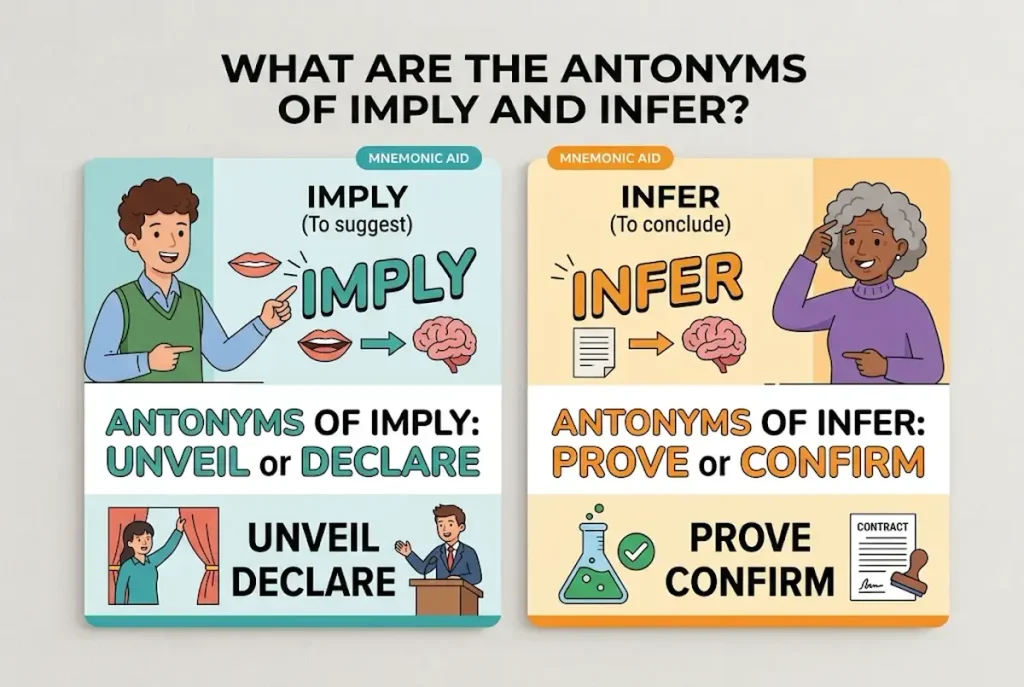
These words describe communicating something openly rather than suggesting it indirectly.
- State: Express something clearly.
- Declare: Make an official or direct statement.
- Explain: Make an idea understandable.
Antonyms of Infer
These words describe accepting or receiving information rather than reaching a conclusion through reasoning.
- Ignore: Refuse to pay attention to information.
- Overlook: Fail to notice something.
- Misunderstand: Interpret something incorrectly.
Conclusion
Understanding the difference between Imply vs Infer becomes easier when you focus on who is communicating and who is interpreting the message. Imply describes suggesting an idea without expressing it directly, while infer describes reaching a conclusion through clues, facts, or observations.
Both words are useful in everyday conversations, academic writing, professional emails, and storytelling. Remember that an indirect message doesn’t always reveal the complete truth, and an inference isn’t always correct.
Always consider the context before choosing your verb. With regular practice, you’ll recognize the difference naturally and use both words with greater confidence in your speaking and writing.
Frequently Asked Questions
What is the easiest way to remember imply and infer?
Remember that speakers imply and listeners infer. The speaker suggests an indirect message, while the listener uses that message to reach a conclusion.
Can imply and infer be used in the same sentence?
Yes, both words can appear in the same sentence. For example, The teacher implied that the test would be difficult, so the students inferred that they needed more preparation.
Is imply the same as suggest?
They have similar meanings, but they aren’t always interchangeable. Imply usually means communicating something indirectly, while suggest can also mean offering a recommendation or presenting an idea.
What is the noun form of infer?
The noun form of infer is inference. It describes a conclusion reached through reasoning, observation, or evidence.
What is the opposite of imply?
Words such as state, declare, announce, and explicitly express can work as opposites of imply because they describe communicating something directly.
What’s another way to say infer?
Other ways to express infer include conclude, deduce, figure out, understand, and determine. The best alternative depends on the situation and the type of reasoning involved.
Is it correct to say I implied from his behavior?
No, this sentence is incorrect if you mean that you understood something from his behavior. The correct sentence is I inferred from his behavior that he was upset.
Why do people confuse imply and infer?
People confuse them because both words involve communication and meaning. However, imply describes sending an indirect message, while infer describes interpreting information and reaching a conclusion.

Daniel Grammarfield — The Language Learner
Age: 28Occupation: ESL Learner & Digital Professional
Bio:Daniel is a non-native English speaker who wants to communicate more confidently at work and online. He uses Synotrench to improve grammar, understand confusing words, learn correct sentence structures, and build everyday English skills. He prefers simple explanations with practical examples.
Goals:
Master English grammar rules
Avoid common language mistakes
Improve professional communication
Learn English through real-life examples
Quote:“Learning English is not about memorizing rules — it’s about expressing ideas clearly.”
3 thoughts on “Imply vs Infer: Best Ways to Understand the Difference”