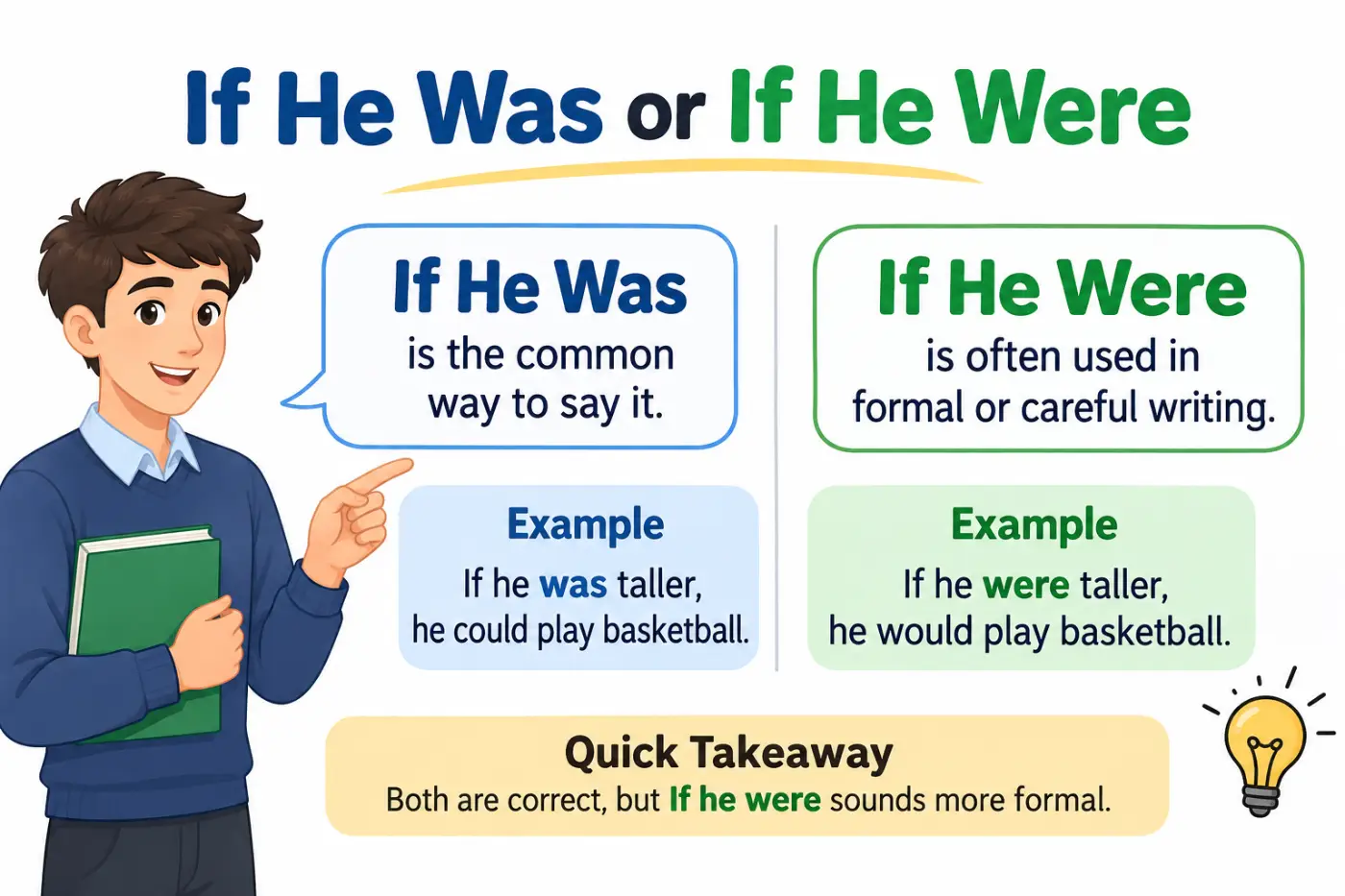
Have you ever stopped while writing an email or school essay because you weren’t sure which sentence sounded correct? You might write, If he was here, he would help us, and then wonder if you should use were instead of was. Both forms appear in English, but they don’t always communicate the same idea or follow the same grammar pattern.
The difference between these expressions comes down to the meaning of your sentence. Was usually describes something that happened or existed in the past. Were can describe an imaginary, unlikely, or unreal situation. However, modern English also allows was in many hypothetical sentences, especially in everyday conversations.
The simple answer is that both forms can be grammatically correct, but were is traditionally preferred for imaginary or contrary to fact situations. Was is generally used for real past situations and is also common in informal hypothetical statements.
In this guide, you’ll learn the difference between the two forms, their grammatical origins, and how to choose the right one in everyday conversations, emails, essays, and professional writing. You’ll also find practical examples, common mistakes, alternative expressions, and answers to frequently asked questions.
What Is the Difference Between If He Was and If He Were?
The main difference is the mood of the verb. Was is the simple past form of the verb be for he, she, and it. Were is normally used with you, we, and they in the past tense, but it also has a special grammatical role called the subjunctive mood.
The subjunctive mood helps express situations that are imaginary, unlikely, or contrary to reality.
Consider these examples:
| Expression | Example | Meaning |
|---|---|---|
| If he was | If he was tired, he didn’t show it. | Refers to a possible real situation in the past. |
| If he were | If he were tired, he would go home. | Presents an imagined or hypothetical situation. |
The first sentence considers a real possibility. Perhaps the person was tired, but the speaker isn’t certain.
The second sentence imagines a situation. The speaker is thinking about what would happen if he were tired.
Here are two more examples:
- If he was at the office yesterday, he probably saw the manager. This refers to a possible past event.
- If he were the manager, he would change the office rules. This imagines him in a position he doesn’t currently hold.
Where Did Was and Were Come From?
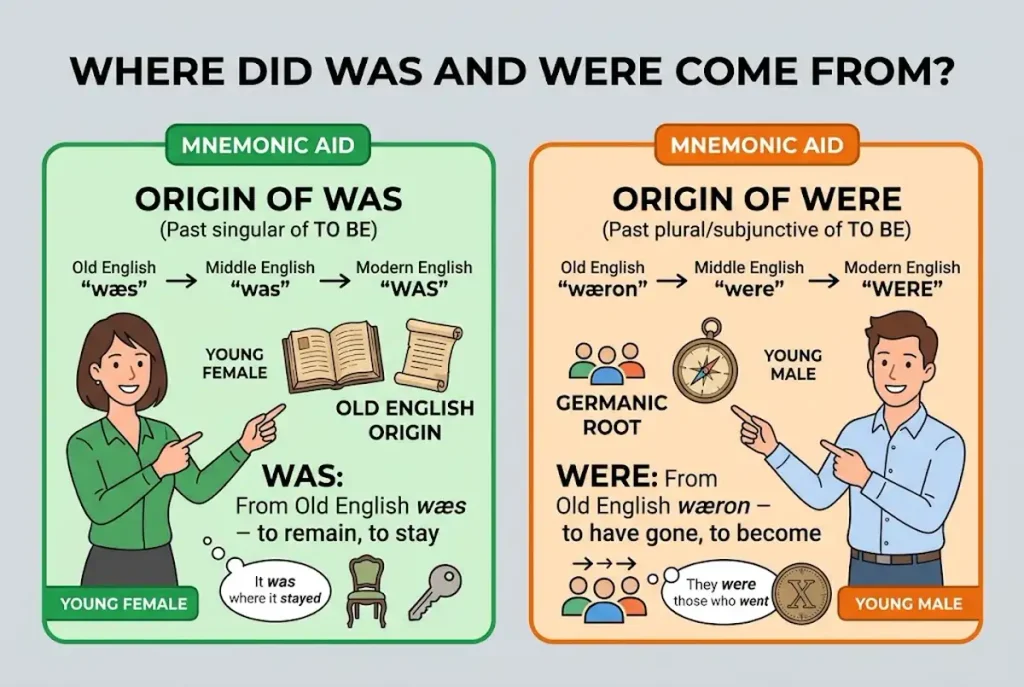
Both words come from the same English verb: be.
The verb be has several forms, including am, is, are, was, were, been, and being. These forms help describe existence, identity, conditions, and states.
However, their history explains why English uses them differently.
What Is the Origin of Was?
Was comes from Old English and developed as a past form of the verb be.
Over time, English established was as the normal past form for first and third person singular subjects in the indicative mood.
For example:
- He was happy yesterday.
- She was at school last week.
- It was raining in the morning.
What Is the Origin of Were?
Were also comes from Old English. Its history is connected to older forms of the verb be, including forms used in the past subjunctive.
English gradually lost many of its older subjunctive verb forms. However, were survived in certain expressions, especially those involving imaginary situations and wishes.
The special use of were became associated with hypothetical statements.
For example:
- If I were rich, I would travel around the world.
- If he were here, we could discuss the problem.
- I wish she were more confident.
What Does the Subjunctive Mood Mean in Simple English?
The subjunctive mood is a verb form used to express situations that aren’t presented as ordinary facts.
It commonly appears when someone:
- Imagines a different situation.
- Expresses a wish.
- Describes something contrary to reality.
- Talks about an unlikely possibility.
- Gives advice using an imaginary situation.
For example:
If he were a famous singer, he would perform around the world.
This sentence doesn’t say that he is a famous singer. It imagines what his life would look like if he had that position.
Is Were a Past Tense or a Subjunctive Form?
Were can serve two grammatical purposes.
First, it is the ordinary past tense form used with plural subjects and the pronoun you.
Examples:
- They were happy.
- We were ready.
- You were correct.
Second, it can work as the past subjunctive form with singular subjects such as he, she, and I.
Examples:
- If he were older, he could apply.
- If she were here, she would understand.
- If I were the teacher, I would explain the lesson differently.
When Should You Use If He Was?
Use was when you’re talking about a real past situation, asking about something that might have happened, or describing a past condition.
It is also commonly used in conversational English for hypothetical situations.
When Describing a Real Past Event
Use was when you are discussing something that may have actually happened.
Examples:
- If he was at the meeting, he heard the announcement.
- If he was sick yesterday, he should have stayed home.
- If he was your teacher, he probably knew the answer.
When Asking About an Uncertain Situation
Was is also useful when you aren’t sure about something that happened.
Examples:
- If he was angry, I didn’t notice.
- If he was upset about the decision, he never mentioned it.
- If he was responsible for the mistake, we need to understand why.
When Speaking Informally
In everyday American English, people frequently use was in hypothetical sentences.
For example:
If he was here, he would know what to do.
This construction is common in casual speech. Many speakers use it naturally instead of the more traditional subjunctive form.
When Should You Use If He Were?
Use were when you’re describing an imaginary, unlikely, or contrary to reality situation.
It is especially useful in formal writing, academic assignments, professional communication, and careful speech.
When Describing an Imaginary Situation
Use were when you’re imagining something that isn’t currently true.
Examples:
- If he were a doctor, he could treat the patients.
- If he were the president, he would change the law.
- If he were taller, he could reach the shelf.
When Giving Advice
Were is especially common in advice giving.
For example:
If I were you, I would accept the job.
This is a standard English expression. It means that the speaker is imagining being in another person’s position.
You can also use similar expressions:
- If I were in your position, I would wait.
- If I were in his shoes, I would apologize.
- If I were in her situation, I would ask for help.
When Expressing a Wish
Were can also appear after wish when someone wants a situation to be different.
Examples:
- I wish he were here.
- I wish he were more careful.
- She wishes he were available today.
What Are the Best Alternative Expressions?
Because this topic involves two grammatical constructions rather than two completely different vocabulary words, there aren’t direct synonyms for both expressions.
However, several related expressions can communicate similar meanings.
The following table groups useful alternatives by tone and context.
Simple Alternatives
| Word or Expression | Meaning | Tone | Example |
|---|---|---|---|
| If he existed | Imagines his existence | Simple | If he existed, we would find him. |
| If he was here | Considers his presence | Simple | If he was here, he could help. |
| If he were present | Imagines his attendance | Simple | If he were present, we could begin. |
| If he could come | Imagines his ability to attend | Simple | If he could come, we would celebrate. |
| If he had time | Imagines available time | Simple | If he had time, he would visit. |
| Suppose he were | Introduces an imagined situation | Simple | Suppose he were the leader. |
Everyday Alternatives
| Word or Expression | Meaning | Tone | Example |
|---|---|---|---|
| Imagine he were | Asks someone to picture a situation | Everyday | Imagine he were your teacher. |
| If he happened to be | Considers a possible condition | Everyday | If he happened to be nearby, call him. |
| If he turned out to be | Considers a possible discovery | Everyday | If he turned out to be right, apologize. |
| If he could be | Imagines a possible condition | Everyday | If he could be here, he would help. |
| If he were around | Imagines his availability | Everyday | If he were around, ask him. |
| In case he was | Considers a possible past situation | Everyday | In case he was waiting, send a message. |
| Assuming he was | Takes something as a possible condition | Everyday | Assuming he was available, we could invite him. |
Formal Alternatives
| Word or Expression | Meaning | Tone | Example |
|---|---|---|---|
| Were he to be | Formal hypothetical construction | Formal | Were he to be selected, he would accept. |
| Were he present | Formal way to imagine attendance | Formal | Were he present, he could answer. |
| If he were to become | Imagines a possible future change | Formal | If he were to become director, he would reorganize the team. |
| Supposing he were | Introduces a hypothetical situation | Formal | Supposing he were responsible, what would happen? |
| In the event that he was | Refers to a possible condition | Formal | In the event that he was absent, record it. |
| Provided that he was | Expresses a condition | Formal | Provided that he was eligible, he could apply. |
| Were he in a position to | Describes an imagined ability or opportunity | Formal | Were he in a position to help, he would do so. |
How Does the Choice Change With Intensity?
The expressions don’t have different levels of emotional intensity in the same way as adjectives such as happy, excited, or furious.
Instead, the difference involves how strongly a speaker presents a situation as real, possible, or imaginary.
The following scale shows how different expressions can communicate different degrees of certainty.
| Level | Expression | Example |
|---|---|---|
| Mild possibility | If he was | If he was busy, he couldn’t answer. |
| Open possibility | If he might be | If he might be available, invite him. |
| Imagined situation | If he were | If he were available, he would join us. |
| Strongly hypothetical | Were he to be | Were he to be selected, he would accept. |
| Contrary to reality | If he had been | If he had been there, he would have helped. |
What Are the Best Words by Part of Speech?
Was and were are both forms of the verb be. They are not nouns, adjectives, or adverbs.
Understanding their grammatical role makes it easier to use them correctly.
| Grammatical Form | Word | Example |
|---|---|---|
| Base verb | Be | He wants to be successful. |
| Present singular | Is | He is happy. |
| Present plural | Are | They are ready. |
| Past singular | Was | He was tired. |
| Past plural | Were | They were tired. |
| Past participle | Been | He has been helpful. |
| Present participle | Being | He is being polite. |
| Subjunctive form | Were | If he were here, he would help. |
Is There a Difference Between American and British English?
The basic grammatical distinction is similar in American and British English.
Both varieties use were for traditional hypothetical subjunctive constructions. Both also use was in ordinary past statements.
However, everyday speech in both varieties can include was in hypothetical sentences.
For example:
- American English: If he was here, he would help us.
- American English: If he were here, he would help us.
- British English: If he was here, he would help us.
Which Form Should You Use in Different Situations?
The best choice depends on your audience and the purpose of your writing.
Which Form Is Better for a Resume?
Use were when describing hypothetical situations in professional writing.
For example:
If he were selected for the position, he would bring strong communication and leadership skills.
However, resumes usually describe actual experience rather than imaginary situations.
A more direct professional sentence would be:
He demonstrated strong communication and leadership skills in his previous position.
The second example is more effective because it describes real experience.
Which Form Is Better for an Essay?
Were is generally the better choice when writing a formal academic essay about an imaginary situation.
Example:
If he were given the opportunity to lead the project, he would introduce several improvements.
This sentence sounds appropriate for academic writing because it uses the traditional subjunctive construction.
When discussing a real past possibility, was remains appropriate.
Example:
If he was absent from the classroom, the teacher should check the attendance record.
Which Form Is Better for Texting?
Both forms are common in casual messages.
Example:
If he was there, he probably knows what happened.
You could also write:
If he were there, he would understand everything.
In texting, natural communication is usually more important than maintaining a highly formal style.
Still, using were in hypothetical situations is always a useful choice.
What Are 12 Correct Example Sentences?
Examples are one of the easiest ways to understand how these forms work in real situations.
Here are 12 original sentences with explanations.
Examples Using Was
1. If he was at the library yesterday, he probably borrowed that book.
This sentence considers a possible event in the past.
2. If he was feeling sick, he should have visited a doctor.
The speaker considers a possible past condition.
3. If he was responsible for the project, he should explain the delay.
The sentence refers to a possible real responsibility.
4. If he was waiting outside, he must have seen our car.
This describes a possible past situation.
5. If he was unhappy with the decision, he could have spoken to the manager.
The speaker considers a possible reaction.
6. If he was working last night, he might be tired today.
The sentence considers a possible past activity and its present result.
Examples Using Were
7. If he were the captain, he would lead the team confidently.
This imagines him in a position he doesn’t currently hold.
8. If he were taller, he could become a basketball player.
This describes an imaginary condition.
9. If he were here, we would celebrate together.
The speaker imagines his presence.
10. If he were my friend, I would tell him the truth.
This describes a hypothetical relationship.
11. If he were more careful, he wouldn’t make so many mistakes.
The sentence imagines a different personal quality.
12. If he were the owner of the company, he would change the working hours.
This imagines him in a different professional position.
What Is the Difference Between Was and Were in Close Examples?
Sometimes two sentences look almost identical but communicate different ideas.
Understanding these differences helps prevent confusion.
If He Was Tired vs If He Were Tired
| If He Was Tired | If He Were Tired |
|---|---|
| If he was tired, he went to bed early. | If he were tired, he would go to bed early. |
| Considers a possible past condition. | Imagines a condition and its result. |
| Often refers to a real situation. | Usually describes a hypothetical situation. |
If He Was Here vs If He Were Here
| If He Was Here | If He Were Here |
|---|---|
| If he was here yesterday, he saw the event. | If he were here now, he would help us. |
| Refers to a possible past presence. | Imagines a present situation. |
| Uses the ordinary past form. | Uses the subjunctive form. |
The time reference makes a major difference.
If He Was Rich vs If He Were Rich
| If He Was Rich | If He Were Rich |
|---|---|
| If he was rich when he lived abroad, I never knew. | If he were rich, he would buy a bigger house. |
| Discusses a possible past fact. | Imagines a different financial situation. |
| Uses was as an ordinary past form. | Uses were as a subjunctive form. |
What Are the Most Common Grammar Mistakes?
Many English learners struggle with these forms because the ordinary past tense and subjunctive mood sometimes look different.
Here are mistakes worth avoiding.
Using Was for Every Hypothetical Sentence
Incorrect in traditional formal grammar:
If he was the principal, he would change the school rules.
Better for formal writing:
If he were the principal, he would change the school rules.
The first construction is common in informal English, so it isn’t automatically wrong in every situation. However, were is the more traditional choice for a clearly imaginary condition.
Using Were for Every Past Situation
Incorrect for the intended ordinary singular past meaning:
If he were at school yesterday, he attended the class.
Better:
If he was at school yesterday, he attended the class.
The sentence considers a possible past event. There is no need to use the subjunctive form.
Confusing Past Hypotheticals With Present Hypotheticals
Consider these sentences:
If he were here, he would help us.
If he had been here, he would have helped us.
The first sentence imagines a different present situation.
The second imagines a different past situation.
Using the wrong structure can change the time reference.
When Should You Avoid Using Were?
Were is not the right choice simply because a sentence contains the word if.
The word if can introduce many types of conditions, including real possibilities, uncertain events, and imaginary situations.
Use the ordinary past form when you are describing a possible past fact.
For example:
If he was at the hospital yesterday, he might have seen my brother.
This sentence considers a real event.
Don’t automatically change it to were just because the sentence starts with if.
Also, avoid using were in ordinary past statements with singular subjects.
Incorrect:
He were tired after work.
Correct:
He was tired after work.
The subjunctive use of were belongs in particular grammatical structures. It doesn’t replace the ordinary past tense throughout English.
What Are the Antonyms of Was and Were?
Was and were are verb forms, so they don’t have direct antonyms in the same way that words like hot and cold do.
However, their opposite meanings can be expressed through different conditions or ideas.
| Word or Expression | Opposite or Contrast | Example |
|---|---|---|
| Present | Absent | He was present, but his brother was absent. |
| Available | Unavailable | If he were available, he would help. |
| Possible | Impossible | If it were possible, we would try. |
| Real | Imaginary | The event was real, not imaginary. |
| Certain | Uncertain | If he was certain, he would explain. |
These are contextual opposites, not direct grammatical antonyms.
What Are the Best Tips for Choosing the Correct Form?
You don’t need to memorize dozens of complicated grammar rules to understand this difference.
Use these practical tips.
1. Check the time reference. If you’re describing a real past event, was is usually the correct form with he.
2. Look for an imaginary situation. If you’re imagining something that isn’t true, were is the traditional choice.
3. Pay attention to the main clause. Expressions such as would, could, and might often appear in hypothetical sentences.
4. Use were in formal writing. It is generally preferred for traditional subjunctive constructions.
5. Understand everyday speech. Was is common in informal hypothetical statements, especially in conversations.
Conclusion
Understanding the difference between If He Was or If He Were becomes easier when you focus on the meaning of your sentence. Was is the ordinary past form used with he, especially when describing real or possible past events. Were is the traditional subjunctive form used for imaginary, unlikely, or contrary to fact situations.
Although both forms appear in everyday American English, were is generally the stronger choice for formal writing and academic assignments when expressing a hypothetical condition.
Remember that the word if alone doesn’t determine the correct verb. The situation and intended meaning matter most. Practice these examples in your conversations and writing, and you’ll become more confident using both forms correctly.
Frequently Asked Questions
Is If He Was grammatically correct?
Yes, If he was is grammatically correct when discussing a real or possible past situation. It is also common in informal hypothetical statements.
Is If He Were more correct than If He Was?
If he were is traditionally preferred for imaginary or contrary to fact situations. However, if he was is also widely used in modern informal English.
Can I use If He Was in formal writing?
Yes, when discussing a possible or actual past situation. For a clearly imaginary condition, were is generally the better choice in formal writing.
Why do people say If He Were instead of If He Was?
People use were because it is the traditional subjunctive form of be. It helps express imaginary situations, wishes, and conditions that aren’t presented as facts.
What’s another way to say If He Were?
You can use expressions such as Suppose he were, Imagine he were, or Were he to be. The best alternative depends on your sentence and intended meaning.
Should I say If He Were Here or If He Was Here?
If you’re imagining that he is present now, If he were here is the traditional choice. If you’re discussing a possible past presence, If he was here is appropriate.
Is If I Were You always correct?
If I were you is the standard expression for giving advice. It uses the subjunctive form because the speaker is imagining being in another person’s situation.
Can Were refer to the present or future?
Yes. In hypothetical sentences, were can refer to an imagined present or future situation. For example, If he were available tomorrow, we would invite him.

Daniel Grammarfield — The Language Learner
Age: 28Occupation: ESL Learner & Digital Professional
Bio:Daniel is a non-native English speaker who wants to communicate more confidently at work and online. He uses Synotrench to improve grammar, understand confusing words, learn correct sentence structures, and build everyday English skills. He prefers simple explanations with practical examples.
Goals:
Master English grammar rules
Avoid common language mistakes
Improve professional communication
Learn English through real-life examples
Quote:“Learning English is not about memorizing rules — it’s about expressing ideas clearly.”
3 thoughts on “If He Was or If He Were: Best Grammar Guide”