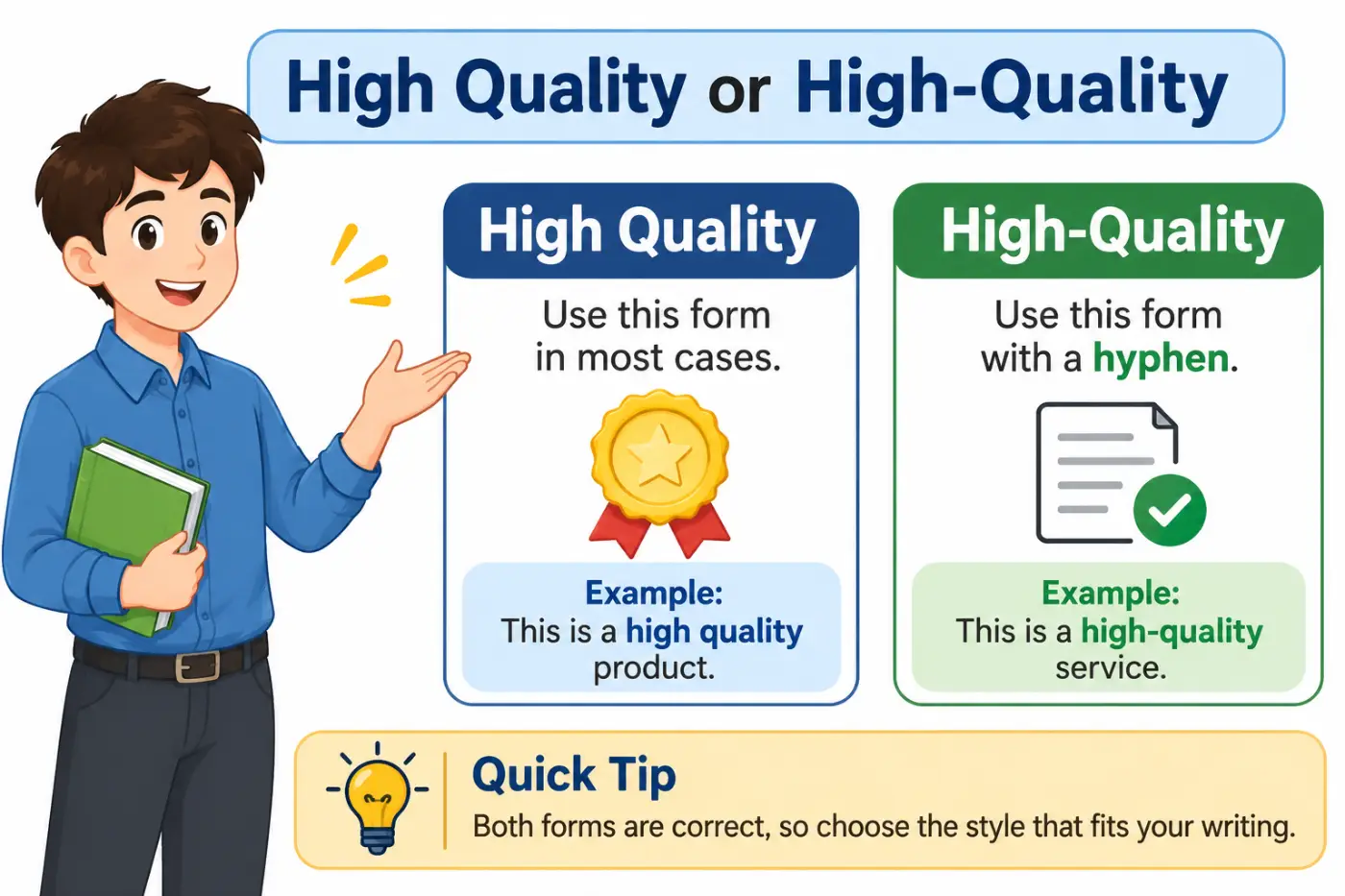
Have you ever stopped while writing an email, resume, or school essay because you weren’t sure if you should write high quality or high-quality? Both forms look correct, and you may have seen them used in different places. This can make a simple writing decision confusing.
The good news is that both forms are correct, but they serve different grammatical purposes. The main difference depends on how the words are used in a sentence. One form is generally used as a compound adjective before a noun, while the other is commonly used as a phrase when it follows a linking verb.
Understanding this small grammar rule can make your writing clearer and more professional. In this guide, you’ll learn the meaning, word formation, grammar rules, examples, common mistakes, and the best form to use in resumes, essays, emails, and everyday conversations.
What Is the Difference Between High Quality and High-Quality?
The main difference is their grammatical position in a sentence. Both expressions describe something that meets a good standard, but the hyphen helps show how the words work together.
Without a Hyphen
High quality is generally written without a hyphen when quality functions as a noun and high describes its level.
Examples:
- The company is known for its high quality.
With a Hyphen
High-quality is a compound adjective. It combines two words to describe a noun that follows.
Examples:
- She bought a high-quality laptop.
Quick Comparison
| High Quality | High-Quality |
|---|---|
| Usually used as a noun phrase | Used as a compound adjective |
| Written without a hyphen | Written with a hyphen |
| Often follows linking verbs | Usually comes before a noun |
| Describes a standard or level | Describes the noun’s standard |
| The service is high quality. | It is a high-quality service. |
Where Did the Words High and Quality Come From?
Understanding the history of words can make their meaning easier to remember.
The Origin of High
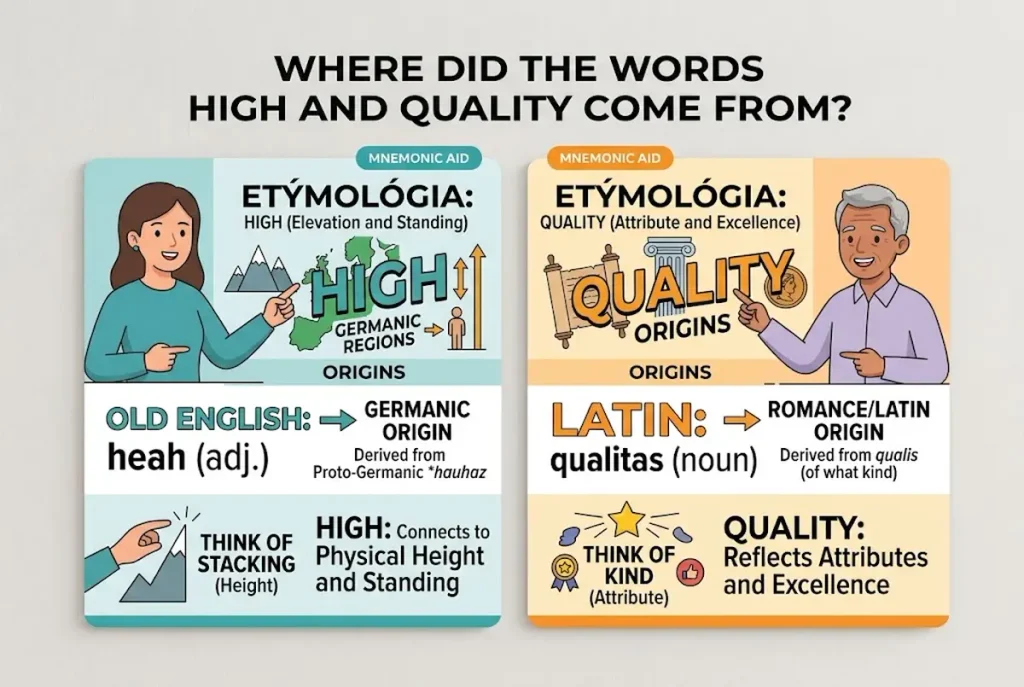
The word high comes from Old English hēah, which described something tall, elevated, or positioned far above the ground.
Over time, its meaning expanded. Today, high can describe physical height, a large amount, a strong level, or an advanced degree.
For example:
- A high mountain describes physical height.
- A high temperature describes a greater level of heat.
- A high price describes something expensive.
The Origin of Word
The word quality comes through Old French qualité and Latin qualitas. It is related to the Latin word qualis, meaning of what kind or what sort.
Its meaning developed to describe the nature, characteristics, or standard of a person or thing.
For example:
- The quality of the fabric is excellent.
How Did High-Quality Become a Compound Expression?
When high and quality work together before a noun, they form a compound modifier.
For example:
- High-quality materials.
The hyphen connects the two words and makes their relationship clear.
What Does High Quality Mean in Simple English?
It means that something has a good standard, performs well, or meets expectations.
It describes something that is made, produced, or delivered with care and attention to important details.
Common Characteristics of Word
- Durability: Something lasts a long time without breaking or wearing out quickly.
- Accuracy: Information is correct and reliable.
- Performance: A product or service works as expected.
- Attention to detail: Small but important parts receive proper care.
- Consistency: The standard remains good over time.
What Are the Best Synonyms for Word?
The best synonym depends on the subject and the level of excellence you want to express. Some words are suitable for everyday conversations, while others work better in professional writing.
Below is a collection of 32 useful alternatives grouped by tone and context.
Simple Synonyms
| Word | Meaning | Tone | Example |
|---|---|---|---|
| Good | Meets a positive standard | Simple | This is a good product. |
| Excellent | Extremely good | Positive | She delivered excellent work. |
| Great | Very good | Casual | They offer great service. |
| Fine | Acceptable or satisfactory | Neutral | The material is of fine quality. |
| Nice | Pleasant or attractive | Casual | It is a nice piece of furniture. |
| Strong | Performs well or has good features | Everyday | The company has a strong product line. |
| Reliable | Can be trusted | Neutral | We need reliable equipment. |
| Solid | Dependable and well made | Casual | This is a solid choice. |
Everyday Synonyms
| Word | Meaning | Tone | Example |
|---|---|---|---|
| Superior | Better than average | Professional | The brand offers superior materials. |
| Premium | Of a higher standard or price category | Commercial | They sell premium coffee. |
| First-rate | Among the best | Positive | The hotel provides first-rate service. |
| Top-notch | Extremely good | Informal | Her presentation was top-notch. |
| Outstanding | Exceptionally good | Positive | He produced outstanding results. |
| Impressive | Creates a strong positive effect | Everyday | The team delivered impressive work. |
| Exceptional | Unusually good | Strong | The product has exceptional durability. |
| Well-made | Constructed with care | Everyday | This is a well-made table. |
Formal Synonyms
| Word | Meaning | Tone | Example |
|---|---|---|---|
| Superior | Higher in standard or performance | Formal | The equipment offers superior performance. |
| Exceptional | Far above the usual standard | Formal | The researcher produced exceptional results. |
| Exemplary | Worthy of imitation | Formal | The company maintains exemplary standards. |
| Outstanding | Remarkably successful or good | Formal | The project received outstanding reviews. |
| Refined | Carefully improved or developed | Formal | The design has a refined appearance. |
| Distinguished | Recognized for excellence | Formal | She has a distinguished academic record. |
| Premium-grade | Made to a particularly high standard | Technical | The manufacturer uses premium-grade steel. |
| First-class | Of an excellent standard | Formal | The business provides first-class support. |
Which Synonyms Are Best From Mild to Strong?
Some alternatives describe an acceptable standard, while others communicate exceptional performance.
Choosing the right level helps prevent exaggeration.
Mild Quality Words
These words describe something that meets basic expectations.
- Acceptable: Good enough for a particular purpose.
- Decent: Satisfactory or reasonably good.
- Fair: At an average or reasonable standard.
- Good: Positive and suitable.
- Solid: Dependable and reasonably strong.
Moderate Words
These words communicate a standard above average.
- Very good: Better than an ordinary standard.
- Reliable: Consistently dependable.
- Well-made: Carefully constructed.
- Superior: Better than comparable options.
- Impressive: Better than expected.
Strong Words
These words describe a particularly high level of excellence.
- Excellent: Extremely good.
- Outstanding: Remarkably successful or impressive.
- Exceptional: Far above the normal standard.
- Exemplary: An excellent example to follow.
- First-rate: Among the best available.
Can High Quality Be Used as a Noun or Adjective?
Yes, but its grammatical role depends on the sentence.
As a Noun Phrase
In the phrase high quality, the word quality is a noun, and high describes its level.
Examples:
- The high quality of this product impressed everyone.
As a Compound Adjective
High-quality works as a compound adjective when it describes a noun.
Examples:
- The company sells high-quality products.
What About High-Quality as a Predicate Adjective?
This is a useful grammar detail.
When a compound adjective follows a linking verb, many style guides recommend removing the hyphen if the meaning remains clear.
However, some publications retain the hyphen for consistency or when a particular house style requires it.
Is High Quality or High-Quality Correct in American English?
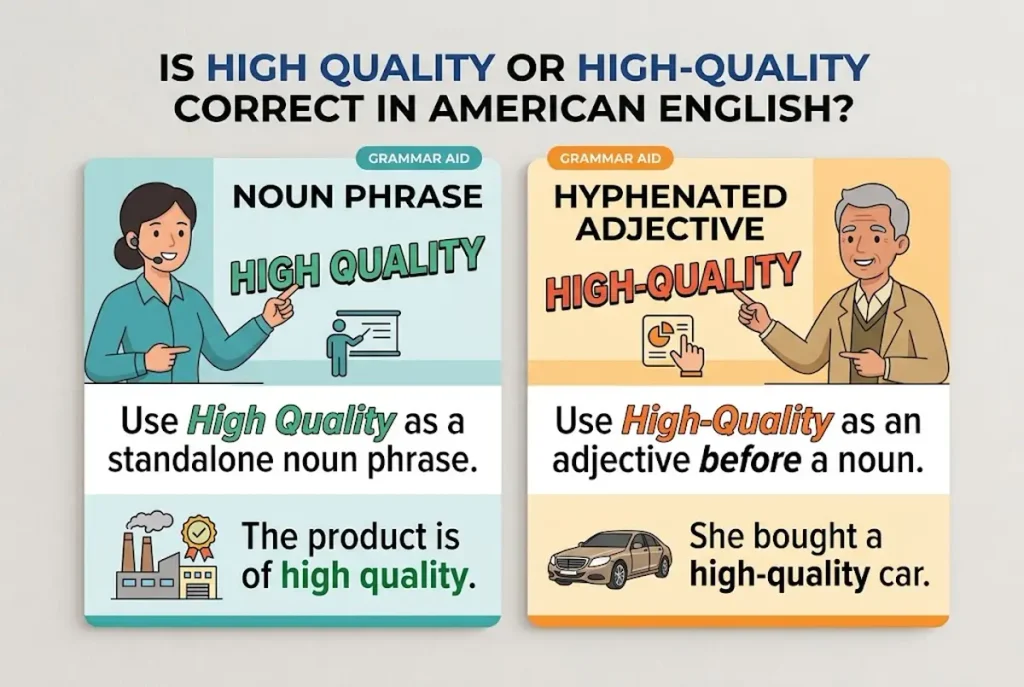
Both forms are correct in American English. The difference is based on grammar, not a spelling difference between countries.
American English generally follows the same compound-modifier rule:
- Use high-quality before a noun when the words work together as one modifier.
- Follow the publication’s style guide if it has a specific preference.
What About British English?
British English also commonly uses high-quality before a noun and high quality in other grammatical positions.
There is no major regional spelling difference between these expressions.
The important point is their grammatical function.
Which Form Should You Use in a Resume?
A resume should communicate your skills and achievements in a clear, professional way.
It is useful when describing work, services, results, or materials.
Examples:
- Created high-quality digital content for business websites.
Which Form Is Best for an Essay?
Academic writing requires clear and precise language. Both expressions are suitable, but the sentence structure determines which form you need.
Examples:
- The researcher collected high-quality data.
Avoid repeating the same adjective in every paragraph.
You can use alternatives such as reliable, accurate, exceptional, well-supported, and rigorous when they match the intended meaning.
For example:
The researchers collected reliable data from several sources.
Which Form Should You Use in Texting?
In casual messages, both expressions are acceptable. Most people focus on the meaning rather than the hyphen.
Examples:
- This phone has really good quality.
- The video looks great.
- That restaurant serves excellent food.
Which Form Is Better for Professional Emails?
Professional emails should be clear, polite, and easy to understand.
when describing a particular product, document, service, or result.
Examples:
- We are looking for high-quality suppliers.
Which Form Sounds Natural When Speaking?
When speaking, the hyphen does not change the pronunciation. Both forms sound the same.
Your listeners understand the intended meaning through the sentence structure and context.
Examples:
- This is a high-quality product.
What Are 12 Examples of High Quality and High-Quality in Real Sentences?
The following examples show how both forms work in different everyday situations.
| No. | Example Sentence | Correct Form | Reason |
|---|---|---|---|
| 1 | She purchased a high-quality camera. | High-quality | Describes camera before the noun. |
| 2 | The camera is high quality. | High quality | Follows the linking verb is. |
| 3 | We need high-quality paper. | High-quality | Describes paper. |
| 4 | The paper is of high quality. | High quality | Refers to the paper’s standard. |
| 5 | They offer high-quality education. | High-quality | Describes education. |
| 6 | Their education is high quality. | High quality | Follows the linking verb is. |
| 7 | The website publishes high-quality articles. | High-quality | Describes articles. |
| 8 | The articles are high quality. | High quality | Describes their standard after are. |
| 9 | He bought a high-quality watch. | High-quality | Describes watch. |
| 10 | The watch has high quality. | High quality | Quality functions as a noun. |
| 11 | We received high-quality service. | High-quality | Describes service. |
| 12 | The service was of high quality. | High quality | Refers to the level of service. |
High Quality vs. Excellent: What’s the Difference?
Both expressions describe something good, but they do not communicate exactly the same idea.
| High Quality | Excellent |
|---|---|
| Describes a strong standard | Describes an extremely good result or condition |
| Often refers to materials, services, or products | Can describe people, work, results, or experiences |
| Can suggest durability or reliability | Usually expresses a strong positive judgment |
| Common in business and product descriptions | Common in general and professional writing. |
High Quality vs. Premium: What’s the Difference?
Premium and high quality are closely related, especially in business and marketing.
However, premium often suggests a higher market category, special features, or a higher price.
| High Quality | Premium |
|---|---|
| Focuses on the standard | Often suggests a higher product category |
| Can describe affordable products | Often associated with more expensive products |
| Emphasizes performance or workmanship | May emphasize materials, features, or exclusivity |
| Does not automatically suggest luxury | Can suggest a luxury or upgraded option |
Examples:
- This company makes high-quality products at affordable prices.
- This company sells premium products with additional features.
A product can be high quality without being expensive. Similarly, a premium price does not automatically prove that a product is well made.
What Are the Common Mistakes With High Quality and High-Quality?
Even experienced writers sometimes use compound adjectives incorrectly. The following mistakes are worth avoiding.
Mistake 1: Leaving Out the Hyphen Before a Noun
Incorrect: We purchased a high quality television.
Better: We purchased a high-quality television.
Why?
High and quality work together to describe television. The hyphen connects them as a compound adjective.
Mistake 2: Adding an Unnecessary Hyphen After a Linking Verb
Less preferred: The television is high-quality.
Preferred: The television is high quality.
Why?
The expression follows the linking verb is. In standard general writing, the open form is preferred.
Mistake 3: Assuming High Quality Always Needs a Hyphen
Incorrect assumption: Every use of high quality must contain a hyphen.
Correct understanding: The hyphen depends on the grammatical position.
Examples:
- We sell high-quality furniture.
- Our furniture is high quality.
Both sentences are correct.
Mistake 4: Using a Hyphen With Every Compound Expression
Not every combination of words needs a hyphen.
For example:
- Good quality products.
- Excellent customer service.
- Superior performance.
- High-quality materials.
The words good quality and excellent service do not need the same hyphen pattern as high-quality when they are used in these constructions.
Mistake 5: Confusing High Quality With Expensive
High quality does not always mean expensive.
A reasonably priced product can be durable, reliable, and carefully made.
For example:
This affordable backpack is high quality and suitable for daily use.
The sentence is perfectly reasonable because price and quality are different ideas.
When Should You Not Use High Quality?
Although the expression is useful, it isn’t always the best choice.
When You Need a More Specific Description
High quality is broad. It does not explain exactly what makes something good.
Instead of:
The company offers high-quality products.
You could write:
The company offers durable products made from recycled materials.
The second sentence gives readers more information.
When You Cannot Support the Claim
Avoid describing something as high quality when you have no evidence to support that statement.
For example, a business should not claim that its product is exceptionally reliable without testing or customer feedback.
Use measurable details when possible.
When a Stronger or More Accurate Word Fits Better
Different subjects require different descriptions.
- Use accurate for information that is correct.
- Use durable for something that lasts.
- Use reliable for something people can depend on.
- Use effective for something that achieves its purpose.
- Use well-made for something carefully constructed.
These alternatives help you communicate more precisely.
What Are the Antonyms of High Quality?
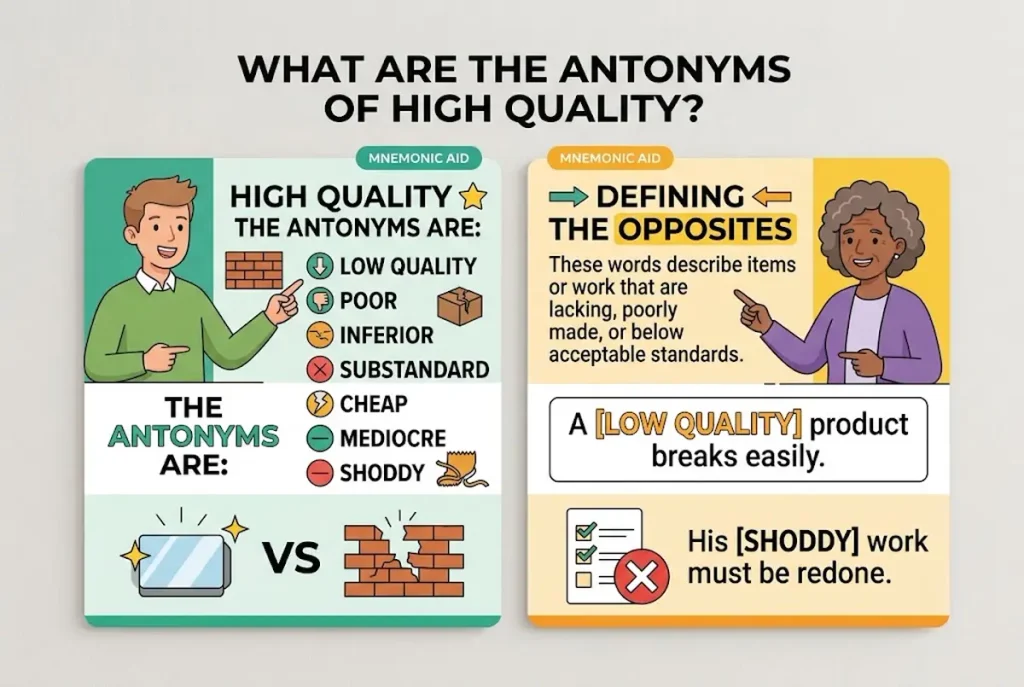
Antonyms are words with opposite or contrasting meanings.
The opposite of high quality depends on the context.
| Antonym | Meaning | Example |
|---|---|---|
| Low-quality | Below an acceptable standard | The store sells low-quality products. |
| Poor | Not good enough | The service was poor. |
| Inferior | Lower in standard | This material is inferior to the original. |
| Substandard | Below the required standard | The company rejected the substandard items. |
| Defective | Having a fault or problem | The customer returned a defective product. |
| Flimsy | Weak or poorly constructed | The chair feels flimsy. |
| Unreliable | Cannot be trusted to work properly | The equipment is unreliable. |
| Faulty | Not working correctly | The technician repaired the faulty machine. |
Quick Tips for Choosing the Correct Form
If you still find the rule confusing, use these practical tips.
- After the word of: Use high quality. Example: The equipment is of high quality.
- In professional writing: Use the form that matches the sentence structure.
- In American English: Follow the same compound adjective rule.
Conclusion
The difference between words comes down to how the expression functions in a sentence. Both forms are correct, but they are not interchangeable in every situation.
Use high quality when referring to a standard or level, such as the product is high quality or the work is of high quality.
The hyphen makes the relationship between the words easier to understand. Once you recognize the role of the expression in a sentence, choosing the correct form becomes simple. Pay attention to the words around it, and your writing will sound clearer, more natural, and more professional.
Frequently Asked Questions
Is high-quality always hyphenated?
No, high-quality is not always hyphenated. The hyphen is generally used when the expression comes before a noun as a compound adjective. It is usually removed when the expression follows a linking verb.
What’s another way to say high quality?
You can use excellent, superior, exceptional, premium, first-rate, outstanding, or top-notch. Choose the word that best matches the subject and tone of your sentence.
Does high quality mean expensive?
No, high quality does not necessarily mean expensive. It describes the standard, performance, or condition of something, while price refers to how much it costs.

Daniel Grammarfield — The Language Learner
Age: 28Occupation: ESL Learner & Digital Professional
Bio:Daniel is a non-native English speaker who wants to communicate more confidently at work and online. He uses Synotrench to improve grammar, understand confusing words, learn correct sentence structures, and build everyday English skills. He prefers simple explanations with practical examples.
Goals:
Master English grammar rules
Avoid common language mistakes
Improve professional communication
Learn English through real-life examples
Quote:“Learning English is not about memorizing rules — it’s about expressing ideas clearly.”
3 thoughts on “High Quality or High-Quality: Best Grammar Guide”