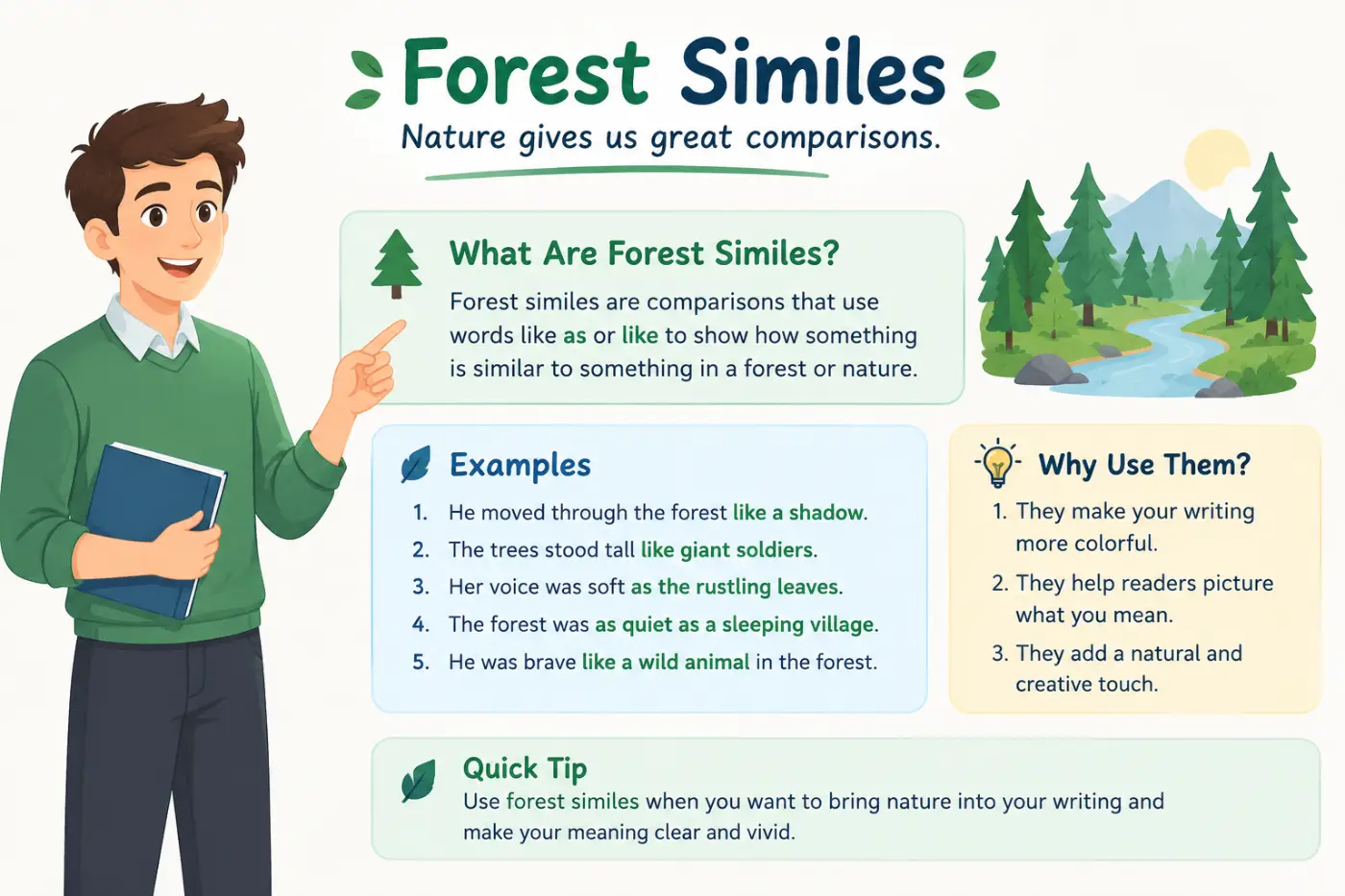
Forest Similes help writers describe the beauty, mystery, darkness, and peacefulness of wooded places. They turn ordinary sentences into descriptions that readers can see, hear, and feel.
A forest simile is a figure of speech that compares a forest or something within it to another thing using “like” or “as.” For example, “The forest stood like a silent guardian” suggests protection, strength, and stillness.
In this guide, you’ll find 40+ creative comparisons with meanings and examples. You’ll also learn how to choose the right words for essays, stories, poems, emails, and everyday conversations.
What Are Forest Similes in Simple English?
A forest simile compares a forest, its trees, sounds, colors, or atmosphere to something familiar. It helps readers understand what a wooded place looks or feels like without using a long explanation.
For example:
- The forest was as quiet as a sleeping baby.
- The trees stood like soldiers guarding a castle.
- The woodland glowed like gold beneath the morning sun.
- The branches stretched like welcoming arms.
- The forest was as dark as a moonless night.
Each comparison creates a different picture.
The first suggests peace, while the second suggests strength and order. The third creates warmth, and the fourth makes the trees seem friendly.
The final example gives the forest a mysterious or frightening feeling.
Where Does the Word Simile Come From?
The word “simile” comes from the Latin word “similis,” meaning “like” or “similar.”
Writers use similes to explain one thing by comparing it with another.
A simile usually contains two main parts:
- The subject being described.
- Something familiar used for comparison.
For example, consider this sentence:
“The forest was like a green ocean.”
Here, the forest is the subject, and the ocean is the comparison. The sentence suggests that the forest looks wide, endless, and full of movement.
Unlike a metaphor, a simile uses a direct comparison word, usually “like” or “as.”
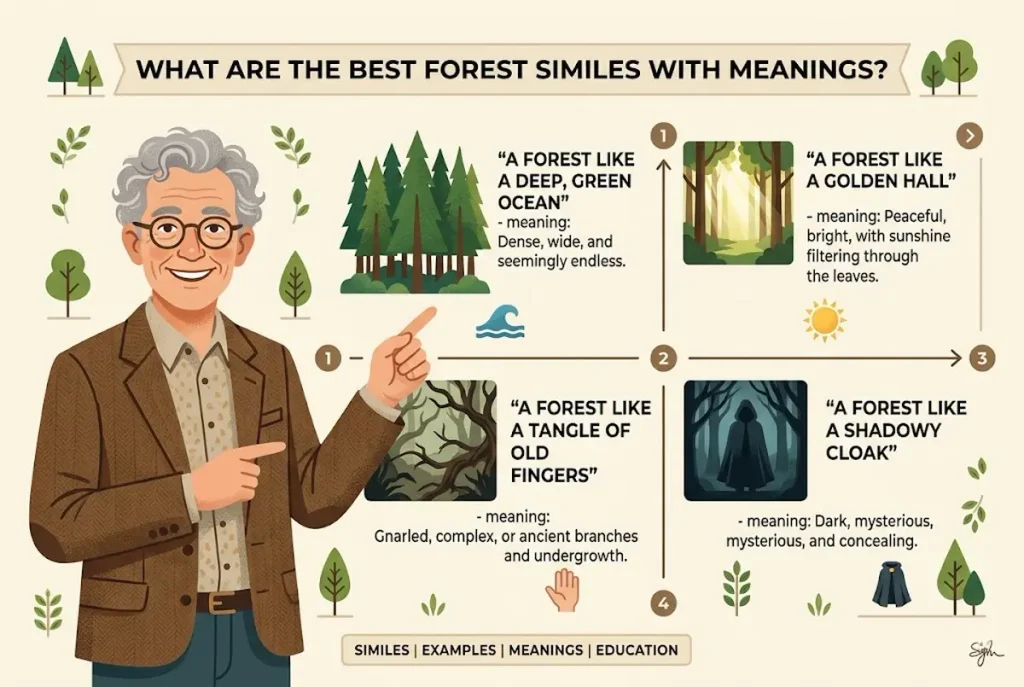
What Are the Best Forest Similes With Meanings?
The best comparisons depend on the mood you want to create. Some describe peaceful scenery, while others capture darkness, mystery, danger, or natural beauty.
Beautiful Word
| Simile | Meaning |
|---|---|
| The forest was like a green paradise. | A beautiful and refreshing place. |
| The trees sparkled like emeralds in sunlight. | Bright green leaves reflecting light. |
| The forest was as beautiful as a painted landscape. | Scenery that looks almost unreal. |
| The woodland glowed like a golden treasure. | Warm sunlight covering the trees. |
| The forest stretched like an endless green carpet. | A large area covered with greenery. |
| The trees stood like nature’s masterpieces. | Trees with impressive shapes and beauty. |
| The forest looked like a garden made by giants. | Huge plants and trees growing together. |
| The leaves shimmered like tiny green mirrors. | Sunlight reflecting from moving leaves. |
Dark and Scary Word
Dark forests often appear in mystery stories, adventure books, and scary scenes.
| Simile | Meaning |
|---|---|
| The forest was as dark as a forgotten cave. | Almost no light could enter. |
| The trees stood like silent monsters. | Their shapes looked frightening. |
| The forest swallowed the sunlight like a hungry beast. | Thick branches blocked the light. |
| The shadows crawled like spiders across the ground. | Moving shadows created an unsettling feeling. |
| The woodland was as mysterious as an unsolved puzzle. | Something unknown seemed hidden inside. |
| The branches reached out like skeletal fingers. | Bare branches looked thin and frightening. |
| The forest stood like a prison without walls. | The surroundings felt impossible to escape. |
| The trees whispered like ghosts in the wind. | Rustling leaves sounded strange and eerie. |
Example in a sentence:
As darkness fell, the branches reached out like skeletal fingers, making every step through the forest feel dangerous.
Peaceful and Quiet Word
A peaceful forest can represent comfort, rest, and freedom from everyday noise.
| Simile | Meaning |
|---|---|
| The forest was as peaceful as a sleeping child. | Completely calm and undisturbed. |
| The trees stood like quiet guardians. | They created a safe atmosphere. |
| The woodland rested like a village at dawn. | Everything seemed still and relaxed. |
| The forest was as gentle as a mother’s embrace. | It felt comforting and welcoming. |
| The leaves rustled like a soft lullaby. | Their sound created relaxation. |
| The forest breathed like a resting giant. | Gentle movement made it seem alive. |
| The trees swayed like dancers moving to slow music. | Branches moved smoothly in the breeze. |
| The woodland felt like a peaceful sanctuary. | It offered an escape from stress. |
Example in a sentence:
After a difficult week, the forest felt like a peaceful sanctuary where every sound helped me relax.
Magical Word
Magical comparisons work especially well in fantasy stories, children’s books, and imaginative writing.
| Simile | Meaning |
|---|---|
| The forest sparkled like a kingdom of fairies. | It appeared magical and enchanting. |
| The trees rose like towers in an ancient castle. | Tall trees created a grand atmosphere. |
| The woodland glowed like a dream beneath the moon. | Moonlight gave it an unreal appearance. |
| The branches twisted like enchanted staircases. | Unusual shapes suggested magic. |
| The forest shimmered like a hidden treasure. | Its beauty seemed rare and special. |
| The leaves floated like tiny green butterflies. | Falling leaves moved gracefully. |
| The woodland opened like a secret doorway. | It seemed to lead into another world. |
| The trees sparkled like stars brought down to earth. | Tiny lights or reflections created wonder. |
Example in a sentence:
Under the silver moonlight, the woodland glowed like a dream, inviting the travelers into its mysterious depths.
What Words Can You Use Instead of Forest?
Sometimes repeating the word “forest” makes writing sound unnatural. Related words can add variety, but they don’t always mean exactly the same thing.
The following table includes 30 useful alternatives and related descriptive terms.
Master Word List for Describing Forests
| Word | Meaning | Tone | Example |
|---|---|---|---|
| Woods | Land covered with trees | Simple | We walked through the woods. |
| Trees | Large woody plants | Simple | The trees blocked the sun. |
| Grove | Small group of trees | Simple | A quiet grove stood nearby. |
| Greenery | Green plants and leaves | Simple | Greenery covered the hillside. |
| Shade | Area protected from sunlight | Simple | We rested in the shade. |
| Woodland | Land covered with trees | Everyday | The woodland looked peaceful. |
| Thicket | Dense bushes or small trees | Everyday | A rabbit entered the thicket. |
| Canopy | Upper layer of branches | Everyday | Birds rested in the canopy. |
| Undergrowth | Plants beneath taller trees | Everyday | The undergrowth was thick. |
| Clearing | Open space among trees | Everyday | We stopped in a clearing. |
| Pinewood | Area containing pine trees | Everyday | The pinewood smelled fresh. |
| Timberland | Land containing growing trees | Everyday | The timberland covered the valley. |
| Wilderness | Wild natural land | Everyday | The wilderness seemed endless. |
| Rainforest | Forest with heavy rainfall | Formal | The rainforest supports many species. |
| Evergreen forest | Forest with mostly evergreen trees | Formal | The evergreen forest stayed green. |
| Deciduous forest | Forest with trees that shed leaves | Formal | The deciduous forest changed color. |
| Boreal forest | Northern forest dominated by conifers | Formal | The boreal forest experiences long winters. |
| Temperate forest | Forest in a moderate climate | Formal | The temperate forest receives seasonal rain. |
| Vegetation | Plant life in an area | Formal | Dense vegetation covered the ground. |
| Ecosystem | Interacting living things and surroundings | Formal | The forest ecosystem supports wildlife. |
These words help you avoid repetition, but choose them carefully. A grove is smaller than a forest, while a clearing is an open space within one.
Similarly, jungle often suggests dense tropical vegetation, so it shouldn’t replace forest in every sentence.
How Do Forest Descriptions Change From Mild to Strong?
The intensity of a comparison changes how readers imagine a scene.
A mild description creates a gentle impression. A strong one produces a more powerful emotional response.
| Intensity | Simile | Effect |
|---|---|---|
| Very mild | The forest was as calm as a quiet morning. | Gentle peace |
| Mild | The forest moved like a slow river. | Soft movement |
| Moderate | The forest stood like a wall of green. | Thickness and size |
| Strong | The forest towered like a giant fortress. | Power and strength |
| Very strong | The forest swallowed the path like a hungry monster. | Fear and danger |
Consider the difference between these two sentences:
“The forest was as quiet as a library.”
“The forest was as silent as an abandoned graveyard.”
Both describe silence, but they create different feelings. The first sounds peaceful, while the second suggests fear or loneliness.
Choose your comparison based on the emotion you want readers to experience.
Can Word Describe Nouns Verbs and Adjectives?
Yes. You can build comparisons around nouns, actions, and descriptive qualities.
Understanding these differences helps you create more natural sentences.
Similes That Describe Nouns
These comparisons focus on the forest or something inside it.
Examples:
- The forest was like an endless maze.
- The trees stood like ancient warriors.
- The leaves glittered like scattered jewels.
- The roots twisted like sleeping snakes.
Similes That Describe Actions
These examples focus on movement or sound.
- The branches danced like performers in the wind.
- The leaves fell like golden rain.
- The trees bent like dancers taking a bow.
- The forest whispered like an old storyteller.
Similes That Describe Qualities
These comparisons explain how something looks or feels.
- The forest was as green as fresh grass.
- The woodland was as quiet as an empty room.
- The trees were as tall as city buildings.
- The pathway was as narrow as a ribbon.
Notice that a simile is a complete comparison, not a separate part of speech. However, it can describe a noun, action, or quality within a sentence.

Are Forest Similes Different in American and British English?
Forest comparisons work almost the same way in American and British English.
Both varieties use “like” and “as” to create similes. However, some related vocabulary differs by region.
| Term | Common usage |
|---|---|
| Woods | Common in American and British English |
| Woodland | Common in both varieties |
| Forest | Common in both varieties |
| Bush | Common in Australia and New Zealand for wild countryside |
| Backwoods | Especially familiar in American English |
| Copse | A small group of trees, familiar in British English |
| Boondocks | Informal American English for a remote place |
For an American audience, words such as forest, woods, woodland, and grove usually sound natural.
For a British audience, copse may work well when describing a small group of trees.
Regional words can make descriptions more authentic, but they should match the actual setting.
Which Forest Similes Work Best for Different Writing Situations?
A creative comparison that works in a fantasy novel may sound strange in a professional email.
The purpose of your writing should guide your word choice.
Best Word for Essays
Essays benefit from clear descriptions that support the main idea without becoming overly dramatic.
Example:
“The forest stretched across the valley like a vast green blanket, providing shelter for countless animals.”
This comparison communicates size while connecting naturally to an environmental topic.
For school essays, choose comparisons that are easy to understand and relevant to the subject.
Best Word for Creative Stories
Creative stories allow stronger imagery and emotion.
Example:
“The forest stood like a sleeping giant, its branches trembling whenever the cold wind passed through.”
This sentence gives the setting a sense of life and mystery.
You can also change the atmosphere through comparison.
A forest might appear like a welcoming home at sunrise but like a dark prison after sunset.
Should You Use Similes in a Resume?
A traditional resume should focus on measurable achievements, skills, and professional experience rather than poetic comparisons.
Avoid sentences such as:
“My leadership skills are as strong as an ancient forest.”
Instead, describe what you accomplished.
However, creative writing portfolios, environmental storytelling projects, and nature-related marketing samples can include comparisons when they demonstrate your writing ability.
What Are Some Original Forest Simile Sentences?
The following examples show how comparisons can fit into different situations.
| Situation | Example sentence |
|---|---|
| Morning walk | The forest woke like a sleepy village beneath the rising sun. |
| Rainy weather | Raindrops fell through the canopy like silver beads. |
| Winter | The trees stood like frozen statues beneath the snow. |
| Autumn | The forest glowed like a golden painting in October. |
| Summer | The woodland was as warm as a sunlit greenhouse. |
| Night | The forest became as dark as a room without windows. |
| Adventure | The narrow trail twisted like a snake between the trees. |
| Mystery | The branches whispered like strangers sharing secrets. |
| Peaceful moment | The forest rested like a child wrapped in a blanket. |
| Strong wind | The treetops rolled like waves across a green sea. |
| Wildlife | Birds scattered like colorful confetti above the clearing. |
| Hiking | The trees surrounded us like walls in a giant maze. |
| Sunrise | Golden light spilled through the branches like warm honey. |
| Snowfall | Snow settled on the pines like powdered sugar. |
| Fantasy | The woodland shimmered like a doorway into another world. |
These examples show that an effective comparison doesn’t always need complicated vocabulary.
A familiar object, sound, or experience can create a memorable picture.
What Is the Difference Between Similar Forest Comparisons?
Some comparisons may appear interchangeable, but their meanings can change the mood of a sentence.
Understanding these small differences helps you choose more accurate imagery.
Forest Like an Ocean vs Forest Like a Sea
Both comparisons suggest a large wooded landscape, but they can create slightly different impressions.
| Forest Like an Ocean | Forest Like a Sea |
|---|---|
| Often emphasizes enormous size and depth. | Often emphasizes a wide, continuous surface. |
| Can suggest mystery or hidden life. | Can suggest waves of moving treetops. |
| Works well for dense wilderness. | Works well for panoramic landscape descriptions. |
Examples:
“The forest stretched like an ocean beyond the mountains.”
“The treetops moved like a green sea beneath the wind.”
Neither comparison is automatically better. The surrounding sentence determines its meaning.
Forest Like a Fortress vs Forest Like a Prison
These comparisons both suggest enclosure, but their emotional meanings differ.
| Forest Like a Fortress | Forest Like a Prison |
|---|---|
| Suggests protection and strength. | Suggests confinement and fear. |
| Can create a feeling of safety. | Creates a feeling of being trapped. |
| Works well for protective scenery. | Works well for frightening scenes. |
Examples:
“The ancient forest stood like a fortress around the village.”
“The forest closed around us like a prison without doors.”
The first makes the woodland feel protective. The second makes it threatening.
Forest Like a Blanket vs Forest Like a Carpet
These comparisons are useful when describing a large green landscape.
A blanket suggests comfort, softness, or something covering the land.
A carpet mainly suggests a continuous surface spreading across an area.
Examples:
“The forest covered the valley like a warm green blanket.”
“From the airplane, the forest looked like an endless emerald carpet.”
Use blanket for comfort or coverage and carpet for visual appearance.
What Are the Most Common Mistakes When Writing Words?
Creative comparisons improve descriptions only when readers can understand them.
Here are several mistakes worth avoiding.
1. Confusing a Simile With a Metaphor
A simile uses comparison words such as “like” or “as.”
A metaphor states that one thing is another.
| Simile | Metaphor |
|---|---|
| The forest was like a green ocean. | The forest was a green ocean. |
| The trees stood like soldiers. | The trees were soldiers. |
| The branches moved like dancing arms. | The branches were dancing arms. |
Both are useful, but they aren’t the same figure of speech.
2. Using Too Many Comparisons Together
Too many similes can make a paragraph confusing.
Weak example:
“The forest was like an ocean, the trees were like soldiers, the leaves were like diamonds, and the wind was like a singing bird.”
Better example:
“The forest stretched like a green ocean, its treetops moving gently in the afternoon breeze.”
One strong comparison often creates a clearer image than several competing ones.
3. Choosing Comparisons That Don’t Match the Mood
A frightening comparison can ruin an otherwise peaceful description.
For example:
“The peaceful forest surrounded us like a terrifying monster.”
This creates mixed emotions unless the contrast is intentional.
For a calm scene, try:
“The peaceful forest surrounded us like a comforting embrace.”
4. Using Comparisons That Are Difficult to Imagine
A simile should make the subject easier to picture.
Confusing example:
“The forest was as green as an invisible dream.”
Clearer example:
“The forest was as green as fresh spring grass.”
The second comparison gives readers a familiar visual reference.
5. Repeating Familiar Similes Too Often
Expressions such as “as quiet as a mouse” and “as green as grass” are understandable, but they may feel predictable.
Try creating comparisons from details in your scene.
Instead of:
“The forest was as quiet as a mouse.”
Write:
“The forest was as quiet as a village before sunrise.”
The second example creates a more specific atmosphere.
When Should You Avoid Using Word?
Similes aren’t suitable for every type of writing.
Scientific reports, safety instructions, legal documents, and technical explanations usually benefit from precise descriptions.
For example, an environmental report should say:
“The forest covers approximately 500 acres.”
It shouldn’t replace this information with:
“The forest spreads like an endless green kingdom.”
Creative language can support an explanation, but it shouldn’t replace factual details.
Also avoid comparisons that exaggerate a scene in a misleading way. A small wooded park shouldn’t be described as endless wilderness unless you’re intentionally presenting a character’s impression.
What Are the Opposites of Common Forest Descriptions?
Similes don’t have strict antonyms in the same way individual words do. However, you can create contrasting comparisons by changing the quality being described.
| Description | Opposite description |
|---|---|
| As peaceful as a sleeping child | As restless as a stormy sea |
| As green as fresh grass | As brown as dried leaves |
| As bright as morning sunlight | As dark as a moonless night |
| As lively as a busy marketplace | As still as an abandoned house |
| As welcoming as an open home | As frightening as a haunted castle |
| As thick as a green wall | As open as an empty field |
| As warm as a summer afternoon | As cold as winter ice |
These contrasts are especially useful when describing seasonal changes or showing how a setting transforms throughout a story.
For example:
“During summer, the woodland was as lively as a busy marketplace. By winter, it stood as still as an abandoned house.”

How Can You Create Your Own Forest Similes?
You don’t need to memorize dozens of comparisons to write an interesting nature description.
Start by observing one specific feature of the forest.
Then connect that feature to something familiar.
Five Quick Tips for Choosing the Right Comparison
- Decide on the mood. Is the setting peaceful, beautiful, mysterious, frightening, or magical?
- Focus on one detail. Choose the trees, leaves, branches, sounds, shadows, or overall landscape.
- Find a familiar comparison. Think of oceans, blankets, castles, dancers, or everyday objects.
- Use “like” or “as” naturally. Make sure the sentence remains grammatically clear.
- Read the sentence aloud. If it sounds confusing or exaggerated, simplify it.
You can also use this simple writing formula:
Subject + comparison word + familiar image + supporting detail.
Example:
“The trees stood like ancient guards, protecting the quiet pathway beneath their branches.”
The comparison creates an image, while the supporting detail makes it more meaningful.
Try changing the subject and mood to create something original.
Conclusion
Forest Similes make nature writing more descriptive by connecting familiar images with the appearance, movement, and atmosphere of wooded places. A forest can resemble a peaceful sanctuary, an endless ocean, a protective fortress, or a frightening maze. Each comparison gives readers a different emotional experience.
The strongest simile isn’t necessarily the most unusual one. It’s the comparison that fits your scene and helps readers understand exactly what you want to describe.
For peaceful settings, choose gentle images. For adventure or mystery, use comparisons that suggest uncertainty, darkness, or movement. Keep your language clear, and avoid placing too many comparisons in one sentence.
With a little observation and imagination, even an ordinary walk through the woods can become a memorable piece of writing.
Frequently Asked Questions
What’s another way to describe a forest?
You can describe a forest as a green paradise, an endless woodland, a natural sanctuary, or a mysterious wilderness. Choose the expression that matches its appearance and atmosphere.
What is a good simile for a dark forest?
“The forest was as dark as a forgotten cave” is an effective comparison. It suggests deep darkness and creates a mysterious atmosphere.
How do you describe a beautiful forest in creative writing?
Use sensory details and familiar comparisons. For example, “The forest shimmered like an emerald sea beneath the golden morning sunlight.”
What is a simile for tall forest trees?
“The trees stood like giant towers reaching toward the clouds” describes their impressive height. It works well in adventure stories and nature descriptions.
What is the difference between a forest simile and a metaphor?
A simile uses “like” or “as” to compare two things, while a metaphor describes one thing as another. “The forest was like an ocean” is a simile, while “The forest was an ocean of green” is a metaphor.
How do you write an original forest simile?
Choose one feature of the forest and compare it with something familiar that shares a similar quality. For example, “The branches swayed like gentle waves beneath the evening sky.”

Daniel Grammarfield — The Language Learner
Age: 28Occupation: ESL Learner & Digital Professional
Bio:Daniel is a non-native English speaker who wants to communicate more confidently at work and online. He uses Synotrench to improve grammar, understand confusing words, learn correct sentence structures, and build everyday English skills. He prefers simple explanations with practical examples.
Goals:
Master English grammar rules
Avoid common language mistakes
Improve professional communication
Learn English through real-life examples
Quote:“Learning English is not about memorizing rules — it’s about expressing ideas clearly.”
3 thoughts on “Forest Similes Best Examples With Meanings (2026)”