Imagine you’re writing an email about someone who keeps ignoring company rules. You want to explain their behavior, but you’re stuck between two similar words: flaunt vs flout. They look alike, sound somewhat similar, and often appear in discussions about confidence, authority, and behavior.
The confusion is common because both words can describe actions that attract attention. However, they express two very different ideas. Choosing the wrong one can completely change what your sentence means.
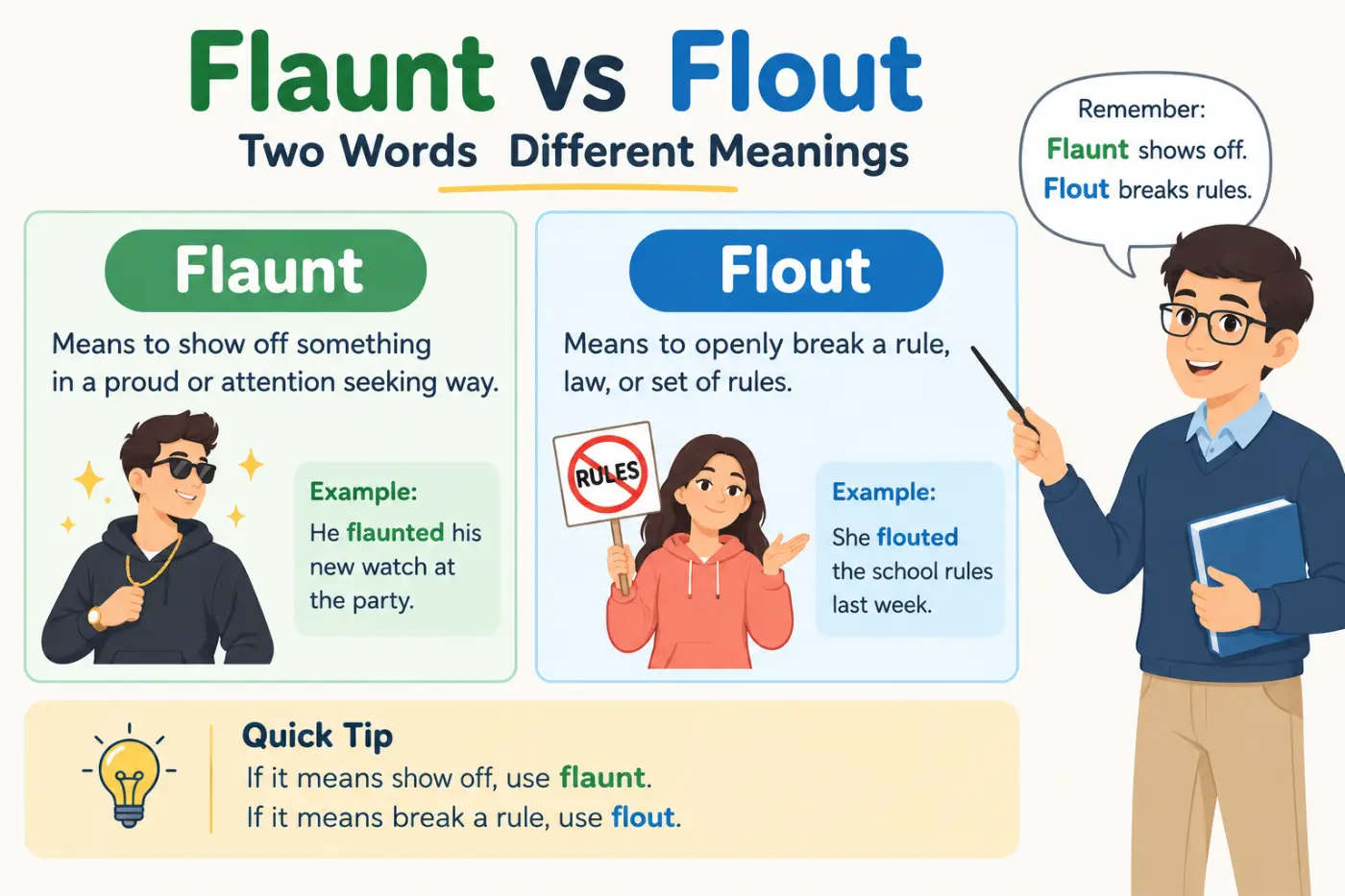
Flaunt means to show something off proudly or noticeably. Flout means to openly ignore or disrespect a rule, law, or accepted standard.
Understanding flaunt vs flout will help you write clearer emails, essays, reports, and everyday messages. This guide explains their meanings, origins, synonyms, grammar rules, real examples, common mistakes, and simple ways to remember the difference.
What Is the Difference Between Flaunt and Flout?
The main difference is that flaunt describes showing something off, while flout describes deliberately ignoring rules or authority.
Both are verbs, but they have different meanings and usually take different kinds of objects.
| Feature | Flaunt | Flout |
|---|---|---|
| Basic meaning | Show off | Openly disregard |
| Main idea | Display | Defiance |
| Common objects | Wealth, beauty, talent, success | Rules, laws, orders, conventions |
| Typical tone | Proud, flashy, sometimes negative | Critical or disapproving |
| Example | She flaunted her expensive watch. | He flouted the parking rules. |
| Past tense | Flaunted | Flouted |
| Related noun | Flaunting | Flouting |
A person might flaunt an expensive car to impress others. That same person might flout traffic laws by deliberately ignoring speed limits.
The first action concerns showing something. The second concerns refusing to follow an established rule.
What Does Flaunt Mean in Simple English?
Flaunt means to display something proudly, openly, or in a way that attracts attention.
People often flaunt things they believe make them look successful, attractive, powerful, or important.
For example:
- She loves to flaunt her designer handbags.
- The athlete flaunted his championship medal.
- He flaunted his wealth at the expensive party.
- The company flaunted its impressive sales figures.
- She wasn’t afraid to flaunt her unique fashion sense.
The word can suggest that someone is showing off too much. However, it doesn’t always carry a negative meaning.
For instance, flaunting your personal style can simply mean expressing yourself confidently.
What Does Flout Mean in Simple English?
Flout means to openly ignore, challenge, or show disrespect for a rule, law, instruction, or accepted standard.
It often suggests deliberate behavior rather than an accidental mistake.
For example:
- The driver flouted the traffic regulations.
- The company continued to flout environmental laws.
- Several students openly flouted the school’s dress code.
- The manager flouted the organization’s safety procedures.
- The politician was criticized for flouting established rules.
Notice that each sentence involves an expectation, restriction, or authority.
Someone who accidentally breaks a rule isn’t necessarily flouting it. The word usually suggests knowing disregard or defiance.
Where Do Flaunt and Flout Come From?
Understanding word origins can make confusing English words easier to remember.
Although these two verbs look similar, their histories are different.
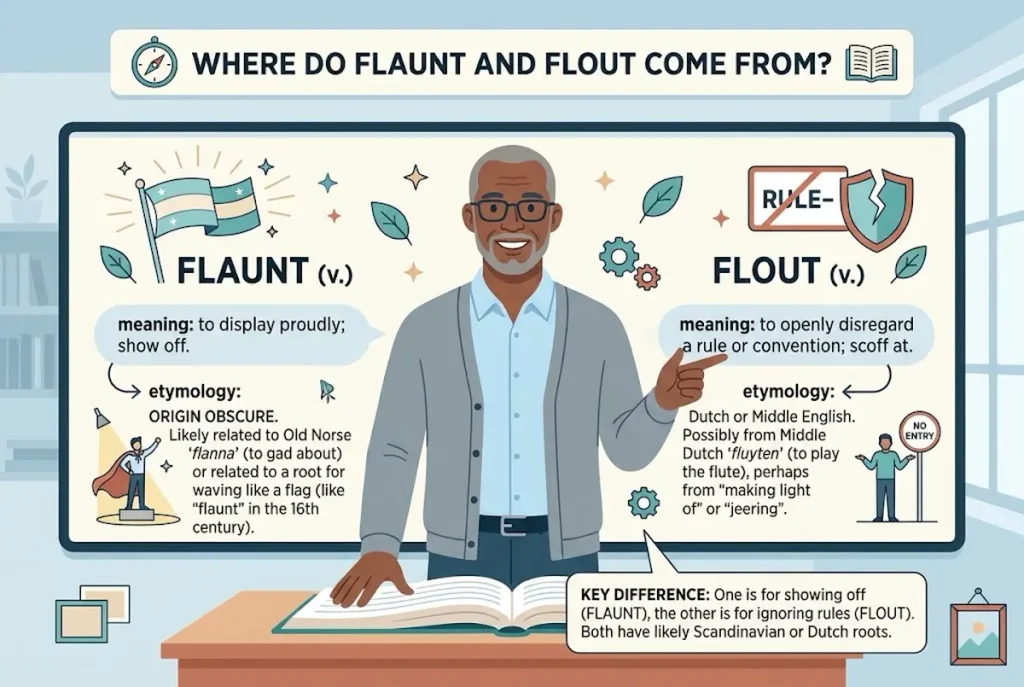
The Origin of Flaunt
Flaunt appeared in English during the 16th century.
Its exact origin remains uncertain. Early uses described displaying oneself in a showy or attention-seeking manner.
Over time, the meaning expanded to include proudly displaying possessions, achievements, appearance, and personal qualities.
Today, people commonly use it when discussing fashion, wealth, confidence, success, and public displays.
Example:
She flaunted her new engagement ring during dinner.
The sentence emphasizes displaying something proudly.
The Origin of Flout
Flout also dates back to the 16th century.
Its exact origin is uncertain, although its early meanings involved mocking, jeering, or treating someone with contempt.
The modern meaning developed around showing open disrespect for rules, expectations, or authority.
Example:
The contractor flouted local building regulations.
Here, the emphasis is on disregarding an established requirement.
Why Are These Words Often Confused?
There are three main reasons.
- Their spellings differ by only one vowel.
- Both describe noticeable behavior.
- Writers sometimes incorrectly use flaunt when they mean openly disregard.
The confusion becomes especially common in phrases involving rules.
Remember that a person can flaunt something by displaying it, but flout a rule by disregarding it.
What Are the Best Synonyms for Flaunt and Flout?
Synonyms can help you choose a word that matches your intended meaning and tone.
However, these two verbs have different synonym groups. A replacement that works for one usually won’t work for the other.
The following tables include more than 30 alternatives, organized by everyday usage and writing style.
Simple Synonyms
These words are easy to understand and work well in ordinary conversations.
| Word | Meaning | Tone | Example |
|---|---|---|---|
| Show | Make something visible | Neutral | She showed her new necklace. |
| Display | Present something openly | Neutral | He displayed his award. |
| Share | Let others see something | Friendly | She shared her achievements. |
| Show off | Display something proudly | Casual | He showed off his new car. |
| Ignore | Pay no attention to something | Neutral | They ignored the warning. |
| Break | Fail to follow a rule | Direct | He broke the school rules. |
| Disobey | Refuse to follow instructions | Direct | The child disobeyed the teacher. |
| Reject | Refuse to accept something | Neutral | They rejected the restrictions. |
Show, display, share, and show off are useful alternatives to flaunt.
Ignore, break, disobey, and reject can sometimes replace flout, depending on context.
Everyday Synonyms
These alternatives sound natural in conversations, emails, and general writing.
| Word | Meaning | Tone | Example |
|---|---|---|---|
| Parade | Display something conspicuously | Critical | He paraded his wealth around town. |
| Brag | Talk proudly about achievements | Negative | She bragged about her promotion. |
| Boast | Speak proudly about something | Mixed | He boasted about his grades. |
| Exhibit | Show something publicly | Neutral | The artist exhibited her work. |
| Highlight | Draw attention to something | Positive | She highlighted her accomplishments. |
| Defy | Openly resist authority | Strong | The workers defied the order. |
| Disregard | Deliberately ignore something | Formal | He disregarded the instructions. |
| Challenge | Question or resist authority | Neutral | They challenged the restrictions. |
| Violate | Act against a rule or law | Serious | The business violated safety regulations. |
| Sidestep | Avoid dealing directly with something | Critical | He sidestepped the requirements. |
Brag and boast often involve speaking, while flaunt can involve actions, appearance, or possessions.
Similarly, defy and disregard are close to flout, but they don’t always suggest the same level of open disrespect.
Formal Synonyms
These words work particularly well in academic essays, professional reports, and official communication.
| Word | Meaning | Tone | Example |
|---|---|---|---|
| Showcase | Present something favorably | Professional | The portfolio showcased her abilities. |
| Demonstrate | Clearly show a quality or skill | Professional | He demonstrated strong leadership. |
| Publicize | Make something widely known | Formal | The company publicized its success. |
| Emphasize | Give special attention to something | Formal | She emphasized her qualifications. |
| Manifest | Make a quality or feeling evident | Formal | His actions manifested confidence. |
| Contravene | Act against a rule or law | Legal | The decision contravened regulations. |
| Transgress | Go beyond an accepted limit | Formal | He transgressed established boundaries. |
| Infringe | Violate a right or rule | Legal | The policy infringed their rights. |
| Repudiate | Reject something openly | Strong | The group repudiated the agreement. |
| Breach | Fail to follow an obligation | Professional | The contractor breached the contract. |
These are related alternatives, not exact replacements in every sentence.
For example, showcase is usually more positive than flaunt, while contravene focuses on breaking a rule rather than showing open contempt for it.
Slang and Casual Alternatives
These expressions are more suitable for informal conversations, social media, and texting.
| Word or Phrase | Meaning | Tone | Example |
|---|---|---|---|
| Flex | Show off something impressive | Slang | He’s flexing his new sneakers. |
| Flash | Display something noticeably | Casual | She flashed her expensive jewelry. |
| Strut | Walk or behave proudly | Casual | He strutted around in his new outfit. |
| Rub it in | Make others notice your advantage | Negative | Stop rubbing your victory in. |
| Do your own thing | Act independently | Casual | She prefers to do her own thing. |
| Blow off | Casually ignore something | Informal | He blew off the instructions. |
| Thumb your nose at | Openly show disrespect | Idiomatic | They thumbed their noses at authority. |
| Go against | Oppose a rule or expectation | Casual | His actions went against company policy. |
Flex is particularly common when discussing possessions, achievements, fitness, and lifestyle.
For example:
He’s always flexing his expensive sneakers online.
For flout, expressions such as thumb your nose at and openly defy communicate deliberate disrespect more clearly.
Which Synonym Should You Choose Based on Intensity?
Not every alternative expresses the same degree of pride, attention, resistance, or disrespect.
Some words are mild. Others make a person’s behavior sound excessive or serious.
Synonyms for Flaunt From Mild to Strong
| Intensity | Word | What It Suggests |
|---|---|---|
| Mild | Show | Simply making something visible |
| Mild | Display | Presenting something openly |
| Moderate | Showcase | Drawing positive attention |
| Moderate | Highlight | Emphasizing something valuable |
| Strong | Flaunt | Showing something proudly and noticeably |
| Strong | Show off | Trying to impress others |
| Very strong | Parade | Making an obvious public display |
| Very strong | Brag | Talking excessively about success |
Synonyms for Flout From Mild to Strong
| Intensity | Word | What It Suggests |
|---|---|---|
| Mild | Overlook | Fail to notice something |
| Mild | Ignore | Give something no attention |
| Moderate | Disregard | Choose not to follow something |
| Moderate | Disobey | Refuse to follow instructions |
| Strong | Flout | Openly disregard a rule |
| Strong | Defy | Actively resist authority |
| Very strong | Violate | Break a rule or law |
| Very strong | Brazenly defy | Resist openly and without shame |
How Do Flaunt and Flout Work in Grammar?
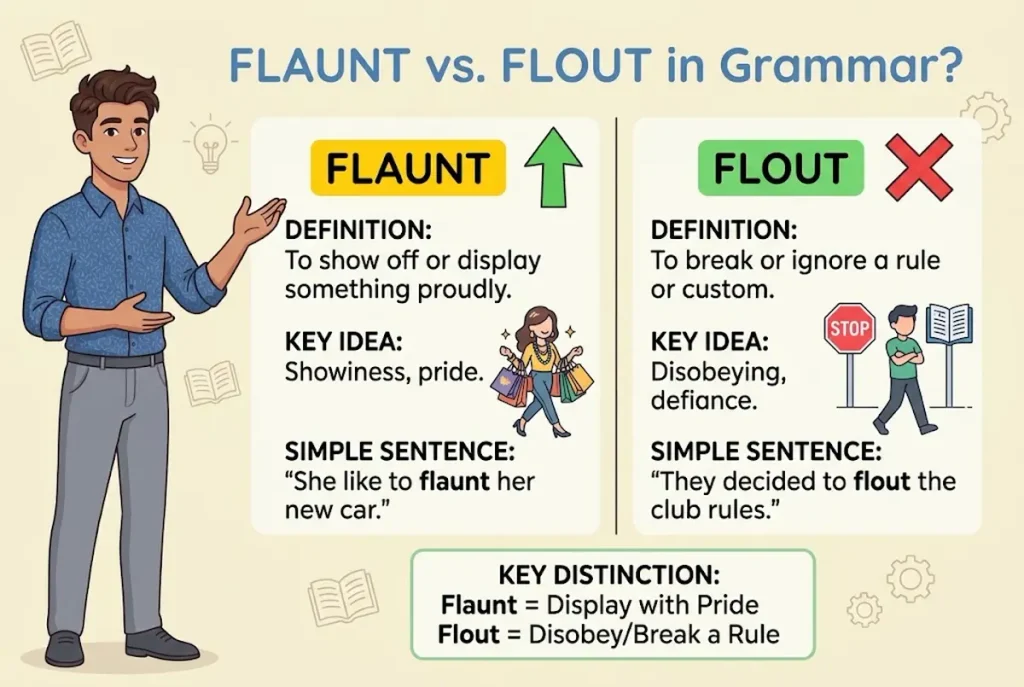
Both words are primarily used as transitive verbs. This means they usually take a direct object.
Their sentence patterns are similar, but their typical objects differ.
Common Forms of Flaunt
| Form | Example |
|---|---|
| Base verb | Some people flaunt their wealth. |
| Third person | She flaunts her achievements. |
| Past tense | He flaunted his expensive clothes. |
| Present participle | They’re flaunting their success. |
| Past participle | She has flaunted her talents before. |
Common Forms of Flout
| Form | Example |
|---|---|
| Base verb | Some drivers flout traffic laws. |
| Third person | He flouts company policy. |
| Past tense | They flouted the restrictions. |
| Present participle | She’s flouting the regulations. |
| Past participle | The organization has flouted several rules. |
Can These Words Be Used as Nouns?
The words themselves are mainly verbs, but their ing forms can function as nouns.
Examples:
- His constant flaunting of wealth annoyed his friends.
- The repeated flouting of safety regulations caused concern.
Flaunting refers to the act of displaying something showily.
Flouting refers to the act of openly disregarding a rule or expectation.
Is There a Difference Between American and British English?
The meanings of these words are essentially the same in American and British English.
Neither word changes its spelling between the two varieties.
| Feature | American English | British English |
|---|---|---|
| Flaunt | Flaunt | Flaunt |
| Flout | Flout | Flout |
| Past tense of flaunt | Flaunted | Flaunted |
| Past tense of flout | Flouted | Flouted |
| Core meanings | Same | Same |
When Should You Use Flaunt or Flout in Different Situations?
The best word depends on the message you’re trying to communicate.
A professional email needs different wording from a casual text. An academic essay may also require more precision than an everyday conversation.
Which Word Is Better for a Resume?
Neither word is usually the best choice for describing your professional achievements.
Flaunt can make you sound overly proud, while flout suggests ignoring rules or authority.
Instead, use positive professional verbs such as demonstrated, highlighted, showcased, or achieved.
Less effective:
I flaunted my excellent leadership skills during the project.
Better:
I demonstrated strong leadership skills while managing a team of eight employees.
The revised sentence communicates confidence without sounding boastful.
Which Word Should You Use in an Essay?
Both words are appropriate in essays when their meanings fit the subject.
Use flaunt when discussing public displays of wealth, status, appearance, or success.
Use flout when discussing deliberate disregard for laws, traditions, or social expectations.
Examples:
The wealthy characters flaunt their social status throughout the novel.
The main character repeatedly flouts society’s expectations.
These sentences express different ideas, making each verb useful in literary analysis.
Which Word Sounds Natural in Texting?
In casual messages, flaunt may sound slightly formal. Show off or flex often feels more conversational.
Example:
He’s always showing off his new phone.
For flout, simpler alternatives such as ignore or break are common.
Example:
He keeps ignoring the apartment rules.
You can still use the original verbs in texting, especially when you want to be precise.
Which Word Is Best for Professional Emails?
Professional communication benefits from clear and neutral wording.
Use flaunt carefully because it can suggest unnecessary pride or criticism.
Use flout when you need to describe deliberate disregard for an established policy.
Examples:
The presentation prominently showcased the team’s achievements.
Several employees have openly flouted the company’s security policy.
The second sentence makes a serious claim. Make sure you have evidence of deliberate disregard before using it.
If intent is uncertain, violated or failed to follow may be safer.
Which Word Should You Use When Speaking?
Both words work in spoken English, but context matters.
Use flaunt when describing someone who displays something proudly.
Example:
He loves to flaunt his new sports car.
Use flout when describing someone who openly ignores a rule.
Example:
They continue to flout the neighborhood’s parking restrictions.
If you’re unsure, replace the word with show off or openly disregard and check which meaning fits.
What Are Some Real Life Examples of Flaunt and Flout?
Seeing the two words in different situations makes their meanings easier to understand.
The following examples cover school, work, fashion, relationships, business, and public behavior.
Examples Using Flaunt
- The actress flaunted her elegant dress at the award ceremony.
- He enjoys flaunting his expensive collection of watches.
- The athlete proudly flaunted her gold medal.
- She never misses an opportunity to flaunt her artistic talent.
- The influencer flaunted his luxury vacation on social media.
Each example involves making something noticeable.
Examples Using Flout
- The construction company flouted several safety regulations.
- He repeatedly flouted the teacher’s classroom instructions.
- The business owner was fined for flouting local health requirements.
- Some drivers continue to flout the speed limit.
- The organization openly flouted the government’s restrictions.
Each sentence describes disregarding an established rule, instruction, or expectation.
Examples Showing Both Words Together
Using both verbs in one sentence can make their difference especially clear.
- He flaunted his expensive motorcycle while flouting local traffic laws.
- The celebrity flaunted her luxurious lifestyle but refused to flout the event’s security rules.
- She flaunted her unusual fashion choices and openly flouted traditional dress expectations.
- The businessman flaunted his success while his company flouted environmental regulations.
These examples demonstrate that displaying something and disregarding a rule are separate actions.
Flaunt vs Show Off: What’s the Difference?
Flaunt and show off are close synonyms, but their tone and usage aren’t always identical.
| Flaunt | Show Off |
|---|---|
| Slightly more formal | More conversational |
| Often suggests noticeable display | Often suggests trying to impress |
| Common in written descriptions | Common in everyday speech |
| Can describe appearance or possessions | Can describe actions, skills, or possessions |
Flout vs Defy: What’s the Difference?
| Flout | Defy |
|---|---|
| Focuses on open disregard | Focuses on active resistance |
| Commonly used with rules and laws | Commonly used with authority and orders |
| Suggests disrespect for expectations | Suggests refusing to submit |
| Often describes rule-breaking behavior | Can describe opposition without breaking a rule |
Flout vs Violate: Are They Interchangeable?
These words overlap, but they aren’t perfect synonyms.
Violate means to break a law, rule, agreement, or requirement.
Flout usually adds the idea of open or deliberate disregard.
Consider these sentences:
The company violated the safety regulations.
The company openly flouted the safety regulations.
The first sentence establishes that a violation occurred.
The second suggests that the company knowingly disregarded the regulations.
In legal, business, or academic writing, this distinction matters. Don’t describe an accidental violation as flouting unless the facts support that stronger meaning.
What Are the Most Common Mistakes With Flaunt and Flout?
The biggest mistake is using flaunt when the intended meaning is openly ignoring a rule.
However, several other errors can make sentences confusing or unnatural.
Mistake 1: Using Flaunt With Rules
Incorrect:
The students flaunted the school rules by refusing to wear uniforms.
Correct:
The students flouted the school rules by refusing to wear uniforms.
The sentence describes deliberate disobedience, not proudly displaying something.
Mistake 2: Using Flout With Wealth
Incorrect:
He flouted his wealth at the party.
Correct:
He flaunted his wealth at the party.
Wealth is something a person can display. It isn’t a rule that someone can disregard.
Mistake 3: Treating Every Rule Violation as Flouting
Less precise:
The employee accidentally flouted the new policy.
Better:
The employee accidentally violated the new policy.
Flout generally suggests deliberate disregard, so it doesn’t fit comfortably with accidentally.
Mistake 4: Using Flaunt for Every Positive Achievement
Less natural:
She flaunted her excellent teamwork skills during the interview.
Better:
She demonstrated her excellent teamwork skills during the interview.
Flaunt can suggest showing off. Demonstrated communicates professional ability more effectively.
Mistake 5: Adding Unnecessary Prepositions
Incorrect:
The company flouted against the regulations.
Correct:
The company flouted the regulations.
Flout normally takes its object directly. You don’t need against after it.
The same principle applies to flaunt.
Correct:
She flaunted her new dress.
What Are the Opposites of Flaunt and Flout?
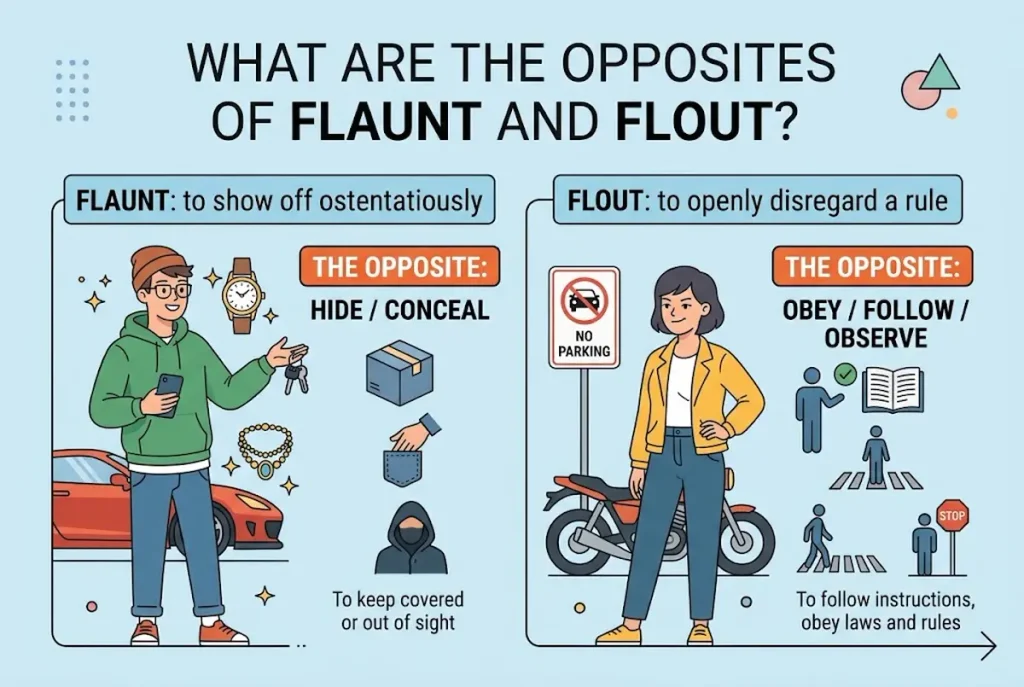
Antonyms can also help you remember the difference between these confusing verbs.
Opposite of Flaunt
| Antonym | Meaning |
|---|---|
| Hide | Keep something out of sight |
| Conceal | Prevent something from being noticed |
| Downplay | Make something seem less important |
| Understate | Present something modestly |
| Suppress | Prevent something from being expressed |
Opposite of Flout
| Antonym | Meaning |
|---|---|
| Obey | Follow an instruction |
| Follow | Act according to a rule |
| Respect | Show proper regard for something |
| Comply | Meet an established requirement |
| Observe | Follow a law or accepted practice |
| Uphold | Support or maintain a principle |
How Can You Remember Flaunt vs Flout Easily?
You don’t need to memorize complicated definitions. A few simple memory tricks can help you choose correctly.
Remember Flaunt as Showing Off
Think of someone wearing flashy clothes and proudly showing everyone their expensive accessories.
Flaunt connects naturally with a flashy display.
Example:
She flaunted her new diamond necklace.
Remember Flout as Openly Disobeying
Connect flout with openly refusing to follow something.
Imagine a driver knowingly ignoring a clearly displayed parking restriction.
Example:
He flouted the parking regulations.
Use This Quick Decision Table
| Ask Yourself | Choose |
|---|---|
| Is someone showing something proudly? | Flaunt |
| Is someone displaying wealth or success? | Flaunt |
| Is someone openly ignoring a rule? | Flout |
| Is someone deliberately disregarding authority? | Flout |
| Is someone simply making an accidental mistake? | Usually neither |
| Is someone describing professional achievements? | Consider showcase or demonstrate |
Conclusion
Understanding flaunt vs flout comes down to recognizing two different actions. One involves displaying something proudly, while the other involves openly disregarding rules or expectations.
Use flaunt when describing someone who shows off wealth, talent, appearance, possessions, or achievements. Choose flout when someone knowingly ignores laws, instructions, regulations, or accepted standards.
Remember that neither word automatically fits every situation. Showcase may sound better when discussing professional achievements, while violate may be more accurate when describing a rule that was broken accidentally.
Before using either verb, consider the action you’re describing and the tone you want your sentence to carry. A quick substitution with show off or openly disregard can usually settle the confusion.With a little practice, choosing the correct word will become a natural part of your writing.
Frequently Asked Questions
What is the main difference between flaunt and flout?
Flaunt means to display something proudly or noticeably, while flout means to openly disregard a rule or accepted standard. The distinction in flaunt vs flout is showing off compared with deliberate disobedience.
Is it flaunt the rules or flout the rules?
Flout the rules is the established expression when describing deliberate disregard for rules. Flaunt means to display something showily, so it doesn’t express the intended meaning in standard edited English.
Can flaunt have a positive meaning?
Yes, flaunt can describe confidently displaying personal style, talent, or achievements. However, it can also suggest excessive pride or showing off, depending on the context.
What’s another way to say flaunt?
Common alternatives include show off, display, showcase, exhibit, parade, and flex. Choose showcase for positive professional writing and show off for everyday conversation.
Does flout always mean breaking the law?
No, flout can describe openly disregarding laws, workplace policies, social conventions, traditions, or other established expectations. It isn’t limited to legal violations.
How do you remember flaunt vs flout?
Connect flaunt with a flashy display and flout with openly disregarding a rule. Remember that flaunt concerns showing something, while flout concerns defying an expectation.
Can I use flout in a professional email?
Yes, flout is appropriate when describing deliberate disregard for established policies or regulations. If you cannot establish intent, violated or failed to follow may be more accurate.
Is flaunting the same as bragging?
Not exactly. Flaunting usually involves noticeably displaying something, while bragging primarily involves talking excessively or proudly about yourself or your achievements.

Daniel Grammarfield — The Language Learner
Age: 28Occupation: ESL Learner & Digital Professional
Bio:Daniel is a non-native English speaker who wants to communicate more confidently at work and online. He uses Synotrench to improve grammar, understand confusing words, learn correct sentence structures, and build everyday English skills. He prefers simple explanations with practical examples.
Goals:
Master English grammar rules
Avoid common language mistakes
Improve professional communication
Learn English through real-life examples
Quote:“Learning English is not about memorizing rules — it’s about expressing ideas clearly.”