You’re writing an email about yesterday’s meeting, and suddenly, you stop at one sentence: Should you write “I feel happy” or “I felt happy”? Both sound natural, but they don’t express exactly the same thing.
The confusion between felt or feel is common because both words describe emotions, physical sensations, opinions, and personal experiences. The difference becomes clearer once you understand how English uses verb tenses.
This guide explains their meanings, word origins, grammar rules, synonyms, and everyday uses. You’ll also find comparison tables, practical examples, common mistakes, and simple tips to help you choose the correct word.
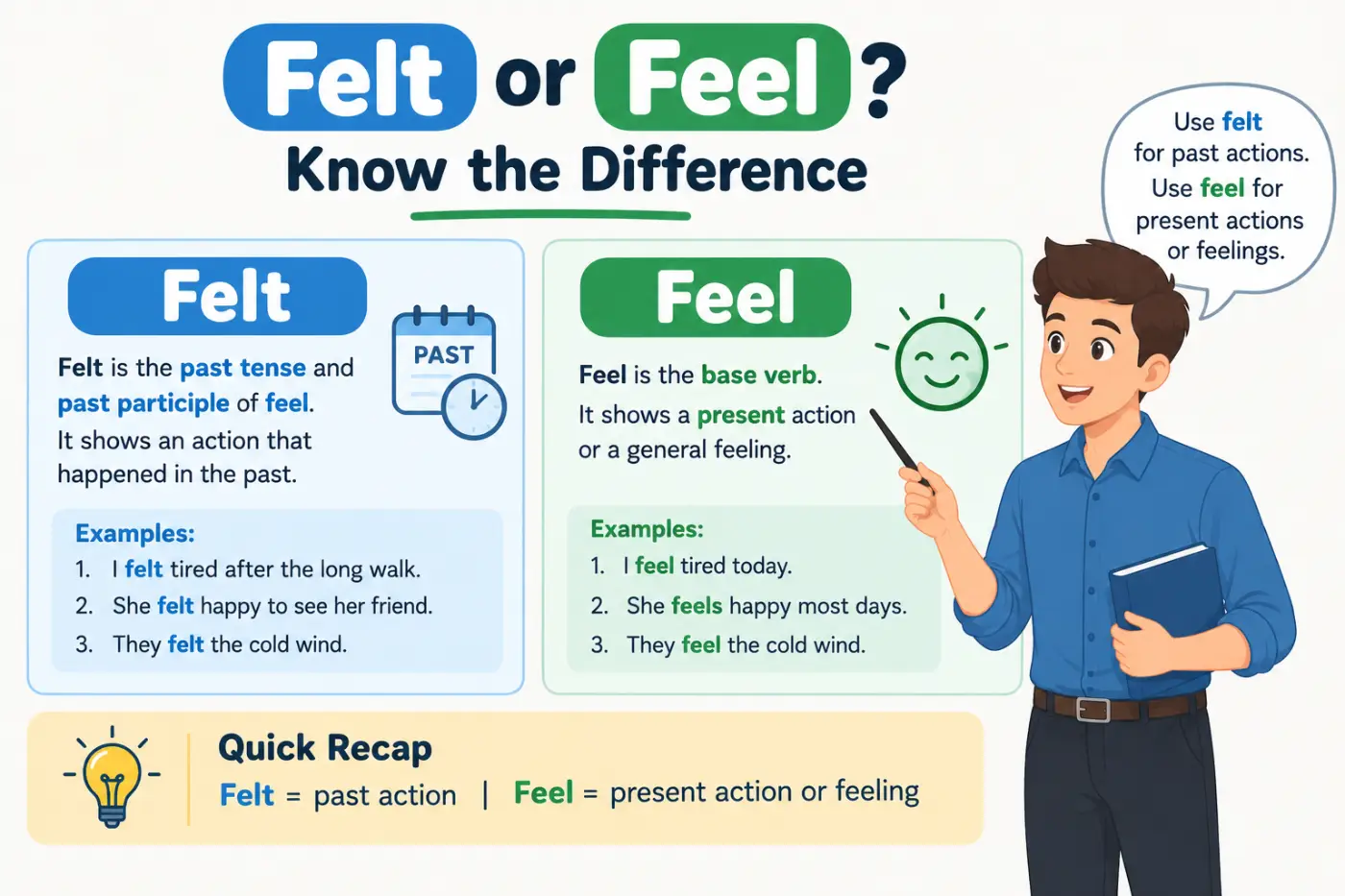
What Is the Difference Between Felt and Feel?
Both come from the same verb, but their grammatical roles are different.
| Word | Grammar Form | Meaning | Example |
|---|---|---|---|
| Feel | Base verb and present tense | Experience an emotion or sensation | I feel happy today. |
| Feels | Third-person singular present | Experiences something now | She feels tired. |
| Felt | Simple past tense | Experienced something before | I felt tired yesterday. |
| Felt | Past participle | Used with have, has, or had | She has felt better recently. |
| Feeling | Present participle | Describes an ongoing experience | I’m feeling nervous. |
Consider these sentences:
- I feel excited about my new job.
- I felt excited when I received the offer.
The first sentence expresses a present emotion. The second refers to an emotion experienced during an earlier event.
The feeling itself can be similar. The verb tense tells the reader when it happened.
What Does Feel Mean in Simple English?
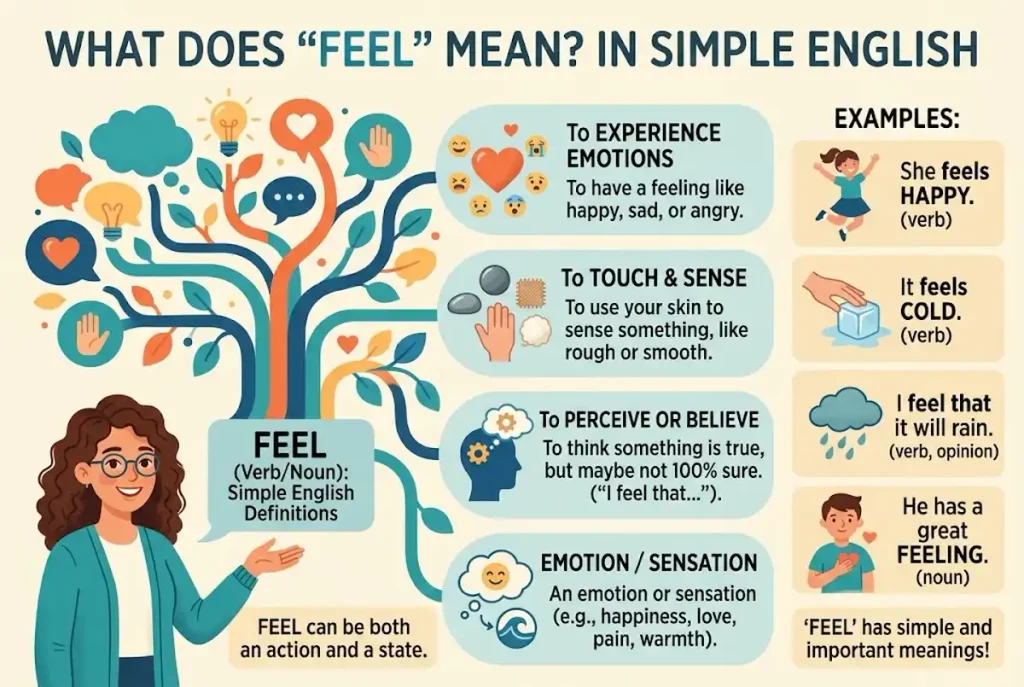
Feel means to experience an emotion, notice a physical sensation, touch something, or have a personal opinion.
It is an irregular English verb commonly used when discussing emotions, health, relationships, and everyday experiences.
When Do We Use Feel?
Use feel when describing something happening now, a general experience, or an opinion you currently hold.
Examples:
- I feel comfortable around my friends.
- We feel excited about the upcoming trip.
- They feel nervous before important exams.
- I feel that this decision is correct.
- Do you feel better after resting?
Feel also describes physical sensations.
Examples:
- I feel cold when the window is open.
- My hands feel rough after working outside.
- I can feel the warm sunlight on my face.
The word doesn’t always refer to emotions. It can describe touch, physical conditions, and personal judgments.
Is Feel a Present Tense Verb?
Yes. Feel is the base form and is also used in the simple present tense with I, you, we, and they.
For example:
- I feel hungry.
- You feel confident.
- We feel comfortable.
- They feel disappointed.
With he, she, or it, add an s.
Correct: She feels happy.
Incorrect: She feel happy.
After helping verbs such as can, will, should, and do, use the base form feel.
Example: She will feel better tomorrow.
What Does Felt Mean in Simple English?
Felt is the simple past tense and past participle of feel.
It describes an emotion, opinion, or physical sensation experienced at an earlier time.
Examples:
- I felt nervous before the interview.
- She felt happy after hearing the news.
- We felt tired after walking all afternoon.
- He felt disappointed with his exam results.
- They felt proud of their achievements.
Felt doesn’t automatically mean that the emotion has disappeared. It simply places the experience in the past.
For example:
I felt sad yesterday.
This sentence tells us about yesterday’s emotion. It doesn’t explain how the speaker feels today.
How Is Felt Used as a Past Participle?
Felt is also used with have, has, and had to form perfect tenses.
| Tense | Example |
|---|---|
| Present perfect | I have felt tired all week. |
| Present perfect | She has felt better recently. |
| Past perfect | He had felt nervous before the interview began. |
| Future perfect | By Friday, I will have felt this way for a month. |
Where Do Feel and Felt Come From?
Both words have roots in Old English.
Feel comes from the Old English verb fēlan, which referred to experiencing something through touch or physical sensation.
Over time, its meaning expanded to include emotions, thoughts, opinions, and personal experiences.
Felt developed as the past tense and past participle of this verb.
This history explains why both words can describe physical and emotional experiences.
For example:
- I feel the soft fabric.
- I felt the soft fabric yesterday.
- I feel worried about my family.
- I felt worried when I heard the news.
English also uses felt as a noun for a type of fabric made from compressed fibers. That meaning is separate from the verb form discussed here.
What Are the Best Synonyms for Words?
The best synonym depends on the meaning you want to express.
Sometimes feel means experience. In other situations, it means believe, notice, sense, or touch.
Similarly, felt can describe an emotion experienced in the past or an impression someone previously had.
The following tables provide more than 30 useful alternatives grouped by tone and everyday usage.
Simple Synonyms
These words are easy to understand and work well in ordinary conversations.
| Word | Meaning | Tone | Example |
|---|---|---|---|
| Sense | Notice something | Simple | I sense something is wrong. |
| Notice | Become aware | Simple | I notice a change in his mood. |
| Think | Have an opinion | Simple | I think this idea will work. |
| Believe | Accept something as true | Simple | I believe she is right. |
| Touch | Make physical contact | Simple | I touch the soft blanket. |
| Experience | Go through something | Neutral | I experience joy when helping others. |
| Know | Be aware or certain | Simple | I know something has changed. |
| Seem | Give an impression | Simple | This seems unusual to me. |
Everyday Synonyms
These words sound natural in emails, conversations, personal stories, and informal writing.
| Word | Meaning | Tone | Example |
|---|---|---|---|
| Realize | Become aware | Everyday | I realized something was missing. |
| Recognize | Identify something familiar | Everyday | She recognized the warning signs. |
| Detect | Notice something | Neutral | I detected a change in his voice. |
| Experience | Personally go through something | Everyday | We experienced great happiness. |
| Suspect | Think something may be true | Everyday | I suspect there’s a problem. |
| Imagine | Form a mental picture | Everyday | I imagine she’s excited. |
| Perceive | Notice or understand | Neutral | He perceived a change in attitude. |
| Consider | Think about something | Everyday | I consider this a good opportunity. |
| Enjoy | Take pleasure in something | Everyday | I enjoy spending time outdoors. |
Formal Synonyms
Formal alternatives are useful in academic writing, professional communication, reports, and essays.
| Word | Meaning | Tone | Example |
|---|---|---|---|
| Perceive | Become aware of something | Formal | Participants perceived a change. |
| Experience | Personally undergo something | Neutral/Formal | Employees experienced increased stress. |
| Recognize | Identify or acknowledge | Formal | Researchers recognized the pattern. |
| Observe | Notice through attention | Formal | We observed several changes. |
| Determine | Reach a conclusion | Formal | The team determined the cause. |
| Interpret | Understand meaning | Formal | Students interpreted the response differently. |
| Evaluate | Judge carefully | Formal | Managers evaluated the situation. |
| Acknowledge | Accept or recognize | Formal | She acknowledged her concerns. |
| Undergo | Experience a process | Formal | Patients underwent significant changes. |
Slang and Informal Alternatives
These expressions are useful in casual conversations, texting, and social media.
| Word or Phrase | Meaning | Tone | Example |
|---|---|---|---|
| Vibe with | Connect with or enjoy | Slang | I really vibe with this song. |
| Get | Understand | Informal | I get what you’re saying. |
| Dig | Like or appreciate | Slang | I dig your new style. |
| Pick up on | Notice something subtle | Informal | I picked up on his sadness. |
| Be into | Strongly like something | Informal | I’m into this new idea. |
| Be down | Be willing or interested | Slang | I’m down for that plan. |
| Relate to | Understand through experience | Casual | I can relate to your situation. |
| Be feeling | Currently enjoy or appreciate | Casual | I’m feeling this new design. |
How Do Synonyms Change From Mild to Strong Feelings?
Not every emotional word communicates the same intensity.
Choosing the correct level helps readers understand how strongly someone experienced an emotion.
| Intensity | Present Expression | Past Expression |
|---|---|---|
| Very mild | Feel slightly uneasy | Felt slightly uneasy |
| Mild | Feel concerned | Felt concerned |
| Moderate | Feel worried | Felt worried |
| Strong | Feel anxious | Felt anxious |
| Very strong | Feel terrified | Felt terrified |
| Extreme | Feel overwhelmed | Felt overwhelmed |
How Can You Express Positive Feelings?
The same principle applies to positive emotions.
| Mild | Moderate | Strong |
|---|---|---|
| Content | Happy | Delighted |
| Interested | Excited | Thrilled |
| Pleased | Proud | Overjoyed |
| Relaxed | Comfortable | Completely at ease |
What Part of Speech Are Feel and Felt?
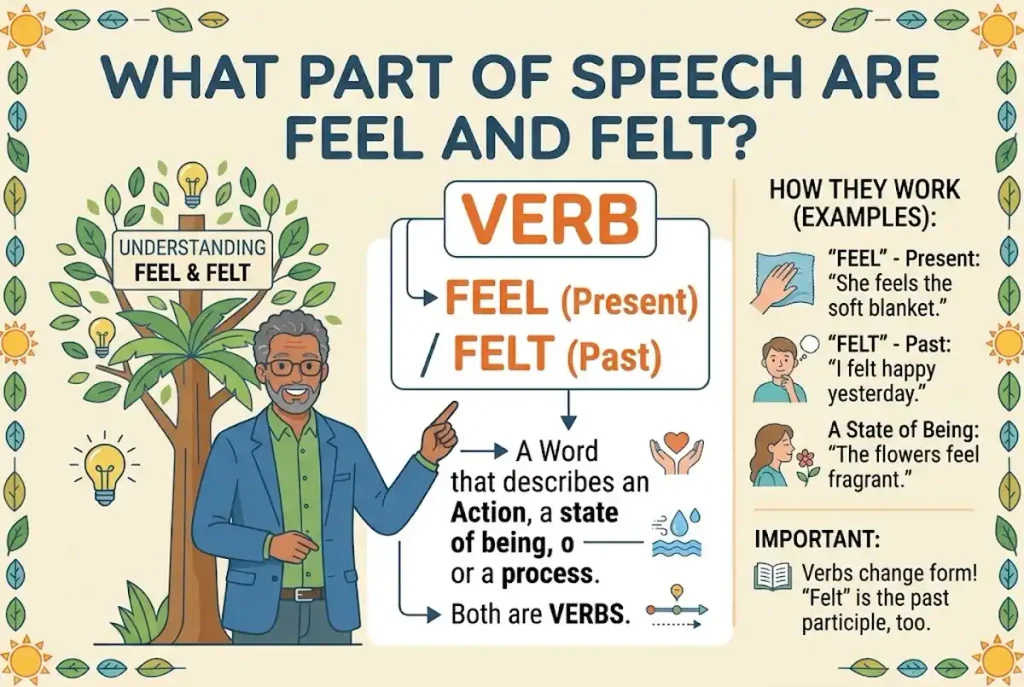
Both words mainly function as verbs, but related forms have different grammatical uses.
Understanding these forms makes sentence construction easier.
| Word | Part of Speech | Example |
|---|---|---|
| Feel | Verb | I feel confident. |
| Feel | Noun | This room has a welcoming feel. |
| Feels | Verb | He feels relaxed. |
| Felt | Past tense verb | She felt nervous. |
| Felt | Past participle | I have felt this before. |
| Felt | Noun | The hat is made of felt. |
| Feeling | Noun | Happiness is a wonderful feeling. |
| Feeling | Verb form | I’m feeling much better. |
| Feelings | Plural noun | Everyone has different feelings. |
What Is the Difference Between Feel and Feeling?
Feel is the base verb, while feeling is its ing form and can also function as a noun.
Examples:
- I feel happy.
- I’m feeling happy.
- She shared her feelings.
The first sentence describes a present state. The second emphasizes the current experience.
Both can be grammatically correct.
Can Felt Be Used as an Adjective?
Felt is sometimes used before nouns as a past participle modifier.
For example:
- A deeply felt emotion.
- A strongly felt need.
- A heartfelt apology.
Heartfelt is a separate adjective meaning sincere or deeply emotional.
It isn’t a tense of feel.
Is There a Difference Between American and British English?
American and British English use words in the same basic grammatical ways.
There is no standard regional rule that changes the past tense to feeled.
| Usage | American English | British English |
|---|---|---|
| Present | I feel happy. | I feel happy. |
| Past | I felt happy. | I felt happy. |
| Present perfect | I have felt better. | I have felt better. |
| Continuous | I’m feeling tired. | I’m feeling tired. |
When Should You Use Both Words in Different Situations?
Context helps determine the correct tense.
A resume, essay, text message, professional email, and spoken conversation may describe similar experiences differently.
Which Word Should You Use in a Resume?
Professional resumes usually focus on completed achievements, responsibilities, and measurable results.
Instead of relying heavily on emotional descriptions, use action verbs that show what you accomplished.
Less effective:
I felt happy when I completed the project.
Better:
I successfully completed the project ahead of schedule.
However, feel can work in a personal statement when describing a current belief or interest.
Example:
I feel strongly about creating accessible learning opportunities.
Use felt when discussing a past personal experience in a cover letter.
Example:
I felt inspired to pursue teaching after volunteering at a local school.
Which Word Should You Use in an Essay?
Use the verb tense that matches the time of the event.
For personal essays, felt often appears when describing past experiences.
Example:
I felt nervous when I entered my new school for the first time.
Use feel when describing your present opinion or emotional response.
Example:
I feel that education should be accessible to everyone.
In formal argumentative essays, more precise expressions may work better.
For example:
Instead of “I feel this policy is ineffective,” write “The available evidence suggests that this policy is ineffective.”
This makes the argument stronger without relying entirely on personal opinion.
Which Word Sounds Better in Texting?
Both forms are common in text messages.
Use feel when describing your current mood.
Examples:
- I feel great today!
- I feel like watching a movie.
- Do you feel okay?
Use felt when talking about something that already happened.
Examples:
- I felt so embarrassed yesterday.
- That message made me feel better.
- I felt really happy after our conversation.
Notice the final example in the first group of past situations: “made me feel” uses the base verb after made, even though the main event happened earlier.
Which Word Should You Use in an Email?
In professional emails, clarity matters more than complicated vocabulary.
Use feel for a current opinion.
Example:
I feel that the proposed schedule gives everyone enough preparation time.
Use felt for a past impression.
Example:
I felt that yesterday’s meeting was productive.
For a more direct professional tone, you can sometimes remove the emotional expression entirely.
Example:
The proposed schedule gives everyone enough preparation time.
Which Word Should You Use When Speaking?
In everyday conversation, both forms appear frequently.
Use feel when someone asks about your current condition.
Example:
How do you feel today?
Answer:
I feel much better, thanks.
Use felt when describing an earlier experience.
Example:
How did you feel after the interview?
Answer:
I felt relieved when it was over.
These natural patterns are useful in daily conversations because the question often signals the tense needed in the answer.
What Are Some Real Life Examples of Words?
The examples below cover emotions, health, relationships, school, work, and everyday activities.
| Situation | Present Example | Past Example |
|---|---|---|
| Happiness | I feel happy today. | I felt happy yesterday. |
| Health | I feel sick this morning. | I felt sick last night. |
| School | I feel prepared for the exam. | I felt prepared before the exam. |
| Work | I feel confident at work. | I felt confident during the presentation. |
| Friendship | I feel comfortable around her. | I felt comfortable when we first met. |
| Weather | I feel cold outside. | I felt cold during our walk. |
| Fear | I feel scared of heights. | I felt scared on the tall bridge. |
| Family | I feel loved by my family. | I felt loved during our family gathering. |
| Exercise | I feel tired after running. | I felt tired after yesterday’s run. |
| Opinions | I feel this is a good decision. | I felt it was a good decision at the time. |
Feel vs Think
Feel and think sometimes appear interchangeable, particularly when expressing opinions.
However, they carry slightly different meanings.
| Feel | Think |
|---|---|
| Often emphasizes personal impressions or emotions | Often emphasizes judgment or reasoning |
| I feel something is wrong. | I think something is wrong. |
| I feel this decision is unfair. | I think this decision is unfair. |
Feel can communicate an emotional or intuitive response.
Think usually places greater emphasis on a person’s opinion or mental judgment.
Both are acceptable in everyday English.
For formal arguments, support your opinion with evidence rather than depending on either expression alone.
Felt vs Experienced
| Felt | Experienced |
|---|---|
| Often emphasizes a personal sensation or emotion | Can describe a broader event or condition |
| I felt nervous during the interview. | I experienced anxiety during the interview. |
| She felt pain in her shoulder. | She experienced shoulder pain. |
Felt vs Feeling
These words are related, but they have different grammatical roles.
Feeling is the present participle and can also be a noun.
Compare:
- I felt tired yesterday.
- I’m feeling tired right now.
- I’ve been feeling tired recently.
The first sentence describes a past state.
The second emphasizes a current experience.
The third describes an experience that began earlier and has continued or occurred repeatedly up to the present.
What Are the Most Common Mistakes With Words?
Several mistakes appear frequently in spoken and written English.
Most happen when learners combine the wrong verb form with a helping verb.
Mistake 1 Using Felt After Did
Incorrect: Did you felt happy?
Correct: Did you feel happy?
After did, use the base form of the main verb.
The helping verb already expresses the past tense.
Mistake 2 Using Feel for a Completed Past Experience
Incorrect: Yesterday, I feel tired after work.
Correct: Yesterday, I felt tired after work.
Yesterday signals a past event, so the simple past tense is normally required.
Historical present is possible in storytelling, but it isn’t the usual choice for a simple account of yesterday.
Mistake 3 Writing Feeled Instead of Felt
Incorrect: I feeled nervous.
Correct: I felt nervous.
Feel is an irregular verb. Its past tense isn’t formed by adding ed.
Mistake 4 Using Felt After Will
Incorrect: I will felt better tomorrow.
Correct: I will feel better tomorrow.
Modal verbs such as will, can, could, and should take the base form.
Mistake 5 Using Feel After Have
Incorrect: I have feel this before.
Correct: I have felt this before.
Perfect tenses require the past participle.
When Should You Avoid Using?
Although both words are useful, they aren’t always the strongest choices.
Avoid relying on them when another word communicates your meaning more accurately.
For example:
Weak: I felt very, very happy about my achievement.
Better: I was thrilled with my achievement.
Weak: I feel the report has several problems.
Better: The report contains several problems.
In professional writing, direct statements often sound more confident.
In personal writing, however, emotional expressions can make your message more natural and relatable.
What Are the Opposites of Feel and Felt?
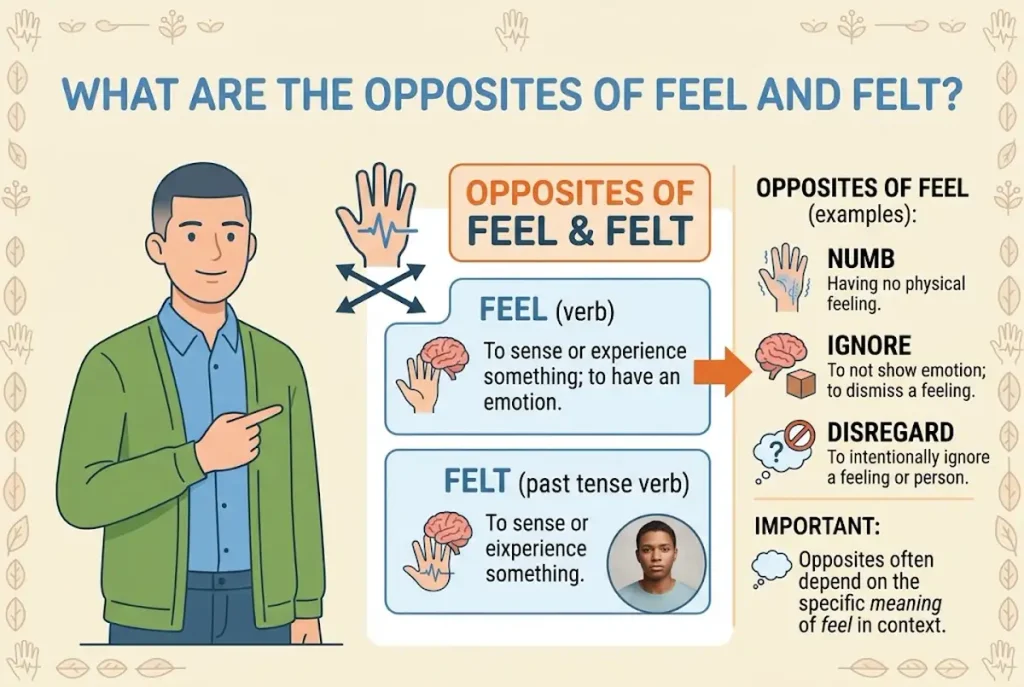
There is no single antonym that works for every meaning of these verbs.
The opposite depends on the context.
| Original Meaning | Possible Opposite | Example |
|---|---|---|
| Feel something physically | Be numb | My fingers were numb from the cold. |
| Feel aware | Be unaware | I was unaware of the problem. |
| Feel connected | Feel disconnected | She felt disconnected from the group. |
| Feel interested | Feel indifferent | He felt indifferent about the result. |
| Feel excited | Feel bored | I felt bored during the long wait. |
| Feel confident | Feel uncertain | She felt uncertain about her answer. |
How Can You Choose the Correct Word Quickly?
When you’re unsure about words, identify the time of the experience first.
Follow these practical tips:
- Use feel for a present emotion, sensation, or general experience.
- Use felt when describing something experienced in the past.
- Use felt after have, has, or had in perfect tenses.
- Use feel after did, can, should, would, and will.
- Use feels with he, she, and it in the simple present.
Conclusion
Choosing between words becomes much easier once you understand their relationship with time and sentence structure.
Feel is the base form and present tense, while felt is the past tense and past participle. Both describe emotions, physical sensations, opinions, and personal experiences. The correct choice depends on when the experience happens and which helping verbs appear in the sentence.
You can also improve your writing by choosing more precise emotional words when needed. Expressions such as excited, relieved, concerned, and disappointed often communicate your meaning more clearly.
With a little practice, selecting the correct form will become a natural part of your everyday English.
Frequently Asked Questions
What’s another way to say I feel happy?
You can say “I’m pleased,” “I’m delighted,” “I’m excited,” or “I’m content.” Choose the expression that best matches the strength of your emotion.
Can I use felt when talking about something happening now?
Felt normally refers to a past experience, but it can appear in the present perfect tense when the experience connects to the present. For example, “I have felt tired all day” can describe tiredness that continues now.
Is feeled a correct English word?
No. Feeled isn’t the standard past tense of feel. The correct past tense and past participle are both felt.
What is the difference between I felt and I was feeling?
“I felt” describes a past experience, while “I was feeling” emphasizes an experience in progress at a particular past time. Both are grammatically correct, but they present the experience differently.

Daniel Grammarfield — The Language Learner
Age: 28Occupation: ESL Learner & Digital Professional
Bio:Daniel is a non-native English speaker who wants to communicate more confidently at work and online. He uses Synotrench to improve grammar, understand confusing words, learn correct sentence structures, and build everyday English skills. He prefers simple explanations with practical examples.
Goals:
Master English grammar rules
Avoid common language mistakes
Improve professional communication
Learn English through real-life examples
Quote:“Learning English is not about memorizing rules — it’s about expressing ideas clearly.”