Imagine you’re writing an email to your manager. You explain that a project is delayed, but you don’t mention the reason behind the delay. Your message contains useful information, yet your manager may misunderstand the situation. This is a simple example of why understanding Content vs Context matters in everyday communication.
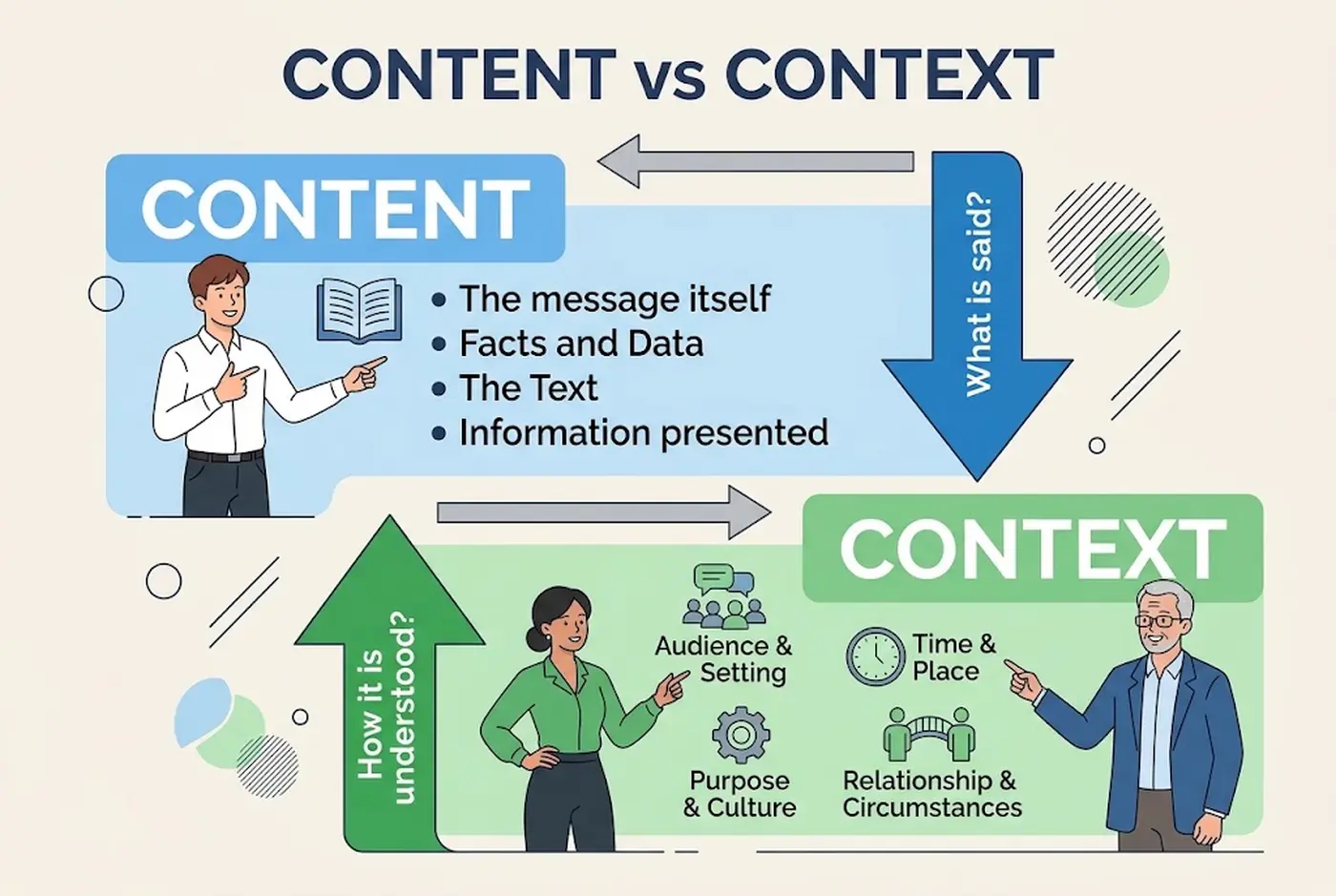
Content is the actual information, message, or material being presented. Context is the background, situation, or surrounding details that help someone understand what that information means.
Knowing this difference can improve your writing, prevent misunderstandings, and make your communication clearer. This guide explains their meanings, origins, related words, real examples, common mistakes, and practical ways to choose the right term.
What Is the Difference Between Content and Context?
The main difference between content and context is that content refers to what is communicated, while context explains the circumstances surrounding that communication.
Content answers the question, “What is being said or shown?”
Context answers the question, “What does it mean in this situation?”
For example, imagine receiving this text message:
“I can’t believe you did that!”
The content is the actual sentence. However, its meaning depends on the context.
If your friend has just received a surprise birthday gift, the message might express excitement. If someone has broken an important promise, the same sentence could express disappointment.
The words haven’t changed, but the situation has changed their meaning.
Content vs Context at a Glance
| Feature | Content | Context |
|---|---|---|
| Basic meaning | Information being shared | Circumstances surrounding information |
| Main question | What is communicated? | Why or how should it be understood? |
| Main purpose | Delivers information | Helps explain meaning |
| Common forms | Text, images, videos, speech | Background, setting, history, situation |
| Example in writing | The words in an essay | The purpose and audience of the essay |
| Example in communication | A spoken statement | Tone, relationship, and situation |
| Example in marketing | An advertisement | Audience needs and market conditions |
| Example in education | A lesson | The circumstances that help explain it |
What Does Content Mean in Simple English?
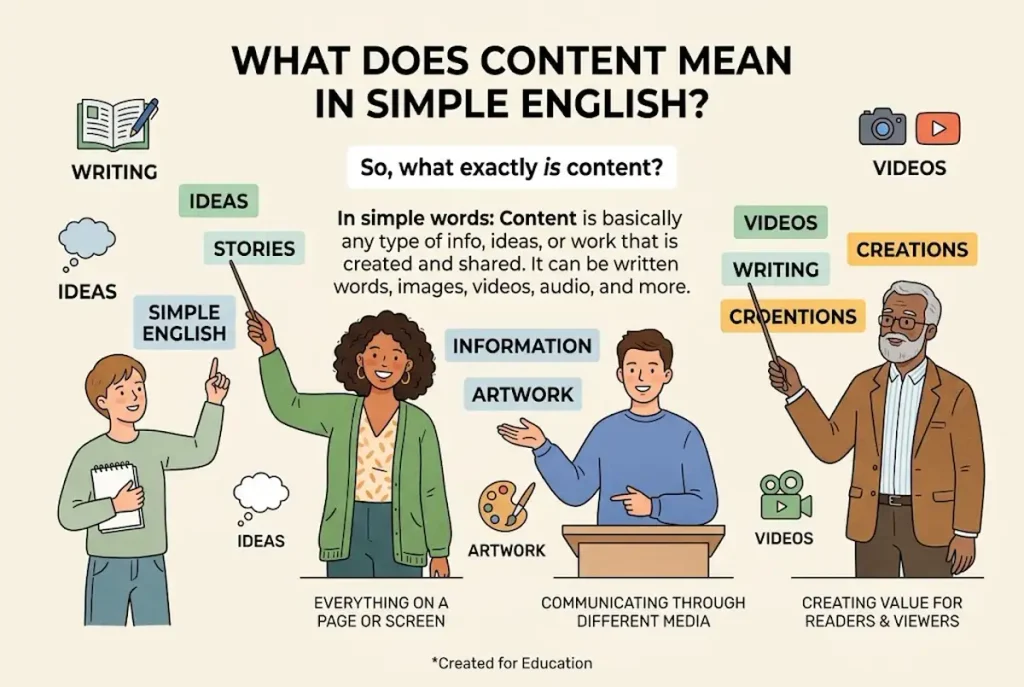
Content is the information, ideas, or material contained in something.
It can refer to written words, spoken messages, pictures, videos, or other forms of communication.
For example, the content of a book includes its story, explanations, and ideas. The content of a website may include articles, photographs, videos, and product descriptions.
The word can also describe what something physically contains.
Consider these examples:
- The teacher reviewed the content of the student’s essay.
- The website publishes educational content every week.
- The content of the email was clear and professional.
In each sentence, the word points toward what is included, presented, or communicated.
Where Does the Word Content Come From?
The noun content comes through Latin roots connected with the idea of holding or containing something.
Its history is linked to the Latin word continere, meaning to hold together or contain.
Over time, English developed the word to describe the things contained inside an object, document, or communication.
Today, content has several common uses.
| Type | Meaning | Example |
|---|---|---|
| Written content | Information expressed through writing | A newspaper article |
| Visual content | Information presented through images | An infographic |
| Digital content | Material published electronically | A blog post |
| Educational content | Material created for learning | A grammar lesson |
| Physical contents | Things contained inside something | Items inside a package |
What Does Context Mean in Simple English?
Context refers to the background information, conditions, or circumstances that help explain something.
It allows readers and listeners to understand a message beyond its individual words.
For example, imagine someone saying:
“That’s just great.”
Without additional information, the sentence seems positive.
However, imagine the speaker has just missed an important flight. The same words might express frustration or sarcasm.
The surrounding situation provides the context needed to understand the speaker’s intention.
Context can include:
- The time and place of an event.
- The relationship between people.
- The speaker’s tone or intention.
Where Does the Word Context Come From?
Context comes from the Latin word contextus, which carries the idea of joining, connecting, or weaving things together.
Its roots are associated with contexere, meaning to weave together.
This origin helps explain its modern meaning.
Just as individual threads form a larger piece of fabric, separate details combine to create a complete understanding of a message.
In English, context originally had a strong connection to surrounding written passages. Its meaning later expanded to include social, historical, cultural, and situational circumstances.
Today, people use the word in education, language studies, communication, technology, and many other fields.
What Are the Best Synonyms for Content and Context?
Both terms have several related words, but their alternatives aren’t always interchangeable.
A synonym that works in an academic essay might sound unnatural in a casual conversation.
The following tables group more than 30 useful alternatives by tone and everyday usage.
Simple Synonyms
These words are easy to understand and work well in ordinary communication.
| Word | Meaning | Tone | Example |
|---|---|---|---|
| Information | Facts or details | Simple | The report contains useful information. |
| Material | Something presented or used | Simple | The teacher prepared reading material. |
| Message | An idea being communicated | Simple | Her message was easy to understand. |
| Details | Small pieces of information | Simple | Please include the missing details. |
| Background | Earlier or supporting information | Simple | We need some background first. |
| Situation | The conditions surrounding something | Simple | The situation explains his reaction. |
| Setting | Place or circumstances | Simple | The setting helps explain the story. |
| Meaning | What something expresses | Simple | The meaning changes with the situation. |
Everyday Synonyms
These alternatives are common in workplace communication, education, and regular conversations.
| Word | Meaning | Tone | Example |
|---|---|---|---|
| Subject matter | Topic being discussed | Neutral | The subject matter is appropriate for students. |
| Substance | Main ideas or meaningful material | Neutral | The article has useful substance. |
| Topic | Main subject | Neutral | The topic is workplace communication. |
| Explanation | Information that makes something clear | Neutral | Her explanation helped everyone understand. |
| Circumstances | Conditions surrounding an event | Neutral | Consider the circumstances before deciding. |
| Environment | Surrounding conditions | Neutral | The learning environment affects students. |
| Perspective | A particular way of viewing something | Neutral | His perspective changed after the meeting. |
| Framework | Structure used to understand something | Neutral | The framework helps explain the findings. |
Formal and Academic Synonyms
These words are especially useful in essays, reports, research papers, and professional writing.
| Word | Meaning | Tone | Example |
|---|---|---|---|
| Subject | Matter being examined | Formal | The subject requires further discussion. |
| Documentation | Recorded information | Formal | The documentation explains the procedure. |
| Data | Collected facts or information | Formal | The research data supports the conclusion. |
| Discourse | Spoken or written communication | Academic | The study examines political discourse. |
| Narrative | A connected account of events | Formal | The narrative presents several viewpoints. |
| Historical background | Earlier events that explain something | Academic | Historical background clarifies the conflict. |
| Circumstantial factors | Conditions affecting an event | Formal | Several circumstantial factors influenced the result. |
| Social setting | Social conditions surrounding an event | Academic | The social setting shaped their behavior. |
| Cultural framework | Shared beliefs influencing interpretation | Academic | The cultural framework explains the tradition. |
| Interpretive framework | A system for understanding information | Academic | The interpretive framework guides the analysis. |
Which Synonyms Are Stronger or More Specific?
Not every related word communicates the same amount of information.
Some terms are broad and simple. Others suggest a deeper explanation or more detailed analysis.
Words Related to Content From General to Specific
| Level | Word | Best Use |
|---|---|---|
| General | Stuff | Casual reference to material |
| General | Information | Facts or details |
| Moderate | Material | Written, visual, or educational resources |
| Moderate | Message | Information meant to communicate an idea |
| Specific | Substance | Important or meaningful information |
| Specific | Subject matter | The actual topic being examined |
| Specialized | Documentation | Organized recorded information |
| Specialized | Discourse | Extended communication or discussion |
Words Related to Context From Basic to Detailed
| Level | Word | Best Use |
|---|---|---|
| Basic | Setting | Location or surrounding conditions |
| Basic | Situation | Immediate circumstances |
| Moderate | Background | Supporting or earlier information |
| Moderate | Circumstances | Conditions influencing an event |
| Detailed | Historical background | Earlier events that explain the present |
| Detailed | Cultural framework | Shared beliefs shaping interpretation |
| Specialized | Interpretive framework | A structured approach to understanding |
Are Content and Context Nouns or Verbs?
Both words are most commonly used as nouns when discussing communication.
However, content has additional grammatical uses.
Content as a Noun
Content refers to information or material.
Example: The content of the article needs improvement.
Content as an Adjective
Content can mean satisfied or pleased.
Example: She felt content with her decision.
This meaning is unrelated to information or digital material.
Content as a Verb
The verb content means to satisfy or make someone accept something as sufficient.
Example: He contented himself with a short explanation.
This use is less common in everyday speech.
Context as a Noun
Context describes the circumstances surrounding something.
Example: The context of the conversation explains her response.
Context isn’t normally used as a verb in standard everyday English. The verb contextualize expresses the action of placing information within its proper background.
Example: The historian contextualized the event by explaining earlier political changes.
Useful Related Word Forms
| Word | Part of Speech | Meaning |
|---|---|---|
| Content | Noun | Information or material |
| Contents | Plural noun | Things included inside something |
| Content | Adjective | Satisfied |
| Context | Noun | Surrounding circumstances |
| Contextual | Adjective | Related to surrounding circumstances |
| Contextualize | Verb | Explain something within its situation |
| Contextualization | Noun | The process of providing background |
| Contextually | Adverb | In relation to surrounding circumstances |
Is There a Difference in American and British English?
The basic meanings of content and context are the same in American and British English.
Both varieties use content for information and context for surrounding circumstances.
There is no major regional spelling difference between the two words.
However, some related expressions vary slightly.
| American English | British English | Meaning |
|---|---|---|
| Content | Content | Information or material |
| Context | Context | Surrounding circumstances |
| Contextualize | Contextualise | Place something within its background |
| Contextualization | Contextualisation | Providing surrounding information |
When Should You Use Content or Context?
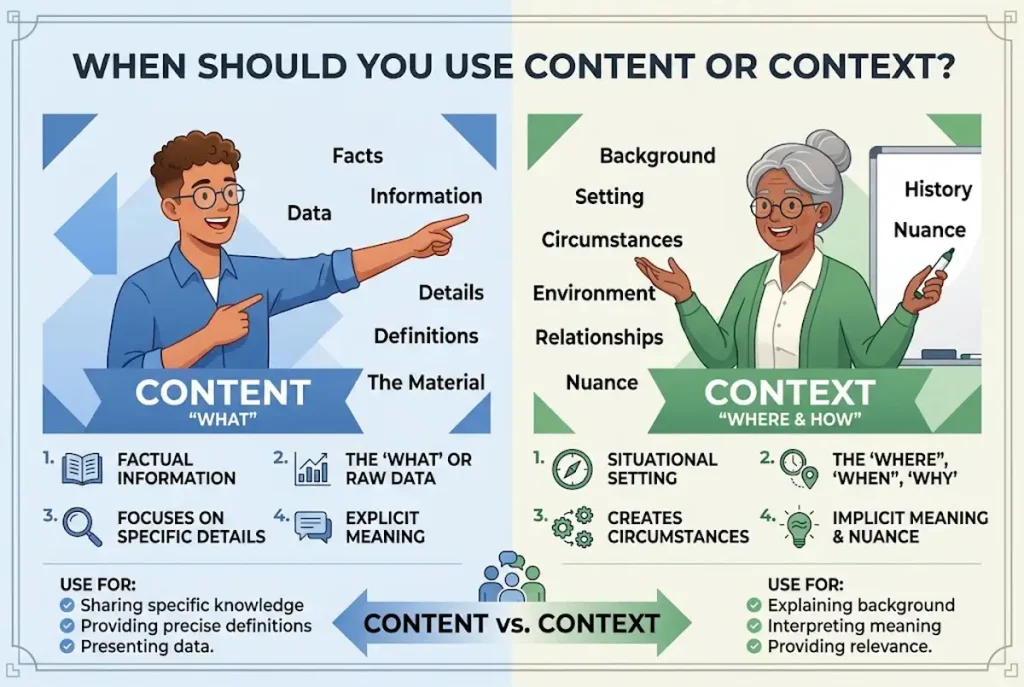
The easiest way to choose the correct term is to identify what your sentence is discussing.
Use content when describing the actual information.
Use context when describing the background that helps explain that information.
The following examples show how this works in common situations.
Which Word Should You Use on a Resume?
On a resume, content refers to the actual information you include about your education, skills, achievements, and work experience.
Context refers to the background that helps an employer understand those achievements.
For example:
Content: “Increased monthly sales by 25%.”
Context: “Increased monthly sales by 25% during a companywide decline in customer spending.”
The second version provides additional background that makes the achievement easier to evaluate.
Useful resume sentences include:
- Developed website content for multiple business clients.
- Provided context for performance improvements through measurable results.
- Created educational materials for new employees.
When describing professional achievements, give enough supporting information to show why your results matter.
Which Word Should You Use in an Essay?
Academic writing requires both clear information and supporting background.
Content includes your arguments, examples, evidence, and explanations.
Context includes the historical period, social conditions, cultural setting, or earlier events that help explain your topic.
Consider an essay about the American Civil War.
The content may describe major battles, political decisions, and historical figures.
The context may explain slavery, economic differences, and political tensions leading up to the war.
Example sentences:
- The essay presents accurate historical content.
- Understanding the historical context makes the author’s argument clearer.
- The writer should provide enough background before introducing the main claim.
A strong essay doesn’t simply present facts. It also helps readers understand how those facts connect.
Which Word Should You Use When Texting?
Text messages are often short, which makes missing background a common problem.
The content is the message itself.
The context includes earlier conversations, personal relationships, tone, and shared experiences.
Imagine receiving this message:
“Fine. Do whatever you want.”
Depending on the situation, the sender might be giving permission, expressing frustration, or ending an argument.
Without context, the intended meaning may be unclear.
Example sentences:
- I understood your message after reading the earlier texts.
- That joke sounds rude without context.
- The content of her message was brief but friendly.
When a text seems confusing, checking the surrounding conversation is often better than making an immediate assumption.
Which Word Should You Use in an Email?
Professional emails need accurate information and enough background for the recipient to understand the message.
Content refers to the subject, main message, details, and requested actions.
Context explains why the email is being sent and what happened before it.
Compare these examples:
Without background:
“Please update the document immediately.”
With background:
“The client requested a few changes during today’s meeting. Please update the document before tomorrow’s review.”
The second email gives the recipient a clearer reason for the request.
Other examples:
- The email content should remain professional.
- Please provide additional context about the client’s complaint.
- The message includes all the necessary project details.
A useful professional email explains what needs attention and provides enough background to help the reader respond correctly.
Which Word Should You Use When Speaking?
In spoken communication, content includes the words and ideas someone expresses.
Context includes the setting, speaker’s tone, body language, relationship with listeners, and surrounding events.
Imagine a teacher saying:
“That’s an interesting answer.”
The statement could express genuine appreciation. In another situation, it might politely suggest that a student’s answer is unexpected.
Tone and circumstances help listeners understand the intention.
Example sentences:
- His speech contained valuable educational content.
- Her comment makes sense when you understand the situation.
- The audience misunderstood the joke because they lacked context.
Good speakers pay attention to both their message and the circumstances in which people receive it.
How Do Content and Context Work Together?
Content and context are closely connected, but they perform different jobs.
Content provides something to understand. Context helps people interpret it.
This relationship becomes especially clear in education, journalism, marketing, and online communication.
Example in Education
A teacher presents the sentence:
“He finally returned home.”
The content tells students that someone returned to a particular place.
However, students may need more information to understand its importance.
Was the person missing for several years? Had they been traveling? Were they returning from military service?
Those details provide context.
Example in Journalism
A news headline states:
“Local Business Closes After 30 Years.”
The headline provides the main information.
However, readers may need additional details to understand why the business closed.
Possible background information could include rising operating costs, retirement, changing customer habits, or a property sale.
A complete news report should explain the relevant circumstances rather than encouraging readers to guess.
Example in Digital Marketing
A company publishes an advertisement for winter clothing.
The content includes product images, descriptions, prices, and promotional messages.
The context includes the target audience, season, location, customer needs, and current market conditions.
An advertisement that works well in a cold region may be less relevant to customers experiencing warm weather.
This is why effective marketing considers more than the message itself.
Example in Social Media
A short video shows someone laughing during a serious discussion.
Without additional information, viewers might assume the person is being disrespectful.
However, the complete recording could reveal that someone had made a harmless joke immediately before the clip began.
The video is the content. The surrounding conversation provides context.
This example shows why sharing isolated clips can sometimes create misleading impressions.
Content vs Context Examples in Real Life
The following examples show how the distinction works across different situations.
| Situation | Content | Context |
|---|---|---|
| Job interview | Candidate’s answers | Job requirements and interview setting |
| Classroom | Lesson material | Students’ learning needs |
| News article | Reported facts | Historical and social background |
| Text message | Written words | Earlier conversation |
| Advertisement | Promotional message | Audience and market conditions |
| Novel | Story and dialogue | Historical period and cultural setting |
| Business meeting | Discussion points | Company goals and recent developments |
| Social media post | Image and caption | Events surrounding the post |
| Research paper | Findings and arguments | Existing research and study conditions |
| Political speech | Spoken statements | Occasion, audience, and current events |
| Customer review | Written feedback | Customer expectations and experience |
| Medical explanation | Information communicated | Patient circumstances and relevant history |
What’s the Difference: Content vs Information?
Content and information are closely related, but they aren’t always identical.
Content refers to the material contained in something. Information refers to facts, details, or knowledge communicated through that material.
| Content | Information |
|---|---|
| Can include text, images, audio, and video | Refers to facts, details, or knowledge |
| Describes the material as a whole | Emphasizes what someone learns |
| Can be entertaining or informative | Primarily communicates knowledge |
| Common in publishing and digital media | Common in education and communication |
Context vs Background: What’s the Difference?
Context and background often overlap, but context is usually broader.
Background refers to earlier events or supporting information.
Context includes that background along with current conditions, relationships, purpose, and other relevant circumstances.
| Context | Background |
|---|---|
| Includes surrounding circumstances | Focuses on supporting or earlier information |
| Can include present conditions | Often explains what happened before |
| Helps interpret meaning | Helps establish understanding |
| May involve tone, culture, or setting | Often involves history or previous events |
What Are the Most Common Mistakes With Content and Context?
Writers sometimes confuse these terms because both are connected to communication.
However, choosing the wrong word can change the meaning of a sentence.
Mistake 1: Using Context When You Mean Information
Incorrect: The context of the website includes five articles and three videos.
Correct: The content of the website includes five articles and three videos.
The sentence describes materials published on a website, not the circumstances surrounding them.
Mistake 2: Using Content When You Mean Background
Incorrect: You need more content to understand why she was upset.
Better: You need more context to understand why she was upset.
The second sentence makes it clear that the listener needs surrounding details.
The first sentence isn’t always grammatically wrong, but it doesn’t express the intended meaning as precisely.
Mistake 3: Assuming Context Means an Excuse
Providing context doesn’t automatically mean defending someone’s behavior.
For example, explaining the circumstances surrounding a mistake can help others understand what happened without suggesting that the mistake was acceptable.
Context provides understanding, not automatic justification.

What Does Taken Out of Context Mean?
The expression taken out of context describes a statement, image, or action presented without enough surrounding information to understand its original meaning accurately.
This can happen accidentally or deliberately.
For example, imagine someone saying:
“I thought the first version was terrible, but the updated design looks excellent.”
If another person shares only the words “the first version was terrible,” readers may receive an incomplete impression of the speaker’s overall opinion.
The selected words are genuine, but the missing information affects their interpretation.
This expression is common in journalism, politics, social media, and everyday conversations.
Other useful expressions include:
| Expression | Meaning |
|---|---|
| In context | Considered with surrounding information |
| Out of context | Separated from relevant background |
| Provide context | Give supporting details |
| Put something into context | Explain its place within a larger situation |
| Context matters | Surrounding circumstances affect understanding |
| Lack of context | Missing information needed for interpretation |
Conclusion
Understanding Content vs Context helps you communicate more accurately in writing, speaking, education, and everyday conversations. Content is the information being shared, while context provides the surrounding details that explain its meaning or importance.
The easiest way to remember the distinction is to think about the message and the situation. A message tells you what someone said. The situation helps you understand why they said it and how their words should be interpreted.
Both are useful, but they aren’t interchangeable. When writing an essay, preparing a presentation, sending an email, or reading a social media post, consider the information and its surrounding circumstances together.
With a little practice, choosing the correct word becomes natural, and your communication becomes easier for others to understand.
Frequently Asked Questions
What is the main difference between content and context?
Content is the actual information or material being communicated. Context refers to the surrounding circumstances that help explain its meaning.
Can you give a simple example of Content vs Context?
A text message saying “That’s great” is content. The earlier conversation, relationship between the people, and sender’s tone provide context that helps explain the intended meaning.
Why is context important in communication?
Context helps people interpret messages accurately by providing relevant background information. Without it, statements can be misunderstood or given meanings the speaker never intended.
What’s another way to say content?
Information, material, message, substance, and subject matter are common alternatives. The best choice depends on what you’re describing.
Are content and context interchangeable?
No. Content describes what is communicated, while context describes the circumstances surrounding it. They work together but express different ideas.
What does content mean in writing?
In writing, content refers to the actual words, ideas, arguments, examples, and information included in a document.
What is the difference between Content vs Context in education?
In education, content refers to the material students learn, such as facts, concepts, and lessons. Context includes the background, real-world situations, and supporting details that help students understand that material.
What does without context mean?
Without context means information is presented without enough surrounding details to explain its original meaning. This can make a statement confusing or misleading.

Daniel Grammarfield — The Language Learner
Age: 28Occupation: ESL Learner & Digital Professional
Bio:Daniel is a non-native English speaker who wants to communicate more confidently at work and online. He uses Synotrench to improve grammar, understand confusing words, learn correct sentence structures, and build everyday English skills. He prefers simple explanations with practical examples.
Goals:
Master English grammar rules
Avoid common language mistakes
Improve professional communication
Learn English through real-life examples
Quote:“Learning English is not about memorizing rules — it’s about expressing ideas clearly.”