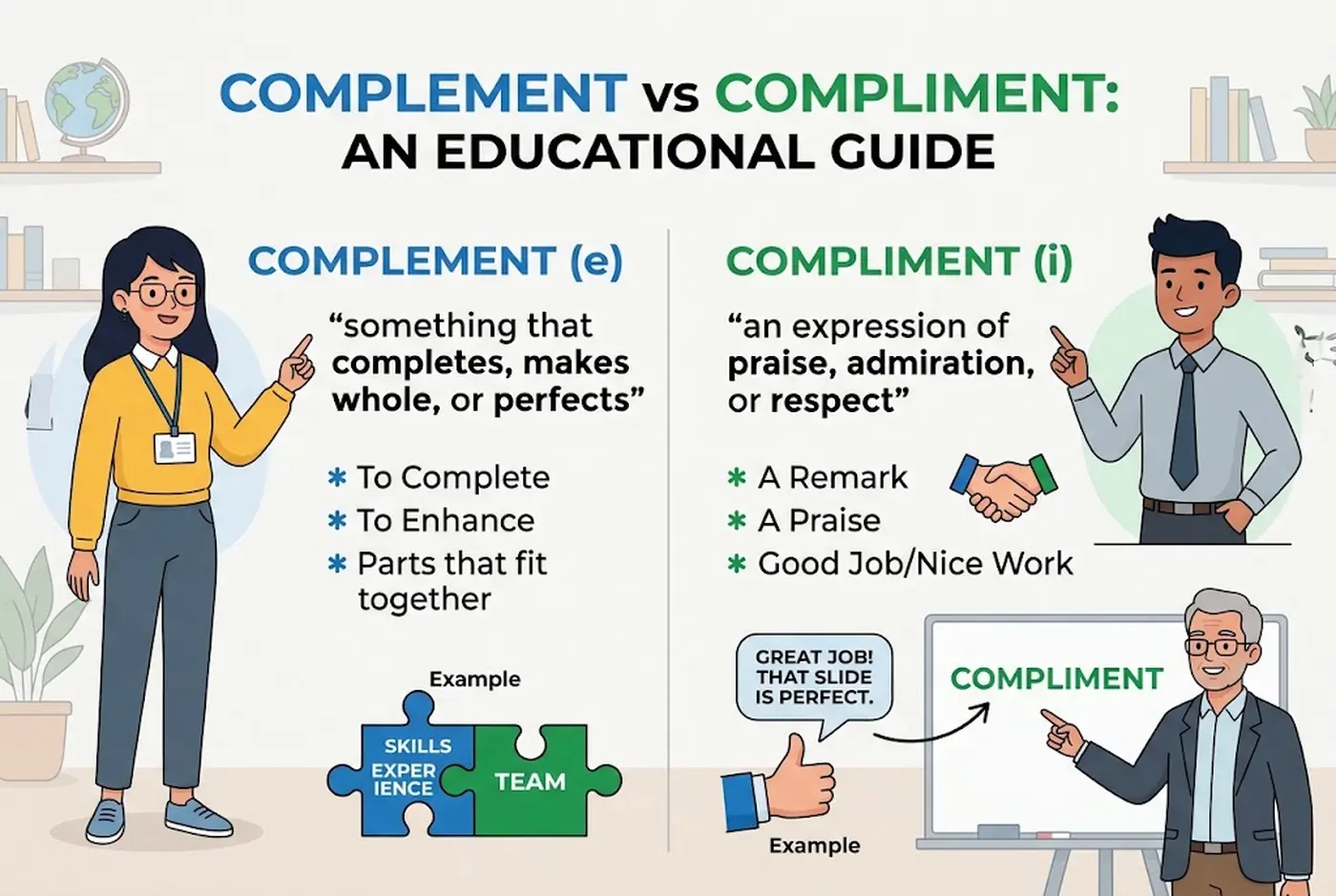
Have you ever written Complement vs Compliment an email praising a coworker and paused to check if you should use complement or compliment? These two words sound exactly alike, but they have different meanings. Choosing the wrong one can change your sentence, especially when you are writing a professional email, a school essay, or a message to a friend.
The easiest way to remember the difference is to focus on what each word does. A complement completes something, improves it, or makes it work well with another thing. A compliment is a kind or positive remark that expresses praise or admiration.
Complement means something that completes or improves another thing, while compliment means a statement of praise or admiration.
This guide explains their meanings, explores useful related words, compares close synonyms, and shows how to use each word in emails, essays, resumes, conversations, and everyday writing.
What Is the Difference Between Complement vs Compliment?
The main difference is that complement relates to completion or compatibility, while compliment relates to praise.
A complement is something that completes, improves, or balances another thing. It can describe colors that look good together, skills that work well as a team, or food that enhances a meal.
A compliment is a positive statement about someone or something. You might compliment a friend on a new haircut, praise a colleague for a presentation, or tell a student that their writing is excellent.
How Can You Remember Which Word to Use?
Try connecting each word with a familiar idea.
- Complement = complete. Both words contain the letters comple. Think of a missing piece that completes a whole.
- Compliment = praise. Think of a kind comment that makes someone feel appreciated.
For example, if you say that a jacket complements someone’s outfit, you mean the jacket looks good with the other clothes. If you compliment someone on the jacket, you are praising their choice.

Where Do Complement and Compliment Come From?
Understanding the history of these words makes their meanings easier to remember. Although their modern uses differ, they share a historical connection to Latin.
What Is the Origin of Complement?
The word complement comes through French from the Latin word complementum, meaning something that fills up or completes.
This origin explains why complement is associated with completeness. Something that complements another thing adds what is needed, creates balance, or makes the whole arrangement more effective.
Consider a meal that includes rice, vegetables, and a flavorful sauce. The sauce might complement the rice because its flavor improves the dish. It does not have to be missing from the meal for the relationship to work. It simply adds something that fits well.
The word also appears in mathematics, grammar, and science, where it can have more specific meanings.
For example, in grammar, a subject complement can describe or identify the subject of a sentence. In geometry, a complementary angle is one of two angles whose measures add up to 90 degrees.
What Is the Origin of Compliment?
Compliment came into English through French and Italian, ultimately tracing back to the Latin complementum and related forms associated with completing or fulfilling an obligation.
Over time, the word developed its familiar connection to courteous behavior, polite remarks, and expressions of respect or admiration.
Today, a compliment usually makes a positive judgment about a person, their work, their appearance, or something they have done.
For example, telling a teammate that they handled a difficult customer calmly is a compliment. You are recognizing a quality or action that deserves praise.
Why Are the Two Words So Similar?
Their shared history helps explain why their spellings are so close. Their meanings eventually developed along different paths, even though the words retained similar sounds.
In modern English, both words are homophones. Homophones are words that sound alike but have different meanings and spellings.
Other common examples include:
| Homophones | Difference |
|---|---|
| Accept and except | Receive or agree versus exclude |
| Affect and effect | Usually influence versus result |
| Principal and principle | A person or main item versus a rule or belief |
| Stationary and stationery | Not moving versus writing materials |
| Complement and compliment | Complete or enhance versus praise |
What Are the Main Synonyms for Complement and Compliment?
Synonyms can help you express an idea more precisely. However, not every synonym works in every sentence. The best choice depends on your meaning, audience, and tone.
The following lists separate words related to completion and compatibility from words related to praise.
What Are Simple Synonyms for Complement?
These words work well when you want to explain that something completes, improves, or fits with something else.
| Word | Meaning | Tone | Example |
|---|---|---|---|
| Complete | Make something whole | Simple | The final chapter completes the story. |
| Finish | Bring something to an end | Everyday | The frame finishes the look of the picture. |
| Add | Put something extra into a whole | Simple | Fresh herbs add flavor to the soup. |
| Improve | Make something better | Everyday | The new lighting improves the room. |
| Match | Go well with something | Everyday | Her shoes match her dress. |
| Fit | Suit or work well with something | Simple | This role fits his skills. |
| Balance | Create a pleasing or stable combination | Everyday | The acidity balances the sweetness. |
| Enhance | Improve a quality or effect | Everyday | Good lighting enhances the photograph. |
What Are Everyday Synonyms for Complement?
Everyday language often focuses on how things work together.
| Word | Meaning | Tone | Example |
|---|---|---|---|
| Suit | Be appropriate for someone or something | Everyday | The design suits the small room. |
| Go with | Look or work well together | Casual | This shirt goes with those pants. |
| Pair with | Combine two suitable things | Everyday | Pair the cheese with fresh fruit. |
| Support | Help something work or succeed | Everyday | Her technical skills support his research. |
| Round out | Make a group or set more complete | Conversational | The final speaker rounds out the panel. |
| Complete | Supply a missing or final element | Everyday | The final detail completes the design. |
| Harmonize | Work or look well together | Everyday | The colors harmonize beautifully. |
What Are Formal Synonyms for Complement?
Formal alternatives are helpful in business writing, academic essays, reports, and professional presentations.
| Word | Meaning | Tone | Example |
|---|---|---|---|
| Supplement | Add something extra to support the whole | Formal | The appendix supplements the main report. |
| Augment | Increase or strengthen something | Formal | The new data augment the existing findings. |
| Reinforce | Make something stronger | Formal | The second study reinforces the conclusion. |
| Corroborate | Provide additional support for a claim | Formal | The interviews corroborate the initial findings. |
| Integrate | Combine parts into a working whole | Formal | The program integrates theory and practice. |
| Complete | Supply what is needed for a whole | Neutral | The final section completes the analysis. |
| Synergize | Work together to produce a combined effect | Specialized | The departments synergize their research efforts. |
What Are the Best Synonyms for Compliment?
Compliment has a different set of related words because it involves praise, appreciation, or recognition.
What Are Simple Synonyms for Compliment?
| Word | Meaning | Tone | Example |
|---|---|---|---|
| Praise | Express approval or admiration | Neutral | The teacher praised her effort. |
| Approve | Regard something as acceptable or good | Neutral | Her manager approved the proposal. |
| Admire | Respect or appreciate a quality | Everyday | I admire your patience. |
| Appreciate | Recognize the value of someone or something | Everyday | I appreciate your help. |
| Thank | Express gratitude | Everyday | She thanked him for his support. |
| Applaud | Show approval or admiration | Everyday | The audience applauded his performance. |
| Recognize | Acknowledge an achievement or quality | Neutral | The company recognized her contribution. |
| Encourage | Give support or confidence | Everyday | His coach encouraged his progress. |
What Are Everyday Synonyms for Compliment?
| Word | Meaning | Tone | Example |
|---|---|---|---|
| Congratulate | Express pleasure at an achievement | Everyday | I congratulated her on the promotion. |
| Celebrate | Show happiness about an achievement | Everyday | The team celebrated his success. |
| Applaud | Express strong approval | Everyday | We applauded the team’s effort. |
| Commend | Praise someone’s actions or qualities | Neutral to formal | The director commended the staff. |
| Accolade | An expression of recognition or honor | Formal | She received an accolade for her work. |
| Kudos | Informal praise for an achievement | Casual | Kudos on finishing the project early. |
| Props | Informal recognition or respect | Slang | Give him props for helping the team. |
How Do Complement and Compliment Change With Intensity?
The strength of a word matters. A small improvement, a perfect match, and a complete transformation are not the same thing. Likewise, a friendly compliment differs from an award winning level of praise.
Which Words Describe a Mild Complement?
Use these words when two things fit together or make a modest improvement.
- Match. The colors match the furniture.
- Suit. The simple design suits the office.
- Fit. Her experience fits the position.
- Support. The chart supports the explanation.
- Add to. The flowers add to the room’s charm.
Which Words Describe a Strong Complement?
Choose stronger terms when one element noticeably improves another.
- Enhance. The music enhances the scene.
- Enrich. The discussion enriches the lesson.
- Strengthen. The new evidence strengthens the argument.
- Complete. The final piece completes the collection.
- Transform. The renovation transforms the space.
Which Words Express Mild Praise?
For a friendly remark or modest recognition, consider these options.
- Appreciate. I appreciate your help with the assignment.
- Like. I like the way you organized the report.
- Approve of. I approve of your approach.
- Thank. Thank you for staying late.
- Recognize. I recognize the effort you put into this work.
What Is the Difference Between the Noun and Verb Forms?
Both complement and compliment can function as nouns and verbs. Their spelling stays the same, but their grammatical role changes depending on the sentence.
How Is Complement Used as a Noun?
As a noun, complement refers to something that completes, improves, or works well with another thing.
Examples:
- The scarf is a perfect complement to her coat.
- The research team has a full complement of specialists.
- The sauce is an excellent complement to the roasted vegetables.
How Is Complement Used as a Verb?
As a verb, complement means to complete, improve, or go well with something.
Examples:
- The wooden table complements the modern chairs.
- Her calm personality complements his energetic nature.
- The photographs complement the written report.
How Is Compliment Used as a Noun?
As a noun, compliment means a remark that expresses praise or admiration.
Examples:
- Your kind compliment made my day.
- He received a compliment from his supervisor.
- The customer left a compliment about the service.

Is Complement or Compliment Different in American and British English?
The basic distinction is the same in American and British English. Both varieties use complement for completion or compatibility and compliment for praise.
| Situation | American English | British English |
|---|---|---|
| Something improves a meal | The sauce complements the dish. | The sauce complements the dish. |
| Someone praises a colleague | She complimented her colleague. | She complimented her colleague. |
| A matching item | A complement to the outfit | A complement to the outfit |
| A positive remark | A compliment on the design | A compliment on the design |
There is no standard regional spelling difference between these two words. Unlike color and colour, you do not need to choose a different spelling for an American or British audience.
Pronunciation is also generally the same within each variety of English. Both words are homophones, so listeners usually rely on context to understand the intended meaning.
Which Word Should You Use in a Resume?
Should You Use Complement or Compliment on a Resume?
Use complement when describing skills, experience, or qualifications that work well together. Use compliment only when you are referring to praise someone gave you.
Resume example:
My project management skills complement my background in data analysis.
This sentence means that your abilities support each other and create a useful combination.
Another example:
I received a compliment from the department director for improving the reporting process.
This sentence describes praise you received. However, a resume usually benefits more from measurable achievements than from mentioning a compliment.
A stronger professional statement might be:
Improved the monthly reporting process and reduced preparation time by 20 percent.
This focuses on the result instead of another person’s opinion.
Which Word Works Best in an Essay?
How Do You Use Complement and Compliment in Academic Writing?
Use complement when discussing ideas, evidence, methods, or theories that work together. Use compliment when describing praise or positive comments.
Complement example:
The second study complements the findings of the original research.
Compliment example:
The reviewer complimented the author on the clarity of the argument.
In academic writing, complement can describe how one source adds to another without repeating it. For example, historical records may complement interviews by providing another kind of evidence.
Do not use compliment to mean that two arguments support each other. If you mean that ideas fit together, complement is the correct choice.
Which Word Should You Use in Text Messages?
Is Complement or Compliment Better for Casual Texting?
Use compliment when you want to praise a friend, family member, or coworker. Use complement when talking about things that look good or work well together.
Text message examples:
- You look great in that jacket. That is a compliment.
- Your new shoes complement your outfit.
- Thanks for the compliment. That made me smile.
- Your playlist complements the mood perfectly.
- I love your new haircut. You deserve a compliment for choosing that style.
Which Word Is Correct in an Email?
How Do You Use Complement and Compliment in Professional Emails?
Choose complement when describing how two projects, skills, products, or ideas work together. Choose compliment when praising a person or acknowledging a positive comment.
Professional email example using complement:
Your experience in customer support complements the technical skills required for this position.
Professional email example using compliment:
I wanted to compliment you on the clear and helpful presentation you delivered yesterday.
A useful rule is to ask what the sentence is doing. If it describes a relationship between two things, complement is usually appropriate. If it expresses praise, compliment is usually appropriate.
You can also use compliment in the phrase with my compliments, which is a formal way to express goodwill or offer something as a courtesy.
Which Word Sounds Natural in Speaking?
How Do You Choose the Right Word in Conversation?
The choice depends on what you want to communicate, not on how formal the conversation is.
Use complement when describing a good combination:
The lemon flavor complements the fish.
Use compliment when expressing admiration:
I want to compliment you on your patience.
Here are more natural spoken examples:
- That color complements your eyes.
- Thanks for the compliment.
- Your sense of humor complements hers.
- I complimented the waiter on the excellent service.
- The new design complements the building’s original style.
In conversation, listeners can often work out the meaning from context. In writing, correct spelling makes the meaning clear before the sentence is read aloud.
What Are More Examples of Complement and Compliment?
Across different situations help you recognize the distinction without memorizing a complicated rule.
Examples Using Complement
- The white trim complements the dark blue walls.
- His practical experience complements his academic training.
- Fresh lemon juice complements the rich flavor of the sauce.
- The final chapter complements the book’s opening section.
- The new employee’s design skills complement the team’s technical knowledge.
Examples Using Compliment
- My friend gave me a compliment on my new haircut.
- The teacher complimented the class on its thoughtful answers.
- She received a compliment from her manager after the presentation.
- He complimented the chef on the quality of the meal.
- Your positive feedback is a wonderful compliment.
What Is the Difference Between Complement and Similar Words?
Related words can express similar ideas without carrying exactly the same meaning. Choosing carefully makes your writing more precise.
Complement vs Match
| Complement | Match |
|---|---|
| Suggests that something completes, improves, or works well with another thing | Suggests similarity, compatibility, or a suitable pairing |
| The sauce complements the dish. | The napkins match the tablecloth. |
Complement vs Enhance
| Complement | Enhance |
|---|---|
| Describes a relationship in which one thing completes or works well with another | Emphasizes making something better or stronger |
| Her skills complement the team’s experience. | Her training enhances the team’s performance. |
Compliment vs Praise
| Compliment | Praise |
|---|---|
| Often refers to a specific positive remark | Can refer to approval, recognition, or expressions of admiration more broadly |
| He gave her a compliment on her speech. | The director praised her leadership. |
What Are the Common Mistakes With Complement and Compliment?
Even experienced writers mix up homophones because spellcheckers may accept both spellings. The solution is to check the meaning rather than relying on sound.
Using Compliment When You Mean Complete
Incorrect: The final chapter compliments the story.
Correct: The final chapter complements the story.
The intended meaning is that the chapter adds to or completes the story. Complement is the correct word.
Using Complement When You Mean Praise
Incorrect: She gave me a complement on my presentation.
Correct: She gave me a compliment on my presentation.
The sentence refers to a positive remark, so compliment is required.
Confusing a Compliment With a Complementary Relationship
Incorrect: His calm attitude is a nice compliment to her energetic personality.
Correct: His calm attitude is a nice complement to her energetic personality.
The first sentence uses compliment incorrectly because it describes two personalities that work well together rather than an expression of praise.
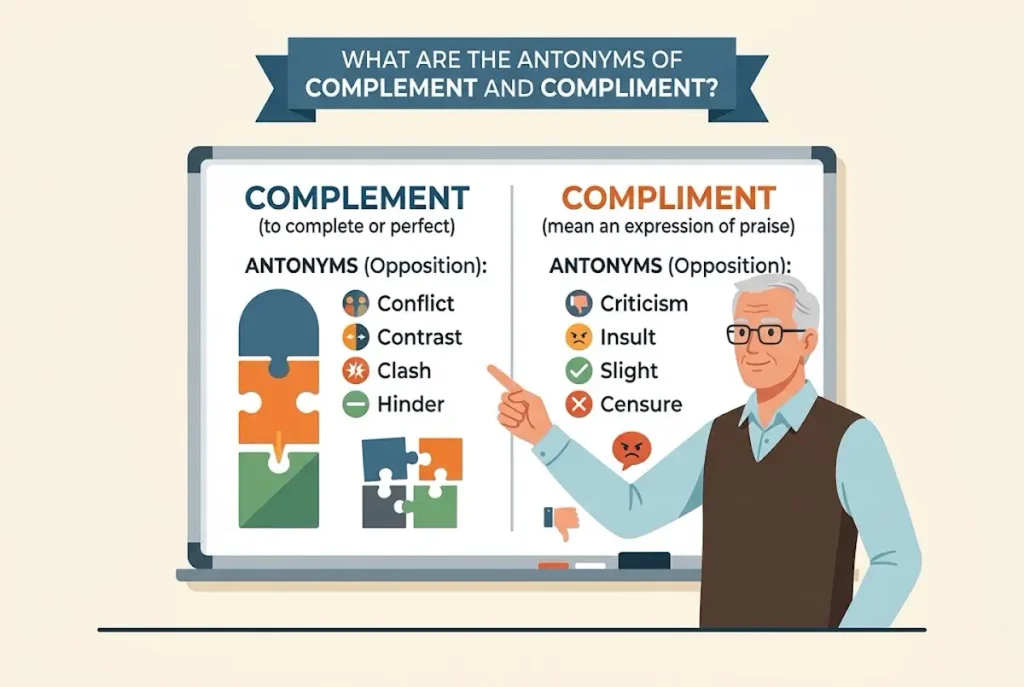
What Are the Antonyms of Complement and Compliment?
An antonym is a word with an opposite or contrasting meaning. Neither complement nor compliment has one universal opposite, so the best choice depends on the sentence.
| Word | Possible Opposite | Example |
|---|---|---|
| Complement | Clash | The colors clash rather than complement each other. |
| Complement | Conflict | The two methods conflict instead of working together. |
| Complement | Undermine | The new evidence undermines the earlier argument. |
| Compliment | Insult | He offered an insult instead of a compliment. |
| Compliment | Criticize | The reviewer criticized the work rather than praising it. |
| Compliment | Condemn | The committee condemned the action instead of approving it. |
Conclusion
The difference between complement and compliment comes down to completion versus praise. Complement describes something that completes, improves, balances, or works well with another thing. Compliment refers to an expression of admiration or the act of praising someone.
Remembering the connection between complement and complete can help you choose the correct spelling. When you want to recognize someone’s effort, appearance, skill, or achievement, use compliment instead.
Both words are useful in everyday conversations, academic writing, professional emails, and business communication. Their meanings stay consistent in American and British English, so you do not need to learn separate regional spellings.
Frequently Asked Questions
What is the difference between complement and compliment?
Complement means to complete, improve, or work well with something. Compliment means to express praise or admiration.
Is it a compliment or a complement to my outfit?
It is a complement to your outfit if you mean that an item matches or improves the overall look. It is a compliment if someone praises your outfit.
How do you use complement in a sentence?
Use complement to describe something that completes or improves another thing. For example, the blue curtains complement the white walls.
How do you use compliment as a verb?
Use compliment when someone praises another person or something they have done. For example, I complimented my coworker on her excellent presentation.
Are complement and compliment pronounced the same way?
Yes, they are homophones in standard American English. They sound alike but have different spellings and meanings.
Can I use complement and compliment in the same sentence?
Yes. For example, I complimented her on choosing shoes that complement her dress. The first word means praise, and the second means to match or enhance.
What’s another way to say compliment?
You can use praise, commend, admire, applaud, or recognize, depending on the situation. For casual conversations, kudos and props are also common alternatives.
What is the easiest trick to remember complement vs compliment?
Connect complement with complete and compliment with praise. If something works well with another thing, use complement. If someone says something kind or admiring, use compliment.

Daniel Grammarfield — The Language Learner
Age: 28Occupation: ESL Learner & Digital Professional
Bio:Daniel is a non-native English speaker who wants to communicate more confidently at work and online. He uses Synotrench to improve grammar, understand confusing words, learn correct sentence structures, and build everyday English skills. He prefers simple explanations with practical examples.
Goals:
Master English grammar rules
Avoid common language mistakes
Improve professional communication
Learn English through real-life examples
Quote:“Learning English is not about memorizing rules — it’s about expressing ideas clearly.”
1 thought on “Complement vs Compliment: Best and Simple Guide”