You’re writing Conscience vs Conscious an important email and want to explain that you made a decision because of your conscience. But then you stop typing. Should you use conscience or conscious? Both words look similar, and both have something to do with the mind. Still, they mean very different things.
The confusion is common in everyday writing, school essays, professional emails, and even casual conversations. Understanding conscience vs conscious can help you express your thoughts clearly and avoid mistakes that change the meaning of your sentence.
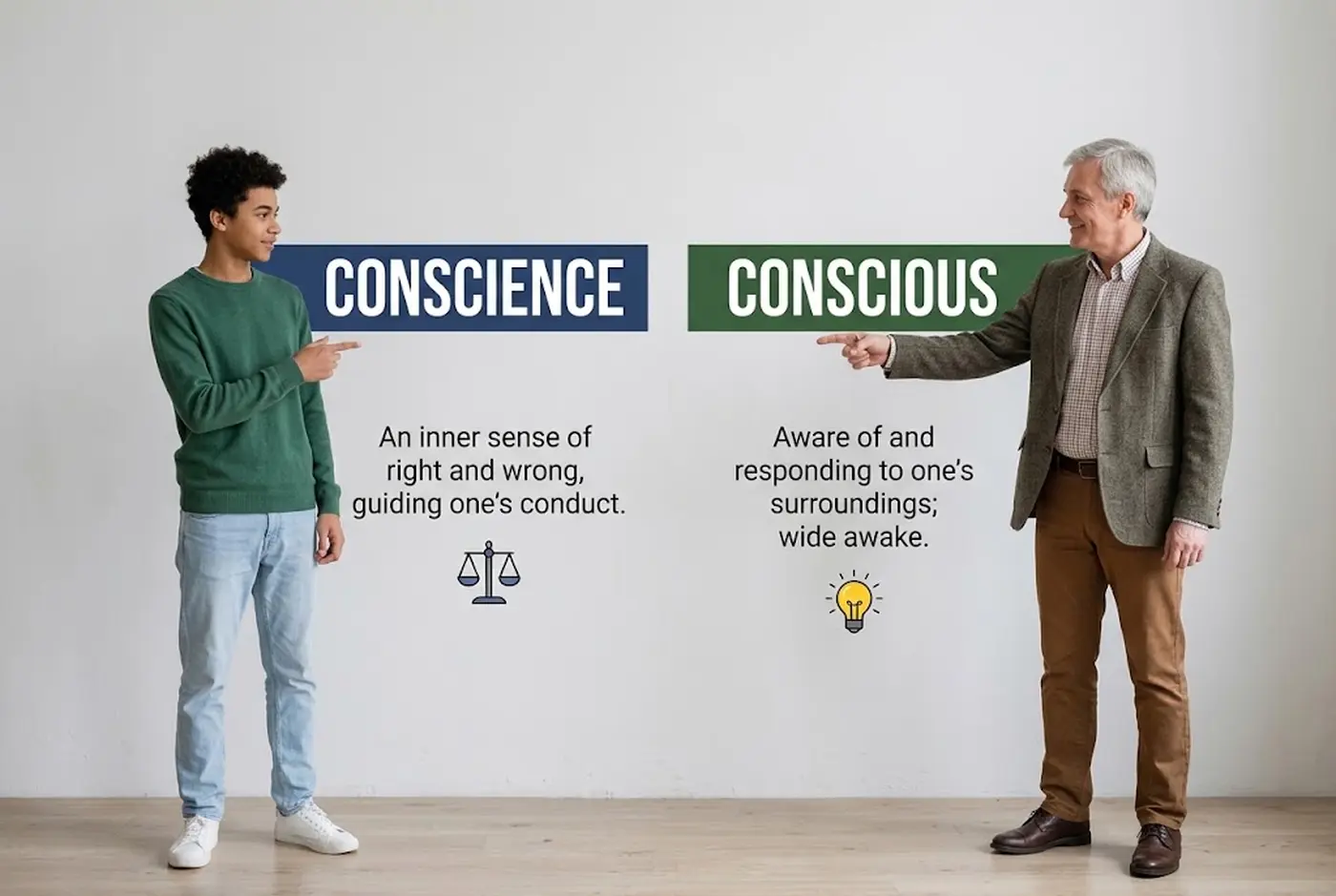
Conscience is your inner sense of right and wrong. Conscious means being awake, aware, or able to notice something happening around you or within yourself.
The easiest way to remember the difference is that your conscience guides your moral choices, while being conscious means you are aware. This guide explains their meanings, origins, grammar rules, synonyms, pronunciation, and common mistakes. You’ll also find comparison tables and practical examples to help you choose the correct word every time.
What Is the Difference Between Conscience and Conscious?
The main difference between conscience and conscious is their meaning and grammatical function.
Conscience is a noun. It refers to the inner feeling that helps you decide if an action is morally right or wrong.
Conscious is an adjective. It describes someone who is awake, aware, or able to recognize a situation, feeling, or action.
Here is a simple comparison:
| Feature | Conscience | Conscious |
|---|---|---|
| Part of speech | Noun | Adjective |
| Main meaning | Sense of right and wrong | Being awake or aware |
| Main purpose | Guides moral decisions | Describes awareness |
| Related idea | Morality | Awareness |
| Example | My conscience told me to apologize. | I was conscious of my mistake. |
| Common phrase | Guilty conscience | Fully conscious |
| Opposite | Lack of conscience | Unconscious |
Consider these two sentences:
- Her conscience wouldn’t let her tell a lie.
- She was conscious of the people watching her.
The first sentence discusses moral judgment. The second describes awareness.
Although both words relate to the human mind, you cannot exchange them without changing the sentence’s meaning.
What Does Conscience Mean in Simple English?
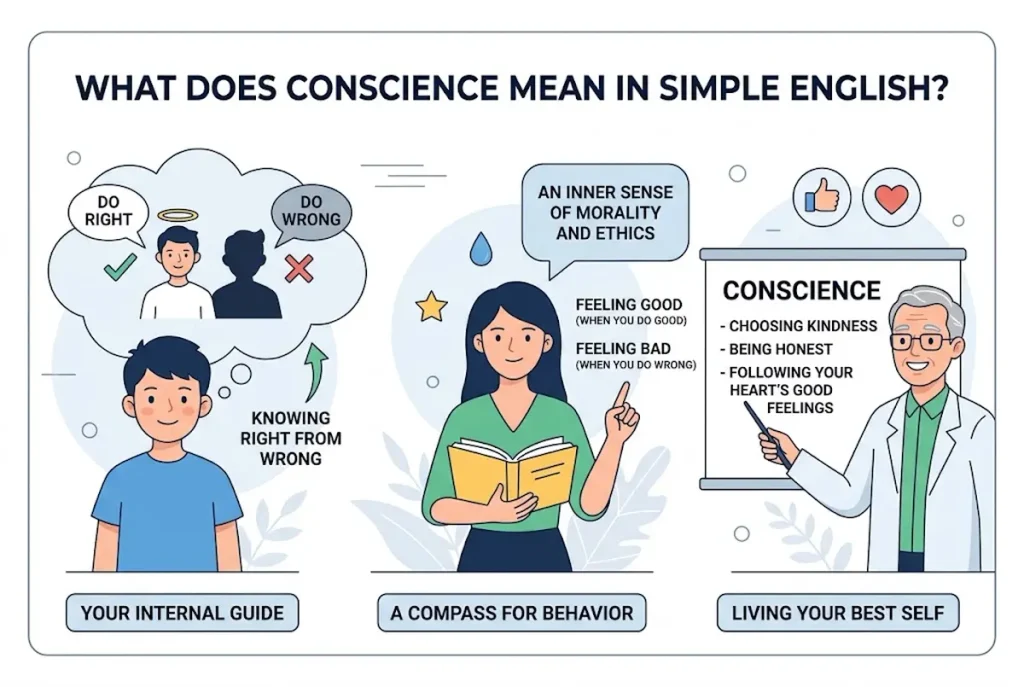
Conscience is the inner voice that helps you recognize right and wrong.
It can make you feel proud after doing something kind or guilty after hurting another person. Your conscience may also influence your choices before you take action.
For example, imagine finding someone’s lost wallet. Nobody sees you pick it up, but you decide to return it because you believe keeping it would be wrong.
That feeling of moral responsibility comes from your conscience.
Examples of Conscience in Sentences
- My conscience told me to return the extra money.
- He couldn’t ignore his conscience after lying to his parents.
- She followed her conscience and reported the mistake.
Notice that conscience refers to moral judgment in each example. It doesn’t describe someone being awake or physically alert.
What Does a Guilty Conscience Mean?
A guilty conscience means feeling bad because you believe you have done something wrong.
For example:
He had a guilty conscience after blaming his younger brother for the broken window.
The expression often describes regret, shame, or an uncomfortable feeling about past behavior.
A clear conscience has the opposite meaning. It describes the feeling that you have acted honestly or have no moral reason to feel guilty.
What Does Conscious Mean in Simple English?
Conscious means awake, aware, or able to recognize what is happening.
It can describe physical awareness, mental attention, or someone’s understanding of a particular situation.
For example, a person who is awake and responding normally is conscious. Someone who understands that their words might hurt another person is also conscious of their actions.
The meaning depends on the situation.
Three Common Meanings of Conscious
| Meaning | Explanation | Example |
|---|---|---|
| Awake | Not unconscious | The patient remained conscious after the accident. |
| Aware | Knowing something exists or is happening | She was conscious of the growing problem. |
| Deliberate | Done with awareness or intention | He made a conscious decision to save money. |
Examples of Conscious in Sentences
- The injured driver was still conscious.
- I’m conscious of how much time we’ve spent discussing this.
- She made a conscious effort to improve her writing.
These examples show that conscious isn’t limited to physical wakefulness. It can also describe attention, understanding, and intentional behavior.
Where Do Conscience and Conscious Come From?
The two words share a historical connection, which helps explain their similar spelling.
Both come from Latin roots connected to knowledge and awareness.
The Latin verb scire means to know. When combined with the prefix con, meaning with or together, it helped form words related to knowing and awareness.
However, the two English words developed different meanings.
Origin of Conscience
Conscience comes through Old French from the Latin word conscientia, which carried meanings related to knowledge, awareness, and moral understanding.
Over time, its English meaning became closely connected to moral judgment.
Today, conscience usually describes someone’s inner sense of right and wrong.
Origin of Conscious
Conscious comes from the Latin conscius, meaning aware of or knowing with others.
Its modern English meaning developed around awareness, mental recognition, and wakefulness.
This shared history explains why the words look and sound alike, even though they serve different purposes in modern English.
How Do You Pronounce Conscience and Conscious?
Their pronunciation is another reason people confuse them.
| Word | Simple pronunciation | Syllables |
|---|---|---|
| Conscience | KON-shuhns | Two |
| Conscious | KON-shuhs | Two |
The main difference is the ending.
Conscience has an n sound before the final s sound. Conscious doesn’t have that same ending.
Practicing the two words in complete sentences can make the difference easier to hear and remember.
What Are the Best Synonyms for Conscience and Conscious?
Understanding related words can help you choose more accurate language.
However, conscience and conscious don’t share the same synonyms. One concerns morality, while the other describes awareness.
The following tables include more than 30 useful related words and expressions. Some are direct alternatives, while others work only in particular contexts.
Simple Synonyms and Related Words
| Word | Meaning | Tone | Example |
|---|---|---|---|
| Awareness | Knowing something | Simple | Her awareness of the danger increased. |
| Awake | Not sleeping | Simple | The child was awake during the storm. |
| Alert | Ready to notice things | Simple | The driver remained alert. |
| Aware | Knowing what is happening | Simple | I’m aware of the problem. |
| Morals | Beliefs about right and wrong | Simple | His morals influenced his decision. |
| Values | Personal beliefs and principles | Simple | Her values guided her actions. |
| Feelings | Emotional reactions | Simple | His feelings told him something was wrong. |
| Knowing | Having knowledge | Simple | She gave him a knowing look. |
Everyday Synonyms and Related Words
| Word | Meaning | Tone | Example |
|---|---|---|---|
| Mindful | Paying careful attention | Everyday | Be mindful of your words. |
| Attentive | Listening or noticing carefully | Everyday | The students remained attentive. |
| Responsible | Acting with care and duty | Everyday | She made a responsible choice. |
| Thoughtful | Considering others or consequences | Everyday | That was a thoughtful response. |
| Sensitive | Aware of feelings or situations | Everyday | He’s sensitive to criticism. |
| Deliberate | Done intentionally | Everyday | It was a deliberate decision. |
| Principled | Guided by strong moral beliefs | Everyday | She is a principled leader. |
| Ethical | Following accepted moral standards | Everyday | The company made an ethical decision. |
| Observant | Quick to notice details | Everyday | He’s an observant student. |
| Self-aware | Understanding your own behavior | Everyday | A self-aware person recognizes personal weaknesses. |
Formal Synonyms and Related Words
| Word | Meaning | Tone | Example |
|---|---|---|---|
| Moral compass | Inner guide for right and wrong | Formal | Her moral compass shaped her choices. |
| Moral judgment | Ability to judge right and wrong | Formal | The situation required moral judgment. |
| Ethical awareness | Understanding moral concerns | Formal | Ethical awareness matters in healthcare. |
| Scruples | Feelings that prevent dishonest behavior | Formal | He had no scruples about cheating. |
| Integrity | Honesty and strong moral principles | Formal | She handled the matter with integrity. |
| Cognizant | Aware of something | Formal | We are cognizant of the risks. |
| Perceptive | Quick to understand or notice | Formal | The manager was highly perceptive. |
| Sentient | Able to experience feelings or sensations | Formal | The discussion concerned sentient beings. |
| Conscientious | Careful and guided by responsibility | Formal | He’s a conscientious employee. |
| Intentional | Done on purpose | Formal | The change was intentional. |
Informal and Slang Alternatives
These expressions can communicate similar ideas in casual conversations, but they aren’t always direct replacements.
| Word or Phrase | Meaning | Tone | Example |
|---|---|---|---|
| Clued in | Aware of what’s happening | Informal | She’s clued in on the situation. |
| Switched on | Mentally alert or quick to understand | Informal | He’s really switched on today. |
| On the ball | Alert and attentive | Informal | Our new assistant is on the ball. |
| Tuned in | Paying attention | Informal | Stay tuned in during the meeting. |
| Gut feeling | An instinctive reaction | Informal | My gut feeling told me to stop. |
| Inner voice | Personal thoughts or moral guidance | Informal | Her inner voice told her to apologize. |
| Wide awake | Fully awake | Informal | I’m wide awake now. |
| Doing the right thing | Acting morally | Conversational | She believes in doing the right thing. |
Which Synonyms Are Mild and Which Are Strong?
Not all related words communicate the same level of awareness or moral concern.
Choosing a mild or strong expression can change how readers understand your sentence.
Words Related to Conscious From Mild to Strong
| Level | Word or Phrase | Meaning |
|---|---|---|
| Mild | Somewhat aware | Having limited awareness |
| Moderate | Aware | Knowing something |
| Moderate | Mindful | Paying careful attention |
| Strong | Alert | Ready to notice and respond |
| Strong | Fully conscious | Completely awake and aware |
| Very strong | Acutely aware | Having a particularly strong awareness |
Words Related to Conscience From Mild to Strong
| Level | Expression | Meaning |
|---|---|---|
| Mild | Moral concern | Feeling that an action raises a moral question |
| Moderate | Sense of responsibility | Feeling responsible for doing the right thing |
| Moderate | Moral awareness | Recognizing ethical concerns |
| Strong | Guilty conscience | Feeling guilty about wrongdoing |
| Strong | Deep remorse | Experiencing serious regret |
| Very strong | Overwhelming guilt | Feeling extremely guilty |
Is Conscience a Noun or an Adjective?
One of the easiest ways to understand conscience vs conscious is to learn their grammatical roles.
Conscience is a noun, while conscious is an adjective.
A noun names a person, place, thing, feeling, or idea. An adjective describes a noun or pronoun.
Conscience as a Noun
You can use conscience with words such as my, your, his, her, and clear.
Examples:
- My conscience wouldn’t let me cheat.
- She has a clear conscience.
- His conscience troubled him.
You can also use its plural form, consciences.
Example:
The debate challenged the consciences of everyone involved.
Conscious as an Adjective
Conscious describes a person, action, decision, or state of awareness.
Examples:
- The patient is conscious.
- He made a conscious choice.
- She’s conscious of the risks.
It often appears after linking verbs such as be, become, and remain.
Other Useful Word Forms
| Word | Part of Speech | Meaning |
|---|---|---|
| Conscience | Noun | Inner sense of right and wrong |
| Conscious | Adjective | Awake or aware |
| Consciously | Adverb | With awareness or intention |
| Consciousness | Noun | State of being conscious |
| Conscientious | Adjective | Careful, responsible, and thorough |
| Conscientiously | Adverb | In a careful and responsible way |
| Unconscious | Adjective | Not conscious or not deliberately aware |

Is There a Difference Between American and British English?
Conscience and conscious have the same standard spelling and core meanings in American and British English.
There is no separate British spelling for either word.
| Feature | American English | British English |
|---|---|---|
| Conscience spelling | Conscience | Conscience |
| Conscious spelling | Conscious | Conscious |
| Grammar | Noun and adjective | Noun and adjective |
| Core meanings | Moral sense and awareness | Moral sense and awareness |
| Usage | Standard | Standard |
When Should You Use Conscience or Conscious?
The best word depends on what you want to communicate.
Are you discussing morality, awareness, an intentional decision, or someone’s physical condition?
Here are five common writing situations.
Which Word Should You Use on a Resume?
On a resume, conscious works when describing awareness or intentional decisions. However, conscientious is often a better choice when discussing your work habits.
Examples:
I made a conscious effort to improve customer satisfaction.
I am a conscientious professional who pays close attention to detail.
The second sentence describes a personal quality rather than a single action.
Conscience is less common in resume writing unless you’re discussing ethical responsibility.
Which Word Is Better in an Essay?
Both words work in academic essays, but their meanings must match your argument.
Use conscience when discussing morality, ethics, guilt, or personal responsibility.
Example:
The character’s conscience prevents him from accepting the dishonest offer.
Use conscious when discussing awareness, understanding, or deliberate action.
Example:
The character becomes conscious of the consequences of his decisions.
For an essay about psychology, you may also need consciousness, which is the noun form of conscious.
Should You Use Conscience or Conscious in Texting?
In casual messages, the correct choice still depends on meaning.
Examples:
My conscience won’t let me keep the money.
I’m conscious of how late it is.
The first message expresses moral concern. The second shows awareness of time.
In everyday texting, aware may sometimes sound more natural than conscious.
For example:
I know it’s getting late.
This is simpler than saying you’re conscious of the time, although both can communicate a similar idea.
What Is the Difference Between Similar Related Words?
Several related terms overlap with conscience and conscious, but they aren’t interchangeable.
Understanding their smaller differences helps you write with greater accuracy.
Conscience vs Consciousness
| Conscience | Consciousness |
|---|---|
| Refers to moral judgment | Refers to the state of being conscious |
| Connected to right and wrong | Connected to awareness and experience |
| Can make someone feel guilty | Can describe wakefulness or mental experience |
| Example: His conscience troubled him. | Example: He regained consciousness. |
Consciousness isn’t simply another word for conscience.
A person can be conscious without making a moral decision. Likewise, someone can discuss their conscience without discussing their physical state of awareness.
Conscious vs Conscientious
These two adjectives are especially easy to confuse.
| Conscious | Conscientious |
|---|---|
| Means aware or awake | Means careful and responsible |
| Describes awareness | Describes a person’s approach to duties |
| Can describe a deliberate action | Often describes reliable behavior |
| Example: She made a conscious choice. | Example: She’s a conscientious employee. |
Conscience vs Moral Compass
Conscience and moral compass are closely related, but they carry slightly different meanings.
Moral compass is a figurative expression for the beliefs and principles that guide someone’s behavior.
Examples:
His conscience made him admit the truth.
Her strong moral compass helped her make difficult decisions.
The second expression often suggests a broader and more lasting set of personal values.
What Are Some Common Mistakes With Conscience and Conscious?
Most mistakes happen because writers remember the similar spelling but forget the different meanings.
Here are several errors worth avoiding.
Mistake 1: Using Conscious for Moral Judgment
Incorrect: My conscious told me to apologize.
Correct: My conscience told me to apologize.
The sentence discusses moral responsibility, so conscience is required.
Mistake 2: Using Conscience for Awareness
Incorrect: She was conscience of the danger.
Correct: She was conscious of the danger.
Conscious is the adjective needed after was.
Mistake 3: Confusing Conscious With Consciousness
Incorrect: He lost his conscious after the accident.
Correct: He lost consciousness after the accident.
Consciousness is the noun that describes the state of being conscious.
When Should You Not Use Conscience or Conscious?
Even when a word is grammatically correct, it may not communicate your intended meaning.
Avoid conscience when you’re simply discussing knowledge, attention, or wakefulness.
For example, don’t write:
She was conscience of the noise.
Write:
She was conscious of the noise.
You can also use aware if you want a simpler expression.
Avoid conscious when you mean someone’s personal morals.
For example, don’t write:
His conscious made him feel guilty.
Write:
His conscience made him feel guilty.
Also, avoid using conscious as a general replacement for intelligent, thoughtful, or responsible. These qualities can overlap, but they don’t mean the same thing.
A conscious decision is intentional. It isn’t automatically a wise or ethical decision.
What Are the Opposites of Conscience and Conscious?
The antonyms depend on the meaning you want to express.
Conscious has a clear opposite: unconscious.
Conscience is more complicated because it refers to an inner moral sense rather than a simple condition.
| Word | Opposite or Contrasting Expression | Example |
|---|---|---|
| Conscious | Unconscious | The patient was unconscious. |
| Aware | Unaware | He was unaware of the change. |
| Alert | Inattentive | The tired driver became inattentive. |
| Conscientious | Careless | His careless work caused mistakes. |
| Clear conscience | Guilty conscience | She had a guilty conscience after lying. |
| Moral concern | Lack of moral concern | He showed a lack of moral concern. |
What Are the Best Tips for Remembering the Difference?
You don’t need to memorize complicated grammar rules to choose the correct word.
Use these simple checks whenever you’re unsure.
The Right and Wrong Test
Ask yourself:
Am I discussing someone’s inner sense of right and wrong?
If yes, choose conscience.
Example:
Her conscience encouraged her to tell the truth.
The Awareness Test
Ask yourself:
Am I describing someone who is awake, aware, or making an intentional choice?
If yes, choose conscious.
Example:
He was conscious of the risks.
The Grammar Test
Check the word’s role in your sentence.
If you need a noun referring to moral judgment, use conscience.
If you need an adjective describing awareness, use conscious.
Final Answer About Conscience vs Conscious
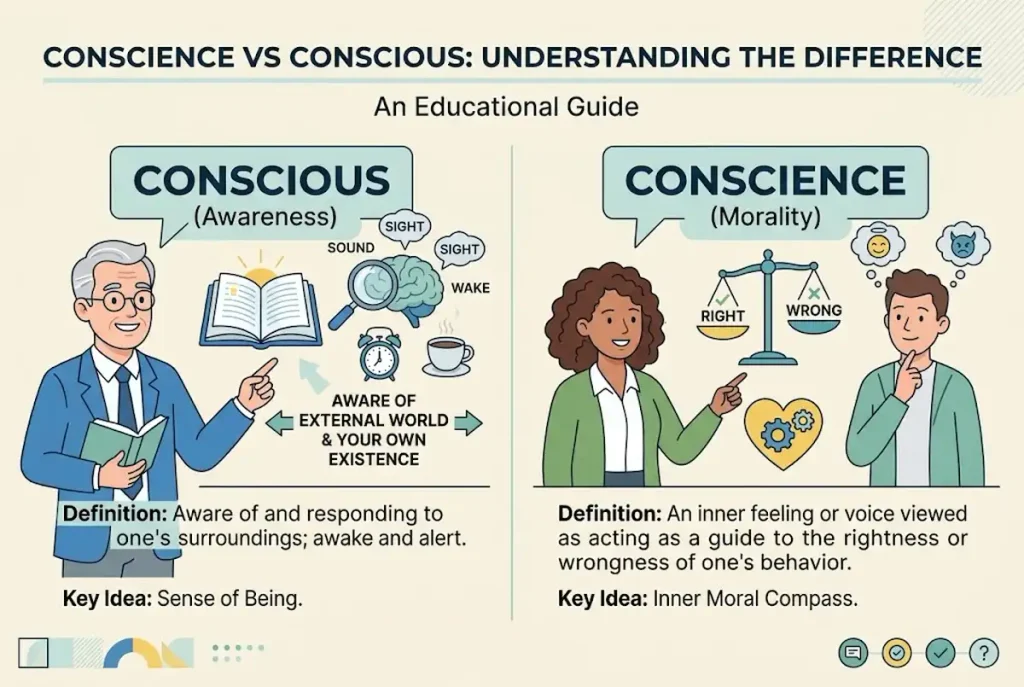
The difference between conscience vs conscious becomes easy once you connect each word to its purpose. Conscience is a noun that refers to your inner sense of right and wrong. Conscious is an adjective that describes being awake, aware, or intentional.
Use conscience when discussing honesty, guilt, morality, and ethical decisions. Choose conscious when describing awareness, physical wakefulness, or a deliberate action.
Remember that consciousness is the state of being conscious, while conscientious describes someone who acts carefully and responsibly. These related words have their own meanings and shouldn’t be used interchangeably.
Conclusion
Understanding the difference between conscience vs conscious is simple once you know their meanings. Conscience refers to your inner sense of right and wrong, helping you make moral decisions and recognize when something feels wrong.
Conscious, on the other hand, means being awake, aware, or able to understand what is happening around you. Remember that conscience is a noun, while conscious is an adjective. For example, your conscience may tell you to apologize, but being conscious means you are aware of your actions.
Both words are useful in everyday conversations, essays, and professional writing, but they cannot replace each other. The easiest way to avoid confusion is to connect conscience with morality and conscious with awareness. With this simple distinction in mind, you can confidently choose the correct word every time.
Frequently Asked Questions
What is the main difference between conscience and conscious?
In conscience vs conscious, the main difference is that conscience refers to your inner sense of right and wrong, while conscious means awake, aware, or intentional. Conscience is a noun, and conscious is an adjective.
Is it guilty conscience or guilty conscious?
Guilty conscience is correct. It describes the uncomfortable feeling someone experiences after believing they have done something wrong.
Can someone be conscious without having a conscience?
Yes. Being conscious means being awake or aware, while having a conscience involves moral judgment. The two concepts describe different aspects of the mind.
What’s another way to say conscience?
Moral compass, moral sense, and inner voice are useful alternatives, depending on the context. Moral compass is especially helpful when discussing someone’s guiding values.
Is conscious the same as aware?
Conscious and aware can have similar meanings when discussing recognition or understanding. However, conscious can also describe physical wakefulness and deliberate actions.
Is it self-conscious or self-conscience?
Self-conscious is correct. It describes someone who is unusually aware of themselves, especially their appearance or behavior, and may feel embarrassed or uncomfortable.
How can I remember conscience vs conscious easily?
Remember that conscience relates to moral choices, while conscious relates to awareness. If you’re discussing right and wrong, use conscience; if you’re discussing being awake or aware, use conscious.
What is the difference between conscious and conscientious?
Conscious means awake, aware, or intentional. Conscientious describes someone who takes their responsibilities seriously and performs tasks carefully.

Daniel Grammarfield — The Language Learner
Age: 28Occupation: ESL Learner & Digital Professional
Bio:Daniel is a non-native English speaker who wants to communicate more confidently at work and online. He uses Synotrench to improve grammar, understand confusing words, learn correct sentence structures, and build everyday English skills. He prefers simple explanations with practical examples.
Goals:
Master English grammar rules
Avoid common language mistakes
Improve professional communication
Learn English through real-life examples
Quote:“Learning English is not about memorizing rules — it’s about expressing ideas clearly.”