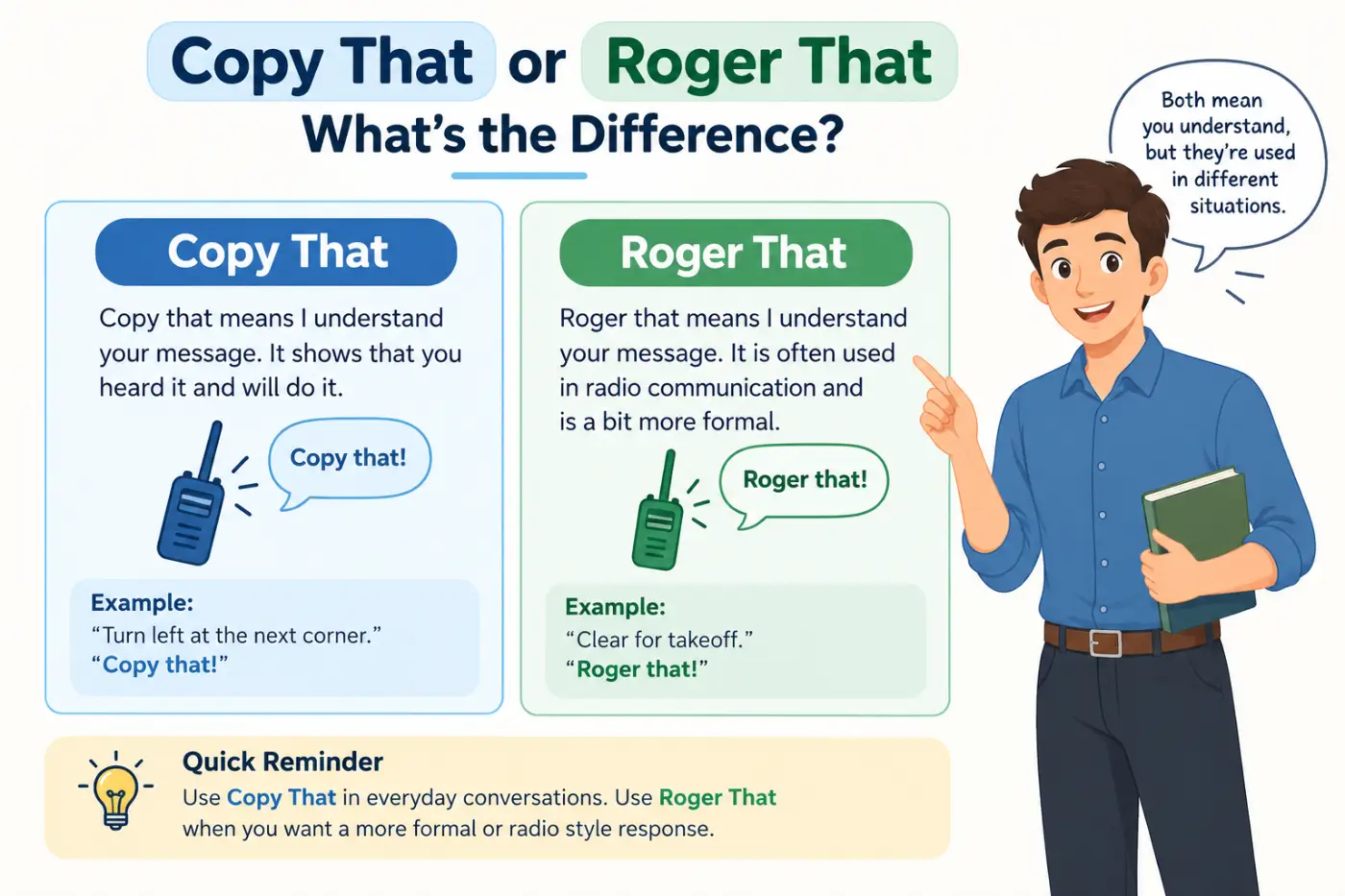
You’re writing a quick text to a coworker who just sent you instructions. You want to acknowledge the message without sounding too formal. Should you reply with “copy that” or “roger that”? Both expressions sound familiar, especially if you’ve heard them in military movies, police shows, or radio conversations.
The choice may seem small, but these phrases have slightly different backgrounds. They both confirm that you’ve received a message, yet their tone, history, and everyday usage aren’t exactly the same.
Understanding these expressions helps you respond clearly without sounding awkward. This guide explains their meanings, origins, differences, alternatives, and practical uses. You’ll also find 30 related expressions, real examples, common mistakes, and tips for choosing the right response.
What Does Copy That Mean in Simple English?
“Copy that” is an informal expression used to confirm that you’ve received and understood someone’s message.
It’s another way of saying:
- I got your message.
- I understand what you said.
- Message received.
- I heard your instructions.
- Got it.
The expression is especially common when someone gives instructions, shares information, or asks another person to acknowledge a message.
For example:
Manager: Please send the updated report before lunch.
Employee: Copy that. I’ll send it before noon.
The employee confirms that the message was received and understood.

Where Did Copy That Come From?
The expression comes from radio communication.
Before modern digital communication became common, radio operators needed reliable ways to confirm that they had received transmitted information.
The word “copy” was used to describe successfully receiving or recording a message.
An operator might say, “Do you copy?” to ask if another person could receive the transmission.
The reply “I copy” confirmed successful reception.
Over time, “copy that” became a familiar expression in military communication, emergency services, aviation-related conversations, and everyday English.
Today, people also use it humorously when replying to simple requests.
For example:
Mom: Don’t forget to buy milk.
Son: Copy that!
There’s nothing military about buying milk. The expression simply makes the reply sound playful.
What Does Roger That Mean?
“Roger that” means that you’ve received a message.
It’s commonly associated with radio operators, military personnel, pilots, and emergency communication.
In everyday conversation, people also use it to show that they understand someone’s instructions.
Consider this example:
Team leader: Move to the next checkpoint.
Team member: Roger that.
The reply confirms that the instruction was received.
However, there’s an important technical detail: in formal radio communication, “roger” means a transmission has been received. It doesn’t automatically mean that the person agrees with the message or promises to follow an instruction.
Where Did Roger That Come From?
The expression has an interesting history connected to the phonetic alphabet.
In older radio communication systems, the letter R represented the word “received.”
Under the older US military phonetic alphabet, the letter R was spoken as “Roger.”
Radio operators used “Roger” to confirm that they had successfully received a transmission.
The modern NATO phonetic alphabet uses “Romeo” for the letter R, but “Roger” remains an established radio communication term.
The expression later became popular outside professional communication through military films, television shows, aviation culture, and everyday speech.
The additional word “that” makes the phrase sound more conversational.
What’s the Difference?
Both expressions acknowledge a received message. Their biggest differences involve tone, background, and common usage.
| Feature | Copy That | Roger That |
|---|---|---|
| Basic meaning | I received your message | Your message was received |
| Origin | Radio communication terminology | Older phonetic alphabet |
| Tone | Casual and direct | Radio-style and slightly dramatic |
| Everyday texting | Fairly natural | Often playful |
| Workplace conversations | Suitable in informal teams | Less common in ordinary offices |
| Military association | Strong | Very strong |
| Formal writing | Usually unsuitable | Usually unsuitable |
| Main purpose | Acknowledge information | Confirm message reception |
Copy That vs Roger That in Everyday Conversations
In ordinary conversation, the expressions are often interchangeable.
For example:
Friend: Meet me outside the library at six.
You: Copy that!
Alternatively:
Friend: Meet me outside the library at six.
You: Roger that!
Both replies work.
The first sounds like a relaxed acknowledgment. The second may sound like you’re pretending to communicate over a military radio.
Neither is grammatically incorrect.
Does Roger That Mean You Agree?
Not necessarily.
In formal radio communication, “roger” confirms message reception. It does not independently communicate agreement or compliance.
For example:
Operator: Weather conditions have changed.
Pilot: Roger.
The pilot confirms receiving the information.
In everyday English, however, people sometimes use “roger that” to communicate understanding and acceptance together.
Context determines the intended meaning.
30 Useful Alternatives to Copy That and Roger That
English offers many ways to acknowledge a message. Some sound friendly, others professional, and a few belong mainly to casual speech.
The following expressions are grouped by tone to help you choose naturally.
Not every alternative is an exact synonym. Some confirm reception, while others express agreement, understanding, or a promise to act.
Simple Alternatives
These expressions work well when you want a short and clear response.
| Word or Phrase | Meaning | Tone | Example |
|---|---|---|---|
| Okay | General acknowledgment | Neutral | Okay, I’ll check it. |
| Got it | I understand | Casual | Got it. I’ll be there. |
| Understood | I understand the message | Neutral | Understood. I’ll proceed. |
| Received | Your message arrived | Direct | Received, thank you. |
| Noted | I’ve taken note | Neutral | Noted. I’ll update the file. |
| All right | I accept or understand | Friendly | All right, see you soon. |
| Sure | Positive acknowledgment | Casual | Sure, I’ll help. |
| Yes | Simple confirmation | Neutral | Yes, I received it. |
Everyday Alternatives
These phrases are useful in texts, friendly workplace conversations, and daily speech.
| Word or Phrase | Meaning | Tone | Example |
|---|---|---|---|
| Sounds good | I agree with the plan | Friendly | Sounds good. Let’s meet at five. |
| No problem | I can handle that | Relaxed | No problem. I’ll send it. |
| Will do | I’ll complete the request | Cooperative | Will do. Thanks! |
| I’m on it | I’ve started handling it | Confident | I’m on it right now. |
| Gotcha | I understand you | Very casual | Gotcha. I’ll wait outside. |
| Makes sense | I understand the reasoning | Conversational | Makes sense. Thanks for explaining. |
| You got it | I’ll handle your request | Friendly | You got it. |
| Loud and clear | I heard or understood you clearly | Radio-inspired | Loud and clear, team! |
Formal and Professional Alternatives
These options are better suited to professional emails, business discussions, and official correspondence.
| Word or Phrase | Meaning | Tone | Example |
|---|---|---|---|
| Acknowledged | Message formally received | Professional | Acknowledged. Thank you. |
| Confirmed | Information has been verified | Professional | Confirmed. The meeting is scheduled. |
| Duly noted | Information has been formally noted | Formal | Your concerns are duly noted. |
| I understand | Clear confirmation of understanding | Professional | I understand your instructions. |
| Message received | Communication successfully received | Direct | Message received. Thank you. |
| I’ll proceed accordingly | I’ll act based on the instructions | Formal | I’ll proceed accordingly. |
| Thank you for clarifying | Your explanation helped | Polite | Thank you for clarifying the deadline. |
| I acknowledge receipt | Formal confirmation of delivery | Very formal | I acknowledge receipt of your request. |
Slang and Playful Alternatives
These expressions suit informal conversations, jokes, and friendly messages.
| Word or Phrase | Meaning | Tone | Example |
|---|---|---|---|
| Roger | Message received | Radio-style | Roger. Heading out now. |
| 10-4 | Message received | Radio slang | 10-4, buddy! |
| Say less | I understand; no more explanation needed | Modern slang | Say less. I’m coming. |
| Bet | Okay or agreed | Slang | Bet. See you tonight. |
| Aye aye | I understand and will comply | Nautical or playful | Aye aye, captain! |
| Affirmative | Yes | Military-style | Affirmative. We’re ready. |
These 30 alternatives give you more choices than repeating the same acknowledgment in every conversation.
However, always consider the situation before selecting one.
For instance, “bet” might sound natural between friends but inappropriate in an email to your supervisor.
Which Alternatives Sound Mild or Strong?
Acknowledgment expressions can communicate different levels of commitment.
A mild response may simply confirm that you heard something. A stronger response can indicate that you’ve accepted responsibility for completing a task.
The following table shows a practical progression.
| Level | Expression | What It Communicates |
|---|---|---|
| Mild | Okay | General acknowledgment |
| Mild | Noted | Information recognized |
| Moderate | Got it | Message understood |
| Moderate | Copy that | Message received and understood |
| Moderate | Roger that | Message received |
| Clear | Understood | Explicit understanding |
| Strong | Will do | Intention to complete the request |
| Strong | I’m on it | Active responsibility |
| Very strong | I’ll take care of it | Commitment to handle the task |
This isn’t a strict linguistic ranking. The strength depends on context, delivery, and the speaker’s intentions.
A useful distinction is that acknowledging information and promising action are two separate things.
If your manager assigns an urgent task, “I’ll take care of it” communicates more commitment than simply saying “noted.”
What Part of Speech Are These Expressions?
Both phrases function as acknowledgment expressions in English.
They are commonly treated as conversational responses or interjections rather than ordinary single-word nouns, verbs, or adjectives.
However, some related words can serve different grammatical functions.
| Expression | Grammatical Role | Example |
|---|---|---|
| Copy that | Acknowledgment phrase | Copy that. I’ll check. |
| Roger that | Acknowledgment phrase | Roger that. |
| Understand | Verb | I understand the request. |
| Received | Verb form or adjective | I received your email. |
| Confirmation | Noun | Please send confirmation. |
| Confirm | Verb | Please confirm the date. |
| Acknowledged | Verb form or adjective | Your request was acknowledged. |
| Clear | Adjective | Your instructions are clear. |
Can You Use Copy as a Verb?
Yes.
In radio communication, “copy” can mean to receive or understand a transmitted message.
Example:
Do you copy my last transmission?
In ordinary English, however, “copy” usually means to reproduce something.
Example:
Please copy this paragraph into your notebook.
The meaning changes with context.
Is Roger a Verb?
“Roger” is primarily used as an acknowledgment in radio communication.
In casual conversation, people occasionally use it playfully as a verb, but that usage isn’t standard in formal English.
For professional writing, choose “receive,” “understand,” or “acknowledge” instead.
Are These Expressions Different in American and British English?
Both expressions are understood in American and British English.
Their origins and use in international radio communication have helped them become recognizable across English-speaking regions.
However, everyday preferences can vary.
| Situation | American English | British English |
|---|---|---|
| Casual acknowledgment | Got it | Got it |
| Radio-style acknowledgment | Roger | Roger |
| Informal understanding | Copy that | Copy that |
| Friendly agreement | Sounds good | Sounds good |
| Simple acceptance | Okay | All right |
| Formal acknowledgment | Acknowledged | Acknowledged |
In the United States, “copy that” is especially recognizable through police dramas, military entertainment, and emergency-service language.
British speakers also understand it, although expressions such as “right,” “all right,” and “understood” are common everyday choices.
Neither phrase has a separate British spelling.
The meanings remain largely consistent across regions.
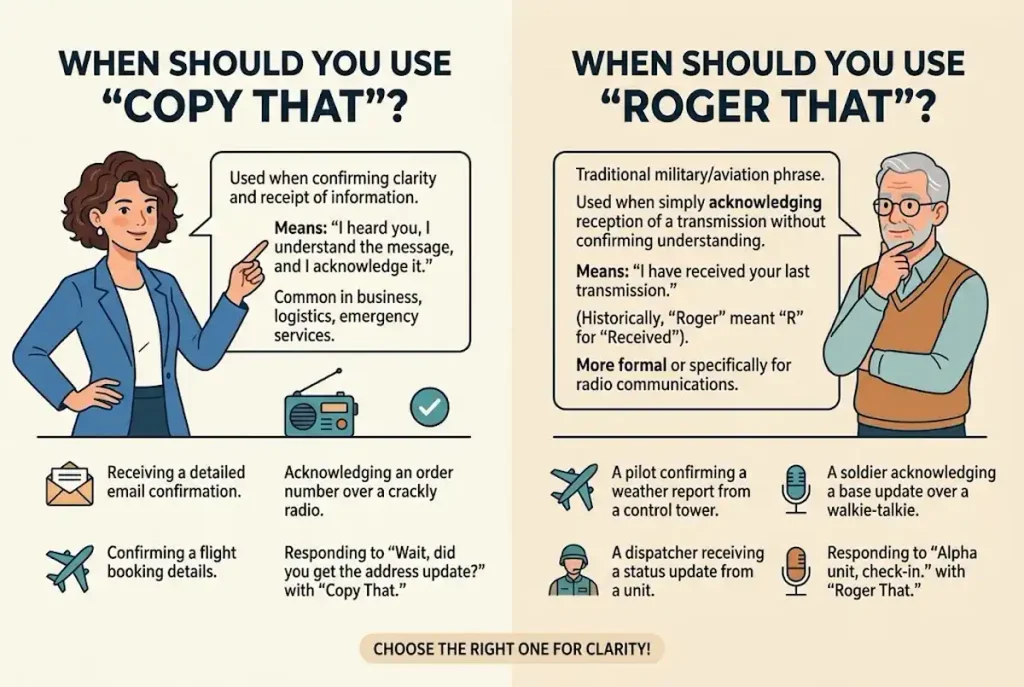
When Should You Use Copy That or Roger That?
The best expression depends on your audience and communication style.
A phrase that sounds friendly in a group chat may feel strange in a formal business email.
Which Expression Is Best for a Resume?
Neither expression belongs in a typical professional resume.
A resume should describe your abilities and achievements rather than imitate spoken acknowledgments.
Instead, use action verbs that demonstrate communication skills.
Suitable words include:
- Communicated.
- Coordinated.
- Confirmed.
- Acknowledged.
- Responded.
- Collaborated.
Example sentence:
“Coordinated daily team communication and confirmed task instructions to maintain accurate project delivery.”
This sounds more professional than describing yourself as someone who frequently says “roger that.”
Which Expression Should You Use in an Essay?
Academic essays generally require more precise language.
If you’re writing about communication, you can discuss these expressions as examples of acknowledgment language.
However, avoid using them as casual transitions between arguments.
For example:
“The radio operator acknowledged the transmission before requesting additional information.”
This sentence works well in an academic discussion.
If your essay specifically explores military terminology or informal English, both expressions may be relevant as quoted examples.
Is Copy That Appropriate for Texting?
Yes. It’s a natural choice for casual text messages.
You can use it when a friend sends instructions, changes a meeting location, or reminds you about something.
Example:
Friend: Bring your charger when you come over.
You: Copy that!
The response is brief, friendly, and easy to understand.
“Roger that” also works, especially if you want a slightly humorous tone.
What Should You Say in a Professional Email?
Professional emails usually benefit from clearer acknowledgment language.
Instead of relying on radio expressions, consider:
- Understood, thank you.
- I’ve received your message.
- I’ll make the requested changes.
- Thank you for the update.
- I’ll proceed as instructed.
Example sentence:
“Thank you for the clarification. I’ll update the document and send the revised version this afternoon.”
This response confirms understanding while explaining your next action.
Which Phrase Sounds Better When Speaking?
Both expressions work in spoken English, but your relationship with the listener matters.
With friends, either can sound natural or playful.
In a relaxed workplace, “copy that” can be an efficient acknowledgment.
During formal meetings, “understood” or “certainly” may sound more appropriate.
Example:
Supervisor: Please check the equipment before starting.
Employee: Understood. I’ll inspect it now.
The reply communicates professionalism without unnecessary drama.
15 Real-Life Example Sentences
The following examples demonstrate how acknowledgment expressions work in different situations.
At Work
1. “Copy that. I’ll send the updated presentation before the meeting.”
2. “Roger that. The equipment inspection is complete.”
3. “Understood. I’ll contact the client this afternoon.”
During Travel
4. “Copy that. We’ll meet you at the main entrance.”
5. “Roger that. We’re heading toward the checkpoint.”
6. “Got it. I’ll bring the tickets.”
In Everyday Text Messages
7. “Copy that! I’ll pick up some groceries on my way home.”
8. “Roger that, captain! Pizza is officially on the menu.”
9. “Sounds good. See you at seven.”
During Team Activities
10. “Copy that. I’ll cover the left side of the field.”
11. “Roger that. Everyone is ready to begin.”
12. “Loud and clear. We’ll follow the updated plan.”
In Professional Communication
13. “Acknowledged. Your request has been forwarded to the relevant department.”
14. “Message received. I’ll review the documents shortly.”
15. “Thank you for clarifying. I’ll proceed with the revised schedule.”
Notice how the tone changes between situations.
A playful acknowledgment can improve a friendly conversation, while a professional response should focus on clarity and responsibility.
Copy That vs Got It: Are They the Same?
These expressions have similar meanings, but “got it” is more flexible in ordinary English.
| Copy That | Got It |
|---|---|
| Comes from radio communication | General conversational expression |
| Usually acknowledges a message | Can acknowledge information or understanding |
| Slightly radio-inspired | Natural in almost any casual situation |
| Common after instructions | Common after explanations and instructions |
Consider these examples:
Teacher: Divide the total by four.
Student: Got it!
This sounds completely natural.
The student could also say “copy that,” but the reply might sound playful or unusually radio-inspired.
Use “got it” when you want a simple response without any special tone.
Roger That vs 10-4: What’s Different?
Both expressions have roots in radio communication, but their histories aren’t identical.
“Roger” developed from the older phonetic alphabet’s spoken representation of the letter R.
“10-4” comes from ten-code systems used in radio communication, particularly in public safety and related services.
In systems using that code, 10-4 commonly communicates acknowledgment.
| Roger That | 10-4 |
|---|---|
| Based on the radio term Roger | Based on radio ten-codes |
| Means message received | Commonly means acknowledgment |
| Strong military and aviation association | Strong police and CB-radio association |
| Recognizable internationally | Especially familiar in American popular culture |
Example:
Dispatcher: The delivery address has changed.
Driver: 10-4.
In casual conversation, people sometimes use 10-4 humorously.
However, don’t assume every radio organization uses identical codes. Professional communication procedures vary.
Roger That vs Wilco: Why Aren’t They Identical?
This is one of the most useful distinctions in radio terminology.
“Roger” indicates that a transmission has been received.
“Wilco” is short for “will comply.” It communicates that the instruction has been understood and will be followed.
| Roger | Wilco |
|---|---|
| Confirms reception | Confirms intention to comply |
| Doesn’t independently promise action | Communicates compliance |
| Suitable for acknowledging information | Suitable for accepting instructions |
Common Mistakes People Make With These Expressions
Although these phrases are easy to understand, several mistakes can make your communication less effective.
1. Assuming Both Expressions Always Mean Agreement
Receiving information isn’t necessarily the same as agreeing with it.
Someone might acknowledge an instruction without accepting its reasoning.
If you need to express agreement, use a clearer response.
Example:
“I agree with the proposed changes.”
2. Using Radio Slang in Formal Emails
An email to a senior executive, university professor, or unfamiliar client usually calls for professional language.
Instead of:
“Roger that, sir!”
Write:
“Understood. Thank you for the instructions.”
The second option sounds respectful without feeling theatrical.
3. Thinking Roger Is Someone’s Name in This Expression
Although Roger is a common personal name, the radio expression originally refers to the letter R in an older phonetic alphabet.
It isn’t an acknowledgment addressed to a person named Roger.
When Should You Avoid These Expressions?
Neither phrase is offensive or inherently inappropriate. However, certain situations call for more precise language.
Avoid casual radio expressions when:
- Responding to sensitive personal news.
- Writing a formal complaint or legal document.
- Confirming detailed financial instructions.
For example, imagine someone tells you that a family member is seriously ill.
Responding with “roger that” may sound emotionally distant.
A more thoughtful reply would be:
“I’m sorry to hear that. Thank you for letting me know.”
The lesson is simple: an acknowledgment should match the emotional weight of the message.
What Are the Opposites of Copy That and Roger That?
These expressions don’t have perfect one-word antonyms because they function as acknowledgments.
However, several responses communicate the opposite idea.
| Acknowledgment | Opposite or Contrasting Response |
|---|---|
| Copy that | I didn’t catch that |
| Roger that | Message not received |
| Understood | I don’t understand |
| Got it | I missed that |
| Loud and clear | You’re breaking up |
| Message received | No message received |
| Confirmed | Unconfirmed |
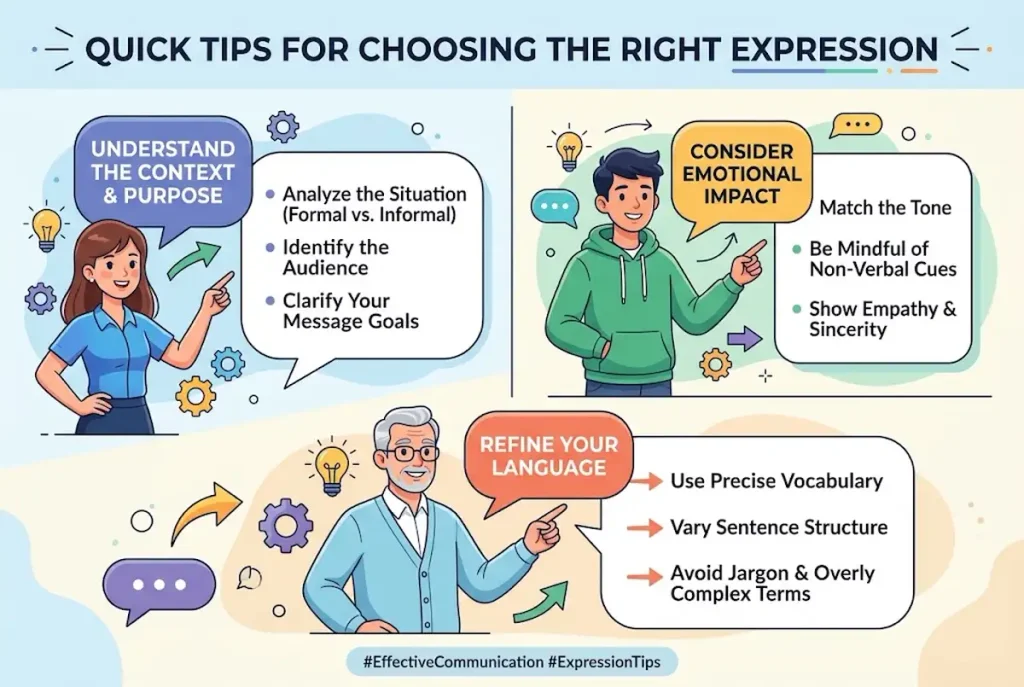
Quick Tips for Choosing the Right Expression
You don’t need to memorize every alternative. A few simple rules can help you make the right choice.
| Your Situation | Best Response |
|---|---|
| Friend sends instructions | Got it |
| Casual team conversation | Copy that |
| Playful military-style reply | Roger that |
| Professional email | Understood, thank you |
| Confirming task completion | Done |
| Promising to handle something | Will do |
| Confirming message reception | Received |
| Asking someone to repeat information | Could you repeat that? |
| Accepting responsibility | I’ll take care of it |
Conclusion
Choosing between Copy That or Roger That becomes easier once you understand their backgrounds and intended meanings. Both acknowledge communication, but they aren’t perfect substitutes in every setting.
“Copy that” works especially well in relaxed conversations and informal workplace exchanges. “Roger that” carries a stronger radio and military association, making it useful when you want that particular tone.
For professional writing, simpler alternatives such as “understood,” “received,” and “acknowledged” usually communicate your message more effectively. Remember that confirming receipt isn’t always the same as agreeing or promising to act. If you’re accepting responsibility, say so clearly.
Good communication doesn’t require impressive expressions. It requires choosing words that help the other person understand your response without confusion.
Frequently Asked Questions
Is It Better to Say Copy That or Roger That?
Both are correct, but “copy that” often sounds more natural in informal everyday conversations. “Roger that” has a stronger military and radio communication feel.
Is Roger That a Military Term?
Yes. “Roger” became established in radio communication through an older phonetic alphabet, where Roger represented the letter R for received. It remains recognizable in military and aviation communication.
What’s Another Way to Say Copy That?
Common alternatives include “got it,” “understood,” “received,” “noted,” and “message received.” Choose one based on the situation and your relationship with the listener.
Can I Say Roger That to My Boss?
Yes, especially if your workplace has a relaxed communication style. For formal conversations or emails, “understood, thank you” usually sounds more professional.
Does Roger That Mean Yes?
Not exactly. In formal radio communication, it confirms that a message has been received. It doesn’t automatically express agreement or compliance.
What’s the Difference Between Roger and Wilco?
“Roger” confirms that a transmission was received. “Wilco” means that the speaker understands the instruction and intends to comply with it.

Daniel Grammarfield — The Language Learner
Age: 28Occupation: ESL Learner & Digital Professional
Bio:Daniel is a non-native English speaker who wants to communicate more confidently at work and online. He uses Synotrench to improve grammar, understand confusing words, learn correct sentence structures, and build everyday English skills. He prefers simple explanations with practical examples.
Goals:
Master English grammar rules
Avoid common language mistakes
Improve professional communication
Learn English through real-life examples
Quote:“Learning English is not about memorizing rules — it’s about expressing ideas clearly.”