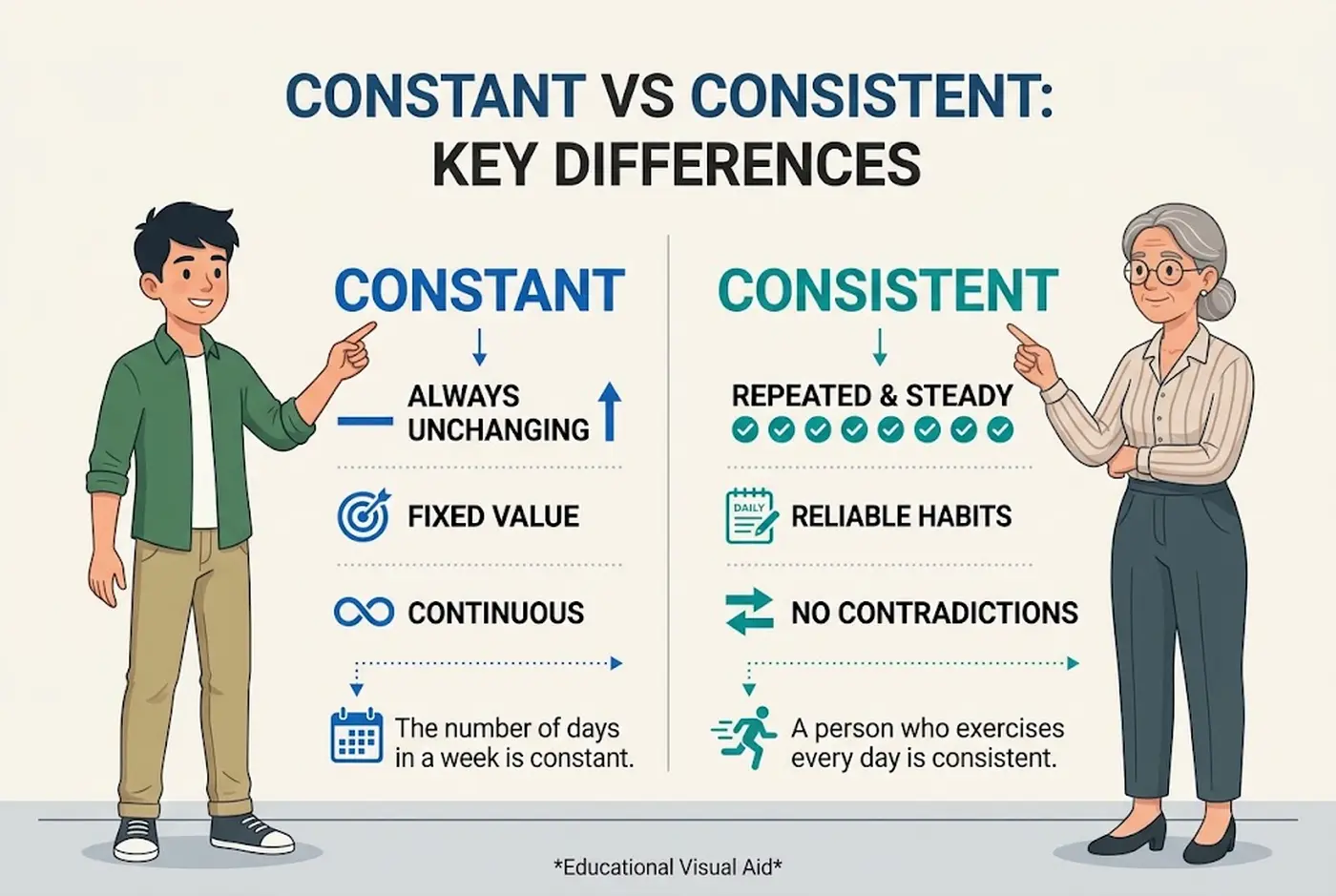
The confusion between Constant vs Consistent is common in everyday English. You might hear someone talk about constant effort, consistent progress, constant communication, or consistent results. These expressions sound similar, yet each gives the reader a slightly different message.
Constant means something happens continuously or repeatedly, often without much of a break. Consistent means something stays steady, follows the same pattern, or produces similar results over time. The main difference is that constant focuses on frequency or continuity, while consistent focuses on regularity and reliability.
Understanding this difference can improve your emails, essays, resumes, and daily conversations. This guide explains both meanings, their origins, useful synonyms, real examples, common mistakes, and simple ways to choose the right word.
What Is the Difference Between Constant and Consistent?
The easiest way to understand these two adjectives is to look at what each one describes.
Constant usually refers to something that continues, remains unchanged, or happens very frequently. It can describe an activity, condition, feeling, quantity, or situation.
Consistent describes something that remains similar, follows a regular pattern, or meets the same standard over time. It often suggests dependability, although consistency isn’t always positive.
For example:
- She receives constant phone calls throughout the day.
- She receives consistent support from her manager.
The first sentence emphasizes how frequently the phone rings. The second emphasizes how reliably her manager provides support.
Constant vs Consistent at a Glance
| Feature | Constant | Consistent |
|---|---|---|
| Basic meaning | Continuous, frequent, or unchanged | Regular, steady, or following the same pattern |
| Main focus | Frequency or continuity | Reliability or uniformity |
| Suggests no breaks | Often, but not always | No |
| Suggests similar results | Sometimes | Usually |
| Can describe behavior | Yes | Yes |
| Can describe measurements | Yes | Yes |
| Common expressions | Constant noise, constant pressure | Consistent quality, consistent effort |
| Possible negative meaning | Repeated annoyance or pressure | Repeated unwanted behavior |
| Best for describing reliability | Less commonly | More commonly |
Consider a student who studies for one hour every evening.
That student is consistent because the study routine follows a regular pattern. However, the student isn’t studying constantly because there are breaks between study sessions.
Someone who studies for six hours without stopping is studying continuously. That doesn’t automatically mean the person follows a consistent study routine.
This distinction matters because frequency and regularity aren’t the same thing.
What Does Constant Mean in Simple English?
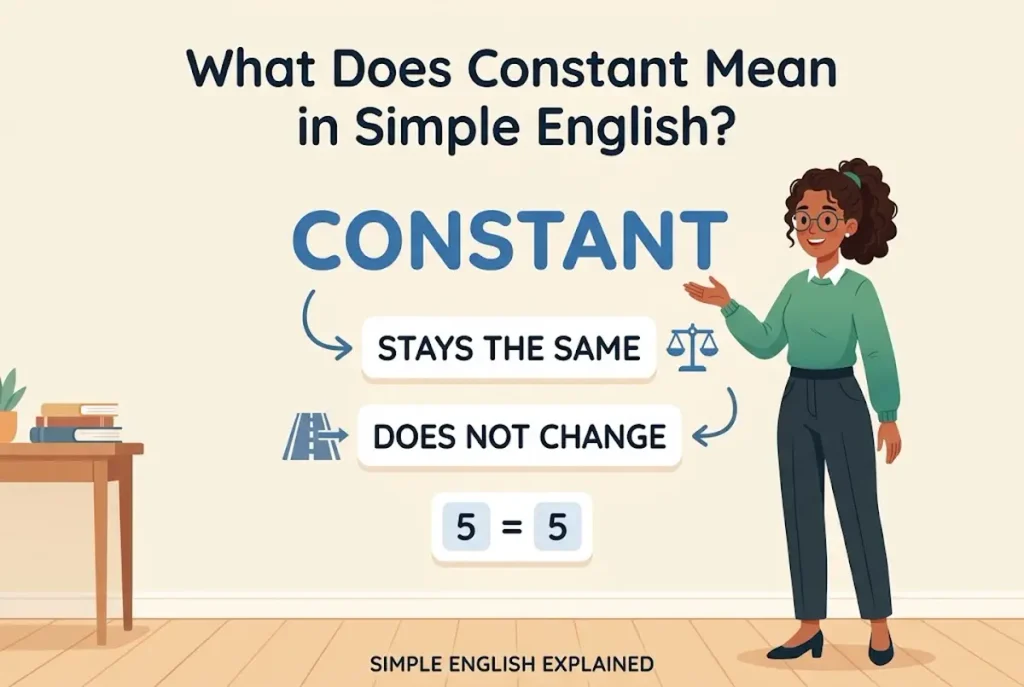
Constant describes something that continues, stays unchanged, or happens repeatedly over a period of time.
The word comes from the Latin word constans, which means standing firm or remaining steady. It is related to constare, meaning to stand firm.
Over time, constant developed several closely connected meanings in English.
Three Common Meanings of Constant
- Continuous: Something continues without stopping.
- Frequent: Something happens repeatedly, sometimes so often that it becomes noticeable or annoying.
- Unchanging: Something remains at the same level, amount, or condition.
Examples:
- The constant noise from the construction site made studying difficult.
- He needs constant attention from his parents.
- The machine operates at a constant speed.
- The temperature remained constant during the experiment.
- She felt constant pressure to meet her deadlines.
Notice that constant doesn’t always mean something happens every second.
Constant interruptions, for example, can describe frequent interruptions with short gaps between them.
In scientific writing, however, constant often has a more precise meaning. A constant value is one that does not change under the stated conditions.
Is Constant a Positive or Negative Word?
Constant is neutral by itself. Its meaning depends on the noun and the situation.
| Positive use | Negative use |
|---|---|
| Constant support | Constant criticism |
| Constant love | Constant interruptions |
| Constant dedication | Constant pressure |
| Constant protection | Constant complaints |
A person may appreciate constant support but become frustrated by constant complaints.
The word simply emphasizes continuity, repetition, or an unchanged condition.
What Does Consistent Mean in Simple English?
Consistent means staying steady, following a similar pattern, or behaving in a reliable way over time.
It comes from the Latin word consistere, meaning to stand together, stand firm, or take a position.
The modern meaning developed around the idea of things fitting together, remaining compatible, or following an established pattern.
In everyday English, consistent often describes habits, performance, behavior, results, and quality.
Examples:
- Her consistent effort helped her improve her English.
- The restaurant provides consistent food quality.
- He follows a consistent morning routine.
- The athlete delivered consistent performances throughout the season.
- Their explanation is consistent with the available evidence.
Does Consistent Mean Doing Something Every Day?
No. Consistent doesn’t necessarily mean doing something every day.
A person who exercises every Monday, Wednesday, and Friday can have a consistent exercise routine.
The important point is that the activity follows a regular pattern.
Similarly, a company that delivers the same quality of service every month demonstrates consistency, even though its employees aren’t working continuously.
Consistency is about maintaining a pattern or standard, not eliminating every break.
Can Consistent Describe Something Negative?
Yes. A person can be consistently late, rude, careless, or dishonest.
For example:
He is consistently late for morning meetings.
This sentence means his lateness follows a repeated pattern. It doesn’t suggest that being late is a positive quality.
What Are the Best Synonyms for Constant and Consistent?
Finding alternatives becomes easier when you understand the meaning you want to express.
Some synonyms describe continuous activity, while others describe steady behavior, repeated actions, or dependable results.
Simple Synonyms
These words are easy to understand and work well in ordinary conversations, school assignments, and basic writing.
| Word | Meaning | Tone | Example |
|---|---|---|---|
| Steady | Staying at a similar level | Neutral | Her progress has been steady. |
| Regular | Following a repeated schedule | Neutral | He takes regular breaks. |
| Ongoing | Continuing over time | Neutral | The ongoing repairs caused delays. |
| Repeated | Happening again and again | Neutral | Repeated mistakes affected his score. |
| Stable | Not changing much | Neutral | The patient’s condition remained stable. |
| Reliable | Someone or something you can depend on | Positive | She is a reliable employee. |
| Unchanging | Remaining the same | Neutral | The temperature stayed unchanging throughout the test. |
| Frequent | Happening often | Neutral | Frequent calls interrupted his work. |
Everyday Synonyms
These alternatives sound natural in emails, conversations, personal descriptions, and informal articles.
| Word | Meaning | Tone | Example |
|---|---|---|---|
| Continuous | Happening without interruption | Neutral | Continuous rainfall flooded the road. |
| Dependable | Worth trusting | Positive | Our team needs dependable workers. |
| Persistent | Continuing despite difficulty | Mixed | His persistent effort finally paid off. |
| Predictable | Following an expected pattern | Neutral | Her work schedule is predictable. |
| Uninterrupted | Continuing without a break | Neutral | The generator provided uninterrupted power. |
| Repetitive | Happening in the same way repeatedly | Often negative | The repetitive tasks became tiring. |
| Uniform | Remaining similar throughout | Neutral | The company maintains uniform standards. |
| Habitual | Done regularly as a habit | Neutral | His habitual lateness annoyed the team. |
Formal Synonyms
Formal alternatives are useful in academic writing, business reports, professional communication, and research.
| Word | Meaning | Tone | Example |
|---|---|---|---|
| Sustained | Maintained over an extended period | Formal | Sustained investment supported growth. |
| Systematic | Following an organized method | Formal | The researcher used a systematic approach. |
| Invariable | Not changing | Formal | The process followed an invariable sequence. |
| Perpetual | Continuing indefinitely or repeatedly | Formal | Perpetual disagreements delayed the project. |
| Unvarying | Staying the same throughout | Formal | The device maintained an unvarying output. |
| Recurring | Happening repeatedly over time | Formal | Recurring errors affected the results. |
| Coherent | Logically connected and free from contradictions | Formal | She presented a coherent argument. |
| Congruent | Agreeing or matching | Formal | The findings were congruent with earlier research. |
Informal and Slang Alternatives
These expressions are more conversational. Some are exaggerations rather than exact dictionary synonyms.
| Word or Phrase | Meaning | Tone | Example |
|---|---|---|---|
| Nonstop | Without stopping | Casual | The neighbors played music nonstop. |
| Like clockwork | Happening regularly and predictably | Informal | He arrives at eight like clockwork. |
| On repeat | Happening repeatedly | Casual | That song has been playing on repeat. |
| Always on | Continuously active or available | Informal | The customer support system is always on. |
| Rock solid | Very dependable or stable | Informal | Her performance has been rock solid. |
| Day in and day out | Happening regularly over a long time | Informal | She practices day in and day out. |
| Same old thing | An unchanged, familiar situation | Casual | Every meeting feels like the same old thing. |
| On the dot | At an exact scheduled time | Informal | He arrives at nine on the dot. |
Which Synonyms Are Mild and Which Are Strong?
Words can express different levels of repetition, regularity, and intensity.
Choosing the right level helps you avoid exaggeration.
Synonyms for Constant From Mild to Strong
| Intensity | Word | What It Suggests |
|---|---|---|
| Mild | Occasional | Happening sometimes |
| Mild | Frequent | Happening often |
| Moderate | Repeated | Happening again and again |
| Moderate | Persistent | Continuing despite obstacles |
| Strong | Continuous | Continuing without interruption |
| Strong | Uninterrupted | Having no breaks |
| Very strong | Nonstop | Continuing without stopping |
| Very strong | Perpetual | Continuing indefinitely or seeming endless |
Occasional is included as a weaker point of comparison, not as an exact synonym for constant.
Compare these sentences:
- I receive frequent messages from my manager.
- I receive constant messages from my manager.
- I receive nonstop messages from my manager.
Synonyms for Consistent From Mild to Strong
| Intensity | Word | What It Suggests |
|---|---|---|
| Mild | Regular | Following a repeated pattern |
| Moderate | Steady | Maintaining similar progress or performance |
| Moderate | Uniform | Showing little variation |
| Strong | Reliable | Producing dependable results |
| Strong | Dependable | Worth trusting repeatedly |
| Very strong | Unwavering | Not weakening or changing |
| Very strong | Rock solid | Extremely reliable or stable |
How Do Constant and Consistent Change by Part of Speech?
Both words are commonly used as adjectives, but their related forms serve different grammatical purposes.
Knowing these forms can help you write more natural sentences.
| Part of Speech | Constant Family | Consistent Family |
|---|---|---|
| Adjective | Constant | Consistent |
| Adverb | Constantly | Consistently |
| Noun | Constancy | Consistency |
| Opposite adjective | Inconstant | Inconsistent |
| Opposite adverb | Inconstantly | Inconsistently |
Constantly vs Consistently
Constantly emphasizes repeated or continuous activity.
Consistently emphasizes regular behavior or similar results.
Examples:
- She constantly checks her phone.
- She consistently checks her work before submitting it.
The first sentence focuses on how frequently she checks her phone.
The second describes a dependable work habit.
Constancy vs Consistency
Constancy describes faithfulness, firmness, or an unchanged condition.
Consistency describes regularity, uniformity, or agreement between things.
Examples:
- His constancy during difficult times earned everyone’s respect.
- Her consistency in completing assignments improved her grades.
Constancy is less common in everyday speech. Consistency is widely used in professional, educational, and personal settings.
Are Constant and Consistent Used Differently in American and British English?
Both American English and British English use constant and consistent with essentially the same meanings.
There is no major regional spelling difference between the two adjectives.
| Expression | American English | British English |
|---|---|---|
| Constant effort | Correct | Correct |
| Consistent performance | Correct | Correct |
| Constant temperature | Correct | Correct |
| Consistent results | Correct | Correct |
| Constantly improving | Correct | Correct |
| Consistently improving | Correct | Correct |
When Should You Use Constant or Consistent in Different Situations?
Choosing between Constant vs Consistent becomes easier when you consider the purpose of your sentence.
Professional writing often benefits from words that emphasize reliability. Descriptions of repeated events may need words that emphasize frequency instead.
Which Word Is Better for a Resume?
Consistent is usually the better choice when describing your work ethic, achievements, reliability, or performance.
Employers generally want to know that you can maintain quality and meet expectations over time.
Examples:
- Maintained consistent performance across multiple projects.
- Delivered consistent customer service during busy periods.
- Demonstrated consistent attention to detail.
Constant can still be appropriate when describing an activity or responsibility that requires ongoing attention.
Example:
Maintained constant monitoring of critical equipment during assigned shifts.
Avoid calling yourself a constant employee or constant worker. These expressions sound unnatural and don’t clearly communicate your professional strengths.
Which Word Should You Use in an Essay?
Both words are useful in academic writing, but they express different ideas.
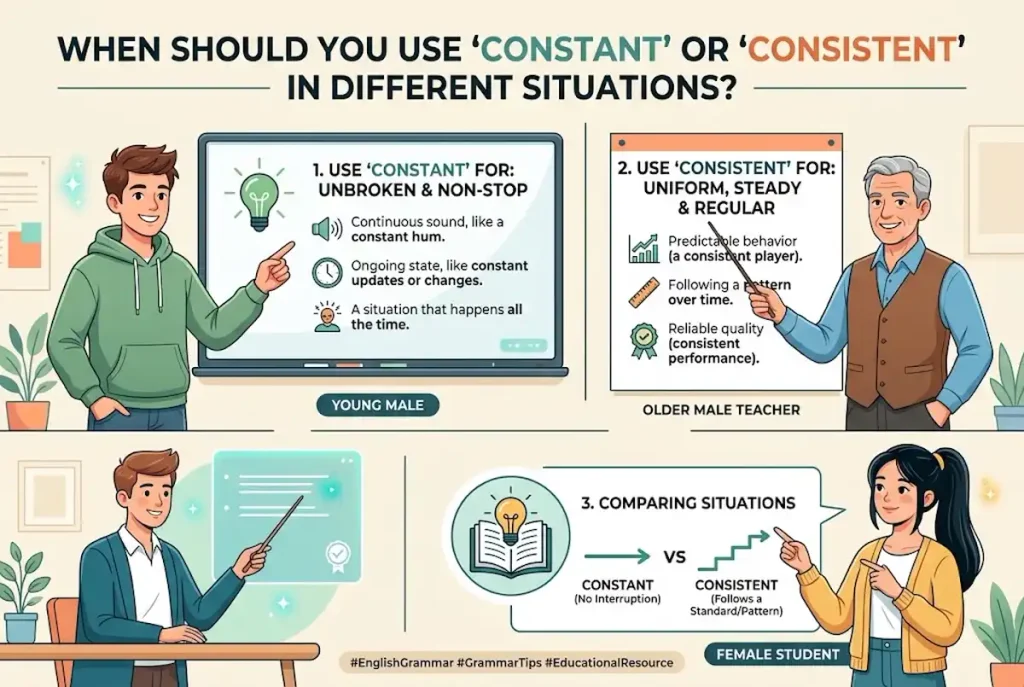
Use constant for continuous conditions, unchanged measurements, or frequent events.
Use consistent for regular patterns, matching findings, or evidence that supports an explanation.
Examples:
- The experiment was conducted at a constant temperature.
- The findings were consistent with the original hypothesis.
- Constant exposure to loud noise may affect concentration.
- The author maintains a consistent argument throughout the essay.
In research writing, consistent with is especially useful when explaining that one finding agrees with another.
Which Word Sounds Better in Texting?
Text messages usually sound more natural when the wording is simple and conversational.
Constantly often expresses frustration about something happening too frequently.
Consistently can express appreciation, describe a repeated habit, or point out a pattern.
Examples:
- Why are you constantly calling me?
- You’ve been consistently supportive lately.
- My phone keeps making noise nonstop.
- He’s consistently late whenever we make plans.
For casual conversations, always, nonstop, regularly, and every time can also work.
Which Word Is Better for a Professional Email?
Choose the word that accurately describes the situation.
If you’re discussing repeated interruptions, continuous activity, or unchanged conditions, constant may be appropriate.
If you’re discussing dependable service, quality, or progress, consistent is usually more suitable.
Examples:
- We appreciate your consistent support throughout this project.
- Our team has maintained consistent communication with the client.
- The constant system interruptions have delayed our work.
Be careful with tone. Constant complaints or constant delays can sound more critical than frequent complaints or recurring delays.
Which Word Should You Use in Everyday Speaking?
In spoken English, both words are common.
Constant often appears when someone describes an ongoing problem or repeated experience.
Consistent frequently appears when discussing habits, personal improvement, and reliability.
Examples:
- The traffic noise is constant around here.
- She’s very consistent with her workouts.
- I can’t focus because of the constant interruptions.
A useful speaking tip is to ask yourself what you’re emphasizing.
If you’re talking about how often something happens, consider constant. If you’re talking about how regularly something follows a pattern, consider consistent.
What Are Some Real Life Examples of Constant and Consistent?
The following examples show how both adjectives work across different situations.
| Situation | Example Sentence | Why It Works |
|---|---|---|
| Workplace | The constant interruptions reduced our productivity. | Emphasizes frequent disruptions |
| Education | Her consistent study habits improved her grades. | Describes a regular routine |
| Fitness | He made consistent progress during training. | Emphasizes steady improvement |
| Technology | The server requires constant monitoring. | Describes an ongoing need |
| Family | Her parents provided consistent emotional support. | Emphasizes dependable support |
| Science | The liquid remained at a constant temperature. | Describes an unchanged measurement |
| Business | The company maintained consistent product quality. | Emphasizes uniform standards |
| Relationships | Constant arguments damaged their friendship. | Describes repeated conflict |
| Sports | The goalkeeper delivered consistent performances. | Describes similar performance levels |
| Health | She experienced constant discomfort throughout the night. | Emphasizes a continuing condition |
| Finance | The business generated consistent monthly revenue. | Describes a dependable pattern |
| Communication | Constant notifications distracted the students. | Emphasizes repeated interruptions |
Can Both Words Be Correct in the Same Situation?
Yes. Sometimes both adjectives are grammatically correct, but they change the meaning.
Consider:
She makes constant efforts to improve.
She makes consistent efforts to improve.
The first emphasizes frequent or ongoing attempts. The second emphasizes regular effort over time.
Neither is automatically wrong.
However, the second sounds more natural when praising someone’s dependable work habits.
Which Word Has a Different Meaning?
Some closely related expressions make the difference especially clear.
Constant Effort vs Consistent Effort
| Constant Effort | Consistent Effort |
|---|---|
| Emphasizes ongoing or frequent effort | Emphasizes regular and steady effort |
| Focuses on continuity | Focuses on maintaining a pattern |
| May suggest sustained attention | Suggests dependable commitment |
| Useful for describing intensive work | Useful for describing long-term habits |
Constant Progress vs Consistent Progress
| Constant Progress | Consistent Progress |
|---|---|
| Suggests progress continues | Suggests progress follows a steady pattern |
| Emphasizes ongoing movement | Emphasizes regular improvement |
| Doesn’t necessarily promise equal results | Suggests relatively dependable results |
What Common Mistakes Should You Avoid?
Although both adjectives share ideas of stability and repetition, using them interchangeably can make your writing less accurate.
Mistake 1 Using Constant When You Mean Reliable
Incorrect or unnatural:
She is a constant employee who always meets deadlines.
Better:
She is a consistent employee who always meets deadlines.
The second sentence communicates dependable performance more naturally.
Mistake 2 Using Consistent for Something That Never Stops
Less precise:
The machine produces a consistent noise without stopping.
Better:
The machine produces a constant noise without stopping.
Consistent noise can describe sound that stays similar in volume or pattern. Constant noise better emphasizes uninterrupted sound.
Mistake 3 Thinking Consistency Means Perfection
A person can be consistent without being perfect.
Someone who regularly completes most assignments on time may demonstrate consistent effort, even if an occasional mistake occurs.
Consistency doesn’t require flawless results.
What Are the Opposites of Constant and Consistent?
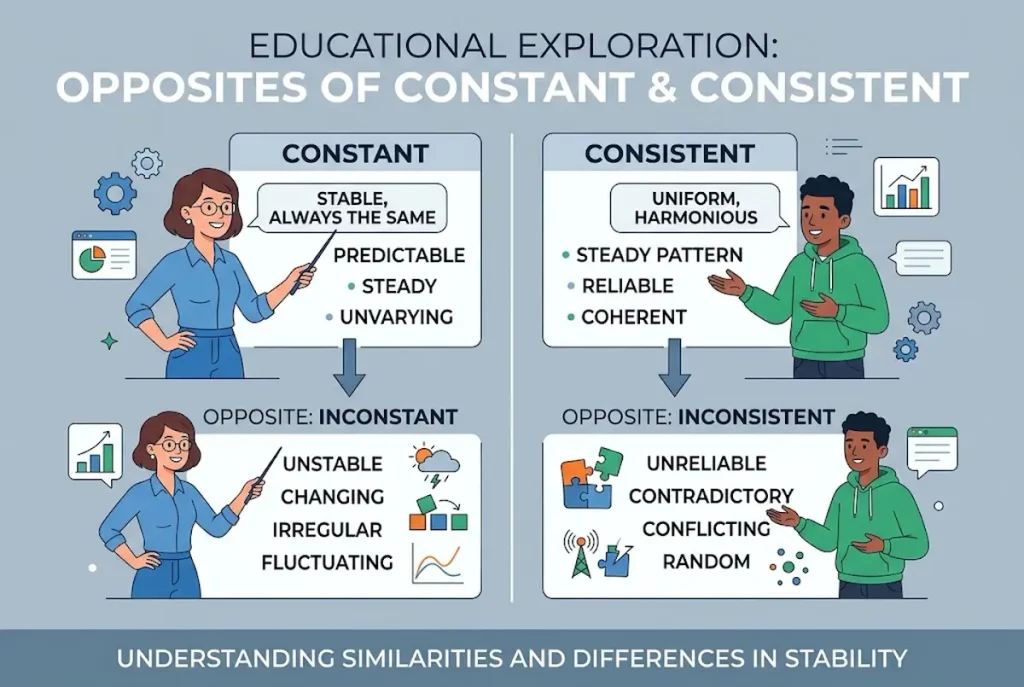
Antonyms help clarify the difference between the two adjectives.
| Constant Antonyms | Meaning |
|---|---|
| Intermittent | Starting and stopping |
| Occasional | Happening sometimes |
| Sporadic | Happening irregularly |
| Temporary | Lasting for a limited time |
| Variable | Changing rather than remaining fixed |
| Inconstant | Not remaining steady |
| Consistent Antonyms | Meaning |
|---|---|
| Inconsistent | Not following the same pattern |
| Unreliable | Not dependable |
| Irregular | Not following a regular schedule |
| Erratic | Changing unpredictably |
| Contradictory | Conflicting with something else |
| Uneven | Not maintaining the same standard |
How Can You Quickly Choose the Right Word?
You don’t need to memorize every synonym to make the correct choice.
Use these five questions when writing or speaking:
- Does something continue without stopping? Choose constant.
- Does something happen very frequently? Constant may be suitable.
- Does someone follow a regular routine? Choose consistent.
- Does something maintain similar quality or results? Choose consistent.
- Does a measurement remain unchanged? Choose constant.
Conclusion
Understanding Constant vs Consistent helps you describe actions, habits, and results more accurately. Constant is the better choice when you want to emphasize continuous activity, frequent repetition, or an unchanged condition. Consistent works better when you’re describing regular behavior, dependable performance, or results that follow a similar pattern.
Remember that someone can work consistently without working constantly. Taking regular breaks doesn’t make a person unreliable, just as doing something nonstop doesn’t guarantee good results.
For professional writing, consistent is often more useful when describing positive qualities such as effort, communication, and performance. Constant is especially helpful when discussing ongoing conditions, repeated events, and fixed measurements.
The next time you’re choosing between these words, focus on the message you want your reader to understand. A small change in wording can make your sentence much clearer.
Frequently Asked Questions
What is the main difference between constant and consistent?
Constant describes something that continues, happens frequently, or remains unchanged. Consistent describes something that follows a regular pattern, maintains similar quality, or remains dependable over time.
Is it better to be constant or consistent?
Consistent is usually better when describing personal habits, professional performance, or long-term improvement. Constant activity isn’t always necessary for achieving reliable results.
What’s another way to say consistent effort?
Steady effort, regular effort, sustained commitment, and persistent effort are useful alternatives. Choose the expression that best matches the situation and level of intensity.
Does consistent mean always?
No. Consistent means following a regular pattern or maintaining similar standards. An activity can happen three times a week and still be consistent.
Is constant a positive or negative word?
Constant can be positive, negative, or neutral depending on the context. Constant support sounds positive, while constant criticism usually sounds negative.
Should I write constant improvement or consistent improvement?
Both expressions are correct, but they emphasize different ideas. Constant improvement suggests ongoing advancement, while consistent improvement suggests steady, regular progress.
Is constantly the same as consistently?
No. Constantly emphasizes continuous or frequent activity, while consistently emphasizes regular behavior or dependable results. This is the same basic distinction explained in Constant vs Consistent.

Daniel Grammarfield — The Language Learner
Age: 28Occupation: ESL Learner & Digital Professional
Bio:Daniel is a non-native English speaker who wants to communicate more confidently at work and online. He uses Synotrench to improve grammar, understand confusing words, learn correct sentence structures, and build everyday English skills. He prefers simple explanations with practical examples.
Goals:
Master English grammar rules
Avoid common language mistakes
Improve professional communication
Learn English through real-life examples
Quote:“Learning English is not about memorizing rules — it’s about expressing ideas clearly.”