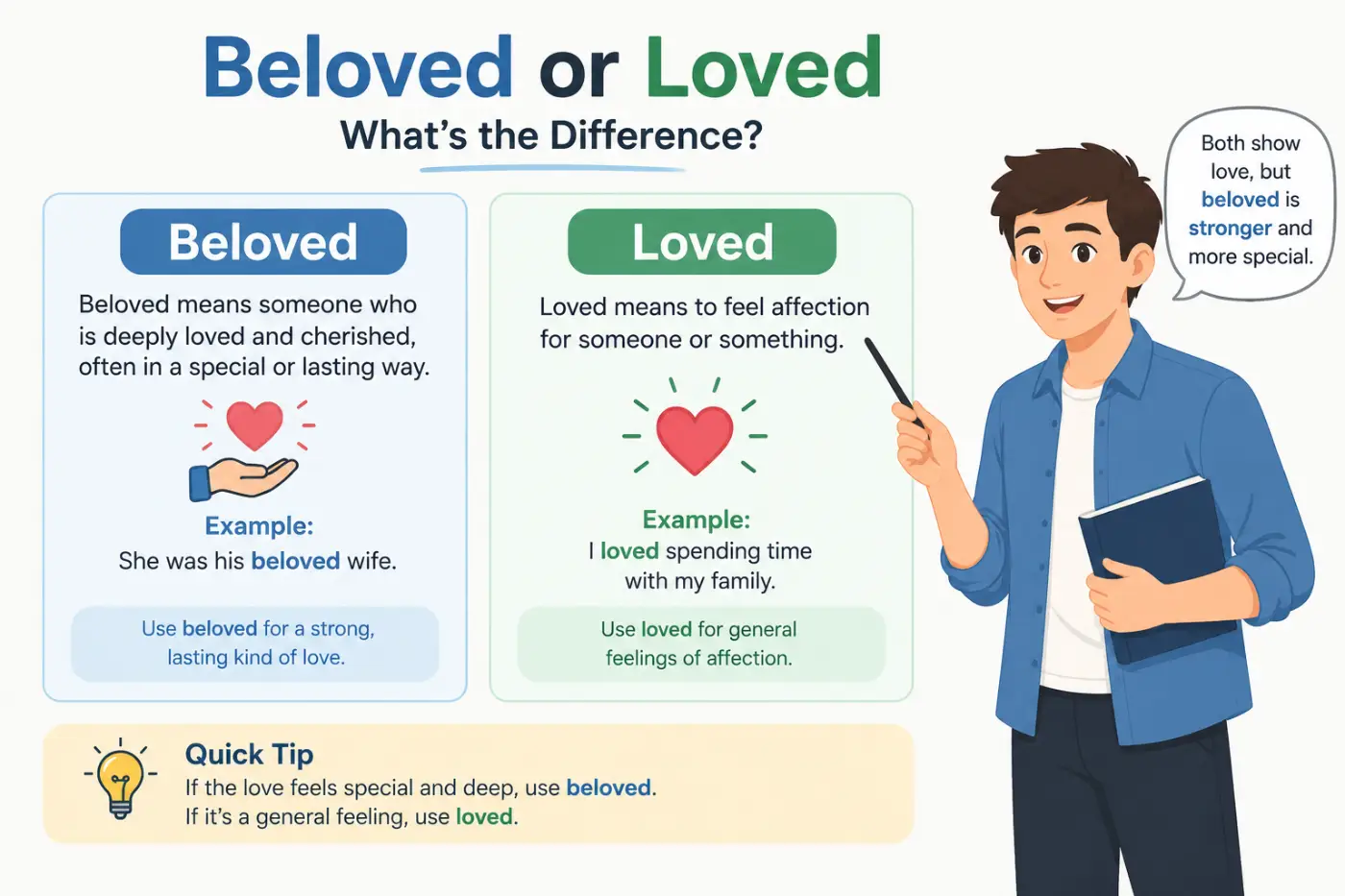
When you’re writing an email, essay, resume, or text message, you may pause over two words that seem almost identical: beloved and loved. Both describe strong affection, but they don’t always sound the same. Choosing the right one can change the feeling of a sentence.
Beloved usually carries a warmer, deeper, or more emotional sense. Loved is more common and works in a much wider range of everyday situations.
The difference becomes clearer when you look at tone, context, intensity, grammar, and common usage. This guide explains the origins and meanings of both words, gives you a large synonym list, compares their shades of meaning, and shows which word works best in emails, resumes, essays, texts, and everyday speech.
Where did beloved come from?
Beloved has a long history in English. It comes from the verb love combined with the older past participle form beloved. The word has been used in English for centuries to describe someone who is dearly loved.
Beloved has kept a somewhat special position in English because it can sound more literary or emotional than ordinary forms of the word love.
It can describe deep affection, respect, admiration, or attachment.
For example:
- The beloved family dog passed away.
- The museum is a beloved local landmark.
- She became a beloved figure in the community.
In each example, the word suggests more than simple affection. It suggests that many people feel a strong emotional connection to the person, animal, place, or thing.
What is the plain English meaning of loved?
Loved is much simpler and more flexible.
If someone is loved, another person feels strong affection for them. The word can describe family relationships, friendships, romantic relationships, appreciation, and enjoyment.
For example:
- I love my parents.
- She loved her childhood home.
- We loved the concert.
Loved can also describe something you enjoyed in the past.
In the sentence, “I loved the movie,” loved does not mean that you had deep emotional affection for the movie. It usually means that you enjoyed it very much.

What is the difference between beloved and loved?
The easiest way to remember the distinction is this:
| Word | Main idea | Typical feeling |
|---|---|---|
| Beloved | Deeply cherished or dearly loved | Warm, emotional, respectful |
| Loved | Received love or was greatly enjoyed | General, common, flexible |
Beloved often works as an adjective before a noun.
- a beloved teacher
- a beloved author
- a beloved tradition
Loved can also work as an adjective, but it is closely connected to the verb love.
- a loved child
- a loved family member
- a loved song
Beloved usually feels more descriptive. Loved often feels more direct.
What are the best synonyms?
There are many words you can use. The best choice depends on how strong the emotion is and how formal the situation feels.
Simple synonyms
| Word | Meaning | Tone | Example |
|---|---|---|---|
| Dear | Loved or valued | Warm | She was a dear friend. |
| Liked | Enjoyed or favored | Mild | He was liked by his classmates. |
| Cared for | Treated with concern | Gentle | The child was deeply cared for. |
| Valued | Considered important | Neutral | She was valued by her team. |
| Enjoyed | Found pleasant or satisfying | Casual | The show was enjoyed by many viewers. |
| Cherished | Loved and protected emotionally | Warm | He cherished his childhood memories. |
| Admired | Respected or appreciated | Positive | She was admired for her honesty. |
Everyday synonyms
| Word | Meaning | Tone | Example |
|---|---|---|---|
| Cherished | Deeply loved and valued | Warm | It was a cherished family tradition. |
| Dear | Special and loved | Warm | My dear grandmother lived nearby. |
| Special | Important in an emotional way | Friendly | This is a special place for us. |
| Appreciated | Recognized as valuable | Neutral | Her work was appreciated by everyone. |
| Valued | Seen as important | Neutral | He was highly valued by his coworkers. |
| Adored | Loved very strongly | Emotional | The children adored their teacher. |
| Treasured | Considered extremely valuable | Emotional | She treasured the old photograph. |
| Favorite | Preferred above others | Casual | That is my favorite song. |
Formal synonyms
| Word | Meaning | Tone | Example |
|---|---|---|---|
| Esteemed | Highly respected | Formal | He was an esteemed professor. |
| Revered | Deeply respected and admired | Formal | The writer was revered by generations of readers. |
| Respected | Held in high regard | Formal | She was respected throughout the organization. |
| Honored | Treated with great respect | Formal | The honored leader addressed the audience. |
| Valued | Regarded as important | Professional | Her contributions were highly valued. |
| Admired | Respected for qualities or achievements | Professional | He was admired for his leadership. |
| Acclaimed | Publicly praised | Formal | The acclaimed artist opened the exhibition. |
| Esteemed | Greatly respected or valued | Formal | The esteemed author spoke at the event. |
Slang and casual alternatives
Slang does not always provide a perfect replacement. These words can work in casual speech, but they carry different shades of meaning.
| Word | Meaning | Tone | Example |
|---|---|---|---|
| Obsessed | Extremely interested in something | Casual | I’m obsessed with that show. |
| Into | Very interested in something | Casual | She’s really into that band. |
| Crazy about | Like or love very strongly | Casual | He’s crazy about his new puppy. |
| Big fan of | Like something a lot | Casual | I’m a big fan of this author. |
| Sweet on | Romantically interested in someone | Casual | He was sweet on his neighbor. |
| Adore | Love or enjoy strongly | Casual to warm | I absolutely adore this little café. |
| Love | Feel strong affection or enjoyment | Casual | I love this song. |
Some of these choices are not direct replacements. For example, obsessed is much stronger than loved and can sometimes suggest an unhealthy level of interest.
Which synonym is strongest?
Words connected to love do not all have the same emotional strength. You can think of them as a range.
Mild affection
These words suggest positive feelings without strong emotional attachment.
- Like
- Enjoy
- Appreciate
- Favor
- Admire
Example:
She appreciated the gift.
This does not necessarily mean she felt deep emotional attachment.
Moderate affection
These words suggest a stronger connection.
- Care for
- Value
- Respect
- Dear
- Treasure
Example:
He treasured the memories of his childhood.
Strong affection
These words suggest deep emotional attachment.
- Love
- Cherish
- Adore
- Beloved
- Devoted
Example:
The town cherished its longtime coach.
Very strong emotional or respectful language
These words can suggest deep admiration, lasting affection, or almost universal respect.
- Revered
- Venerated
- Devoted
- Deeply cherished
- Greatly admired
Example:
The revered teacher influenced thousands of students.
The strongest word is not always the best word. If you use revered for an ordinary friend, the sentence may sound exaggerated. Good word choice depends on context, not just intensity.
What part of speech are used for words?
Both words have different grammatical roles.
Beloved as an adjective
Beloved is commonly used as an adjective.
Examples:
- She is a beloved grandmother.
- This is a beloved tradition.
- He became a beloved community leader.
Here, beloved describes a noun.
Beloved as a noun
Beloved can also be used as a noun.
Example:
- She mourned the loss of her beloved.
This use is more emotional and sometimes romantic.
Loved as a verb
Loved is commonly the past tense of love.
Examples:
- They loved the restaurant.
- She loved her parents.
- I loved the book.
Loved as an adjective
Loved can also describe someone or something that receives affection.
Examples:
- He was a loved member of the family.
- It was a loved local tradition.
However, cherished or beloved may sound more natural in many situations when you want to emphasize deep affection.
Which word sounds more natural in a resume?
Best word for a resume
A resume should focus on professional qualities, achievements, skills, and results. Words such as respected, valued, trusted, and admired are usually more useful.
Example:
She was a respected team leader who trained new employees.
Instead of:
She was a beloved team leader.
Beloved sounds personal and emotional. It does not tell a hiring manager what the person actually achieved.
If you are writing a professional biography, however, beloved may work when discussing public reputation.
Example:
The beloved local coach served the community for more than 20 years.
Which word works best in an essay?
Best word for an essay
The best choice depends on your subject and purpose.
Use loved when you’re describing a straightforward relationship or action.
Example:
The character was loved by his family despite his mistakes.
Use beloved when you want to show that a person, place, tradition, or work has a special emotional value.
Example:
The novel became a beloved part of American literary culture.
Beloved can be especially useful in literary analysis because it adds emotional depth without requiring a long explanation.
Which word works best in texting?
Best word for texting
Loved is usually more natural in everyday texting.
Examples:
- I loved that movie.
- I loved your message.
- We loved the food.
- She loved the gift.
Beloved can sound dramatic or playful in a text.
For example:
“My beloved coffee shop finally reopened.”
This can be funny because beloved sounds more formal than normal texting language.
For a casual message, loved is usually the safer choice.
Which word works best in an email?
Best word for email
In a personal email, either word can work.
Example:
I loved the photos you sent.
For a formal or professional email, valued, appreciated, or respected may sound more appropriate.
Example:
We greatly appreciated your support.
Beloved can work in an emotional announcement or community message.
Example:
Our beloved teacher will retire at the end of the school year.
That sentence sounds warm and respectful.
Which word works best in speaking?
Best word for speaking
Loved is more common in ordinary conversation.
You might say:
“I loved that restaurant.”
“I loved the concert.”
“My kids loved the movie.”
Beloved is less common in casual speech, but it appears often in stories, speeches, tributes, and emotional descriptions.
Example:
“She was a beloved member of our community.”
The word sounds natural when the speaker wants to express respect and affection.
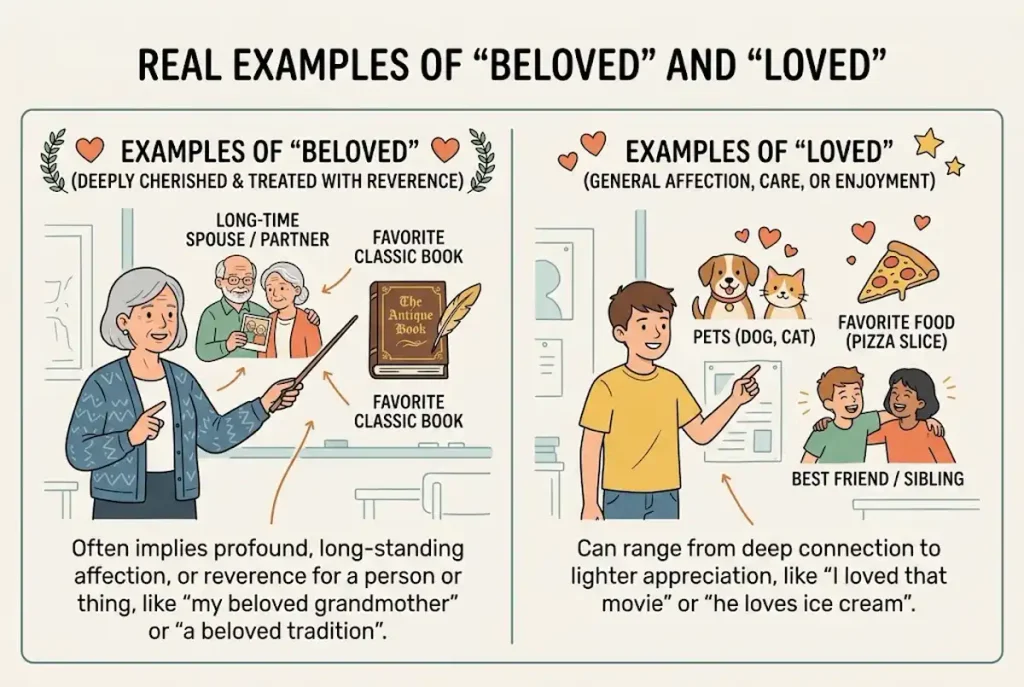
What are some real examples of beloved and loved?
Here are examples from different situations.
- The children loved their new teacher.
- She was a beloved teacher who inspired generations of students.
- I loved the book you recommended.
- The old library became a beloved part of the neighborhood.
- His parents loved him deeply.
- The dog was a beloved member of the family.
- We loved spending summer evenings by the lake.
- The singer became a beloved figure among her fans.
- She loved her hometown and returned every summer.
- I loved your idea for the project.
- His grandchildren loved hearing his stories.
- The old theater remains a beloved landmark.
- The holiday is a beloved family tradition.
- They loved the chance to work together.
- I loved the way the story ended.
Beloved vs cherished: what’s the difference?
Beloved and cherished are close in meaning, but they aren’t identical.
| Beloved | Cherished |
|---|---|
| Focuses on being deeply loved | Focuses on being deeply valued and protected |
| Often describes people, places, traditions, and cultural works | Often describes people, memories, possessions, and relationships |
| Can sound public or widely shared | Often feels more personal |
| Warm and emotional | Warm and personal |
Compare:
The singer was beloved by her fans.
This suggests that many fans had strong affection for her.
She cherished the letters from her mother.
This suggests that the letters had deep personal value to her.
You can sometimes replace one with the other, but the emotional focus changes.
Beloved vs adored: what’s the difference?
Adored usually expresses very strong love or enthusiasm. Beloved tends to sound more respectful, lasting, or established.
| Beloved | Adored |
|---|---|
| Deeply loved | Loved very strongly |
| Often warm and respectful | Often enthusiastic or emotional |
| Can describe cultural or community favorites | Often describes people, pets, entertainment, or things |
| Can sound literary | Often sounds conversational |
Examples:
The beloved author inspired generations of readers.
The children adored their grandfather.
The first sounds respectful and lasting. The second sounds personal and affectionate.
Beloved vs dear: what’s the difference?
Dear is often softer and less intense than beloved.
You might say:
She is a dear friend.
This means she is special and valued.
You could also say:
She is a beloved friend.
This suggests a deeper level of affection and emotional attachment.
Dear is also common in greetings such as “Dear John” or “Dear Professor Smith.” Beloved does not normally work that way.
You would not normally begin a professional email with “Beloved Professor Smith.”
What are common mistakes?
Using beloved for every kind of love
Incorrect or awkward:
I beloved the movie.
Correct:
I loved the movie.
Beloved is not normally used as the simple past tense of love.
Using beloved as a verb
Beloved is not used like this:
She beloved her family.
Use:
She loved her family.
Beloved is generally an adjective or noun in modern English.
Using beloved when the meaning is casual
If you are talking about enjoying a meal, loved is usually more natural.
Natural:
I loved the pizza.
Possible but unusual:
The pizza was beloved by me.
The second sentence sounds unnecessarily formal and awkward.
Using loved when you need a deeper emotional tone
Loved is grammatically correct, but sometimes it does not express the feeling you want.
Compare:
He was loved by the community.
He was beloved by the community.
The second sentence suggests a stronger shared emotional bond.
Assuming beloved always means romantic love
Beloved can describe romantic relationships, but it does not have to.
Examples:
- beloved grandmother
- beloved teacher
- beloved pet
- beloved author
- beloved tradition
The word can express family love, community affection, admiration, or cultural attachment.
When should you not use beloved?
Avoid beloved when the situation is very casual and the word would sound overly dramatic.
For example:
“I beloved my new headphones.”
This is incorrect.
“I loved my new headphones.”
This is natural.
Also avoid beloved when you are trying to make a precise professional statement. If you mean respected, use respected. If you mean appreciated, use appreciated.
Choosing a more specific word often makes your writing stronger.
What are the antonyms?
The opposite of loved is usually unloved, disliked, hated, or unwanted, depending on the sentence.
| Antonym | Meaning |
|---|---|
| Unloved | Not receiving love |
| Hated | Strongly disliked |
| Disliked | Not liked |
| Rejected | Not accepted or wanted |
| Unwanted | Not desired |
| Ignored | Given little or no attention |
| Detested | Strongly hated |
| Despised | Viewed with intense dislike |
The exact opposite depends on the context.
For example:
She was loved by her family.
She was unloved by her family.
But:
I loved the movie.
I hated the movie.
Here, hated is the natural opposite because the sentence is about an opinion or reaction.
How do US and UK usage differ?
There is no major difference between American and British English in the basic meanings of words.
Both also use loved as the past tense of love.
There can be small differences in style and frequency depending on the writer, publication, or situation. Beloved may appear more often in literary, historical, religious, memorial, or formal writing. Loved is common in both casual and formal English.
Examples work naturally in both varieties:
- a beloved teacher
- a beloved family tradition
- a loved child
- loved by millions
You do not need to change the word simply because your audience is American or British.
How can you choose the right word quickly?
Use these simple questions.
Do you mean simply felt love or enjoyed something?
Choose loved.
Example:
I loved the concert.
Do you mean deeply cherished?
Choose beloved or cherished.
Example:
The old theater was beloved by local residents.
Do you want a professional tone?
Consider respected, valued, admired, or esteemed.
Example:
She was a respected leader.
Do you want a personal and emotional tone?
Consider cherished, dear, treasured, or beloved.
Example:
He kept the cherished photograph in his wallet.
Do you want casual everyday English?
Choose loved, liked, enjoyed, or adored.
Example:
I loved that movie.
Do you want a strong literary feeling?
Beloved can be an excellent choice.
Example:
The river remained a beloved symbol of the town.
Quick comparison table
| Situation | Best choice | Why |
|---|---|---|
| Casual conversation | Loved | Natural and common |
| Talking about enjoyment | Loved | Direct and flexible |
| Emotional tribute | Beloved | Warm and respectful |
| Family memories | Cherished | Personal and emotional |
| Professional praise | Respected | Clear and appropriate |
| Strong admiration | Admired | Focuses on respect |
| Very strong affection | Adored | Strong emotional feeling |
| Cultural tradition | Beloved | Suggests lasting shared affection |
| Resume | Respected or valued | More professional |
| Text message | Loved | Natural and conversational |
| Formal essay | Beloved or admired | Depends on the meaning |
| Personal letter | Loved or cherished | Warm and natural |
What should you remember about words?
If you are talking about something you enjoyed, loved is usually the natural choice.
If you are describing someone or something that holds a special place in the hearts of many people, beloved often works better.
Think about the feeling you want your reader to receive. Do you simply want to say that affection exists? Use loved. Do you want to show that the affection is deep, special, or lasting? Beloved may be the better choice.

Final answer about beloved and loved
Both words are closely related, but they aren’t interchangeable in every sentence. Loved is the more common and flexible word. It can describe affection between people or enjoyment of an experience, object, book, movie, meal, or activity. Beloved has a stronger emotional flavor. It usually suggests that someone or something is deeply cherished, greatly admired, or especially important to a person or community.
For everyday conversation, loved is often the natural choice. For tributes, emotional writing, literary descriptions, community stories, and descriptions of lasting affection, beloved can add warmth and depth. The best choice depends on the exact feeling you want to express. When in doubt, use loved for simple everyday meaning and choose beloved when you want to emphasize deep or special affection.
Conclusion
Both words express strong affection, but they create a different feeling. Loved is the natural everyday choice for talking about affection, enjoyment, or care. Beloved adds a deeper sense of emotional connection, respect, or lasting importance.
Use loved when you want simple and natural English, and choose beloved when you want your writing to sound warmer or more meaningful. For professional writing, words such as respected, valued, or admired may sometimes be more precise.
The best choice depends on the situation and the feeling you want to communicate. Once you understand this small difference, choosing between these two words becomes much easier.
Frequently Asked Questions
Is beloved a correct word?
Yes, beloved is a standard English word. It is commonly used as an adjective meaning deeply loved or cherished, and it can also be used as a noun for a dearly loved person.
What’s another way to say beloved?
Another way to say beloved is cherished, adored, treasured, dear, admired, or deeply loved. The best synonym depends on the level of affection and the context.
Is beloved a formal word?
Beloved can sound more formal, literary, or emotional than loved. It is common in tributes, biographies, essays, speeches, and descriptions of people or traditions with lasting importance.
Is it correct to say beloved friend?
Yes, beloved friend is grammatically correct. It suggests a friend who is deeply loved and emotionally important.
What is the difference between words?
The main difference is emotional tone.

Daniel Grammarfield — The Language Learner
Age: 28Occupation: ESL Learner & Digital Professional
Bio:Daniel is a non-native English speaker who wants to communicate more confidently at work and online. He uses Synotrench to improve grammar, understand confusing words, learn correct sentence structures, and build everyday English skills. He prefers simple explanations with practical examples.
Goals:
Master English grammar rules
Avoid common language mistakes
Improve professional communication
Learn English through real-life examples
Quote:“Learning English is not about memorizing rules — it’s about expressing ideas clearly.”
3 thoughts on “Beloved or Loved: The Best Word Choice Guide (2026)”