You’re writing an email and want to say that you think something is true, but you’re not completely sure. You type assume, then wonder if presume sounds more precise. A few lines later, you need a word for reaching a conclusion from clues, and infer comes to mind. This is where Assume vs Presume vs Infer can get confusing.
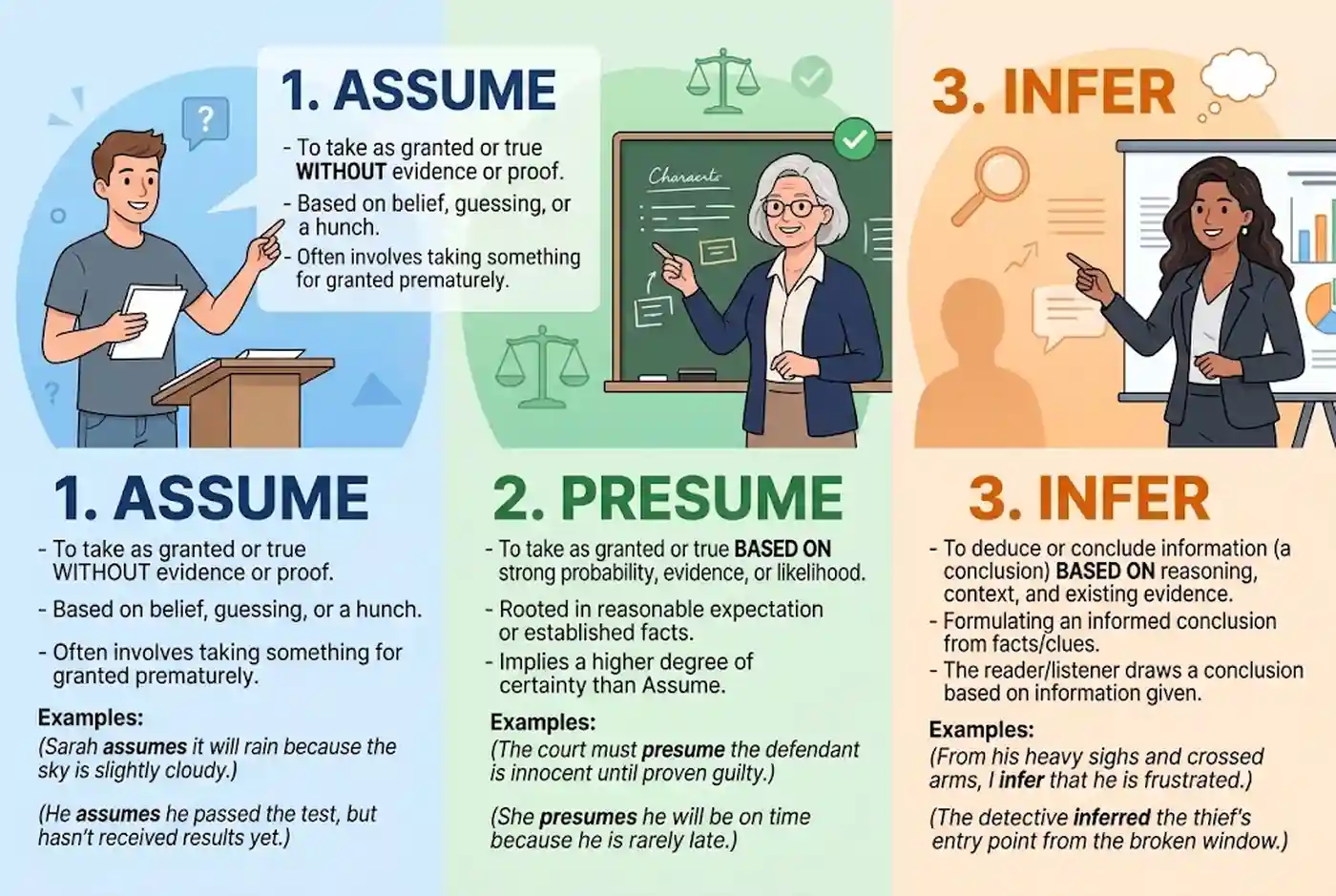
All three words deal with ideas that are not stated as simple facts. The difference is how you reach that idea and how confident or justified you are. Assume usually means accepting something as true without proof. Presume often suggests that you have a reasonable basis for believing it. Infer means reaching a conclusion from evidence, clues, or information.
This guide explains the meanings, origins, related words, intensity levels, common mistakes, regional usage, and the best choice for emails, essays, resumes, texting, and everyday speech. You’ll also see clear examples that show exactly how these three verbs work.
What do assume presume and infer mean?
The easiest way to understand these words is to focus on the source of your belief.
| Word | Plain English meaning | Main idea |
|---|---|---|
| Assume | Accept something as true without enough proof | You take it as true |
| Presume | Believe something is probably true based on reasonable grounds | You have some reason to believe it |
| Infer | Reach a conclusion from evidence or clues | You figure it out from information |
Consider this short situation.
Your coworker usually arrives at 8:00 a.m. Today, the office is open, but your coworker hasn’t arrived.
You might assume your coworker is late. You don’t have proof.
That distinction is small but useful.
Where do assume presume and infer come from?
Understanding word origins can make these words easier to remember.
Assume comes from the Latin word assumere, meaning to take up or take to oneself. It developed into the idea of accepting something as true or taking something for granted.
Presume also comes from Latin. It traces back to praesumere, meaning to take beforehand or suppose beforehand. The word developed the sense of believing something before complete proof is available.
Infer comes from the Latin inferre, meaning to bring in, bring toward, or carry into. In English, it developed the meaning of drawing a conclusion from facts, evidence, or clues.
The origins reveal an interesting difference. Assume and presume focus on what you accept or believe. Infer focuses on what you conclude from information.
A simple memory trick is:
Assume = accept.
Presume = believe with some reason.
Infer = conclude from clues.
What is the difference between assume presume and infer?
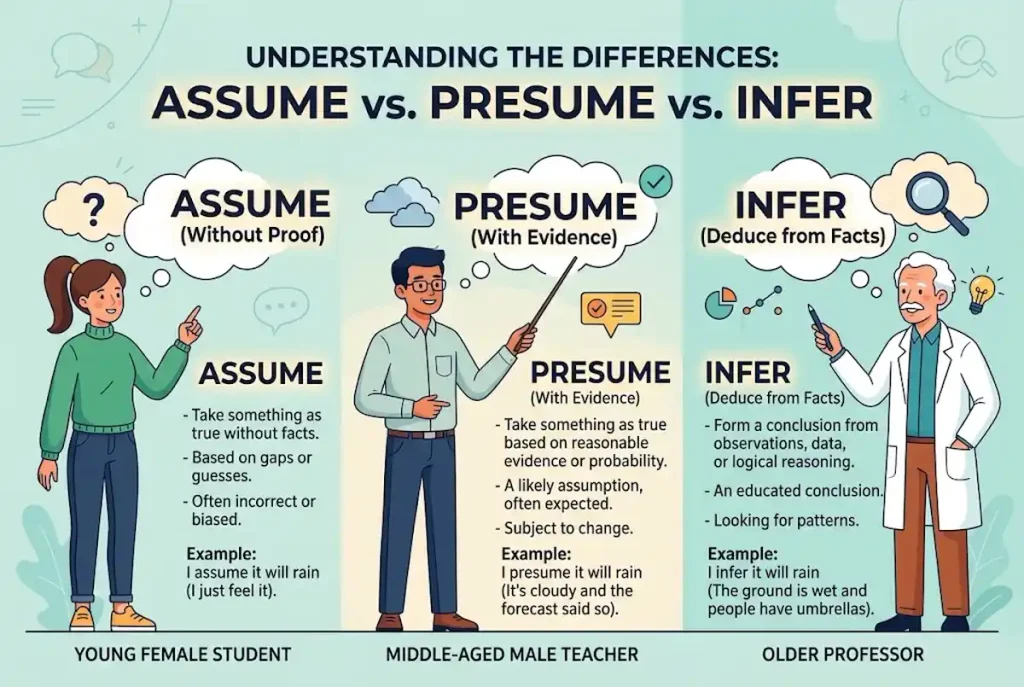
The biggest difference is the direction of reasoning.
When you assume something, you start with an idea and accept it without having enough evidence to establish it.
When you presume something, you also accept an idea, but the belief usually has some reasonable basis.
For example:
I assumed Maya was at home because her car was outside.
The speaker made an assumption from one clue. The clue isn’t enough to prove Maya is home.
I presumed Maya was at home because she had said she wasn’t going anywhere.
This belief has a stronger basis.
I inferred that Maya was at home because her car was outside, her phone was connected to the home Wi-Fi, and she had recently posted from her house.
Here, the speaker combines clues to reach a conclusion.
The words can overlap in casual speech, but their reasoning patterns are different.
Which synonyms are mild and which are strong?
Not all words express the same level of confidence.
Mild words for uncertain ideas
Use these when you have little evidence.
- Guess
- Think
- Imagine
- Suppose
- Speculate
- Wonder
- Suspect
Example:
I guess the store is closed.
The speaker isn’t claiming certainty.
Medium strength words
These suggest a more developed belief.
- Believe
- Expect
- Presume
- Assume
- Figure
- Reckon
- Gather
Example:
I presume the manager has approved the request.
The speaker expects this to be true, but isn’t presenting it as confirmed fact.
Stronger conclusion words
These suggest that information supports the conclusion.
- Infer
- Deduce
- Conclude
- Determine
- Establish
Example:
From the available evidence, investigators concluded that the system had failed.
The speaker isn’t simply guessing. The conclusion comes from information.
Still, the strength of a word depends on context. Infer doesn’t automatically mean the conclusion is correct. A person can infer something incorrectly if the evidence is misunderstood or incomplete.
Are assume presume and infer verbs?
Yes. Assume, presume, and infer are all verbs.
They describe mental processes or acts of reasoning.
Assume:
We assumed the restaurant was open.
Presume:
I presumed she knew about the change.
Infer:
The reader can infer the meaning from the final paragraph.
Their noun forms are also useful.
| Verb | Related noun | Example |
|---|---|---|
| Assume | Assumption | That assumption was incorrect. |
| Presume | Presumption | The decision was based on a presumption. |
| Infer | Inference | Her inference was based on several clues. |
Notice that the noun forms follow the same basic distinctions.
An assumption is something accepted as true without confirmation.
A presumption is a belief accepted as probably true, often because there is some reasonable basis.
An inference is a conclusion drawn from evidence.
Is there a US or UK difference?
There is no major American versus British English difference in the basic meanings of assume, presume, and infer.
All three are standard in both US and UK English.
The main difference is usually register and context rather than geography.
Presume can sound somewhat more formal or traditional in everyday American conversation. In British English, it can also appear frequently in formal expressions.
For example:
I presume you have already spoken with the manager.
This sounds formal in both varieties.
Assume is very common in both.
I assumed you knew about the meeting.
Infer is also standard in both varieties and is especially common in academic, technical, legal, and analytical writing.
The results allow us to infer that the treatment was effective.
Regional vocabulary isn’t the main issue here. The important thing is choosing the word that matches your reasoning.
Which word is best for a resume?
Assume, presume, and infer aren’t usually the strongest choices for a resume because resumes should focus on actions, results, and measurable facts.
Still, infer can be useful in a technical or analytical role.
For example:
Analyzed customer data to infer purchasing patterns.
That sentence tells the reader that you used evidence to reach a conclusion.
You could also write:
Examined sales data and identified purchasing trends.
This is often clearer because it describes the actual action.
Avoid unnecessary statements such as:
I assumed the project would succeed.
A resume isn’t the right place to emphasize an unsupported belief.
For professional documents, use infer when you genuinely describe analytical reasoning. Use assume only when the assumption itself is relevant to your work.
Which word is best for an essay?
Infer is often useful in essays because academic writing frequently asks readers to draw conclusions from evidence.
For example:
From the character’s repeated actions, readers can infer that he feels guilty.
Assume can also work when discussing an unsupported belief.
The author should not assume that every reader shares the same experience.
Presume is more formal and may fit certain academic arguments.
We cannot presume that the results apply to every population.
The best choice depends on what you’re saying.
If you’re talking about a belief supported by reasonable grounds, presume can fit.
If you’re discussing a conclusion drawn from evidence, infer is usually the natural choice.
Which word is best for texting?
Assume is the most natural choice in casual texting.
I assumed you were already home.
Don’t assume I’m mad.
Guess and think are also common.
I guess you’re busy.
I thought you were coming.
Presume is grammatically correct, but it can sound formal or playful in a casual text.
I presume you’re enjoying your vacation.
That might sound intentionally formal between friends.
Infer is also less common in everyday texting because it sounds analytical.
I inferred from your message that you’re upset.
This is correct, but many people would simply write:
I figured you were upset from your message.
Texting usually favors simple conversational language.
Which word is best for an email?
The right word depends on the purpose of the email.
Assume works when you’re describing something you believed without confirmation.
I assumed the deadline was Friday.
Presume works when you want to express a reasonable expectation politely.
I presume the updated document has been approved.
Infer works when you’re discussing a conclusion based on information.
From the figures in the report, we can infer that demand has increased.
In professional emails, be careful with assume. Saying that you assumed something can sometimes reveal that you didn’t verify an important detail.
Instead of:
I assumed you had approved the request.
You might write:
I understood that you had approved the request. Could you please confirm?
That sounds clearer and avoids placing blame.
Which word is best when speaking?
Assume is the most common of the three in ordinary conversation.
I assumed you were joking.
I assumed we’d meet at six.
Presume is more formal.
I presume you’re the person I spoke with yesterday.
Infer is usually used when talking about evidence or conclusions.
I inferred from his reaction that he was disappointed.
In casual speech, people often replace infer with figure out, guess, tell, or gather.
I figured he was tired.
I could tell she was nervous.
The formal word isn’t always the best word. Clear communication matters more than sounding sophisticated.
What are some real examples of assume presume and infer?
These examples show how the words work in different situations.
Everyday situations
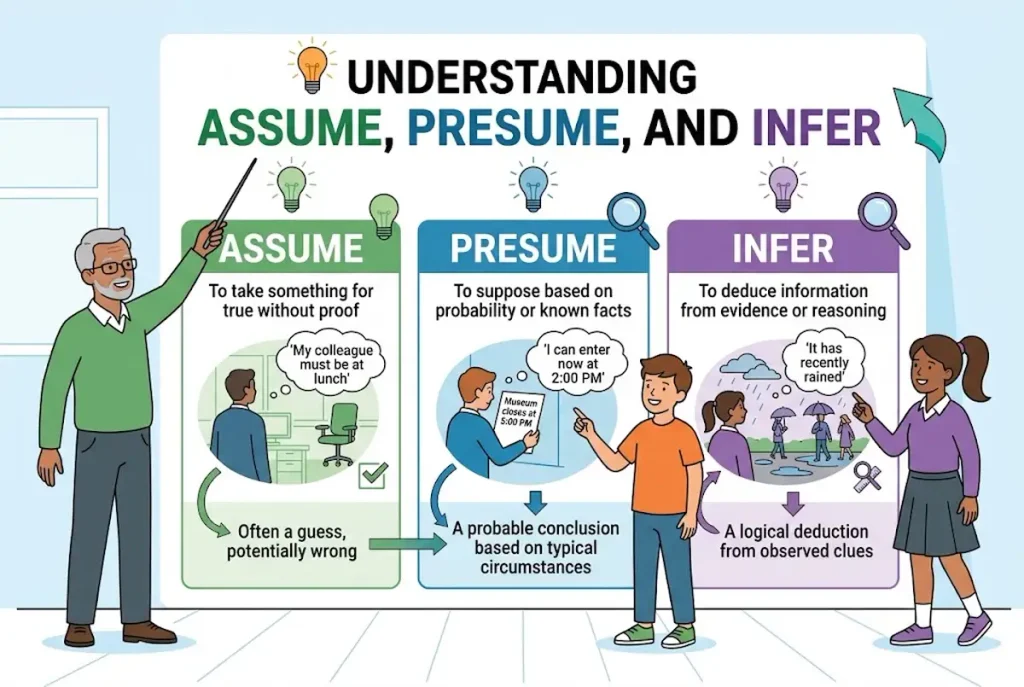
I assumed the store closed at nine.
The speaker believed the closing time without checking.
I presumed the package had arrived because the tracking page showed it as delivered.
The belief has a reasonable basis.
I inferred that the package had been left at the front door because the delivery photo showed the entrance.
The speaker reached the conclusion from evidence.
At work
I assumed the meeting was online because the invitation contained a video link.
I presumed the client had received the proposal because the email system showed successful delivery.
We inferred from the sales numbers that customers preferred the smaller package.
At school
The teacher warned us not to assume that the first answer was correct.
Students may presume that a difficult passage has only one interpretation.
From the author’s word choice, readers can infer that the character is worried.
In an email
I assumed the revised schedule had already been shared.
I presume you’ve had an opportunity to review the attachment.
From your comments, I infer that you would like us to revise the proposal.
In a conversation
I assumed you were busy, so I didn’t call.
I inferred from your silence that you disagreed.
In research
Researchers cannot assume that one result applies to every group.
Scientists may presume a relationship when earlier studies provide supporting evidence.
Researchers can infer a pattern from repeated observations.
In storytelling
She assumed the stranger was lost.
He presumed the old house was empty because no lights were visible.
From the footprints near the door, she inferred that someone had entered recently.
Assume vs presume: what’s the real difference?
Assume and presume are close synonyms, so confusion is understandable.
The main distinction is the strength of the basis for the belief.
Assume often means you accept something as true without checking.
Presume often suggests that you have a reasonable reason for believing it.
Compare these:
| Assume | Presume |
|---|---|
| I assumed he was sick. | I presumed he was sick because he had a fever. |
| I assumed the store was open. | I presumed the store was open because the lights were on. |
| We assumed she knew. | We presumed she knew because we had told her earlier. |
This isn’t an absolute rule. In many ordinary sentences, assume and presume can overlap.
Presume can also carry a formal sense of acting as if something is true until there is evidence to the contrary.
For example:
Everyone is presumed innocent until proven guilty.
This is a formal legal expression. It doesn’t mean someone has guessed randomly.
Presume vs infer: what’s the real difference?
The easiest distinction is this:
Presume means you believe something is probably true.
Infer means you reach a conclusion from evidence.
Compare:
I presumed the meeting was canceled.
The speaker believed it was canceled, perhaps because nobody had mentioned it.
I inferred that the meeting was canceled after reading the manager’s message.
The speaker used information to reach the conclusion.
Inference is an evidence based process. Presumption is a belief or expectation based on reasonable grounds.
You can presume something before you have enough information to make a firm inference.
Assume vs infer: what’s the real difference?
This pair is especially important in academic writing.
Assume:
I assumed the answer was correct.
Infer:
I inferred that the answer was correct from the evidence.
An assumption can happen before investigation.
An inference usually happens after considering information.
This doesn’t mean every assumption is careless. People make useful assumptions all the time. The key is that an assumption is accepted rather than demonstrated.
Inference is more closely connected to evidence and reasoning.
What are common mistakes with these words?
Using infer when you mean imply
This is one of the most common mistakes.
The speaker or writer implies something.
The listener or reader infers something.
For example:
The manager implied that the deadline might change.
I inferred from her comment that the deadline might change.
The person giving the message implies. The person receiving and interpreting it infers.
Treating assume as proof
Assume does not mean prove.
Incorrect reasoning:
I assumed it was true, so it must be true.
A belief doesn’t become a fact simply because you accept it.
Better:
I assumed it was true, but I later discovered that I was wrong.
Using presume for every guess
Presume isn’t just a fancy version of guess.
If you have no real reason for your belief, guess may be more accurate.
I guess the package will arrive tomorrow.
If you have a tracking update showing tomorrow’s delivery date, presume may fit better.
I presume the package will arrive tomorrow based on the tracking information.
Using infer when there is no evidence
Inference requires some information to work from.
I inferred that he likes pizza.
If you have no evidence at all, this is weak reasoning.
You could say:
I guessed that he likes pizza.
Making an assumption sound like a fact
This can cause confusion in professional communication.
Instead of:
The client doesn’t want the new design.
Say:
I assumed the client didn’t want the new design, but I haven’t confirmed it.
That small change makes your statement more accurate.
When should you not use assume?
Don’t use assume when you actually mean know.
I know the meeting starts at three.
is stronger and clearer than:
I assume the meeting starts at three.
Don’t use assume when you have direct evidence that establishes the fact.
If you checked the official schedule, say:
The meeting starts at three.
You don’t need to weaken a confirmed fact with assume.
Also avoid using assume when you want to describe a conclusion based on evidence. In that situation, infer may be more precise.
When should you not use presume?
Avoid presume when you are making a random guess.
I guess she’ll arrive at six.
is more natural than:
I presume she’ll arrive at six.
if you have no particular reason for expecting six.
Presume can also sound overly formal in a casual conversation.
I presume you are hungry.
is grammatically fine, but:
I guess you’re hungry.
sounds more natural in many everyday situations.
When should you not use infer?
Don’t use infer as a direct synonym for imply.
Incorrect:
The author inferred that the character was dishonest.
If the author communicated the idea indirectly, the author implied it.
Better:
The author implied that the character was dishonest.
Then:
Readers inferred that the character was dishonest from the author’s description.
Also avoid infer when you simply mean understand.
I understood your point.
is often clearer than:
I inferred your point.
Infer suggests that you reached the understanding through clues or evidence.
What are the antonyms of assume presume and infer?
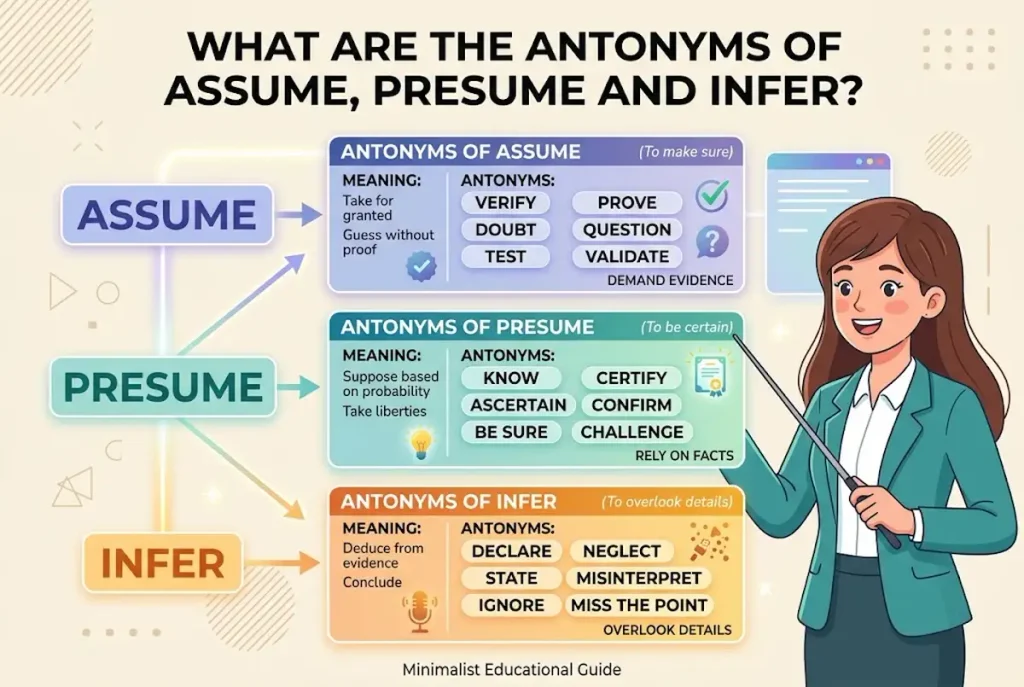
The exact opposite depends on the context.
| Word | Possible opposite | Example |
|---|---|---|
| Assume | Verify | Don’t assume it. Verify it. |
| Assume | Confirm | I won’t assume the date. I’ll confirm it. |
| Presume | Doubt | She presumed it was safe, but others doubted it. |
| Presume | Question | We should question the presumption. |
| Infer | Observe directly | We don’t need to infer the answer because we can observe it. |
| Infer | Know directly | I don’t have to infer his name because he introduced himself. |
| Infer | Verify | We inferred the cause first, then verified it. |
There isn’t one perfect antonym for all three words. The opposite of making a conclusion may be obtaining direct confirmation.
Why does this distinction matter?
Choosing the right word can change how readers understand your level of certainty.
Compare:
I assumed the data was accurate.
This tells readers that you accepted the data without full confirmation.
I presumed the data was accurate.
This suggests that there was a reasonable basis for trusting it.
I inferred that the data was accurate from the consistency of the results.
Now the sentence explains that evidence led to the conclusion.
These differences are especially useful in school writing, workplace communication, research, reports, and formal discussions.
They also help you avoid overstating what you know.
If you’re not sure, don’t make your sentence sound certain. If you have evidence, explain that evidence.
Final tips for choosing the right word
Remember these three short formulas.
Assume = accept without confirmation.
Presume = believe with reasonable grounds.
Infer = conclude from evidence.
Keep another distinction in mind:
Writer or speaker implies. Reader or listener infers.
And don’t feel that presume is always better than assume. It isn’t. Don’t choose infer just because it sounds academic. Choose the word that accurately describes your reasoning.
For casual conversation, simple words such as think, guess, and figure out are often better.
For academic and analytical writing, infer and inference can be useful when you are discussing conclusions supported by evidence.
Confirm important facts instead of presenting guesses as certainty.
Conclusion
The main difference in Assume vs Presume vs Infer comes down to how a belief is formed. You assume something when you accept it as true without complete confirmation. You presume something when you believe it is probably true based on reasonable grounds.
Think of the three words as different steps in reasoning. Assume starts with acceptance. Presume adds a reasonable basis. Infer starts with evidence and moves toward a conclusion.
Once you notice that difference, these words become much easier to use. When you’re writing, ask yourself one simple question: Am I accepting, reasonably expecting, or concluding from evidence? Your answer will usually point you to the right word.
Frequently Asked Questions
Is assume stronger than presume?
No, assume and presume are close in meaning, but presume often suggests that there is a reasonable basis for the belief.
What is the difference between infer and assume?
Assume means accepting something as true without complete confirmation, while infer means reaching a conclusion from evidence or clues.
Can I use presume instead of assume?
Sometimes, yes. The words overlap, but presume often sounds more formal and can suggest that the belief has reasonable grounds.
Is infer the same as guess?
No. Infer usually involves evidence or clues, while a guess can be made without much evidence.
What’s another way to say assume?
Other choices include suppose, guess, believe, expect, take for granted, or presume, depending on the context and level of certainty.
Is it correct to say I inferred that?
Yes. I inferred that is correct when you reached a conclusion from information, evidence, or clues.
Which is correct for academic writing: assume or infer?
Both can be correct. Use assume for an accepted or unconfirmed idea and infer when describing a conclusion drawn from evidence.
Are assume presume and infer interchangeable?
No. They can overlap in some contexts, but they describe different kinds of belief and reasoning. Assume vs Presume vs Infer is mainly a question of how you arrive at the idea.

Daniel Grammarfield — The Language Learner
Age: 28Occupation: ESL Learner & Digital Professional
Bio:Daniel is a non-native English speaker who wants to communicate more confidently at work and online. He uses Synotrench to improve grammar, understand confusing words, learn correct sentence structures, and build everyday English skills. He prefers simple explanations with practical examples.
Goals:
Master English grammar rules
Avoid common language mistakes
Improve professional communication
Learn English through real-life examples
Quote:“Learning English is not about memorizing rules — it’s about expressing ideas clearly.”