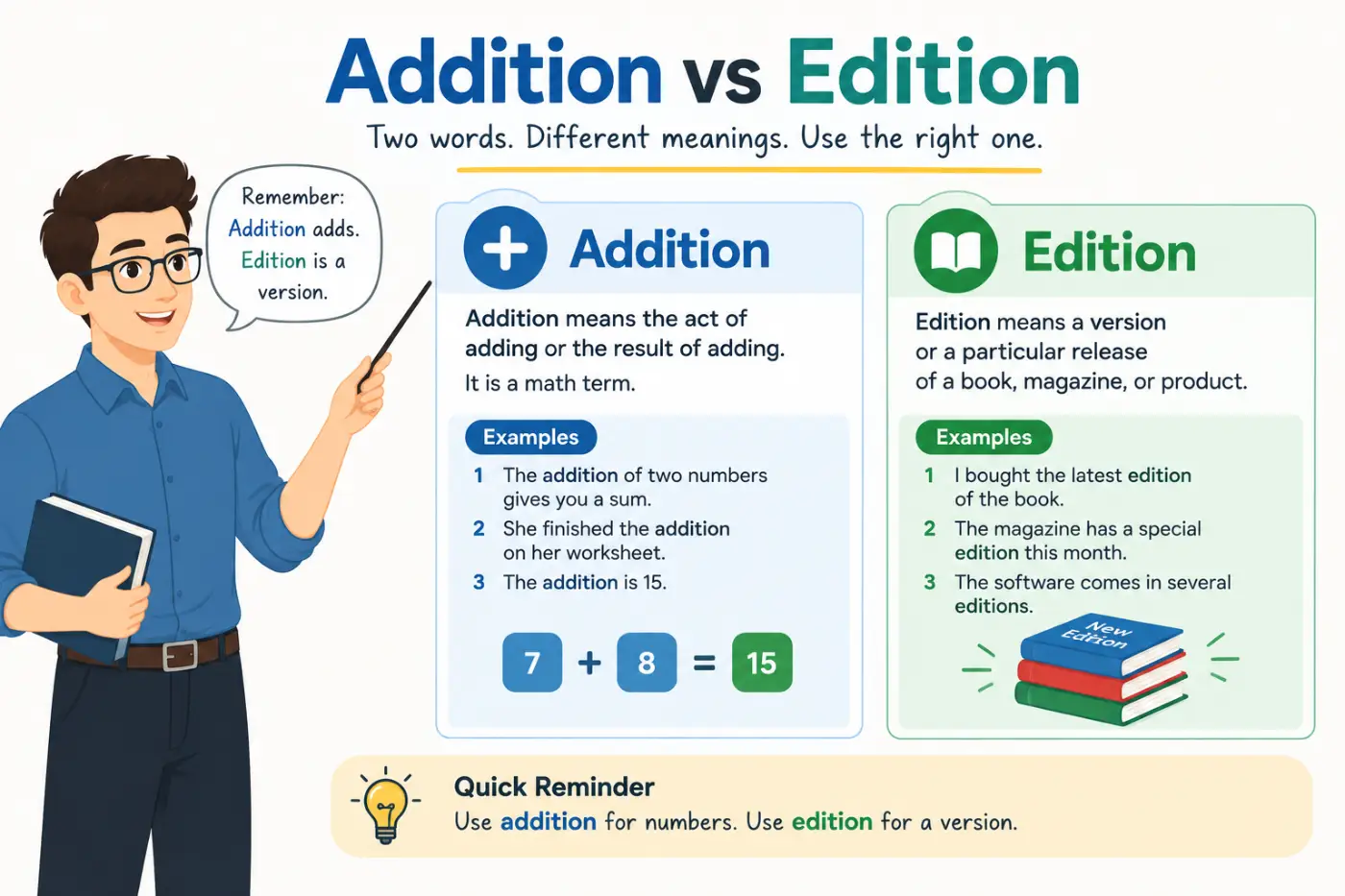
When you are writing an email, essay, resume, report, or text, you may stop at a word that sounds right but looks uncertain. Addition vs Edition is one of those confusing pairs. The two words sound somewhat similar, but they have different meanings and are used in different situations.
Addition usually means something that is added to something else. Edition usually means a particular version of a book, newspaper, magazine, product, or published work.
Knowing the difference can help you choose the right word quickly. You may need addition when you are talking about adding information, people, features, or objects. You may need edition when you are talking about a specific version of something that has been published or released.
In this guide, you will learn the meanings, origins, synonyms, differences, common mistakes, examples, regional notes, and the best word to use in emails, resumes, essays, texts, and everyday speech.
What is the difference between addition and edition?
The simple difference is that addition refers to something being added, while edition refers to a particular version of something that has been published, produced, or released.
Think of addition as adding something and edition as identifying a version.
For example:
The teacher made an addition to the lesson.
This means the teacher added something to the lesson.
The second edition of the textbook is available.
This means it is the second published version of the textbook.
The words are related in appearance, but they do not have the same job in a sentence. Replacing one with the other can change the meaning completely.
What does addition mean in plain English?
Addition is a noun that describes something added to an existing thing.
It can refer to a new person, object, idea, feature, section, amount, or piece of information.
For example:
The new paragraph is a useful addition to the essay.
The word addition tells us that something has been added.
It can also refer to the mathematical process of putting numbers together.
For example:
Five plus three is an addition problem.
Addition can also describe a new part of a building.
For example:
The school built an addition to the main building.
So, addition has several common meanings, but they all connect to the basic idea of adding something.
What are the main meanings of addition?
The word addition commonly has three meanings.
- Something that is added to something else.
Example:
The new chapter is a helpful addition to the book.
- The act or process of adding something.
Example:
The addition of more examples made the lesson clearer.
- The mathematical operation of combining numbers.
Example:
The student practiced addition before moving on to multiplication.
The central idea is always connected to adding or combining.
What does edition mean in plain English?
Edition is a noun that usually means a particular version of something that has been published, printed, produced, or released.
For example:
I bought the latest edition of the dictionary.
The newspaper published a special evening edition.
The third edition of the textbook contains updated information.
An edition may contain changes, corrections, new information, or a different design from an earlier version.
The important idea is version.
When you see the word edition, think about a particular release or version rather than something simply being added.
What are the main meanings of edition?
The word edition commonly refers to a particular version of a published or released work.
For example:
The first edition was published in 2010.
The latest edition includes two new chapters.
I have an older edition of the book.
The word can also describe a particular issue of a newspaper or magazine.
For example:
Did you read today’s edition of the newspaper?
In some contexts, edition can also refer to a particular version of an event or program.
For example:
This year’s edition of the festival attracted many visitors.
The common idea is that an edition is a distinct version or release.
Where did addition come from?
The word addition comes from Latin roots connected with the idea of adding or putting something toward something else. It entered English through French and became established as a word for adding something.
Its history matches its modern meaning.
When something is added to an existing thing, it becomes an addition.
That connection is useful because it gives you a simple memory clue.
Think:
Addition means add.
The spelling also gives you a helpful reminder. The beginning of addition contains the word add in a recognizable form.
Where did edition come from?
The word edition comes from Latin roots connected with publishing, giving out, or producing something. It developed through French before becoming part of English vocabulary.
That history connects closely with its modern meaning.
An edition is a particular version of something that has been produced or published.
Think:
Edition means version.
This memory trick is especially useful when you are deciding between the two words while writing.
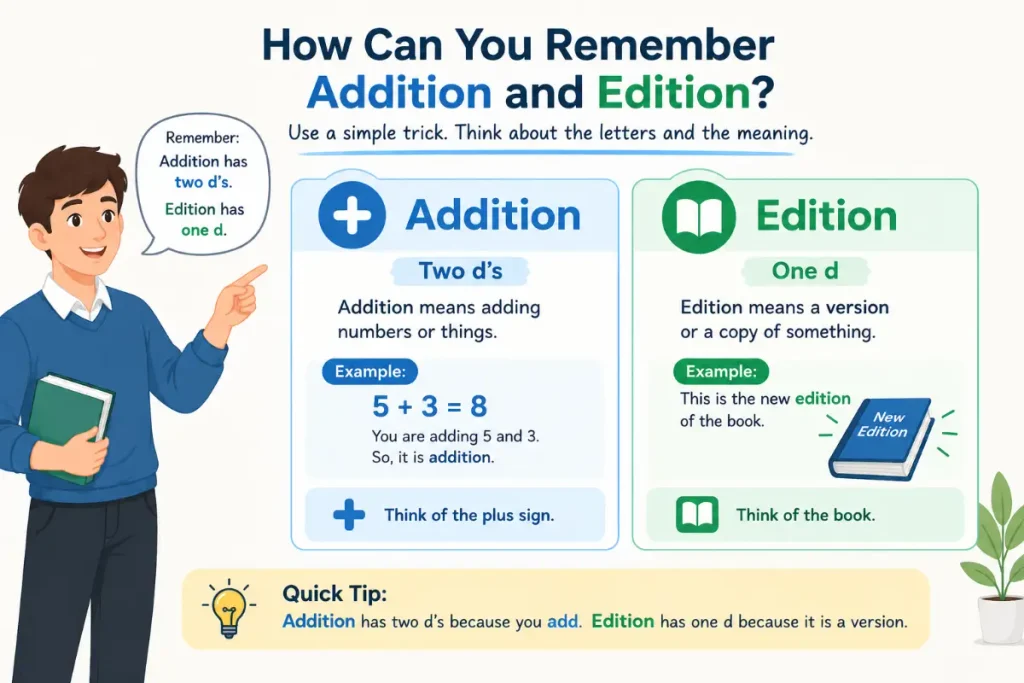
How can you remember addition and edition?
Use this simple rule:
Addition means something added. Edition means a particular version.
You can also connect each word with a familiar word.
Addition → add.
Edition → version.
For example:
The company made an addition to the product.
The company released a new edition of the product.
The first sentence focuses on something being added.
The second sentence focuses on a version being released.
That small difference makes the correct choice much easier.
Not every synonym can replace addition in every sentence. For example, bonus can describe something extra, but it does not normally replace addition in a mathematical sentence.
Context matters.
What are the synonyms for edition?
Edition has fewer direct synonyms because its meaning is more specific. Most alternatives describe a version, release, issue, or form of something.
| Word | Meaning | Tone | Example |
|---|---|---|---|
| Version | A particular form of something | Simple | I downloaded the latest version. |
| Release | Something made available to the public | Everyday | The new release came out today. |
| Issue | A particular publication | Everyday | I read the latest issue. |
| Printing | A particular production of a book | Neutral | This printing contains corrections. |
| Revision | A changed version | Formal | The revised version is clearer. |
| Variant | A different form | Formal | This is a regional variant. |
| Form | A particular type or form | Simple | Use the current form. |
| Copy | An individual example of a publication | Everyday | I bought a new copy. |
| Publication | A published work | Formal | The publication was released last year. |
| Release | A newly available version | Neutral | The software release fixed the problem. |
| Issue | A published installment | Neutral | The June issue has an interview. |
| Revision | A version changed from an earlier one | Formal | The latest revision fixes errors. |
The closest everyday replacement for edition is often version, but the two words are not always interchangeable.
Which synonyms are mild and which are strong?
Synonyms can also differ in intensity.
For ideas related to addition, you might organize words from a small change to a larger change.
Mild additions
These words suggest something small or limited.
- Extra.
- Add on.
- Bonus.
- Addition.
- Increment.
Example:
The teacher included an extra example.
Medium additions
These suggest a noticeable change.
- Increase.
- Extension.
- Improvement.
- Enhancement.
- Supplement.
Example:
The update included an important enhancement.
Strong additions or changes
These suggest a larger expansion.
- Expansion.
- Enlargement.
- Augmentation.
- Growth.
- Major extension.
Example:
The company announced a major expansion.
The best word depends on the size and type of change. Calling a small extra note a major expansion would sound exaggerated.
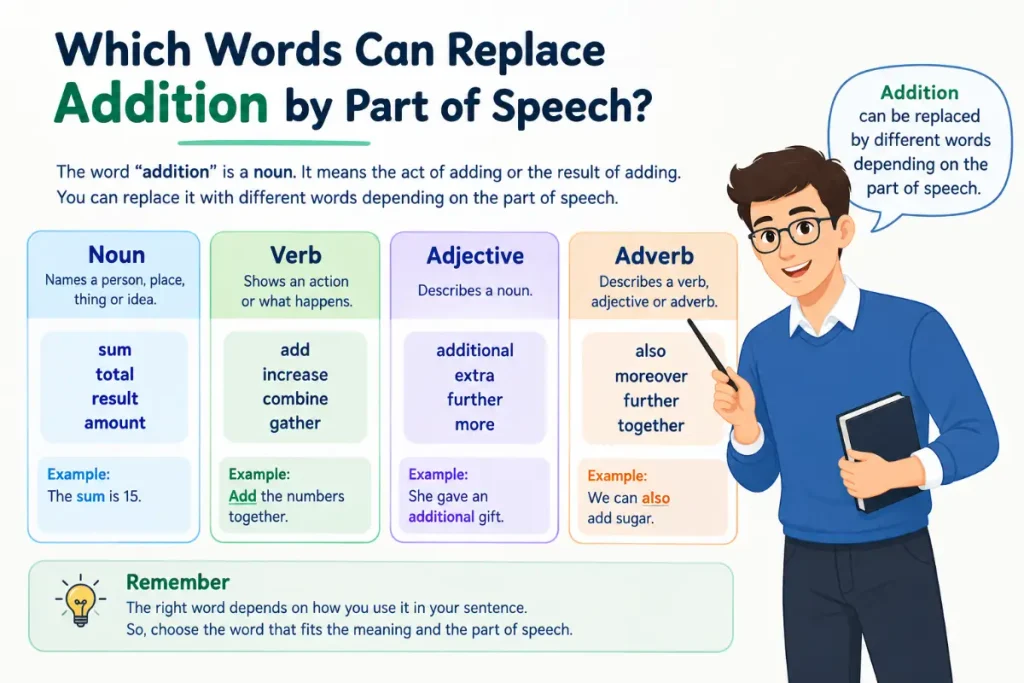
Which words can replace addition by part of speech?
Addition is mainly a noun. If you need a different part of speech, you may need to change the word.
| Part of speech | Word | Example |
|---|---|---|
| Noun | Addition | The addition helped the project. |
| Verb | Add | Please add your name. |
| Adjective | Additional | We need additional information. |
| Adverb | Additionally | Additionally, the report includes charts. |
| Noun | Increase | There was an increase in cost. |
| Verb | Increase | Costs may increase next year. |
| Adjective | Additional | We need additional examples. |
This is useful when editing an essay or professional document.
For example:
The addition of examples improved the article.
You could write:
Adding examples improved the article.
Or:
Additional examples improved the article.
The basic idea stays similar, but the grammar changes.
Is addition used differently in American and British English?
Addition is widely used in both American and British English with the same basic meanings.
There is no major US versus UK difference in the core meaning.
The same applies to edition.
Both American and British speakers use edition for books, newspapers, magazines, and other versions.
Some vocabulary choices can vary by region, but the difference between these two words is not mainly a regional issue.
For example, an American writer can say:
I bought the latest edition of the book.
A British writer can use the same sentence.
The important distinction remains meaning, not geography.
What word should you use in a resume?
In a resume, addition is useful when describing something you added or contributed.
For example:
I made several additions to the company’s training materials.
However, edition is usually used when you are discussing a specific version of a published work.
For example:
Contributed to the third edition of a professional training manual.
If you are describing your contribution to a project, words such as addition, improvement, enhancement, or contribution may be more natural.
If you are naming a particular book or published version, edition is usually the right choice.
What word should you use in an essay?
In an essay, addition is useful when discussing something added to an argument, explanation, paragraph, or collection of ideas.
Example:
The addition of historical evidence makes the argument stronger.
You can also use in addition as a transition.
Example:
In addition, the study provides useful evidence.
Edition is appropriate when you are identifying a particular version of a source.
Example:
The third edition of the textbook was published in 2024.
If you are writing about a source, check what you mean before choosing the word.
Are you talking about something added?
Use addition.
Are you identifying a particular version?
Use edition.
What word should you use in a text message?
In texting, addition is useful when talking about something extra.
Example:
The new photo is a great addition to the post.
Edition can be used when talking about a particular version.
Example:
I have the older edition of that book.
In casual texting, people often use simpler words such as extra or version.
For example:
Do you have the newer version?
That sounds natural in everyday conversation.
What word should you use in an email?
Both words can appear in professional emails, but they communicate different ideas.
Use addition when discussing something that has been added.
Example:
The new section is a useful addition to the report.
Use edition when discussing a specific version of a publication.
Example:
Please review the latest edition of the manual.
A simple email sentence might be:
I have made an addition to the document.
Another might be:
Please use the latest edition of the document.
The first focuses on a change.
The second focuses on a version.
What word should you use when speaking?
In everyday speech, addition is common when you are talking about something extra or newly added.
For example:
That’s a great addition to the team.
Edition is common when discussing books, newspapers, magazines, or versions.
For example:
I have the newest edition.
If you are unsure during conversation, think about the basic meaning.
Added thing means addition.
Specific version means edition.
What are some real examples of addition and edition?
Here are examples from different situations.
- The new employee is a valuable addition to the team.
- The restaurant made an addition to its menu.
- The teacher made an addition to the lesson plan.
- The new bedroom is an addition to the house.
- The addition of pictures made the presentation easier to understand.
- We need an addition to the current safety rules.
- The second edition of the novel contains corrected errors.
- I bought the latest edition of the dictionary.
- The newspaper published a special evening edition.
- The fourth edition includes several new chapters.
- This edition has a different cover.
- The company released a new edition of its annual report.
- The addition of another example made the explanation clearer.
- The software update was an important addition to the system.
- The newest edition of the guide contains updated information.
These examples show why the two words cannot normally be exchanged.
Addition vs Edition What is the key difference?
The key difference is simple.
| Addition | Edition |
|---|---|
| Something that is added | A particular version |
| Connected with adding | Connected with publishing or releasing |
| Can describe a new part | Can describe a new version |
| Used in mathematics | Used with books and publications |
| Often means extra material | Often means a specific release |
| Example: an addition to a report | Example: the second edition of a report |
A useful test is to replace the word with extra or version.
If extra makes sense, you probably need addition.
If version makes sense, you probably need edition.
For example:
The new chapter is an addition to the book.
The third edition of the book is now available.
The first sentence means something was added.
The second identifies a particular version.
Addition vs Supplement What is the difference?
Addition and supplement can be close in meaning, but they are not always identical.
An addition is something added to an existing thing.
A supplement is usually extra material provided to complete or support something.
Compare these sentences:
The new paragraph is an addition to the article.
The magazine included a health supplement.
The paragraph simply becomes part of the article.
The supplement is an extra section or publication that provides additional material.
A supplement often has a supporting role.
Edition vs Version What is the difference?
Edition and version are closely related, but version is broader.
A version can describe almost any form of something.
For example:
The latest version of the software.
The latest version of the plan.
Edition is more strongly connected with published works, issues, releases, or particular forms of a product.
For example:
The second edition of the textbook.
The Sunday edition of the newspaper.
So, version is usually broader, while edition is more specific in many publishing contexts.
Addition vs Extension What is the difference?
Addition means something has been added.
Extension often means something has been made longer, larger, or continued.
Compare:
The new room is an addition to the house.
The company gave us an extension on the deadline.
The room is a new part of the building.
The extension gives extra time.
These words overlap in some situations, but their focus is different.
An addition adds something.
An extension lengthens or continues something.
What are the common mistakes with addition and edition?
One common mistake is using edition when you mean something has been added.
Incorrect:
The new paragraph is an edition to the essay.
Correct:
The new paragraph is an addition to the essay.
Another mistake is using addition when talking about a particular published version.
Incorrect:
I bought the third addition of the textbook.
Correct:
I bought the third edition of the textbook.
This mistake is common because the two words look and sound similar.
The meanings are still different.
When should you not use addition?
Do not use addition when you are clearly naming a particular published version.
For example:
I need the latest edition of the textbook.
Not:
I need the latest addition of the textbook.
Also, do not use addition when another word gives a more exact meaning.
For example, if you mean that a deadline was made longer, extension may be more accurate.
If you mean that a product was improved, enhancement may be more precise.
Choosing the most exact word makes your writing clearer.
When should you not use edition?
Do not use edition simply because something is new.
A new feature is not automatically an edition.
For example:
The new search tool is an addition to the website.
Calling the search tool an edition would suggest that it is a separate version of the entire website or product.
Likewise, a new paragraph is normally an addition, not an edition.
Use edition when the idea of a particular version or release is important.
What are the antonyms of addition?
The opposite of addition depends on the meaning.
For adding something, possible opposites include:
- Removal.
- Subtraction.
- Deletion.
- Deduction.
- Reduction.
- Elimination.
- Omission.
For example:
The addition of a paragraph made the essay longer.
The deletion of a paragraph made the essay shorter.
In mathematics, subtraction is the clearest opposite of addition.
In editing, deletion or removal may be more appropriate.
What are the antonyms of edition?
Edition does not have one perfect direct antonym.
Depending on the context, you might contrast it with:
- Original.
- Earlier version.
- Draft.
- Unpublished copy.
- Previous release.
For example:
The final edition differs from the original draft.
These are contextual opposites rather than exact dictionary antonyms.
How can you choose the right word quickly?
Use these simple questions.
Are you talking about something added?
Choose addition.
Example:
The new chart is an addition to the report.
Are you talking about a particular version?
Choose edition.
Example:
I have the second edition of the report.
Are you talking about mathematics?
Choose addition.
Example:
The students practiced addition.
Are you talking about a book?
Check the meaning.
If something was added to the book, use addition.
If you mean a particular published version, use edition.
Are you talking about a newspaper or magazine?
A particular issue or release can be called an edition.
Example:
The morning edition is already available.
Are you talking about a new feature?
Usually use addition.
Example:
The dark mode feature is a useful addition.
Are you talking about software?
Version is often the most natural word.
Example:
Download the latest version.
What is the easiest memory trick?
Remember two words:
Add means addition.
Version means edition.
If you can connect the sentence to the idea of adding something, choose addition.
If you can replace the word with version, edition may be correct.
For example:
The new feature is an addition.
The new release is a new edition.
This trick will not solve every unusual use, but it works well for everyday writing.
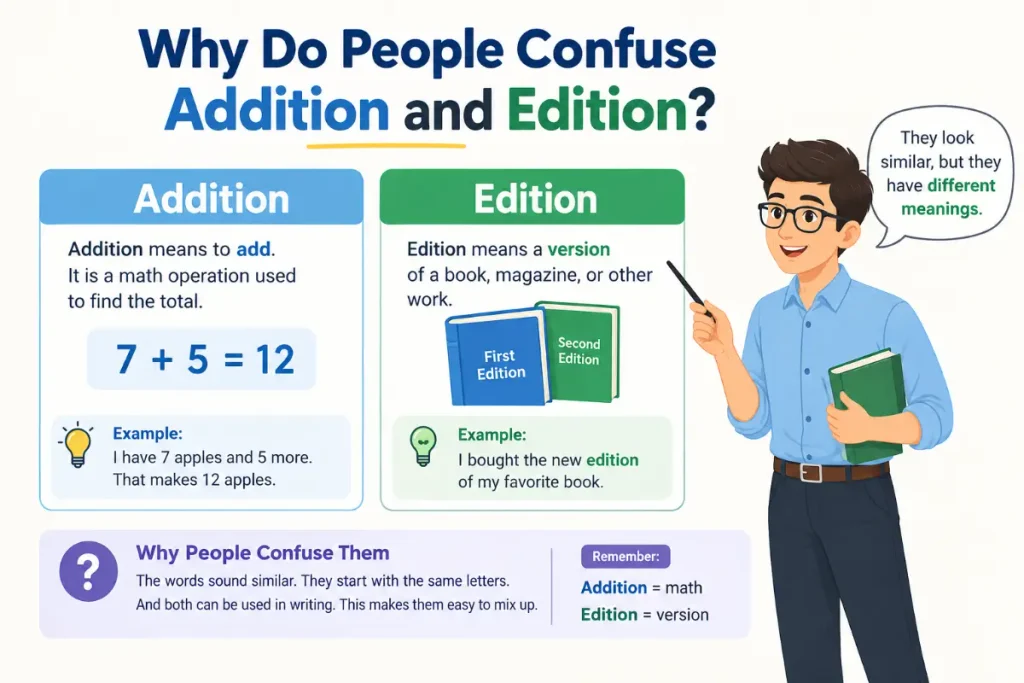
Why do people confuse addition and edition?
The main reason is that the words look and sound similar.
Both can appear in discussions about books, documents, products, and other objects.
But their meanings developed around different ideas.
Addition is connected to adding.
Edition is connected to a particular produced or published version.
The spelling difference is small, but the meaning difference is important.
That is why proofreading matters.
A single letter can change the meaning of your sentence.
Conclusion
The difference between addition vs edition becomes clear when you focus on the main idea behind each word. Addition is connected with adding something, increasing something, or including something extra. Edition is connected with a particular version or release, especially for books, newspapers, magazines, and other published works.
Use addition when you are talking about a new part, feature, idea, or amount. Use edition when you are identifying a specific version. If you are still unsure, try replacing the word with extra or version. That quick test often reveals the correct choice.
Once you connect addition with adding and edition with versions, this commonly confused pair becomes much easier to use accurately.
Frequently Asked Questions
What is the difference between addition and edition?
Addition means something that is added, while edition means a particular version of something published or released.
Is it the first addition or the first edition?
It is usually the first edition when you mean the first published version of a book, magazine, or similar work.
Is addition or edition correct for a book?
Both can be correct, but they mean different things. A new part added to a book is an addition, while a particular published version is an edition.
What’s another way to say addition?
You can say extra, increase, supplement, extension, enhancement, expansion, or addition depending on the context.
Can edition mean version?
Yes. Edition can mean a particular version of a book, publication, product, or other released work.
Is addition used in mathematics?
Yes. Addition is one of the basic mathematical operations used to combine numbers.
How do I remember addition vs edition?
Think of add when you see addition and version when you see edition. This simple connection can help you choose the correct word.

Daniel Grammarfield — The Language Learner
Age: 28Occupation: ESL Learner & Digital Professional
Bio:Daniel is a non-native English speaker who wants to communicate more confidently at work and online. He uses Synotrench to improve grammar, understand confusing words, learn correct sentence structures, and build everyday English skills. He prefers simple explanations with practical examples.
Goals:
Master English grammar rules
Avoid common language mistakes
Improve professional communication
Learn English through real-life examples
Quote:“Learning English is not about memorizing rules — it’s about expressing ideas clearly.”
3 thoughts on “Addition vs Edition Best Simple Guide (2026)”