Have you ever stopped while writing might vs would an email or text because you weren’t sure if you should use might or would? Both words help us talk about situations that are not happening right now. However, they don’t express exactly the same idea. Choosing the wrong one can change the meaning of your sentence.
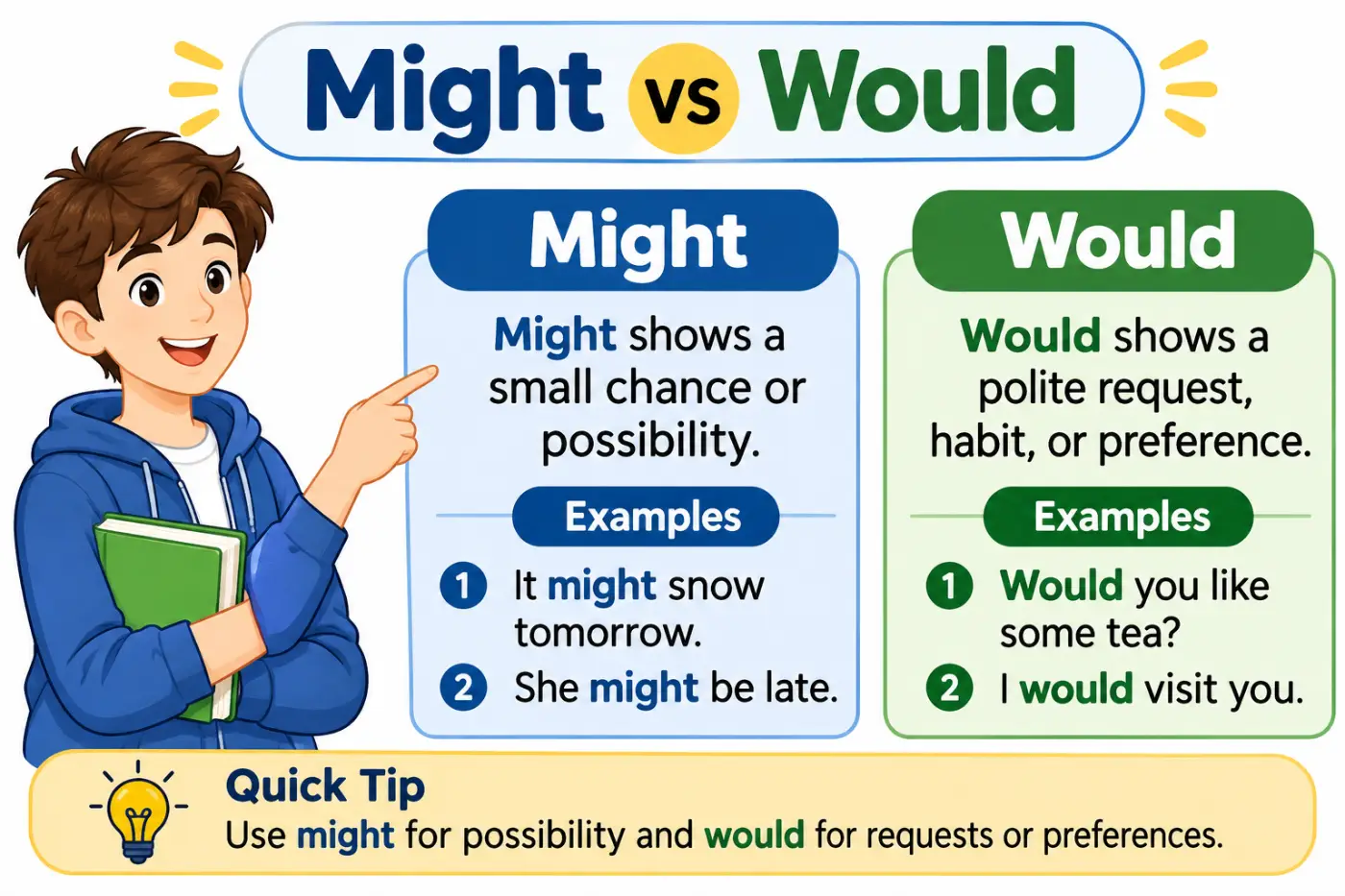
The main difference between might and would is that might expresses possibility, while would usually expresses an imagined result, a willingness, a preference, or a polite request. The right choice depends on what you want to communicate.
Both words are common in everyday American English. You will find them in conversations, school assignments, professional emails, stories, and formal writing. This guide explains their meanings, origins, differences, synonyms, common mistakes, and practical uses through simple explanations and real-life examples.
What Do Might and Would Mean?
Might and would are modal auxiliary verbs. They work with main verbs to express ideas such as possibility, intention, willingness, imagined situations, and polite communication.
Although they sometimes appear in similar sentences, their meanings are different.
What Does Might Mean?
Might expresses possibility or uncertainty. It tells someone that something could happen, but the speaker isn’t completely sure.
Examples:
- I might go shopping after work.
- She might call you this evening.
- It might rain tomorrow.
What Does Would Mean?
Would expresses imagined situations, expected results, willingness, preferences, habits in the past, and polite requests.
Examples:
- I would travel more if I had enough money.
- She would help you if she were available.
- I would like a glass of water.
What Is the Main Difference?
| Might | Would |
|---|---|
| Expresses possibility. | Expresses an imagined result or intention. |
| Shows uncertainty. | Often describes a conditional situation. |
| Suggests something could happen. | Describes what someone would do or prefer. |
| Can introduce a gentle suggestion. | Can make requests more polite. |
| Example: I might join you. | Example: I would join you if I were free. |
Where Did Might and Would Come From?
Understanding the history of these words makes their modern meanings easier to remember.
What Is the Origin of Might?
Might comes from Old English miht or meaht, which was connected to the idea of power, strength, and ability. It developed as the past-tense form of may.
Over time, English speakers began using might to express possibility and uncertainty. Today, it commonly describes something that could happen.
For example:
- He might become a doctor.
- They might arrive before noon.
- This change might improve the results.
What Is the Origin of Would?
Would comes from Old English wolde, the past form of willan, meaning to wish, want, or intend.
As English developed, would gained several grammatical functions. It became useful for discussing imagined situations, polite requests, future actions viewed from the past, and repeated past habits.
Examples:
- I would buy that car if I had enough money.
- She said she would visit us.
- When we were children, we would play outside every evening.
When Should You Use Might Instead of Would?
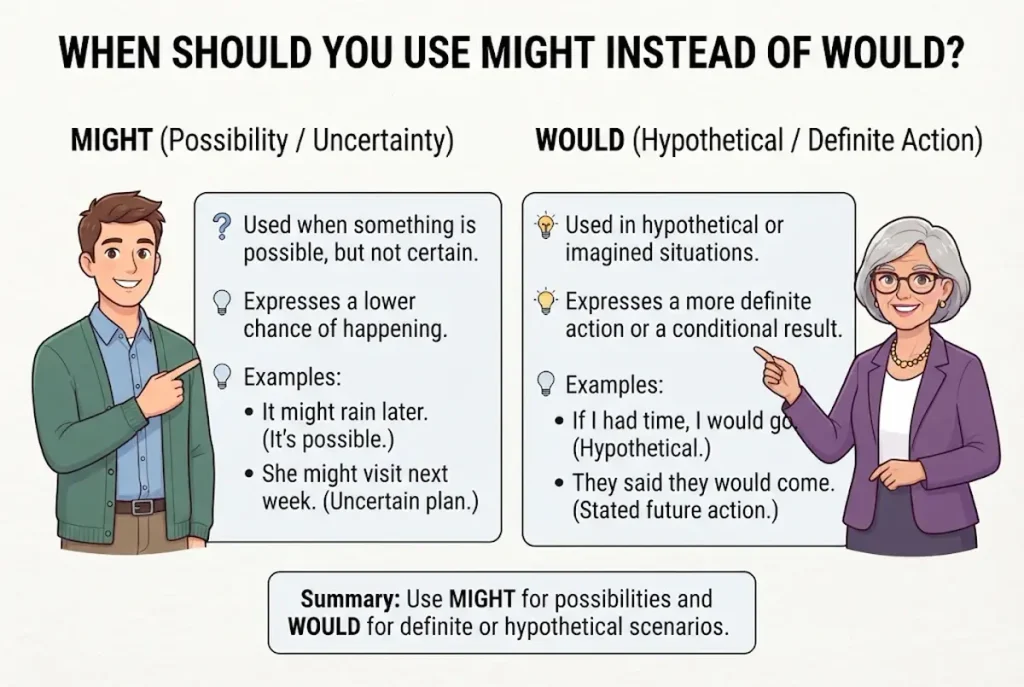
Use might when your main purpose is to communicate that something is possible but not guaranteed.
Here are the most useful situations.
1. When You Are Unsure About Something
Might is appropriate when you don’t know exactly what will happen.
Examples:
- I might attend the meeting tomorrow.
- My brother might come home this weekend.
- The teacher might give us another assignment.
2. When Something Could Happen in the Future
Use might when discussing a possible future event.
Examples:
- The company might open a new office next year.
- Our team might win the competition.
- She might move to another city.
3. When Giving a Gentle Suggestion
Might can make advice sound less forceful.
Examples:
- You might want to check your spelling.
- You might consider applying for another position.
- We might try a different approach.
When Should You Use Would Instead of Might?
Use would when you want to describe an imagined action, a conditional result, a preference, or a polite request.
1. When Describing an Imagined Situation
Would often appears in sentences about situations that aren’t currently real.
Examples:
- I would live near the beach if I could afford it.
- She would travel around the world if she had more money.
- He would study medicine if he enjoyed science.
2. When Expressing a Conditional Result
Would commonly appears in the result part of a second conditional sentence.
Examples:
- If I had a car, I would drive to work.
- If she studied harder, she would get better grades.
- If we left earlier, we would reach the airport on time.
3. When Making a Polite Request
Would helps make questions sound respectful and less direct.
Examples:
- Would you help me with this assignment?
- Would you please send the document?
- Would you mind opening the window?
Might vs Would in Different Types of Writing
The best word depends on your purpose and the situation. A sentence that sounds natural in a text message might need a more professional structure in a business email.
Here is how to choose the right expression in different situations.
Which Word Is Better for a Resume?
Neither word is usually necessary when describing your professional experience, skills, or achievements. Resumes work best with direct and confident language.
Instead of writing:
- I might manage a team of employees.
- I would help improve company performance.
Use stronger and more specific statements:
- Managed a team of 12 employees.
- Improved company performance through better planning.
- Led daily operations and supported team development.
Which Word Should You Use in an Essay?
Both words are useful in academic writing, but they communicate different ideas.
Use might when discussing possible explanations, uncertain outcomes, or interpretations.
Examples:
- This discovery might change how scientists understand the disease.
- The results might suggest a connection between sleep and memory.
- A lack of communication might explain the problem.
Use would when explaining hypothetical situations or expected results.
Examples:
- More funding would improve educational facilities.
- This approach would reduce unnecessary expenses.
- The policy would benefit students from low-income families.
Which Word Sounds Better in Texting?
Both words are natural in text messages. Your choice depends on the message.
Use might when you’re unsure about your plans.
Examples:
- I might come over later.
- We might watch a movie tonight.
- I might call you after dinner.
Use would when expressing preferences or imagined actions.
Examples:
- I would love to see you.
- I would go if I had time.
- Would you like to hang out?
For casual communication, both expressions are perfectly normal.
What Are the Best Synonyms for Might and Would?
Might and would have several related expressions, but their synonyms depend on the meaning of the sentence.
For example, possible, perhaps, and possibly can communicate uncertainty. Prefer, wish, and choose can express preferences. Agree, volunteer, and offer can communicate willingness.
The following table groups useful alternatives by tone and gives examples of their natural use.
What Are Simple Alternatives for Expressing Possibility?
| Word | Meaning | Tone | Example |
|---|---|---|---|
| Could | Something is possible. | Simple | It could rain today. |
| May | Something is possible. | Neutral | She may arrive late. |
| Perhaps | Possibly or maybe. | Simple | Perhaps he is busy. |
| Maybe | Something is possible. | Casual | Maybe we can meet tomorrow. |
| Possibly | Something could happen. | Neutral | We could possibly finish early. |
| Potentially | Something has the ability to happen. | Formal | The plan could potentially succeed. |
| Conceivably | Something is imaginable. | Formal | This change could conceivably help. |
What Are Everyday Alternatives for Expressing Preferences?
| Word | Meaning | Tone | Example |
|---|---|---|---|
| Prefer | Like one option more. | Neutral | I prefer to stay home. |
| Like | Enjoy or want something. | Simple | I would like some water. |
| Want | Desire something. | Direct | I want to join the team. |
| Wish | Desire something different. | Neutral | I wish I could travel. |
| Choose | Select an option. | Neutral | I would choose the blue one. |
| Rather | Prefer one option. | Everyday | I would rather walk. |
| Hope | Want something to happen. | Neutral | I hope we can meet soon. |
Are Formal Alternatives for Expressing Willingness?
| Word | Meaning | Tone | Example |
|---|---|---|---|
| Agree | Accept a proposal. | Formal | I would agree with that decision. |
| Consent | Give permission. | Formal | They would consent to the changes. |
| Accept | Receive or approve something. | Neutral | We would accept the offer. |
| Volunteer | Offer to do something. | Neutral | She would volunteer to help. |
| Offer | Make something available. | Neutral | I would offer my assistance. |
| Be willing | Show readiness. | Formal | I would be willing to participate. |
| Intend | Plan to do something. | Formal | I would intend to finish early. |
Which Synonyms Are Stronger or Weaker?
The strength of an expression depends on how certain, direct, or committed the speaker sounds.
What Are Mild Alternatives for Possibility?
These words communicate a small degree of certainty or leave the outcome open.
- Perhaps: Perhaps she will visit us.
- Maybe: Maybe we can finish today.
- Possibly: We could possibly meet tomorrow.
What Are Moderate Alternatives for Possibility?
These expressions suggest that something is reasonably possible.
- Could: This could solve the problem.
- May: The package may arrive tomorrow.
- Likely: The results are likely to improve.
What Are Strong Alternatives for Willingness or Preference?
These words communicate a clearer intention, preference, or commitment.
- Prefer: I prefer the second option.
- Intend: I intend to complete the task.
- Plan: I plan to visit next week.
Can Might and Would Be Used With Different Parts of Speech?
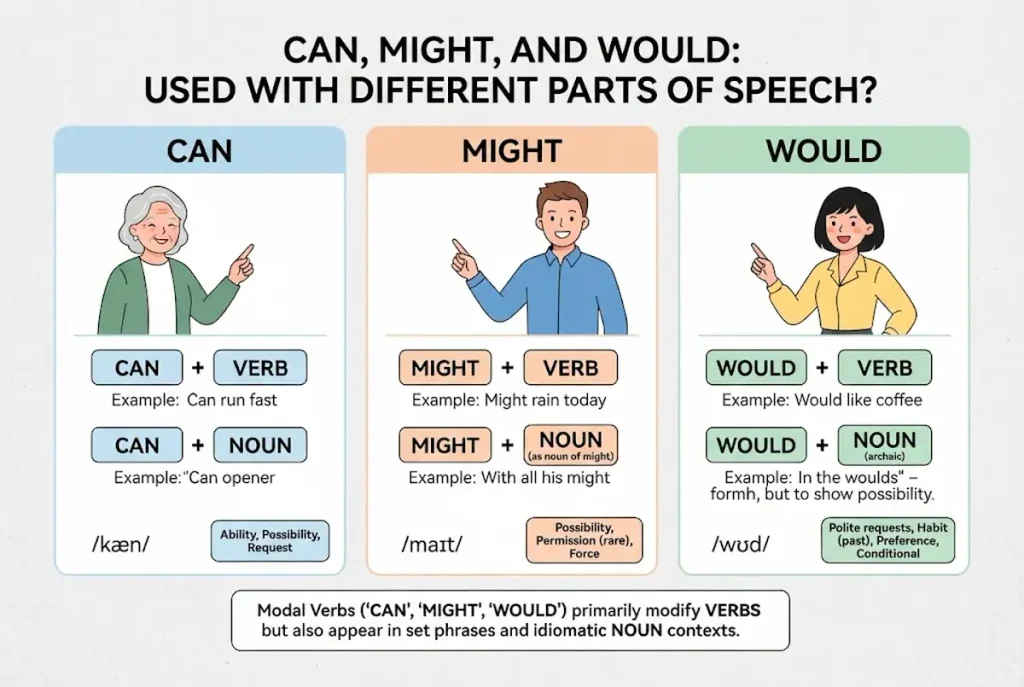
Might and would are modal auxiliary verbs. They don’t function as ordinary nouns or adjectives.
However, their related expressions can belong to different parts of speech.
What Are Related Verbs?
Some useful verbs include:
- May: Expresses permission or possibility.
- Could: Expresses ability or possibility.
- Prefer: Expresses a choice.
- Wish: Expresses a desire.
- Hope: Expresses a desired outcome.
- Intend: Expresses a plan.
What Are Related Adverbs?
Adverbs can communicate different levels of possibility.
Examples include:
- Maybe.
- Perhaps.
- Possibly.
- Probably.
- Certainly.
- Definitely.
What Are Related Nouns?
Some nouns describe the ideas associated with these modal verbs.
Examples include:
- Possibility.
- Probability.
- Preference.
- Intention.
- Willingness.
- Desire.
Are There Differences Between American and British English?
Might and would are used in both American and British English. Their basic grammatical meanings remain the same.
However, some expressions and conversational preferences can vary.
How Do Americans Use Might?
American English speakers commonly use might to discuss possible future events, uncertain plans, and suggestions.
Examples:
- I might stop by later.
- We might need another meeting.
- You might want to check that email.
How Do British Speakers Use Might?
British English also uses might to express possibility and make suggestions.
Examples:
- I might pop round later.
- We might need to leave early.
- You might want to have a look.
How Do Americans Use Would?
American speakers frequently use would in polite requests, preferences, and conditional statements.
Examples:
- Would you mind helping me?
- I would love to visit California.
- I would buy it if I had enough money.
What Is the Difference Between Could and Might?
Could and might both express possibility, so people sometimes use them in similar situations. However, they can communicate different shades of meaning.
| Could | Might |
|---|---|
| Expresses possibility or ability. | Mainly expresses possibility. |
| Can describe something someone is able to do. | Can describe something that may happen. |
| Often relates to available options. | Often emphasizes uncertainty. |
What Is the Difference Between May and Might?
May and might are closely related. Both can express possibility, but they can sound slightly different depending on the situation.
| May | Might |
|---|---|
| Often expresses possibility. | Often expresses a more uncertain possibility. |
| Can express formal permission. | Can express a gentle suggestion. |
| Common in formal and everyday writing. | Common in everyday conversation and writing. |
What Are Some Original Examples in Real-Life Situations?
The easiest way to understand modal verbs is to see how people use them in normal situations.
Here are examples from school, work, family life, travel, and everyday conversations.
What Are Examples in Everyday Life?
- I might cook dinner at home tonight because I don’t feel like eating outside.
- My sister might visit us during the summer vacation.
- We might watch a movie after finishing our homework.
- I would buy that phone if it were less expensive.
- He would rather spend the weekend with his family.
Are Examples in School and Education?
- The teacher might give us a surprise test tomorrow.
- I would study harder if I wanted to improve my grades.
- This explanation might help students understand the lesson.
- She would become a great teacher because she enjoys helping others.
What Are Examples in Business and Professional Situations?
- The manager might postpone the meeting until Monday.
- I would appreciate your assistance with this project.
- Our company might introduce a new service next month.
- We would complete the project earlier if we had more employees.
Are Examples in Travel and Planning?
- We might visit New York during our next vacation.
- I would travel around Europe if I had enough savings.
What Are Common Mistakes When Using These Words?
Even fluent English speakers sometimes confuse these modal verbs. Most mistakes happen because people focus on the sentence structure instead of its meaning.
Mistake 1: Using Would for Every Possible Future Event
Incorrect:
I would visit my parents tomorrow.
This sentence sounds incomplete if you simply want to express an uncertain plan.
Better:
I might visit my parents tomorrow.
The second sentence clearly communicates that a visit is possible.
However, the original sentence can be correct when the context supplies a condition.
For example:
I would visit my parents tomorrow if I didn’t have to work.
Mistake 2: Using Might to Express a Definite Preference
Incorrect:
I might like a cup of coffee.
This sentence can be grammatical, but it sounds uncertain. It doesn’t clearly communicate a normal preference.
Better:
I would like a cup of coffee.
This is a natural and polite way to order a drink.
Mistake 3: Forgetting the Base Form of the Verb
Incorrect:
- She might goes to school.
- He would likes a new car.
- They might visited us.
Correct:
- She might go to school.
- He would like a new car.
- They might visit us.
Mistake 4: Adding To After a Modal Verb
Incorrect:
- I might to call you.
- She would to help us.
Correct:
- I might call you.
- She would help us.
Modal verbs such as might and would are followed directly by the base form of the verb.
There is one important exception involving certain expressions.
For example:
I would like to visit London.
Here, would is followed by like, and like takes to before the next verb.
Mistake 5: Confusing Possibility With a Conditional Result
Compare:
- I might buy a new laptop.
- I would buy a new laptop if I had enough money.
The first sentence expresses uncertainty about a possible purchase. The second describes a purchase that depends on a condition.
The sentences are both correct, but they communicate different situations.
When Should You Avoid Using These Words?
Although both words are useful, they aren’t always the best choice.
When You Need to Communicate Certainty
Avoid might when you need to make a definite statement.
Unclear:
I might submit the assignment by Friday.
Clearer:
I will submit the assignment by Friday.
The second sentence communicates a stronger commitment.
When You Need to Give a Direct Instruction
Would can make requests polite, but it isn’t necessary for every instruction.
For example:
Would you please close the door?
This is polite.
Please close the door.
This is direct and still respectful.
Choose the structure that fits the relationship and situation.
When You Need to Describe a Real Past Event
Neither word should replace the simple past tense when you are describing something that definitely happened.
Incorrect:
I might visited my grandmother yesterday.
Correct:
I visited my grandmother yesterday.
Might can still describe an uncertain past event when followed by have and a past participle.
Example:
I might have visited her last year.
This sentence suggests that the speaker isn’t completely sure.
What Are the Antonyms of Might and Would?
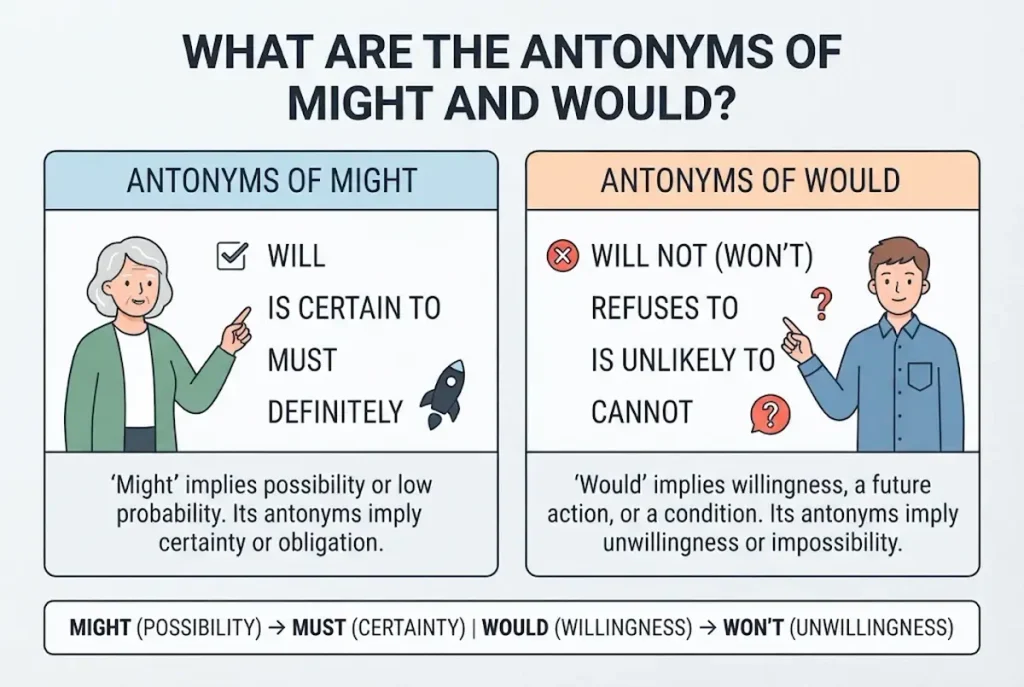
An antonym is a word with an opposite meaning. Since these are modal verbs with several uses, they don’t have one perfect opposite.
However, some words communicate contrasting ideas.
| Word | Related Opposite | Example |
|---|---|---|
| Might | Definitely | She might come. / She will definitely come. |
| Might | Certainly | He might agree. / He will certainly agree. |
| Would | Refuse | I would help. / I refuse to help. |
| Would | Decline | She would accept. / She would decline. |
| Would | Reject | They would approve. / They would reject it. |
These are contextual opposites rather than exact grammatical antonyms.
How Can You Choose the Right Word Every Time?
You don’t need to memorize complicated grammar rules to make the right choice. Start by identifying the message you want to communicate.
Follow these practical tips.
- Use might when you are talking about something that is possible but uncertain.
- Use would when describing an imagined situation or its result.
- Use might when offering a gentle suggestion.
- Use would like when expressing a polite preference or desire.
- Use would in polite questions and requests.
- Use might have when discussing an uncertain past event.
- Use would have when describing an imagined past result.
- Check the condition in your sentence before choosing a modal verb.
- Remember that both words are followed by the base form of the main verb.
- Read the complete sentence aloud to check that the meaning sounds natural.
Can You Test Your Understanding?
Choose the correct word in each sentence.
Grammar practice
0 of 5 answered
1. I _____ visit my uncle tomorrow, but I’m not sure.mightwould
2. I _____ buy that house if I had enough money.mightwould
3. _____ you please send me the report?MightWould
4. It _____ rain this evening.mightwould
5. I _____ like a glass of water.mightwould
Check answers
Might vs Would: How Can You Remember the Difference?
A simple way to remember the difference is to connect each word with its main purpose.
- Might = possibility.
- Would = imagined action or result.
- Might be = something is possibly true.
- Would be = something is imagined or conditional.
- Might like = possibly enjoy or want something.
- Would like = politely express a preference.
Compare these sentences:
| Sentence | What It Communicates |
|---|---|
| I might be late. | There is a possibility of being late. |
| I would be late if I missed the bus. | Being late depends on a condition. |
| She might help us. | Helping is possible. |
| She would help us if she had time. | Helping depends on having time. |
| I might like that movie. | I’m uncertain about liking it. |
| I would like that movie. | I expect to enjoy it or express a preference. |
The most useful habit is to identify the meaning before choosing the verb. This small step can prevent many common grammar mistakes.
Conclusion
Choosing between these two modal verbs becomes easier when you understand the message behind your sentence. Might is the better choice for uncertain events, possible explanations, and gentle suggestions. Would works best for imagined situations, conditional results, preferences, and polite requests.
Both words are important in everyday American English, and neither is automatically more formal or correct than the other. The key lesson in might vs would is to focus on possibility versus an imagined action or result.
Pay attention to the surrounding words, especially conditional phrases such as if I had more time. With regular practice, you’ll recognize the difference naturally and write clearer, more confident sentences.
Frequently Asked Questions
Can I Use Might and Would in the Same Sentence?
Yes, you can use both words in one sentence when they communicate different ideas.
For example: I might visit you if I would have enough time is not a natural standard conditional construction. A better sentence is: I might visit you if I have enough time.
Is Might More Polite Than Would?
Not necessarily. Might can make suggestions sound gentle, while would is commonly used for polite requests and offers.
For example, Would you help me? is a natural polite request.
Can Might and Would Express Possibility?
Might directly expresses possibility, while would usually describes an imagined or conditional result. The context determines the exact meaning.
Should I Use Might or Would for Future Plans?
Use might when a future plan is uncertain. Use would when describing an imagined plan or an action that depends on a condition.
For example, I might travel next month. I would travel if I had enough money.
What’s Another Way to Say Might or Would?
For might, you can use could, may, perhaps, or possibly. For would, you can use prefer, wish, intend, or be willing, depending on the sentence.
Is Would the Past Tense of Will?
Yes. Would is historically the past form of will. However, modern English also uses it for hypothetical situations, polite requests, preferences, and repeated past actions.
Can I Use Might Have and Would Have?
Yes. Might have expresses an uncertain past possibility, while would have often describes an imagined past result.
Examples:
- She might have forgotten the meeting.
- I would have helped you if I had known.
Do Might and Would Follow the Same Grammar Rules?
Yes. Both are modal auxiliary verbs and are followed by the base form of the main verb.
Examples:
- He might come tomorrow.
- He would come tomorrow if he were free.

Daniel Grammarfield — The Language Learner
Age: 28Occupation: ESL Learner & Digital Professional
Bio:Daniel is a non-native English speaker who wants to communicate more confidently at work and online. He uses Synotrench to improve grammar, understand confusing words, learn correct sentence structures, and build everyday English skills. He prefers simple explanations with practical examples.
Goals:
Master English grammar rules
Avoid common language mistakes
Improve professional communication
Learn English through real-life examples
Quote:“Learning English is not about memorizing rules — it’s about expressing ideas clearly.”
1 thought on “Might vs Would: The Ultimate Simple Guide (2026)”