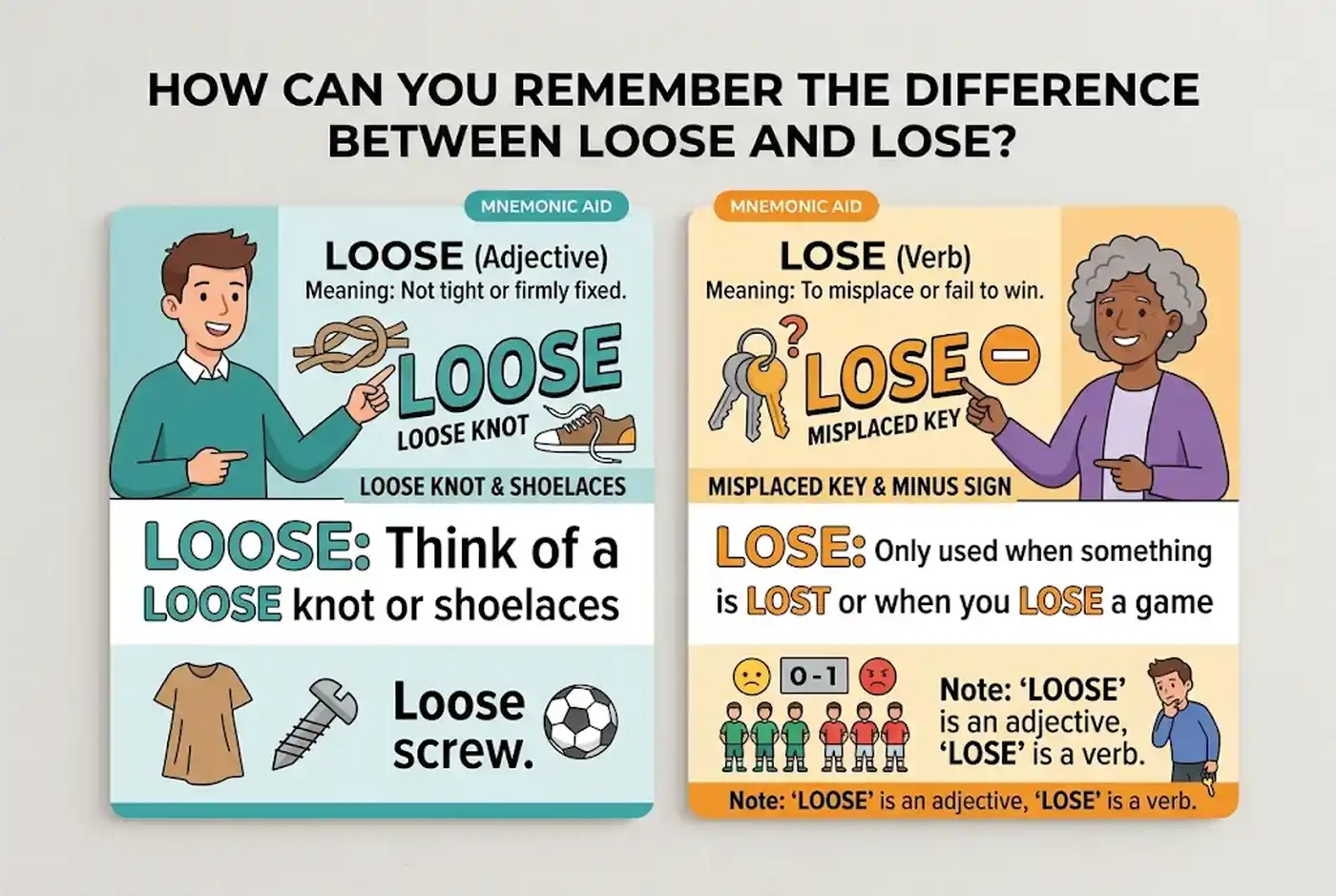
Have you ever written loose vs lose an email, school assignment, or text message and paused because you weren’t sure if you should write loose or lose? These two words look and sound similar, so it’s easy to mix them up. However, they have different meanings and uses.
Loose is an adjective that means not tight, not firmly attached, or free to move. Lose is a verb that means to misplace something, fail to keep it, or not win a game or competition.
The easiest way to remember the difference is this: loose describes something that is not tight, while lose describes the act of misplacing something or failing to keep it.
This guide explains their meanings, origins, correct usage, common synonyms, and differences in everyday American English. You’ll also find examples for emails, essays, resumes, and conversations so you can choose the right word with confidence.
What Is the Difference Between Loose vs Lose?
The main difference is their meaning and part of speech. Loose describes a condition, while lose describes an action or result.
| Word | Part of Speech | Meaning | Example |
|---|---|---|---|
| Loose | Adjective | Not tight, attached, or controlled | My shirt feels loose. |
| Loose | Verb | To release or set free | The farmer will loose the horses. |
| Lose | Verb | To misplace, fail to keep, or not win | Don’t lose your keys. |
When Should You Use Loose?
Use loose when you describe something that has room to move, is not tight, or is not firmly attached.
Examples:
- These shoes are too loose for my feet.
- A loose button fell off my jacket.
- The dog broke free from its loose leash.
When Should You Use Lose?
Use lose when you talk about misplacing something, failing to win, or no longer having something.
Examples:
- I don’t want to lose my wallet.
- Our team might lose the final match.
- You can lose weight through healthy habits.
What Are the Origins of These Words?
Understanding word origins can make spelling and meaning easier to remember. Although the two words look similar, they have different histories.
Where Did the Word Loose Come From?
Loose comes from the Old Norse word lauss, which meant free, unrestrained, or not tied. It entered English through older forms of the word and developed the meaning we use today.
Over time, loose came to describe things that were not firmly attached, tightly fitted, or held in place.
For example:
- A loose rope is not tightly secured.
- Loose clothing does not fit closely.
- Loose rules allow more freedom.
Where Did the Word Lose Come From?
Lose comes from the Old English word losian, which meant to perish, become lost, or be destroyed. Its meaning later developed to include misplacing something, failing to keep it, or not winning.
Today, people use lose in many situations.
For example:
- You lose your keys when you cannot find them.
- You lose a match when your opponent wins.
- You lose time when you wait too long.
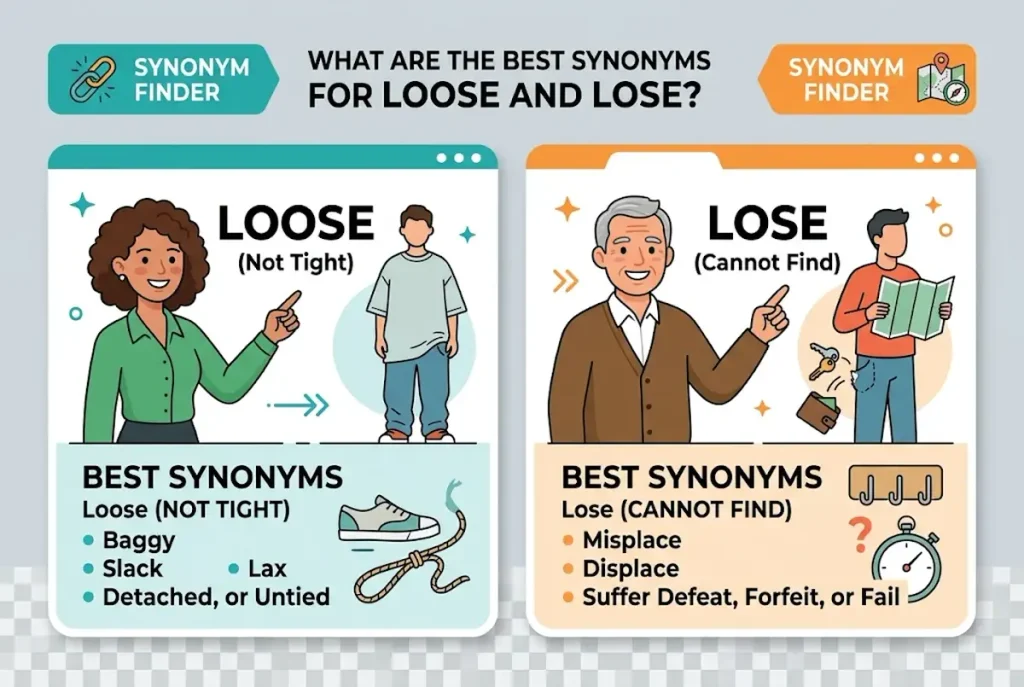
What Are the Best Synonyms for Loose and Lose?
Synonyms can help you express an idea more clearly. However, not every alternative works in every sentence. Choose a replacement based on the meaning you want to communicate.
The following tables group useful alternatives by tone and context.
What Are Common Synonyms for Loose?
These words can describe something that is not tight, firmly attached, or strictly controlled.
| Word | Meaning | Tone | Example |
|---|---|---|---|
| Free | Not restricted | Simple | The bird is free. |
| Open | Not closed or restricted | Simple | Keep the gate open. |
| Slack | Not tight or stretched | Everyday | The rope is slack. |
| Relaxed | Not strict or tense | Everyday | The rules are relaxed. |
| Baggy | Hanging loosely | Everyday | He wore baggy jeans. |
| Unfastened | Not secured | Everyday | The belt was unfastened. |
| Untied | Not tied together | Simple | My shoelaces are untied. |
| Unsecured | Not safely attached | Formal | The equipment was unsecured. |
| Unattached | Not connected | Formal | The cable is unattached. |
| Detached | Separated from something | Formal | A detached handle needs repair. |
| Unrestrained | Not held back | Formal | The crowd showed unrestrained excitement. |
| Unrestricted | Not limited | Formal | The program offers unrestricted access. |
| Lax | Not strict enough | Formal | The company had lax security. |
| Flexible | Able to change or bend | Everyday | We have a flexible schedule. |
| Casual | Not formal or strict | Everyday | The office has a casual dress code. |
| Loose-fitting | Not close to the body | Everyday | She prefers loose-fitting clothes. |
| Laid-back | Relaxed and informal | Slang | His teaching style is laid-back. |
| Free-flowing | Moving without restriction | Everyday | The event had a free-flowing schedule. |
| Unbuttoned | Not fastened with buttons | Everyday | His shirt was unbuttoned. |
| Unclasped | Not fastened with a clasp | Everyday | The necklace was unclasped. |
| Unbound | Not tied or restricted | Formal | The pages remained unbound. |
| Unconfined | Not kept within limits | Formal | The animals were unconfined. |
What Are Common Synonyms for Lose?
These alternatives can describe misplacing something, giving something up, or failing to win.
| Word | Meaning | Tone | Example |
|---|---|---|---|
| Misplace | Put something somewhere and forget where | Simple | I misplaced my glasses. |
| Forget | Fail to remember something | Simple | Don’t forget your password. |
| Drop | Let something fall | Everyday | He dropped his phone. |
| Miss | Fail to catch or reach something | Everyday | She missed the bus. |
| Forfeit | Give something up as a penalty | Formal | The team may forfeit the match. |
| Surrender | Stop resisting or fighting | Formal | The army had to surrender. |
| Relinquish | Give up possession or control | Formal | He relinquished his position. |
| Sacrifice | Give something up for a purpose | Everyday | She sacrificed her free time. |
| Waste | Use something carelessly | Everyday | Don’t waste your money. |
| Squander | Waste something valuable | Formal | He squandered his savings. |
| Miss out | Fail to experience an opportunity | Everyday | Don’t miss out on the event. |
| Fail | Not achieve a goal | Simple | We failed to reach our target. |
| Be defeated | Lose a contest or fight | Everyday | The team was defeated. |
| Be beaten | Lose against an opponent | Everyday | Our school was beaten in the final. |
| Relinquish control | Give up authority | Formal | The manager relinquished control. |
| Fall behind | Fail to keep up | Everyday | We fell behind in the race. |
| Let slip | Fail to hold or keep something | Everyday | He let the opportunity slip. |
| Blow | Waste or lose an opportunity | Slang | They blew their chance. |
| Take an L | Experience a loss | Slang | Our team took an L yesterday. |
| Come up short | Fail to reach a goal | Everyday | We came up short in the competition. |
Which Words Describe Loose From Mild to Strong?
The right synonym depends on how loose something is and what you want to describe.
Mild Descriptions
Use these words when something is slightly loose or has a little room to move.
- Relaxed: Not tight or strict.
- Flexible: Able to bend or change.
- Slightly slack: Not completely stretched.
- Casual: Informal or not strict.
- Loose-fitting: Designed to fit without being tight.
Moderate Descriptions
Use these words when something is clearly not tight or securely attached.
- Slack: Not pulled tight.
- Baggy: Hanging with extra space.
- Unfastened: Not properly secured.
- Detached: Separated from another object.
- Unsecured: Not firmly fixed in place.
Strong Descriptions
Use these words when something is completely free, uncontrolled, or not restricted.
- Unrestrained: Not held back.
- Unconfined: Not kept within limits.
- Unrestricted: Free from rules or limitations.
- Unbound: Not tied or controlled.
- Free-flowing: Moving without barriers.
Which Words Describe Lose From Mild to Strong?
The strength of a synonym for lose depends on the situation.
Mild Descriptions
These words describe small mistakes or missed chances.
- Misplace: Put something somewhere and forget its location.
- Forget: Fail to remember something.
- Miss: Fail to catch or reach something.
- Drop: Let something fall.
- Fall behind: Fail to keep up.
Moderate Descriptions
These words describe a more noticeable failure or loss.
- Waste: Use something without good results.
- Miss out: Fail to enjoy an opportunity.
- Come up short: Fail to reach a goal.
- Be beaten: Lose against another person or team.
- Let slip: Fail to keep something.
Strong Descriptions
Use these words when the loss involves giving up something important or suffering a major defeat.
- Surrender: Stop resisting.
- Forfeit: Lose something because of a rule or decision.
- Relinquish: Give up possession or control.
- Squander: Waste something valuable.
- Be defeated: Lose a serious contest or struggle.
What Part of Speech Do Loose and Lose Have?
The two words usually play different grammatical roles.
Is Loose an Adjective or a Verb?
Loose is mainly an adjective. It describes a person, object, or situation.
Examples:
- The screw is loose.
- She wore a loose sweater.
- The company has loose security rules.
Loose can also work as a verb, meaning to release or set free.
Example: The officer decided to loose the dogs.
It can also appear in the expression let loose, which means to allow someone or something to act freely.
Example: The children let loose their excitement after the final bell.
Is Lose a Verb or an Adjective?
Lose is a verb. It describes an action or change.
Examples:
- I don’t want to lose my phone.
- They may lose the game.
- We could lose valuable time.
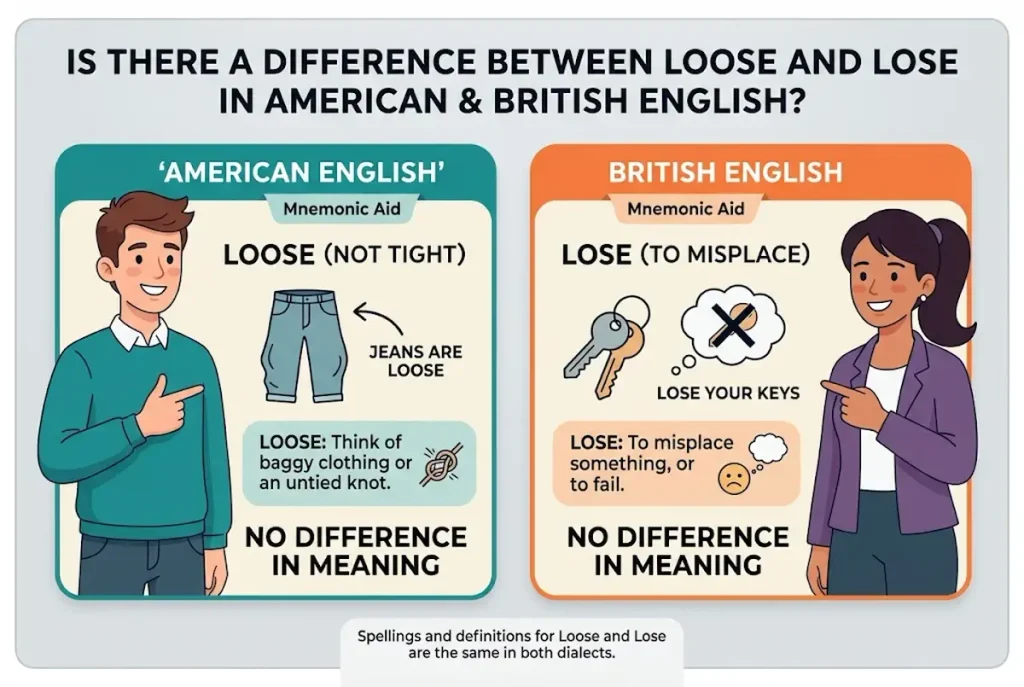
Is There a Difference Between Loose and Lose in American and British English?
No major spelling or meaning difference separates these words in American and British English. Both varieties use loose to mean not tight and lose to mean misplace or fail to win.
The spelling stays the same in both regions.
| Meaning | American English | British English |
|---|---|---|
| Not tight | Loose | Loose |
| Misplace something | Lose | Lose |
| Fail to win | Lose | Lose |
| Past tense of lose | Lost | Lost |
| Not firmly attached | Loose | Loose |
Which Word Should You Use in a Resume?
In a resume, choose lose when you describe a result, risk, or change. Use loose only when you need to describe something that is not tight or firmly controlled.
Examples:
- I helped the company avoid losing important clients.
- My team reduced the risk of losing valuable data.
- I developed a system that prevented the company from losing time.
Which Word Should You Use in an Essay?
Use loose when describing an object, rule, connection, or idea that is not tight or strict. Use lose when discussing failure, loss, or a missed opportunity.
Examples:
- The loose soil made it difficult for the plants to grow.
- Students can lose interest when lessons become repetitive.
- A loose interpretation of the rule created confusion.
Which Word Should You Use in Texting?
In text messages, the correct choice depends on what you mean. Use loose for something that is not tight and lose for something you might misplace or fail to keep.
Examples:
- My jeans are too loose.
- Don’t lose your phone.
- I think this bracelet is loose.
Which Word Should You Use in an Email?
Use loose when describing something that is not secure or strict. Use lose when explaining a possible loss, mistake, or missed result.
Examples:
- The loose cable may cause the system to stop working.
- We could lose important information if we don’t save the file.
- Please check the loose connection before the meeting.
Which Word Sounds Correct in Everyday Speaking?
Both words are common in everyday conversations. The correct one depends on the meaning.
Use loose when talking about clothing, objects, or rules.
Examples:
- These shoes are loose.
- Your watch strap looks loose.
- The lid is loose.
Use lose when talking about something you cannot find or something you fail to keep.
Examples:
- I always lose my pens.
- Don’t lose your ticket.
- We don’t want to lose this match.
What Are 12 Correct Example Sentences?
Looking at examples in different situations makes the distinction easier to understand.
| No. | Sentence | Correct Word | Why It Is Correct |
|---|---|---|---|
| 1 | My new jacket is too loose. | Loose | It describes the fit. |
| 2 | Don’t lose your house keys. | Lose | It means misplace. |
| 3 | One screw became loose. | Loose | It describes something not secure. |
| 4 | Our team could lose the final. | Lose | It means fail to win. |
| 5 | She prefers loose clothing. | Loose | It describes the fit of clothing. |
| 6 | I don’t want to lose my job. | Lose | It means fail to keep something. |
| 7 | The dog ran away because its collar was loose. | Loose | It describes a collar that was not tight. |
| 8 | We may lose power during the storm. | Lose | It means no longer have electricity. |
| 9 | The teacher gave us loose guidelines. | Loose | It describes rules that are not strict. |
| 10 | He worked hard to lose weight. | Lose | It describes a change in weight. |
| 11 | The handle feels loose. | Loose | It means the handle is not firmly attached. |
| 12 | Don’t lose confidence after one mistake. | Lose | It means stop having confidence. |
More Examples in Questions
These examples show how the words work in questions.
- Is this shirt too loose?
- Did you lose your wallet?
- Why is the handle so loose?
- Could our team lose the next game?
- Should I tighten this loose screw?
More Examples in Negative Sentences
- I don’t want to lose my place in line.
- The door isn’t loose anymore.
- She didn’t lose her notebook.
- These pants aren’t too loose.
- We must not lose focus during the exam.
Loose vs Slack: What’s the Difference?
Loose and slack can both describe something that is not tight. However, they are not always interchangeable.
Loose is a general word for something that is not tight, firmly attached, or controlled. Slack usually describes something that is not stretched or pulled tight.
| Loose | Slack |
|---|---|
| The screw is loose. | The rope is slack. |
| My shirt is loose. | The cable is slack. |
| The rules are loose. | The schedule is slack. |
Lose vs Misplace: What’s the Difference?
Lose and misplace can both describe something you cannot find. However, misplace has a narrower meaning.
Misplace means putting something somewhere and forgetting its location. Lose has a wider meaning. It can describe misplacing an object, failing to win, or no longer having something.
| Lose | Misplace |
|---|---|
| I lost my phone. | I misplaced my phone. |
| We lost the game. | We misplaced the game. |
| She lost her job. | She misplaced her job. |
What Are the Most Common Mistakes With These Words?
Many English learners and native speakers mix up these spellings. The following mistakes are common, but they’re easy to fix.
Writing Loose When You Mean Lose
Incorrect: I don’t want to loose my money.
Correct: I don’t want to lose my money.
The sentence describes the possibility of no longer having money. Therefore, lose is the correct verb.
Writing Lose When You Mean Loose
Incorrect: My shoes are too lose.
Correct: My shoes are too loose.
The sentence describes how the shoes fit. Since loose is an adjective, it is the right choice.
Using Loose as the Past Tense of Lose
Incorrect: I loose my keys yesterday.
Correct: I lost my keys yesterday.
The past tense of lose is lost, not loose or loosed.
Using Loosing Instead of Losing
Incorrect: Our team is loosing the match.
Correct: Our team is losing the match.
Losing is the present participle of lose. It describes an action happening now or around the present time.
Confusing Lose With Loss
Lose and loss are related, but they have different grammatical roles.
- Lose is a verb: I don’t want to lose my phone.
- Loss is a noun: The company reported a financial loss.
Don’t write I suffered a lose. The correct sentence is I suffered a loss.
Writing Looser When You Mean Loser
Looser means more loose or less tight.
Example: This shirt is looser than the other one.
Loser means a person or team that loses a competition. It can also be an insulting label, so use it carefully.
Example: The losing team accepted the result.
When Should You Avoid Using Loose or Lose?
Although these words are common, some situations call for a more exact term.
Avoid Loose When You Mean Unreliable
Loose can describe something that is not tight or strict. However, it may not clearly communicate that a person, plan, or system is unreliable.
Unclear: The company has loose workers.
Clearer: The company has unreliable employees.
Avoid Lose When You Mean Waste
Lose and waste can sometimes describe similar situations, but their meanings are different.
Unclear: Don’t lose your time.
Better: Don’t waste your time.
Lose usually means no longer having something or failing to keep it. Waste means using something carelessly or without a good result.
Avoid Loose When You Mean Free
Loose can mean released or not restricted, but free may be clearer in many situations.
Example: The bird is free to fly.
You could use loose in a sentence such as the farmer loosed the animals, but this verb form sounds less common in everyday conversation.
Avoid Lose When You Mean Miss
Lose and miss are related in some situations, but they do not always mean the same thing.
Example: I missed the bus.
This means you failed to catch it. Saying I lost the bus would suggest that you misplaced it, which does not communicate the intended meaning.
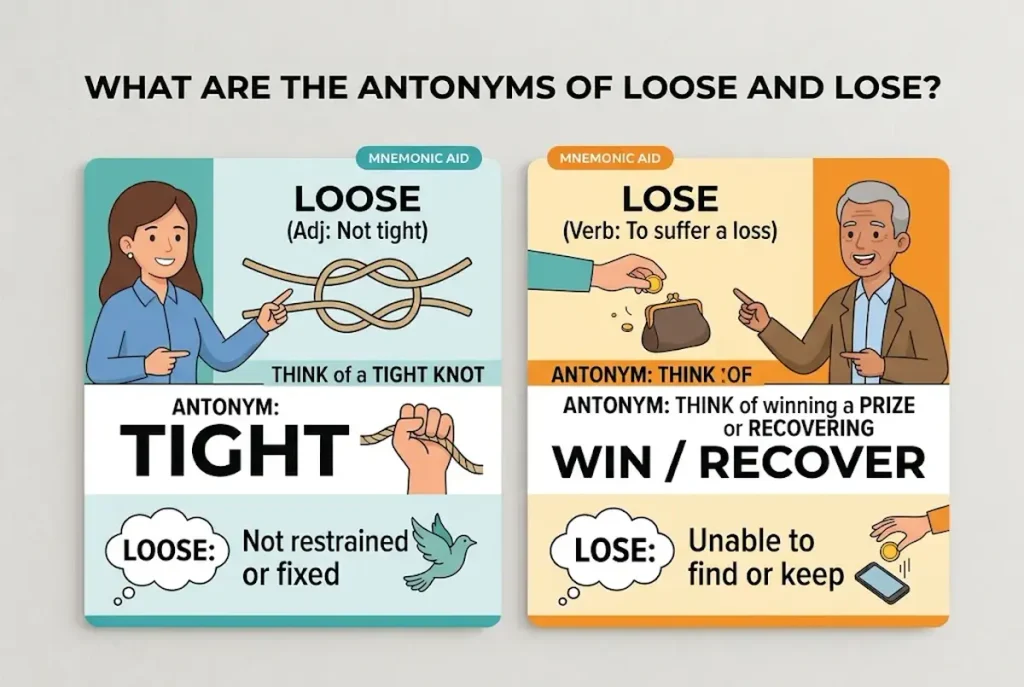
What Are the Antonyms of Loose and Lose?
Antonyms are words with opposite meanings. They can help you understand the difference more clearly.
Opposite Words of Loose?
| Word | Antonym | Example |
|---|---|---|
| Loose | Tight | The lid is tight. |
| Loose | Secure | The cable is secure. |
| Loose | Firm | The handle feels firm. |
| Loose | Attached | The button is attached. |
| Loose | Strict | The rules are strict. |
| Loose | Restrained | The movement was restrained. |
Opposite Words of Lose?
| Word | Antonym | Example |
|---|---|---|
| Lose | Win | Our team hopes to win. |
| Lose | Find | I finally found my keys. |
| Lose | Keep | You should keep your receipt. |
| Lose | Gain | She hopes to gain experience. |
| Lose | Retain | The company retained its customers. |
| Lose | Preserve | We must preserve important records. |
What Are the Best Tips for Remembering the Difference?
Use these simple tricks to choose the right spelling.
- Remember the extra O in loose. Loose has two O’s, just like the extra space in loose clothing.
- Connect lose with losing something. If you are talking about misplacing an item, failing to win, or no longer having something, choose lose.
- Check the part of speech. Loose is usually an adjective. Lose is a verb.
- Listen to the ending sound. Loose has an s sound. Lose has a z sound.
- Remember the past tense. The past tense of lose is lost. It is not loosed.
Conclusion
The difference between loose and lose comes down to meaning and grammar. Loose usually describes something that is not tight, firmly attached, or strictly controlled. Lose is a verb that describes misplacing something, failing to win, or no longer having something.
Remember that loose has two O’s and often describes extra space or freedom. Lose has one O and refers to an action or result. Also, the past tense of lose is lost, not loosed.
With a little practice, you’ll recognize the correct spelling in emails, school assignments, professional writing, and everyday conversations. Focus on the meaning of your sentence, and you’ll make the right choice with confidence.
Frequently Asked Questions
Is loose vs lose correct?
Both words are correct, but they have different meanings. Use loose for something that is not tight and lose when you mean to misplace something or fail to win.
How do you use loose vs lose in a sentence?
Use loose to describe something that is not tight, such as My shoes are loose. Use lose for an action, such as I don’t want to lose my shoes.
Why do people confuse loose and lose?
People often confuse them because their spellings are similar and their pronunciations are close. However, loose has an s sound, while lose has a z sound.
Is it lose weight or loose weight?
The correct phrase is lose weight. Lose is the verb used to describe reducing body weight. Loose means not tight, so loose weight is incorrect in this context.
Is it loose change or lose change?
The correct phrase is loose change. It refers to coins that are not organized or kept together in a wallet or container.
What is the past tense of lose?
The past tense of lose is lost. For example, I lost my keys yesterday. Loosed is not the past tense of lose.
What’s another way to say loose?
Another word for loose is slack, relaxed, baggy, or unfastened. The best choice depends on what you’re describing. For example, slack works well for a rope, while baggy describes clothing.
Can loose ever be used as a verb?
Yes, loose can be a verb meaning to release or set free. For example, The farmer decided to loose the horses. However, this use is less common than the adjective form.

Daniel Grammarfield — The Language Learner
Age: 28Occupation: ESL Learner & Digital Professional
Bio:Daniel is a non-native English speaker who wants to communicate more confidently at work and online. He uses Synotrench to improve grammar, understand confusing words, learn correct sentence structures, and build everyday English skills. He prefers simple explanations with practical examples.
Goals:
Master English grammar rules
Avoid common language mistakes
Improve professional communication
Learn English through real-life examples
Quote:“Learning English is not about memorizing rules — it’s about expressing ideas clearly.”
1 thought on “Loose vs Lose: The Ultimate Guide to the Difference”