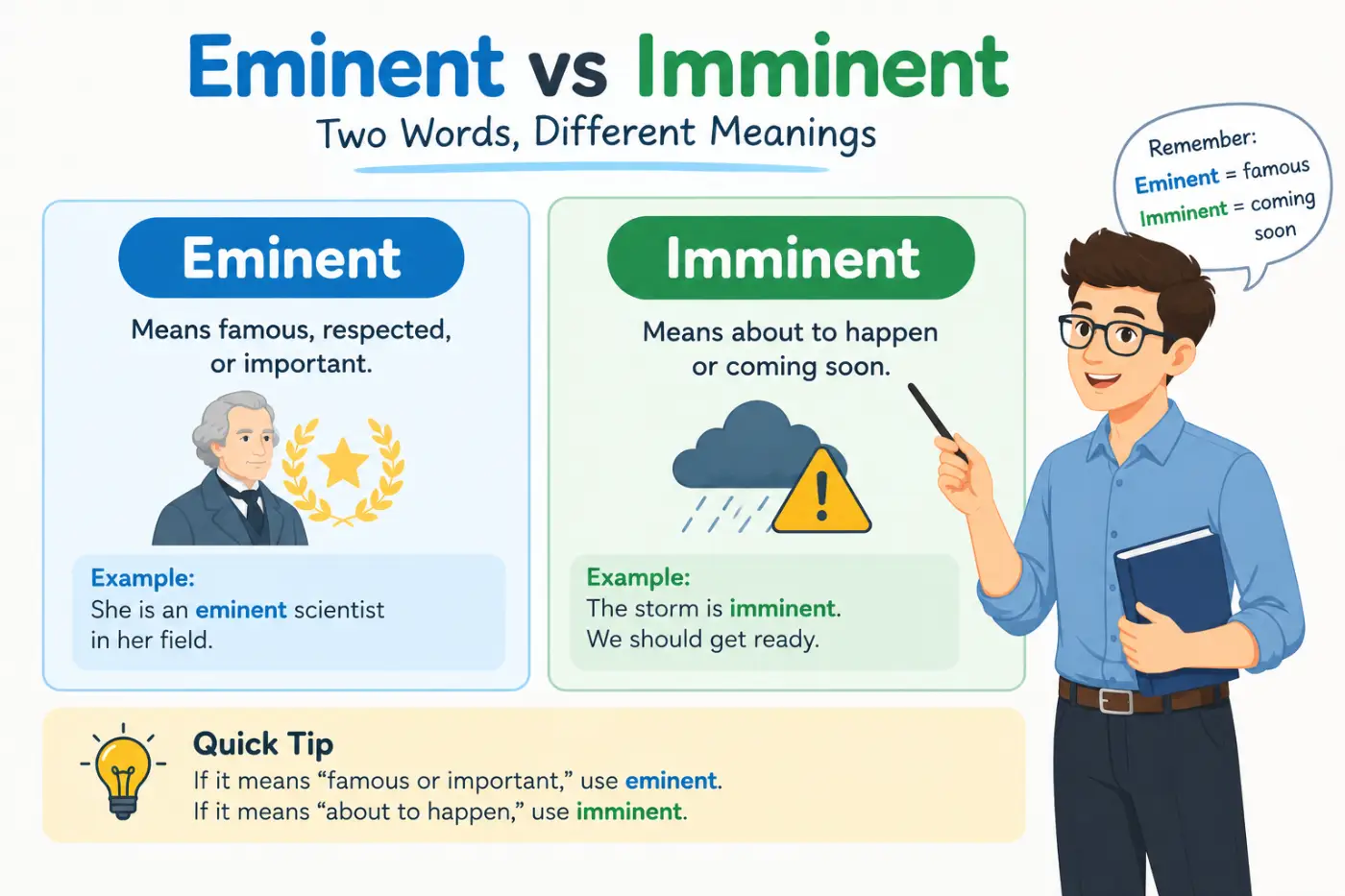
The confusion between eminent vs imminent is common in English writing. One word describes someone who is respected or important. The other describes something that is about to happen. Mixing them up can change the meaning of your sentence.
Eminent means famous, respected, or important in a particular field. Imminent means something is expected to happen very soon. Use eminent for a distinguished person and imminent for an approaching event or situation.
This guide explains their meanings, word origins, synonyms, differences, and everyday uses. You’ll also find comparison tables, practical examples, common mistakes, and simple tricks to help you choose the correct word every time.
What Is the Difference Between Eminent and Imminent?
The main difference is that eminent describes importance or reputation, while imminent describes something that is about to happen.
Although both words are adjectives, they serve different purposes in a sentence.
| Feature | Eminent | Imminent |
|---|---|---|
| Meaning | Famous or highly respected | About to happen soon |
| Main idea | Reputation or distinction | Time or approaching events |
| Part of speech | Adjective | Adjective |
| Common use | People and professional achievements | Events, situations, and changes |
| Example | She is an eminent scientist. | A storm is imminent. |
| Similar words | Distinguished, renowned | Approaching, impending |
| Opposite idea | Unknown, obscure | Distant, remote |
Consider these two sentences:
- An eminent doctor visited our hospital.
- The doctor’s arrival is imminent.
The first sentence tells us that the doctor is highly respected. The second tells us that the doctor will arrive very soon.
A person can be eminent, while their arrival can be imminent. This distinction makes the words easier to understand.
What Does Eminent Mean in Simple English?
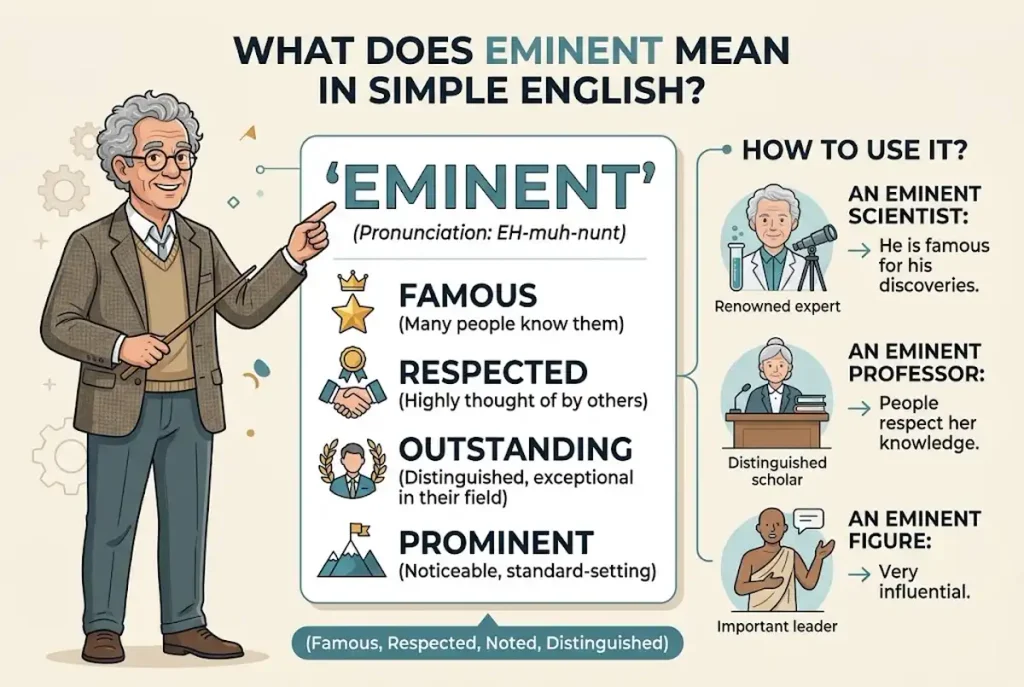
Eminent means someone is famous, respected, or recognized for outstanding work in a particular profession or field. It usually describes people who have earned a strong reputation through their knowledge, achievements, or contributions.
For example:
- Dr. Wilson is an eminent heart surgeon.
- An eminent professor delivered the opening lecture.
- The university invited several eminent researchers.
In each example, eminent expresses respect or professional distinction.
Where Does Eminent Come From?
Eminent comes from the Latin word eminere, meaning to stand out or project above something.
Over time, its meaning developed from physical height into the idea of standing above others through achievement, reputation, or importance.
Today, eminent generally refers to someone who stands out because of exceptional work or professional recognition.
When Should You Use Eminent?
Use eminent when describing someone with an established reputation in a specific field.
Common combinations include:
- Eminent scientist
- Eminent professor
- Eminent physician
- Eminent historian
- Eminent scholar
- Eminent author
- Eminent lawyer
You can also use the word with certain abstract nouns, such as eminent achievement or eminent position.
However, simply being popular doesn’t automatically make someone eminent. The word usually suggests earned respect, distinction, or recognized expertise.
What Does Imminent Mean in Simple English?
Imminent means something is expected to happen very soon.
It describes an approaching event or situation, especially one that seems likely to happen at any moment.
For example:
- Heavy rainfall is imminent.
- The company announced that major changes were imminent.
- The firefighters warned residents of imminent danger.
- The baby’s birth appeared imminent.
These sentences all describe events or situations that are approaching.
Imminent doesn’t always describe something negative. However, it’s frequently used with serious or urgent situations.
Where Does Imminent Come From?
Imminent comes from the Latin word imminere, which means to overhang or threaten.
Its original meaning suggested something hanging over a person or situation.
This helps explain why modern English often connects imminent with approaching danger, threats, or important developments.
The word eventually developed its broader meaning of something expected to happen very soon.
When Should You Use Imminent?
Use imminent when an event appears close to happening.
Common combinations include:
- Imminent danger
- Imminent arrival
- Imminent threat
- Imminent collapse
- Imminent disaster
- Imminent departure
- Imminent announcement
For example:
The manager’s departure is imminent.
This means the manager is expected to leave very soon. It doesn’t suggest that the manager is famous or respected.
Eminent vs Imminent Synonyms With Meanings and Examples
Understanding synonyms is one of the easiest ways to recognize the difference between these two adjectives.
Eminent has synonyms related to reputation, distinction, and achievement.
Imminent has synonyms connected to time, urgency, and approaching events.
The following tables include more than 30 useful alternatives, organized by tone and everyday usage.
Simple Synonyms for Eminent
These words work well in straightforward writing and conversation.
| Word | Meaning | Tone | Example |
|---|---|---|---|
| Famous | Known by many people | Simple | She is a famous author. |
| Respected | Admired by others | Simple | He is a respected teacher. |
| Important | Having great value or influence | Simple | She holds an important position. |
| Known | Recognized by people | Simple | He is known for his research. |
| Successful | Having achieved goals | Simple | She became a successful scientist. |
| Leading | Among the best in a field | Everyday | He is a leading heart specialist. |
| Notable | Worth attention or recognition | Everyday | She is a notable historian. |
| Celebrated | Widely praised | Everyday | The celebrated writer attended the event. |
Formal Synonyms for Eminent
These alternatives are useful in academic papers, professional biographies, and formal introductions.
| Word | Meaning | Tone | Example |
|---|---|---|---|
| Distinguished | Respected for excellent achievements | Formal | A distinguished professor joined the panel. |
| Renowned | Widely known and admired | Formal | The renowned surgeon led the operation. |
| Prominent | Important or widely recognized | Formal | She is a prominent researcher. |
| Prestigious | Highly respected or admired | Formal | He received a prestigious award. |
| Illustrious | Famous for outstanding achievements | Formal | She enjoyed an illustrious career. |
| Acclaimed | Publicly praised | Formal | The acclaimed author released another novel. |
| Esteemed | Held in high regard | Formal | Our esteemed guest addressed the audience. |
| Preeminent | Superior or especially distinguished | Very formal | He is a preeminent expert in genetics. |
Prestigious usually describes institutions, awards, positions, or achievements rather than people directly.
Simple and Everyday Synonyms for Imminent
These words help describe events that are approaching or expected soon.
| Word | Meaning | Tone | Example |
|---|---|---|---|
| Near | Close in time | Simple | The deadline is near. |
| Soon | After a short time | Simple | The meeting will begin soon. |
| Close | Not far away in time | Simple | The launch date is close. |
| Coming | Expected to happen | Everyday | The coming changes may affect everyone. |
| Approaching | Getting closer in time | Everyday | The approaching storm worried residents. |
| Upcoming | Scheduled or expected in the future | Everyday | The upcoming event looks exciting. |
| Nearing | Moving closer to something | Everyday | The project is nearing completion. |
| Oncoming | Moving toward something | Everyday | Drivers struggled through the oncoming storm. |
Formal Synonyms for Imminent
These alternatives are especially useful in reports, news articles, and serious discussions.
| Word | Meaning | Tone | Example |
|---|---|---|---|
| Impending | Expected to happen soon | Formal | The impending closure worried employees. |
| Forthcoming | Expected or planned to happen | Formal | Details will appear in the forthcoming report. |
| Looming | Approaching in a worrying way | Formal | The looming deadline created pressure. |
| Pending | Awaiting a decision or completion | Formal | The application is pending approval. |
| Threatening | Suggesting possible danger | Formal | Threatening weather forced the cancellation. |
| At hand | Very close in time | Formal | The final decision is at hand. |
| In prospect | Expected or possible in the future | Formal | Further changes are in prospect. |
| Brewing | Developing and possibly approaching | Figurative | Trouble was brewing within the organization. |
Not every synonym is interchangeable. For example, forthcoming can describe something expected in the future without suggesting that it will happen immediately.
Informal and Slang Alternatives
Neither eminent nor imminent has many exact slang replacements. However, casual expressions can communicate similar ideas.
| Expression | Meaning | Tone | Example |
|---|---|---|---|
| Big name | A famous or influential person | Informal | She’s a big name in medicine. |
| Top dog | Someone with a leading position | Slang | He’s the top dog in the department. |
| Big deal | Someone considered important | Informal | She’s a big deal in publishing. |
| Just around the corner | Happening soon | Informal | Graduation is just around the corner. |
| Any minute now | Expected very soon | Informal | The bus should arrive any minute now. |
| About to happen | Very close to occurring | Everyday | The announcement is about to happen. |
These expressions are useful in conversation but may not fit formal academic writing.
Which Synonyms Are Stronger or Weaker?
Synonyms don’t always express the same level of meaning.
Some suggest ordinary recognition, while others communicate exceptional professional status. Similarly, some describe events happening in the future, while others suggest immediate urgency.
Eminent Synonyms From Mild to Strong
| Intensity | Word | Meaning |
|---|---|---|
| Mild | Known | Recognized by others |
| Mild | Respected | Regarded positively |
| Moderate | Notable | Worth recognizing |
| Moderate | Prominent | Important within a field |
| Strong | Renowned | Widely admired |
| Strong | Distinguished | Recognized for exceptional achievement |
| Very strong | Eminent | Highly respected and accomplished |
| Very strong | Preeminent | Standing above others in a field |
For example, calling someone a respected researcher communicates admiration.
Calling that person a preeminent researcher makes a stronger claim. It suggests that they rank among the very best in their profession.
Imminent Synonyms From Mild to Strong
| Intensity | Expression | Meaning |
|---|---|---|
| Mild | Upcoming | Expected in the future |
| Mild | Forthcoming | Expected or planned |
| Moderate | Approaching | Getting closer |
| Moderate | Nearing | Becoming closer |
| Strong | Impending | Expected soon, often seriously |
| Strong | Imminent | Expected very soon |
| Very strong | Any moment now | Expected almost immediately |
These are approximate levels, not fixed dictionary rankings. Context determines how urgent each expression sounds.
Are Eminent and Imminent Adjectives or Adverbs?
Both words are adjectives. They describe nouns, but their meanings remain different.
| Form | Eminent family | Imminent family |
|---|---|---|
| Adjective | Eminent | Imminent |
| Adverb | Eminently | Imminently |
| Noun | Eminence | Imminence |
| Main meaning | Distinction or reputation | Nearness of an event |
How to Use Eminently
Eminently is an adverb that can mean highly, notably, or especially. It often appears in expressions describing suitability or qualification.
Example:
She is eminently qualified for the position.
This means she is exceptionally well qualified.
How to Use Imminently
Imminently means very soon or at any moment.
Example:
The official announcement is expected imminently.
The sentence suggests that the announcement will happen very soon.
Imminently is correct, although soon often sounds more natural in everyday conversation.
Is There a Difference Between American and British English?
Eminent and imminent have the same standard meanings in American and British English.
Their spellings also remain unchanged.
| Feature | American English | British English |
|---|---|---|
| Eminent spelling | Eminent | Eminent |
| Imminent spelling | Imminent | Imminent |
| Meaning | Same | Same |
| Grammar | Adjective | Adjective |
| Common usage | Professional and formal writing | Professional and formal writing |
Both varieties use phrases such as eminent professor and imminent danger.
There may be small pronunciation differences between regional accents, but neither word changes its meaning.
Writers in the United States and the United Kingdom can follow the same grammar rules.
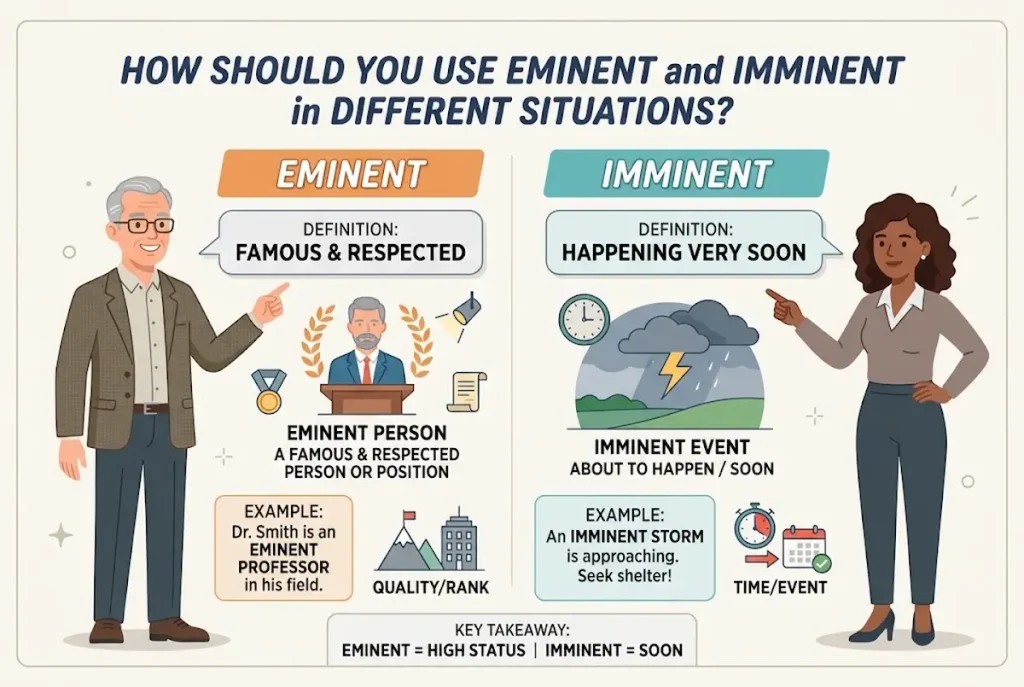
How Should You Use Eminent and Imminent in Different Situations?
Choosing the correct word depends on what you’re trying to communicate.
The following examples show how these adjectives work in professional and everyday settings.
Which Word Should You Use on a Resume?
Use eminent when referring to a genuinely distinguished professional, mentor, or institution-associated expert.
Example:
I completed my research under the guidance of an eminent professor of economics.
Avoid describing yourself as eminent unless the claim is clearly supported. On a resume, specific achievements usually sound more convincing than self-praise.
Imminent is less common in resumes because it refers to approaching events.
Which Word Is Better for an Academic Essay?
Both words work in academic essays, depending on the meaning.
Examples:
- The eminent historian challenged the traditional interpretation.
- Researchers warned that an environmental crisis was imminent.
The first sentence discusses professional recognition. The second discusses an approaching situation.
Academic writing benefits from using precise words instead of unnecessarily complicated vocabulary.
Can You Use These Words in Text Messages?
Yes, but both sound somewhat formal in casual texting.
For example:
- An eminent scientist is visiting our college tomorrow.
- The results are imminent!
In ordinary messages, people may prefer simpler expressions.
You could write:
- A famous scientist is visiting tomorrow.
- The results should be out any minute!
Both versions communicate the intended meaning naturally.
Which Word Sounds Better in a Professional Email?
Use eminent when introducing a highly respected guest or professional.
Example:
We are pleased to welcome an eminent researcher to our annual conference.
Use imminent when discussing something expected very soon.
Example:
Please complete your preparations, as the official announcement is imminent.
The second sentence creates a sense of urgency without stating an exact time.
How Do You Use These Words While Speaking?
Both adjectives are acceptable in spoken English, especially in professional discussions, presentations, and news reporting.
Examples:
- She’s an eminent expert in public health.
- The team believes a major breakthrough is imminent.
For casual conversations, famous, respected, or happening soon may sound more natural.
15 Example Sentences Using Eminent and Imminent
Seeing the words in realistic situations helps you remember their meanings.
Examples Using Eminent
- The hospital hired an eminent surgeon to lead its new department.
- An eminent scientist received an international research award.
- The documentary featured several eminent historians.
- She studied literature under an eminent professor.
- The committee consulted an eminent legal scholar.
- An eminent architect designed the city’s cultural center.
- The conference attracted eminent researchers from several universities.
- His work established him as an eminent figure in modern medicine.
Each sentence highlights reputation, distinction, or professional achievement.
Examples Using Imminent
- Dark clouds suggested that heavy rain was imminent.
- The workers feared that factory closure was imminent.
- Officials warned residents about the imminent risk of flooding.
- The company expects an imminent announcement about its expansion.
- Everyone prepared for the imminent arrival of the guests.
- The pilot reported that landing was imminent.
- Investors discussed the possibility of an imminent economic slowdown.
Notice that imminent doesn’t guarantee an event will happen. It communicates that the event appears likely to occur very soon.
Eminent vs Prominent
Eminent and prominent are close synonyms, but they don’t always communicate the same level of professional respect.
| Eminent | Prominent |
|---|---|
| Emphasizes outstanding reputation | Emphasizes importance or visibility |
| Usually suggests earned distinction | Can describe influence or public attention |
| Often describes accomplished professionals | Can describe people, places, or features |
| Example: An eminent scientist | Example: A prominent business leader |
A person may be prominent because they receive frequent media attention.
An eminent person is generally recognized for exceptional achievements or expertise.
Someone can be both prominent and eminent, but the words aren’t exact replacements.
Imminent vs Impending
Imminent and impending both describe approaching events. However, their tone and timing can differ.
| Imminent | Impending |
|---|---|
| Emphasizes something expected very soon | Emphasizes something approaching |
| Often suggests immediate closeness | Often creates anticipation or concern |
| Can describe positive or negative events | Frequently describes serious or negative events |
| Example: Her arrival is imminent. | Example: The impending crisis worried officials. |
For example:
The announcement is imminent.
This suggests the announcement is expected very soon.
The impending announcement created uncertainty.
This emphasizes the approaching announcement and the concern surrounding it.
Impending doesn’t always suggest the same immediate timing as imminent.
Eminent vs Immanent
Another commonly confused word is immanent.
Although immanent resembles both eminent and imminent, it has a separate meaning.
Immanent means existing or operating within something rather than coming from outside it.
It frequently appears in philosophy, theology, and academic discussions.
| Word | Meaning | Example |
|---|---|---|
| Eminent | Highly respected | An eminent philosopher spoke. |
| Imminent | Expected very soon | A major change is imminent. |
| Immanent | Existing within something | The philosopher discussed immanent principles. |
This third word is less common in everyday English, but recognizing it can prevent confusion in academic writing.
What Are the Most Common Mistakes With Eminent and Imminent?
The biggest mistake is choosing a word based on its similar spelling or pronunciation rather than its actual meaning.
Here are several errors worth avoiding.
Mistake 1 Using Eminent for Approaching Events
Incorrect: The storm is eminent.
Correct: The storm is imminent.
A storm doesn’t have a professional reputation. The sentence describes approaching weather.
Mistake 2 Using Imminent for Respected People
Incorrect: She is an imminent professor.
Correct: She is an eminent professor.
The professor is highly respected, not an event expected to happen soon.
Mistake 3 Assuming Imminent Always Means Dangerous
Imminent frequently appears with danger, but its meaning isn’t limited to negative situations.
Correct examples include:
- Their wedding is imminent.
- The publication of her new book is imminent.
- The team’s victory seemed imminent.
All three sentences describe something expected very soon.
Mistake 4 Using Eminent for Anyone Famous
Eminent usually suggests more than simple popularity.
A viral internet personality may be famous without being eminent in a recognized profession.
Use the word when professional achievement, distinction, or established reputation is relevant.
Mistake 5 Using Imminent for Distant Events
Incorrect: The conference scheduled for three years from now is imminent.
Better: The conference is scheduled for three years from now.
Imminent suggests that an event is very close, not merely planned for the future.
When Should You Avoid Using These Words?
Neither adjective is suitable for every situation.
Avoid eminent when you only mean that someone is popular, wealthy, or temporarily receiving attention. Those qualities don’t necessarily establish professional distinction.
Avoid imminent when describing something that might happen someday but isn’t expected soon.
Also, avoid either word when simpler vocabulary communicates your meaning more naturally.
For example:
Formal: The departure of the train is imminent.
Everyday: The train is about to leave.
Both sentences are correct, but the second sounds more natural in ordinary conversation.
The best choice depends on your audience and purpose.
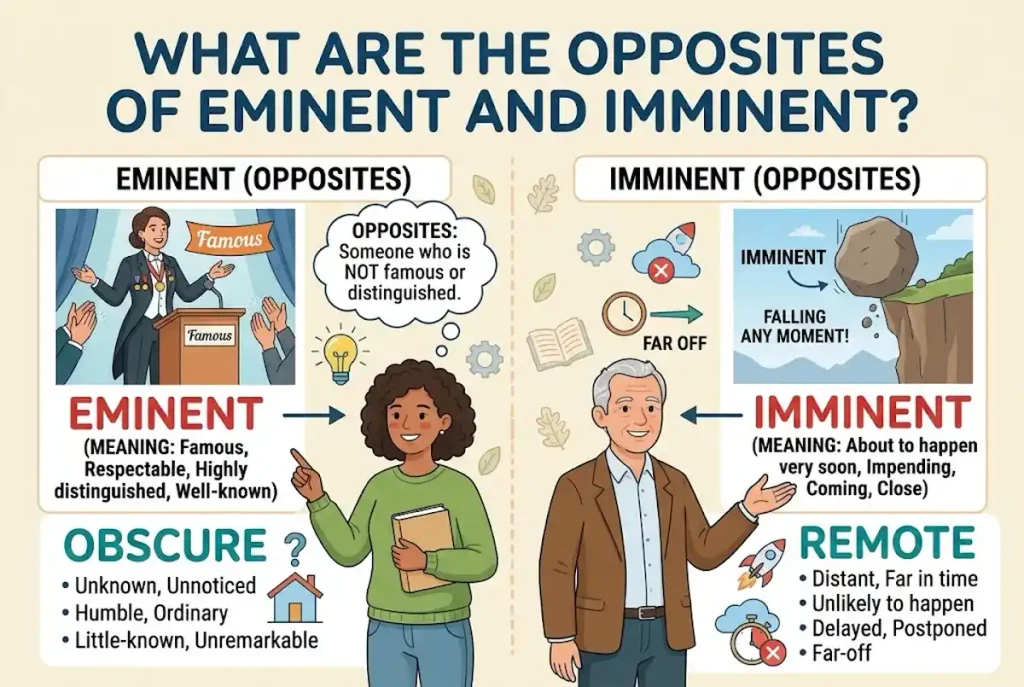
What Are the Opposites of Eminent and Imminent?
Antonyms can make the distinction even clearer.
| Word | Antonym | Meaning |
|---|---|---|
| Eminent | Unknown | Not widely recognized |
| Eminent | Obscure | Not famous or well known |
| Eminent | Undistinguished | Lacking notable distinction |
| Imminent | Distant | Far away in time |
| Imminent | Remote | Unlikely or far from happening |
| Imminent | Far off | Not expected soon |
How Can You Remember Eminent vs Imminent Easily?
You don’t need to memorize complicated grammar rules. A few simple associations can help you choose correctly.
Remember Eminent With Excellence
Think of the letter E in eminent as the E in excellence.
An eminent person stands out because of excellent achievements or a respected professional reputation.
Example:
An eminent engineer received the national award.
Remember Imminent With Immediate
Connect imminent with immediate.
Both words begin with IM, and both can relate to something close in time.
Example:
The deadline is imminent.
This means the deadline is approaching very soon.
Use This Quick Decision Table
| Ask yourself | Choose |
|---|---|
| Am I describing a highly respected person? | Eminent |
| Am I discussing an approaching event? | Imminent |
| Does the sentence focus on professional reputation? | Eminent |
| Does the sentence focus on something happening soon? | Imminent |
| Could I replace the word with distinguished? | Eminent |
| Could I replace the word with about to happen? | Imminent |
Conclusion
Understanding eminent vs imminent becomes easier when you connect each word to its main purpose.
Eminent describes someone who has earned recognition, respect, or distinction through their achievements. It’s especially useful when discussing respected professionals, scholars, scientists, and other accomplished people.
Imminent describes an event or situation expected to happen very soon. It often appears in discussions about deadlines, arrivals, warnings, and approaching changes.
The easiest memory trick is to connect eminent with excellence and imminent with immediate. These two associations help you recognize the correct meaning without memorizing lengthy definitions.
Frequently Asked Questions
What is the main difference between eminent and imminent?
Eminent means highly respected or distinguished, while imminent means expected to happen very soon. One describes reputation, and the other describes an approaching event.
Is it eminent danger or imminent danger?
Imminent danger is correct. It describes a threat that is expected to occur very soon.
Can a person be both eminent and imminent?
A person can be eminent, but imminent normally describes an event rather than the person. For example, an eminent professor’s arrival may be imminent.
What’s another way to say eminent?
Common alternatives include distinguished, renowned, respected, prominent, and acclaimed. The best choice depends on the person’s reputation and the tone of your sentence.
Does imminent always mean something bad will happen?
No. Imminent can describe positive, negative, or neutral events. For example, a wedding, announcement, or promotion may be imminent.
How do you remember eminent vs imminent?
Connect eminent with excellence and imminent with immediate. The first concerns distinction, while the second concerns something expected soon.
What does an eminent personality mean?
An eminent personality is someone recognized and respected for notable achievements or contributions. However, eminent person or eminent figure often sounds more natural in American English.
Is imminent the same as immediate?
No. Immediate describes something happening now or without delay, while imminent describes something expected to happen very soon.

Daniel Grammarfield — The Language Learner
Age: 28Occupation: ESL Learner & Digital Professional
Bio:Daniel is a non-native English speaker who wants to communicate more confidently at work and online. He uses Synotrench to improve grammar, understand confusing words, learn correct sentence structures, and build everyday English skills. He prefers simple explanations with practical examples.
Goals:
Master English grammar rules
Avoid common language mistakes
Improve professional communication
Learn English through real-life examples
Quote:“Learning English is not about memorizing rules — it’s about expressing ideas clearly.”
2 thoughts on “Eminent vs Imminent Simple Guide With Examples (2026)”