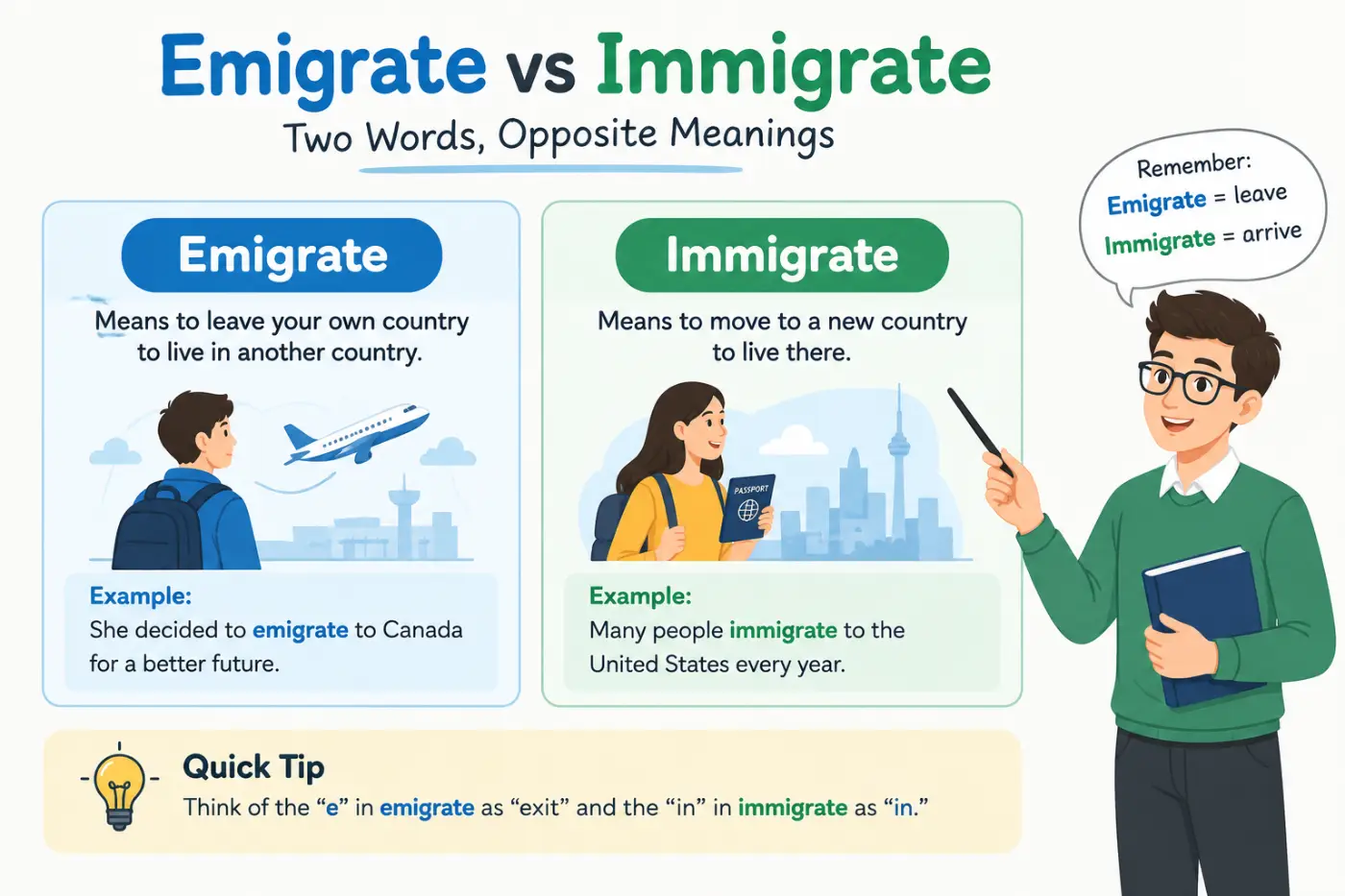
The difference between emigrate vs immigrate is easier to understand than it first appears. These words describe the same type of international move, but they tell the story from different points of view.
Emigrate means to leave your home country to live in another country. Immigrate means to enter a new country to live there. The difference is the direction of the move.
In this guide, you’ll learn their meanings, word origins, useful synonyms, grammar rules, and everyday examples. You’ll also discover how to choose the correct word in essays, emails, resumes, and conversations without second guessing yourself.
What Does Emigrate vs Immigrate Mean in Simple English?
Both words describe people moving between countries to establish a new home. However, they focus on opposite sides of that journey.
What Does Emigrate Mean?
Emigrate means to leave your country and move to another country to live there.
The word focuses on the country someone is leaving.
For example:
- My grandparents emigrated from Italy in 1975.
- Thousands of people emigrated from Ireland during the famine.
- She plans to emigrate from Canada next year.
- His family emigrated from Germany when he was young.
Notice that emigrate usually works with the preposition from.
You emigrate from a country because you’re describing your departure.
What Does Immigrate Mean?
Immigrate means to enter a foreign country with the intention of living there.
This word focuses on the destination rather than the starting point.
For example:
- My grandparents immigrated to the United States in 1975.
- She hopes to immigrate to Australia.
- His parents immigrated to Canada before he was born.
- Many families immigrated to America during the nineteenth century.
Immigrate commonly works with the preposition to.
You immigrate to a country because you’re describing your arrival.
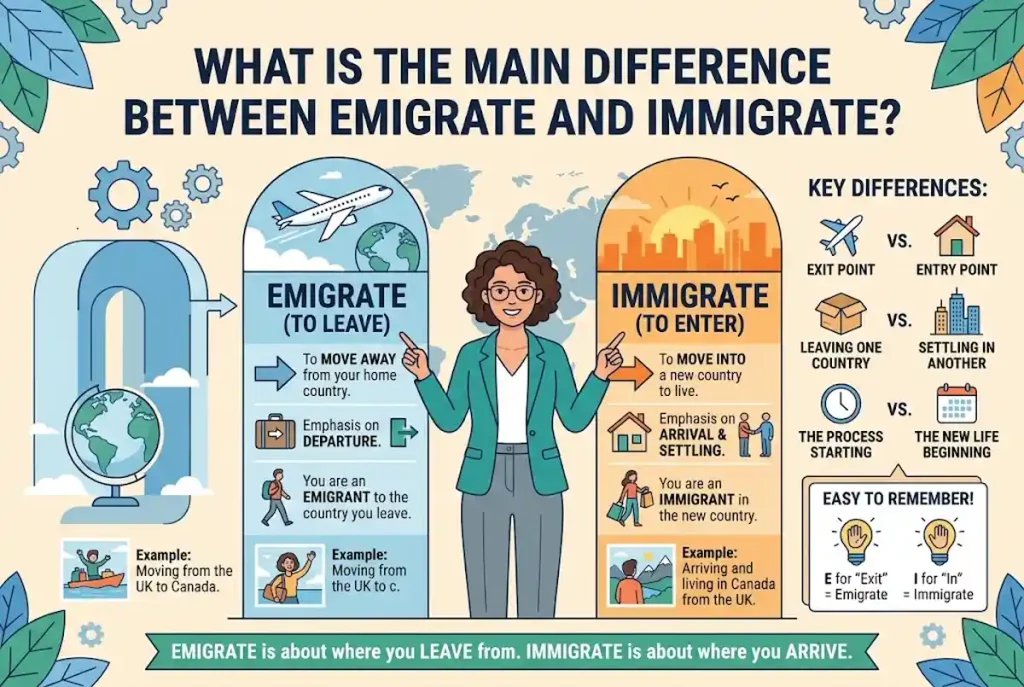
What Is the Main Difference Between Emigrate and Immigrate?
The simplest way to understand these words is to imagine one person moving from one country to another.
Consider someone leaving India to settle in Canada.
| Word | Meaning | Example |
|---|---|---|
| Emigrate | Leave a country | She emigrated from India. |
| Immigrate | Enter a country | She immigrated to Canada. |
| Migrate | Move between places | She migrated from India to Canada. |
Where Do Emigrate and Immigrate Come From?
Understanding the history of these words makes them much easier to remember.
Both come from Latin and share a root connected to movement.
The Latin verb migrare means to move or change one’s residence.
Different prefixes change the direction of that movement.
The Origin of Emigrate
Emigrate comes from the Latin emigrare, meaning to move away or depart.
Its prefix comes from the Latin e or ex, meaning out of or away from.
That’s why emigrate describes leaving a country.
Think of the letter E as standing for exit.
Example:
The family emigrated from Poland after the war.
The sentence focuses on their departure from Poland.
The Origin of Immigrate
Immigrate comes from the Latin immigrare, meaning to move into.
Its prefix comes from in, meaning into or toward the inside.
That’s why immigrate describes entering another country.
Think of the letter I as standing for in.
Example:
The family immigrated to the United States after the war.
This sentence focuses on their arrival in America.
The shared Latin root also appears in migration, migrant, and migratory.
Once you understand the prefixes, the difference becomes much easier to remember.
What Are the Best Synonyms for Emigrate and Immigrate?
English offers several alternatives for describing someone moving to another country.
However, not every synonym carries exactly the same meaning.
Some describe leaving, others describe arriving, and several simply describe moving without identifying the direction.
The following tables include 32 useful words and expressions grouped by tone.
Simple Synonyms
These expressions work well in everyday writing and basic explanations.
| Word | Meaning | Tone | Example |
|---|---|---|---|
| Leave | Go away from a place | Simple | They left France in 2010. |
| Move | Change where you live | Simple | We moved to Canada. |
| Arrive | Reach a destination | Simple | They arrived in Spain. |
| Settle | Establish a home | Simple | She settled in Germany. |
| Depart | Leave a place | Neutral | He departed his homeland. |
| Enter | Go into a country | Simple | They entered Australia legally. |
| Move abroad | Move to another country | Simple | My sister moved abroad. |
| Go overseas | Travel or move to another country | Casual | He went overseas for work. |
Everyday Synonyms
These expressions sound natural in conversations, emails, and personal stories.
| Word | Meaning | Tone | Example |
|---|---|---|---|
| Relocate | Move to another place | Neutral | They relocated to London. |
| Move away | Leave your current home | Casual | She moved away last summer. |
| Start over | Begin a new life | Conversational | They started over in Canada. |
| Make a new home | Establish a home elsewhere | Warm | We made a new home in Texas. |
| Move out | Leave a particular place | Casual | They moved out of their hometown. |
| Settle down | Establish a stable life | Casual | He settled down in New Zealand. |
| Move internationally | Change countries of residence | Neutral | The family moved internationally. |
| Resettle | Establish a home somewhere new | Neutral | They resettled in Sweden. |
Formal Synonyms
Formal alternatives work better in academic essays, government documents, historical writing, and professional discussions.
| Word | Meaning | Tone | Example |
|---|---|---|---|
| Migrate | Move between regions or countries | Formal | Workers migrated across Europe. |
| Resettle | Establish residence somewhere new | Formal | The families resettled abroad. |
| Depart one’s homeland | Leave one’s native country | Formal | Many departed their homeland. |
| Establish residency | Become a resident somewhere | Administrative | She established residency in Canada. |
| Seek permanent residence | Apply or attempt to gain long term residence | Legal | He sought permanent residence abroad. |
| Cross international borders | Move between countries | Formal | Millions cross international borders each year. |
| International relocation | Moving residence between countries | Professional | The company supported international relocation. |
| Expatriate | Live outside one’s native country | Formal | She expatriated herself to France. |
Slang and Casual Expressions
English speakers also use informal expressions when discussing moving abroad.
These aren’t exact synonyms, but they can communicate the general idea in casual conversations.
| Word | Meaning | Tone | Example |
|---|---|---|---|
| Head abroad | Go to another country | Casual | She’s heading abroad next month. |
| Pack up and leave | Leave your current home | Informal | They packed up and left. |
| Make the move | Complete a planned relocation | Conversational | We finally made the move to Canada. |
| Set up shop | Establish yourself somewhere new | Informal | He set up shop in Berlin. |
| Take off | Leave a place | Slang | They took off for Australia. |
| Put down roots | Establish a lasting home | Idiomatic | She put down roots in Ireland. |
| Make a fresh start | Begin life somewhere new | Conversational | They made a fresh start overseas. |
| Uproot yourself | Leave an established home | Expressive | He uprooted himself and moved abroad. |
Which Synonyms Are Stronger or More Emotional?
Not every word describing international movement creates the same feeling.
Some words sound neutral. Others suggest hardship, pressure, danger, or a major life change.
Consider this progression:
| Intensity | Expression | What It Suggests |
|---|---|---|
| Mild | Move | A general change of residence |
| Mild | Relocate | An organized move |
| Moderate | Move abroad | Moving to another country |
| Moderate | Emigrate | Leaving one’s country to live elsewhere |
| Moderate | Immigrate | Entering another country to live there |
| Moderate | Resettle | Establishing a new home |
| Strong | Uproot | Leaving an established life behind |
| Strong | Flee | Escaping danger or hardship |
| Strong | Escape | Getting away from a threatening situation |
| Strong | Be forcibly displaced | Being compelled to leave home |
How Do Emigrate and Immigrate Change as Nouns and Adjectives?
One reason people confuse these words is that their related nouns look almost identical.
Learning the complete word families helps you use them correctly.
| Word | Part of Speech | Meaning |
|---|---|---|
| Emigrate | Verb | Leave a country to live elsewhere |
| Emigration | Noun | The process of leaving a country |
| Emigrant | Noun | Someone who leaves a country |
| Immigrate | Verb | Enter another country to live |
| Immigration | Noun | The process of entering a country to live |
| Immigrant | Noun | Someone who enters another country to live |
| Migratory | Adjective | Related to movement or migration |
What Is the Difference Between Emigrant and Immigrant?
An emigrant is a person viewed from the country they’re leaving.
An immigrant is a person viewed from the country they’re entering.
For example:
Maria leaves Mexico and moves to Canada.
From Mexico’s perspective, Maria is an emigrant.
From Canada’s perspective, Maria is an immigrant.
She’s the same person in both descriptions.
The difference is simply the point of view.
What About Emigration and Immigration?
Emigration describes the departure of people from a country.
Immigration describes the arrival of people into a country to live.
For example:
Emigration from Ireland increased during the Great Famine.
Immigration to the United States increased during the same historical period.
These words allow writers to describe international population movement from two different perspectives.
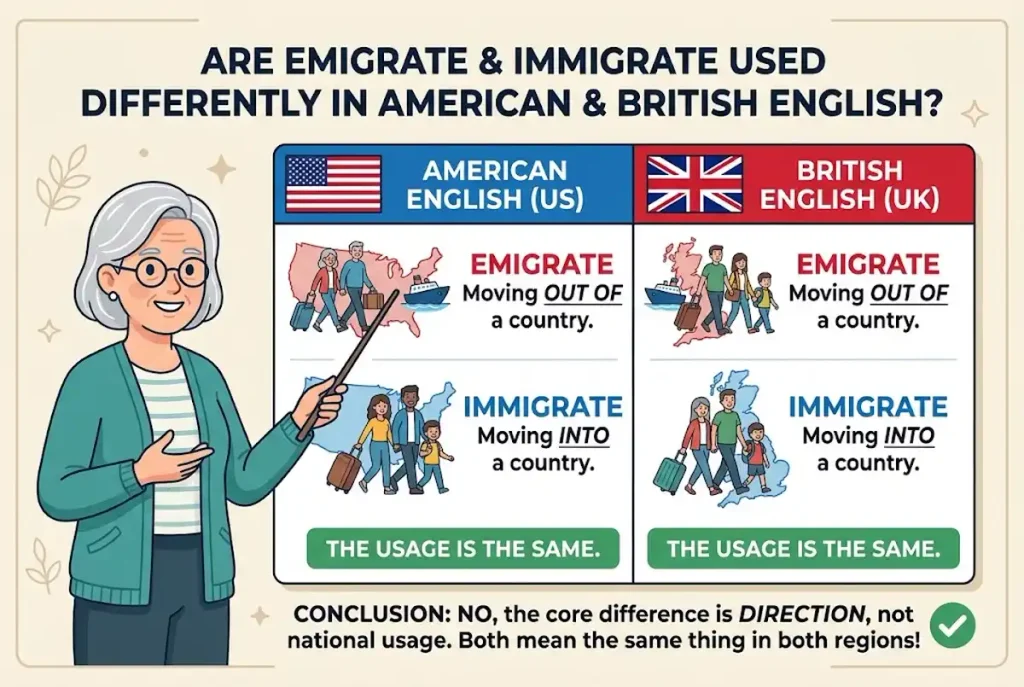
Are Emigrate and Immigrate Used Differently in American and British English?
The meanings of these words are essentially the same in American and British English.
There is no major regional rule that changes their definitions.
Both varieties distinguish between leaving a country and entering another country.
However, the surrounding vocabulary may differ.
| American English | British English | Meaning |
|---|---|---|
| Immigrant | Immigrant | Someone entering a country to live |
| Emigrant | Emigrant | Someone leaving a country |
| Move abroad | Move abroad | Move to another country |
| Green card | Indefinite leave to remain | Different legal residence statuses |
| Immigration attorney | Immigration solicitor or lawyer | Legal professional handling immigration matters |
What About Expat and Immigrant?
Expat is short for expatriate.
It often describes someone living outside their native country, especially in professional or international work settings.
An immigrant is someone who enters another country to establish a home.
These categories can overlap. Expat isn’t a separate legal immigration status, and the label alone doesn’t tell you someone’s nationality, income, or length of stay.
Which Word Should You Use in Different Writing Situations?
The best choice depends on what you’re trying to communicate.
Here are five common situations where these words appear.
How Should You Use Emigrate or Immigrate on a Resume?
Resumes usually focus on professional experience rather than personal migration history.
If international relocation is relevant, use clear language that explains the move without adding unnecessary personal details.
Example:
Relocated from Germany to the United States to pursue an engineering career.
Another option:
Immigrated to Canada in 2020 and continued my professional career in software development.
Relocated is often the more natural choice when describing a career move.
Which Word Is Better in an Academic Essay?
Academic writing requires precision.
Use emigrate when discussing people leaving a country.
Use immigrate when discussing people entering a country.
Example:
Many Irish families emigrated from Ireland during the Great Famine and immigrated to the United States.
This sentence correctly describes both sides of the journey.
For broader population studies, migration may be more useful because it doesn’t automatically emphasize departure or arrival.
How Do You Use These Words in Text Messages?
In casual messages, people often prefer move abroad or move to.
These expressions sound natural and are easy to understand.
Example:
My cousin is planning to move to Australia next summer.
You could also write:
My cousin wants to immigrate to Australia.
Both sentences work, although the second is more specific about establishing residence there.
Which Word Should You Use in a Professional Email?
Professional emails benefit from clear, direct wording.
Use immigrate when discussing plans to establish residence in a destination country.
Example:
I am planning to immigrate to Canada and would appreciate information about the required application process.
If the focus is leaving the current country, use emigrate.
Example:
My family intends to emigrate from France later this year.
Avoid using the two words interchangeably in official correspondence.
How Should You Use Them in Everyday Speaking?
In ordinary conversation, both words are correct.
However, move to and move from are often easier and more natural.
Example:
My grandparents moved from Italy to America many years ago.
A more precise version would be:
My grandparents emigrated from Italy and immigrated to America.
Use the simpler expression when the direction is already obvious.
What Are Some Real Life Examples of Emigrate and Immigrate?
Seeing these words in different situations helps you understand their natural use.
The following examples cover family history, education, employment, and international movement.
Examples Using Emigrate
- My grandfather emigrated from Scotland in 1962.
- Many families emigrated from Europe during the nineteenth century.
- She decided to emigrate from Brazil after receiving a job offer abroad.
- His parents emigrated from Pakistan before he was born.
- The couple plans to emigrate from France next year.
- Some workers emigrate because they want better career opportunities.
Each sentence focuses on the country being left behind.
Examples Using Immigrate
- My uncle immigrated to Canada twenty years ago.
- She hopes to immigrate to the United States after completing her studies.
- The family immigrated to Australia in 2018.
- Many people immigrated to America through Ellis Island.
- His grandparents immigrated to England after World War II.
- They applied for permission to immigrate to New Zealand.
These examples focus on the destination.
Examples Using Both Words Together
Sometimes using both words in one sentence gives readers a complete picture.
- My parents emigrated from India and immigrated to Canada.
- She emigrated from Germany before immigrating to the United States.
- The family emigrated from Mexico and later immigrated to Spain.
- He emigrated from Ireland and immigrated to Australia for work.
Notice that the country following from is the starting point.
The country following to is the destination.
Emigrate vs Migrate What Is the Difference?
Migrate is a broader word than emigrate.
Emigrate specifically describes leaving one country to establish a home in another.
Migrate describes movement between places. It can refer to people, animals, and even movement within a single country.
| Emigrate | Migrate |
|---|---|
| Focuses on leaving a country | Describes movement generally |
| Used for people | Used for people and animals |
| Involves moving abroad | Can involve domestic or international movement |
| Emigrated from Spain | Migrated across Europe |
Immigrate vs Relocate What Is the Difference?
Immigrate specifically describes entering a foreign country to live there.
Relocate simply means moving to another place.
The destination might be another city, state, or country.
| Immigrate | Relocate |
|---|---|
| Involves international movement | Can be domestic or international |
| Focuses on entering a country | Focuses on changing location |
| Common in immigration discussions | Common in business and employment |
| She immigrated to Canada. | She relocated to Toronto. |
What Common Mistakes Should You Avoid?
Even experienced English speakers sometimes mix up these words.
Most mistakes happen because writers forget which country they’re focusing on.
Mistake 1 Using the Wrong Preposition
Incorrect: She emigrated to Canada from India.
Better: She emigrated from India to Canada.
Also correct: She immigrated to Canada from India.
Although the first sentence may be understood, using emigrated from and immigrated to makes the distinction clearer.
Mistake 2 Using Immigrate for Domestic Moves
Incorrect: He immigrated from California to Texas.
Correct: He relocated from California to Texas.
Immigrate involves moving into a different country, not simply moving between states.
Mistake 3 Confusing Immigrant and Emigrant
Incorrect: He was an immigrant from his homeland’s perspective.
Correct: He was an emigrant from his homeland’s perspective.
Remember that the label changes depending on the country being discussed.
Mistake 4 Using Emigrate for Short Vacations
Incorrect: We emigrated to France for a two week vacation.
Correct: We traveled to France for a two week vacation.
Emigrate and immigrate involve establishing a home in another country, not ordinary tourism.
Mistake 5 Assuming Every International Move Is Permanent
People often connect immigration with permanent settlement.
However, immigration terminology can also cover people establishing residence abroad for extended or legally defined periods.
The exact legal meaning depends on the country and immigration category.
A temporary tourist, however, isn’t automatically an immigrant.
What Are the Opposite Words for Emigrate and Immigrate?
These words have no single perfect opposite that works in every sentence.
Their closest opposites depend on the situation.
| Word | Possible Opposite | Example |
|---|---|---|
| Emigrate | Remain | She remained in her home country. |
| Emigrate | Stay | They stayed in Italy. |
| Immigrate | Depart | He departed Canada. |
| Immigrate | Leave | She left her adopted country. |
| Migrate | Remain | The family remained in one place. |
| Relocate | Stay put | They decided to stay put. |
How Can You Remember Emigrate vs Immigrate Easily?
You don’t need to memorize complicated grammar rules to remember these words.
A few simple tricks can help.
Remember E for Exit
Emigrate begins with E.
Exit also begins with E.
Connect these two words in your mind.
Emigrate = Exit your country.
Example:
He emigrated from Spain.
Remember I for In
Immigrate begins with I.
In also begins with I.
Immigrate = Move into another country.
Example:
He immigrated to Canada.
Follow the Direction of the Journey
Imagine a person traveling from Mexico to the United States.
Emigrate
Leaving Mexico
Focus on the exit.
Immigrate
Entering the US
Focus on the arrival.
One journey described from two different perspectives.
The journey stays the same. Only your point of view changes.
Test Your Understanding
Choose the correct word for each sentence.
1. My parents _____ from Italy in 1990.emigratedimmigrated
2. She hopes to _____ to Australia.emigrateimmigrate
3. The family _____ from India to Canada.emigratedimmigrated
4. Many people _____ to the United States each year.emigrateimmigrate
0 of 4 answered · 0 correctTry again
When Should You Avoid Using Emigrate or Immigrate?
Sometimes neither word is the best choice.
Choose more precise language when discussing situations that don’t clearly involve establishing residence in another country.
For example:
- Vacation: Use travel or visit.
- Short business trip: Use travel for work.
- Moving between cities: Use move or relocate.
- Seasonal animal movement: Use migrate.
- Escaping immediate danger: Use flee when that detail is relevant.
- Returning to your original country: Use return or repatriate when appropriate.
The distinction matters because immigration words can suggest a different type of movement than the one you’re describing.
For instance, saying someone immigrated to France for a weekend would give readers the wrong impression.
They visited France instead.
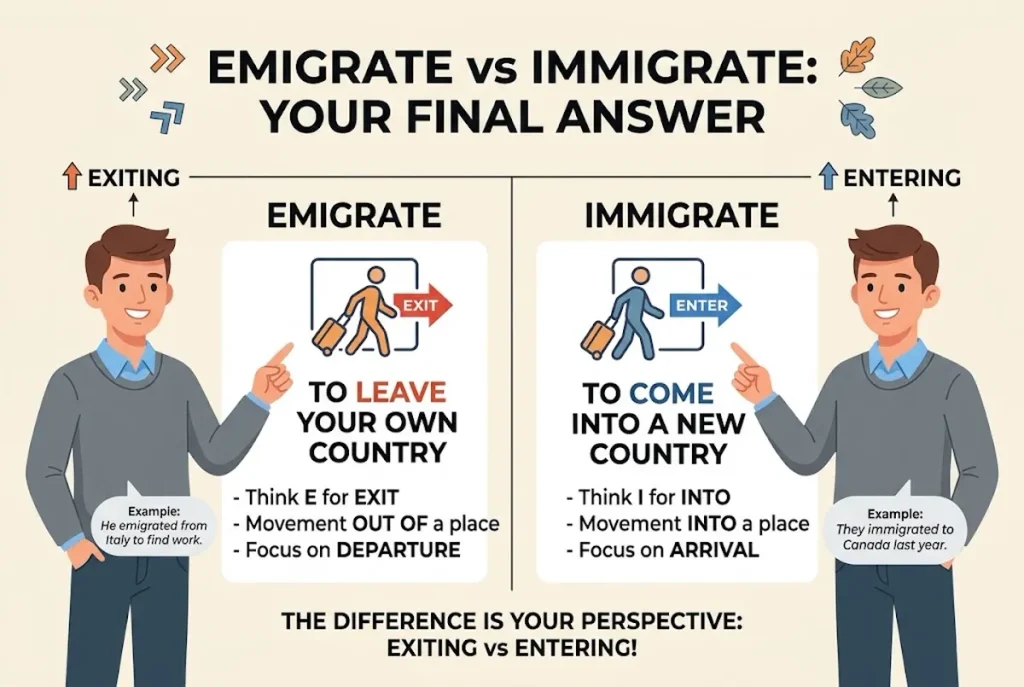
Final Answer About Emigrate vs Immigrate
The difference between emigrate vs immigrate comes down to direction. Emigrate describes leaving your country to establish a home elsewhere, while immigrate describes entering another country to live there.
Both words can describe the same person’s international move. The correct choice depends on the country you’re discussing and the perspective you want readers to understand.
For accurate writing, remember the two most useful patterns: emigrate from and immigrate to. If you’re describing international movement without focusing on either side, migrate or move abroad may be a better option.
These small differences make your writing clearer, especially when discussing family history, education, employment, or population movement. With a little practice, choosing between these words will become a natural part of your English vocabulary.
Conclusion
Understanding the difference between emigrate vs immigrate becomes easy once you remember the direction of movement. Emigrate means leaving your home country to live somewhere else, while immigrate means entering a new country to settle there. Both words can describe the same journey, but they focus on different sides of it.
A simple trick is to remember E for Exit and I for In. For example, someone can emigrate from India and immigrate to Canada. When writing essays, emails, or everyday messages, choosing the correct word makes your meaning clearer and more accurate. Just remember that emigrate focuses on where someone leaves, while immigrate focuses on where someone arrives.
Frequently Asked Questions
What is the difference between emigrate and immigrate?
Emigrate means leaving your country to live elsewhere, while immigrate means entering another country to live there. The difference is the direction of movement.
Can someone be both an emigrant and an immigrant?
Yes. Someone can be an emigrant from their original country and an immigrant in their destination country because both terms describe different perspectives of the same journey.
What’s another way to say emigrate?
Move abroad, relocate overseas, and leave one’s homeland are common alternatives. The best expression depends on the situation and the tone of your writing.
Is it correct to say immigrate from a country?
Immigrate from can appear when the sentence also identifies a destination, but immigrate to is the clearer pattern for describing arrival. For example, she immigrated to Canada from India.
Is migration the same as immigration?
No. Migration is a broader term describing movement between places, while immigration specifically focuses on entering another country to establish residence.
How do I remember emigrate vs immigrate?
Remember E for exit and I for in. Emigrate focuses on leaving a country, while immigrate focuses on entering one.
Do Americans and British people use these words differently?
No. Both American and British English use emigrate for leaving a country and immigrate for entering another country to live.
Can I use emigrate and immigrate in the same sentence?
Yes. For example, my grandparents emigrated from Italy and immigrated to the United States. This correctly describes both sides of their journey.

Daniel Grammarfield — The Language Learner
Age: 28Occupation: ESL Learner & Digital Professional
Bio:Daniel is a non-native English speaker who wants to communicate more confidently at work and online. He uses Synotrench to improve grammar, understand confusing words, learn correct sentence structures, and build everyday English skills. He prefers simple explanations with practical examples.
Goals:
Master English grammar rules
Avoid common language mistakes
Improve professional communication
Learn English through real-life examples
Quote:“Learning English is not about memorizing rules — it’s about expressing ideas clearly.”
3 thoughts on “Emigrate vs Immigrate Simple Guide With Examples (2026)”