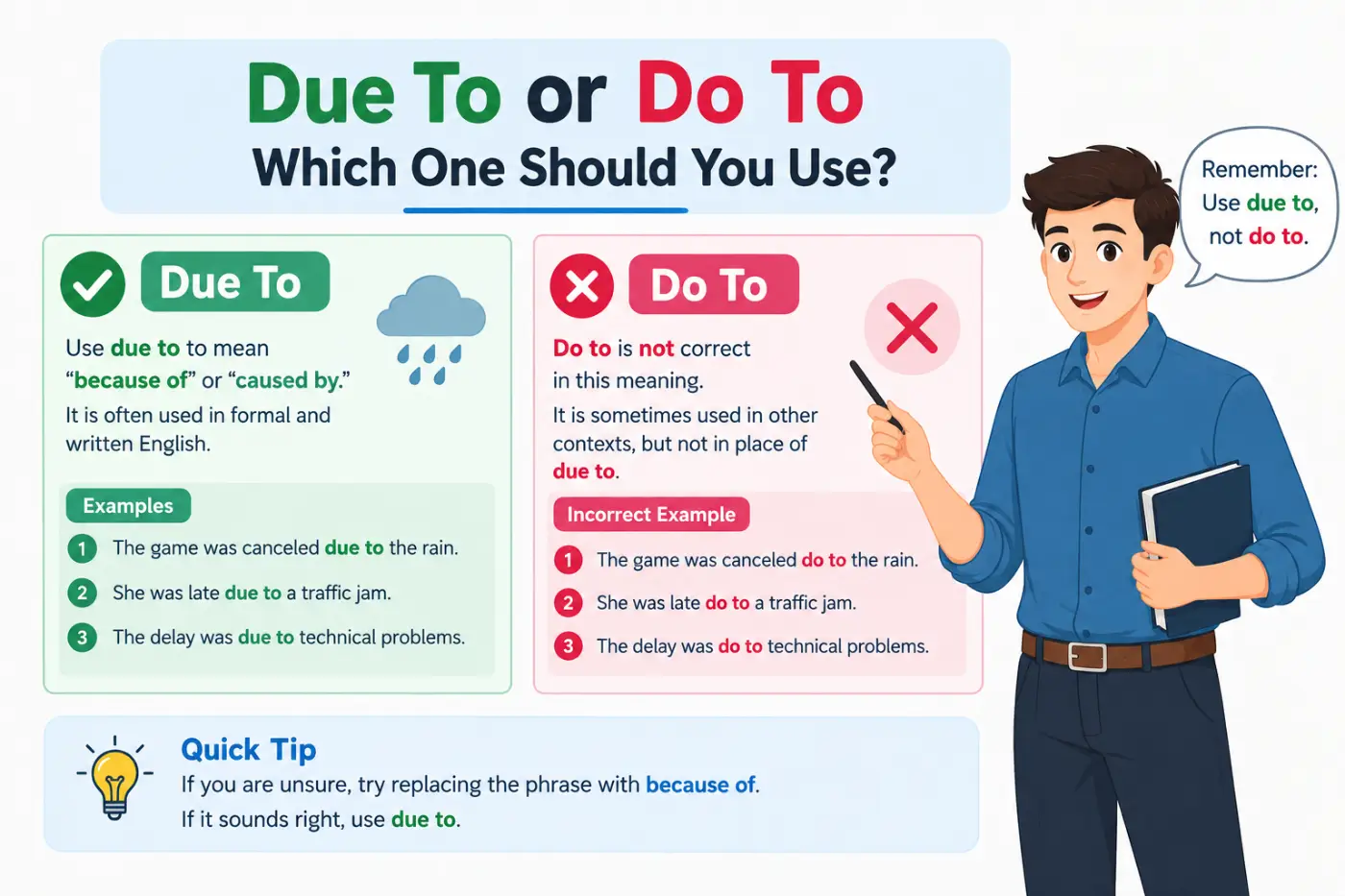
You’re writing an important email and suddenly stop at a sentence: “The meeting was canceled due to bad weather.” But then you wonder if you should write “do to” instead. Both expressions sound similar when spoken, making them easy to confuse.
The confusion between Due To or Do To is common in English writing. Although they sound alike, they have different meanings and grammatical uses. Choosing the wrong one can change your sentence or make it grammatically incorrect.
This guide explains their meanings, word origins, grammar rules, alternatives, and everyday uses. You’ll also find comparison tables, practical examples, common mistakes, and simple tips to help you choose the correct expression every time.
What Does Due To or Do To Mean in Simple English?
The easiest way to understand these expressions is to look at what each one does in a sentence.
Do to combines the verb “do” with the preposition “to.” It describes an action that affects someone or something.
Consider these examples:
- The flight was delayed due to heavy rain.
- What did you do to your phone?
- The school closed due to a power outage.
What Does Due To Mean?
Writers use it when they want to explain the reason behind a particular event, condition, or situation.
Examples:
- The game was postponed due to bad weather.
- Her success was due to years of hard work.
- The road was closed due to construction.
What Does Do To Mean?
Do to isn’t a fixed expression with one special meaning. It combines two separate words that work together in a sentence.
The word “do” is a verb that describes performing an action. The word “to” connects that action to the person or thing affected.
Examples:
- What did you do to my laptop?
- What can stress do to your health?
- I don’t know what to do to fix this problem.
Where Do Due and Do Come From?
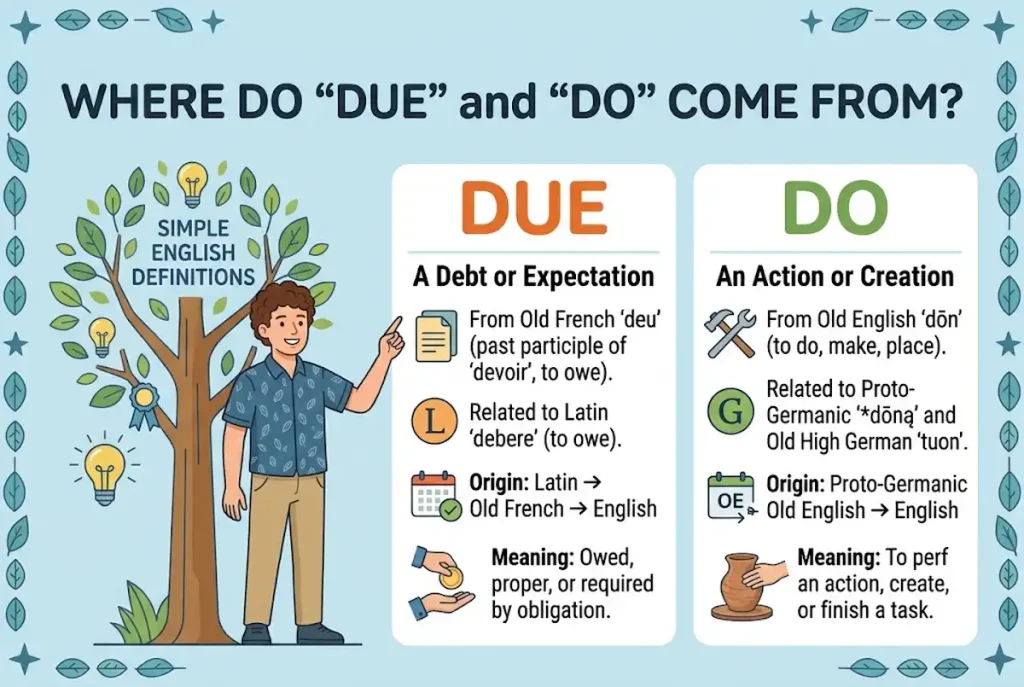
Understanding the history of these words makes their different meanings easier to remember.
Although they sound alike, they developed from different linguistic roots.
The Origin of Due
Its deeper roots trace back to the Latin word “debere,” meaning to owe.
That meaning still appears in everyday expressions:
- Your payment is due tomorrow.
- The assignment is due Friday.
- Give everyone the respect they are due.
The Origin of Do
The verb “do” comes from Old English “dōn,” meaning to perform, make, or carry out an action.
It belongs to the Germanic family of languages and has been part of English for centuries.
Today, it appears in countless everyday expressions:
- Do your homework.
- Do the dishes.
- Do your best.
Why Do People Confuse These Expressions?
The main reason is pronunciation.
In American English, “due” and “do” are generally pronounced the same way. Both commonly sound like “doo.”
As a result, people sometimes write the wrong word because they rely on sound rather than meaning.
The solution is simple: identify the purpose of the expression before choosing its spelling.
What Is the Main Difference Between Due To and Do To?
The most important difference is grammatical function.
| Feature | Due to | Do to |
|---|---|---|
| Main meaning | Because of | Perform an action affecting something |
| Grammar | Prepositional expression | Verb followed by a preposition |
| Main purpose | Explains a cause | Describes an action or effect |
| Common use | Explaining reasons | Asking about actions or consequences |
| Example | Closed due to rain | What did rain do to the crops? |
| Replacement | Because of | Perform an action on or affect |
| Interchangeable? | No | No |
What Are the Best Synonyms for Due To?
The expression has several alternatives, but they aren’t all interchangeable.
Some sound natural in casual conversations. Others work better in academic papers, professional reports, or formal emails.
The following master list includes more than 30 related words and expressions grouped by tone and usage.
Simple Alternatives
These options work well in everyday writing and straightforward explanations.
| Word or Phrase | Meaning | Tone | Example |
|---|---|---|---|
| Because of | For the reason of | Simple | We stayed home because of the rain. |
| Caused by | Produced by something | Simple | The damage was caused by flooding. |
| From | Originating in a cause | Simple | She was tired from working late. |
| Thanks to | Because of a helpful cause | Positive | We finished early thanks to your help. |
| For | On account of a reason | Simple | The store closed for repairs. |
| After | Following an event | Neutral | The roads closed after the storm. |
| Through | By means of something | Neutral | She improved through regular practice. |
| Resulting from | Developing because of something | Neutral | The injury resulted from a fall. |
Everyday Alternatives
These expressions are useful in conversations, emails, and general writing.
| Word or Phrase | Meaning | Tone | Example |
|---|---|---|---|
| As a result of | As a consequence of | Neutral | Sales increased as a result of advertising. |
| Owing to | Because of | Neutral | The match was canceled owing to rain. |
| On account of | For a particular reason | Conversational | He stayed home on account of illness. |
| Thanks to | Because of a positive influence | Positive | We succeeded thanks to teamwork. |
| In light of | Considering a situation | Professional | Plans changed in light of new information. |
| Given | Considering a fact | Neutral | Given the weather, we stayed indoors. |
| Following | After an event | Neutral | Services stopped following the outage. |
| With | Because of a surrounding condition | Conversational | With all that noise, I couldn’t sleep. |
Formal Alternatives
Formal expressions are useful in academic writing, research papers, business reports, and official communication.
| Word or Phrase | Meaning | Tone | Example |
|---|---|---|---|
| Attributable to | Explained by a particular cause | Formal | Growth was attributable to higher demand. |
| As a consequence of | Resulting from an event | Formal | Production stopped as a consequence of the shortage. |
| In consequence of | Because of a previous event | Very formal | Operations changed in consequence of the ruling. |
| By reason of | Because of | Legal | Access was restricted by reason of safety concerns. |
| Arising from | Originating from | Formal | Problems arose from poor planning. |
| Resultant from | Produced by a cause | Technical | The pressure change was resultant from heating. |
| In response to | As a reaction to | Professional | The company acted in response to complaints. |
| In view of | Considering existing circumstances | Formal | The event was postponed in view of safety concerns. |
| On the grounds of | Based on a stated reason | Formal | The request was rejected on the grounds of insufficient evidence. |
| In consideration of | Taking something into account | Formal | The deadline changed in consideration of staffing needs. |
How Do You Choose Synonyms by Intensity?
Not every cause-and-effect expression carries the same emotional weight.
Some simply introduce a reason. Others emphasize responsibility, blame, or a serious consequence.
Understanding these differences helps you select words that match your intended message.
| Intensity | Expression | Typical Use |
|---|---|---|
| Mild | Because of | Explaining a simple reason |
| Mild | Owing to | Giving a neutral explanation |
| Moderate | As a result of | Showing a clear consequence |
| Moderate | Attributable to | Identifying a specific cause |
| Moderate | Caused by | Establishing direct causation |
| Strong | Entirely because of | Emphasizing one main cause |
| Strong | Directly caused by | Highlighting a direct connection |
| Strong | Solely attributable to | Assigning responsibility to one cause |
How Do Synonyms Change by Part of Speech?
A common writing mistake is replacing one expression with another without adjusting the sentence structure.
English words perform different grammatical jobs. Understanding those jobs helps you write more natural sentences.
Prepositional Expressions
These are followed by a noun, pronoun, or noun phrase.
Examples include:
- Because of
- Owing to
- As a result of
- On account of
Conjunctions
Conjunctions connect clauses.
The most useful alternatives include:
- Because
- Since
- As
Verbs
You can also express cause and effect through verbs.
Common choices include:
- Cause
- Trigger
- Produce
- Create
- Lead to
- Result in
Nouns
Useful cause-related nouns include:
- Reason
- Cause
- Source
- Factor
- Origin
- Explanation

Is Due To Used Differently in American and British English?
Its meaning remains essentially the same in both varieties.
However, some related alternatives differ in frequency and tone.
| Expression | American English | British English |
|---|---|---|
| Due to | Common | Common |
| Because of | Very common | Very common |
| Owing to | Accepted, somewhat formal | Common, especially in formal writing |
| On account of | Conversational | Conversational |
| Down to | Understood, less typical in this sense | Common informal expression |
| Attributable to | Formal | Formal |
When Should You Use Each Expression?
Choosing the correct wording depends on the situation, your audience, and the meaning you want to communicate.
The following examples show how to handle common writing situations.
How Should You Use It on a Resume?
Resumes should communicate achievements clearly and professionally.
Use cause-related expressions when explaining measurable results. However, action verbs often make resume statements stronger.
A stronger version:
Improved response times, resulting in higher customer satisfaction.
The second version emphasizes your contribution instead of simply reporting a result.
Avoid using “do to” when describing reasons for achievements.
Which Expression Works Best in an Essay?
Academic essays frequently discuss causes, consequences, and relationships between events.
Useful expressions include “because of,” “owing to,” “as a result of,” and “attributable to.”
Alternative:
The population declined as a result of limited access to clean water.
Choose wording that accurately reflects the strength of the evidence.
If research identifies only a possible contributing factor, avoid suggesting that it was the sole cause.
What Should You Write in a Text Message?
Text messages usually sound better with simple, conversational language.
Example:
Sorry, I’m late because of traffic.
Both are understandable, although “because of” often sounds more relaxed.
Use the other expression when discussing an action.
Example:
What did you do to my headphones?
What Are Some Real-Life Example Sentences?
Seeing both expressions in different situations helps you recognize the correct choice naturally.
Examples Using Due To
- The concert was canceled due to severe weather.
- Several employees arrived late due to road construction.
- The restaurant closed early due to a plumbing problem.
- Her excellent grades were due to consistent studying.
- The website stopped working due to a server failure.
Examples Using Do To
- What did you do to the kitchen?
- What can too much sunlight do to your skin?
- I wonder what the storm will do to our garden.
- What should we do to improve customer service?
- What did the mechanic do to your car?
Due To vs Because Of: What’s the Difference?
These two expressions are close in meaning, but they have slightly different grammatical histories.
Traditionally, “due to” was treated as an adjective-like expression meaning “caused by.”
Example:
The event was canceled because of bad weather.
Modern English widely accepts both expressions in many of the same positions.
| Due to | Because of |
|---|---|
| Often sounds slightly formal | Sounds natural in most situations |
| Common in reports and notices | Common in speech and writing |
| Identifies a cause | Introduces a reason |
| The delay was due to rain. | The delay happened because of rain. |
Due To vs Owing To: Which One Sounds Better?
Both expressions introduce reasons, and they often communicate almost identical meanings.
Their main difference is tone and usage frequency.
| Due to | Owing to |
|---|---|
| Common in everyday English | Slightly more formal |
| Popular in American writing | Familiar in British formal writing |
| Suitable for emails and reports | Suitable for notices and official statements |
| The delay was due to rain. | The delay was owing to rain. |
Do To vs Do For: What’s the Difference?
These combinations are also easy to confuse.
“Do to” commonly describes an action affecting someone or something.
“Do for” often describes an action performed for someone’s benefit or on someone’s behalf.
Compare them:
| Do to | Do for |
|---|---|
| What did you do to my computer? | What can I do for you? |
| What will the storm do to the house? | What can this service do for customers? |
| Focuses on an action or effect | Often focuses on assistance or benefit |
What Are the Most Common Grammar Mistakes?
Even experienced writers sometimes confuse similar-sounding words.
The following mistakes are particularly common.
Mistake 1: Using Do To When Explaining a Reason
Incorrect: The match was canceled do to rain.
Correct: The match was canceled due to rain.
The sentence explains why the match was canceled, so the cause-related expression is required.
Mistake 2: Using Due To When Asking About an Action
Incorrect: What did you due to my phone?
Correct: What did you do to my phone?
The sentence asks about an action performed on the phone.
Mistake 3: Confusing Due With Do
Incorrect: My homework is do tomorrow.
Correct: My homework is due tomorrow.
When Should You Avoid Using Due To?
The expression is grammatically acceptable in many situations, but it isn’t always the clearest choice.
Avoid it when another construction expresses your meaning more directly.
For example:
Better: Because the system failed, we stopped working.
The second sentence is shorter and easier to understand.
Also avoid repeating the same cause-related expression several times in one paragraph.
Improved:
The event was delayed because of rain. Transportation problems reduced attendance, and several speakers were absent because they were ill.
The revised version communicates the same information with more natural sentence variety.
What Are the Opposites of Due To?
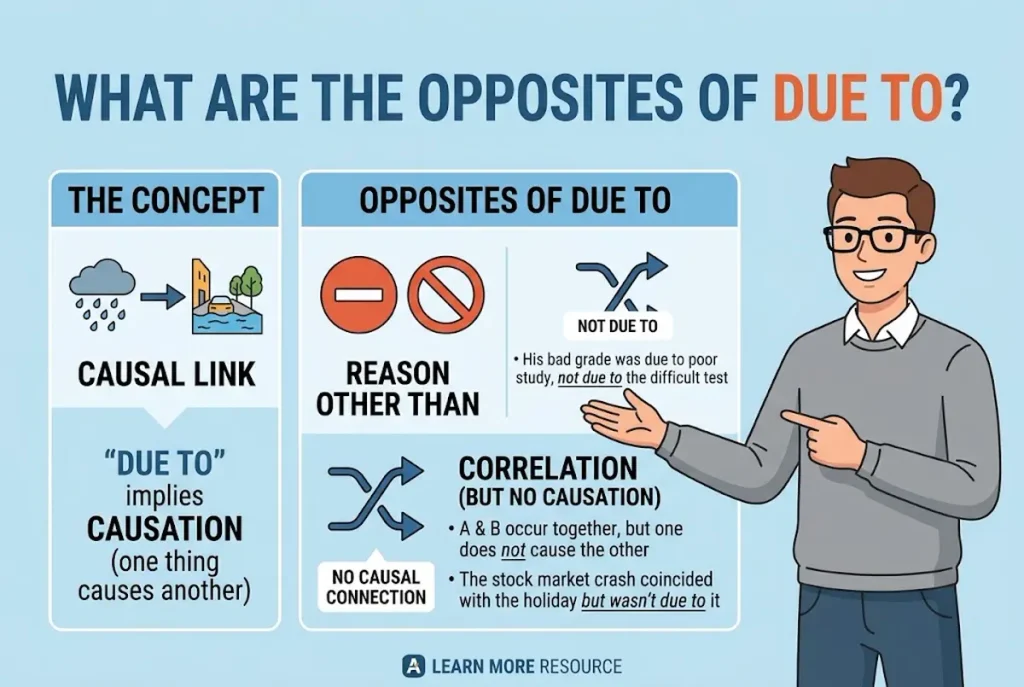
There isn’t one exact antonym for the entire expression.
However, several words and phrases express contrast, absence of cause, or an unexpected outcome.
| Expression | Meaning | Example |
|---|---|---|
| Despite | Something happened regardless of a condition | We traveled despite the rain. |
| In spite of | Regardless of an obstacle | She succeeded in spite of difficulties. |
| Regardless of | Without being affected by something | The event continued regardless of the weather. |
| Not because of | Rejects a suggested cause | He left early, not because of boredom. |
| Unrelated to | Indicates no relevant connection | The failure was unrelated to the update. |
| Independent of | Not dependent on something | The results were independent of age. |
Quick Tips for Choosing the Correct Expression
- Look for an action. If someone performs an action affecting something, choose “do to.”
- Check the surrounding grammar. “What did you…” usually needs the verb “do.”
- Read the entire sentence instead of judging the expression by sound.
Conclusion
Understanding Due To or Do To becomes much easier once you focus on meaning rather than pronunciation. One expression introduces a cause, while the other combines a verb and preposition to describe an action or its effect.
For professional writing, “due to” is useful when explaining delays, changes, problems, and results. You can also choose alternatives such as “because of,” “owing to,” or “as a result of” when they better match your sentence.
Use “do to” when discussing actions performed on someone or something. Always check the surrounding words because context determines its meaning.
The simplest proofreading trick is to ask yourself one question: Am I explaining a reason or describing an action? Once you know the answer, choosing the correct spelling becomes much easier.
Frequently Asked Questions
Is It Due To or Do To?
Both are correct, but they serve different purposes. “Due to” means because of, while “do to” describes an action performed on or affecting someone or something.
Can I Use Due To Instead of Because Of?
Yes. These expressions are interchangeable in many modern English sentences, although their traditional grammatical uses differ slightly.
Is Do To Grammatically Correct?
Yes. “Do to” is correct when the verb “do” is followed by the preposition “to,” as in “What did you do to my computer?”
What’s Another Way to Say Due To?
Common alternatives include “because of,” “owing to,” “as a result of,” and “caused by.” Choose the expression that fits your sentence structure and tone.
What Is the Difference Between Words?
“Due” can mean expected, owed, scheduled, or caused by when used in certain expressions. “Do” is a verb meaning to perform or carry out an action.

Daniel Grammarfield — The Language Learner
Age: 28Occupation: ESL Learner & Digital Professional
Bio:Daniel is a non-native English speaker who wants to communicate more confidently at work and online. He uses Synotrench to improve grammar, understand confusing words, learn correct sentence structures, and build everyday English skills. He prefers simple explanations with practical examples.
Goals:
Master English grammar rules
Avoid common language mistakes
Improve professional communication
Learn English through real-life examples
Quote:“Learning English is not about memorizing rules — it’s about expressing ideas clearly.”
3 thoughts on “Due To or Do To: Simple Guide With Examples (2026)”