You’re writing an email, school essay, or professional report when you suddenly stop at one word. Should you write disfunction or dysfunction? Both spellings look reasonable, and the prefix dis appears in many familiar English words. However, choosing the wrong spelling can make an otherwise polished sentence look careless.
The confusion is understandable. English contains words such as dislike, disconnect, and disagree. That pattern might make disfunction seem correct. But English spelling doesn’t always follow the pattern we expect.
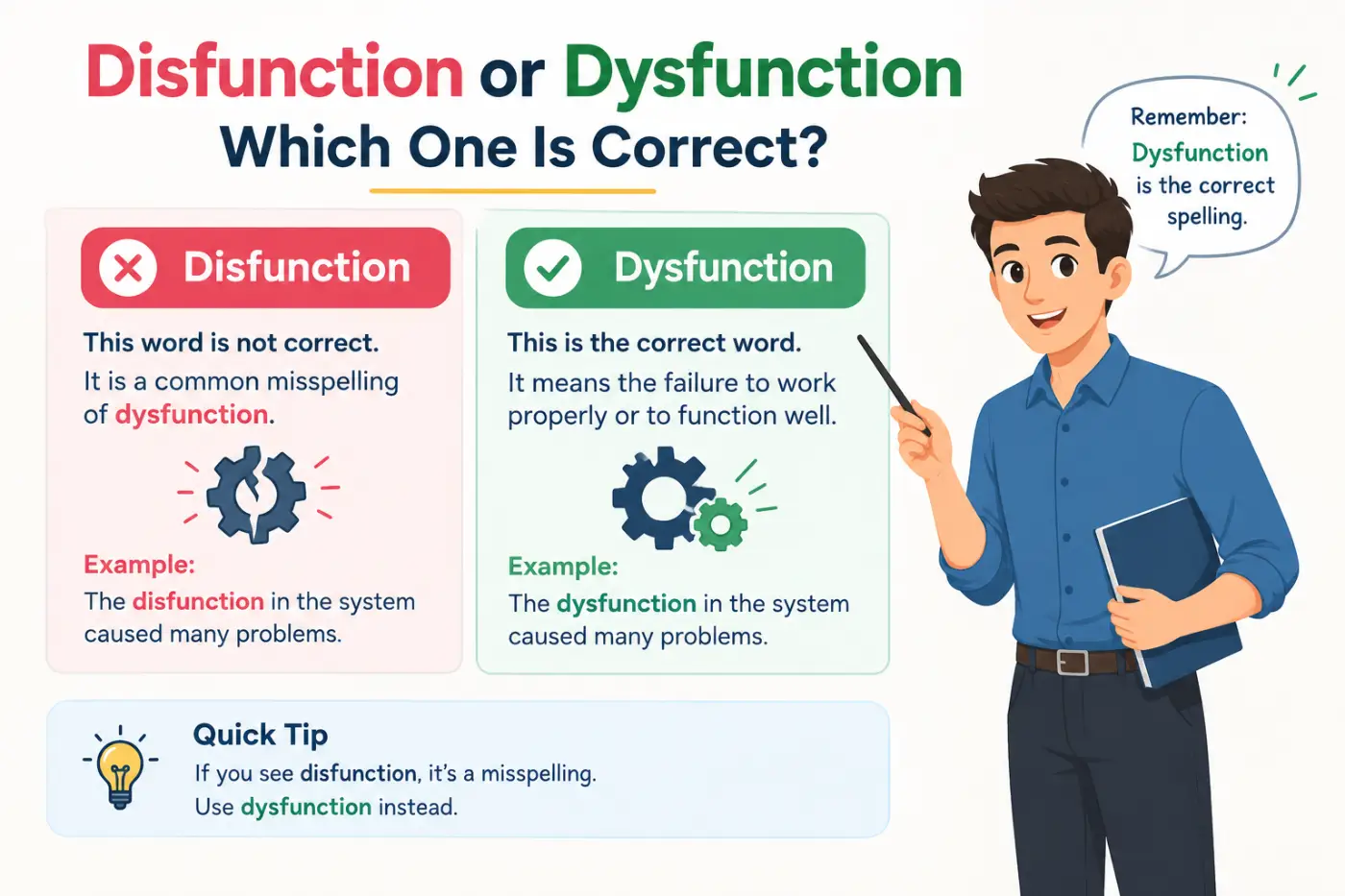
Dysfunction is the correct standard spelling. It means that something isn’t working normally or properly. Disfunction is a nonstandard spelling that you should avoid in modern English writing.
This guide explains the meaning, spelling, origin, synonyms, and everyday uses of dysfunction. You’ll also find more than 30 related words, practical examples, common mistakes, and simple tips for choosing the right expression in different situations.
What Is the Difference Between Disfunction and Dysfunction?
The main difference is spelling. Dysfunction is the accepted standard English word, while disfunction is generally considered a misspelling or nonstandard variant.
Dysfunction describes a problem with the normal operation of something. It can refer to a person’s body, a relationship, a family, a workplace, or an entire organization.
For example:
- The company experienced serious dysfunction after changing its management team.
- Poor communication created dysfunction within the family.
- The doctor explained the possible causes of thyroid dysfunction.
- Organizational dysfunction made it difficult for employees to complete their work.
Each sentence describes something that isn’t functioning as expected.
Quick Comparison Table
| Word | Status | Meaning | Recommended Use |
|---|---|---|---|
| Dysfunction | Standard spelling | Abnormal, impaired, or ineffective functioning | Correct for general writing |
| Disfunction | Nonstandard spelling | Sometimes used with the intended meaning of dysfunction | Avoid in edited English |
| Dysfunctional | Standard adjective | Not working normally or effectively | Describes a person, system, or situation |
| Malfunction | Standard word | Failure to operate correctly | Often describes machines or equipment |
What Does Dysfunction Mean in Simple English?
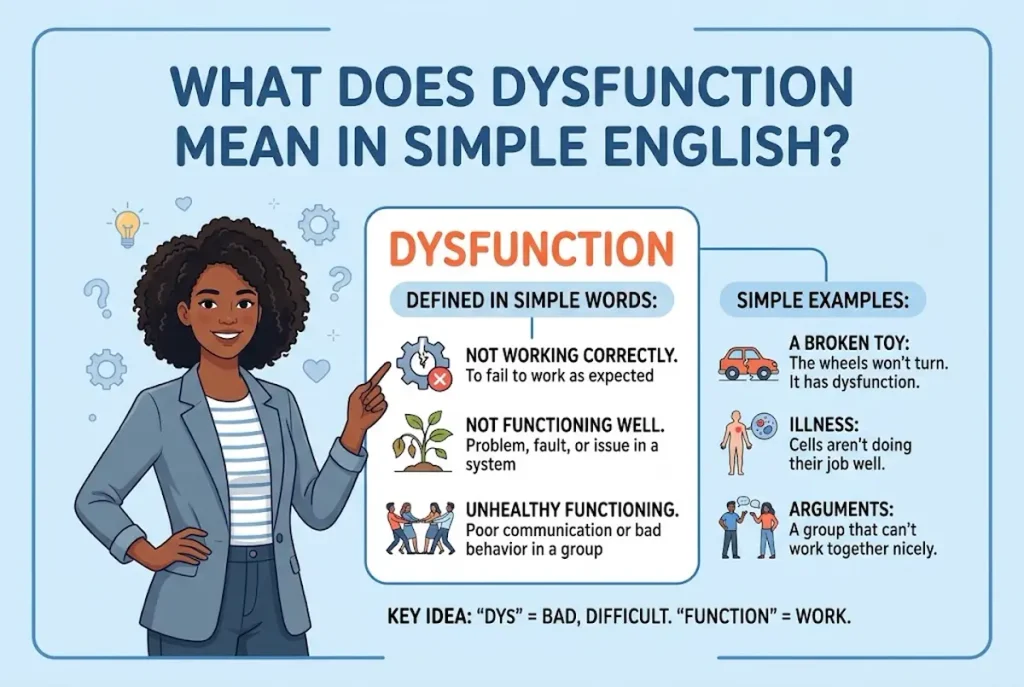
Dysfunction means that something isn’t working the way it normally should.
The word can describe physical, emotional, social, technical, or organizational problems. Its exact meaning depends on the subject being discussed.
For instance, a medical professional might use dysfunction to describe an organ that isn’t operating normally. A business manager might use the same word to describe a department struggling with poor communication and unclear responsibilities.
Common Meanings of Dysfunction
| Area | Meaning | Example |
|---|---|---|
| Medical | Abnormal functioning of a body part or system | The patient showed signs of kidney dysfunction. |
| Family | Unhealthy patterns that affect family relationships | Constant arguments contributed to family dysfunction. |
| Workplace | Problems that prevent effective teamwork | Workplace dysfunction reduced productivity. |
| Technology | A system that doesn’t operate as expected | The investigation identified a software malfunction. |
| Social | Problems affecting the normal operation of a group | Social dysfunction weakened cooperation. |
| Organizational | Ineffective structures or processes | Organizational dysfunction delayed important decisions. |
Where Does the Word Dysfunction Come From?
Understanding the word’s origin makes its spelling easier to remember.
Dysfunction combines two parts:
- Dys, a prefix derived from Greek that expresses difficulty, abnormality, or impaired functioning.
- Function, a word connected to performing a task, operating, or fulfilling a purpose.
Together, these parts create the meaning of abnormal or impaired functioning.
The prefix dys appears in several medical and scientific terms.
| Word | Simple Meaning |
|---|---|
| Dysfunction | Impaired or abnormal functioning |
| Dyslexia | A learning difficulty involving reading and related language skills |
| Dysphagia | Difficulty swallowing |
| Dysplasia | Abnormal development of cells or tissues |
| Dysregulation | Difficulty maintaining normal regulation |
| Dyspepsia | Indigestion |
Why Do People Write Disfunction Instead?
The confusion comes from the familiar English prefix dis.
This prefix commonly expresses separation, reversal, absence, or opposition.
Consider these examples:
- Disagree means to have a different opinion.
- Disconnect means to break a connection.
- Disapprove means to have an unfavorable opinion.
Because these words are common, some writers naturally apply the same spelling pattern to function.
However, dysfunction uses the Greek-derived prefix dys. Its established spelling reflects that origin.
What Are the Best Synonyms for Dysfunction?
The best synonym depends on the situation. Dysfunction can describe anything from a minor operational problem to a serious failure affecting an entire organization.
Some alternatives are simple and conversational. Others belong mainly in medical, academic, or professional writing.
The following tables provide more than 30 related words and expressions. They aren’t all exact substitutes. Each captures a particular aspect of impaired or ineffective functioning.
Simple Synonyms
These alternatives work well when you want readers to understand the problem without needing specialized vocabulary.
| Word | Meaning | Tone | Example |
|---|---|---|---|
| Problem | Something causing difficulty | Simple | The system has a problem. |
| Trouble | An issue preventing normal progress | Casual | We’re having trouble with the equipment. |
| Issue | A matter that needs attention | Neutral | The department has several issues. |
| Failure | An inability to perform successfully | Direct | The equipment failure stopped production. |
| Fault | Something wrong with a system or process | Neutral | Engineers discovered a fault. |
| Error | A mistake or incorrect result | Neutral | An error interrupted the process. |
| Difficulty | Something that makes a task harder | Simple | The team experienced communication difficulties. |
| Weakness | An area that doesn’t perform well | Neutral | Poor planning exposed a weakness in management. |
Everyday Synonyms
Everyday alternatives are especially useful in conversations, emails, workplace discussions, and general articles.
| Word | Meaning | Tone | Example |
|---|---|---|---|
| Breakdown | A failure in normal operation | Everyday | A communication breakdown delayed the project. |
| Disruption | An interruption to normal activity | Neutral | The outage caused major disruption. |
| Complication | Something making a situation harder | Neutral | Unexpected complications slowed progress. |
| Disorder | A lack of normal order or functioning | Neutral | The department fell into disorder. |
| Confusion | A lack of clear understanding | Everyday | Confusion affected the entire team. |
| Inefficiency | Poor use of time, effort, or resources | Professional | Inefficiency increased operating costs. |
| Instability | A lack of steady or reliable functioning | Neutral | Leadership changes created instability. |
| Mismanagement | Poor handling of responsibilities | Critical | Mismanagement weakened the organization. |
| Conflict | Serious disagreement between people | Neutral | Repeated conflict damaged team relationships. |
| Disorganization | A lack of effective structure | Everyday | Disorganization delayed the event. |
Formal Synonyms
Formal alternatives are useful in academic papers, research reports, medical discussions, and professional documents.
| Word | Meaning | Tone | Example |
|---|---|---|---|
| Impairment | Reduced ability to function | Medical/Formal | The examination revealed functional impairment. |
| Malfunction | Incorrect operation of a system | Technical | A sensor malfunction affected the readings. |
| Abnormality | Something outside the expected pattern | Formal | Testing identified an abnormality. |
| Deficiency | An important shortage or weakness | Formal | The report identified a procedural deficiency. |
| Irregularity | A departure from normal operation | Formal | Inspectors noticed several irregularities. |
| Inadequacy | Failure to meet required standards | Formal | The audit exposed inadequacies in oversight. |
| Ineffectiveness | Failure to produce intended results | Formal | The policy’s ineffectiveness became clear. |
| Deterioration | A gradual decline in condition | Formal | Researchers observed functional deterioration. |
| Dysregulation | Impaired control of a normal process | Scientific | The study examined emotional dysregulation. |
| Pathology | A disease process or abnormal condition | Medical | The specialist investigated the underlying pathology. |
Slang and Informal Alternatives
These expressions are suitable for relaxed conversations and personal messages. Most aren’t appropriate for academic or medical writing.
| Word or Phrase | Meaning | Tone | Example |
|---|---|---|---|
| Mess | A poorly organized situation | Informal | The whole project became a mess. |
| Glitch | A small technical problem | Casual | The app experienced another glitch. |
| Mix-up | Confusion or an arrangement mistake | Casual | A scheduling mix-up delayed the meeting. |
| Snafu | A confused or badly handled situation | Slang | Another paperwork snafu slowed approval. |
| Chaos | Serious disorder or confusion | Informal | The office descended into chaos. |
| Train wreck | A situation that goes badly wrong | Slang | The presentation became a train wreck. |
| Out of whack | Not working or balanced properly | Informal | The settings are out of whack. |
| On the fritz | Not operating reliably | Slang | My laptop is on the fritz again. |
Which Synonym Shows the Right Level of Severity?
Not every problem deserves the same level of language.
A minor inconvenience isn’t necessarily a breakdown, and an occasional disagreement doesn’t automatically indicate serious dysfunction.
The following scale can help you choose a word that matches the seriousness of the situation.
| Intensity | Suggested Word | Typical Situation |
|---|---|---|
| Very mild | Issue | A small concern needs attention. |
| Mild | Difficulty | Something requires additional effort. |
| Mild | Glitch | A temporary technical problem occurs. |
| Moderate | Disruption | Normal activity is interrupted. |
| Moderate | Inefficiency | A process produces poor results. |
| Moderate | Impairment | Normal functioning is reduced. |
| Serious | Dysfunction | A system experiences impaired functioning. |
| Strong | Breakdown | An important process stops working. |
| Very strong | Collapse | A system or structure fails extensively. |
How Can You Avoid Exaggerating a Problem?
Describe the actual effect instead of automatically choosing the strongest expression.
Compare these sentences:
- The team experienced a minor scheduling issue.
- The team experienced repeated communication problems.
- Persistent organizational dysfunction prevented the team from completing essential tasks.
Each sentence communicates a different level of concern.
Using the correct intensity makes your writing more trustworthy.
Is Dysfunction a Noun or an Adjective?
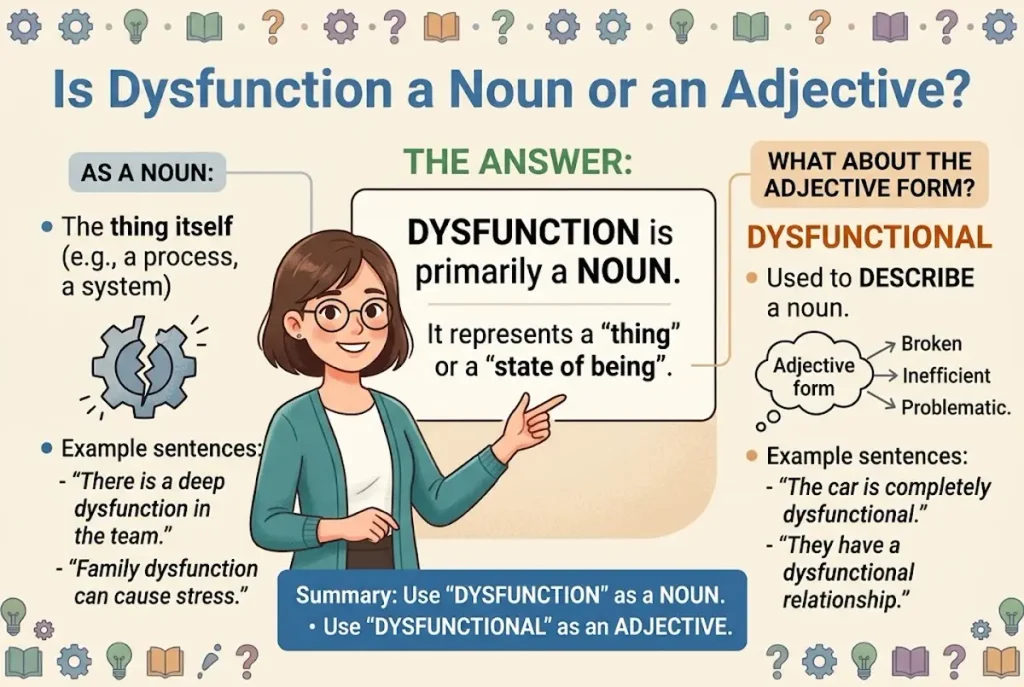
Dysfunction is a noun. Its related adjective is dysfunctional.
Choosing the correct part of speech helps your sentence sound natural and grammatically correct.
| Part of Speech | Word | Example |
|---|---|---|
| Noun | Dysfunction | Dysfunction affected the organization. |
| Adjective | Dysfunctional | The organization became dysfunctional. |
| Noun | Function | The function of this device is to measure temperature. |
| Adjective | Functional | The device remains functional. |
| Verb | Function | The device should function normally. |
| Adverb | Dysfunctionally | The department operated dysfunctionally. |
Dysfunction vs Dysfunctional
The difference is straightforward.
Dysfunction names the problem, while dysfunctional describes something affected by that problem.
Examples:
- The investigation revealed dysfunction within the department.
- The investigation revealed a dysfunctional department.
Both sentences are correct, but they use different grammatical structures.
Is the Spelling Different in American and British English?
No. Dysfunction is the standard spelling in both American and British English.
Unlike color and colour or organize and organise, this word doesn’t normally change its spelling between the two varieties.
| English Variety | Standard Spelling | Example |
|---|---|---|
| American English | Dysfunction | The report identified workplace dysfunction. |
| British English | Dysfunction | The report identified workplace dysfunction. |
| Canadian English | Dysfunction | The organization experienced dysfunction. |
| Australian English | Dysfunction | The system showed signs of dysfunction. |
Which Word Should You Use in Different Writing Situations?
Your audience determines how formal or specific your vocabulary should be.
Dysfunction works in several settings, but it isn’t always the clearest choice.
What Should You Use on a Resume?
A resume should emphasize professional achievements, responsibilities, and measurable improvements.
Instead of using negative or overly technical language, describe the problem you solved.
For example:
- Identified workflow inefficiencies and improved task completion rates.
- Resolved communication problems between departments.
- Improved team coordination by introducing clearer reporting procedures.
Avoid describing a former employer as dysfunctional. That wording can sound unnecessarily critical.
A stronger resume focuses on your actions and results.
What Should You Use in an Academic Essay?
Dysfunction is appropriate in academic writing when you’re discussing impaired social, biological, psychological, or organizational functioning.
Example:
Persistent organizational dysfunction can reduce employee motivation and weaken decision-making.
However, choose a more specific term when the evidence supports one.
If your essay discusses poor leadership, mismanagement may be more precise. If it discusses abnormal biological activity, impairment or dysfunction might be appropriate.
What Should You Use When Texting?
Everyday messages usually sound better with simple alternatives.
Examples:
- My phone isn’t working properly.
- This app keeps glitching.
- Our group chat is a complete mess.
- Something’s wrong with the booking system.
You can use dysfunction in a text, but it may sound unusually formal when describing a small problem.
What Should You Use in a Professional Email?
Professional emails benefit from neutral language that identifies a problem without unnecessarily blaming someone.
Example:
We’ve identified an issue with the current reporting process and are working to resolve it.
Other useful expressions include:
- Operational difficulties
- Communication problems
- System malfunction
- Workflow inefficiencies
- Process irregularities
Use dysfunction when you’re describing a broader pattern of ineffective functioning rather than one isolated mistake.
What Should You Use in Everyday Speaking?
In conversation, the simplest word is often the best.
Examples:
- Something isn’t working right.
- There’s a problem with the system.
- Our team has trouble communicating.
- The whole process has become disorganized.
Dysfunction is still appropriate when discussing a serious or ongoing issue.
For example:
The documentary examines dysfunction within the political system.
The key is to match your vocabulary to the topic and the person listening.
How Do You Use Dysfunction in a Sentence?
The following original examples show how the word works across different real-life situations.
Medical Examples
- The specialist ordered additional tests to investigate possible liver dysfunction.
- Early treatment may help manage certain forms of thyroid dysfunction.
- The medical report described impaired cardiac function.
- Researchers examined the relationship between sleep disruption and cognitive dysfunction.
Workplace Examples
- Poor communication contributed to dysfunction across several departments.
- The new manager introduced clearer procedures to address organizational dysfunction.
- Repeated leadership changes created instability within the company.
- The audit identified several operational weaknesses.
Family and Relationship Examples
- The novel explores how family dysfunction affects relationships between siblings.
- Constant disagreements created tension throughout the household.
- The counselor discussed unhealthy communication patterns within the family.
- Unresolved conflict made cooperation increasingly difficult.
Technology Examples
- Engineers investigated a malfunction in the monitoring equipment.
- A software error prevented the application from saving information.
- The technician discovered that the device wasn’t functioning correctly.
- A network failure interrupted communication between the computers.
Academic and Social Examples
- The research examined the effects of institutional dysfunction on public services.
- Social instability made long-term planning difficult.
- The report connected administrative inefficiency with delayed decision-making.
- Researchers studied how organizational structures influence employee performance.
These examples also demonstrate an important writing principle: you don’t need to repeat dysfunction in every sentence.
Using a precise alternative often makes your message clearer.
Dysfunction vs Malfunction: What’s the Difference?
These two words share a similar general meaning, but they aren’t always interchangeable.
Dysfunction often describes impaired functioning in biological, psychological, social, or organizational contexts.
Malfunction usually refers to something operating incorrectly, especially a machine, device, or technical system.
| Dysfunction | Malfunction |
|---|---|
| Often describes ongoing impaired functioning | Often describes an operational fault |
| Common in medical and social contexts | Common in technical contexts |
| Can describe complex patterns | Often identifies a specific operating problem |
| Example: Organizational dysfunction affected productivity. | Example: A printer malfunction delayed the report. |
Dysfunction vs Disorder: Are They the Same?
Not exactly.
Dysfunction describes impaired or abnormal functioning. Disorder can refer to a lack of order or to a recognized medical or psychological condition.
| Dysfunction | Disorder |
|---|---|
| Focuses on impaired functioning | May describe disorganization or a recognized condition |
| Can refer to a symptom or functional problem | Can refer to a defined diagnostic category |
| Doesn’t automatically indicate a diagnosed disease | May have a specific clinical definition |
| Example: The examination revealed swallowing dysfunction. | Example: The patient received a diagnosis of a swallowing disorder. |
Dysfunction vs Inefficiency: Which Is More Accurate?
Dysfunction and inefficiency overlap in workplace discussions, but they emphasize different problems.
Inefficiency means that something uses more time, money, effort, or resources than necessary.
Dysfunction describes impaired functioning more broadly.
For example:
- Inefficiency: Employees spend three hours completing a task that should take one hour.
- Dysfunction: Conflicting instructions and unclear responsibilities repeatedly prevent employees from completing their tasks.
An inefficient process may still work consistently. A dysfunctional process may have deeper problems involving communication, structure, or decision-making.
Choose inefficiency when wasted resources are the main concern.
Choose dysfunction when the normal operation of a system is impaired.
What Are the Most Common Mistakes With Dysfunction?
Even when writers know the correct spelling, they sometimes use the word incorrectly.
Understanding these mistakes can help you avoid awkward or misleading sentences.
Mistake 1: Using the Wrong Prefix
Incorrect: The report identified serious disfunction.
Correct: The report identified serious dysfunction.
The standard word begins with dys.
Mistake 2: Confusing the Noun and Adjective
Incorrect: The company has a dysfunction management system.
Correct: The company has a dysfunctional management system.
Use dysfunctional when directly describing a noun.
Mistake 3: Using Dysfunction for Every Small Problem
Less suitable: My coffee maker experienced serious dysfunction because I forgot to plug it in.
Better: My coffee maker wasn’t working because I forgot to plug it in.
The simpler sentence explains the situation without exaggeration.
What Are the Opposites of Dysfunction?
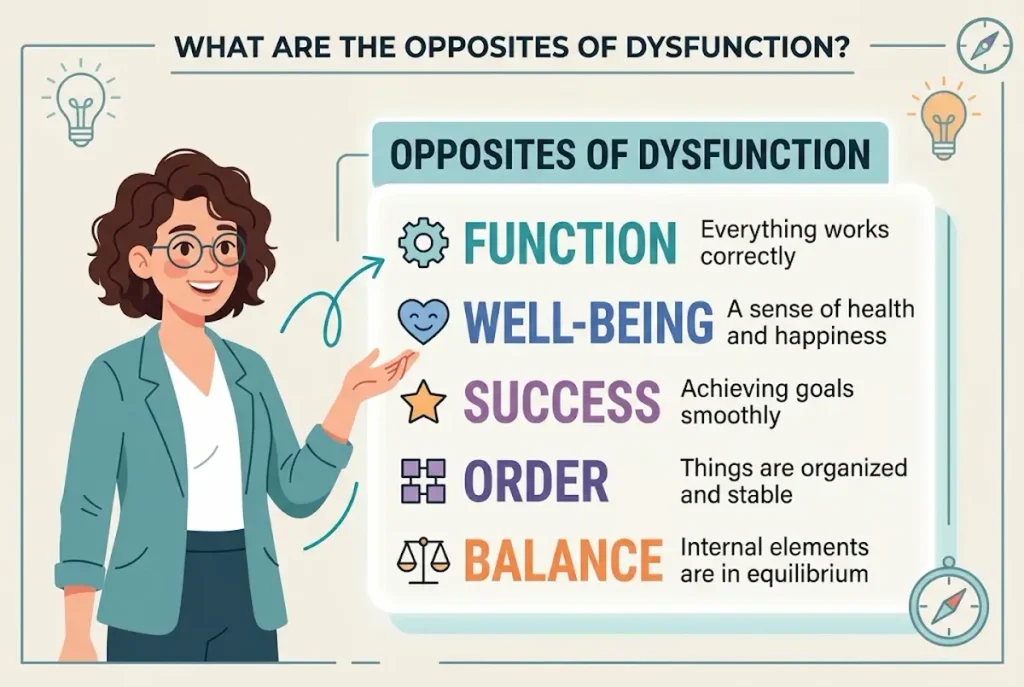
The most suitable antonym depends on the context.
There isn’t one perfect opposite that works in every sentence.
| Antonym | Meaning | Example |
|---|---|---|
| Function | Normal operation | The device performs its intended function. |
| Functionality | Ability to operate properly | The update restored full functionality. |
| Efficiency | Effective use of resources | Better planning improved efficiency. |
| Stability | A steady and reliable condition | Clear leadership restored stability. |
| Effectiveness | Ability to achieve intended results | Training improved team effectiveness. |
| Coordination | Organized cooperation | Better coordination reduced delays. |
| Harmony | Peaceful agreement or cooperation | Open communication encouraged harmony. |
| Proper functioning | Operation as expected | Regular maintenance supports proper functioning. |
How Can You Remember the Correct Spelling?
If you frequently confuse Disfunction or Dysfunction, a few simple memory tricks can help.
Remember the Dys Prefix
Think of other familiar words that begin with dys, such as dyslexia and dysphagia.
These words share the same Greek-derived prefix.
Connect It With Dysfunctional
Many people recognize dysfunctional from expressions such as dysfunctional family or dysfunctional workplace.
Remembering the adjective can help you spell the related noun correctly.
Dysfunctional becomes dysfunction when you remove the final al.
Quick Tips for Choosing the Right Word
Good word choice involves more than checking spelling. You also need to consider meaning, audience, and context.
Use these simple guidelines when editing your work.
- Choose dysfunction when describing impaired or abnormal functioning.
- Use dysfunctional when the word directly describes a person, system, organization, or relationship.
- Choose malfunction when discussing a machine or technical fault.
- Use inefficiency when wasted time, money, or resources are the main problem.
- Choose breakdown when an important process or connection has failed.
- Use issue or problem when a simpler expression communicates the meaning clearly.
- Avoid exaggerated language when describing minor inconveniences.
- Use medical terminology carefully and accurately.
- Keep the spelling consistent in American and British English.
- Read your sentence aloud to check that the vocabulary sounds natural.
One final tip: identify the specific problem before choosing a synonym.
If you can describe exactly what’s wrong, you’ll usually find a clearer word.
Conclusion
The answer to Disfunction or Dysfunction is straightforward: dysfunction is the accepted standard spelling in modern English. It describes impaired or abnormal functioning and works in medical, social, academic, and professional contexts.
However, spelling is only part of effective communication. Choosing the most accurate word matters just as much. Malfunction may better describe a faulty device, while inefficiency can explain wasted resources. Words such as problem, difficulty, and breakdown may also fit particular situations more naturally.
Remember the Greek-derived prefix dys, and connect the spelling with the familiar adjective dysfunctional. This simple association can help you avoid future mistakes. With a clear understanding of the word’s meaning, grammar, and alternatives, you can use it confidently in your writing.
Frequently Asked Questions
Is it disfunction or dysfunction?
Dysfunction is the correct standard spelling. Disfunction is generally treated as a nonstandard variant or misspelling and should be avoided in modern edited English.
What does dysfunction mean in simple words?
Dysfunction means that something isn’t working normally or properly. It can describe problems involving the body, relationships, organizations, or other systems.
Is disfunction a real English word?
Disfunction occasionally appears in English usage, but it isn’t the accepted standard spelling. Use dysfunction in professional, academic, and everyday writing.
What’s another way to say dysfunction?
Common alternatives include problem, impairment, malfunction, breakdown, inefficiency, and disorder. The best choice depends on the specific situation.
Is dysfunctional the same as dysfunction?
No. Dysfunction is a noun that names impaired functioning, while dysfunctional is an adjective that describes something affected by that problem.
Can dysfunction describe a family?
Yes. Family dysfunction describes unhealthy patterns or problems that interfere with family relationships and functioning. It doesn’t necessarily mean that every family member has a medical or psychological condition.
Is dysfunction spelled differently in British English?
No. Both American and British English use dysfunction as the standard spelling.
Does dysfunction always mean complete failure?
No. Dysfunction can describe reduced, abnormal, or ineffective functioning without indicating complete failure. Something may continue operating despite significant problems.

Daniel Grammarfield — The Language Learner
Age: 28Occupation: ESL Learner & Digital Professional
Bio:Daniel is a non-native English speaker who wants to communicate more confidently at work and online. He uses Synotrench to improve grammar, understand confusing words, learn correct sentence structures, and build everyday English skills. He prefers simple explanations with practical examples.
Goals:
Master English grammar rules
Avoid common language mistakes
Improve professional communication
Learn English through real-life examples
Quote:“Learning English is not about memorizing rules — it’s about expressing ideas clearly.”