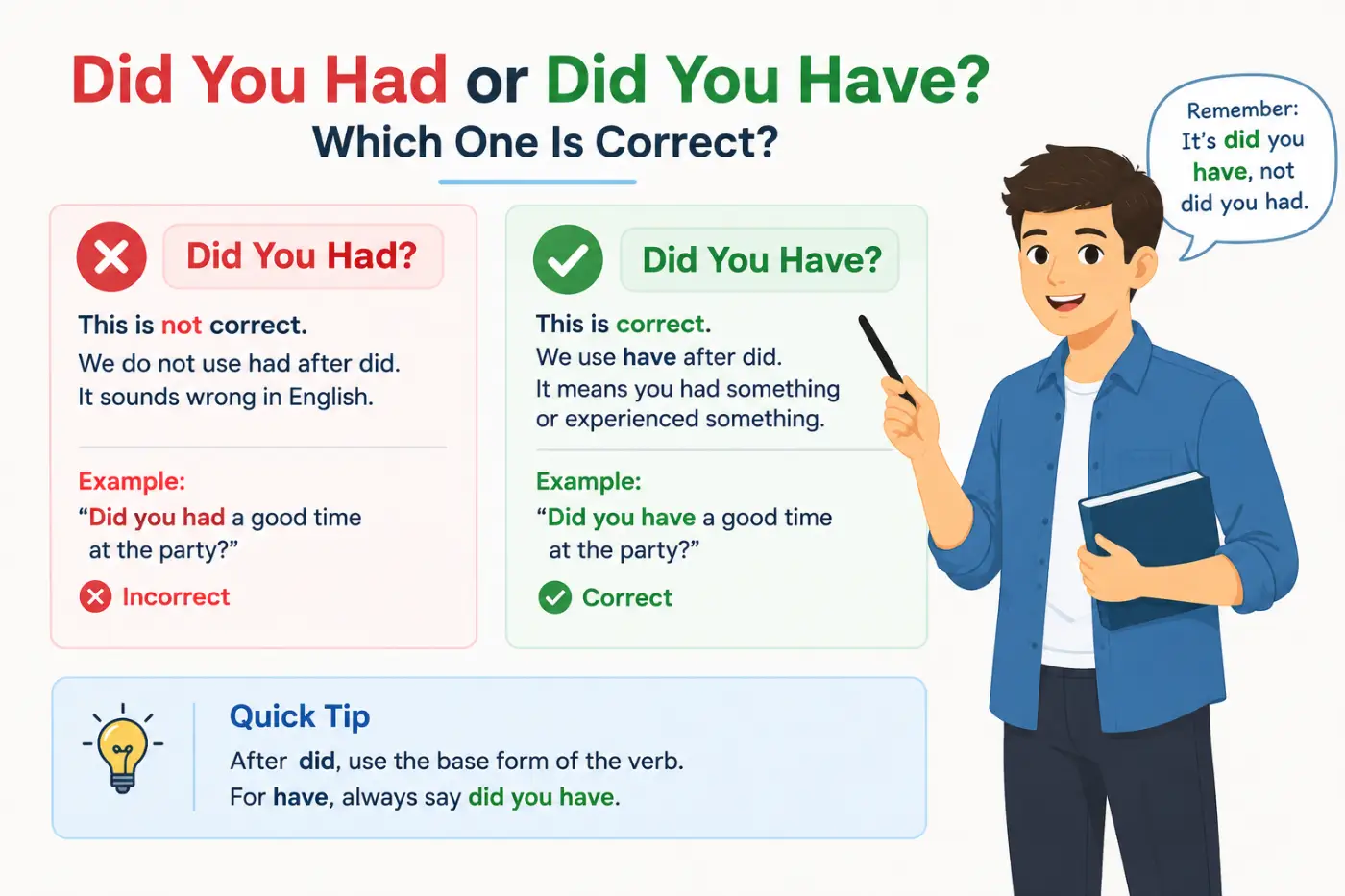
Imagine you’re writing an email to a coworker and want to ask about yesterday’s meeting. You type, “Did you had a chance to review the report?” Something doesn’t sound right. Should you write “did you had” or “did you have”?
This is a common English grammar mistake. Both had and have are forms of the same verb, but they follow different rules when used with did. Understanding this small difference can make your writing clearer and your everyday conversations more natural.
The correct expression is “Did you have?” Always use the base form have after the helping verb did. “Did you had” is grammatically incorrect because did already shows that the question refers to the past.
In this guide, you’ll learn the grammar rule, word meanings, useful alternatives, sentence examples, common mistakes, and practical ways to choose the correct expression in emails, essays, text messages, and everyday conversations.
What Does Did You Have Mean in Simple English?
“Did you have” is a question structure used to ask about something that happened, existed, or belonged to someone in the past.
It combines three words:
- Did: A helping verb that shows past time.
- You: The person being asked.
- Have: The base form of the verb.
For example:
- Did you have breakfast this morning?
- Did you have enough time to finish?
- Did you have a good weekend?
- Did you have your phone with you?
Each question asks about a past situation.
The word have can express several meanings, including possession, experience, availability, and participation.
Consider these examples:
| Sentence | Meaning |
|---|---|
| Did you have a car? | Past possession |
| Did you have fun? | Past experience |
| Did you have enough money? | Past availability |
| Did you have a meeting? | Past participation |
| Did you have a headache? | Past physical condition |
Why Is Did You Had Grammatically Incorrect?
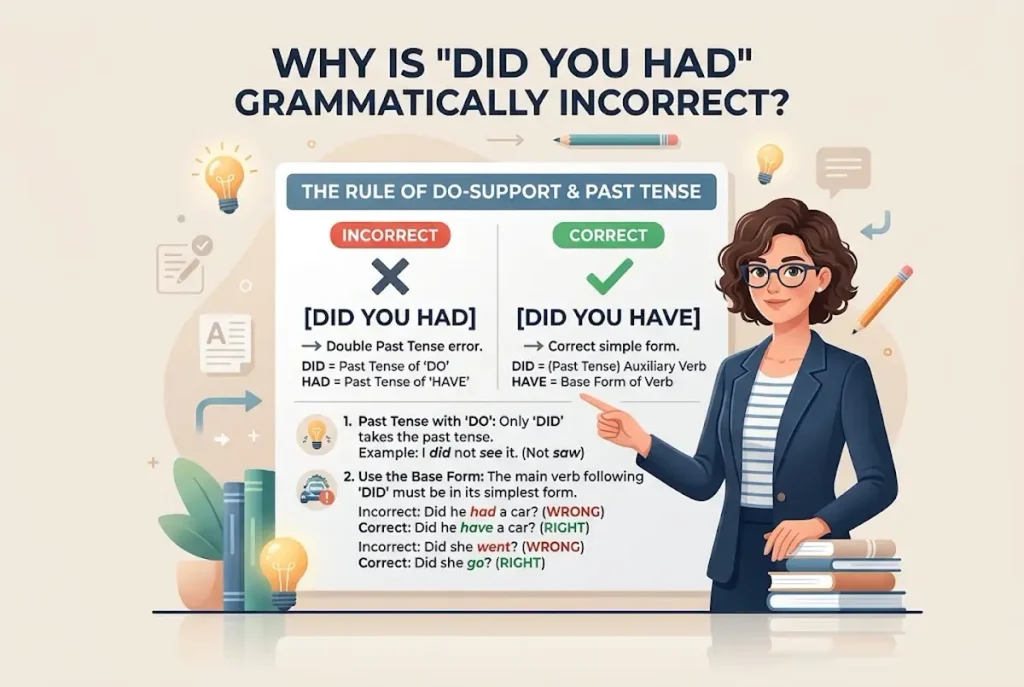
The main reason is a simple English grammar rule: when did acts as a helping verb in a question, the main verb must stay in its base form.
The past tense is already expressed through did.
Adding had after did incorrectly gives the main verb another past-tense form.
Look at the difference:
| Incorrect | Correct |
|---|---|
| Did you had breakfast? | Did you have breakfast? |
| Did she had a meeting? | Did she have a meeting? |
| Did they had enough money? | Did they have enough money? |
| Did he had your number? | Did he have your number? |
| Did we had an appointment? | Did we have an appointment? |
The same rule applies to other English verbs.
For example:
- Did you went? Incorrect.
- Did you go? Correct.
- Did she saw it? Incorrect.
- Did she see it? Correct.
- Did they bought anything? Incorrect.
- Did they buy anything? Correct.
Think of did as the word carrying the past tense. The main verb doesn’t need to carry it again.
What Is the Correct Grammar Formula?
Use this structure when asking a simple past-tense question:
Did + Subject + Base Verb + Rest of the Sentence + ?
Examples:
- Did + you + have + lunch?
- Did + she + have + permission?
- Did + they + have + enough time?
- Did + he + have + an appointment?
This formula works with I, you, we, they, he, she, and it.
Unlike present-tense questions, you don’t need to change the helping verb for different subjects.
| Subject | Correct Question |
|---|---|
| I | Did I have enough time? |
| You | Did you have a ticket? |
| He | Did he have a problem? |
| She | Did she have an interview? |
| We | Did we have homework? |
| They | Did they have permission? |
Where Do Have and Had Come From?
Understanding the history of these words can make their relationship easier to remember.
Both have and had come from the Old English verb habban, which meant to possess, hold, or own something.
Over time, English developed different forms of this verb to express different grammatical meanings.
Today, have is commonly used as a base verb and present-tense form, while had serves as its simple past and past participle form.
Here are the main forms:
| Verb Form | Word | Example |
|---|---|---|
| Base form | Have | I want to have lunch. |
| Present tense | Have | They have two dogs. |
| Present tense | Has | She has a new laptop. |
| Simple past | Had | We had a wonderful trip. |
| Past participle | Had | I have had enough time. |
| Present participle | Having | They’re having dinner. |
Notice that had is a perfectly correct English word.
The mistake isn’t using had itself. The mistake is placing it after the helping verb did in an ordinary past-tense question.
For example:
- I had breakfast at eight.
- Did you have breakfast at eight?
Both sentences describe the past, but their structures are different.
Did You Had or Did You Have in Different Tenses?
One of the easiest ways to understand this grammar rule is to compare the same idea across different tenses.
Consider a question about someone’s lunch.
| Tense | Correct Sentence | Meaning |
|---|---|---|
| Simple present | Do you have lunch at noon? | Regular habit |
| Simple past | Did you have lunch? | Completed past situation |
| Present perfect | Have you had lunch? | Past action connected to now |
| Past perfect | Had you had lunch before leaving? | Earlier past action |
| Future | Will you have lunch? | Future situation |
When Should You Use Have You Had?
“Have you had” is correct in the present perfect tense.
It uses have as a helping verb and had as the past participle.
Examples:
- Have you had breakfast yet?
- Have you had any problems with the software?
- Have you had enough time to prepare?
- Have you had a chance to speak with her?
These questions usually connect a past action or experience to the present moment.
For example, “Have you had lunch yet?” asks about your current situation by checking if you’ve eaten.
“Did you have lunch yesterday?” asks about a specific past time.
Can You Say Had You Had?
Yes. Although it may look unusual, “had you had” is grammatically correct.
It belongs to the past perfect tense.
For example:
“Had you had breakfast before the meeting started?”
The first had is a helping verb. The second had is the past participle of have.
This structure describes an action completed before another past event.
In everyday conversation, people may use a simpler alternative:
“Did you eat breakfast before the meeting?”
Both versions can communicate the same basic idea, although the past perfect makes the order of past events more explicit.
What Are Other Ways to Say Did You Have?
Sometimes, repeating the same question makes your writing sound less natural.
Depending on the situation, you can replace have with another verb or rewrite the entire question.
However, have has several meanings. There isn’t one synonym that works in every sentence.
The following alternatives are grouped by tone and everyday use.
Master List of 30 Useful Alternatives
| Word or Phrase | Meaning | Tone | Example |
|---|---|---|---|
| Get | Receive something | Simple | Did you get my message? |
| Eat | Consume food | Simple | Did you eat breakfast? |
| Own | Possess something | Simple | Did you own that house? |
| Take | Receive or participate in something | Simple | Did you take a break? |
| Use | Make practical use of something | Simple | Did you use my laptop? |
| Keep | Continue holding something | Simple | Did you keep the receipt? |
| Hold | Carry or possess something | Simple | Did you hold the ticket? |
| Receive | Get something | Everyday | Did you receive the package? |
| Enjoy | Experience pleasure | Everyday | Did you enjoy your vacation? |
| Experience | Go through something | Everyday | Did you experience any problems? |
| Attend | Be present somewhere | Everyday | Did you attend the meeting? |
| Spend | Use time or money | Everyday | Did you spend enough time there? |
| Find | Discover or obtain something | Everyday | Did you find a solution? |
| Bring | Carry something along | Everyday | Did you bring your ID? |
Which Alternative Sounds Mild or Strong?
Words can communicate different levels of emotion, seriousness, or formality.
A simple question might sound friendly, while a more specific verb can make the experience seem stronger.
Consider these examples:
| Intensity | Expression | Example |
|---|---|---|
| Mild | Have | Did you have a problem? |
| Mild | Notice | Did you notice an issue? |
| Moderate | Experience | Did you experience difficulties? |
| Moderate | Encounter | Did you encounter a problem? |
| Strong | Struggle with | Did you struggle with the assignment? |
| Strong | Suffer from | Did you suffer from severe headaches? |
| Very strong | Endure | Did you endure difficult conditions? |
How Do These Alternatives Work as Different Parts of Speech?
Most replacements for have are verbs because have itself is a verb.
However, you can sometimes rewrite the question using a noun or adjective to express a similar idea.
Verb Alternatives
Verbs describe actions, experiences, and states.
Examples:
- Did you receive the email?
- Did you attend the event?
- Did you experience any discomfort?
- Did you obtain permission?
Noun-Based Alternatives
A noun can express the central idea when you change the sentence structure.
| Original Question | Alternative |
|---|---|
| Did you have any problems? | Were there any problems? |
| Did you have a good experience? | Was your experience good? |
| Did you have enough time? | Was there enough time? |
| Did you have permission? | Was permission granted? |
Adjective-Based Alternatives
Adjectives can describe a person’s condition instead of using have.
Examples:
- Did you have enough preparation time? → Were you prepared?
- Did you have a good time? → Were you happy with the experience?
- Did you have any worries? → Were you worried?
The rewritten questions may change the meaning slightly, so choose the version that best expresses your intention.
Is There a Difference Between American and British English?
The basic grammar rule is the same in American English and British English.
Both varieties use have after did.
However, American and British speakers sometimes prefer different expressions when discussing possession.
Compare these examples:
| American English | British English |
|---|---|
| Do you have a pen? | Have you got a pen? |
| Did you have enough money? | Did you have enough money? |
| Do you have any questions? | Have you got any questions? |
| Have you had lunch yet? | Have you had lunch yet? |
Which Expression Should You Use in Different Situations?
Choosing the right wording depends on your audience and purpose.
A question that sounds natural in a text message might seem too casual in a professional email.
How Should You Write It on a Resume?
Resumes usually describe achievements rather than ask direct questions.
When discussing past responsibilities, use strong action verbs.
For example:
Less effective: “I had responsibility for customer complaints.”
Better: “Managed customer complaints and resolved service issues.”
If you’re preparing interview questions, use a direct past-tense structure.
Example:
“Did you have experience managing customer accounts in your previous position?”
A more precise alternative is:
“Did you manage customer accounts in your previous position?”
The second question focuses on the actual responsibility.
Which Form Is Best for an Essay?
Academic essays benefit from clear and grammatically accurate sentences.
Use had in affirmative past-tense statements and did with have in simple past questions.
Example:
“The participants had access to the learning materials.”
Question form:
“Did the participants have access to the learning materials?”
In formal academic writing, you might also use:
“Were the learning materials available to all participants?”
This version focuses on availability rather than possession.
What Should You Write in a Text Message?
Text messages usually sound more relaxed and conversational.
You can use short, natural questions without changing the grammar.
Examples:
- Did you have fun yesterday?
- Did you have lunch?
- Did you have time to call her?
For an even more casual tone, you might write:
“Have you eaten yet?”
This is short, friendly, and grammatically correct.
How Should You Use It in a Professional Email?
Professional emails should sound polite and direct.
A useful example is:
“Did you have a chance to review the document I sent yesterday?”
You can also write:
“Have you had a chance to review the document?”
The second version often sounds natural when you’re following up on something that remains relevant.
Another polite option is:
“Were you able to review the document?”
This wording focuses on the person’s opportunity or ability to complete the task.
Which Form Sounds Natural in Everyday Speaking?
In everyday conversations, people often use did when asking about completed events.
Examples:
- Did you have a nice weekend?
- Did you have trouble finding the address?
- Did you have your keys with you?
In casual speech, did you may sound like “didja” because the sounds blend together.
This is a pronunciation feature, not a different grammar rule.
In writing, keep the standard form.
15 Correct Examples From Real-Life Situations
Learning grammar becomes easier when you see how a structure works in different situations.
Here are 15 original examples using the correct past-tense question pattern.
| Situation | Example Sentence |
|---|---|
| Breakfast | Did you have eggs this morning? |
| School | Did you have homework yesterday? |
| Office | Did you have a meeting with your manager? |
| Travel | Did you have a comfortable flight? |
| Shopping | Did you have enough cash? |
| Family | Did you have dinner with your parents? |
| Friendship | Did you have fun at the party? |
| Interview | Did you have any questions for the interviewer? |
| Technology | Did you have trouble opening the file? |
| Healthcare | Did you have a fever last night? |
| Transportation | Did you have your driving license with you? |
| Entertainment | Did you have a favorite movie as a child? |
| Education | Did you have access to the library? |
| Customer service | Did you have any problems with your order? |
| Daily routine | Did you have time to finish your chores? |
How Should You Answer These Questions?
Short answers normally repeat the helping verb did.
For example:
Question: Did you have breakfast?
Positive answer: Yes, I did.
Negative answer: No, I didn’t.
You can also give complete answers.
| Question | Complete Answer |
|---|---|
| Did you have lunch? | Yes, I had lunch at noon. |
| Did she have a ticket? | No, she didn’t have a ticket. |
| Did they have fun? | Yes, they had a wonderful time. |
| Did he have enough money? | No, he didn’t have enough money. |
Did You Have vs Have You Had
These two expressions are correct, but they don’t always communicate exactly the same meaning.
“Did you have” uses the simple past tense.
“Have you had” uses the present perfect tense.
| Did You Have | Have You Had |
|---|---|
| Simple past tense | Present perfect tense |
| Often asks about a finished past event | Connects a past event to the present |
| Common with specific past times | Common with yet, ever, and so far |
| Did you have lunch yesterday? | Have you had lunch yet? |
| Did you have problems last week? | Have you had any problems recently? |
Did You Have vs Did You Get
Have and get are related in some situations, but their meanings differ.
Have often describes possession, availability, or experience.
Get commonly describes receiving, obtaining, or becoming something.
| Did You Have | Did You Get |
|---|---|
| Did you have my number? | Did you get my number? |
| Did you have a ticket? | Did you get a ticket? |
| Did you have enough information? | Did you get enough information? |
| Did you have the opportunity? | Did you get the opportunity? |
Did You Have vs Had You
These expressions use different grammatical structures.
“Did you have” is a standard simple past question.
“Had you” commonly introduces a past perfect question when followed by a past participle.
Compare:
- Did you have dinner before leaving?
- Had you eaten dinner before leaving?
The first question asks about a completed past event.
The second emphasizes that eating happened before another past event.
You can also use had with another had:
“Had you had dinner before the guests arrived?”
Although this sounds repetitive, it’s grammatically correct.
For most everyday conversations, the simpler version is often easier to understand.
What Are the Most Common Grammar Mistakes?
Even people who understand the rule sometimes make mistakes when writing quickly.
Here are some errors worth watching for.
Mistake 1 Using Had After Did
Incorrect: Did you had a good weekend?
Correct: Did you have a good weekend?
Did already expresses past time.
Mistake 2 Using Had After Didn’t
Incorrect: I didn’t had enough money.
Correct: I didn’t have enough money.
The rule applies to negative sentences too.
Mistake 3 Using Have Instead of Had in Past Statements
Incorrect: I have a meeting yesterday.
Correct: I had a meeting yesterday.
Without the helping verb did, a simple past statement normally uses had.
When Should You Not Use Did You Have?
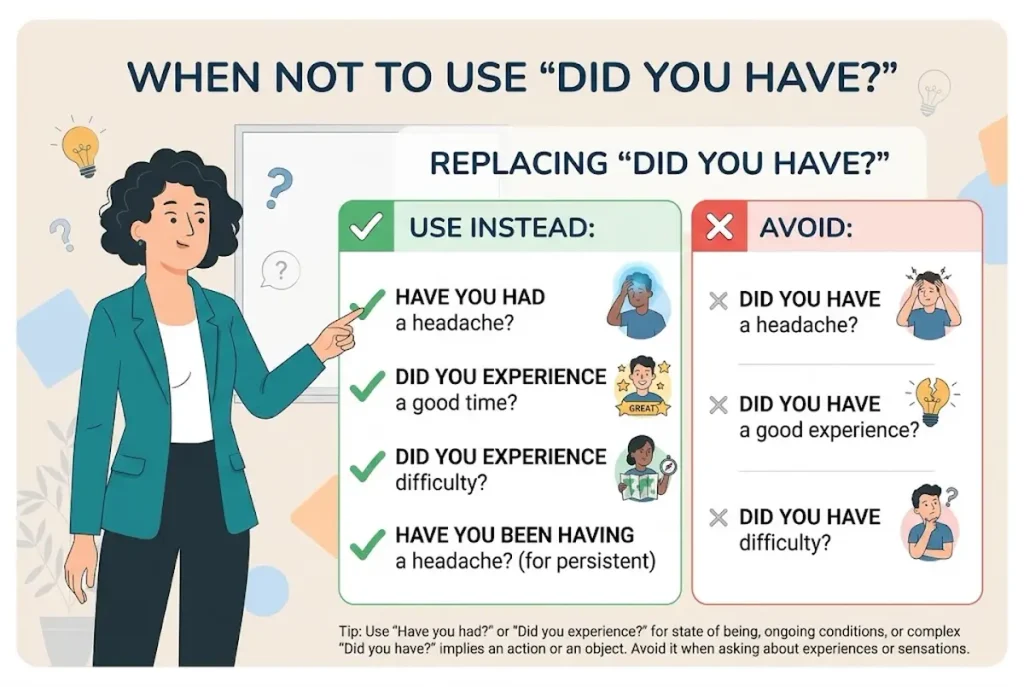
Although the expression is correct, it isn’t suitable for every question.
Avoid it when you’re asking about a regular habit, current possession, or future event.
| Intended Meaning | Better Question |
|---|---|
| Current possession | Do you have a car? |
| Regular habit | Do you have breakfast every morning? |
| Future plan | Will you have time tomorrow? |
| Present activity | Are you having lunch? |
| Experience up to now | Have you had any problems so far? |
| Earlier past event | Had you eaten before arriving? |
What Is the Opposite of Have?
Have doesn’t have one universal antonym because it can express several meanings.
Depending on the sentence, its opposite may involve losing, lacking, missing, or giving something away.
| Word | Opposite or Contrasting Idea | Example |
|---|---|---|
| Have | Lack | Did you lack the required information? |
| Own | Rent | Did you rent the apartment instead? |
| Receive | Give | Did you give the package to someone? |
| Keep | Lose | Did you lose your ticket? |
| Obtain | Forfeit | Did you forfeit your opportunity? |
| Attend | Miss | Did you miss the meeting? |
| Enjoy | Dislike | Did you dislike the experience? |
| Possess | Be without | Were you without your phone? |
Quick Tips for Choosing the Correct Form
You don’t need to memorize every grammar rule to avoid this mistake.
A few practical habits can help you choose the correct verb naturally.
- Look for did. If it acts as a helping verb, use the base form of the main verb.
- Use had in ordinary affirmative simple past statements.
- Remember that didn’t also requires the base form.
- Use have you had when asking about past experiences connected to the present.
- Use do you have when asking about current possession or regular habits.
- Check time expressions such as yesterday, last week, already, and yet.
- Read your sentence aloud to check if it sounds natural.
A simple memory trick is to compare these three sentences:
| Sentence Type | Correct Example |
|---|---|
| Positive | You had a meeting. |
| Negative | You didn’t have a meeting. |
| Question | Did you have a meeting? |
Conclusion
The correct choice in standard English is “Did you have?” because did already expresses the past tense. The main verb must remain in its base form.
Remember that had isn’t an incorrect word. You can use it in simple past statements such as “I had a meeting yesterday.” You can also use it in perfect-tense structures, including “Have you had lunch?” and “Had you had enough time?”
The key is understanding how helping verbs work with main verbs. When writing an email, asking a question in class, or sending a quick message, check the word that follows did. If you’re using the verb have, keep it in its base form.
Frequently Asked Questions
Is It Correct to Say Did You Had or Did You Have?
“Did you have” is correct. The helping verb did already indicates past time, so the main verb must stay in its base form.
Why Can’t We Use Had After Did?
Because did already carries the past tense in a simple past question. Adding the past-tense form had creates an incorrect grammatical structure.
Can I Say Did You Have Breakfast?
Yes. “Did you have breakfast?” is a grammatically correct way to ask if someone ate breakfast in the past.
What Is the Difference Between Did You Have and Have You Had?
“Did you have” uses the simple past, while “have you had” uses the present perfect. The second expression connects a past experience or action to the present.
What’s Another Way to Say Did You Have a Good Time?
You can say “Did you enjoy yourself?” or “Did you have fun?” Both sound natural in everyday American English.
Is Did You Had Ever Correct in English?
No. “Did you had” is incorrect in standard English when did functions as the helping verb in a simple past question. Use have instead.
Should I Say Did You Have Lunch or Have You Had Lunch?
Both are correct. Use “Did you have lunch?” to ask about a past event and “Have you had lunch?” when checking if someone has eaten by now.
What Is the Negative Form of Did You Have?
The negative form uses “did not have” or its contraction “didn’t have.” For example, “I didn’t have enough time to finish my homework.”

Daniel Grammarfield — The Language Learner
Age: 28Occupation: ESL Learner & Digital Professional
Bio:Daniel is a non-native English speaker who wants to communicate more confidently at work and online. He uses Synotrench to improve grammar, understand confusing words, learn correct sentence structures, and build everyday English skills. He prefers simple explanations with practical examples.
Goals:
Master English grammar rules
Avoid common language mistakes
Improve professional communication
Learn English through real-life examples
Quote:“Learning English is not about memorizing rules — it’s about expressing ideas clearly.”
2 thoughts on “Did You Had or Did You Have? Simple Grammar Guide”