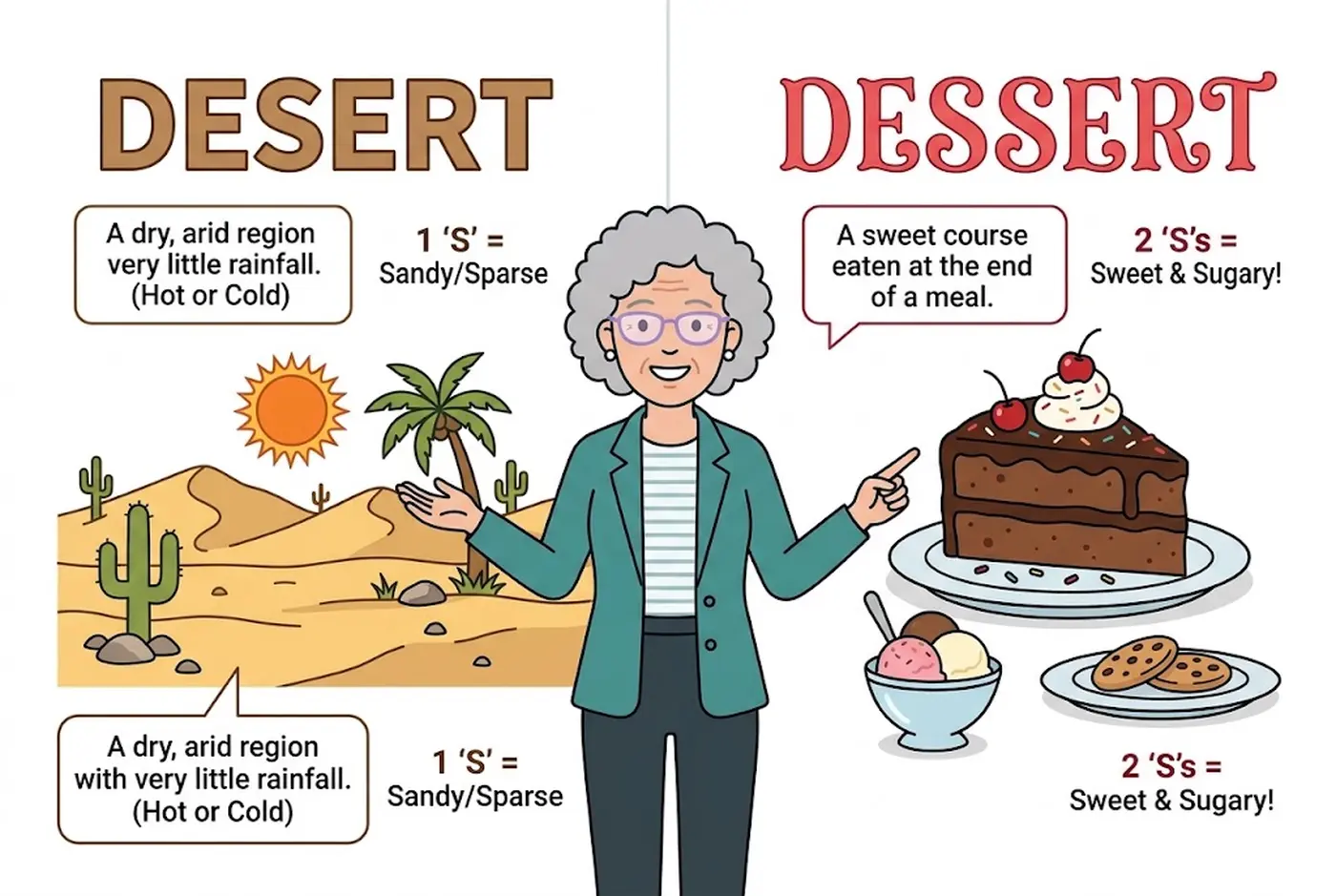
The confusion between desert vs dessert is common because these words look almost identical. However, they have different meanings, pronunciations, and uses. Learning the difference can help you avoid embarrassing mistakes in school assignments, emails, and everyday conversations.
Desert usually means a dry region with little rainfall, while dessert means sweet food eaten after a meal. Remember that dessert has two S’s because you might want a second serving of something sweet.
In this guide, you’ll learn their meanings, word origins, pronunciation, related vocabulary, synonyms, and common mistakes. You’ll also find practical examples, comparison tables, and simple memory tricks to help you choose the correct spelling every time.
What Is the Difference Between Desert and Dessert?
The main difference is meaning. A desert is a dry geographical region, while dessert is a sweet dish usually served at the end of a meal.
However, desert can also function as a verb meaning to abandon someone or something. Its pronunciation changes when used this way.
Here’s a simple comparison:
| Feature | Desert | Dessert |
|---|---|---|
| Main meaning | A very dry region | Sweet food served after a meal |
| Part of speech | Noun or verb | Noun |
| Spelling | One S | Two S’s |
| Noun pronunciation | DEZ-ert | dih-ZURT |
| Main use | Geography and nature | Food and dining |
| Example | The Sahara is a desert. | Chocolate cake is my favorite dessert. |
| Memory trick | One S for sand | Two S’s for something sweet |
What Does Desert Mean in Simple English?
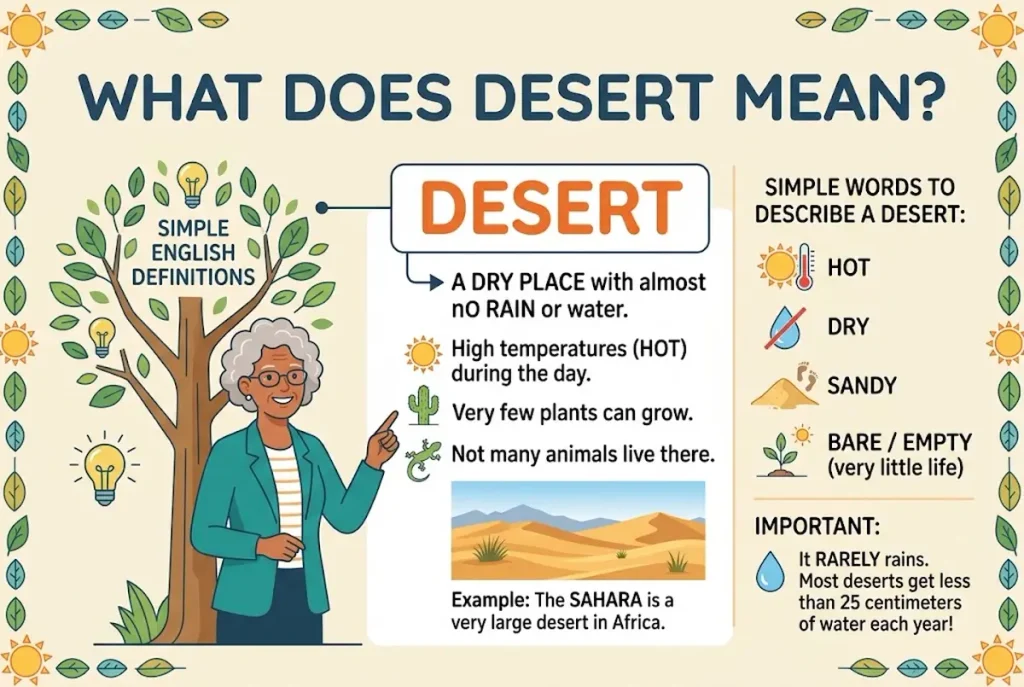
A desert is a region that receives very little precipitation. Many deserts are hot and sandy, but some are cold, rocky, or covered with ice.
A place doesn’t need to have sand dunes to qualify as a desert. What matters most is how little precipitation it receives.
Desert as a noun
When desert functions as a noun, it describes a dry geographical area.
Examples:
- The Sahara Desert stretches across North Africa.
- Some animals can survive without much water in the desert.
- The travelers crossed the desert before sunset.
- Cactus plants are common in certain desert regions.
- Antarctica is considered a polar desert because it receives very little precipitation.
Notice that desert describes a place in all five sentences.
Desert as a verb
Desert can also mean to leave or abandon someone, especially when that person needs support.
Examples:
- The soldier decided to desert his post.
- Good friends shouldn’t desert each other during difficult times.
- Several workers deserted the project before its completion.
When desert is a verb, the stress moves to the second syllable. This makes its pronunciation similar to dessert, even though the spelling and meaning remain different.
Where does the word desert come from?
The noun desert comes through Old French from Latin desertum, meaning an abandoned or uninhabited place.
Its history connects with the idea of land that appears empty or sparsely populated.
Today, desert has a more specific geographical meaning. It describes an area with very low precipitation rather than simply an empty location.
This distinction matters because many deserts support plants, animals, and human communities.
What Does Dessert Mean in Simple English?
Dessert is a sweet dish or course usually eaten after the main part of a meal.
Popular desserts include cakes, cookies, ice cream, fruit pies, puddings, brownies, and pastries.
A dessert can be homemade, purchased from a bakery, or served at a restaurant.
Examples:
- We ordered chocolate cake for dessert.
- My grandmother makes delicious apple pie.
- Would you like some dessert after dinner?
- The restaurant offers several dairy-free desserts.
- She prepared strawberry pudding for the family.
Dessert is a noun. Unlike desert, it isn’t normally used as a verb.
Where does the word dessert come from?
Dessert entered English from French.
It comes from the French word desservir, which means to clear the table or remove what has been served.
Historically, dessert referred to the course served after the main dishes had been cleared away.
Over time, the word became closely associated with sweet foods eaten near the end of a meal.
This origin explains why dessert is connected to dining rather than geography.
Does dessert always have to be sweet?
Dessert usually refers to something sweet, but the final course of a meal isn’t always sugary.
For example, some traditional European meals include cheese or fruit as a final course.
In everyday American English, however, people generally expect dessert to mean something sweet.
If someone asks, “What’s for dessert?” they’re probably hoping for cake, ice cream, cookies, or another treat.
How Do You Pronounce Desert and Dessert?
Pronunciation is another important difference between these two words.
The noun desert and the noun dessert don’t sound the same in standard American English.
| Word | Simple pronunciation | Stressed syllable |
|---|---|---|
| Desert (noun) | DEZ-ert | First |
| Desert (verb) | dih-ZURT | Second |
| Dessert (noun) | dih-ZURT | Second |
How to pronounce desert as a place
When talking about a dry region, emphasize the first syllable.
Example:
The camel traveled across the desert.
The beginning of the word receives the stronger stress.
How to pronounce desert as an action
When desert means abandon, emphasize the second syllable.
Example:
He refused to desert his teammates.
This pronunciation sounds like dessert.
How to pronounce dessert
Dessert has two syllables, with stronger stress on the second.
Example:
We saved room for dessert.
The shared pronunciation of the verb desert and the noun dessert can cause confusion when listening. Fortunately, the surrounding sentence usually makes the intended meaning clear.
What Are the Best Synonyms for Desert and Dessert?
These words have different meanings, so their synonyms must be considered separately.
A synonym is a word or expression with the same or a similar meaning. However, not every synonym can replace the original word in every sentence.
For example, wilderness can sometimes describe a desert, but not every wilderness is dry.
Similarly, sweet treat can refer to dessert, but someone might eat a sweet treat at any time of day.
The following tables include more than 30 useful related words and expressions, grouped by tone and everyday use.
Simple synonyms and related words
These expressions are easy to understand and suitable for everyday English.
| Word | Meaning | Tone | Example |
|---|---|---|---|
| Dry land | Land with little moisture | Simple | The plants struggled on the dry land. |
| Dry region | Area receiving little moisture | Simple | This dry region gets very little rain. |
| Sandy area | Place covered mainly with sand | Simple | We walked across the sandy area. |
| Wasteland | Barren or neglected land | Simple | The abandoned property became a wasteland. |
| Sweet | Informal term for sweet food | Simple | Can I have something sweet? |
| Treat | Something enjoyable to eat | Simple | Ice cream is my favorite treat. |
| Cake | Sweet baked food | Simple | She made a cake for dessert. |
| Pudding | A sweet dish, often soft and creamy | Simple | We enjoyed chocolate pudding. |
| Ice cream | Frozen sweet food | Simple | The children requested ice cream. |
Everyday synonyms and related expressions
These words appear frequently in conversations, articles, and informal writing.
| Word | Meaning | Tone | Example |
|---|---|---|---|
| Arid land | Extremely dry land | Everyday | Few crops grow naturally on arid land. |
| Wilderness | Uncultivated natural area | Everyday | They explored the remote wilderness. |
| Badlands | Dry land with heavily eroded terrain | Everyday | The hikers photographed the badlands. |
| Sand dunes | Hills formed from windblown sand | Everyday | The sand dunes looked beautiful at sunrise. |
| Sweet course | Sweet part of a meal | Everyday | The sweet course included fresh berries. |
| Pastry | Baked food made with pastry dough | Everyday | She ordered a fruit pastry. |
| Confection | Sweet food or candy | Everyday | The bakery displayed colorful confections. |
| Baked treat | Enjoyable baked food | Everyday | Brownies make a wonderful baked treat. |
| After-dinner treat | Food enjoyed after dinner | Everyday | We shared an after-dinner treat. |
Formal synonyms and related vocabulary
These expressions are useful in academic writing, geography, food descriptions, and professional communication.
| Word | Meaning | Tone | Example |
|---|---|---|---|
| Arid zone | Region with very low precipitation | Formal | The research focused on an arid zone. |
| Hyperarid region | Area with extremely little precipitation | Formal | The Atacama contains hyperarid regions. |
| Desert biome | Ecological region defined by desert conditions | Formal | The desert biome supports adapted wildlife. |
| Barren terrain | Land with little visible vegetation | Formal | The expedition crossed barren terrain. |
| Xeric environment | Environment characterized by dryness | Scientific | These plants thrive in xeric environments. |
| Final course | Last course of a meal | Formal | The final course featured chocolate mousse. |
| Sweet dish | Food prepared with a sweet flavor | Neutral | The chef presented a traditional sweet dish. |
| Confectionery | Sweets or the craft of making them | Formal | The shop specializes in confectionery. |
| Patisserie | French-style pastries or a shop selling them | Formal | The patisserie prepared fresh fruit tarts. |
| Dessert course | Course traditionally served after the main meal | Formal | The dessert course included three small dishes. |
How Do Synonyms Change From Mild to Strong?
Words can express different levels of dryness, isolation, sweetness, or enjoyment.
Choosing the right level makes your description more accurate.
Words describing dry environments
| Intensity | Expression | Meaning |
|---|---|---|
| Mild | Dry | Having little moisture |
| Moderate | Semi-arid | Receiving limited precipitation |
| Strong | Arid | Characterized by very low moisture |
| Very strong | Hyperarid | Receiving extremely little precipitation |
Words describing sweet food
Sweetness and richness can also be expressed at different levels.
| Description | Meaning | Example |
|---|---|---|
| Light | Not overly rich or heavy | Fresh fruit makes a light dessert. |
| Sweet | Having a sugary taste | The pudding tastes sweet. |
| Rich | Full of flavor, often containing cream, butter, or chocolate | This chocolate cake is rich. |
| Decadent | Especially luxurious or indulgent | The restaurant serves decadent chocolate mousse. |
Which Part of Speech Should You Use?
Understanding parts of speech makes it easier to choose the correct word.
Desert has several grammatical uses, while dessert mainly functions as a noun.
| Word | Part of speech | Meaning | Example |
|---|---|---|---|
| Desert | Noun | Dry geographical region | The desert receives little rain. |
| Desert | Verb | To abandon | Don’t desert your friends. |
| Desert | Adjective modifier | Relating to a desert | Desert plants conserve water. |
| Dessert | Noun | Sweet food after a meal | Dessert is ready. |
| Deserts | Plural noun | More than one desert | Africa has several deserts. |
| Desserts | Plural noun | More than one sweet dish | The menu includes five desserts. |
| Deserted | Adjective | Empty or abandoned | The street looked deserted. |
| Desertion | Noun | The act of abandoning | His desertion surprised everyone. |
Deserted vs desert
Deserted usually means empty, abandoned, or left behind.
Example:
The old building had been deserted for years.
It doesn’t mean the building became a dry geographical region.
Dessert vs desserts
Dessert can describe the sweet course generally, while desserts refers to multiple sweet dishes or varieties.
Examples:
- We had dessert after dinner.
- The bakery offers several desserts.
- Chocolate mousse is a popular dessert.
The plural form keeps both S’s before adding the final S.
Is There a Difference Between American and British English?
The spelling of desert and dessert is the same in American and British English.
Unlike color and colour, these words don’t have separate regional spelling standards.
However, vocabulary associated with dessert can vary.
| American English | British English | Meaning |
|---|---|---|
| Dessert | Dessert | Sweet course after a meal |
| Dessert | Pudding | Pudding can refer to the dessert course generally in British English |
| Cookie | Biscuit | Small baked treat |
| Candy | Sweets | Sugary confectionery |
| Jell-O or gelatin dessert | Jelly | Sweet gelatin-based dish |
How Should You Use Desert and Dessert in Different Situations?
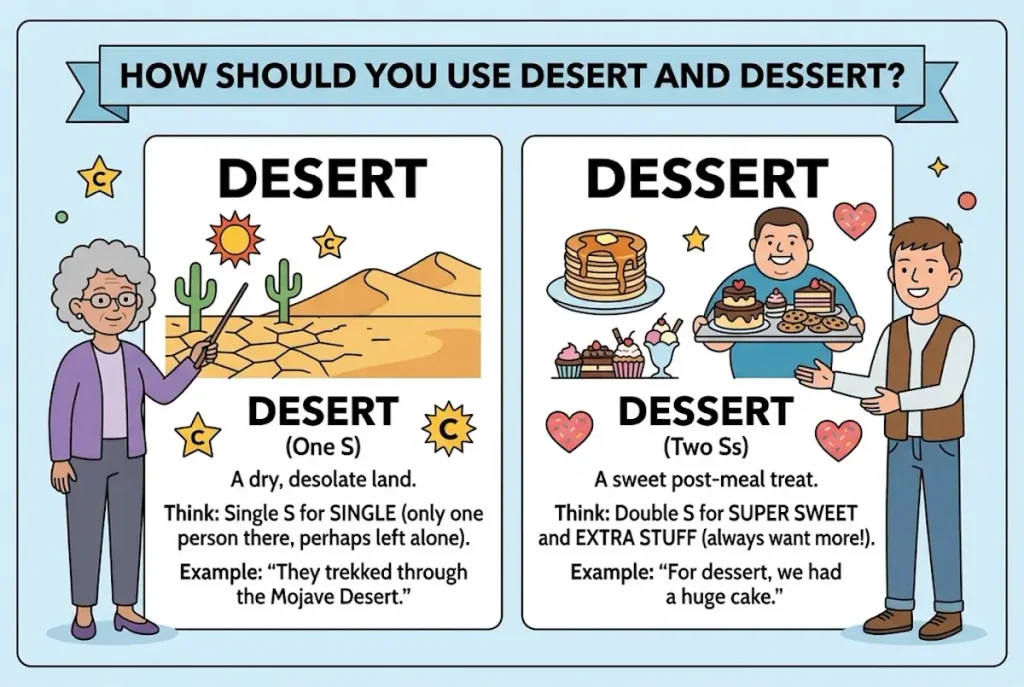
The best choice depends on the meaning you want to express.
In professional writing, schoolwork, messages, and conversations, a small spelling mistake can change your sentence completely.
Which word should you use on a resume?
Neither word commonly appears on a resume unless it’s relevant to your work experience.
For example, someone working in hospitality might mention dessert preparation, while a researcher might discuss desert ecosystems.
Examples:
Correct: Developed seasonal dessert menus for a luxury restaurant.
Correct: Conducted environmental research on desert vegetation.
If you’re describing professional responsibilities, make sure the spelling matches your field.
Which word should you use in an essay?
Academic writing requires clear and accurate vocabulary.
Use desert when discussing geography, climate, ecosystems, or abandonment.
Use dessert when discussing food, nutrition, culture, or dining habits.
Examples:
The Sahara Desert plays an important role in North Africa’s climate.
Traditional desserts often reflect the cultural history of a region.
For formal essays, avoid using casual alternatives such as sweet fix or the middle of nowhere unless they serve a clear purpose.
Which word should you use when texting?
Text messages are usually informal, but correct spelling still helps avoid confusion.
Examples:
I’m bringing dessert tonight. Do you prefer brownies or cookies?
Our road trip includes a drive through the desert.
A useful trick is to check the topic before sending your message.
Food means dessert. Dry geographical land means desert.
Desert vs Dessert Examples in Everyday English
Reading complete sentences helps you understand how these words naturally work.
The following examples cover travel, education, food, family life, and professional situations.
Examples using desert
- The Sahara is one of the world’s largest hot deserts.
- Some desert animals are active mainly at night.
- We carried extra water during our desert hike.
- The desert landscape looked beautiful at sunrise.
- Scientists study how plants survive in desert environments.
Examples using dessert
- My mother baked a chocolate cake for dessert.
- We shared a bowl of ice cream after dinner.
- The restaurant has a separate dessert menu.
- She prefers fruit instead of a heavy dessert.
- Everyone enjoyed the homemade apple pie.
Desert vs Dessert vs Deserts: What’s Different?
Another common source of confusion is the word deserts.
It can be the plural form of desert, but it also appears in the expression just deserts.
| Expression | Meaning | Example |
|---|---|---|
| Desert | A dry region | The desert is extremely dry. |
| Dessert | Sweet food | We ordered dessert. |
| Deserts | Multiple dry regions | The world has many deserts. |
| Just deserts | A deserved reward or punishment | He finally got his just deserts. |
Why is it called just deserts?
The expression just deserts means receiving what someone deserves, especially as a consequence of their actions.
It comes from an older use of desert meaning something deserved.
It has nothing to do with sweet food or dry geographical regions.
Correct: The dishonest businessman finally got his just deserts.
Incorrect: The dishonest businessman finally got his just desserts.
The incorrect version is common because people associate the pronunciation with sweet food.
However, the traditional expression uses one S in deserts.
Desert vs Dessert: Which Word Is Correct in Common Phrases?
Some expressions are easy to confuse because the words sound similar.
Here’s how to choose the correct spelling.
| Phrase | Correct spelling | Reason |
|---|---|---|
| Chocolate dessert | Dessert | Refers to sweet food |
| Sahara Desert | Desert | Names a geographical region |
| Dessert menu | Dessert | Lists sweet dishes |
| Desert island | Desert | Describes an isolated or uninhabited island |
| Desert climate | Desert | Refers to environmental conditions |
| Frozen dessert | Dessert | Refers to frozen sweet food |
| Desert safari | Desert | Describes travel through a desert |
| Dessert table | Dessert | Displays sweet dishes |
| Just deserts | Deserts | Means deserved consequences |
| Desert a friend | Desert | Means abandon someone |
Desert island vs deserted island
These expressions are closely related, but they aren’t always identical.
A desert island traditionally means an uninhabited island. It doesn’t necessarily have a dry desert climate.
A deserted island emphasizes that nobody lives there or that its inhabitants have left.
For example:
The sailors became stranded on a desert island.
The explorers discovered a deserted island.
Both sentences describe an island without inhabitants, but the second places greater emphasis on its abandoned or empty condition.
Sweet dish vs dessert
A sweet dish isn’t automatically a dessert.
For example, pancakes with syrup are sweet, but people often eat them for breakfast.
Dessert generally refers to the sweet course served after a meal.
Compare:
She made sweet pancakes for breakfast.
She served chocolate pudding for dessert.
The difference comes from the food’s role in the meal, not simply its flavor.
What Are the Most Common Spelling Mistakes?
Most errors happen because writers remember how a word sounds rather than what it means.
The following mistakes are especially common.
Mistake 1: Using desert for sweet food
Incorrect: I want chocolate desert after dinner.
Correct: I want chocolate dessert after dinner.
Dessert needs two S’s when referring to sweet food.
Mistake 2: Using dessert for dry land
Incorrect: Camels can survive in the dessert.
Correct: Camels can survive in the desert.
A dry geographical region uses only one S.
Mistake 3: Writing just desserts
Incorrect: He finally received his just desserts.
Correct: He finally received his just deserts.
The traditional expression refers to deserved consequences, not sweet food.
What Are the Opposites of Desert and Dessert?
These words don’t have perfect opposites in every context.
However, several expressions communicate contrasting ideas.
Opposites and contrasting terms for desert
| Word | Meaning |
|---|---|
| Rainforest | Forest ecosystem with high rainfall |
| Wetland | Land saturated or covered with water |
| Humid region | Area with considerable atmospheric moisture |
| Fertile land | Land capable of supporting plant growth |
| Oasis | Place with water and vegetation in a dry region |
Opposites and contrasting terms for dessert
Dessert doesn’t have a strict dictionary antonym because it’s a type of food course.
However, these expressions provide useful contrasts:
| Expression | Meaning |
|---|---|
| Appetizer | Small dish served before the main course |
| Main course | Central dish of a meal |
| Savory dish | Food with a salty or non-sweet flavor |
| Starter | First course of a meal |
What Is the Easiest Trick to Remember Desert and Dessert?
The most popular memory trick focuses on the number of S’s.
Dessert has two S’s because you might want seconds of something sweet.
Desert has one S because it describes a dry region.
Here are five additional ways to remember the difference.
- Think of strawberry shortcake. Both strawberry and shortcake begin with S, giving you two S’s for dessert.
- Connect desert with dry land. Both ideas relate to geography and climate.
- Picture a dessert menu filled with cakes, brownies, and ice cream.
- Read the entire sentence before choosing the spelling.
- Remember that desert as a verb means abandon, not eat something sweet.
Final Answer About Desert vs Dessert
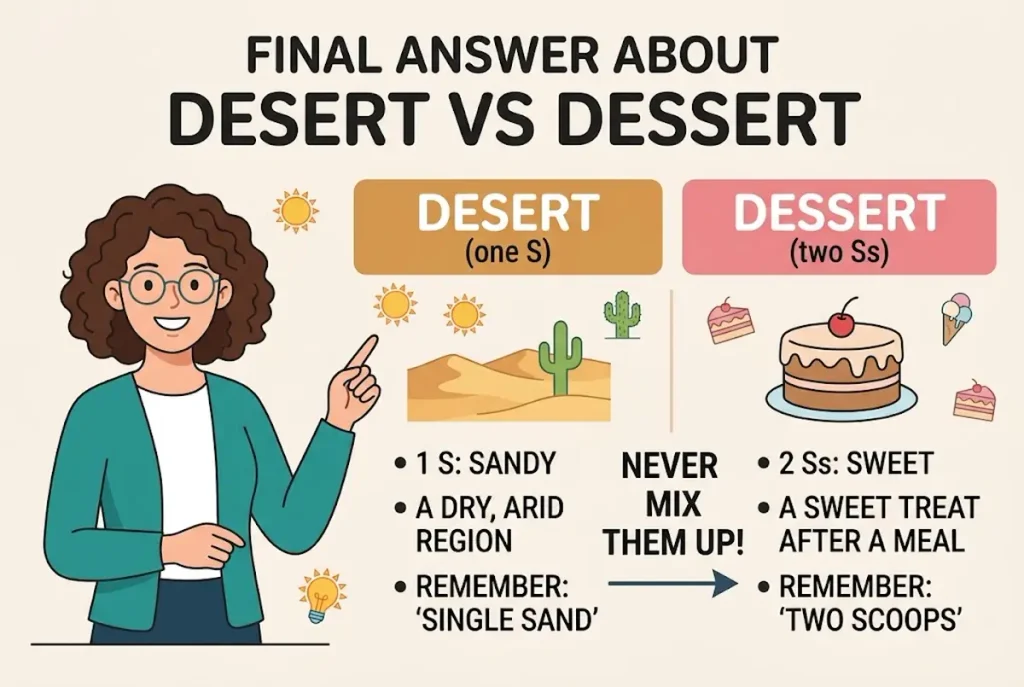
The difference between words becomes easy to remember once you connect each spelling with its meaning. Desert usually describes a dry geographical region, while dessert refers to sweet food served after a meal. Desert can also function as a verb meaning to abandon someone.
The simplest memory trick is to associate the two S’s in dessert with wanting a second serving of something sweet.
Remember that pronunciation also matters. The geographical noun desert emphasizes its first syllable, while dessert emphasizes the second. The verb desert sounds like dessert but carries a completely different meaning.
Before using either word, consider the subject of your sentence. Are you discussing geography, abandonment, or food? That single question will usually lead you to the correct spelling. With a little practice, choosing between these commonly confused words will become second nature.
Conclusion
Understanding the difference between desert vs dessert is simple once you remember their meanings and spellings. Desert refers to a dry geographical region, while dessert means a sweet dish usually enjoyed after a meal. Desert can also be used as a verb meaning to abandon someone or something.
An easy memory trick is that dessert has two S’s because you might want a second serving of something sweet. Desert has only one S when describing dry land.
Although these words look similar, their meanings are completely different. Always check the context of your sentence before choosing the correct spelling. With a little practice, you’ll confidently use both words in everyday conversations, school assignments, emails, and professional writing without mixing them up.
Frequently Asked Questions
Why does dessert have two S’s?
Dessert has two S’s because of its spelling history, which comes from the French word desservir. A helpful memory trick is that you might want seconds of your favorite dessert.
Is it desert or dessert after dinner?
Dessert is correct when referring to sweet food eaten after dinner. For example, “We had chocolate cake for dessert.”
What’s another way to say dessert?
Sweet treat, sweet course, after-dinner treat, and final course are useful alternatives. The best expression depends on the context and level of formality.
Is the Sahara a desert or dessert?
The Sahara is a desert because it’s a geographical region characterized by very low precipitation. Dessert refers to sweet food, not a place.
Why is it just deserts instead of just desserts?
The expression just deserts comes from an older meaning of desert related to something deserved. It means receiving the consequences or rewards that one’s actions deserve.
Can desert and dessert sound the same?
Yes, desert used as a verb and dessert used as a noun are pronounced alike in standard American English. However, desert referring to a dry region has stress on its first syllable.

Daniel Grammarfield — The Language Learner
Age: 28Occupation: ESL Learner & Digital Professional
Bio:Daniel is a non-native English speaker who wants to communicate more confidently at work and online. He uses Synotrench to improve grammar, understand confusing words, learn correct sentence structures, and build everyday English skills. He prefers simple explanations with practical examples.
Goals:
Master English grammar rules
Avoid common language mistakes
Improve professional communication
Learn English through real-life examples
Quote:“Learning English is not about memorizing rules — it’s about expressing ideas clearly.”
1 thought on “Desert vs Dessert: Simple Guide to Never Mix Them Up”