Have you ever started writing an email and stopped because you weren’t sure which word sounded better? Maybe you wanted to ask your manager for a day off. Should you write, “Can I take Friday off?” or “Could I take Friday off?” Both sentences make sense, but they create slightly different impressions.
Understanding could vs can helps you express ability, ask polite questions, make requests, and discuss possibilities. These two common English words look simple, yet choosing the right one can change the tone and meaning of your sentence.
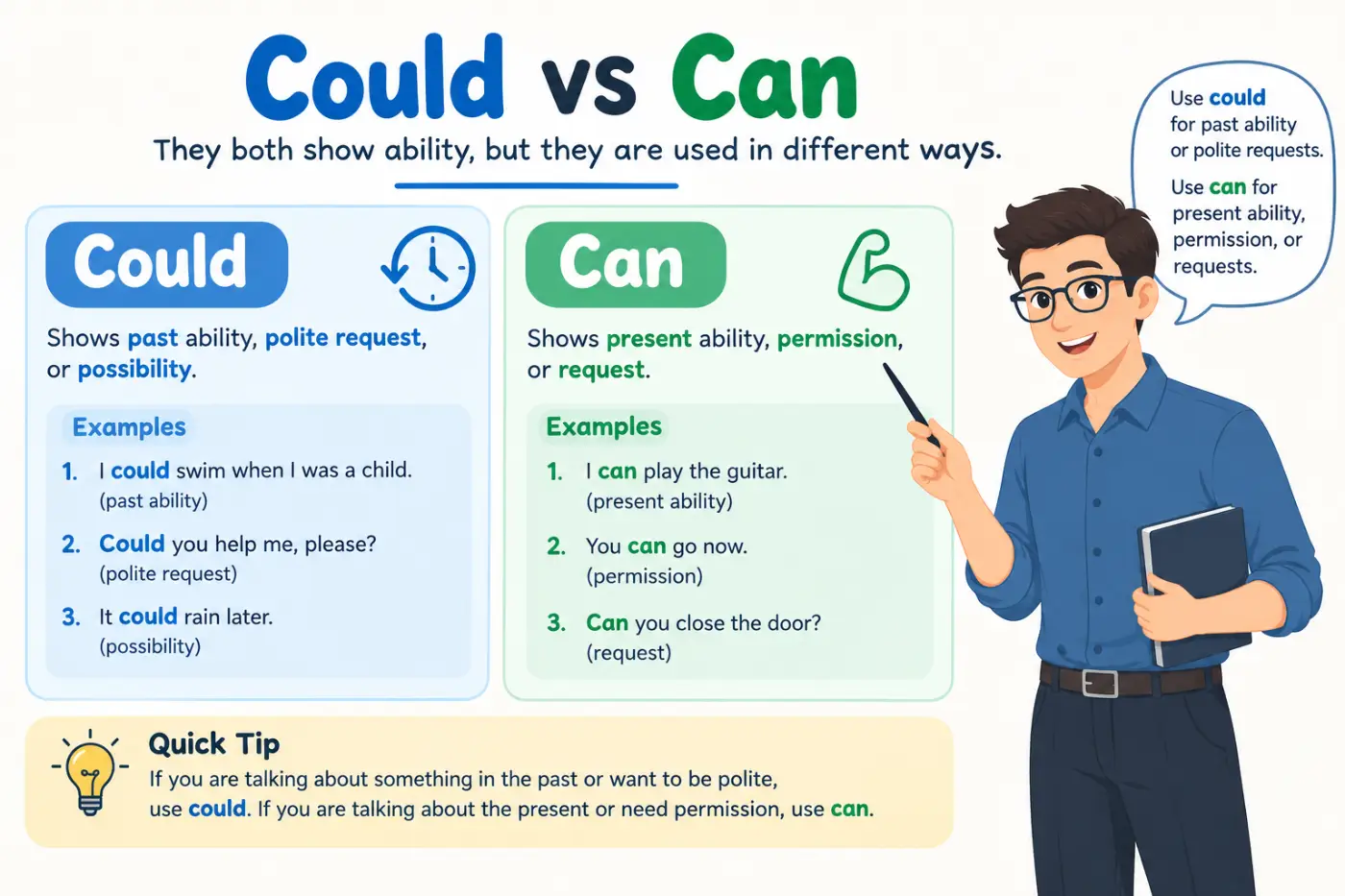
Can expresses present ability, permission, or possibility. Could expresses past ability, polite requests, hypothetical situations, or less certain possibilities. Both are modal verbs, but they aren’t always interchangeable.
This guide explains their meanings, origins, grammar rules, alternatives, and everyday uses. You’ll also find comparison tables, practical examples, common mistakes, and simple tips to help you choose confidently.
What Is the Difference Between Could and Can?
The main difference between can and could involves time, certainty, and politeness.
Can usually describes something someone is able to do now. It also expresses permission and general possibilities. Could often refers to past ability, makes requests sound more polite, or describes something that might happen.
Look at this comparison:
| Can | Could |
|---|---|
| Expresses present ability | Expresses past ability |
| Makes direct requests | Makes more polite requests |
| Shows permission | Asks for permission politely |
| Describes general possibilities | Describes uncertain possibilities |
| Sounds direct and confident | Often sounds softer or more tentative |
Where Do Can and Could Come From?
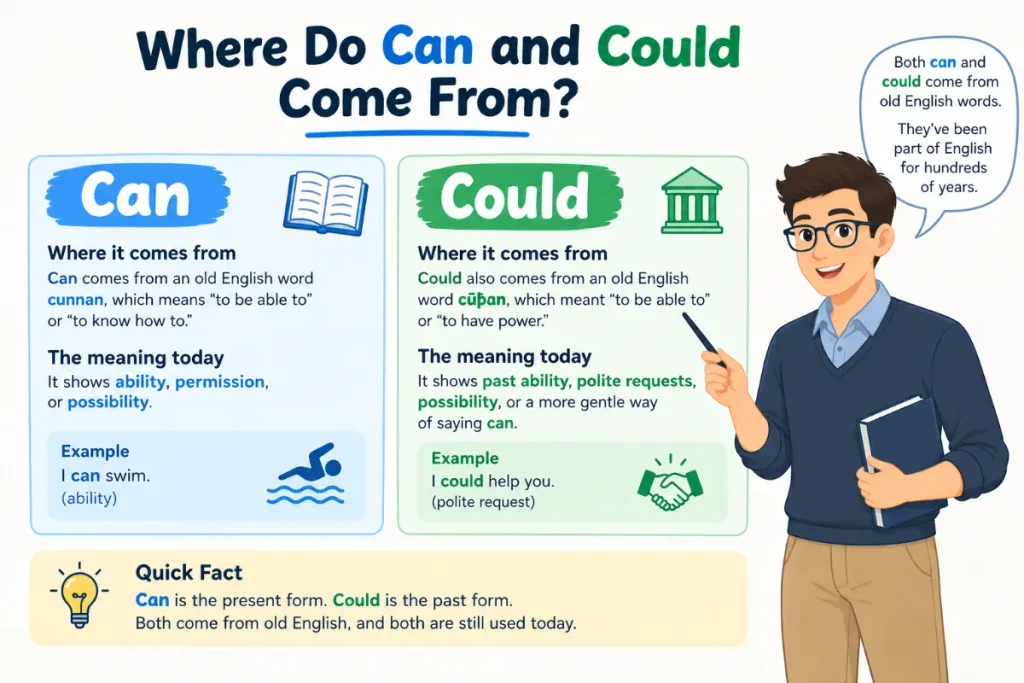
Understanding their history makes the relationship between these words easier to remember.
Origin of Can
Can comes from the Old English word cunnan, which meant to know how to do something or possess knowledge.
Over time, its meaning developed from knowing something to having the ability to perform an action.
Today, can is commonly used to express:
- Physical ability.
- Mental ability.
- Permission.
- General possibility.
- Requests and offers.
For example:
I can solve this math problem.
Here, can tells us that the speaker has the necessary ability.
Origin of Could
Could developed from the Old English past-tense form of cunnan, commonly written as cuþe.
It originally expressed past knowledge or ability. As English changed, could gained additional meanings involving politeness, uncertainty, and imagined situations.
For example:
I could read simple books when I was five.
Here, could describes an ability someone had in the past.
However, consider this sentence:
Could you open the window?
This isn’t asking about someone’s past ability. It’s making a polite request in the present.
That’s why understanding modern usage matters more than simply memorizing could as the past form of can.
When Should You Use Can in English?
Use can when discussing current ability, permission, general possibility, or direct requests.
Can for Present Ability
Can tells someone that you have the skill, knowledge, or physical ability to do something.
Examples:
- I can speak three languages.
- My sister can drive a car.
- He can finish the assignment without help.
These sentences describe abilities that exist now.
Can for Permission
Can is also common when asking for or giving permission.
Examples:
- Can I borrow your notebook?
- You can leave after completing the test.
- Can we use this classroom?
Some traditional grammar lessons prefer may for formal permission. However, using can to ask permission is completely normal in modern English.
Can for General Possibility
Use can when something is generally possible.
Examples:
- Summers can be extremely hot in Arizona.
- Learning a new language can take time.
- Too much sugar can affect your teeth.
These statements describe situations that are possible in general, not necessarily events expected to happen at one specific time.
When Should You Use Could in English?
Could has several important uses. It can describe past ability, polite requests, uncertainty, suggestions, and imagined situations.
Could for Past Ability
Use could to describe a general ability someone had in the past.
Examples:
- I could ride a bicycle when I was seven.
- My grandfather could speak four languages.
- She could play the piano beautifully as a child.
These sentences describe abilities that existed during an earlier period.
However, could isn’t always the best choice for a single successful past action.
Compare:
I could swim when I was young.
This describes general past ability.
I was able to swim across the river yesterday.
This describes one successful action.
For a specific completed achievement, was able to or managed to is often more natural.
Could for Polite Requests
Could makes requests sound softer and more respectful.
Examples:
- Could you explain this rule again?
- Could I speak with your manager?
- Could you please check my application?
These requests are especially useful in professional communication.
Could for Uncertain Possibilities
Use could when something might happen, but you aren’t certain.
Examples:
- It could rain this evening.
- The package could arrive tomorrow.
- This decision could affect our results.
Could suggests possibility without promising a particular outcome.
Could vs Can in Different Situations
The following table shows how choosing one word can change your message.
| Situation | Can | Could |
|---|---|---|
| Ability | I can cook. | I could cook when I was younger. |
| Permission | Can I leave? | Could I leave early? |
| Request | Can you help? | Could you help? |
| Possibility | It can happen. | It could happen tomorrow. |
| Suggestion | We can walk. | We could walk instead. |
| Offer | I can help you. | I could help you if needed. |
| Imaginary situation | I can afford it. | I could afford it if I saved more. |
What Are the Best Synonyms for Can and Could?
Both words have several useful alternatives. However, no single synonym replaces them correctly in every sentence.
Some alternatives express ability. Others communicate permission, possibility, willingness, or politeness.
The following master list includes everyday expressions, formal alternatives, and casual phrases.
Simple Alternatives
| Word or Phrase | Meaning | Tone | Example |
|---|---|---|---|
| Able to | Having the ability | Neutral | She is able to swim. |
| May | Permission or possibility | Neutral | You may enter now. |
| Might | Something is possible | Neutral | It might rain later. |
| Allowed to | Having permission | Neutral | We are allowed to leave. |
| Know how to | Having learned a skill | Simple | I know how to cook. |
| Possible | Something can happen | Neutral | A delay is possible. |
| Capable of | Having the necessary ability | Neutral | He is capable of winning. |
| Free to | Having permission or freedom | Friendly | You’re free to choose. |
Everyday Alternatives
| Word or Phrase | Meaning | Tone | Example |
|---|---|---|---|
| Manage to | Succeed in doing something | Conversational | I managed to finish early. |
| Have the ability to | Possess a skill | Neutral | She has the ability to lead. |
| Have permission to | Be officially allowed | Neutral | We have permission to enter. |
| Be willing to | Agree to do something | Friendly | I’m willing to help. |
| Have a chance to | Have an opportunity | Natural | We have a chance to improve. |
| Be in a position to | Have the means or opportunity | Professional | I’m in a position to assist. |
| Be available to | Have time to do something | Professional | I’m available to meet. |
| Be likely to | Have a strong possibility | Neutral | Prices are likely to rise. |
Formal Alternatives
| Word or Phrase | Meaning | Tone | Example |
|---|---|---|---|
| Be permitted to | Have official permission | Formal | Visitors are permitted to enter. |
| Be authorized to | Have official approval | Formal | Staff are authorized to access records. |
| Have the capacity to | Possess the necessary ability | Formal | The system has the capacity to expand. |
| Have the potential to | Be capable of future success | Professional | This plan has the potential to succeed. |
| Be qualified to | Have suitable skills | Professional | She is qualified to teach. |
| Be equipped to | Have the necessary resources | Professional | Our team is equipped to respond. |
| Be eligible to | Meet stated requirements | Formal | Students are eligible to apply. |
| Be feasible | Be practical or possible | Academic | The proposed solution is feasible. |
Which Alternatives Sound Stronger or Weaker?
Sometimes, you need to express more than simple ability. You might want to communicate uncertainty, confidence, or determination.
These expressions can be arranged from weaker to stronger, depending on context.
| Level | Expression | Example |
|---|---|---|
| Very uncertain | Might possibly | She might possibly attend. |
| Uncertain | Might | She might attend. |
| Possible | Could | She could attend. |
| Available option | Can | She can attend. |
| Expected | Is likely to | She is likely to attend. |
| Confident prediction | Will probably | She will probably attend. |
| Strong commitment | Will | She will attend. |
| Firm determination | Is determined to | She is determined to attend. |
Are Can and Could Verbs or Other Parts of Speech?
Can and could are modal auxiliary verbs when they express ability, permission, or possibility.
A modal auxiliary verb works with another verb to add meaning.
Other common modal verbs include:
- May.
- Might.
- Must.
- Shall.
- Should.
- Will.
- Would.
How to Form Sentences With Can and Could
Both modal verbs usually follow the same basic structure.
Subject + can/could + base form of the verb.
Examples:
I can write.
She could dance.
They can participate.
We could travel.
Don’t add to immediately after either modal.
Incorrect: I can to swim.
Correct: I can swim.
Can These Words Have Other Parts of Speech?
Can can also function as a noun or main verb.
For example:
I bought a can of soup.
Here, can is a noun referring to a container.
They can vegetables every summer.
Here, can is a main verb meaning to preserve food in containers.
Could, however, functions as a modal auxiliary verb in standard modern English.
Alternatives by Grammatical Function
| Function | Alternative | Example |
|---|---|---|
| Modal verb | May | May I enter? |
| Modal verb | Might | It might snow. |
| Adjective | Capable | She is capable of leading. |
| Adjective | Possible | Success is possible. |
| Verb phrase | Be able to | He is able to drive. |
| Verb phrase | Be permitted to | They are permitted to leave. |
| Noun | Ability | She has the ability to learn quickly. |
| Noun | Permission | We received permission to enter. |
These alternatives help you vary your writing without changing your intended message.
Is There a Difference Between American and British English?
Can and could follow almost identical grammar rules in American and British English.
Both varieties use can for present ability and could for past ability, polite requests, and hypothetical situations.
The main differences involve conversational preferences rather than strict grammar rules.
| Situation | American English | British English |
|---|---|---|
| Everyday permission | Can I leave? | Can I leave? |
| Polite request | Could you help me? | Could you help me? |
| Formal permission | May I enter? | May I enter? |
| Casual request | Can you pass that? | Can you pass that? |
| Past ability | I could swim at five. | I could swim at five. |
Which Word Should You Use in Different Contexts?
The best choice depends on your audience, purpose, and intended tone.
A message to a friend doesn’t need to sound like a formal business email. Similarly, professional writing may benefit from softer requests.
Could or Can in a Resume?
Use can sparingly in resumes. Strong action verbs usually communicate your abilities more effectively.
Weak example:
I can manage multiple projects.
Stronger example:
Managed multiple projects while meeting deadlines.
For a professional summary, you might write:
I can coordinate teams and solve complex problems.
However, a more polished version would be:
Skilled in coordinating teams and solving complex problems.
Avoid could when describing proven professional achievements because it may suggest a hypothetical ability rather than something you’ve already demonstrated.
Could or Can in an Essay?
Both words are useful in academic writing, but they express different levels of certainty.
Use can for general abilities or established possibilities.
Example:
Regular exercise can improve physical health.
Use could when discussing a possible outcome that isn’t guaranteed.
Example:
Introducing flexible schedules could improve employee satisfaction.
Be careful not to use can when the evidence supports only a tentative claim.
Could or Can in Texting?
Can is common in casual text messages because it sounds simple and direct.
Examples:
Can you call me later?
Can we meet tomorrow?
Could also works, especially when making a gentle request.
Example:
Could you pick me up after work?
Neither word sounds strange in texting. Choose based on how direct or polite you want to be.

Can vs Could Examples in Real Life
The following examples show how these modal verbs work across everyday situations.
| Situation | Example With Can | Example With Could |
|---|---|---|
| School | I can answer this question. | I could answer these questions easily last year. |
| Workplace | I can attend the meeting. | Could we move the meeting to Friday? |
| Travel | We can take the train. | We could take the train instead. |
| Family | My brother can cook dinner. | My brother could cook when he was ten. |
| Weather | It can get windy here. | It could get windy tonight. |
| Shopping | I can afford this jacket. | I could buy it if the price dropped. |
| Technology | This phone can record videos. | My old phone could only record short videos. |
| Health | Walking can improve fitness. | A short walk could help you relax. |
| Restaurant | Can I see the menu? | Could I have another glass of water? |
| Education | Students can use calculators. | Could students submit their work online? |
| Friendship | I can visit you tonight. | I could visit you this weekend. |
| Sports | She can run very fast. | She could run faster when she was younger. |
Notice that some examples describe time differences, while others show changes in politeness or possibility.
The meaning comes from the complete sentence, not just the individual modal verb.
Can vs Could vs May
These three words sometimes appear in similar situations, especially when asking permission.
However, they don’t always communicate the same meaning.
| Word | Main Meaning | Example |
|---|---|---|
| Can | Ability or permission | Can I use your phone? |
| Could | Polite request or possibility | Could I use your phone? |
| May | Permission or possibility | May I use your phone? |
Can sounds natural and direct.
Could makes the request softer.
May can sound more formal when asking permission.
For example:
Can I leave early?
Could I leave early?
May I leave early?
All three sentences are grammatically correct.
In everyday American English, can and could are extremely common. May remains useful in formal settings, but it isn’t required for every permission request.
Could vs Might
Could and might both express possibility, but their meanings aren’t always identical.
Compare:
She could win the competition.
She might win the competition.
The first sentence presents winning as a possible outcome. Depending on context, it may also suggest that she has the ability or opportunity to win.
The second sentence focuses on uncertainty about the result.
Another comparison:
We could visit Chicago next month.
We might visit Chicago next month.
The first sentence can introduce Chicago as an option.
The second suggests that a visit is possible, but the decision or outcome remains uncertain.
When discussing available choices, could often sounds more natural. When simply expressing uncertainty, might is frequently useful.
Could vs Would
Could and would are both common modal verbs, especially in polite requests and imaginary situations.
However, they communicate different ideas.
| Could | Would |
|---|---|
| Expresses ability or possibility | Often expresses willingness or an imagined result |
| Could you help me? | Would you help me? |
| I could buy a car. | I would buy a car. |
| We could leave early. | We would leave early. |
Consider these sentences:
If I had enough money, I could buy a house.
This means buying a house would be possible.
If I had enough money, I would buy a house.
This suggests buying a house is what the speaker intends or expects to do under that condition.
In polite requests, both words work naturally, but would often focuses more on someone’s willingness.
What Are the Most Common Mistakes With Can and Could?
Even experienced English learners sometimes confuse these modal verbs.
Most errors involve verb forms, tense, or sentence meaning.
Mistake 1: Adding To After Can or Could
Incorrect: She can to drive.
Correct: She can drive.
Incorrect: I could to help you.
Correct: I could help you.
Always use the base form of the main verb immediately after these modals.
Mistake 2: Adding S After Can
Incorrect: He cans speak English.
Correct: He can speak English.
Modal verbs don’t take an s ending with he, she, or it.
Mistake 3: Using Could for Every Past Achievement
Incorrect or unnatural in ordinary affirmative usage:
Yesterday, I could finish the entire assignment before lunch.
Better:
Yesterday, I managed to finish the entire assignment before lunch.
Use managed to or was able to when emphasizing one completed past achievement.
However, could remains natural for general past ability and in many negative or perception-related sentences.
For example:
I couldn’t open the door yesterday.
I could hear someone calling my name.
What Are the Opposites of Can and Could?
The most direct negative forms are cannot, can’t, and couldn’t.
| Positive Form | Negative Form | Example |
|---|---|---|
| Can | Cannot | I cannot attend today. |
| Can | Can’t | She can’t drive. |
| Could | Could not | He could not understand the question. |
| Could | Couldn’t | We couldn’t find the address. |
Cannot is written as one word in standard usage.
Can’t and couldn’t are contractions, making them common in everyday speech and informal writing.
Other expressions that communicate opposite meanings include:
- Unable to.
- Incapable of.
- Not permitted to.
Quick Tips for Choosing Can or Could
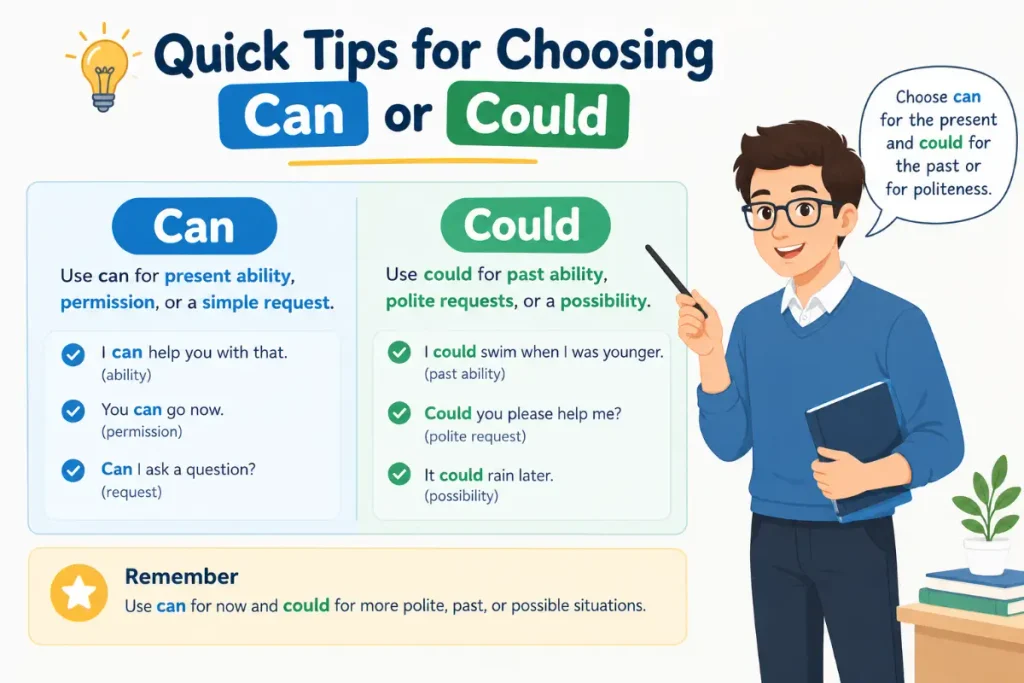
When you’re unsure which word fits your sentence, identify the message you want to communicate.
| Your Intended Meaning | Best Choice |
|---|---|
| Present ability | Can |
| General past ability | Could |
| Direct everyday request | Can |
| Softer or more polite request | Could |
| General possibility | Can |
| Uncertain future possibility | Could |
| Imaginary situation | Could |
| Available option | Can or could |
| Past possibility that didn’t happen | Could have |
| Present inability | Can’t |
| General past inability | Couldn’t |
Conclusion
Understanding could vs can becomes easier once you recognize the purpose behind each word. Can usually expresses present ability, permission, or general possibility. Could describes general past ability, introduces suggestions, makes requests more polite, and discusses uncertain or imaginary situations.
The most useful habit is to think about meaning before choosing a modal verb. Are you describing a skill, asking for permission, offering an idea, or discussing something that might happen? Your answer will usually point you toward the correct word.
Remember that both forms are common in American and British English. Neither is automatically more correct or professional.
With regular practice, you’ll become more comfortable using these words in conversations, emails, essays, and everyday writing.
Frequently Asked Questions
What is the main difference between could and can?
Can usually expresses present ability, permission, or general possibility, while could expresses past ability, polite requests, or hypothetical possibilities. The correct choice depends on context.
Is could more polite than can?
Yes, could generally sounds more polite and less direct when making requests. Both forms are grammatically correct.
Can I use could instead of can?
Sometimes, but not always. Replacing can with could may change the time, certainty, or meaning of your sentence.
Is could the past tense of can?
Could is historically the past form of can and still expresses general past ability. However, it also has several present and hypothetical uses.
What’s another way to say can in English?
Common alternatives include be able to, have the ability to, and be permitted to. Choose an expression that matches your intended meaning.
Which is correct, can you help me or could you help me?
Both are correct. Can you help me sounds direct and natural, while could you help me usually sounds softer and more polite.
How do I remember could vs can easily?
Remember that can commonly describes what is possible or available now, while could often describes past ability, polite requests, or imagined possibilities.
Can we use could for future possibilities?
Yes. Could can describe something that might happen in the future, as in “It could rain tomorrow.”

Daniel Grammarfield — The Language Learner
Age: 28Occupation: ESL Learner & Digital Professional
Bio:Daniel is a non-native English speaker who wants to communicate more confidently at work and online. He uses Synotrench to improve grammar, understand confusing words, learn correct sentence structures, and build everyday English skills. He prefers simple explanations with practical examples.
Goals:
Master English grammar rules
Avoid common language mistakes
Improve professional communication
Learn English through real-life examples
Quote:“Learning English is not about memorizing rules — it’s about expressing ideas clearly.”
1 thought on “Could vs Can: The Ultimate Guide With Examples (2026)”