Have you ever started writing an email, essay, or message and stopped because you weren’t sure which expression sounded correct? You might want to write about several important details, but you can’t decide between here is and here are. Both expressions are common in everyday English, yet choosing the wrong one can make your sentence sound grammatically incorrect.
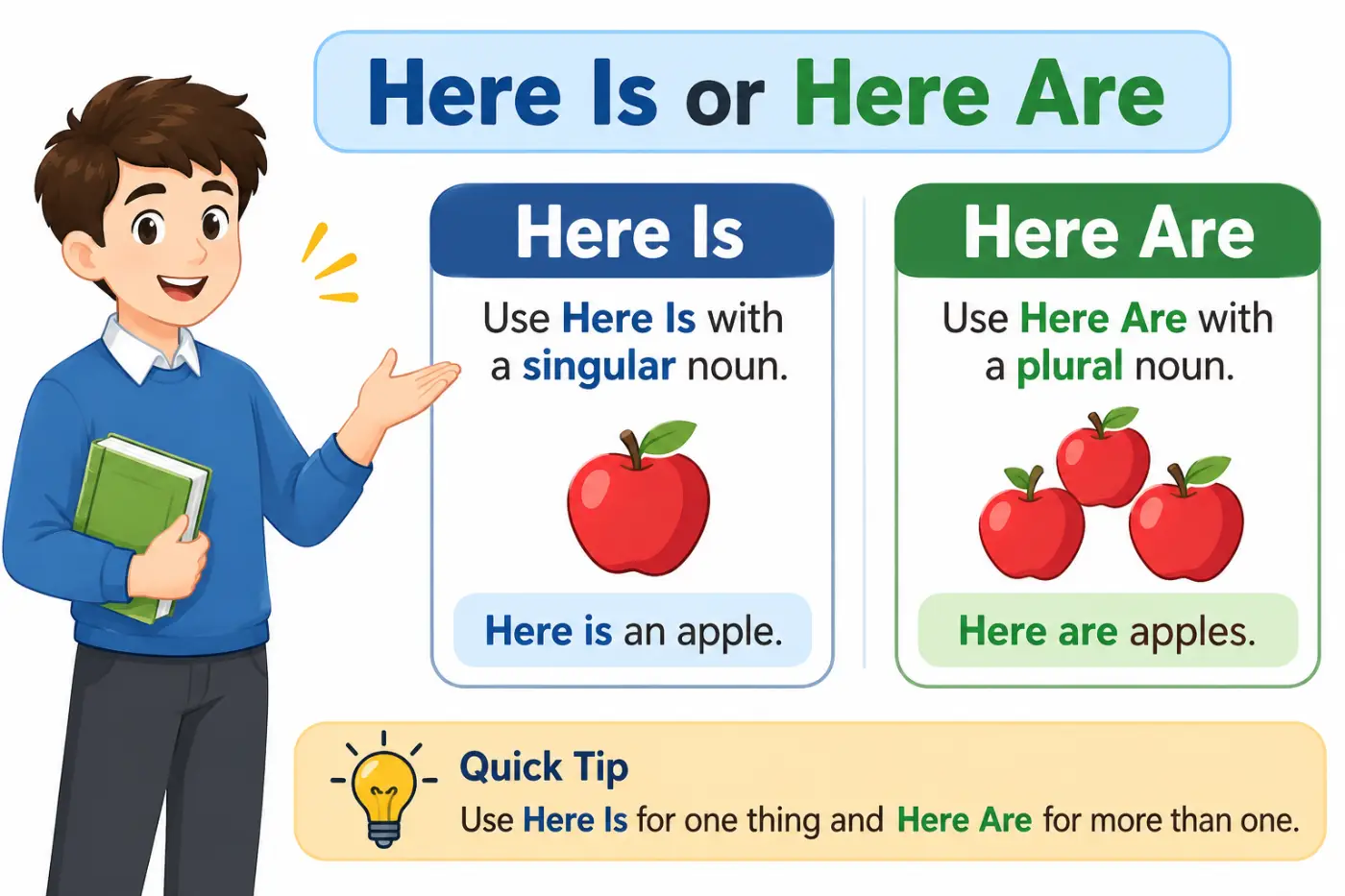
The difference comes down to singular and plural nouns. Here is introduces one person, thing, idea, or situation. Here are introduces two or more people, things, ideas, or situations. Understanding this simple rule makes it easier to write clear sentences and speak with confidence.
The correct choice depends on the noun or subject that follows the expression. For example, you would write Here is your answer when referring to one answer, but Here are your answers when referring to several answers.
In this guide, you’ll learn the meanings, grammar rules, examples, common mistakes, and practical alternatives. You’ll also discover which expression works best in emails, essays, resumes, conversations, and other everyday situations.
What Is the Difference Between Here Is and Here Are?
The main difference is subject and verb agreement. Here is is used with singular nouns, while here are is used with plural nouns.
English verbs often change depending on whether their subjects are singular or plural. The same rule applies to these two expressions.
| Expression | When to Use It | Example |
|---|---|---|
| Here is | One person, thing, or idea | Here is your notebook. |
| Here are | Two or more people, things, or ideas | Here are your notebooks. |
When Should You Use Here Is?
Use here is when you are introducing or pointing out one thing.
The word is is the singular form of the verb be in the present tense. It agrees with a singular subject.
Examples:
- Here is your coffee.
- Here is the information you requested.
- Here is my final answer.
- Here is the address of the office.
- Here is a simple explanation.
In each sentence, the expression introduces one item, one piece of information, or one idea.
You can also use here is with uncountable nouns. These nouns refer to things that aren’t normally counted as separate individual units.
Examples:
- Here is some useful advice.
- Here is the latest news.
- Here is the water you ordered.
- Here is enough evidence to support the claim.
Advice, news, water, and evidence are uncountable in these examples. They take the singular verb is.
When Should You Use Here Are?
Use here are when introducing or pointing out two or more things.
The word are is the present-tense form of be used with plural subjects.
Examples:
- Here are your keys.
- Here are the documents you requested.
- Here are three reasons to consider this option.
- Here are my favorite books.
- Here are the answers to your questions.
Each sentence introduces more than one item or idea.
You can also use here are when introducing a list of people, places, or things.
Examples:
- Here are the students who passed the exam.
- Here are the restaurants we discussed.
- Here are the main points of the meeting.
- Here are the available payment options.
The important rule is simple: use is for a singular subject and are for a plural subject.
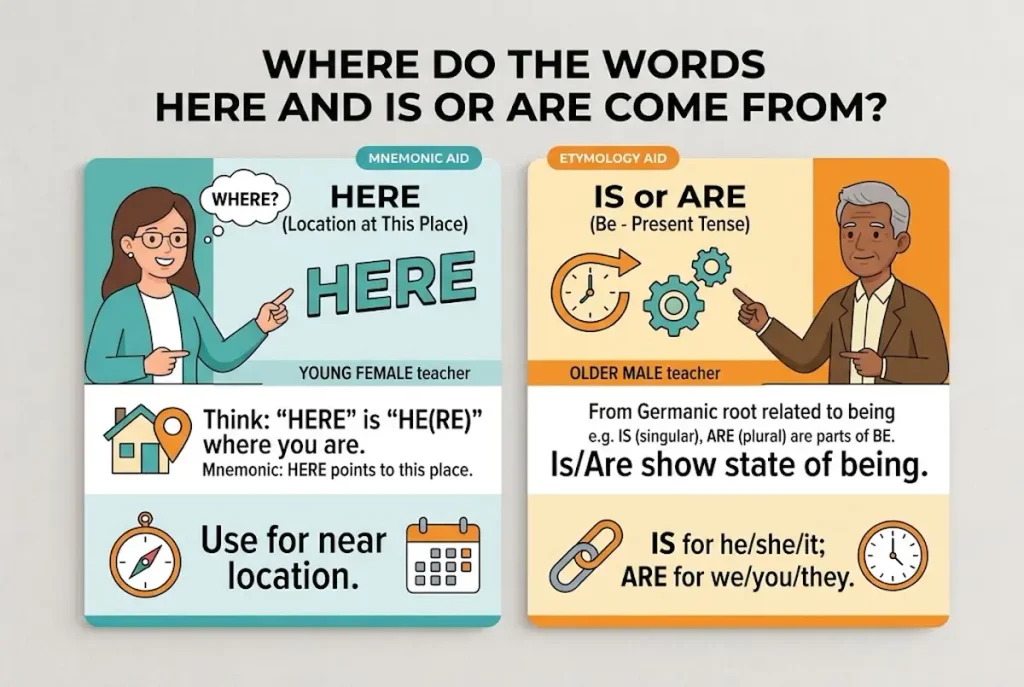
Where Do the Words Here and Is or Are Come From?
Understanding the individual words can make the expressions easier to remember.
What Does the Word Here Mean?
Here is an adverb that usually refers to a place near the speaker or writer.
It helps identify a location or draw attention to something being presented.
Examples:
- Come here for a moment.
- Your package is here.
- Here is the book you wanted.
The word here can also introduce information or direct someone’s attention to something.
For example:
Here are the details of your appointment.
In this sentence, here introduces information rather than describing a physical location.
What Does Is Mean?
Is is a present-tense form of the verb be. It is used with third-person singular subjects, including he, she, it, and singular nouns.
Examples:
- The room is clean.
- She is my teacher.
- The answer is correct.
- The computer is working.
When used in here is, it introduces one person, thing, or idea.
What Does Are Mean?
Are is another present-tense form of the verb be. It is used with plural subjects and the pronouns you and we.
Examples:
- The rooms are clean.
- They are my teachers.
- The answers are correct.
- We are ready.
When used in here are, it introduces multiple people, things, or ideas.
What Are the Best Alternatives to Here Is and Here Are?
Sometimes you may want to avoid repeating the same expressions in an essay, email, report, or conversation.
Several alternatives can help you introduce information naturally. However, these expressions aren’t interchangeable in every sentence. Choose one based on your meaning and writing style.
Simple Alternatives
These expressions are easy to understand and work well in everyday communication.
| Word or Expression | Meaning | Tone | Example |
|---|---|---|---|
| This is | Introduces one thing | Simple | This is your receipt. |
| These are | Introduces multiple things | Simple | These are your books. |
| That is | Points to one thing | Simple | That is my office. |
| Those are | Points to multiple things | Simple | Those are my shoes. |
| It is | Identifies one thing | Simple | It is your turn. |
| They are | Identifies multiple things | Simple | They are my friends. |
Everyday Alternatives
These expressions work in normal conversations, emails, and informal writing.
| Word or Expression | Meaning | Tone | Example |
|---|---|---|---|
| Look at | Directs attention | Everyday | Look at these pictures. |
| Take a look at | Invites someone to examine something | Everyday | Take a look at my notes. |
| Check out | Draws attention to something | Casual | Check out these options. |
| Meet | Introduces a person | Everyday | Meet my new colleague. |
| Find | Directs someone to something | Everyday | Find the details below. |
| Notice | Draws attention to a detail | Everyday | Notice the difference between them. |
Formal Alternatives
These expressions are useful in professional emails, academic papers, business reports, and official communication.
| Word or Expression | Meaning | Tone | Example |
|---|---|---|---|
| The following | Introduces upcoming information | Formal | The following points explain the process. |
| Presented below | Shows information underneath | Formal | The results are presented below. |
| Provided here | Makes information available | Formal | The requested details are provided here. |
| Included below | Indicates attached or following information | Formal | The documents are included below. |
| Outlined below | Introduces a summary | Formal | The requirements are outlined below. |
| As follows | Introduces a list or explanation | Formal | The main objectives are as follows. |
Casual and Slang Alternatives
These expressions are more conversational. They are useful in texts, friendly messages, and informal discussions.
| Word or Expression | Meaning | Tone | Example |
|---|---|---|---|
| Here’s | Short form of here is | Casual | Here’s your coffee. |
| Here’re | Short form of here are | Very informal | Here’re your keys. |
| There you go | Presents or hands over something | Casual | There you go, your ticket. |
| Check this out | Directs attention to something interesting | Slang | Check this out, I found a great deal. |
| Got it here | Indicates something is available | Casual | I’ve got it here. |
| Right here | Emphasizes a nearby location | Casual | Your name is right here. |
Note that here’s is a standard contraction of here is. Here’re is a possible contraction of here are, but it is uncommon in modern writing and can look awkward. In most situations, writing here are in full is clearer.
How Do You Choose Between Mild and Strong Alternatives?
The choice of expression can change the level of emphasis in your sentence. Some alternatives simply introduce information, while others direct attention or make something sound more important.
Neutral Expressions
Neutral expressions present information without adding much emotion or emphasis.
Examples:
- Here is the report.
- This is the final result.
- The following are the main requirements.
These expressions work in most everyday and professional situations.
Attention-Grabbing Expressions
Use these expressions when you want someone to notice something.
Examples:
- Look at these results.
- Notice the changes in the document.
- Check out these new features.
They work well in conversations, presentations, and informal writing.
Strong and Formal Expressions
Use more direct or formal language when presenting important information.
Examples:
- The following evidence supports the argument.
- The key findings are presented below.
- The main concerns are outlined in this report.
These choices are especially useful in academic and professional communication.
Remember that stronger expressions don’t automatically make writing better. The best choice is the one that communicates your message clearly.
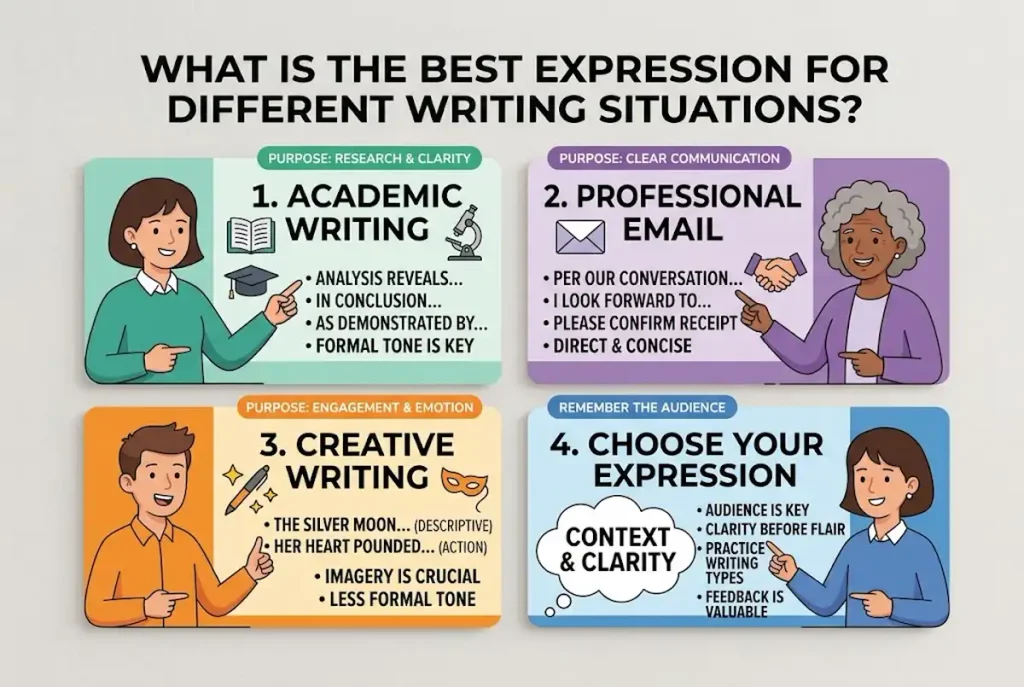
What Is the Best Expression for Different Writing Situations?
Your choice should depend on your audience, purpose, and writing style. A casual message doesn’t need the same language as a business report.
What Should You Use in a Resume?
A resume should be professional, clear, and direct.
You can use here is or here are when introducing information, but action words and direct statements often create a stronger impression.
Examples:
- Here are my main professional qualifications.
- Here is a summary of my work experience.
- The following are my key technical skills.
For a resume, avoid repeating introductory expressions too often. Use headings such as Skills, Experience, and Education to organize information.
A better example:
Technical Skills: Python, Excel, HTML, and SQL.
This is shorter and easier for employers to scan.
What Should You Use in an Essay?
Both expressions can work in an essay, depending on the sentence.
However, formal alternatives may sound more natural in academic writing.
Examples:
- Here is an explanation of the main argument.
- Here are three reasons supporting this theory.
- The following examples demonstrate the importance of education.
- These findings support the research hypothesis.
If you’re introducing a list of arguments, use a clear introductory sentence. Don’t choose a complicated expression just to make your essay sound more academic.
What Should You Use in Text Messages?
In text messages, natural and short expressions are usually best.
Examples:
- Here’s your photo.
- Here are the pictures.
- Here’s the address.
- Here are the details.
- Check this out!
Contractions are common in texting because they make messages shorter and more conversational.
For example:
Here’s your order information.
This sounds natural when sending one set of information to a friend.
What Should You Use in Professional Emails?
Professional emails should sound polite and easy to understand.
Both expressions are useful when sharing information, documents, or instructions.
Examples:
- Here is the report you requested.
- Here are the files for your review.
- The following are the details of our meeting.
- Here is the updated project schedule.
Use here is when introducing one document or item. Use here are when introducing several documents or items.
You can also use please find attached when referring to files included with an email, although here are the attached files is often more conversational.
What Should You Use When Speaking?
In everyday speech, both expressions are natural.
Your choice depends on the number of things you’re introducing.
Examples:
- Here is your seat.
- Here are your friends.
- Here is the menu.
- Here are the tickets.
In spoken English, contractions such as here’s are especially common.
For example:
Here’s your coffee.
This sounds natural when giving someone one cup of coffee.
What Are Some Real-Life Examples of Here Is and Here Are?
Learning the grammar rule is helpful, but seeing it in different situations makes it easier to use correctly.
Here are original examples from everyday communication.
Examples at Home
- Here is the remote control you were looking for.
- Here are the clean towels for the bathroom.
- Here is your lunch on the kitchen table.
- Here are the groceries we bought this morning.
At School
- Here is your homework assignment.
- Here are the questions for tomorrow’s test.
- Here is the book you need for English class.
- Here are the students who joined the competition.
At Work
- Here is the updated business report.
- Here are the files you requested yesterday.
- Here is the schedule for next week’s meetings.
- Here are the changes we discussed during the meeting.
In Online Communication
- Here is the link to the online class.
- Here are the screenshots showing the problem.
- Here is the password reset information.
- Here are the instructions for creating an account.
In Everyday Conversations
- Here is my favorite restaurant.
- Here are the pictures from our vacation.
- Here is the reason I called you.
- Here are a few suggestions for your project.
Examples With Uncountable Nouns
- Here is some important information.
- Here is the advice you asked for.
- Here is enough time to finish the assignment.
- Here is the equipment we need for the experiment.
These examples show that the choice isn’t based on how long a sentence is. It depends on the grammatical number of the subject.
What’s the Difference: Here Is vs This Is?
Here is and this is can sometimes introduce the same information, but they don’t always communicate exactly the same thing.
Here is often presents or points out something. This is identifies or introduces a particular person, thing, or idea.
| Here Is | This Is |
|---|---|
| Here is your new phone. | This is your new phone. |
| Here is the report. | This is the report. |
| Here is my suggestion. | This is my suggestion. |
The first expression often draws attention to something being presented or made available.
The second identifies the thing being discussed.
For example:
- Here is your appointment card.
This sounds natural when handing someone a card.
- This is your appointment card.
This identifies the card or explains what it is.
Both can be grammatically correct. The situation determines which sounds more natural.
What’s the Difference: Here Are vs These Are?
Here are and these are both work with plural nouns, but they have different purposes.
Here are usually introduces or presents multiple things. These are identifies or points to multiple things.
| Here Are | These Are |
|---|---|
| Here are your shoes. | These are your shoes. |
| Here are the documents. | These are the documents. |
| Here are my friends. | These are my friends. |
Consider these situations:
You are giving someone several documents.
Here are the documents you requested.
You are pointing to several documents and explaining what they are.
These are the documents you requested.
The first expression focuses on presenting the documents. The second focuses on identifying them.
What Common Grammar Mistakes Should You Avoid?
Even though the rule is simple, some sentence structures can cause confusion.
Using Here Is With Plural Nouns
One common mistake is using is before a plural noun.
Incorrect: Here is your books.
Correct: Here are your books.
Books is plural, so the correct verb is are.
Using Here Are With Singular Nouns
Another mistake is using are when introducing one item.
Incorrect: Here are your notebook.
Correct: Here is your notebook.
Notebook is singular, so it needs is.
Forgetting That Uncountable Nouns Are Singular
Uncountable nouns can be confusing because they may describe large amounts of something.
Incorrect: Here are the information you requested.
Correct: Here is the information you requested.
Information is uncountable in standard English. It takes a singular verb.
Other examples include:
- Here is the furniture.
- Here is the research.
- Here is the equipment.
- Here is the advice.
Confusing the Nearest Noun With the Main Subject
Sometimes a sentence contains several nouns, making the correct verb harder to identify.
Incorrect: Here is the books and notebook.
Correct: Here are the books and notebook.
The sentence introduces multiple items. The plural verb are is appropriate.
For better clarity, you could also write:
Here are the books and the notebook.
Using Here’re Too Often
Here’re is a contraction of here are, but it is uncommon and can look unnatural in formal writing.
Less natural: Here’re the documents.
Better: Here are the documents.
Use the complete expression in professional emails, essays, reports, and academic work.
Assuming That Every Long Sentence Needs Are
Sentence length doesn’t determine the correct verb.
For example:
Here is the detailed explanation of the three different problems that we discussed yesterday.
Even though the sentence contains several nouns, the main subject is explanation, which is singular.
Therefore, is is correct.
When Should You Avoid Using Here Is or Here Are?
These expressions are useful, but they aren’t always the best choice.
Knowing when to replace them can improve your writing.
Avoid Repeating Them in Every Paragraph
Using the same expression repeatedly can make your writing sound dull.
Repetitive:
Here is the first reason. Here is the second reason.
Better:
The first reason is cost. The second is convenience. The third is reliability.
Vary your sentence structure to make your writing more natural.
Avoid Them When a Direct Sentence Is Clearer
Sometimes a direct statement communicates your idea more effectively.
Wordy: Here is the fact that the meeting starts at nine.
Better: The meeting starts at nine.
The shorter version is more direct.
Avoid Unnecessary Formal Alternatives
Don’t replace simple language with complicated expressions just to sound professional.
Unnatural: Presented herein are the details of your appointment.
Natural: Here are your appointment details.
Clear writing is usually better than unnecessarily complicated writing.
Avoid Using Them When the Subject Is Unclear
Your reader should understand what you’re introducing.
Unclear: Here is what they said about it.
Clearer: Here is what the manager said about the new policy.
Adding specific information makes the sentence easier to understand.
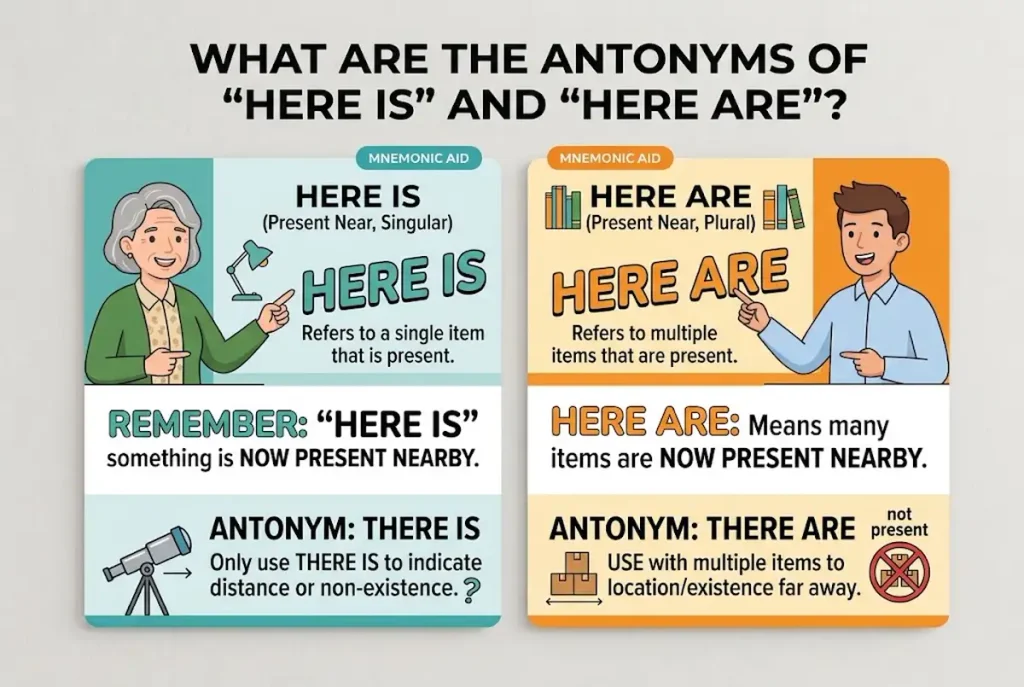
What Are the Antonyms of Here Is and Here Are?
Here is and here are don’t have exact antonyms because they are grammatical expressions rather than descriptive words.
However, some expressions communicate an opposite or different idea.
| Expression | General Meaning | Example |
|---|---|---|
| Not here | Indicates absence | Your package is not here. |
| Gone | Indicates something has left | The documents are gone. |
| Missing | Indicates something cannot be found | The keys are missing. |
| No longer available | Indicates unavailability | The tickets are no longer available. |
| Taken away | Indicates removal | The chairs were taken away. |
These expressions aren’t direct grammatical opposites. They simply communicate meanings that contrast with presenting or showing something.
What Are the Quick Tips for Choosing the Correct Expression?
Use these simple tips whenever you’re unsure about your sentence.
- Check the noun that follows the expression. If it is singular, use here is.
- If the noun is plural, use here are.
- Remember that uncountable nouns generally take is.
- Use here is with one person, object, or idea.
- Use here are when introducing several people, objects, or ideas.
- Don’t let the length of a sentence confuse you. Find the main subject.
- Use here’s as a natural contraction of here is in casual communication.
- Prefer here are over the uncommon contraction here’re in standard writing.
- Use formal alternatives when writing reports or academic papers.
- Read your sentence aloud to check if the expression sounds natural.
A useful memory trick is to connect is with one and are with more than one. This small habit can help you make the right choice quickly.
Conclusion
Choosing between these expressions becomes easy once you understand subject-verb agreement. Use the singular form when introducing one item, person, or uncountable noun. Choose the plural form when presenting two or more items or people.
The most reliable way to avoid mistakes is to look at the noun that follows the expression instead of guessing based on how the sentence sounds. Also, remember that alternatives such as this is, these are, and the following can make your writing more varied when used in the right context.
With a little practice, you’ll naturally know when to use here is or here are in emails, essays, conversations, and professional documents. Keep the basic rule in mind, and your sentences will become clearer and more accurate.
Frequently Asked Questions
Can I Use Here Is With Uncountable Nouns?
Yes, here is is correct with uncountable nouns such as information, advice, furniture, and equipment. For example, Here is the information you requested.
Is Here’s Short for Here Is?
Yes, here’s is the standard contraction of here is. It is commonly used in conversations, text messages, and informal writing.
Is Here’re Correct English?
Here’re is a possible contraction of here are, but it is uncommon in modern English. Writing here are in full is usually clearer and more appropriate.
What’s Another Way to Say Here Is or Here Are?
You can use expressions such as this is, these are, the following, presented below, or included below. Choose an alternative based on the sentence and level of formality.
Do Americans Use Here Is and Here Are Differently?
No major difference exists between American and British English for these expressions. Both varieties follow the same singular and plural subject-verb agreement rules.
How Do I Remember When to Use Here Is or Here Are?
Remember that is goes with one singular or uncountable subject, while are goes with plural subjects. Check the noun being introduced before choosing the verb.

Daniel Grammarfield — The Language Learner
Age: 28Occupation: ESL Learner & Digital Professional
Bio:Daniel is a non-native English speaker who wants to communicate more confidently at work and online. He uses Synotrench to improve grammar, understand confusing words, learn correct sentence structures, and build everyday English skills. He prefers simple explanations with practical examples.
Goals:
Master English grammar rules
Avoid common language mistakes
Improve professional communication
Learn English through real-life examples
Quote:“Learning English is not about memorizing rules — it’s about expressing ideas clearly.”
3 thoughts on “Here Is or Here Are: The Best Simple Grammar Guide”