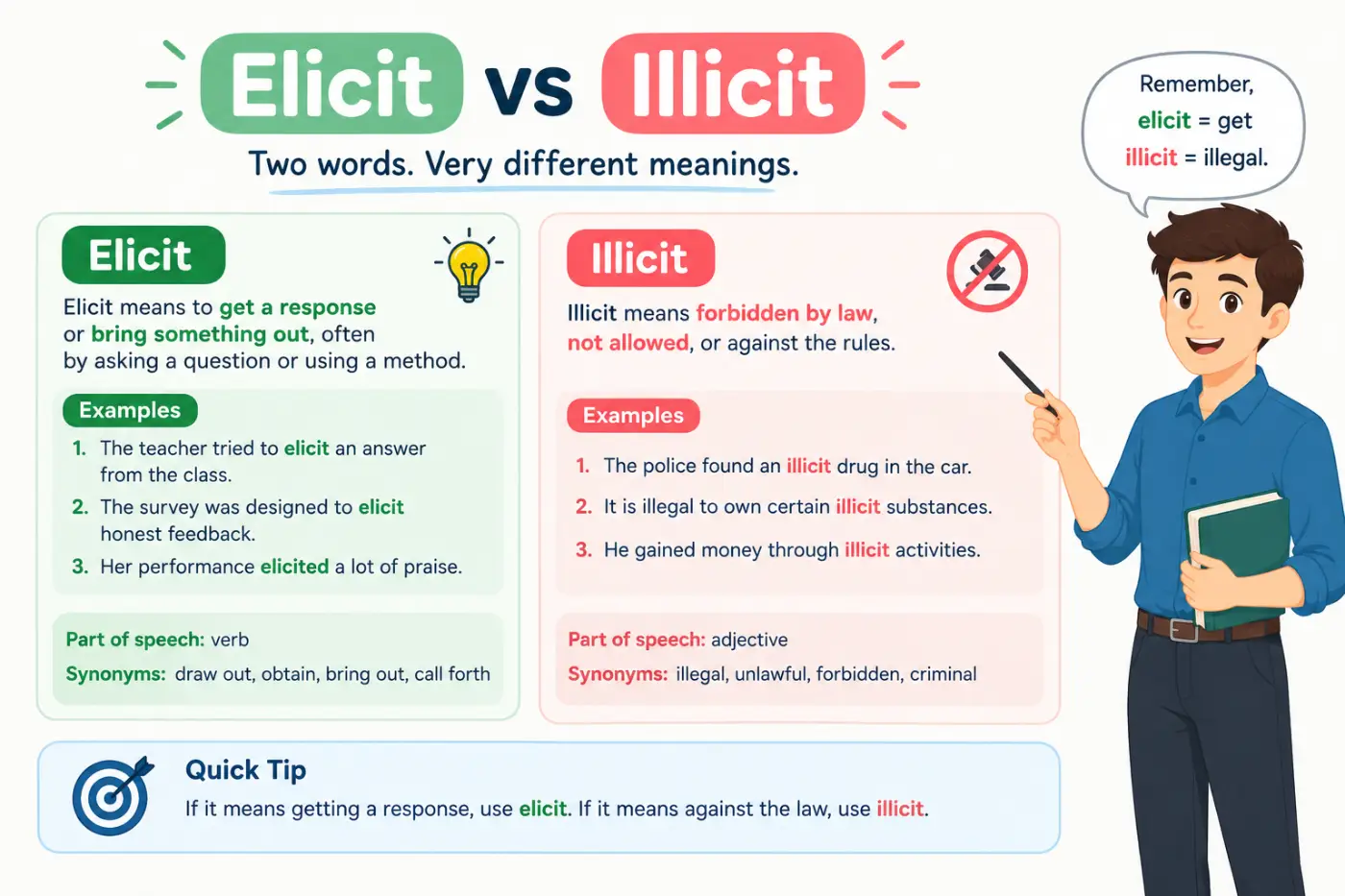
The difference between Elicit vs Illicit is simple: Elicit is a verb meaning to draw out a response, reaction, or information. Illicit is an adjective describing something illegal or forbidden.
Imagine you’re writing an email about a company investigation. You want to explain that certain questions helped uncover information about illegal activities. Should you write elicit information or illicit information?
Both words sound exactly alike, but their meanings are completely different. Choosing the wrong one can change your message and make your writing confusing.
This guide explains their meanings, origins, grammar rules, synonyms, and everyday uses. You’ll also find comparison tables, practical examples, common mistakes, and simple memory tricks to help you choose the correct word every time.
What Is the Difference Between Elicit and Illicit?
Elicit and illicit are homophones. This means they have the same pronunciation but different spellings and meanings.
The biggest difference is how they work in a sentence.
| Feature | Elicit | Illicit |
|---|---|---|
| Part of speech | Verb | Adjective |
| Basic meaning | To draw out something | Illegal or forbidden |
| Common use | Responses, emotions, information | Activities, substances, trade |
| Example | The question elicited a response. | Police discovered illicit goods. |
| Similar words | Obtain, evoke, draw out | Illegal, unlawful, prohibited |
| Opposite | Suppress, discourage | Legal, lawful, permitted |
You cannot exchange these words without changing the meaning or creating a grammatical mistake.

What Does Elicit Mean in Simple English?
Elicit means to draw out, bring forth, or cause a particular response, feeling, or piece of information.
It is a verb because it describes an action.
You might elicit a smile, an answer, a reaction, or information from another person.
For example:
- The comedian’s joke elicited laughter from the audience.
- Her thoughtful question elicited an honest response.
- The photograph elicited memories of childhood.
- The manager tried to elicit feedback from employees.
Where Does the Word Elicit Come From?
Elicit comes from the Latin word elicere, meaning to draw out or bring forth.
The Latin word combines the idea of drawing something out with movement away from its original place.
This origin helps explain its modern meaning.
When you elicit information, you draw it out of someone. When a song elicits emotion, it brings a feeling to the surface.
What Are the Different Forms of Elicit?
Because elicit is a verb, its spelling changes according to tense and sentence structure.
| Verb form | Example |
|---|---|
| Elicit | Good questions elicit useful answers. |
| Elicits | Her speech elicits strong emotions. |
| Elicited | The survey elicited several complaints. |
| Eliciting | The interviewer is eliciting detailed responses. |
What Does Illicit Mean in Simple English?
Illicit means illegal, unlawful, or forbidden by accepted rules.
It is an adjective, so it describes a noun rather than an action.
People commonly use it when discussing crime, prohibited behavior, illegal trade, and activities carried out against established rules.
Examples include:
- The officers discovered illicit substances.
- Authorities investigated an illicit business.
- The company faced accusations of illicit financial activities.
- The organization worked to prevent illicit trade.
The word often carries a serious or negative meaning.
However, illicit does not always mean something violates criminal law. It can also describe behavior that breaks established social or moral rules.
For example, an illicit affair may describe a secret romantic relationship considered forbidden or improper.
Where Does the Word Illicit Come From?
Illicit comes from the Latin word illicitus, meaning not allowed or unlawful.
It developed from licitus, meaning permitted or lawful, with the negative prefix il.
This history explains why illicit describes something prohibited.
You may recognize a related word: licit.
Licit means lawful or permitted, although it is less common in everyday conversation.
Is Illicit Always Related to Crime?
No. Illicit can describe behavior that breaks laws, social expectations, or accepted rules.
Its exact meaning depends on the situation.
| Expression | Meaning |
|---|---|
| Illicit drugs | Drugs prohibited by law |
| Illicit trade | Unlawful commercial activity |
| Illicit relationship | A relationship considered forbidden or improper |
| Illicit financial activity | Financial conduct that violates laws or regulations |
| Illicit access | Access obtained without proper permission |
Elicit vs Illicit Synonyms With Meanings and Examples
Knowing related words helps you understand the difference between these two expressions.
However, their synonyms belong to separate meaning groups. A synonym for elicit cannot automatically replace illicit.
The following tables include more than 30 useful alternatives, organized by simple, everyday, formal, and informal language.
Simple Synonyms for Elicit
These words work well in basic explanations and everyday writing.
| Word | Meaning | Tone | Example |
|---|---|---|---|
| Get | Receive something | Simple | The teacher got an answer. |
| Draw out | Encourage something to emerge | Simple | Her questions drew out his feelings. |
| Bring out | Cause something to appear | Simple | The story brought out strong emotions. |
| Cause | Make something happen | Neutral | The announcement caused excitement. |
| Produce | Create a result | Neutral | The experiment produced useful responses. |
| Obtain | Get something through effort | Neutral | The researcher obtained detailed information. |
| Encourage | Help something develop | Positive | The discussion encouraged honest feedback. |
| Prompt | Cause someone to respond | Neutral | His comment prompted a reply. |
Everyday Synonyms for Elicit
These alternatives are useful in conversations, emails, articles, and general communication.
| Word | Meaning | Tone | Example |
|---|---|---|---|
| Evoke | Bring a feeling or memory to mind | Expressive | The song evoked childhood memories. |
| Trigger | Cause a reaction | Neutral | The news triggered widespread concern. |
| Inspire | Encourage a feeling or action | Positive | Her speech inspired confidence. |
| Provoke | Cause a reaction, often a strong one | Strong | His remarks provoked anger. |
| Generate | Produce something | Professional | The campaign generated interest. |
| Stir | Awaken feelings | Expressive | The film stirred deep emotions. |
| Spark | Start a reaction or discussion | Conversational | The question sparked debate. |
| Invite | Encourage a response | Friendly | The announcement invited criticism. |
Formal Synonyms for Elicit
Formal alternatives are useful in academic essays, research reports, professional documents, and technical writing.
| Word | Meaning | Tone | Example |
|---|---|---|---|
| Extract | Obtain through effort | Formal | The interviewer extracted key details. |
| Induce | Cause a particular response | Formal | The treatment induced a reaction. |
| Stimulate | Encourage activity or response | Formal | The exercise stimulated discussion. |
| Solicit | Ask for information or feedback | Professional | The company solicited suggestions. |
| Evince | Show or reveal a quality | Formal | The students evinced genuine interest. |
| Incite | Encourage a strong action | Strong | The message incited unrest. |
| Activate | Cause something to become active | Technical | The signal activated the system. |
| Arouse | Awaken interest or emotion | Formal | The discovery aroused curiosity. |
Which Synonyms Are Mild and Which Are Strong?
Word intensity matters because similar words can create different impressions.
Some expressions sound neutral, while others suggest serious wrongdoing or emotional reactions.
Intensity Levels for Elicit
| Intensity | Word | Typical use |
|---|---|---|
| Mild | Encourage | Encourage feedback |
| Mild | Invite | Invite discussion |
| Moderate | Prompt | Prompt a response |
| Moderate | Elicit | Elicit information |
| Moderate | Evoke | Evoke memories |
| Strong | Trigger | Trigger an emotional reaction |
| Strong | Provoke | Provoke anger |
| Strong | Incite | Incite unrest |
Intensity Levels for Illicit
| Intensity | Word | Typical use |
|---|---|---|
| Mild | Improper | Improper behavior |
| Mild | Unauthorized | Unauthorized entry |
| Moderate | Forbidden | Forbidden activity |
| Moderate | Prohibited | Prohibited substances |
| Strong | Illicit | Illicit financial transactions |
| Strong | Unlawful | Unlawful conduct |
| Strong | Criminal | Criminal operations |
How Do Parts of Speech Affect Elicit and Illicit?
Understanding grammar is one of the easiest ways to avoid mixing up these words.
Elicit is a verb, while illicit is an adjective.
That means they perform different jobs in a sentence.
Elicit as a Verb
Use elicit when someone or something causes a response.
Examples:
- The interviewer elicited detailed answers.
- The presentation elicited several questions.
- The survey may elicit useful feedback.
The verb can appear in different tenses.
You can say elicit, elicits, elicited, or eliciting.
Illicit as an Adjective
Use illicit when describing something illegal or forbidden.
Examples:
- Authorities uncovered an illicit operation.
- The report described illicit financial transactions.
- Investigators found evidence of illicit trade.
You cannot change illicit into a past-tense verb.
For instance, illicitated is not a standard English word.
Related Nouns and Adjectives
| Base word | Related form | Part of speech | Meaning |
|---|---|---|---|
| Elicit | Elicitation | Noun | The process of drawing out information |
| Elicit | Elicited | Verb form | Drew out or caused |
| Illicit | Illicitness | Noun | The quality of being forbidden |
| Illicit | Illicitly | Adverb | In an unlawful or forbidden way |
| Illicit | Licit | Adjective | Lawful or permitted |
Is There a Difference Between American and British English?
Elicit and illicit have the same meanings and standard spellings in American and British English.
Neither word requires a regional spelling change.
| Feature | American English | British English |
|---|---|---|
| Elicit spelling | Elicit | Elicit |
| Illicit spelling | Illicit | Illicit |
| Elicit meaning | Draw out a response | Draw out a response |
| Illicit meaning | Illegal or forbidden | Illegal or forbidden |
| Grammar | Verb and adjective | Verb and adjective |
Both words are pronounced alike in standard English, although their vowel sounds may vary slightly between accents.
This similarity explains why people sometimes confuse them while writing.
The difference is grammatical and semantic, not regional.
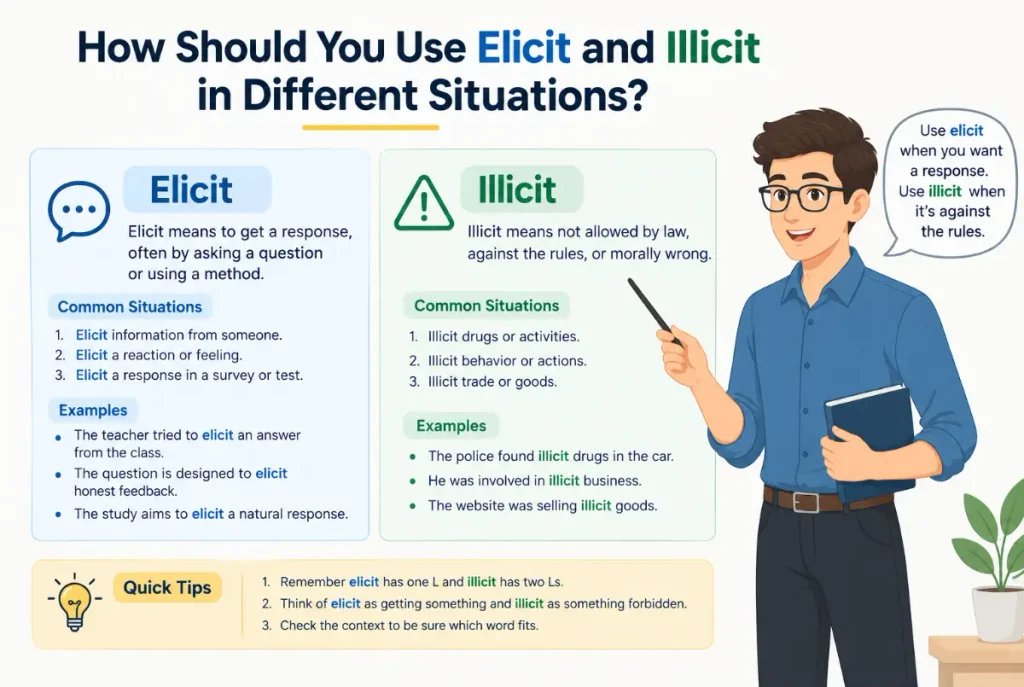
How Should You Use Elicit and Illicit in Different Situations?
The best choice depends on what you want to communicate.
One word describes producing a response. The other describes something prohibited.
Which Word Should You Use on a Resume?
Use elicit when describing communication, research, interviewing, or customer engagement skills.
For example:
My interview techniques helped elicit valuable customer feedback.
However, simpler action verbs may sound more natural on a resume.
A stronger alternative is:
Collected valuable customer feedback through structured interviews.
Illicit is rarely suitable for a general resume unless you’re describing professional experience related to investigations, compliance, or law enforcement.
Example:
Investigated illicit financial transactions and prepared compliance reports.
Which Word Is Better for an Academic Essay?
Both words are appropriate in academic writing, but they communicate different ideas.
Use elicit when discussing research methods, emotional responses, or information gathering.
Example:
The researchers designed open-ended questions to elicit detailed participant responses.
Use illicit when discussing unlawful activities or forbidden behavior.
Example:
The study examined the economic effects of illicit international trade.
In academic writing, accuracy matters more than choosing a sophisticated word.
Can You Use Elicit or Illicit in Text Messages?
Yes, although both words may sound slightly formal in casual texting.
Instead of writing:
Your message elicited a smile.
You could write:
Your message made me smile.
However, illicit is useful when discussing something forbidden or suspicious.
Example:
That sounds like an illicit business operation.
For everyday texting, illegal or not allowed may sound more natural.
How Should You Use These Words in Professional Emails?
Use elicit when discussing feedback, responses, surveys, or communication.
Example:
We hope these questions will elicit useful suggestions from the team.
Use illicit when discussing prohibited conduct or compliance issues.
Example:
Our department is reviewing reports of possible illicit transactions.
Be careful with accusations. Describing an activity as illicit can suggest serious wrongdoing.
When facts remain uncertain, phrases such as suspected illicit activity may communicate the situation more accurately.
Which Word Sounds Natural in Everyday Speaking?
Elicit appears more often in formal explanations than in casual conversations.
For example:
The speaker’s comments elicited laughter.
In ordinary speech, someone might simply say:
The speaker made everyone laugh.
Illicit commonly appears in news reports, legal discussions, and conversations about prohibited activities.
Example:
Police discovered an illicit trading network.
You don’t need to force either word into casual conversation. Use it when its meaning fits naturally.
15 Real-Life Example Sentences Using Elicit and Illicit
Examples make the difference easier to remember.
Notice how elicit describes an action, while illicit describes a person, thing, or activity.
| Situation | Example sentence |
|---|---|
| Classroom | The teacher’s question elicited several thoughtful answers. |
| Workplace | The manager tried to elicit honest feedback from employees. |
| Research | The survey elicited responses from hundreds of participants. |
| Entertainment | The comedian’s performance elicited loud laughter. |
| Family | The old photograph elicited happy memories. |
| Healthcare | The doctor asked questions to elicit more details about the symptoms. |
| Marketing | The advertisement elicited strong customer interest. |
| Law enforcement | Officers discovered illicit substances inside the vehicle. |
| Business | Investigators uncovered an illicit financial operation. |
| International trade | The government introduced measures against illicit trade. |
| Technology | The report identified illicit access to private information. |
| Education | Students discussed the consequences of illicit activities. |
| Banking | The institution reported suspected illicit transactions. |
| Journalism | The article examined the growth of illicit online markets. |
| Relationships | The novel follows two characters involved in an illicit affair. |
Can Both Words Appear in One Sentence?
Yes. Using them together can make their different meanings especially clear.
Consider these examples:
- The investigator asked questions to elicit information about the illicit operation.
- The journalist hoped to elicit a response from officials regarding illicit trade.
- The survey was designed to elicit public opinions about illicit online activities.
What’s the Difference: Elicit vs Evoke?
Elicit and evoke are close synonyms, but they have slightly different uses.
Elicit usually suggests drawing out a response or obtaining information through a question, action, or situation.
Evoke often describes bringing feelings, memories, or images into someone’s mind.
| Elicit | Evoke |
|---|---|
| Draws out a response | Brings something to mind |
| Often used with answers and feedback | Often used with memories and emotions |
| Common in interviews and research | Common in literature and descriptions |
| The question elicited an answer. | The song evoked childhood memories. |
Illicit vs Illegal: Are They the Same?
Illicit and illegal are closely related, but they are not always interchangeable.
Illegal directly describes something that violates the law.
Illicit can describe unlawful conduct or behavior considered forbidden under established social or moral rules.
| Illicit | Illegal |
|---|---|
| Can refer to unlawful or forbidden conduct | Specifically refers to violations of law |
| Often suggests secrecy or wrongdoing | Directly states legal prohibition |
| Common in formal and journalistic writing | Common in everyday and legal discussions |
| An illicit affair | An illegal transaction |
Elicit vs Solicit: Which Word Should You Choose?
Another useful comparison involves elicit and solicit.
Solicit means to ask for, request, or seek something.
Elicit means to draw out or produce a response.
| Elicit | Solicit |
|---|---|
| Focuses on obtaining or producing a response | Focuses on requesting something |
| May happen without a direct request | Usually involves an intentional request |
| The question elicited feedback. | The company solicited feedback. |
What Are the Most Common Mistakes With Elicit and Illicit?
The most common error comes from their identical pronunciation.
Writers hear one word but accidentally type the other.
Here are several mistakes worth avoiding.
Mistake 1: Using Illicit Instead of Elicit
Incorrect: The teacher tried to illicit answers.
Correct: The teacher tried to elicit answers.
Why?
The teacher is trying to draw out responses, not describe something forbidden.
Mistake 2: Using Elicit Instead of Illicit
Incorrect: Police discovered an elicit operation.
Correct: Police discovered an illicit operation.
An operation is being described as unlawful, so an adjective is needed.
Mistake 3: Treating Illicit as a Verb
Incorrect: The questions illicitated a response.
Correct: The questions elicited a response.
Illicit is an adjective. It does not have verb forms such as illicitated or illiciting.
Mistake 4: Using Elicit for Every Kind of Communication
Elicit does not simply mean say, ask, or tell.
Consider:
Incorrect: She elicited her opinion during the meeting.
Better: She expressed her opinion during the meeting.
Elicit means drawing something out, usually from another person or situation.
Mistake 5: Assuming Illicit Always Means Illegal
An illicit relationship may be considered socially forbidden without necessarily violating criminal law.
The surrounding context determines the intended meaning.
When Should You Avoid Using These Words?
Sometimes a simpler alternative communicates your message more effectively.
Avoid elicit when you only mean ask, receive, or collect and no special meaning is needed.
For example:
Formal: We aim to elicit responses from customers.
Simpler: We want to collect customer feedback.
Both sentences work, but the second may be better for a general audience.
Similarly, avoid illicit when you cannot reasonably describe something as unlawful or forbidden.
Calling an unfamiliar business practice illicit without evidence may create an unfair accusation.
Use suspicious, questionable, unauthorized, or potentially unlawful when those descriptions more accurately reflect the available information.
Good writing isn’t about using the most advanced vocabulary. It’s about choosing the word that communicates your exact meaning.
What Are the Opposites of Elicit and Illicit?
Antonyms of Elicit
| Antonym | Meaning |
|---|---|
| Suppress | Prevent something from being expressed |
| Conceal | Keep something hidden |
| Discourage | Reduce someone’s willingness to respond |
| Inhibit | Hold back a reaction |
| Stifle | Prevent something from developing or appearing |
Antonyms of Illicit
| Antonym | Meaning |
|---|---|
| Legal | Allowed by law |
| Lawful | Consistent with the law |
| Licit | Permitted or lawful |
| Authorized | Officially approved |
| Permitted | Allowed under applicable rules |
| Legitimate | Proper, lawful, or accepted |
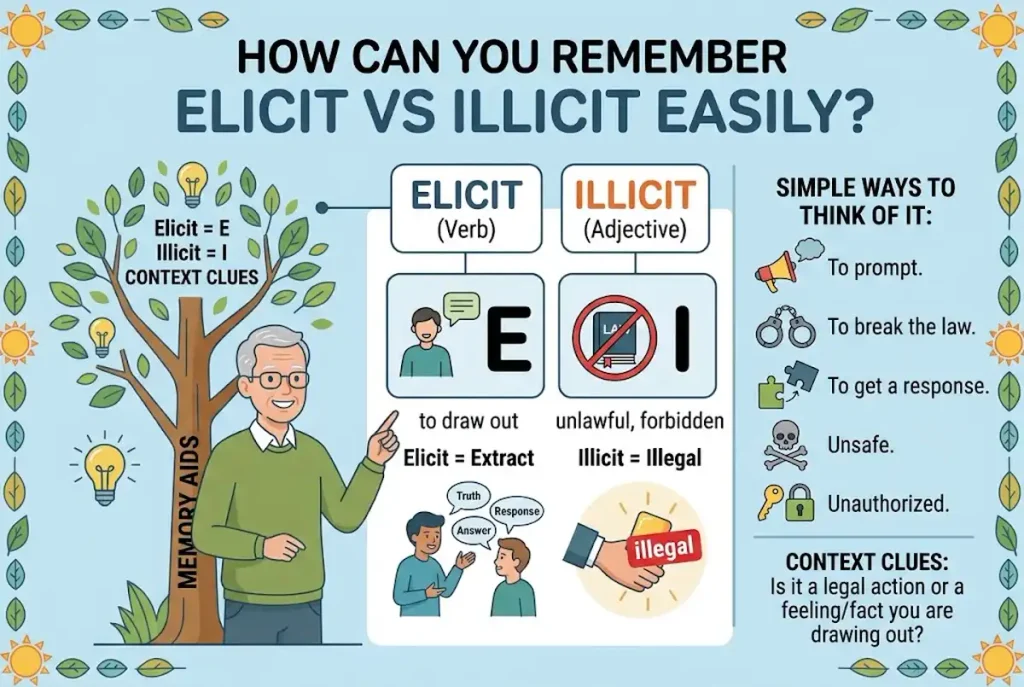
How Can You Remember Elicit vs Illicit Easily?
You don’t need to memorize complicated grammar rules.
A few simple associations can help you recognize the correct spelling.
Remember Elicit With E for Extract
Elicit begins with E.
Think of Extract, which also begins with E.
Both words can involve drawing something out.
Elicit = Extract a response.
Example:
The interviewer elicited useful information.
Remember Illicit With Illegal
Illicit begins with the same three letters as illegal.
Both words describe something forbidden or unlawful.
Illicit = Illegal or forbidden.
Example:
Authorities discovered illicit goods.
Use This Quick Comparison
| If you mean… | Choose |
|---|---|
| Draw out information | Elicit |
| Cause a reaction | Elicit |
| Produce an emotional response | Elicit |
| Describe unlawful trade | Illicit |
| Describe prohibited goods | Illicit |
| Describe forbidden behavior | Illicit |
Another helpful trick is to check the word’s position.
If you need an action word, elicit is probably correct.
If you need a describing word before a noun, illicit may be correct.
Test Your Knowledge With These Practice Questions
Choose the correct word to complete each sentence.
- The interview was designed to (elicit / illicit) detailed responses.
- Police investigated an (elicit / illicit) trading operation.
- The photograph (elicited / illicit) childhood memories.
- The organization reported suspected (elicit / illicit) transactions.
- Her speech helped (elicit / illicit) support from the audience.
Conclusion
Understanding Elicit vs Illicit comes down to remembering two different jobs. Elicit is a verb used when something draws out information, emotions, or responses. Illicit is an adjective used to describe unlawful or forbidden activities.
Their identical pronunciation makes them easy to confuse, but their grammar provides a reliable way to tell them apart.
When writing about interviews, surveys, questions, or reactions, elicit is usually the appropriate choice. When describing prohibited goods, unlawful trade, or forbidden conduct, illicit is the word you need. You can also remember the simple connections: elicit relates to extract, while illicit relates to illegal.
With these distinctions in mind, you’ll find it easier to use both words accurately in emails, essays, professional documents, and everyday communication.
Frequently Asked Questions
What is the main difference between elicit and illicit?
Elicit is a verb meaning to draw out a response or information. Illicit is an adjective meaning illegal or forbidden.
Are elicit and illicit pronounced the same way?
Yes. They are homophones, meaning they sound alike despite having different spellings and meanings.
Is it elicit information or illicit information?
Elicit information is correct when you mean obtaining or drawing out details. Illicit information would describe information connected with something unlawful or forbidden, although that expression is less common.
What’s another way to say elicit?
Common alternatives include draw out, evoke, prompt, obtain, encourage, and bring forth. The best synonym depends on the sentence.
Can illicit mean something other than illegal?
Yes. Illicit can also describe behavior considered forbidden under established social or moral rules, even when it does not violate criminal law.
How do I remember Elicit vs Illicit?
Connect elicit with extract because both involve drawing something out. Connect illicit with illegal because both describe something unlawful or forbidden.
Can you use elicit and illicit in the same sentence?
Yes. For example: The investigator tried to elicit information about the illicit operation. Each word performs a different grammatical function.
Is illicit a verb or an adjective?
Illicit is an adjective. It describes a noun, as in illicit trade, illicit substances, or illicit activities.

Daniel Grammarfield — The Language Learner
Age: 28Occupation: ESL Learner & Digital Professional
Bio:Daniel is a non-native English speaker who wants to communicate more confidently at work and online. He uses Synotrench to improve grammar, understand confusing words, learn correct sentence structures, and build everyday English skills. He prefers simple explanations with practical examples.
Goals:
Master English grammar rules
Avoid common language mistakes
Improve professional communication
Learn English through real-life examples
Quote:“Learning English is not about memorizing rules — it’s about expressing ideas clearly.”
3 thoughts on “Elicit vs Illicit: Simple Guide With Examples (2026)”