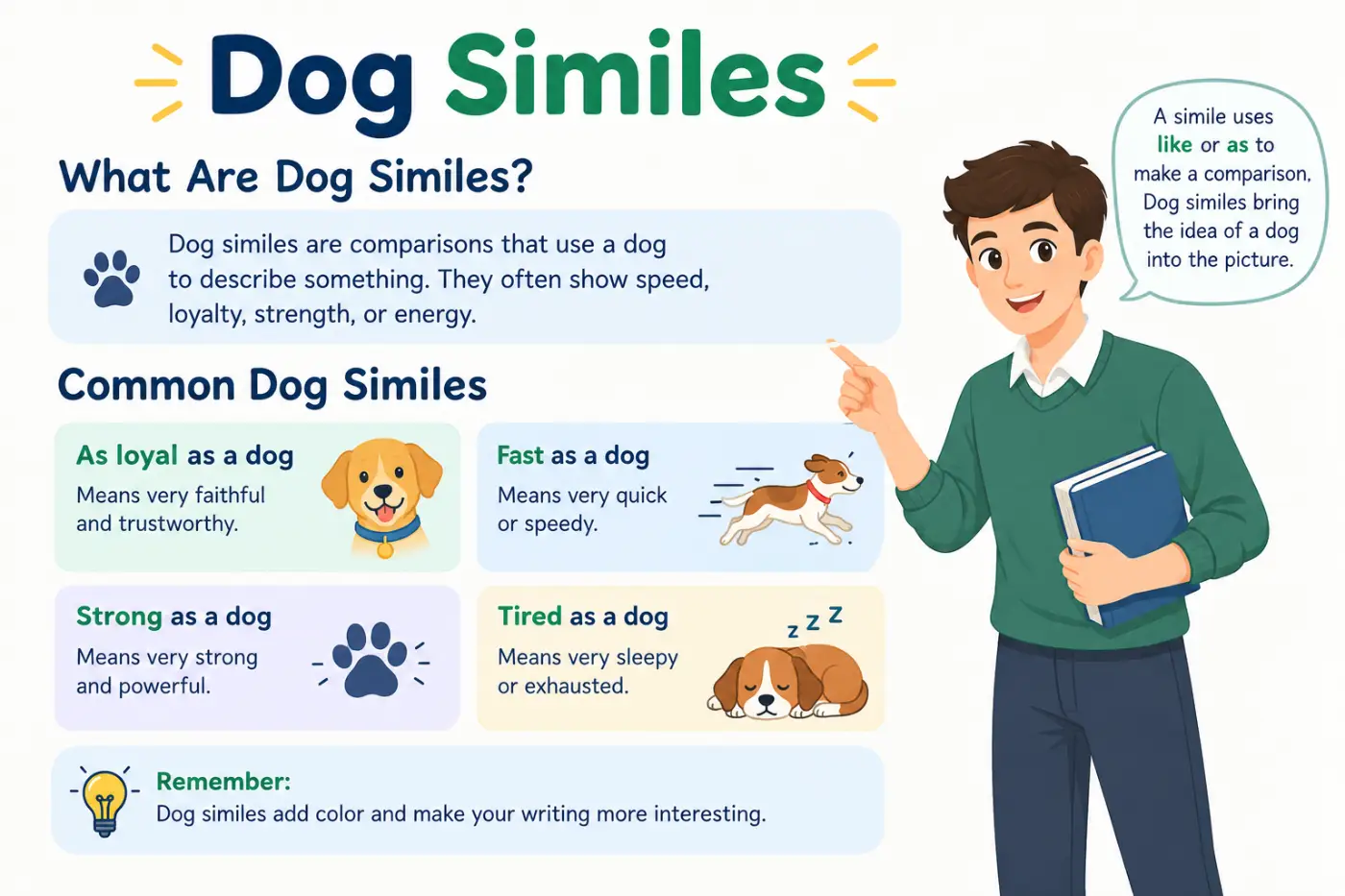
Have you ever tried to describe someone who is loyal, playful, protective, or full of energy in an essay or story? Sometimes, ordinary words don’t paint a clear enough picture. That’s where Dog Similes can make your writing more interesting and meaningful.
Dogs are known for their loyalty, sharp senses, playful behavior, and strong bonds with people. Writers often compare human qualities to these familiar traits. For example, saying someone is as loyal as a dog creates a stronger image than simply calling that person loyal.
A dog simile is a figure of speech that compares a person, action, feeling, or situation to a dog using the words like or as. It helps readers understand a quality through a familiar image.
What Are Dog Similes in Simple English?
A dog simile compares something or someone to a dog to describe a particular quality or behavior.
The comparison usually begins with like or as.
For example:
- As loyal as a dog.
- As playful as a puppy.
- Like a dog chasing its tail.
- As alert as a watchdog.
- Like a puppy following its owner.
Each expression creates a different picture in the reader’s mind.
Consider these two sentences:
- Michael followed his older brother everywhere.
- Michael followed his older brother like a puppy following its owner.
The second sentence gives readers a clearer image. It suggests that Michael admires his brother and enjoys being around him.
These comparisons can describe positive qualities, such as loyalty and affection. They can also describe negative behaviors, such as aggression, stubbornness, or unnecessary chasing.
The meaning depends on the dog’s behavior being compared.
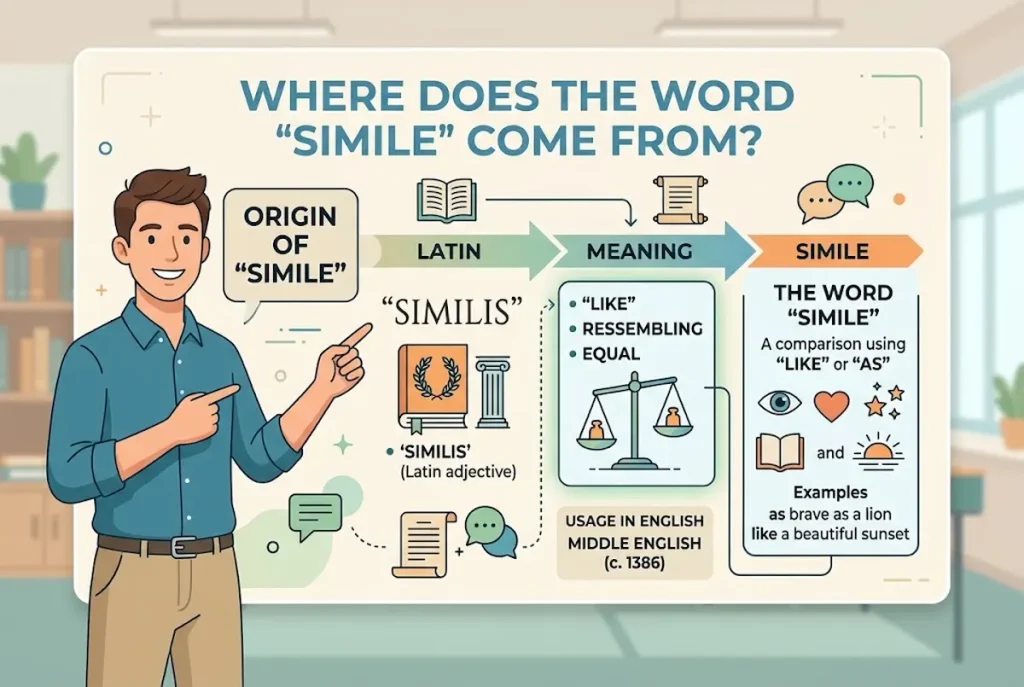
Where Does the Word Simile Come From?
The word simile comes from the Latin word similis, meaning similar or like.
English adopted the term to describe a figure of speech that compares two different things through a shared quality.
Dogs have appeared in human stories, sayings, and comparisons for centuries. Their close relationship with people makes their behavior easy to recognize.
A writer might compare a loyal friend to a faithful dog or an excited child to a playful puppy.
These comparisons work because readers already understand many common dog behaviors.
However, dogs have different personalities. Not every dog is aggressive, obedient, playful, or protective. A simile uses a familiar image rather than making a scientific claim about every animal.
What Are the Best Words With Meanings?
The following collection includes 35 comparisons organized by tone and everyday use.
Some are familiar expressions, while others are original creative comparisons you can use in stories, poems, and descriptive writing.
Simple Words
These expressions are easy to understand and work well in school assignments and everyday descriptions.
| Simile | Meaning | Tone | Example |
|---|---|---|---|
| As loyal as a dog | Extremely faithful | Positive | Ben remained as loyal as a dog. |
| As playful as a puppy | Full of fun and energy | Positive | The children were as playful as puppies. |
| As alert as a watchdog | Very watchful | Positive | The guard was as alert as a watchdog. |
| As friendly as a puppy | Warm and welcoming | Positive | Emma was as friendly as a puppy. |
| As protective as a guard dog | Ready to defend others | Positive | Dad was as protective as a guard dog. |
| As excited as a puppy | Extremely happy | Positive | Jake was as excited as a puppy. |
| As obedient as a trained dog | Quick to follow instructions | Neutral | The performer was as obedient as a trained dog. |
| As restless as a caged dog | Unable to remain calm | Negative | He felt as restless as a caged dog. |
| As curious as a puppy | Eager to discover things | Positive | Lily was as curious as a puppy. |
| As noisy as a barking dog | Very loud | Negative | The crowd was as noisy as barking dogs. |
Everyday Words
These comparisons describe situations that people experience in daily life.
| Simile | Meaning | Tone | Example |
|---|---|---|---|
| Like a dog chasing its tail | Making no real progress | Negative | We argued like a dog chasing its tail. |
| Like a dog with a bone | Refusing to give up | Mixed | She pursued the mystery like a dog with a bone. |
| Like a lost puppy | Looking confused or helpless | Sympathetic | Tom wandered around like a lost puppy. |
| Like a dog waiting for its owner | Waiting eagerly | Emotional | He stood by the gate like a dog waiting for its owner. |
| Like a puppy learning to walk | Moving awkwardly | Humorous | I skated like a puppy learning to walk. |
| Like a dog guarding its food | Acting possessively | Negative | He protected his snacks like a dog guarding its food. |
| Like a puppy seeing its favorite person | Showing sudden happiness | Positive | She smiled like a puppy seeing its favorite person. |
| Like a dog sniffing out a trail | Searching carefully | Positive | The detective searched like a dog sniffing out a trail. |
| Like a dog digging for treasure | Searching with determination | Positive | He explored the files like a dog digging for treasure. |
| Like a puppy following footsteps | Staying close to someone | Gentle | Mia followed her mother like a puppy following footsteps. |
Formal and Literary
These comparisons suit descriptive essays, fiction, poetry, and storytelling.
They are more expressive than ordinary conversational phrases.
| Simile | Meaning | Tone | Example |
|---|---|---|---|
| As vigilant as a sentry dog | Extremely watchful | Formal | The officer remained as vigilant as a sentry dog. |
| As faithful as an old hound | Deeply loyal | Literary | His companion was as faithful as an old hound. |
| Like a hound following a scent | Pursuing a goal | Literary | She followed the clues like a hound following a scent. |
| Like a wounded dog seeking shelter | Feeling hurt and vulnerable | Emotional | He returned home like a wounded dog seeking shelter. |
| As determined as a tracking hound | Strongly focused | Positive | The researcher was as determined as a tracking hound. |
| Like a watchdog guarding its territory | Remaining protective | Serious | The soldiers stood like watchdogs guarding their territory. |
| Like an old dog resting by the fire | Feeling peaceful | Gentle | Grandpa relaxed like an old dog resting by the fire. |
| Like a hound awakened by a distant call | Suddenly becoming alert | Literary | The explorer rose like a hound awakened by a distant call. |
How Do Words Change From Mild to Strong?
Not every comparison creates the same emotional effect.
Some expressions describe gentle behavior. Others suggest powerful emotions or extreme actions.
Choosing the right intensity helps you communicate your meaning without exaggerating.
| Intensity | Dog Comparison | Meaning |
|---|---|---|
| Mild | As friendly as a puppy | Pleasant and welcoming |
| Mild | As curious as a young pup | Interested in something |
| Moderate | As playful as a puppy | Energetic and cheerful |
| Moderate | As alert as a watchdog | Paying close attention |
| Strong | As loyal as a faithful hound | Deeply devoted |
| Strong | Like a dog with a bone | Extremely persistent |
| Very strong | As protective as a guard dog | Ready to defend someone |
| Very strong | Like a fierce dog defending its territory | Aggressively protective |
Can Words Describe Different Parts of Speech?
Yes. A simile can describe a person, an action, a feeling, or a condition.
It doesn’t belong to just one part of speech. Instead, the complete comparison works within a sentence to describe something.
Comparisons That Describe Nouns
These expressions describe people or things.
Examples:
- The soldier was as loyal as a faithful dog.
- My little brother was like a curious puppy.
- The security officer stood as alert as a watchdog.
The comparisons help readers imagine the qualities of the people being described.
Comparisons That Describe Verbs
These expressions describe how someone performs an action.
Examples:
- She searched like a hound following a scent.
- He followed me like a puppy.
- The children raced around like excited dogs in a park.
Here, the comparisons make the actions more visual.
Comparisons That Describe Feelings
Dog comparisons can also express emotions.
Examples:
- I felt like a lost puppy on my first day at school.
- She was as excited as a puppy waiting for a walk.
- He looked like a frightened dog during the thunderstorm.
These sentences help readers understand feelings through recognizable animal behavior.
Are Words Different in American and British English?
Most common comparisons involving dogs are understandable in both American and British English.
Expressions such as as loyal as a dog, like a lost puppy, and like a dog with a bone work naturally in either variety.
However, some related idioms have different levels of familiarity.
| Expression | Meaning | Usage Note |
|---|---|---|
| Like a dog with a bone | Very persistent | Common in US and UK English |
| Like a dog with two tails | Extremely happy | Especially familiar in British English |
| Work like a dog | Work extremely hard | Familiar in both varieties |
| Dog tired | Completely exhausted | Familiar in both varieties |
| A dog’s breakfast | A complete mess | Especially familiar in British English |
| As sick as a dog | Feeling extremely ill | Familiar in both varieties |
How Can You Use Word in Different Situations?
A comparison that sounds wonderful in a children’s story might sound strange in a professional email.
The audience, purpose, and tone should guide your choice.
What Work Best in a Resume?
Resumes usually benefit from clear, professional language rather than animal comparisons.
Instead of writing:
I am as loyal as a dog and work like a hound.
Write:
I am a dependable team member who approaches challenging tasks with persistence and attention to detail.
The second sentence communicates the same positive qualities without sounding too casual.
Dog comparisons can still help you brainstorm qualities such as loyalty, focus, dedication, and reliability before turning them into professional language.
What Work Best in an Essay?
Essays allow more creative freedom, especially when the assignment involves storytelling or descriptive writing.
Example:
The young boy followed his grandfather like a puppy following its favorite person, eager to hear another story.
This comparison shows affection and admiration without directly naming those emotions.
For academic essays, use figurative language only when it supports the subject and expected writing style.
What Work Best in Text Messages?
Text messages allow playful and informal expressions.
Example:
I’m waiting for the weekend like a puppy waiting for its favorite treat!
The sentence communicates excitement in a friendly way.
Other useful expressions include:
- Like a dog spotting a squirrel.
- As excited as a puppy.
- Like a lost puppy.
- Like a dog with a bone.
Keep the comparison short enough that the reader understands it immediately.
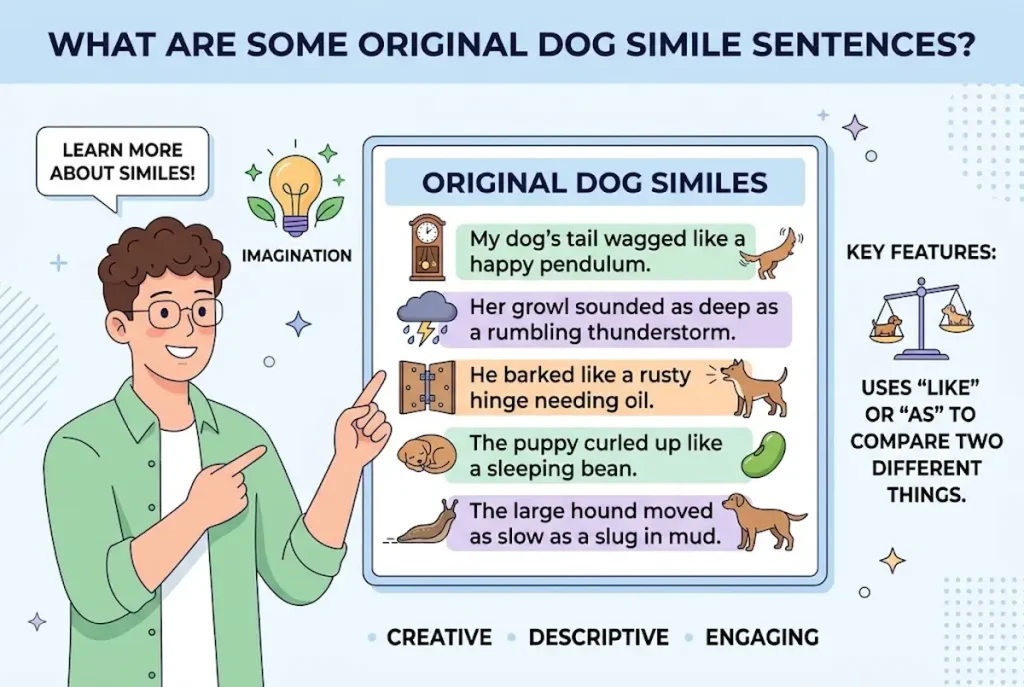
What Are Some Original Dog Simile Sentences?
Understanding a comparison becomes easier when you see it in a realistic situation.
The following examples cover school, family, friendship, work, sports, and emotional experiences.
About Loyalty
Daniel remained as loyal as a dog, even when his closest friend faced criticism.
My grandmother’s old friend was as faithful as a hound, visiting her every Sunday for twenty years.
The young assistant stood beside his mentor like a loyal dog refusing to abandon its companion.
About Happiness
When Olivia received her birthday gift, she bounced around like a puppy with a new toy.
The children rushed toward the playground like excited dogs entering an open field.
Ethan smiled like a puppy seeing its favorite person after a long day.
What Is the Difference Between Similar Dog Comparisons?
Two expressions may describe the same general quality while creating different impressions.
Understanding these small differences helps you avoid using the wrong comparison.
As Loyal as a Dog vs Like a Dog With a Bone
Both expressions can describe someone who refuses to give up, but they focus on different qualities.
| As Loyal as a Dog | Like a Dog With a Bone |
|---|---|
| Describes faithfulness | Describes persistence |
| Focuses on relationships | Focuses on determination |
| Usually has a positive meaning | Can be positive or negative |
| Suggests dependable behavior | Suggests refusing to let something go |
Examples:
Marcus remained as loyal as a dog to his childhood friends.
The reporter pursued the missing evidence like a dog with a bone.
The first sentence emphasizes devotion. The second emphasizes determination.
As Playful as a Puppy vs As Excited as a Puppy
These expressions are related, but they describe different kinds of energy.
| As Playful as a Puppy | As Excited as a Puppy |
|---|---|
| Describes a playful personality or behavior | Describes strong enthusiasm |
| Suggests fun and movement | Suggests anticipation or happiness |
| Can describe a regular habit | Often describes a particular moment |
| Usually feels cheerful | Usually feels eager and energetic |
Examples:
The children were as playful as puppies during their summer vacation.
Anna was as excited as a puppy when she heard about the surprise trip.
The first sentence describes playful behavior. The second focuses on a sudden emotional reaction.
Like a Lost Puppy vs Like a Wounded Dog
Both comparisons can describe vulnerability, but their emotional meanings differ.
| Like a Lost Puppy | Like a Wounded Dog |
|---|---|
| Suggests confusion | Suggests emotional or physical pain |
| May describe someone needing guidance | Suggests someone needing comfort |
| Usually creates a gentle image | Creates a heavier emotional image |
| Works in casual descriptions | Often suits serious storytelling |
Examples:
James wandered through the unfamiliar airport like a lost puppy.
After hearing the painful news, he withdrew from everyone like a wounded dog seeking shelter.
Choosing between them depends on the emotion you want readers to understand.
What Is the Difference Between a Dog Simile and a Metaphor?
A simile makes a direct comparison using like or as.
A metaphor describes one thing as another without those comparison words.
Consider these examples:
| Simile | Metaphor |
|---|---|
| He is as loyal as a dog. | He is a loyal hound. |
| She follows me like a puppy. | She is my little shadow. |
| He watches like a guard dog. | He is the family’s watchdog. |
| She searches like a tracking hound. | She is a tracking hound when solving mysteries. |
Both techniques make writing more expressive, but they work differently.
A simile openly signals the comparison. A metaphor creates a more direct figurative connection.
For beginners, similes are often easier to recognize and create.
What Are Common Mistakes When Using Word?
Creative comparisons are useful, but poorly chosen expressions can confuse readers or make sentences sound unnatural.
1. Comparing Unrelated Qualities
Incorrect:
Her voice was as blue as a puppy.
This comparison doesn’t create a clear connection between the two ideas.
Better:
Her voice was as gentle as a sleepy puppy’s breathing.
The revised sentence connects two qualities readers can imagine.
2. Using Too Many Comparisons Together
Weak:
He was as loyal as a dog, as playful as a puppy, and as watchful as a guard dog.
Although the sentence is understandable, it feels overloaded.
Better:
He was as loyal as a dog, always standing beside his friends when they needed him.
One well-developed comparison often works better than several competing images.
3. Confusing Similes With Idioms
Not every expression involving dogs qualifies as a simile.
For example:
- Every dog has its day.
- Let sleeping dogs lie.
- It’s raining cats and dogs.
These are idioms.
They communicate figurative meanings, but they don’t make explicit comparisons using like or as.
When Should You Avoid Dog Comparisons?
Avoid them when they could sound disrespectful, distract from the message, or weaken the seriousness of your writing.
For example, comparing an employee to an obedient dog can suggest that the person lacks independence.
Similarly, describing someone as a wounded dog may feel insensitive when discussing real emotional suffering.
Use direct language in situations that require precision, such as:
- Professional performance reviews.
- Medical or legal documents.
- Formal research papers.
- Sensitive personal conversations.
- Serious complaints or official reports.
In creative writing, these comparisons are more flexible. Still, each one should serve a clear purpose.
What Words Can Replace Common Words?
Sometimes, a single descriptive word communicates your meaning more clearly than a full comparison.
The following table provides 28 useful alternatives, grouped by tone.
These words are semantic alternatives rather than exact replacements in every sentence.
Simple and Everyday Words
| Word | Meaning | Tone | Example |
|---|---|---|---|
| Loyal | Faithful to someone | Positive | He is a loyal friend. |
| Friendly | Pleasant toward others | Positive | She has a friendly personality. |
| Playful | Enjoying fun | Positive | The child remained playful. |
| Curious | Eager to learn | Positive | Mia is naturally curious. |
| Happy | Feeling joy | Positive | Everyone looked happy. |
| Excited | Feeling enthusiastic | Positive | Ben was excited about the trip. |
| Watchful | Paying close attention | Neutral | The guard remained watchful. |
| Restless | Unable to relax | Negative | He became restless. |
| Protective | Wanting to keep others safe | Positive | Her brother is protective. |
| Persistent | Continuing despite difficulty | Positive | She is a persistent learner. |
Formal Words
| Word | Meaning | Tone | Example |
|---|---|---|---|
| Devoted | Deeply committed | Positive | He is devoted to his family. |
| Vigilant | Carefully watchful | Formal | The officer remained vigilant. |
| Dependable | Someone others can trust | Positive | Emma is dependable. |
| Tenacious | Unwilling to give up | Strong | The team showed a tenacious spirit. |
| Diligent | Careful and hardworking | Positive | He is a diligent researcher. |
| Attentive | Paying close attention | Positive | The teacher was attentive. |
| Affectionate | Showing love | Positive | She gave him an affectionate smile. |
| Resolute | Firmly determined | Strong | The captain remained resolute. |
| Apprehensive | Worried about something | Negative | He felt apprehensive. |
| Enthusiastic | Showing strong interest | Positive | The audience was enthusiastic. |
Informal and Slang Words
| Word | Meaning | Tone | Example |
|---|---|---|---|
| Hyper | Extremely energetic | Casual | The kids were hyper. |
| Clingy | Wanting constant attention | Informal | He became clingy. |
| Goofy | Silly in a funny way | Playful | My brother was acting goofy. |
| Pumped | Very excited | Slang | We’re pumped for the game. |
| Nosy | Too interested in others’ affairs | Negative | Stop being nosy. |
| Jumpy | Easily startled | Informal | She felt jumpy. |
| Chill | Relaxed | Slang | Everyone seemed chill. |
| Stubborn | Refusing to change one’s mind | Mixed | He’s too stubborn to quit. |
What Are the Opposites of Common Words?
An antonym expresses an opposite quality or meaning.
Since dog comparisons describe different behaviors, there isn’t one opposite expression that works for all of them.
| Dog Comparison | Opposite Quality | Example |
|---|---|---|
| As loyal as a dog | Disloyal | He abandoned his friends. |
| As playful as a puppy | Serious | She remained serious throughout the game. |
| As alert as a watchdog | Inattentive | The guard missed the warning. |
| As friendly as a puppy | Unfriendly | He avoided everyone. |
| Like a dog with a bone | Easily discouraged | She gave up quickly. |
| As protective as a guard dog | Neglectful | He ignored their safety. |
| As curious as a puppy | Uninterested | The student showed little interest. |
| As restless as a caged dog | Calm | He waited peacefully. |
Understanding opposites helps writers create stronger contrasts between characters and situations.
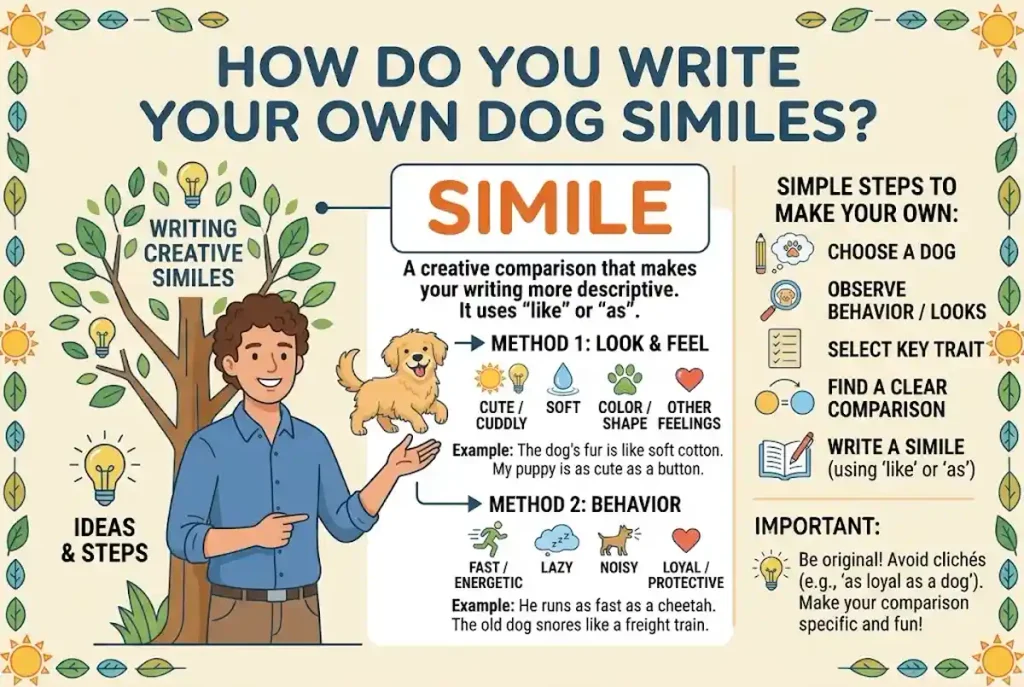
How Do You Write Your Own Dog Similes?
You don’t have to depend entirely on familiar expressions. Creating an original comparison can make your writing more memorable.
Start by choosing one recognizable dog behavior.
Then connect that behavior to a human action or emotion.
A Simple Formula
Person or subject + like/as + dog behavior + shared quality.
For example:
A nervous student + like + a puppy entering an unfamiliar room.
Complete sentence:
The nervous student entered the classroom like a puppy stepping into an unfamiliar room.
Another example:
An eager child + as + excited + a puppy waiting for a walk.
Complete sentence:
The little boy was as excited as a puppy waiting for its morning walk.
Conclusion
Dog Similes can turn ordinary descriptions into clear, memorable images. They help writers express loyalty, excitement, curiosity, determination, fear, and other familiar human experiences through recognizable dog behaviors.
The key is choosing a comparison that matches your intended meaning. A playful puppy creates a different impression from a protective guard dog or a determined tracking hound. Each image brings its own emotional tone.
For school essays and creative stories, try using one carefully chosen comparison instead of filling every sentence with figurative language. In professional writing, direct descriptive words are often more suitable.
Frequently Asked Questions
What is a good simile for a dog?
A good example is as playful as a puppy. Other useful comparisons include as loyal as a dog and as alert as a watchdog.
What’s another way to say someone is as loyal as a dog?
You can describe someone as faithful, devoted, dependable, trustworthy, or deeply committed. These alternatives work well when you want to avoid figurative language.
Is like a dog with a bone a simile?
Yes. It uses like to compare someone’s persistence to a dog refusing to release a bone. It can describe admirable determination or excessive stubbornness.
Are dog similes suitable for school essays?
Yes, especially in descriptive and creative writing assignments. Choose expressions that support your message and avoid using too many in one paragraph.
What is the difference between a dog simile and a dog metaphor?
A dog simile makes an explicit comparison using like or as, while a dog metaphor describes something directly as something else. For example, he watches like a guard dog is a simile, while he is our watchdog is a metaphor.

Daniel Grammarfield — The Language Learner
Age: 28Occupation: ESL Learner & Digital Professional
Bio:Daniel is a non-native English speaker who wants to communicate more confidently at work and online. He uses Synotrench to improve grammar, understand confusing words, learn correct sentence structures, and build everyday English skills. He prefers simple explanations with practical examples.
Goals:
Master English grammar rules
Avoid common language mistakes
Improve professional communication
Learn English through real-life examples
Quote:“Learning English is not about memorizing rules — it’s about expressing ideas clearly.”
3 thoughts on “Dog Similes Best Examples With Meanings (2026)”