Imagine you’re writing an email about someone who broke your trust. You want to describe their behavior, but you’re unsure which word sounds right. Should you write disloyal or unloyal? Both seem to express a lack of loyalty, but they aren’t equally common in modern English.
This small spelling choice can make a difference in your writing. Using an unusual word may distract readers, especially in professional emails, school essays, or formal conversations.
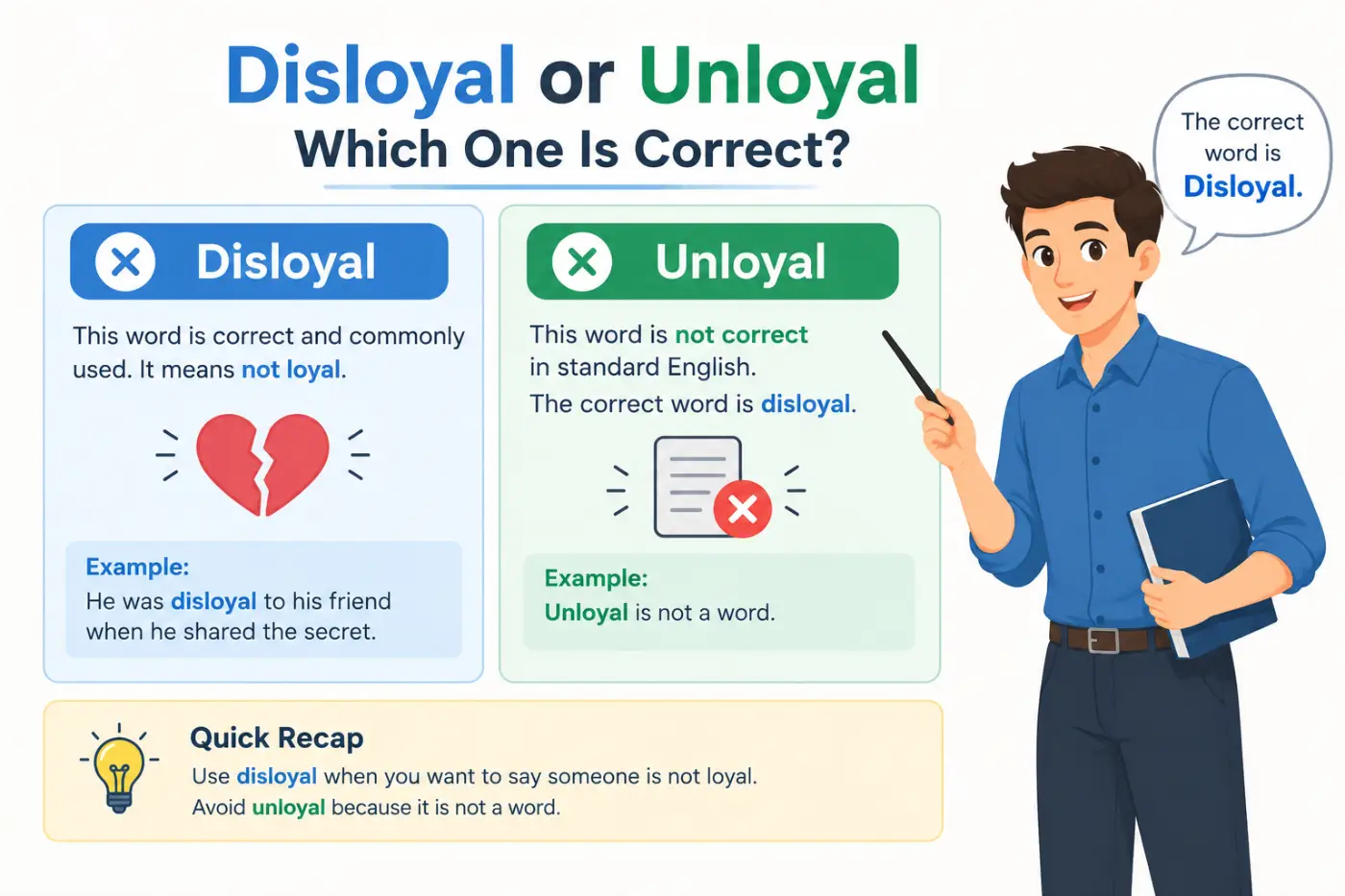
The correct and standard word is disloyal. It describes someone who fails to show loyalty, support, or faithfulness. Unloyal is a rare alternative that most modern English speakers avoid. For clear, natural writing, choose disloyal.
In this guide, you’ll learn the meanings, word origins, grammar rules, synonyms, and differences between these terms. You’ll also find real examples, common mistakes, and practical tips to help you choose the right word confidently.
What Is the Difference Between Disloyal and Unloyal?
The main difference is standard usage. Disloyal is the accepted and widely used adjective, while unloyal is uncommon and may sound unnatural to modern English speakers.
Both words are understandable because their prefixes suggest the absence or opposite of loyalty. However, English doesn’t always allow prefixes to be exchanged freely.
Consider this comparison:
| Feature | Disloyal | Unloyal |
|---|---|---|
| Meaning | Not loyal or faithful | Not loyal |
| Word type | Adjective | Rare adjective |
| Modern usage | Common | Very uncommon |
| Standard English | Yes | Generally avoided |
| Formal writing | Recommended | Not recommended |
| Everyday speaking | Natural | Unusual |
| Example | He was disloyal to his team. | He was unloyal to his team. |
The second example is understandable, but native English speakers would normally use disloyal instead.
This distinction matters because a word can be understandable without being the natural choice in everyday communication.
What Does Disloyal Mean in Simple English?
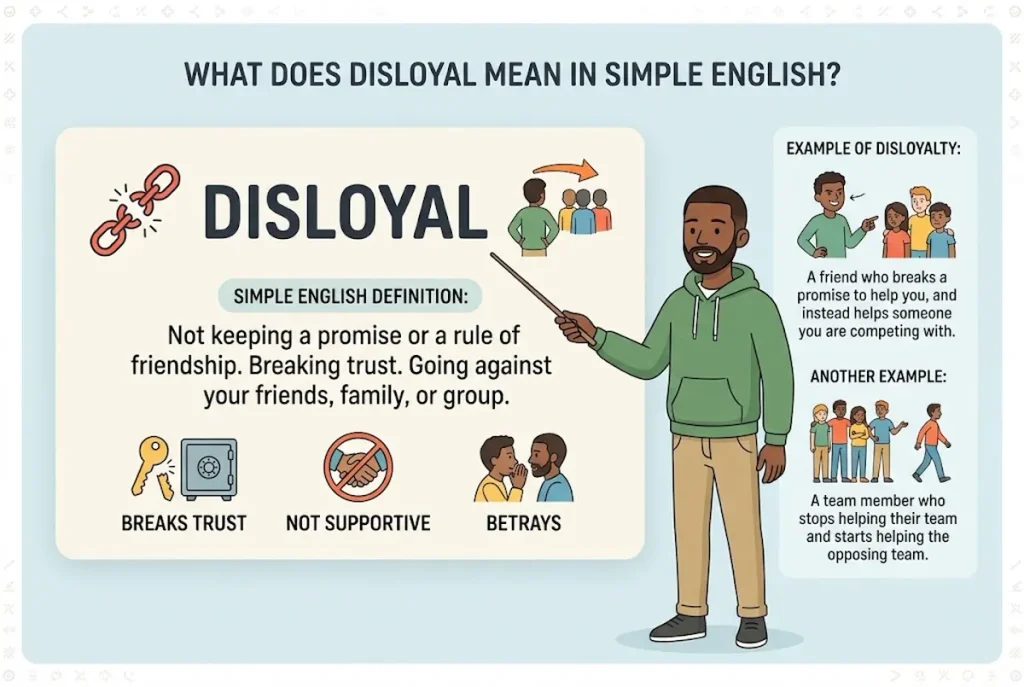
Disloyal means failing to remain faithful, supportive, or committed to someone or something that reasonably expects your loyalty.
It can describe a person who breaks another person’s trust, abandons an agreement, or acts against a group they previously supported.
For example:
- The employee was disloyal to his company.
- She felt disloyal after sharing her friend’s secret.
- His actions showed disloyal behavior toward the team.
- The leader accused several members of being disloyal.
- Supporting the opposing group made him appear disloyal.
The word often carries a negative meaning. It suggests that a person has failed to meet an expectation of trust or commitment.
However, disagreement alone doesn’t automatically make someone disloyal. A person can question a decision, express concerns, or leave an unhealthy relationship without betraying anyone.
Context helps determine how strong the accusation really is.
Is Disloyal an Adjective?
Yes. Disloyal is an adjective because it describes a person, action, attitude, or behavior.
Consider these examples:
- A disloyal friend.
- A disloyal employee.
- Disloyal behavior.
- A disloyal decision.
Its related noun is disloyalty, which describes the quality or act of being disloyal.
Example: His disloyalty damaged their friendship.
The related adverb is disloyally, although this form is less common in everyday conversation.
Example: The officer acted disloyally toward his commander.
Where Do Disloyal and Unloyal Come From?
Understanding word origins makes it easier to see why one form became the standard choice.
The word loyal entered English through French. Its history connects to ideas of lawfulness, faithfulness, and keeping one’s commitments.
Over time, loyal developed its modern meaning of remaining faithful or supportive toward a person, organization, belief, or cause.
Disloyal combines the negative prefix dis with loyal.
The prefix dis can express opposition, reversal, or separation. In this word, it creates the opposite of loyalty.
Other familiar examples include:
| Word | Meaning |
|---|---|
| Dishonest | Not honest |
| Disrespectful | Showing a lack of respect |
| Disobedient | Refusing to obey |
| Discontented | Not satisfied |
| Disloyal | Not loyal or faithful |
Unloyal follows a different pattern by adding the prefix un to loyal.
English uses un in many familiar adjectives, including unhappy, unfair, and unkind. However, that doesn’t mean every adjective naturally accepts this prefix.
Language develops through actual usage, not just logical word combinations.
Disloyal became the established form, while unloyal remained rare.
This explains why unhappy sounds natural, but unloyal may sound strange even though readers can understand its intended meaning.
Is Unloyal a Real English Word?
Unloyal is an attested but rare English word. It isn’t the standard choice in modern everyday writing.
Some older or specialized dictionaries record uncommon forms that are no longer widely used. Their existence doesn’t necessarily make them suitable for professional or academic communication.
For example:
Unusual: The manager considered him unloyal.
Natural: The manager considered him disloyal.
The second sentence sounds clearer and more familiar.
If you’re writing an essay, business message, article, or social media post, there is little reason to choose the rarer form.
You might encounter unloyal in older writing, creative language, or nonstandard usage. In those situations, its intended meaning is generally easy to understand.
Still, disloyal remains the safer choice for modern English.
What Are the Best Synonyms for Disloyal?
Sometimes disloyal is too strong, too formal, or simply not the most accurate word for your sentence.
A synonym can help you describe the exact kind of behavior involved.
For example, someone who shares a private secret might be described as untrustworthy. Someone who deliberately turns against an ally might be called treacherous.
These words are related, but they don’t all mean exactly the same thing.
The following tables include more than 30 useful alternatives and related expressions, grouped by tone and everyday usage.
Simple Synonyms
These choices are easy to understand and useful in everyday writing.
| Word | Meaning | Tone | Example |
|---|---|---|---|
| Unfaithful | Not remaining faithful | Simple | He was unfaithful to his partner. |
| Untrustworthy | Not deserving trust | Simple | She found him untrustworthy. |
| Unreliable | Cannot always be depended on | Mild | His unreliable behavior caused problems. |
| Uncommitted | Lacking commitment | Mild | The group seemed uncommitted. |
| Unsupportive | Not giving expected support | Mild | His friends were unsupportive. |
| Untrue | Not faithful, in some contexts | Literary | He proved untrue to his promise. |
| Faithless | Lacking faithfulness | Strong | The story describes a faithless companion. |
| Two-faced | Acting friendly while being dishonest | Informal | Nobody trusted his two-faced behavior. |
Unreliable and unsupportive are weaker related terms. They don’t always suggest betrayal.
Everyday Synonyms
These expressions work well in conversations, stories, and personal situations.
| Word | Meaning | Tone | Example |
|---|---|---|---|
| Backstabbing | Secretly harming someone who trusts you | Strong | His backstabbing shocked everyone. |
| Deceitful | Dishonest or misleading | Negative | Her deceitful actions hurt the group. |
| Betraying | Breaking someone’s trust | Strong | He was betraying his closest friend. |
| Dishonest | Not truthful | General | His dishonest behavior raised concerns. |
| Disloyalhearted | Having a disloyal attitude | Rare | The fictional ruler feared disloyalhearted followers. |
| Self-serving | Acting mainly for personal benefit | Critical | His decision seemed self-serving. |
| Undependable | Not consistently reliable | Mild | The team found him undependable. |
| Double-dealing | Secretly acting for opposing interests | Strong | The double-dealing agent was exposed. |
Some words describe the behavior rather than the person’s loyalty directly.
For instance, dishonesty can damage trust, but not every dishonest statement proves disloyalty.
Formal Synonyms
These words are useful in serious essays, reports, literature, and political discussions.
| Word | Meaning | Tone | Example |
|---|---|---|---|
| Treacherous | Guilty of serious betrayal | Very strong | The treacherous official exposed confidential plans. |
| Perfidious | Deliberately betraying trust | Very formal | The novel portrays a perfidious adviser. |
| Traitorous | Showing betrayal of one’s group or country | Strong | His traitorous actions alarmed the council. |
| Unprincipled | Lacking moral standards | Formal | The unprincipled leader ignored his promises. |
| Duplicitous | Deliberately deceptive | Formal | The committee condemned his duplicitous conduct. |
| Unfaithful | Failing to remain faithful | Neutral | The report described an unfaithful representative. |
| Inconstant | Changing loyalties or feelings frequently | Literary | The poet described an inconstant lover. |
| Apostate | Someone who abandons a former faith or cause | Specialized | His former associates called him an apostate. |
Apostate is a noun, not an interchangeable adjective. It also has a specific meaning connected to abandoning a belief or cause.
Slang and Informal Alternatives
These expressions are more suitable for casual conversations than professional writing.
| Word or Phrase | Meaning | Tone | Example |
|---|---|---|---|
| Snake | A person viewed as secretly dishonest | Slang | They called him a snake after the betrayal. |
| Backstabber | Someone who secretly betrays others | Informal | Nobody wanted to work with the backstabber. |
| Sellout | Someone accused of abandoning principles for personal gain | Slang | Fans called the performer a sellout. |
| Fake friend | Someone pretending to be a genuine friend | Casual | She realized he was a fake friend. |
| Turncoat | Someone who switches allegiance | Informal | The former supporter was labeled a turncoat. |
| Double-crosser | Someone who betrays another person | Informal | The double-crosser ruined their plan. |
| Rat | An insulting term for someone accused of betrayal | Slang | His former partners called him a rat. |
| Two-timer | Someone who deceives a romantic partner | Informal | She refused to forgive the two-timer. |
These informal terms can sound insulting. Use them carefully, especially when discussing real people.
Which Synonyms Are Mild and Which Are Strong?
Not every failure of loyalty deserves the same description.
Choosing the right intensity helps you avoid making a situation sound worse than it actually is.
| Intensity | Word | Best Used When |
|---|---|---|
| Very mild | Unsupportive | Someone fails to offer expected support |
| Mild | Uncommitted | Someone lacks dedication |
| Mild | Unreliable | Someone repeatedly fails to meet expectations |
| Moderate | Untrustworthy | Someone cannot safely be trusted |
| Moderate | Disloyal | Someone fails to show expected loyalty |
| Strong | Deceitful | Someone deliberately misleads others |
| Strong | Backstabbing | Someone secretly harms a trusted person |
| Very strong | Treacherous | Someone commits serious betrayal |
| Very strong | Traitorous | Someone betrays a group, cause, or country |
| Very strong | Perfidious | Someone deliberately violates established trust |
These levels are approximate. A word’s strength can change depending on the situation.
For example, describing a forgetful coworker as treacherous would usually be excessive.
Unreliable would communicate the problem more accurately.
What Are the Different Forms of Disloyal?
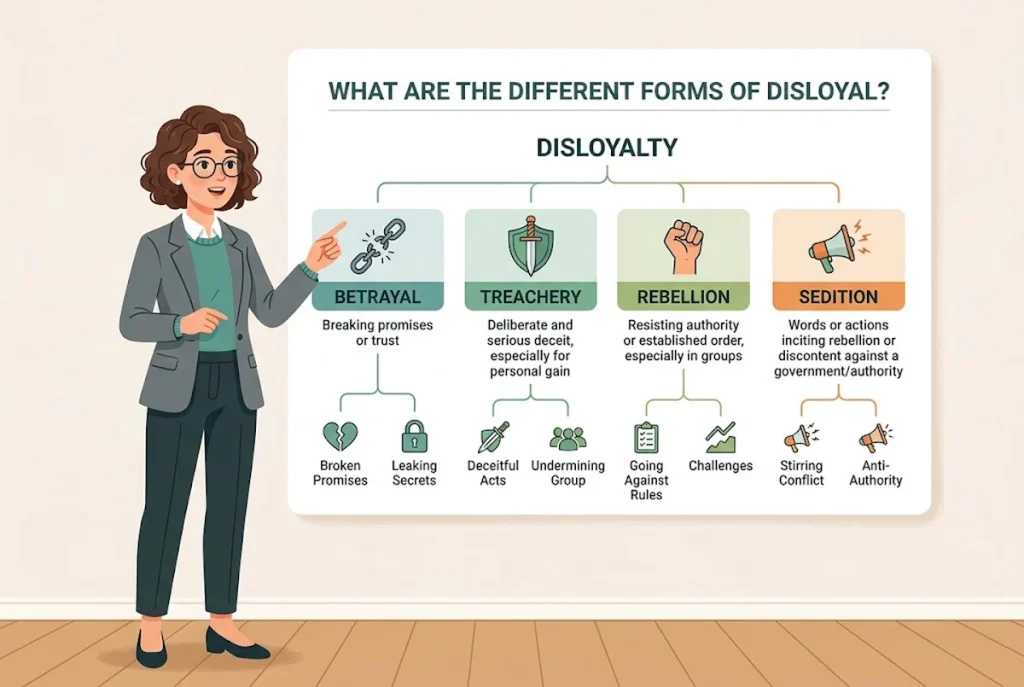
The word belongs to a small family of related grammatical forms.
Knowing these forms helps you build natural sentences without repeating the same adjective.
| Part of Speech | Word | Example |
|---|---|---|
| Adjective | Disloyal | He was disloyal to his employer. |
| Noun | Disloyalty | His disloyalty damaged the partnership. |
| Adverb | Disloyally | She acted disloyally toward the organization. |
| Opposite adjective | Loyal | They remained loyal to their friends. |
| Opposite noun | Loyalty | Loyalty requires honesty and respect. |
| Opposite adverb | Loyally | The volunteers served loyally for years. |
There is no common modern verb formed directly from disloyal.
Instead, use expressions such as betray, act disloyally, break someone’s trust, or turn against someone.
For example:
Incorrect: He disloyaled his team.
Correct: He betrayed his team.
Correct: He acted disloyally toward his team.
Is Disloyal Used Differently in American and British English?
Disloyal is the standard spelling in both American and British English.
There is no major regional difference that requires writers to choose another form.
| Region | Preferred Word | Example |
|---|---|---|
| United States | Disloyal | He was disloyal to his employer. |
| United Kingdom | Disloyal | She remained loyal despite the accusations. |
| Canada | Disloyal | His actions appeared disloyal. |
| Australia | Disloyal | The organization rejected disloyal conduct. |
American and British speakers may use different expressions depending on the situation, but the standard adjective remains the same.
This makes the word suitable for international communication.
When Should You Use Disloyal in Different Contexts?
The best word depends on your audience, purpose, and the seriousness of the situation.
A casual message allows stronger emotional language. A professional document usually requires a more neutral description.
How Should You Use Disloyal on a Resume?
Avoid describing yourself or another person as disloyal on a resume.
Resumes should emphasize professional achievements, reliability, teamwork, and positive qualities.
Instead of making negative statements about a previous workplace, explain your experience constructively.
Example sentence:
I demonstrated loyalty and professionalism while supporting my previous organization.
If you’re describing a difficult workplace experience, focus on the skills you developed rather than personal accusations.
How Do You Use Disloyal in an Essay?
Disloyal works well in academic essays when discussing trust, relationships, leadership, or character development.
However, support the description with evidence.
Example sentence:
The character’s disloyal actions reveal how personal ambition can damage long-standing friendships.
For a more serious act of betrayal, treacherous may be appropriate.
Avoid choosing an emotionally strong word simply because it sounds impressive.
What Should You Say in a Text Message?
Casual messages allow more direct language.
Disloyal is suitable when discussing broken trust, although untrustworthy or fake friend may sound more conversational.
Example sentence:
I felt hurt because sharing my private messages seemed disloyal.
Try to describe the specific behavior instead of immediately labeling the entire person.
This often makes your message clearer.
How Do You Use Disloyal in a Professional Email?
Professional emails benefit from calm and specific wording.
Calling someone disloyal can sound like a serious personal accusation. If possible, describe the action and its consequences.
Example sentence:
Sharing confidential information with an outside organization may be considered disloyal conduct.
For workplace reports, expressions such as breach of trust, conflict of interest, or violation of confidentiality may be more precise.
How Should You Use Disloyal When Speaking?
In everyday speech, disloyal sounds natural when someone fails to remain faithful or supportive.
Example sentence:
I think he was disloyal when he secretly worked against his own team.
If the situation is less serious, consider saying unsupportive, unreliable, or unfair instead.
The goal is to communicate the behavior accurately without exaggerating it.
What Are Some Real Examples of Disloyal in Sentences?
The following original examples show how the word works across different situations.
Friendship Examples
- A disloyal friend shared my private conversation with strangers.
- Maria felt betrayed by her friend’s disloyal behavior.
- Refusing to agree with your friends doesn’t automatically make you disloyal.
Workplace Examples
- The company investigated allegations of disloyal conduct.
- He was accused of being disloyal after secretly helping a competitor.
- The manager believed that honest criticism was better than silent agreement.
Relationship Examples
- She considered his repeated dishonesty a sign of disloyalty.
- Their relationship ended after several serious breaches of trust.
- He felt disloyal for hiding an important decision from his partner.
School and Team Examples
- The captain was disappointed by his teammate’s disloyal actions.
- Supporting another school doesn’t necessarily mean someone is disloyal.
- The students discussed loyalty and betrayal during their literature lesson.
Leadership and Public Life Examples
- The ruler feared that disloyal advisers might undermine his authority.
- Several members denied accusations of disloyalty.
- The organization encouraged respectful disagreement rather than unquestioning loyalty.
Notice that disloyal commonly appears before nouns or after linking verbs such as is, was, became, and seemed.
What’s the Difference: Disloyal vs Unfaithful?
Disloyal and unfaithful share similar meanings, but their usual contexts are different.
Disloyal has a broader meaning. It can describe betrayal involving friends, employers, teams, organizations, or personal relationships.
Unfaithful often describes romantic infidelity, although it can also refer to failing to remain faithful to a promise, belief, or duty.
| Disloyal | Unfaithful |
|---|---|
| Often concerns loyalty and allegiance | Often concerns faithfulness |
| Common in workplace and group situations | Common in romantic relationships |
| Can describe acting against someone’s interests | Can describe breaking an exclusive commitment |
| Example: He was disloyal to his team. | Example: He was unfaithful to his partner. |
Choose the word that identifies the specific kind of broken trust.
Disloyal vs Treacherous: Which Word Is Stronger?
Treacherous is generally stronger than disloyal.
It suggests serious betrayal, often involving deliberate deception or danger.
| Disloyal | Treacherous |
|---|---|
| General failure of loyalty | Serious or dangerous betrayal |
| Common in everyday English | More dramatic or formal |
| Can describe attitudes or actions | Often suggests deliberate harmful conduct |
| Example: His behavior seemed disloyal. | Example: The treacherous adviser betrayed the king. |
For ordinary workplace disagreements, treacherous is usually too dramatic.
For a fictional character who deliberately exposes allies to danger, it may be an excellent choice.
Disloyal vs Untrustworthy: Are They the Same?
No. These words describe different problems.
An untrustworthy person cannot reliably be trusted. This may involve dishonesty, carelessness, or repeated broken promises.
A disloyal person fails to show expected loyalty toward someone or something.
Consider these examples:
- He is untrustworthy because he frequently lies.
- He is disloyal because he secretly works against his own team.
Someone can be unreliable without deliberately betraying another person.
Likewise, a person may commit one disloyal act without being dishonest in every part of life.
This difference matters when choosing accurate language.
What Common Mistakes Should You Avoid?
Several mistakes appear when writers discuss loyalty and betrayal.
Mistake 1: Using Unloyal in Standard Writing
Unloyal is rare and unnecessary in most modern sentences.
Less natural: She was unloyal to her friends.
Better: She was disloyal to her friends.
Mistake 2: Using Disloyal for Every Disagreement
A person who disagrees with a leader isn’t automatically disloyal.
Disagreement may reflect honesty, independence, or concern.
Instead of writing, The employee was disloyal because she questioned the policy, explain the actual behavior.
For example:
The employee openly questioned the company’s new policy.
Mistake 3: Confusing Disloyalty With Dishonesty
These concepts overlap, but they aren’t identical.
Dishonesty concerns a lack of truthfulness.
Disloyalty concerns a failure of expected faithfulness or allegiance.
Someone can tell an uncomfortable truth while remaining loyal.
Mistake 4: Using an Incorrect Preposition
The standard construction is usually disloyal to someone or something.
Incorrect: He was disloyal with his employer.
Correct: He was disloyal to his employer.
Mistake 5: Choosing Words That Are Too Strong
Calling someone traitorous because they missed a meeting exaggerates the situation.
Use unreliable, absent, or uncommitted if those words better describe the actual problem.
Strong language should match strong evidence.
What Are the Opposites of Disloyal?
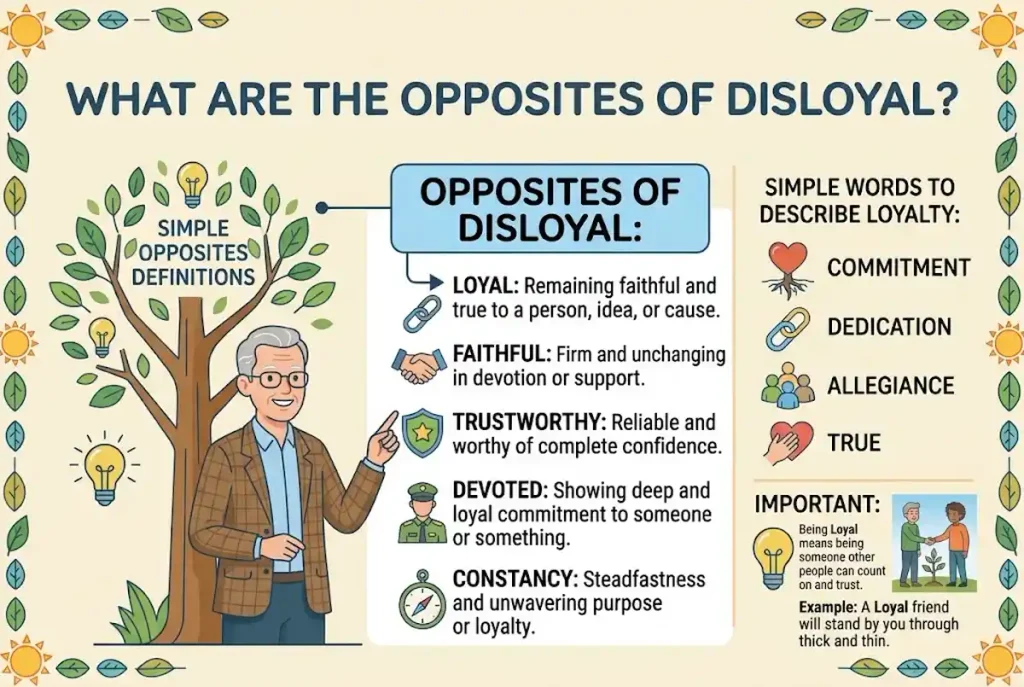
The most direct opposite is loyal.
Other antonyms describe different kinds of faithfulness, trust, and commitment.
| Antonym | Meaning | Example |
|---|---|---|
| Loyal | Remaining faithful | She remained loyal to her friends. |
| Faithful | Keeping one’s commitment | He was faithful to his partner. |
| Trustworthy | Deserving trust | The assistant was trustworthy. |
| Devoted | Showing deep commitment | She was devoted to her family. |
| Dependable | Reliable and consistent | He proved dependable under pressure. |
| Steadfast | Firm in loyalty or purpose | They remained steadfast during the crisis. |
| Committed | Dedicated to something | The volunteers were committed to their cause. |
| True | Faithful or sincere | He remained true to his principles. |
These words aren’t always interchangeable.
For example, dependable emphasizes reliability, while devoted suggests strong emotional commitment.
Conclusion
When choosing between Disloyal or Unloyal, disloyal is the standard word for modern English. It works naturally in everyday conversations, professional writing, essays, and descriptions of broken trust. The alternative is rare and offers no practical advantage for most writers.
Remember that word choice also depends on the seriousness of the behavior. Unreliable may describe someone who repeatedly fails to meet expectations, while treacherous suggests a much more serious betrayal. These differences help you express your meaning without exaggeration.
The easiest rule is to use disloyal when someone fails to show expected loyalty and choose a more specific synonym when the situation calls for one. With a little attention to context, your sentences will sound clearer, more natural, and more accurate.
Frequently Asked Questions
Is It Disloyal or Unloyal in Correct English?
Disloyal is the standard and recommended word in modern English. Unloyal is a rare alternative that generally sounds unnatural in everyday writing.
Is Unloyal Grammatically Correct?
Unloyal is an attested but uncommon adjective. Although its meaning is understandable, disloyal is the established form preferred in standard English.
What’s Another Way to Say Disloyal?
Common alternatives include unfaithful, untrustworthy, faithless, treacherous, and deceitful. Choose the synonym that best matches the situation and seriousness of the behavior.
Can You Call Someone Disloyal for Disagreeing With You?
No, disagreement alone doesn’t establish disloyalty. Someone can express a different opinion while remaining honest, respectful, and committed.
What Is the Noun Form of Disloyal?
The noun form is disloyalty. It describes a lack of loyalty or an act that violates an expected commitment.
Is Disloyal the Same as Betrayal?
Not exactly. Disloyal is an adjective describing a lack of loyalty, while betrayal is a noun describing an act that breaks trust. The related verb is betray.
Is Disloyal a Formal or Informal Word?
Disloyal works in both formal and informal English. It is suitable for academic essays, professional communication, literature, and everyday conversations.
What Is the Opposite of Disloyal?
Loyal is the most direct opposite. Other related antonyms include faithful, devoted, trustworthy, steadfast, and committed.

Daniel Grammarfield — The Language Learner
Age: 28Occupation: ESL Learner & Digital Professional
Bio:Daniel is a non-native English speaker who wants to communicate more confidently at work and online. He uses Synotrench to improve grammar, understand confusing words, learn correct sentence structures, and build everyday English skills. He prefers simple explanations with practical examples.
Goals:
Master English grammar rules
Avoid common language mistakes
Improve professional communication
Learn English through real-life examples
Quote:“Learning English is not about memorizing rules — it’s about expressing ideas clearly.”
1 thought on “Disloyal or Unloyal: Simple Guide to Correct Usage (2026)”