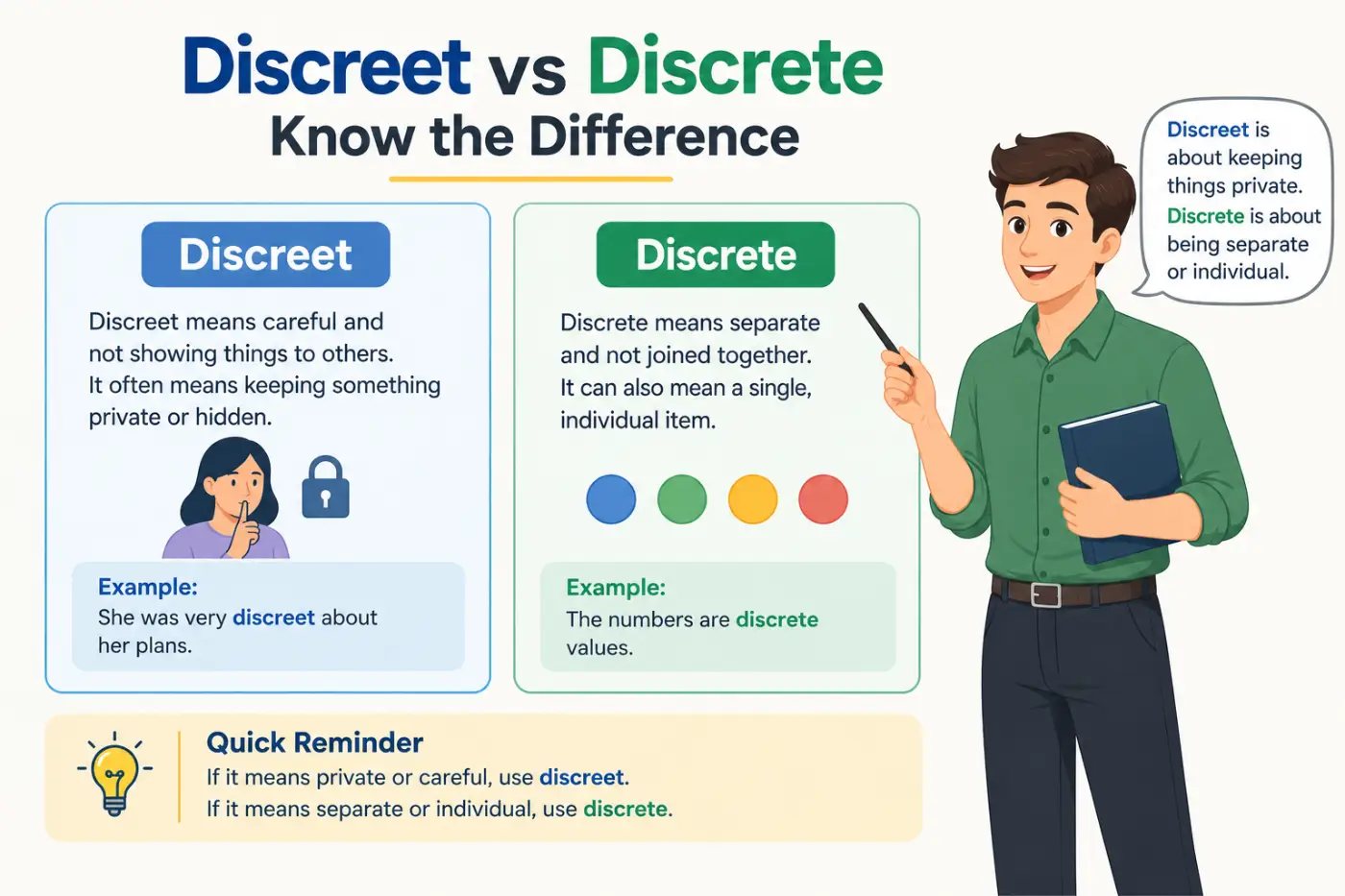
The confusion between Discreet vs Discrete is common because changing just two letters changes the meaning of your sentence. One word describes someone who respects privacy, while the other describes things that are separate or distinct.
Discreet means careful, private, or unlikely to attract attention. Discrete means separate, distinct, or individually identifiable.
Understanding this difference will help you choose the correct spelling in emails, essays, resumes, conversations, and professional writing. This guide covers their meanings, origins, synonyms, grammar rules, real examples, common mistakes, and practical tips for remembering each word.
What Is the Difference Between Discreet and Discrete?
The main difference is simple. Discreet describes careful or private behavior, while discrete describes things that exist separately.
Although both words are adjectives, they serve different purposes in a sentence.
| Feature | Discreet | Discrete |
|---|---|---|
| Basic meaning | Careful and private | Separate and distinct |
| Part of speech | Adjective | Adjective |
| Pronunciation | dih-SKREET | dih-SKREET |
| Common use | Privacy and behavior | Categories and individual units |
| Related noun | Discretion | Discreteness |
| Example | She made a discreet phone call. | The study included three discrete groups. |
Consider these sentences:
- The manager was discreet about the employee’s personal problem.
- The manager divided the project into five discrete tasks.
The first sentence describes how the manager handled sensitive information. The second explains how the project was separated into individual tasks.
The words cannot replace each other without changing the intended meaning.
What Does Discreet Mean in Simple English?
Discreet means being careful about what you say or do, especially when something involves privacy, personal information, or sensitive situations.
A discreet person knows when to speak, when to remain quiet, and how to avoid unnecessary attention.
For example:
- The doctor was discreet when discussing the patient’s condition.
- She gave him a discreet warning during the meeting.
- The restaurant offers discreet service for private guests.
- He made a discreet inquiry about the available position.
Discreet can also describe something designed to avoid attracting attention.
For instance, a discreet security camera might be small and placed where visitors are unlikely to notice it.
What Is the Origin of Discreet?
Discreet comes through Middle English and Old French from the Latin word discretus, meaning separated or distinguished.
Over time, the English spelling discreet became associated with careful judgment, tact, and privacy.
This development explains why discretion is closely related to discreet.
A person who uses discretion makes thoughtful decisions about what should remain private.
What Does Discreet Usually Describe?
Discreet commonly describes:
- People who respect confidential information.
- Conversations involving sensitive subjects.
- Actions performed without attracting attention.
- Services that protect customer privacy.
- Warnings or signals delivered quietly.
For example, a discreet employee doesn’t share private company information with people who don’t need to know it.
However, discreet doesn’t always mean secret. Someone can behave discreetly without hiding anything dishonest or improper.
What Does Discrete Mean in Simple English?
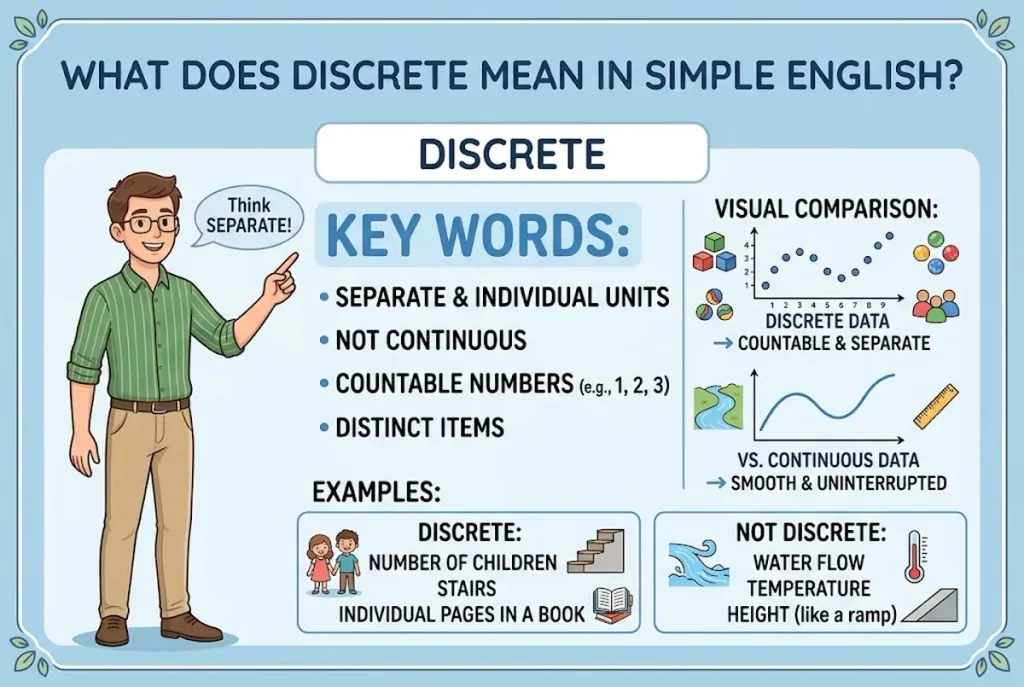
Discrete means separate, distinct, or individually identifiable.
It describes things that can be recognized as different units rather than parts of one continuous whole.
For example:
- The teacher divided the class into four discrete groups.
- The report contains six discrete sections.
- Each customer received a discrete identification number.
- The experiment examined three discrete variables.
In these examples, discrete emphasizes separation.
The groups, sections, numbers, and variables can be identified individually.
What Is the Origin of Discrete?
Discrete shares the same Latin root as discreet.
Both developed from discretus, which relates to separating or distinguishing things.
Historically, the two spellings overlapped. Eventually, English developed a useful distinction between them.
Discreet became associated with careful judgment and privacy, while discrete kept the meaning of separate or distinct.
This shared history helps explain why the words have identical pronunciations despite their different spellings.
What Does Discrete Mean in Mathematics?
In mathematics, discrete describes values or objects that are separate rather than continuous.
For example, the number of students in a classroom is a discrete quantity.
You can have 20 or 21 students, but you cannot normally have 20.5 students.
Compare these two concepts:
| Discrete | Continuous |
|---|---|
| Separate values | Values across an uninterrupted range |
| Number of students | A person’s height |
| Number of cars | Time |
| Number of books | Temperature |
| Individual test scores | Distance |
What Are the Best Synonyms for Discreet and Discrete?
Choosing a synonym depends on the meaning you want to express.
Since the two words describe different ideas, their alternatives should not be mixed.
The following tables provide more than 30 useful alternatives grouped by tone and everyday usage.
Simple Synonyms
These words are easy to understand and work well in general writing.
| Word | Meaning | Tone | Example |
|---|---|---|---|
| Careful | Avoiding mistakes or trouble | Simple | Be careful with that information. |
| Private | Not intended for everyone | Simple | They held a private meeting. |
| Quiet | Not attracting much attention | Simple | She gave him a quiet warning. |
| Separate | Not joined together | Simple | Keep the files separate. |
| Different | Not the same | Simple | These are two different problems. |
| Individual | Considered one at a time | Simple | Each individual task has a deadline. |
| Distinct | Clearly different | Simple | The report identifies three distinct groups. |
| Independent | Existing or working separately | Simple | Each team completed an independent task. |
Everyday Synonyms
These alternatives sound natural in conversations, emails, and ordinary writing.
| Word | Meaning | Tone | Example |
|---|---|---|---|
| Tactful | Careful about people’s feelings | Everyday | Her tactful response avoided an argument. |
| Subtle | Not obvious or noticeable | Everyday | He gave a subtle signal. |
| Low-key | Not attracting much attention | Casual | They planned a low-key celebration. |
| Reserved | Not openly expressing everything | Everyday | She remained reserved during the discussion. |
| Considerate | Thinking about others | Everyday | His considerate reply respected her privacy. |
| Unobtrusive | Not drawing attention | Everyday | The room had unobtrusive lighting. |
| Standalone | Able to exist independently | Everyday | This is a standalone application. |
| Unconnected | Not directly linked | Everyday | The police investigated two unconnected events. |
| Divided | Separated into parts | Everyday | The work was divided into smaller tasks. |
| Self-contained | Complete within itself | Everyday | Each chapter is self-contained. |
Formal Synonyms
Formal alternatives are useful in academic papers, professional reports, and technical documents.
| Word | Meaning | Tone | Example |
|---|---|---|---|
| Prudent | Showing careful judgment | Formal | The director made a prudent decision. |
| Circumspect | Thinking carefully before acting | Formal | She remained circumspect during negotiations. |
| Judicious | Showing sound judgment | Formal | His judicious response prevented confusion. |
| Confidential | Intended to remain private | Formal | The records are confidential. |
| Diplomatic | Handling sensitive matters carefully | Formal | She offered a diplomatic explanation. |
| Differentiated | Made or recognized as different | Formal | The company developed differentiated services. |
| Distinguishable | Able to be recognized separately | Formal | The two patterns are distinguishable. |
| Discontinuous | Having interruptions or gaps | Technical | The graph shows discontinuous segments. |
| Disjoint | Having no shared elements | Technical | The sets are disjoint. |
| Segregated | Kept apart from other things | Formal | The materials were segregated by category. |
Casual and Slang Alternatives
Discreet and discrete are not slang words. However, casual expressions can communicate similar ideas in informal situations.
| Word or Phrase | Meaning | Tone | Example |
|---|---|---|---|
| Under the radar | Avoiding attention | Casual | They kept the project under the radar. |
| Hush-hush | Kept secret | Slang | The arrangement was hush-hush. |
| On the down-low | Kept quiet or private | Slang | They kept the news on the down-low. |
| No big scene | Without public attention | Casual | He wanted to leave with no big scene. |
| Split up | Separated into parts | Casual | We split up the assignments. |
| One by one | Individually | Casual | Check the entries one by one. |
| Apart | Separated | Casual | Keep the two samples apart. |
| In chunks | Divided into sections | Casual | Complete the project in chunks. |
How Do Synonyms Change From Mild to Strong?
Some alternatives express a stronger level of privacy, caution, or separation than others.
Understanding intensity helps you avoid choosing a word that sounds too dramatic.
Discreet Synonyms by Intensity
| Intensity | Word | Meaning |
|---|---|---|
| Mild | Careful | Paying attention to possible problems |
| Mild | Considerate | Thinking about other people |
| Moderate | Tactful | Avoiding embarrassment or offense |
| Moderate | Discreet | Respecting privacy and avoiding attention |
| Strong | Circumspect | Acting with considerable caution |
| Strong | Secretive | Intentionally hiding information |
Discrete Synonyms by Degree of Separation
| Degree | Word | Meaning |
|---|---|---|
| General | Different | Not identical |
| Clear | Distinct | Recognizably different |
| Separate | Independent | Existing or operating separately |
| Complete | Disjoint | Having no elements in common in a mathematical context |
What Are the Different Word Forms of Discreet and Discrete?
Both words are adjectives, but their related nouns and adverbs have different meanings.
Knowing these forms helps you write more naturally.
| Word | Part of Speech | Meaning |
|---|---|---|
| Discreet | Adjective | Careful about privacy or attention |
| Discreetly | Adverb | In a careful or private manner |
| Discretion | Noun | Careful judgment |
| Discrete | Adjective | Separate or distinct |
| Discretely | Adverb | In separate units |
| Discreteness | Noun | The quality of being separate |
Is Discretion Related to Discreet or Discrete?
Discretion is directly associated with discreet in modern English.
It refers to the ability to make sensible decisions, especially when handling sensitive information.
For example:
The manager used discretion when discussing the complaint.
Don’t confuse discretion with discreteness, which refers to separation or distinctness.
Is Discreet Used Differently in American and British English?
American and British English generally follow the same distinction.
In both varieties:
- Discreet means careful, tactful, or private.
- Discrete means separate or distinct.
- Both words have the same pronunciation.
There is no major regional spelling difference to remember.
You can use discreet in a US business email and a UK business email without changing its meaning.
Likewise, discrete has the same basic meaning in American and British academic writing.
The main differences are related to context and field of study, not geography.
When Should You Use Discreet or Discrete in Different Situations?
The correct choice depends on what you’re describing.
Privacy usually calls for discreet. Separation usually calls for discrete.
Here are five common writing situations.
Which Word Should You Use on a Resume?
Use discreet when describing your ability to handle sensitive information professionally.
Example:
Handled confidential employee records with discretion and maintained a discreet approach to workplace concerns.
This wording communicates professionalism and sound judgment.
Discrete may appear on a technical resume when describing data analysis, mathematical models, or separate system components.
Example:
Developed a model for analyzing discrete data sets.
Which Word Is Better in an Essay?
Both words are appropriate, depending on your subject.
Use discreet when discussing human behavior, privacy, or communication.
Example:
The character remained discreet about her family’s financial difficulties.
Use discrete when discussing separate ideas, categories, or observations.
Example:
The researcher divided the results into four discrete categories.
Academic writers should pay special attention to this difference because the wrong spelling can change the meaning of a technical statement.
Which Word Should You Use When Texting?
Discreet is more common in everyday personal messages.
Example:
Please be discreet about the surprise birthday party.
Discrete is less common in casual texting unless you’re discussing separate items or technical information.
Example:
I divided the assignment into three discrete parts.
For informal messages, separate may sound more natural than discrete.
Which Word Works Best in Professional Emails?
Use discreet when requesting privacy or careful communication.
Example:
Please be discreet when discussing this matter with the rest of the team.
Use discrete when referring to individual tasks, sections, or categories.
Example:
We have divided the project into five discrete phases.
If you want a more familiar alternative, separate is often suitable in ordinary business communication.
Which Word Sounds Natural in Everyday Speaking?
Discreet sounds natural when discussing privacy, behavior, or sensitive situations.
Example:
I trust her because she’s always discreet about personal matters.
Discrete is more common in educational, scientific, and technical conversations.
Example:
The instructor explained how discrete values differ from continuous values.
You don’t need to avoid discrete in everyday speech. Just make sure separation is the meaning you intend.
What Are Some Real Examples of Discreet and Discrete?
Seeing the words in different situations makes their meanings easier to remember.
The following examples show how each word works in everyday English.
Examples of Discreet in Sentences
- The receptionist was discreet when discussing the visitor’s appointment.
- She sent a discreet message instead of interrupting the meeting.
- The celebrity requested a discreet entrance to the hotel.
- Our manager is discreet about employee concerns.
- He gave his friend a discreet signal to stop talking.
Each example involves privacy, careful behavior, or avoiding unnecessary attention.
Examples of Discrete in Sentences
- The course consists of six discrete learning modules.
- Each participant received a discrete identification code.
- The computer processes information in discrete units.
- The survey identified four discrete customer groups.
- The experiment measured several discrete variables.
In these examples, the word identifies separate units, categories, or elements.
Examples That Show Both Words Together
Sometimes both words can appear naturally in the same sentence.
- The discreet researcher collected information from three discrete groups.
- She discreetly organized the documents into discrete categories.
- The manager made a discreet announcement about the company’s two discrete projects.
These examples show that the words can describe different features of the same situation.
Discreet vs Discrete and Other Similar Words
Several related words can create confusion because their meanings overlap in certain situations.
Understanding the small differences helps you choose more precise language.
Discreet vs Secretive
Discreet usually describes responsible behavior. Secretive suggests someone is deliberately hiding information.
| Discreet | Secretive |
|---|---|
| Usually positive | Can sound negative |
| Shows careful judgment | Suggests intentional concealment |
| Often protects privacy | May create suspicion |
| She was discreet about the complaint. | He was secretive about his plans. |
Discreet vs Tactful
Both words describe thoughtful behavior, but they emphasize different qualities.
| Discreet | Tactful |
|---|---|
| Focuses on privacy | Focuses on people’s feelings |
| Avoids unnecessary attention | Avoids embarrassment or offense |
| Common with confidential matters | Common with sensitive conversations |
Discrete vs Distinct
Discrete and distinct are close synonyms, but they don’t always express the same idea.
| Discrete | Distinct |
|---|---|
| Emphasizes separation | Emphasizes recognizable difference |
| Common in technical writing | Common in general writing |
| Describes individual units | Describes noticeable differences |
What Are the Most Common Discreet and Discrete Mistakes?
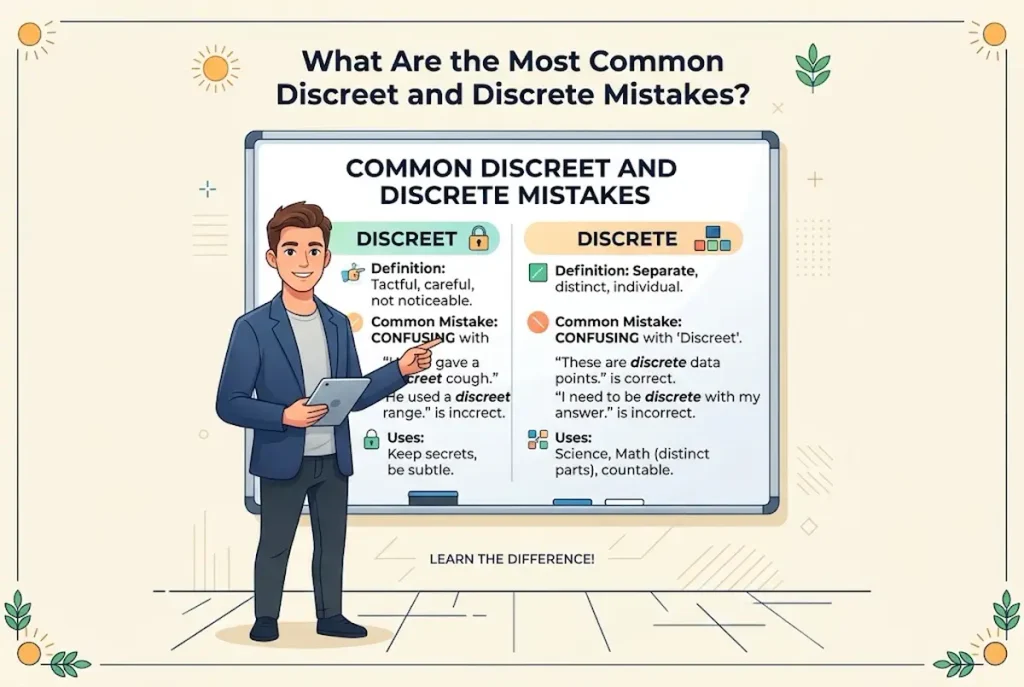
Because these words sound identical, spelling mistakes are easy to make.
Here are some common errors and their corrections.
| Incorrect Sentence | Correct Sentence | Reason |
|---|---|---|
| Please be discrete about the news. | Please be discreet about the news. | Privacy is intended. |
| The data has five discreet categories. | The data has five discrete categories. | The categories are separate. |
| She handled the complaint discretely. | She handled the complaint discreetly. | Careful behavior is intended. |
| The project has three discreet phases. | The project has three discrete phases. | The phases are individual units. |
| He gave me a discrete warning. | He gave me a discreet warning. | The warning avoided attention. |
Can You Use Discreet to Mean Separate?
No. In standard modern English, discreet should not replace discrete when you mean separate or distinct.
Incorrect: The experiment included four discreet samples.
Correct: The experiment included four discrete samples.
The corrected sentence clearly identifies four separate samples.
Can You Use Discrete to Mean Private?
No. Discrete does not normally describe privacy, confidentiality, or tactful behavior.
Incorrect: She remained discrete about the confidential report.
Correct: She remained discreet about the confidential report.
Using the wrong spelling can make your sentence confusing, especially in professional writing.
Does Discreet Always Mean Keeping a Secret?
No. Discreet means showing good judgment about what should be said or done.
A discreet person may share information when necessary while still respecting privacy.
For example, a doctor can be discreet while explaining important medical information to an authorized caregiver.
The word doesn’t require complete silence.
Should You Use Discrete Instead of Separate Everywhere?
No. Although the meanings overlap, separate is usually more familiar in everyday conversation.
Discrete is especially useful when emphasizing individually identifiable units or values.
Compare:
Please keep the two documents separate.
The analysis identified two discrete populations.
Both sentences are correct, but the second has a more technical tone.
What Are the Opposites of Discreet and Discrete?
Antonyms can make the meanings easier to understand.
Since the words express different ideas, they also have different opposites.
Antonyms of Discreet
| Antonym | Meaning |
|---|---|
| Indiscreet | Not careful about private information |
| Tactless | Not considerate of others’ feelings |
| Obvious | Easily noticed |
| Conspicuous | Attracting attention |
| Blatant | Very obvious, often in an offensive way |
| Thoughtless | Acting without enough consideration |
Antonyms of Discrete
| Antonym | Meaning |
|---|---|
| Continuous | Existing without interruption |
| Connected | Joined or linked together |
| Unified | Combined into one whole |
| Integrated | Brought together into a complete system |
| Indivisible | Unable to be divided |
| Unbroken | Having no interruptions |
How Can You Remember Discreet and Discrete Easily?
You don’t need a complicated grammar rule to remember these spellings.
A few simple memory tricks can help.
The Double E Trick
Look closely at discreet.
The two e’s sit together.
Think of them as two people quietly staying close and keeping a private conversation between themselves.
Discreet = privacy and careful behavior.
Now look at discrete.
The two e’s are separated by a t.
Discrete = separate or distinct.
This visual trick is especially helpful when you’re writing quickly.
The Privacy Test
Ask yourself:
Am I describing someone who is careful about attention, feelings, or private information?
If yes, choose discreet.
Example:
The assistant was discreet about the client’s request.
The Separation Test
Ask yourself:
Am I describing separate items, categories, values, or units?
If yes, choose discrete.
Example:
The application contains four discrete features.
The Replacement Test
Try replacing the word with a simpler alternative.
| If You Can Say | Choose |
|---|---|
| Careful about privacy | Discreet |
| Not attracting attention | Discreet |
| Separate | Discrete |
| Individually identifiable | Discrete |
| Distinct | Discrete |
Quick Recap of Discreet vs Discrete
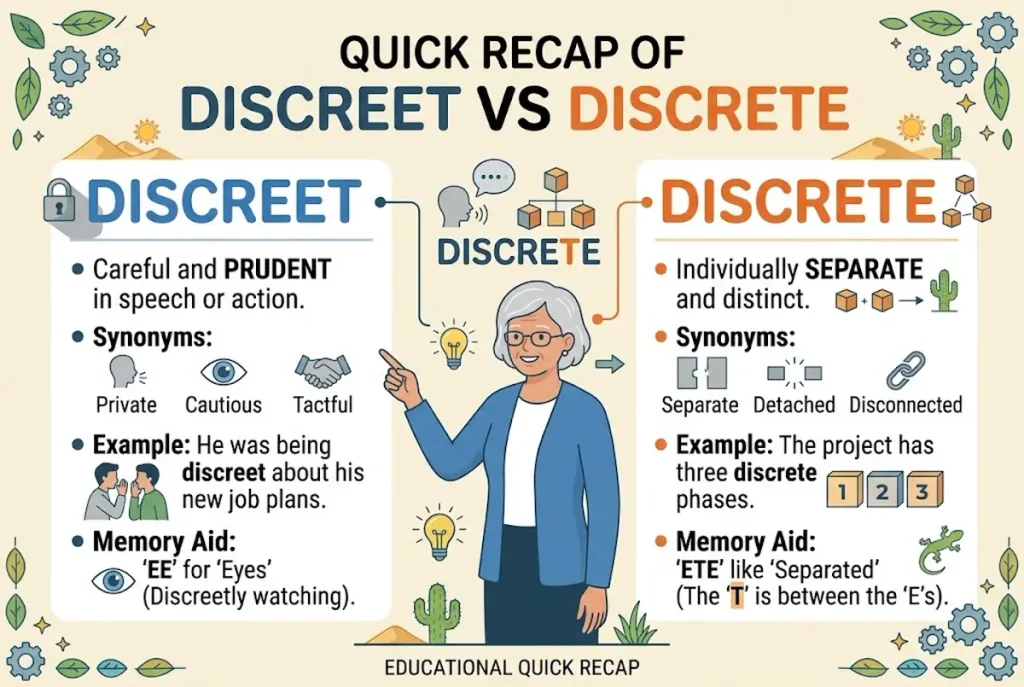
The easiest way to remember these confusing words is to connect each spelling with its main meaning.
| Remember This | Correct Word |
|---|---|
| Respecting someone’s privacy | Discreet |
| Giving a quiet warning | Discreet |
| Handling sensitive information carefully | Discreet |
| Dividing information into separate categories | Discrete |
| Describing individual mathematical values | Discrete |
| Identifying distinct parts of a project | Discrete |
Conclusion
The difference between Discreet vs Discrete comes down to two simple ideas: privacy and separation. Use discreet when describing someone who acts carefully, respects confidential information, or avoids attracting unnecessary attention.
Use discrete when describing things that are separate, distinct, or individually identifiable. Both words are adjectives, share the same historical root, and sound exactly alike. Their spelling and modern meanings, however, are different.
Remember the double e trick: the two e’s in discreet stay together, just like people keeping a private conversation. In discrete, the letters are separated by a t.
Before choosing either word, check the meaning of your sentence. That small habit can make your emails, essays, reports, and everyday writing clearer and more accurate.
Frequently Asked Questions
What is the difference between discreet and discrete?
Discreet means careful, private, or tactful. Discrete means separate or distinct. The two words have identical pronunciations but different meanings.
Is it discreet or discrete when keeping a secret?
Discreet is correct when describing someone who handles private information carefully. For example, she was discreet about her friend’s personal situation.
What is an easy way to remember Discreet vs Discrete?
Remember that the two e’s in discreet sit together, suggesting privacy. In discrete, the e’s are separated by a t, which can remind you of separate things.
What’s another way to say discreet?
Common alternatives include tactful, careful, subtle, considerate, and unobtrusive. The best choice depends on the sentence and the type of behavior you’re describing.
What is another word for discrete in mathematics?
Separate, distinct, and individually identifiable are useful alternatives. However, discrete has a specific technical meaning, so these words may not always replace it accurately.
Is discreet a positive word?
Yes. Discreet usually describes someone who shows good judgment, respects privacy, and avoids unnecessary attention. It is generally considered a positive personal or professional quality.
How do you pronounce Discreet vs Discrete?
Both words are pronounced exactly the same way: dih-SKREET. You must use the sentence’s meaning to identify the intended spelling.
Can discreet and discrete be used interchangeably?
No. Although they share a historical origin and pronunciation, their modern meanings are different. Using one in place of the other can change your sentence’s meaning.

Daniel Grammarfield — The Language Learner
Age: 28Occupation: ESL Learner & Digital Professional
Bio:Daniel is a non-native English speaker who wants to communicate more confidently at work and online. He uses Synotrench to improve grammar, understand confusing words, learn correct sentence structures, and build everyday English skills. He prefers simple explanations with practical examples.
Goals:
Master English grammar rules
Avoid common language mistakes
Improve professional communication
Learn English through real-life examples
Quote:“Learning English is not about memorizing rules — it’s about expressing ideas clearly.”
1 thought on “Discreet vs Discrete Simple Guide With Examples (2026)”