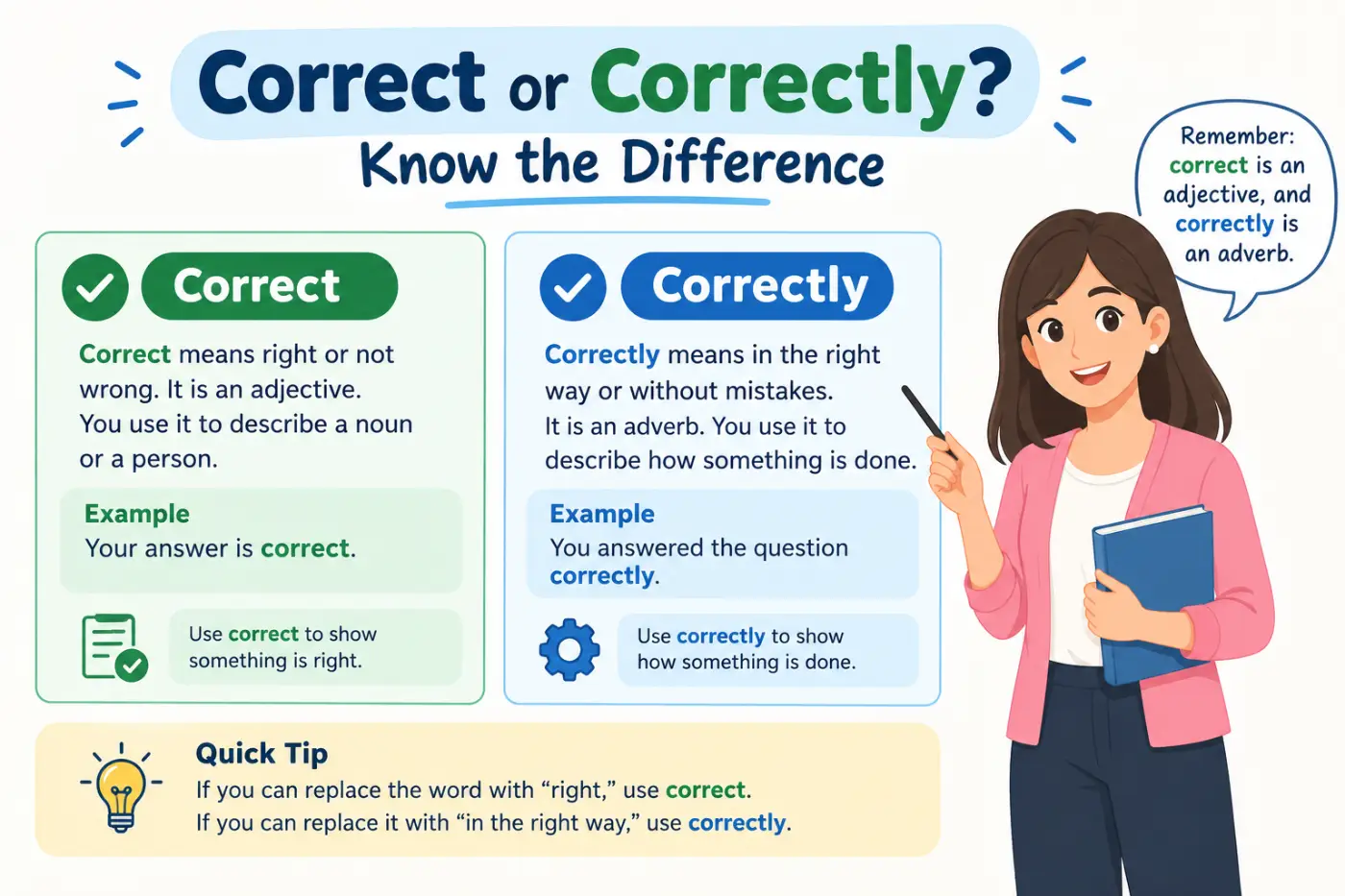
The confusion between Correct or Correctly is common because both words relate to accuracy. However, they serve different purposes in English grammar. One usually describes a person, thing, or result, while the other explains how someone performs an action.
Correct is usually an adjective that means right, accurate, or free from mistakes. Correctly is an adverb that means doing something in the right or proper way. Correct can also work as a verb meaning to fix an error.
This guide explains their meanings, grammar rules, origins, synonyms, and differences. You’ll also find practical examples, common mistakes, and simple tips to help you choose the right word in everyday writing.
What Is the Difference Between Correct and Correctly?
The main difference is their grammatical function.
Compare these examples:
- Your answer is correct.
- You answered the question correctly.
Both sentences express a similar idea, but their structures are different.
In the first sentence, correct describes the answer. In the second sentence, correctly describes the action of answering.
Here’s a simple comparison:
| Feature | Correct | Correctly |
|---|---|---|
| Main part of speech | Adjective | Adverb |
| Basic meaning | Right or accurate | In the right way |
| Describes | A noun or pronoun | Usually a verb |
| Example | This answer is correct. | She answered correctly. |
| Common question | Is it right? | Was it done properly? |
| Opposite | Incorrect | Incorrectly |
Correct also functions as a verb.
For example:
- Please correct this sentence.
- The teacher corrected my spelling.
- I need to correct an error in the report.
In these examples, correct means to identify and fix something that is wrong.
When Should You Use Correct?
Use correct when describing something that is right, accurate, appropriate, or free from errors.
It commonly appears before a noun or after linking verbs such as is, are, was, and seems.
Examples:
- This is the correct address.
- Her calculation is correct.
- Please select the correct option.
- Your information seems correct.
- We found the correct solution.
Notice that correct describes an answer, address, calculation, option, information, or solution.
It tells readers about the quality or accuracy of something.
When Should You Use Correctly?
Use correctly when explaining how an action happens.
It often follows an action verb, although its position can change depending on the sentence.
Examples:
- She completed the assignment correctly.
- Please pronounce my name correctly.
- He correctly identified the problem.
- Make sure you install the software correctly.
- The student correctly answered every question.
In each example, correctly explains how someone performs an action.
It focuses on the action rather than simply describing the person or thing involved.
Where Do Correct and Correctly Come From?
Understanding word origins can make grammar rules easier to remember.
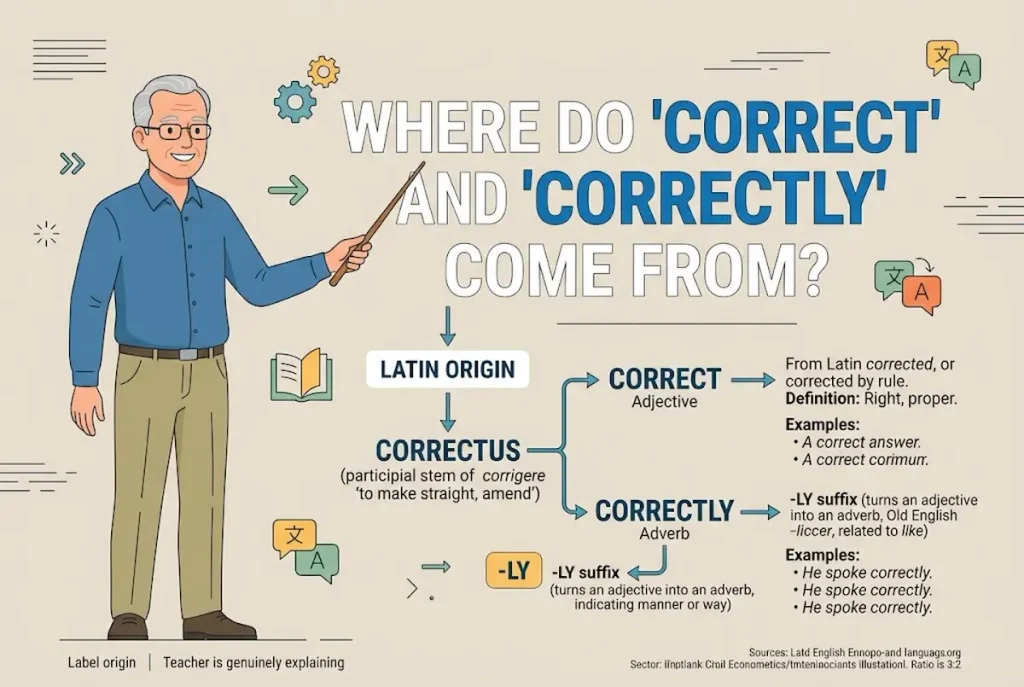
Correct comes from the Latin word correctus, which is related to corrigere. This Latin verb means to make straight, set right, or improve something.
The original idea involved fixing something that was not right.
Over time, correct developed several related meanings in English, including accurate, proper, and free from mistakes.
Today, we use it in sentences such as:
- The correct answer is 25.
- Please correct the spelling mistake.
- His explanation was correct.
In English, adding ly to many adjectives creates an adverb.
For example:
| Adjective | Adverb |
|---|---|
| Correct | Correctly |
| Quick | Quickly |
| Careful | Carefully |
| Accurate | Accurately |
| Proper | Properly |
| Clear | Clearly |
| Safe | Safely |
This pattern helps explain why correctly describes how an action is performed.
However, not every English adverb ends in ly. Words such as fast, hard, and well follow different patterns.
What Are the Best Synonyms for Correct and Correctly?
English offers several alternatives to these two words. The best choice depends on your sentence, audience, and intended meaning.
Some alternatives describe accuracy. Others express proper behavior, successful performance, or freedom from mistakes.
The following tables include more than 30 useful alternatives grouped by tone and everyday usage.
Simple Synonyms
These words are easy to understand and work well in ordinary conversations.
| Word | Meaning | Tone | Example |
|---|---|---|---|
| Right | Not wrong | Simple | Your answer is right. |
| True | Based on fact | Simple | That statement is true. |
| Accurate | Free from errors | Neutral | The information is accurate. |
| Proper | Suitable or acceptable | Neutral | Follow the proper steps. |
| Exact | Completely precise | Neutral | Give me the exact number. |
| Well | In a good or successful way | Simple | She explained it well. |
| Rightly | In a justified or proper way | Neutral | He was rightly concerned. |
| Clearly | In an understandable way | Neutral | Please explain it clearly. |
Right is often the easiest replacement for correct in casual English.
Well can replace correctly in some sentences, but the meanings are not always identical. Doing something well focuses on quality, while doing it correctly focuses on following the right method or meeting a standard.
Everyday Synonyms
These alternatives sound natural in emails, conversations, school assignments, and daily activities.
| Word | Meaning | Tone | Example |
|---|---|---|---|
| Suitable | Right for a purpose | Neutral | Choose a suitable title. |
| Appropriate | Right for a situation | Neutral | That response is appropriate. |
| Valid | Acceptable under a rule | Neutral | Your ticket is valid. |
| Precise | Very accurate | Neutral | Her measurements are precise. |
| Properly | In the right way | Neutral | Please close the lid properly. |
| Accurately | Without mistakes | Neutral | He recorded the results accurately. |
| Successfully | With the intended result | Neutral | She successfully completed the task. |
| Effectively | In a way that works | Neutral | The team communicated effectively. |
| Exactly | Without difference | Neutral | Follow the instructions exactly. |
| Appropriately | In a suitable manner | Neutral | She responded appropriately. |
These words are related, but they are not interchangeable in every sentence.
For example, someone can complete a task successfully without following every instruction correctly.
Formal Synonyms
Formal alternatives are useful in academic writing, professional reports, technical documents, and official communication.
| Word | Meaning | Tone | Example |
|---|---|---|---|
| Factual | Based on established facts | Formal | The report contains factual information. |
| Authentic | Genuine or real | Formal | The document is authentic. |
| Legitimate | Lawful or acceptable | Formal | She raised a legitimate concern. |
| Verified | Checked and confirmed | Formal | We received verified information. |
| Error-free | Containing no mistakes | Formal | Submit an error-free document. |
| Flawless | Having no faults | Formal | Her performance was flawless. |
| Precisely | With great accuracy | Formal | The device measures precisely. |
| Methodically | In an organized manner | Formal | They methodically checked each result. |
| Rigorously | With strict attention | Formal | The researchers rigorously tested the system. |
| Faithfully | Without changing the original | Formal | The translator faithfully reproduced the meaning. |
Choose formal alternatives only when they express your intended meaning.
For instance, authentic means genuine. It does not automatically mean factually correct.
Slang and Informal Alternatives
These expressions appear in relaxed conversations, texting, and social media.
| Word or Phrase | Meaning | Tone | Example |
|---|---|---|---|
| Spot-on | Exactly right | Informal | Your guess was spot-on. |
| On point | Accurate or suitable | Slang | Your explanation is on point. |
| Nailed it | Did something very well | Slang | You nailed it! |
| Bang on | Exactly right | Informal UK | That estimate is bang on. |
| Dead right | Completely right | Informal | You’re dead right about that. |
| Right on the money | Exactly accurate | Informal | Your prediction was right on the money. |
| Got it right | Answered or acted accurately | Casual | You got it right this time. |
| By the book | According to the rules | Informal | She completed everything by the book. |
Avoid most slang expressions in resumes, research papers, and formal business communication.
They work best when the conversation is friendly and relaxed.
Which Synonyms Are Stronger Than Correct?
Not every synonym expresses the same degree of accuracy or confidence.
Some words suggest general suitability, while others communicate a much higher level of precision.
Consider this progression:
| Intensity | Word | Meaning |
|---|---|---|
| Mild | Suitable | Good enough for a purpose |
| Mild | Appropriate | Right for the situation |
| Moderate | Right | Not wrong |
| Moderate | Correct | Meets the required standard |
| Strong | Accurate | Closely matches the facts |
| Strong | Precise | Very exact and specific |
| Very strong | Spot-on | Exactly right |
| Very strong | Flawless | Without faults or mistakes |
This is a guide to emphasis, not a strict dictionary ranking. These words describe different qualities, so their strength depends on context.
Compare these sentences:
- Her answer was suitable for the discussion.
- Her answer was correct.
- Her answer was accurate in every detail.
- Her answer was completely flawless.
The final sentence makes a stronger claim than the others.
Use strong words only when the situation supports them.
Which Synonyms Work as Adjectives Adverbs and Verbs?
One of the easiest ways to avoid grammar mistakes is to identify the part of speech your sentence needs.
A word may express the right idea but still be grammatically unsuitable.
Adjective Alternatives
Adjectives describe nouns or pronouns.
Common examples include:
- Right
- Accurate
- Proper
- Precise
- Appropriate
- Valid
- Suitable
Example: The information is accurate.
Adverb Alternatives
Adverbs often explain how someone performs an action.
Useful alternatives include:
- Properly
- Accurately
- Precisely
- Appropriately
- Exactly
- Effectively
- Successfully
Example: She accurately recorded the information.
Verb Alternatives
Correct can also function as a verb meaning to fix an error.
Related verbs include:
| Verb | Meaning | Example |
|---|---|---|
| Fix | Make something right | Please fix this mistake. |
| Repair | Restore something damaged | He repaired the machine. |
| Revise | Improve written material | Revise the introduction. |
| Amend | Make a formal change | They amended the document. |
| Rectify | Put a mistake right | We must rectify the error. |
| Edit | Improve written content | Edit the final paragraph. |
| Adjust | Make a small change | Adjust the settings. |
These verbs overlap in meaning, but their uses differ.
You can correct a spelling mistake, repair a broken chair, and revise an essay.
Is There a Difference Between American and British English?
They have the same basic meanings and grammatical functions in American and British English.
Neither variety treats them as interchangeable.
For example:
| American English | British English |
|---|---|
| Your answer is correct. | Your answer is correct. |
| Please complete the form correctly. | Please complete the form correctly. |
| Is this information correct? | Is this information correct? |
The main differences appear in certain informal alternatives.
British speakers commonly use expressions such as bang on and spot-on to describe something accurate.
American speakers also understand spot-on and often use expressions such as right on the money.
These are differences in everyday word choice, not grammar rules.
How Should You Use Correct or Correctly in Different Situations?
The right choice becomes easier when you consider the purpose of your sentence.
A resume, academic essay, text message, and business email may all require different wording.
Which Word Is Better for a Resume?
In resumes, focus on measurable achievements and clear action verbs.
Correctly can describe accurate task performance, but stronger wording often explains the actual accomplishment.
Examples:
- Correctly processed customer orders.
- Accurately maintained financial records.
- Verified and corrected database entries.
- Maintained accurate inventory records.
- Successfully resolved customer complaints.
Instead of writing, “I did my work correctly,” describe the responsibility and result.
For example:
“Processed more than 100 customer transactions daily while maintaining accurate records.”
This sounds more professional because it provides useful information about your experience.
Which Word Should You Use in an Essay?
Academic writing often requires accurate descriptions, careful reasoning, and clear explanations.
Use correct when describing an answer, statement, or interpretation.
Use correctly when discussing how someone applies a method, explains an idea, or performs an action.
Examples:
- The correct interpretation depends on the historical context.
- The researcher correctly identified the main cause.
- The study provides accurate information about the subject.
- Students must correctly apply the formula.
Avoid using stronger alternatives such as flawless unless the evidence supports that claim.
How Do You Use Them in Text Messages?
Casual messages allow simpler expressions.
You can use right instead of correct when the meaning remains clear.
Examples:
- Is this right?
- Did I answer correctly?
- You got it right!
- Your guess was spot-on.
- Am I saying this correctly?
Correct is also natural in texting. It may simply sound a little more formal than right in certain situations.
Which Word Sounds Better in a Professional Email?
Both words work well in professional emails, but their placement matters.
Use correct when referring to information, details, dates, or documents.
Use correctly when referring to completing, entering, processing, or checking something.
Examples:
- Could you confirm that the address is correct?
- Please ensure that all details are entered correctly.
- I have attached the corrected document.
A particularly useful sentence is:
“Please confirm that I have understood your instructions correctly.”
It sounds polite, natural, and professional.
How Do You Use These Words in Everyday Speaking?
In everyday speech, right and correctly are both common.
The best choice depends on the sentence structure.
Examples:
- Is that the correct answer?
- Did I pronounce your name correctly?
- You’re right about the meeting time.
Remember that natural spoken English does not always require formal vocabulary.
Simple words often communicate your meaning more clearly.
What Are Some Real-Life Examples?
The following examples show how these words work in different situations.
| Situation | Example Sentence | Explanation |
|---|---|---|
| School | Your answer is correct. | Describes the answer |
| Classroom | She solved the equation correctly. | Describes the action |
| Office | Please provide the correct file. | Describes the file |
| Technology | The application is working correctly. | Describes how it works |
| Travel | Is this the correct departure gate? | Describes the gate |
| Cooking | Make sure the meat is cooked correctly. | Describes the cooking process |
| Healthcare | The nurse correctly recorded the temperature. | Describes the recording action |
| Shopping | They delivered the correct product. | Describes the product |
| Driving | He correctly followed the road signs. | Describes how he followed them |
| Writing | Please correct the spelling errors. | Uses correct as a verb |
| Mathematics | Her final calculation was correct. | Describes the calculation |
| Communication | I hope I understood you correctly. | Describes the understanding |
What’s the Difference: Correct vs Accurate?
Correct and accurate are close in meaning, but they emphasize slightly different ideas.
Correct often means that something meets an expected answer, rule, or standard.
Accurate emphasizes closeness to the actual facts, measurements, or details.
| Correct | Accurate |
|---|---|
| Focuses on being right | Focuses on factual precision |
| Common with answers and choices | Common with measurements and information |
| The correct option is B. | The measurements are accurate. |
| Suitable for rules and procedures | Suitable for data and descriptions |
Consider these sentences:
“The student selected the correct answer.”
“The scientist collected accurate measurements.”
Both words express reliability, but each fits its context more naturally.
A measurement can also be correct, and an answer can be accurate. The difference is mainly one of emphasis.
Correctly vs Properly: Are They Interchangeable?
Correctly and properly often overlap, especially when discussing instructions or procedures.
However, properly can also emphasize suitability, expected behavior, or acceptable standards.
| Correctly | Properly |
|---|---|
| Emphasizes doing something without error | Emphasizes doing something in a suitable way |
| Often relates to accuracy | Often relates to procedure or behavior |
| She answered correctly. | She behaved properly. |
| He calculated the total correctly. | He properly maintained the equipment. |
For example:
“Please install the software correctly.”
This emphasizes avoiding installation mistakes.
“Please install the software properly.”
This emphasizes following the appropriate installation procedure.
In this context, either sentence works naturally.
However, “She behaved correctly” may sound less natural than “She behaved properly” when discussing manners.
Correct vs Right: Which Sounds More Natural?
Right is one of the closest alternatives to correct.
Both can describe an answer or decision that is not wrong.
However, right has several additional meanings, including direction, fairness, and moral judgment.
Compare these examples:
| Correct | Right |
|---|---|
| That is the correct answer. | That is the right answer. |
| Please use the correct password. | Please use the right password. |
| The calculation is correct. | You made the right decision. |
Correct is especially useful when referring to factual accuracy or a specific standard.
Right often sounds more conversational and can express personal or moral judgment.
For example, “It was the right thing to do” refers to a suitable or morally good action, not simply a grammatically or factually accurate one.
What Are the Most Common Mistakes?
Many mistakes happen because writers choose an adjective when the sentence requires an adverb.
Understanding a few common patterns can prevent most errors.
Mistake 1: Using Correct After an Action Verb
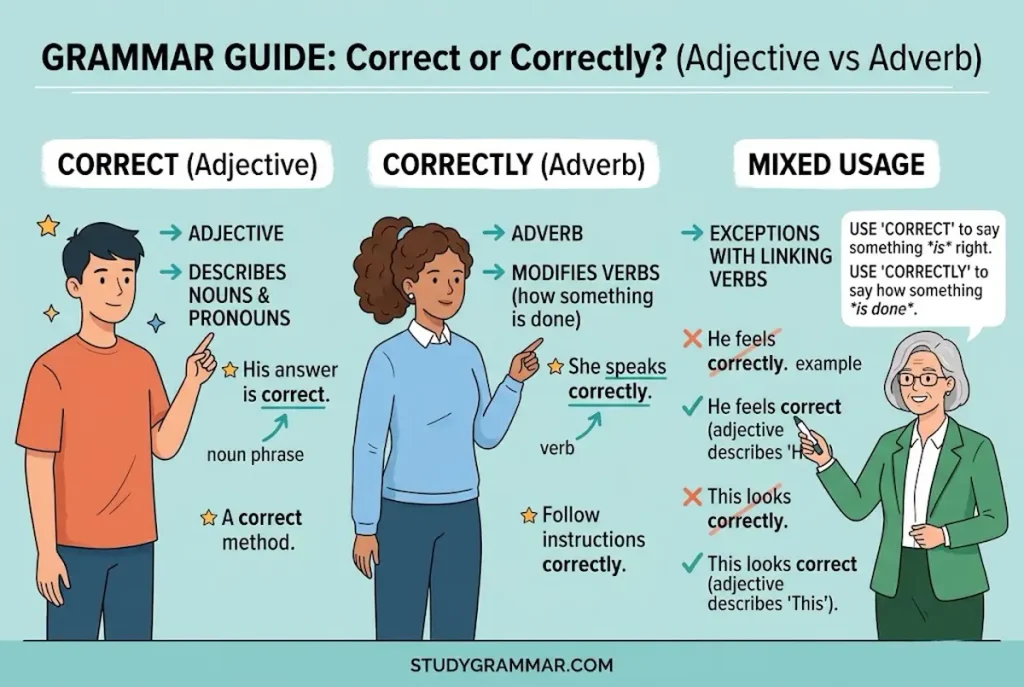
Incorrect: She answered the question correct.
Correct: She answered the question correctly.
The verb answered describes an action. Correctly explains how she performed it.
Mistake 2: Using Correctly After a Linking Verb
Incorrect: Your answer is correctly.
Correct: Your answer is correct.
The linking verb is connects the subject to its description. Therefore, the sentence needs an adjective.
Mistake 3: Using Correctly Before a Noun
Incorrect: Please choose the correctly option.
Correct: Please choose the correct option.
Correct describes the noun option.
When Should You Avoid Using Words?
Sometimes neither word is the most suitable choice.
If you’re discussing personal opinions, correct may sound too absolute.
For example:
“Your favorite movie is correct.”
This sounds unnatural because personal preferences are not usually judged as factually right or wrong.
A better sentence is:
“That’s a great choice.”
Similarly, correctly may not be the best word when discussing general success.
Instead of saying:
“She correctly managed the team.”
You might write:
“She managed the team effectively.”
The second sentence focuses on successful management rather than compliance with a specific procedure.
Also avoid repeating these words several times in one paragraph when a clearer alternative is available.
What Are the Opposites of both words?
Antonyms help explain the boundaries between related meanings.
The most direct opposites are incorrect and incorrectly.
However, other words may work better depending on context.
| Word | Opposite | Example |
|---|---|---|
| Correct | Incorrect | The information is incorrect. |
| Right | Wrong | You selected the wrong option. |
| Accurate | Inaccurate | The report contains inaccurate figures. |
| Proper | Improper | That was an improper procedure. |
| Precise | Imprecise | His description was imprecise. |
| Correctly | Incorrectly | She entered the password incorrectly. |
| Properly | Improperly | The device was installed improperly. |
| Accurately | Inaccurately | The results were reported inaccurately. |
Incorrect is generally suitable for answers, statements, calculations, and information.
Incorrectly describes an action performed with an error.
How Can You Choose the Right Word Every Time?
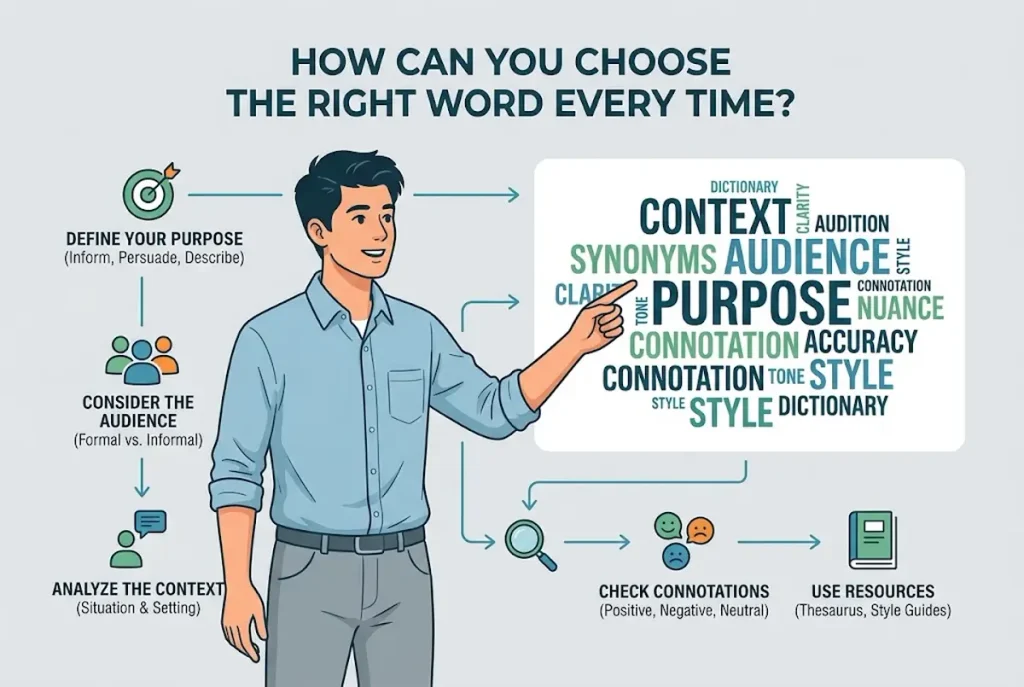
You don’t need to memorize complicated grammar rules. A few simple checks can help you make the right choice.
Ask What Your Sentence Describes
First, identify the word you want to describe.
If you’re describing an answer, object, detail, or result, correct may be suitable.
If you’re describing how someone performs an action, correctly is usually the better choice.
Look at the Verb
Pay attention to the verb in your sentence.
Linking verbs commonly connect subjects to adjectives.
Action verbs can be modified by adverbs.
Compare:
- The answer is correct.
- She answered correctly.
- The information seems correct.
Conclusion
Understanding the difference between Correct or Correctly becomes much easier when you focus on sentence structure instead of memorizing individual examples.
Use correct when describing an answer, result, detail, or other noun that meets the required standard. Use correctly when explaining how an action is performed. Remember that correct can also function as a verb when someone fixes an error.
Related words such as accurate, properly, precisely, and right can improve your writing, but each carries a slightly different meaning. Choose them based on the message you want to communicate.
When you’re unsure, identify the word being described and check its role in the sentence. With regular practice, these small grammar decisions will become natural, helping you write more clearly and confidently.
Frequently Asked Questions
Is It Correct to Say I Did It Correct?
In standard English, the preferred sentence is “I did it correctly.” The verb did requires an adverb when you’re explaining how the action was performed.
Is It Grammatically Correct or Grammatically Correctly?
Grammatically correct is the standard expression. Grammatically modifies the adjective correct, as in “This sentence is grammatically correct.”
What’s Another Way to Say Correctly?
Common alternatives include properly, accurately, precisely, appropriately, and exactly. The best replacement depends on the sentence’s intended meaning.
Can Correct Be Used as a Verb?
Yes. Correct is a verb when it means to fix an error, as in “Please correct the spelling mistakes before submitting your assignment.”
Is Correctly an Adjective or an Adverb?
Correctly is an adverb. It usually modifies a verb and explains how an action is performed, as in “She completed the exercise correctly.”

Daniel Grammarfield — The Language Learner
Age: 28Occupation: ESL Learner & Digital Professional
Bio:Daniel is a non-native English speaker who wants to communicate more confidently at work and online. He uses Synotrench to improve grammar, understand confusing words, learn correct sentence structures, and build everyday English skills. He prefers simple explanations with practical examples.
Goals:
Master English grammar rules
Avoid common language mistakes
Improve professional communication
Learn English through real-life examples
Quote:“Learning English is not about memorizing rules — it’s about expressing ideas clearly.”
1 thought on “Correct or Correctly: Simple Grammar Guide With Examples”