You’re writing an email, finishing an essay, or preparing an important document when you suddenly stop at one word. Should you write color or colour? Both look familiar, and you’ve probably seen them used in books, websites, and everyday conversations. So, which spelling is actually correct?
The confusion comes from a difference between American and British English. Although both words describe the same thing, their spelling changes depending on the type of English you’re using. Choosing the right version can make your writing look more natural, especially when you’re writing for a specific audience.
In this guide, you’ll learn the history behind these spellings, their meanings, related words, useful synonyms, regional differences, and practical examples. You’ll also discover how to choose the correct spelling for emails, essays, resumes, professional documents, and everyday writing.
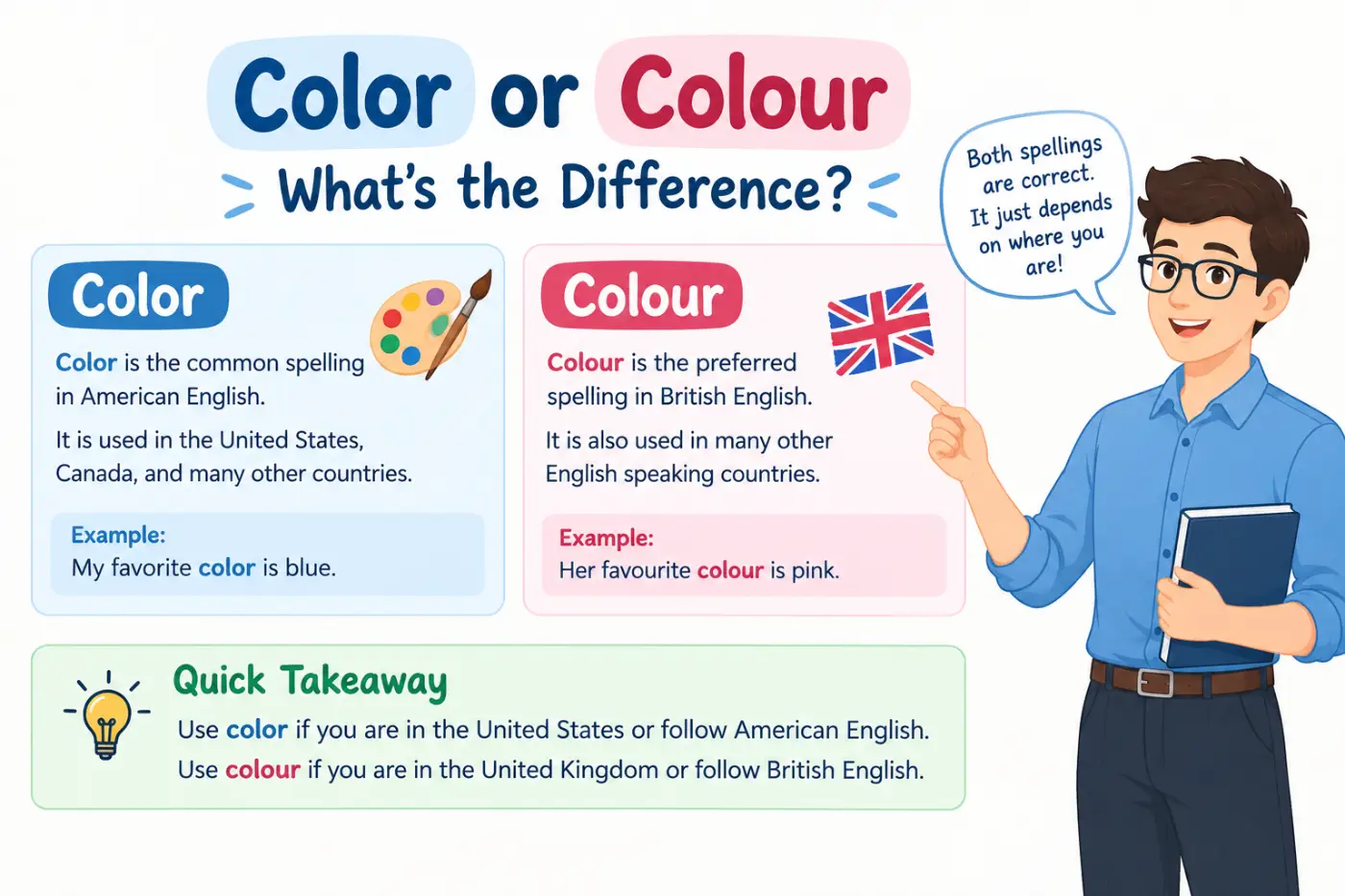
What Is the Difference Between Color and Colour?
The main difference between these two words is spelling, not meaning.
Both refer to the appearance of something based on how it reflects or produces light. They can describe anything from the blue of the sky to the red of a flower.
Here’s a simple comparison:
| Feature | Color | Colour |
|---|---|---|
| Meaning | The visual appearance of something | The visual appearance of something |
| Spelling | Six letters | Six letters |
| Standard usage | American English | British English |
| Part of speech | Noun and verb | Noun and verb |
| Example | My favorite color is blue. | My favourite colour is blue. |
| Correct spelling? | Yes | Yes |
What Does Color Mean in Simple English?
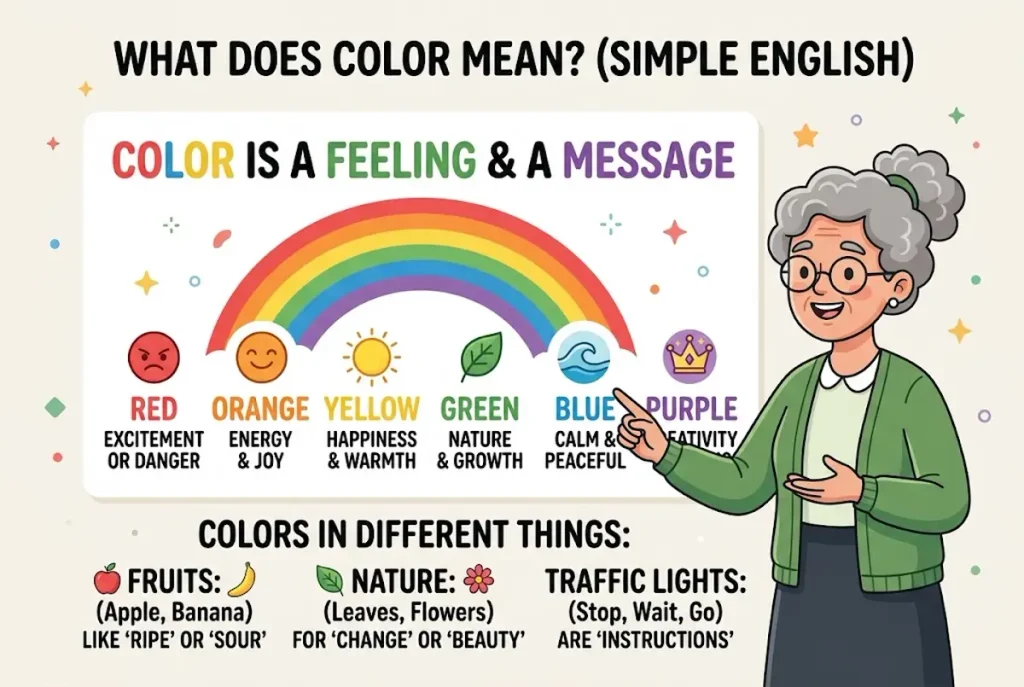
Color refers to the visual quality that allows us to recognize different shades, such as red, blue, yellow, green, and purple.
We see colors because objects reflect or emit different wavelengths of visible light. Our eyes detect that light, and our brains interpret it as different colors.
However, the word has several meanings beyond describing physical appearance.
Color as a noun
When used as a noun, color names or describes a visual quality.
Examples:
- Blue is my favorite color.
- The color of the ocean changes throughout the day.
- She chose a bright color for her bedroom.
In these sentences, the word refers to a visible shade or the general appearance of something.
Color as a verb
Color can also describe the action of adding or changing the appearance of something.
Examples:
- Please color the picture before class ends.
- The children love to color animals.
- She wants to color her hair brown.
As a verb, it can also describe the way feelings, opinions, or experiences influence someone’s thinking.
What does colour mean?
Colour has all the same meanings. The difference is that British English keeps the letter u.
For example:
The children coloured their drawings during art class.
An American writer would normally write:
The children colored their drawings during art class.
The action remains exactly the same.
Where Did the Words Color and Colour Come From?
Understanding the history of these spellings makes their difference easier to remember.
Both words trace their roots to the Latin word color, which referred to appearance, hue, or tint.
For centuries, English spelling wasn’t as standardized as it is today. Writers often used different versions of the same word, and both forms appeared in English writing.
Over time, British English settled on colour as its standard spelling.
American English followed a different path.
Why did Americans remove the letter u?
American spelling reform is closely connected to Noah Webster.
Webster believed American English should have a more consistent spelling system. His dictionaries helped establish several spelling differences between American and British English.
He supported shorter forms of certain words, including color, honor, and favor.
His 1828 dictionary played an important role in promoting these American spellings.
However, Webster didn’t invent the spelling color. Versions without the letter u existed long before his dictionaries. His contribution was helping make the shorter spelling standard in American English.
This historical difference explains why both forms remain correct today.
Which Countries Use Color and Which Use Colour?
English is spoken worldwide, but spelling conventions aren’t identical everywhere.
Some countries follow American English, while others generally follow British English.
The following table shows the usual preferences.
| Country or region | Preferred spelling |
|---|---|
| United States | Color |
| United Kingdom | Colour |
| Canada | Colour is generally preferred |
| Australia | Colour |
| New Zealand | Colour |
| Ireland | Colour |
| South Africa | Colour |
| India | Colour |
| Pakistan | Colour |
| American English publications | Color |
| British English publications | Colour |
These are general writing conventions rather than strict rules for every person or organization.
For example, a Canadian company may use American spelling when preparing content for customers in the United States.
Similarly, a British writer working for an American publication may need to follow American spelling guidelines.
The important rule is to match the style expected by your readers.
Is color correct in American English?
Yes. Color is the standard spelling in American English.
You’ll commonly see it in American textbooks, newspapers, government publications, advertisements, and business documents.
Examples:
- What color is your car?
- The designer selected a neutral color.
- Bright colors can make a room feel cheerful
For content written specifically for a US audience, this spelling is usually the best choice.
Is colour correct in British English?
Yes. Colour is the standard British English spelling.
It appears in British books, newspapers, school materials, and professional writing.
Examples:
- What is your favourite colour?
- The room needs more colour.
- She bought a colourful dress.
British spelling is also common in countries whose educational and publishing traditions follow British English.
What spelling should Canadian writers use?
Canadian English often combines elements of American and British English.
However, colour is generally the preferred spelling in Canadian dictionaries, formal writing, and many government publications.
For example:
The Canadian flag has two main colours.
Some Canadian businesses may use color when following an American company’s branding or writing guidelines.
When preparing professional content, follow the spelling conventions required by your organization.
What Are the Best Synonyms for Color?
The word color has several related terms, but they don’t all mean exactly the same thing.
Some describe a particular shade. Others refer to brightness, intensity, appearance, or artistic effects.
Understanding these differences helps you choose more accurate words instead of repeating the same expression throughout your writing.
Below are 32 useful alternatives and related terms grouped by everyday usage, formal language, and casual expressions.
Simple synonyms
These words are easy to understand and work well in everyday descriptions.
| Word | Meaning | Tone | Example |
|---|---|---|---|
| Hue | A particular color | Simple | The painting has a warm hue. |
| Shade | A variation of a color | Simple | I prefer a darker shade of blue. |
| Tint | A lighter version of a color | Simple | The walls have a pink tint. |
| Tone | A particular color quality | Simple | The room has a soft gray tone. |
| Brightness | How light or bright something appears | Simple | Adjust the brightness of the screen. |
| Darkness | The quality of having little light | Simple | The darkness of the blue makes it look elegant. |
| Appearance | How something looks | Simple | The new paint changed its appearance. |
| Pigment | A substance that provides color | Everyday | This paint contains natural pigment. |
Everyday synonyms and related words
These alternatives are common in clothing, decoration, photography, and casual descriptions.
| Word | Meaning | Tone | Example |
|---|---|---|---|
| Palette | A selected group of colors | Everyday | The designer chose a warm palette. |
| Coloring | The arrangement or use of colors | Everyday | The bird has beautiful coloring. |
| Tinge | A slight amount of color | Everyday | The clouds had a pink tinge. |
| Cast | A noticeable color influence | Everyday | The photograph has a yellow cast. |
| Wash | A thin layer of color | Everyday | She added a blue wash to the painting. |
| Blend | A mixture of colors | Everyday | The sunset displayed a beautiful blend. |
| Contrast | A noticeable difference between colors | Everyday | The contrast makes the text easier to read. |
| Highlight | A lighter or emphasized area | Everyday | The artist added yellow highlights. |
How Do Color Synonyms Change From Mild to Strong?
Not every description of color communicates the same level of intensity.
Some words suggest a soft, barely noticeable appearance. Others describe something extremely bright or visually powerful.
Choosing the right word helps readers picture exactly what you mean.
| Intensity | Word or expression | Meaning | Example |
|---|---|---|---|
| Very mild | Hint | A barely noticeable amount | The sky showed a hint of pink. |
| Mild | Tinge | A slight presence of color | Her cheeks had a red tinge. |
| Mild | Tint | A lighter variation | The glass has a green tint. |
| Moderate | Shade | A particular variation | She selected a warm shade of brown. |
| Moderate | Hue | A recognizable color | The painting uses a golden hue. |
| Moderate | Rich | Deep and full in appearance | The curtains are a rich blue. |
| Strong | Bold | Visually noticeable | The logo uses bold colors. |
| Strong | Vivid | Bright and clear | The flowers have vivid petals. |
| Very strong | Vibrant | Full of visual energy | The market is filled with vibrant colors. |
| Very strong | Intense | Extremely noticeable | The painting features intense red tones. |
| Extremely strong | Dazzling | Impressively bright | The display featured dazzling colors. |
Can Color Be Used as Different Parts of Speech?
Yes. The word works as both a noun and a verb. It also has several related adjective and noun forms.
Understanding these forms makes it easier to write natural sentences.
Color as a noun
A noun names a person, place, thing, or idea.
Examples:
- Green is a relaxing color.
- The color of the leaves changes in autumn.
- Her painting contains many colors.
Color as a verb
A verb describes an action or state.
Examples:
- Please color the flowers yellow.
- She colors pictures in her free time.
- The artist colored the background.
Colorful as an adjective
An adjective describes a noun.
Colorful means containing many colors or having an interesting, lively quality.
Examples:
- She wore a colorful jacket.
- The festival featured colorful decorations.
- He told a colorful story about his childhood.
When Should You Use Color or Colour in Different Writing Situations?
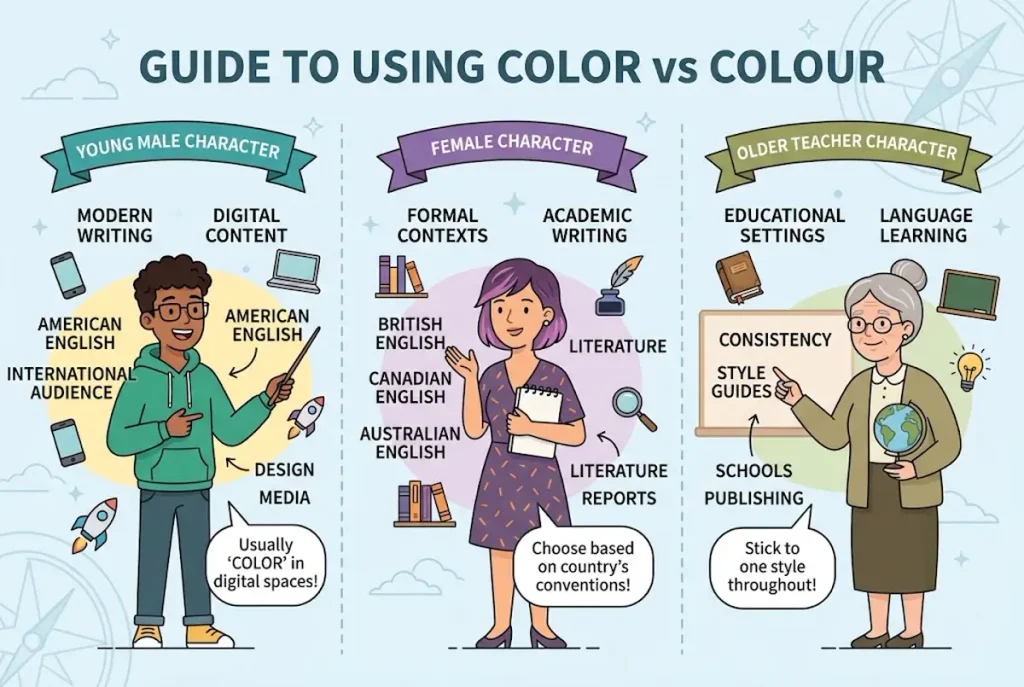
The best spelling depends on the audience you’re addressing.
A word that’s correct in an American business email may need a different spelling in a British university assignment.
Here are five common writing situations and the most suitable approach for each.
Which spelling should you use on a resume?
Use the spelling convention expected by the country where you’re applying for a job.
For a resume intended for an American employer, use American English.
Example:
I developed a consistent color scheme for the company’s marketing materials.
For a CV intended for a British employer, use British English.
Example:
I developed a consistent colour scheme for the company’s marketing materials.
The difference may seem small, but consistent spelling helps your application look carefully prepared.
Other words should follow the same regional style.
For example, an American resume may use organize, while a British CV will commonly use organise.
Don’t switch between regional conventions without a clear reason.
Which spelling is better for an academic essay?
Follow your school’s, university’s, or instructor’s writing guidelines.
American educational institutions generally expect American spelling, while British institutions generally use British spelling.
American example:
The color of an object depends partly on the wavelengths of light it reflects.
British example:
The colour of an object depends partly on the wavelengths of light it reflects.
Both sentences are scientifically and grammatically acceptable.
If your institution accepts either convention, choose one and apply it consistently.
When quoting another author, preserve the original spelling inside the quotation.
Color vs Hue: What’s the Difference?
Color is a broad term, while hue refers more specifically to a recognizable color family.
A hue may be red, green, yellow, or blue.
Color can include additional qualities, such as brightness and saturation.
| Color | Hue |
|---|---|
| A general term for visual appearance | A specific aspect of color |
| Common in everyday language | Common in art and design |
| Can describe an overall appearance | Identifies a color family |
| The room has a beautiful color scheme. | The painting has a reddish hue. |
For everyday writing, color is usually easier and more natural.
Use hue when discussing painting, photography, digital design, or particular color variations.
Example:
The artist selected a blue hue for the background.
This sounds more specific than simply saying the artist selected a color.
Color vs Shade: Are They Interchangeable?
Color and shade are closely related, but they aren’t always interchangeable.
In everyday English, shade often means a particular variation of a color.
In technical color theory, a shade is produced by adding black to a hue, making it darker.
| Color | Shade |
|---|---|
| A broad visual category | A particular variation or darker form |
| Can refer to red, blue, or green | Can refer to navy blue or dark red |
| Common in general descriptions | Useful when comparing variations |
| Blue is my favorite color. | Navy is my favorite shade of blue. |
Consider these examples:
I want to paint my room blue.
I want to paint my room a darker shade of blue.
The second sentence provides more detail.
Use shade when the exact variation matters.
What Are Some Real-Life Examples of Words?
Seeing these spellings in natural situations makes the distinction easier to remember.
The following examples cover school, work, shopping, design, science, and everyday conversations.
Examples using American English
- My favorite color has always been green.
- The teacher asked us to color the map.
- This shirt is available in five different colors.
- The sunset filled the sky with a beautiful orange color.
- Please change the font color to black.
Examples using British English
- My favourite colour is dark blue.
- The children coloured their pictures after lunch.
- This shop sells dresses in several colours.
- The walls need a lighter colour.
- The artist selected a beautiful colour palette.
Notice that the sentence structure doesn’t change.
You simply follow the spelling convention used by your intended audience.
What Are the Most Common Spelling Mistakes?
Although both spellings are correct, writers sometimes use them incorrectly in context.
Here are several mistakes worth avoiding.
Mistake 1: Mixing American and British spellings
Incorrect for a consistently American English document:
My favorite colour is blue, and I love colorful clothes.
Correct American version:
My favorite color is blue, and I love colorful clothes.
Correct British version:
My favourite colour is blue, and I love colourful clothes.
Mixing spelling systems isn’t always a grammatical error, but it can make formal writing look inconsistent.
Mistake 2: Writing colur
Colur isn’t a standard spelling in American or British English.
Incorrect:
What is your favourite colur?
Correct British version:
What is your favourite colour?
Correct American version:
What is your favorite color?
Remember that the word always contains the letters c, o, l, and o at the beginning.
Mistake 3: Writing collor
Collor is another common spelling mistake.
Incorrect:
The collor of the bag is beautiful.
Correct:
The color of the bag is beautiful.
Only one l is needed in the base word.
When Should You Not Replace Color With Colour?
Although both forms have the same meaning, you shouldn’t automatically change one into the other in every situation.
Certain contexts require a fixed spelling.
| Situation | What to do | Reason |
|---|---|---|
| American school assignment | Use color | Matches American conventions |
| British university essay | Use colour | Matches British conventions |
| CSS programming | Use color | Required technical syntax |
| Official brand name | Preserve original spelling | Maintains the correct name |
| Direct quotation | Keep the source spelling | Preserves the original wording |
| International company document | Follow the style guide | Maintains consistency |
| Published book title | Keep the official title | Avoids changing the source |
What Are the Antonyms of Color?
Color doesn’t have one perfect antonym in every context.
However, several words and expressions communicate the absence, reduction, or opposite effect of color.
| Word or expression | Meaning | Example |
|---|---|---|
| Colorless | Having no noticeable color | The liquid is colorless. |
| Achromatic | Without hue | Black, white, and gray are achromatic colors. |
| Monochrome | Using one color or shades of one color | The artist created a monochrome painting. |
| Grayscale | Using shades of gray | The printer produced a grayscale image. |
| Dull | Lacking brightness or visual energy | The old fabric looked dull. |
| Faded | Having lost some original intensity | The curtains became faded over time. |
| Neutral | Not strongly colorful or visually dominant | She prefers neutral tones. |
What Are Other Common American and British Spelling Differences?
The distinction between American and British spelling isn’t limited to one word.
Several everyday words follow similar patterns.
Learning these groups can help you maintain consistent writing without checking every word individually.
Words ending in or and our
One common difference involves words ending in or in American English and our in British English.
| American English | British English |
|---|---|
| Color | Colour |
| Favor | Favour |
| Honor | Honour |
| Labor | Labour |
| Neighbor | Neighbour |
| Behavior | Behaviour |
| Flavor | Flavour |
| Humor | Humour |
| Rumor | Rumour |
| Savior | Saviour |
| Vapor | Vapour |
| Harbor | Harbour |
Words ending in er and re
Some words also differ in the order of their final letters.
| American English | British English |
|---|---|
| Center | Centre |
| Theater | Theatre |
| Meter | Metre |
| Liter | Litre |
| Fiber | Fibre |
How Does the Spelling Affect SEO and Website Content?
If you’re writing articles, product descriptions, or website pages, regional spelling can influence how naturally your content reads to its intended audience.
Search engines generally understand that American and British spelling variants refer to the same concept.
However, readers may have different search habits depending on their location.
For example, an American reader may search for:
- Best hair color ideas.
- What color matches blue?
- Color combinations for bedrooms.
A British reader may search for:
- Best hair colour ideas.
- What colour matches blue?
- Colour combinations for bedrooms.
Both groups are searching for essentially the same information.
Which spelling should a US website use?
For a website primarily targeting American readers, use American spelling throughout the main content.
This keeps headings, navigation labels, product descriptions, and articles consistent with audience expectations.
For example:
Best Hair Color Ideas for Summer
This is a natural title for an American beauty website.
How Can You Remember the Correct Spelling Easily?
You don’t need to memorize a complicated grammar rule.
A few simple habits can help you choose the correct form almost automatically.
Remember the American spelling is shorter
American English commonly uses the shorter version without the extra u.
Think of these examples together:
Color, favor, honor, and labor.
They all follow the same American spelling pattern.
Remember that British English keeps the u
British English retains the u in many words from this group.
Examples include:
Colour, favour, honour, and labour.
Once you recognize the pattern, remembering related words becomes easier.
Follow one spelling system throughout your work
Consistency is especially useful in academic and professional documents.
If you begin with American spelling, continue using American forms for related words.
For example:
The designer selected a colorful background that matched the company’s favorite color.
For British English:
The designer selected a colourful background that matched the company’s favourite colour.
Both versions sound natural when used consistently.

How Do You Choose the Right Spelling Quickly?
When you’re unsure which version to write, use this simple checklist.
| Question | Recommended choice |
|---|---|
| Are you writing for American readers? | Color |
| Are you writing for British readers? | Colour |
| Are you preparing a Canadian document? | Usually colour |
| Are you writing for an Australian audience? | Colour |
| Are you following an American style guide? | Color |
| Are you writing CSS code? | color |
| Are you quoting someone directly? | Preserve the original spelling |
| Are you writing for an international organization? | Follow its established style guide |
Conclusion
The difference between words comes down to regional spelling rather than grammar or meaning. American English uses the shorter form, while British English keeps the additional u. Both describe the same visual quality and work as nouns and verbs.
For everyday writing, choose the version that matches your audience. American readers generally expect the shorter spelling, while British, Australian, and many Canadian readers are more familiar with the longer form.
Once you understand this simple regional difference, choosing the right version becomes much easier. You can write confidently without second-guessing a perfectly correct word.
Frequently Asked Questions
Is it words in American English?
Color is the correct standard spelling in American English. The version with an additional u is primarily associated with British English and several other regional varieties.
Why do British people spell colour with a u?
British English retained the spelling with u through its historical development and standardization. American dictionaries, particularly those associated with Noah Webster, helped establish the shorter spelling in the United States.
Does Canada use which word?
Canadian English generally prefers colour, especially in formal writing, dictionaries, and government publications. However, American spelling sometimes appears in business and commercial content.
What’s another way to say color?
Hue, shade, tint, and tone are common related alternatives. The best choice depends on the sentence because these words describe slightly different aspects of visual appearance.

Daniel Grammarfield — The Language Learner
Age: 28Occupation: ESL Learner & Digital Professional
Bio:Daniel is a non-native English speaker who wants to communicate more confidently at work and online. He uses Synotrench to improve grammar, understand confusing words, learn correct sentence structures, and build everyday English skills. He prefers simple explanations with practical examples.
Goals:
Master English grammar rules
Avoid common language mistakes
Improve professional communication
Learn English through real-life examples
Quote:“Learning English is not about memorizing rules — it’s about expressing ideas clearly.”
2 thoughts on “Color or Colour: Simple Guide to Correct Spelling (2026)”