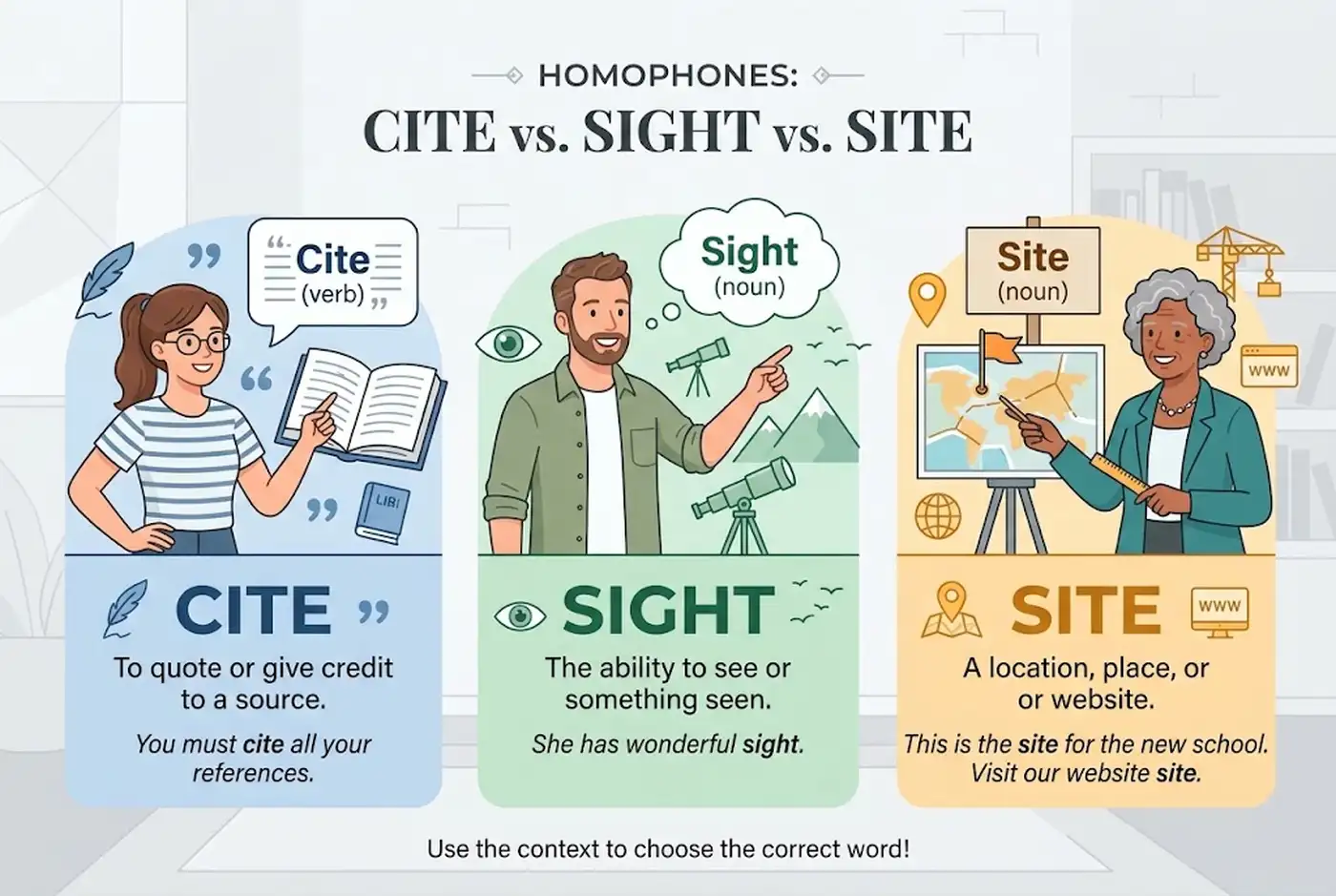
Understanding cite vs sight vs site is easier than you might think. These three words are homophones, meaning they share the same pronunciation but have different spellings and meanings. You’ll find them in school assignments, professional emails, everyday conversations, news articles, and online content.
Cite means to mention a source or give evidence. Sight refers to seeing, vision, or something you can see. Site means a particular place, location, or area, including a website.
The key is to connect each spelling with its purpose. This guide explains their meanings, word origins, related vocabulary, common mistakes, and practical examples. You’ll also learn how to choose the correct word in essays, resumes, emails, texts, and everyday speech.
What Is the Difference Between Cite, Sight, and Site?
The main difference between these three words is how they’re used in a sentence.
Although they have the same pronunciation, they describe three separate ideas: giving credit, seeing something, and identifying a location.
| Word | Simple Meaning | Part of Speech | Example |
|---|---|---|---|
| Cite | Mention a source or provide evidence | Verb | Please cite your sources. |
| Sight | Vision or something seen | Noun and verb | The mountain was a beautiful sight. |
| Site | A place or specific location | Noun and verb | The construction site is closed. |
A simple way to understand their differences is to remember these three sentences:
- Cite the article you used in your research.
- The beautiful sight made everyone stop walking.
- The company selected a new site for its office.
Each sentence uses a different spelling because each communicates a different idea.
Why Do Cite, Sight, and Site Sound the Same?
Cite, sight, and site are homophones.
A homophone is a word that sounds like another word but has a different meaning or spelling.
All three words are pronounced like the English word “sight,” rhyming with night, right, and light.
Their pronunciation is /saɪt/ in both American and British English.
Because pronunciation cannot help you distinguish them, you must look at the sentence’s meaning.
For example:
- I need to cite this study.
- The beautiful sight surprised me.
- We visited the historic site.
Reading these sentences aloud won’t reveal the spelling difference. Their meanings will.

What Does Cite Mean in Simple English?
Cite means to mention something as evidence, identify the source of information, or refer to an example that supports what you’re saying.
It’s a verb, which means it describes an action.
You usually encounter cite when writing essays, preparing reports, discussing research, or explaining information.
For example:
The student must cite three reliable sources in her essay.
Here, cite means identifying where the information came from.
However, the word isn’t limited to academic writing. It also appears in legal, professional, and everyday situations.
A police officer may cite a driver for breaking a traffic law. A manager might cite an employee’s excellent performance when recommending a promotion.
Where Does the Word Cite Come From?
Cite comes from the Latin word citare, which means to summon, call, or set in motion.
It entered English through French and developed several related meanings over time.
The idea of calling someone or something forward helps explain its modern uses.
When you cite a book, you’re bringing that source into your discussion. When an officer cites someone for a violation, they’re formally identifying an offense.
This history makes the word easier to remember.
When Should You Use Cite?
Use cite when you’re:
- Giving credit to an author.
- Mentioning a source of information.
- Supporting an argument with evidence.
Examples:
- Please cite the original author.
- The report cites several recent studies.
- Can you cite an example of this problem?
What Does Sight Mean in Simple English?
Sight means the ability to see or something that a person sees.
It’s commonly used as a noun, but it can also function as a verb.
As a noun, sight may describe vision, a visible object, a view, or something worth looking at.
For example:
The ocean was a wonderful sight at sunrise.
In this sentence, sight describes something beautiful that someone can see.
As a verb, sight means to notice or spot something with your eyes, especially something you’re looking for.
Example:
The sailors sighted land after several days at sea.
Where Does the Word Sight Come From?
Sight comes from Old English sihth, a word connected with seeing and vision.
It belongs to the same historical word family as see.
Unlike cite, which developed from Latin, sight has Germanic roots.
Its original meaning was closely connected to the physical act of seeing. Over time, English speakers also began using it to describe views, appearances, and visible experiences.
That’s why expressions such as beautiful sight, eyesight, and sightseeing all share the same basic idea.
When Should You Use Sight?
Use sight when talking about:
- Eyesight or vision.
- Something visible.
- A beautiful or unusual view.
Examples:
- My grandmother has excellent sight.
- The sunset was an unforgettable sight.
- We lost sight of the boat.
What Does Site Mean in Simple English?
Site means a particular place, position, or location.
It’s usually a noun.
You can use it to describe physical locations, such as construction areas, historical places, and camping grounds.
For example:
The workers arrived at the construction site early.
Here, site refers to the physical location where construction takes place.
Site also appears in digital language. A website is a collection of connected web pages available through an internet address.
For example:
I found the information on the university’s official site.
In this sentence, site refers to a website rather than a physical place.
Where Does the Word Site Come From?
Site comes from the Latin word situs, meaning position or location.
It entered English through French.
Its original meaning was connected to the position of something in a particular area.
That meaning remains clear in expressions such as building site, archaeological site, and historical site.
As internet technology developed, site also became a common shortened form of website.
This newer meaning still follows the original idea of a location, except that the location exists online.
When Should You Use Site?
Use site when referring to:
- A physical location.
- A place where something happens.
- A construction or building area.
Examples:
- The company purchased a new site for its headquarters.
- We visited an ancient archaeological site.
- This site provides free grammar lessons.
Cite vs Sight vs Site: How Can You Remember the Difference?
The easiest way to remember these words is to connect each spelling with another familiar word.
| Word | Memory Trick | What to Remember |
|---|---|---|
| Cite | Think of citation | Cite a source. |
| Sight | Think of eyesight | Sight involves seeing. |
| Site | Think of website | Site means a location. |
You can also use three simple questions.
Are You Mentioning Evidence or a Source?
Choose cite.
Example:
You should cite the article in your assignment.
The word citation begins with the same letters and belongs to the same word family.
Are You Talking About Seeing Something?
Choose sight.
Example:
The mountains were a wonderful sight.
Remember that eyesight contains the complete word sight.
Are You Talking About a Place?
Choose site.
Example:
The school selected a new site for its playground.
Think about a website or construction site. Both represent locations.
What Are the Best Synonyms for Cite, Sight, and Site?
Although these three words sound identical, their synonyms belong to different meaning groups.
You cannot replace cite with a synonym for sight simply because the words share a pronunciation.
The following tables provide more than 30 useful alternatives, organized by simple, everyday, formal, and informal language.
Not every synonym works in every sentence. Some describe only one specific meaning of the original word.
Simple Synonyms
These alternatives work well in clear, straightforward English.
| Word | Meaning | Tone | Example |
|---|---|---|---|
| Mention | Talk about something briefly | Simple | Mention the book in your answer. |
| Name | Identify someone or something | Simple | Name the author of the article. |
| Show | Make something visible | Simple | Show me the picture. |
| See | Notice something with your eyes | Simple | I can see the mountains. |
| View | Something visible or seen | Simple | The room has a lovely view. |
| Place | A particular location | Simple | This place is very peaceful. |
| Area | A section of land or space | Simple | The area is closed to visitors. |
| Spot | A particular small location | Simple | We found a quiet spot to rest. |
| Point out | Direct attention toward something | Simple | Point out the relevant example. |
| Location | The position of something | Simple | Send me the event location. |
Everyday Synonyms
These words sound natural in regular conversations, emails, and general writing.
| Word | Meaning | Tone | Example |
|---|---|---|---|
| Refer to | Mention or direct attention to | Everyday | Refer to the original study. |
| Quote | Repeat someone’s exact words | Everyday | Quote the author’s statement. |
| Bring up | Introduce a topic | Everyday | She brought up an earlier example. |
| Vision | The ability to see | Everyday | His vision improved after treatment. |
| Eyesight | A person’s ability to see | Everyday | Good lighting can reduce strain on your eyesight. |
| Scene | Something visible in a particular setting | Everyday | The beach was a peaceful scene. |
| Glimpse | A quick or brief look | Everyday | I caught a glimpse of the bird. |
| Venue | A place where an event happens | Everyday | The concert venue was crowded. |
| Grounds | Land surrounding or belonging to a building | Everyday | Visitors walked around the school grounds. |
| Webpage | A single page on the internet | Everyday | The information appears on this webpage. |

How Do Cite, Sight, and Site Synonyms Change in Intensity?
Some related words express a stronger or more specific idea than others.
However, these three words don’t share one natural intensity scale because they describe different concepts.
It’s more useful to compare related words within each meaning group.
Cite Synonyms From Mild to Strong
| Level | Word | Meaning |
|---|---|---|
| Mild | Mention | Briefly introduce something. |
| Moderate | Refer to | Direct attention toward information. |
| Specific | Quote | Repeat exact words from a source. |
| Formal | Cite | Identify a source or supporting example. |
| Detailed | Document | Record information with supporting evidence. |
| Strongly supported | Substantiate | Provide evidence that supports a claim. |
Sight Synonyms From General to Specific
| Word | Meaning |
|---|---|
| Look | An act of directing your eyes. |
| Glimpse | A quick or partial view. |
| View | Something visible from a position. |
| Sight | Something seen or the ability to see. |
| Spectacle | An impressive or unusual visual display. |
| Vision | The ability to see or a mental image. |
Are Cite, Sight, and Site Nouns or Verbs?
Part of speech is another useful clue when choosing the correct spelling.
Cite is a verb. Sight and site are usually nouns, although both can also function as verbs.
| Word | As a Noun | As a Verb |
|---|---|---|
| Cite | Not normally used as a noun | To mention or formally identify |
| Sight | Vision or something visible | To spot or notice visually |
| Site | A physical or digital location | To position something somewhere |
Cite as a Verb
Present: cite
Past: cited
Present participle: citing
Examples:
- I cite reliable sources.
- She cited a recent report.
- They’re citing several research papers.
Sight as a Noun and Verb
As a noun:
The sight of the ocean made her smile.
As a verb:
The sailors sighted an island.
Related forms include sighted, sighting, eyesight, and sightseeing.
A sighting is an occasion when someone sees something, especially something unusual or difficult to find.
Example:
The wildlife team reported a rare bird sighting.
Site as a Noun and Verb
As a noun:
The building site is closed.
As a verb:
The company plans to site its new factory outside the city.
The past tense is sited.
Example:
The original school was sited near the river.
This verb is less common in everyday conversation, but it’s useful in architecture, planning, and formal reports.
Is There a Difference Between American and British English?
Cite, sight, and site have the same basic spellings and meanings in American and British English.
You don’t need to change the spelling when writing for readers in the United States or the United Kingdom.
| Word | American English | British English |
|---|---|---|
| Cite | Cite | Cite |
| Sight | Sight | Sight |
| Site | Site | Site |
Which Word Should You Use in Different Writing Situations?
The correct choice depends on the message you’re trying to communicate.
Here are five common situations where these words may appear.
Which Word Should You Use in a Resume?
Professional resumes often contain words connected with research, projects, construction, and measurable achievements.
Use cite when discussing referenced information or formal recognition. Use site for physical work locations. Sight is less common unless you’re describing a role involving vision or visual observation.
Examples:
- Cited industry research in quarterly business reports.
- Supervised daily operations at three construction sites.
- Conducted on-site safety inspections.
Which Word Should You Use in an Essay?
Academic essays frequently require cite because writers must identify the sources supporting their arguments.
Example:
Students should cite reliable academic sources when presenting factual claims.
However, sight and site may also appear depending on the essay’s subject.
Examples:
- The novel explores the relationship between memory and sight.
- The archaeological site provides evidence of early human settlement.
- The researcher cited three previous studies.
Which Word Should You Use When Texting?
In casual messages, site and sight appear more frequently than the academic meaning of cite.
Examples:
- Check out this site when you have time.
- That sunset was an amazing sight!
- Can you cite where you found that information?
What’s the Difference: Cite vs Quote?
Cite and quote are closely related, but they aren’t interchangeable in every situation.
Cite means identifying or referring to a source. Quote means repeating someone’s exact words.
| Cite | Quote |
|---|---|
| Identifies a source or supporting example. | Repeats exact wording. |
| May support a paraphrase or quotation. | Involves wording taken directly from a source. |
| Often includes author and publication details. | Usually requires quotation marks or block formatting. |
| Can refer to evidence without repeating exact text. | Preserves the original wording. |
What’s the Difference: Sight vs Vision?
Sight and vision are closely connected, especially when discussing the eyes.
Sight generally refers to the ability to see or something that is visible.
Vision can refer to eyesight, but it also has a broader meaning connected with imagination, planning, and future goals.
| Sight | Vision |
|---|---|
| Commonly describes seeing. | Can describe seeing or imagining. |
| Often refers to a visible object or scene. | Can refer to a long-term goal. |
| Used in expressions such as at first sight. | Used in expressions such as company vision. |
| Usually emphasizes what is seen. | May emphasize ideas or future possibilities. |
Site vs Location: What’s the Difference?
Site and location both describe places, but they emphasize slightly different things.
A location identifies where something is.
A site often refers to a place connected with a specific activity, purpose, structure, or event.
| Site | Location |
|---|---|
| Often connected with a particular purpose. | Describes where something is. |
| Common in construction and historical writing. | Common in directions and general descriptions. |
| Can refer to a website. | Usually refers to a position or place. |
| May describe an area selected for development. | Can describe almost any identifiable position. |
What Are Some Real-Life Examples of Cite, Sight, and Site?
The best way to learn cite vs sight vs site is to see how the words work in complete sentences.
These examples cover school, work, travel, technology, and everyday conversations.
Examples of Cite in Sentences
- Please cite your sources at the end of the assignment.
- The journalist cited government records in her article.
- Our teacher asked us to cite two examples from the novel.
Examples of Sight in Sentences
- The sight of fresh snow made the children excited.
- He lost sight of his friend in the crowded market.
- The doctor tested her sight during the appointment.
What Are the Most Common Mistakes With Cite, Sight, and Site?
Many spelling mistakes happen because writers remember how a word sounds instead of checking what it means.
The following errors are especially common.
Mistake 1: Using Site Instead of Cite
Incorrect: Please site your sources.
Correct: Please cite your sources.
Why?
You’re asking someone to identify where their information came from, not describe a location.
Mistake 2: Using Sight Instead of Site
Incorrect: The construction sight is closed.
Correct: The construction site is closed.
Why?
A construction site is a physical location where building work takes place.
Mistake 3: Using Cite Instead of Sight
Incorrect: The sunset was a beautiful cite.
Correct: The sunset was a beautiful sight.
Why?
The sentence describes something visible, not a reference or source.
When Should You NOT Use Cite, Sight, or Site?
Knowing when a word doesn’t fit is just as helpful as memorizing its definition.
| Don’t Use | When You Mean | Better Choice |
|---|---|---|
| Cite | A beautiful view | Sight |
| Cite | A physical location | Site |
| Sight | An academic reference | Cite |
| Sight | A website | Site |
| Site | The ability to see | Sight |
| Site | Giving credit to an author | Cite |

What Are the Antonyms of Cite, Sight, and Site?
Antonyms are words with opposite meanings.
Because these three words describe different concepts, they don’t share one set of opposites.
Some also lack a single exact antonym.
| Word | Possible Opposite or Contrast | Explanation |
|---|---|---|
| Cite | Omit | Leave out a reference or mention. |
| Cite | Ignore | Pay no attention to a source or example. |
| Sight | Blindness | Lack of the ability to see. |
| Sight | Invisibility | The state of not being visible. |
| Sight | Concealment | The act of hiding something from view. |
| Site | Displacement | Movement away from an original position. |
| Site | Relocation | Moving something to another location. |
These are contextual opposites rather than perfect antonyms.
For example, relocation isn’t the exact opposite of site because site is a noun describing a place, while relocation describes the process of moving.
Similarly, blindness contrasts with sight when sight means vision, but it doesn’t directly oppose sight when the word means a beautiful view.
How Do You Choose the Correct Word Quickly?
You don’t need to memorize complicated grammar rules to choose the right spelling.
Focus on what the sentence is actually saying.
Use This Simple Three-Step Method
- Ask if the sentence discusses evidence, a reference, or an example. If yes, choose cite.
- Ask if the sentence discusses vision, seeing, or something visible. If yes, choose sight.
- Ask if the sentence discusses a place, area, or website. If yes, choose site.
Can You Test Your Knowledge of These Three Words?
Practice helps you recognize the correct spelling without stopping to think about it every time.
Choose cite, sight, or site to complete each sentence.
10-question grammar quiz
0 of 10 answered
1. Please ___ the original research paper.citesightsite
2. The waterfall was an unforgettable ___.citesightsite
3. The workers cleaned the construction ___.citesightsite
4. Can you ___ an example from the book?citesightsite
5. The ship disappeared from ___.citesightsit.
Conclusion
The difference between cite vs sight vs site comes down to meaning, not pronunciation. All three sound alike, but each serves a separate purpose in English.
Use cite when mentioning evidence, identifying a source, or giving a supporting example. Choose sight when discussing vision, something visible, or the experience of seeing. Use site when referring to a physical location, a particular area, or a website.
The easiest memory trick is to connect cite with citation, sight with eyesight, and site with website. These familiar connections make the spellings easier to recall.
When you’re unsure, read the complete sentence and consider what you’re trying to communicate. With a little practice, choosing the correct word will become a natural part of your writing.
Frequently Asked Questions
What is the difference between cite, sight, and site?
Cite means to mention a source or evidence, sight refers to vision or something visible, and site means a particular place or location. All three are homophones, so they sound identical despite having different meanings.
Is it cite or site your sources?
The correct expression is cite your sources. Cite means identifying where information, ideas, or evidence came from, while site refers to a location.
Is it a beautiful site or a beautiful sight?
Beautiful sight is correct when describing something attractive to look at, such as a sunset or mountain view. Beautiful site can also be correct when describing an attractive location, such as a campsite or historical property.
How do I remember cite vs sight vs site easily?
Remember cite with citation, sight with eyesight, and site with website. These three connections help you match each spelling with its correct meaning.
What’s another way to say cite in an essay?
You can use reference, mention, or quote, depending on the sentence. Reference is often the closest alternative, while quote specifically means repeating someone’s exact words.
Is a construction site or construction sight correct?
Construction site is correct because site refers to a physical location where building work takes place. Sight relates to seeing and doesn’t fit this meaning.
Can sight and site be used as verbs?
Yes, both can function as verbs. Sight means to spot something visually, while site means to position or locate something in a particular place.
Are cite, sight, and site pronounced differently?
No. All three words are pronounced /saɪt/ in standard American and British English. Their spelling and meaning, rather than pronunciation, distinguish them.

Daniel Grammarfield — The Language Learner
Age: 28Occupation: ESL Learner & Digital Professional
Bio:Daniel is a non-native English speaker who wants to communicate more confidently at work and online. He uses Synotrench to improve grammar, understand confusing words, learn correct sentence structures, and build everyday English skills. He prefers simple explanations with practical examples.
Goals:
Master English grammar rules
Avoid common language mistakes
Improve professional communication
Learn English through real-life examples
Quote:“Learning English is not about memorizing rules — it’s about expressing ideas clearly.”
2 thoughts on “Cite vs Sight vs Site: Simple Guide With Examples (2026)”