
When you’re writing an email, finishing an essay, updating a resume, or sending a quick text, a small spelling difference can change the meaning completely. Canvas and canvass look almost identical, but they are not interchangeable. If you’re wondering about canvas vs canvass, the easiest way to remember the difference is this: canvas is usually a noun for a strong fabric or a surface used for art, while canvass is usually a verb meaning to ask people for opinions, votes, support, or information.
Canvas can describe the material used for paintings, tents, bags, shoes, and other products. It can also refer to a blank surface that an artist uses to create something. In some contexts, canvas has a figurative meaning, too. A blank page, a new opportunity, or an empty space for creating something can be called a canvas.
Canvass has a very different job. It usually describes the act of going from person to person to gather opinions, collect votes, seek support, or ask questions. Political campaigns often canvass neighborhoods before an election. Researchers may canvass residents to learn what they think about a local issue.
This guide explains the difference in plain English. You’ll learn where both words came from, how their meanings developed, which related words fit different situations, how Americans and British speakers use them, and how to avoid the most common mistakes.
What is the difference between canvas and canvass?
Canvas is mainly a noun that refers to a strong woven material or the surface used for a painting. Canvass is mainly a verb that means to ask people for information, opinions, votes, or support.
| Word | Main meaning | Example |
|---|---|---|
| Canvas | Strong fabric or an artist’s painting surface | The artist painted a landscape on a canvas. |
| Canvass | Ask people for opinions, votes, support, or information | Volunteers canvassed the neighborhood before the election. |
The extra s in canvass is useful as a memory clue. Think of canvass as something that involves asking or surveying several people.
Canvas is connected to physical objects and creative surfaces. You can touch a canvas, paint on a canvas, stretch a canvas, or buy a canvas bag.
Canvass is connected to communication and information gathering. You can canvass voters, canvass a neighborhood, canvass customers, or canvass residents.

Where did canvas come from?
The word canvas has a long history connected to fabric.
It came into English through French and ultimately traces back to Latin words associated with hemp. Hemp was an important material for making strong cloth, ropes, sails, and other useful products. Over time, the word became associated with the durable fabric we now call canvas.
Canvas became especially useful for practical items because it is strong and relatively durable. It has been used for tents, sails, bags, clothing, covers, and many other products.
Artists also discovered that the fabric made an excellent painting surface. A stretched piece of canvas could provide a stable area for paint while remaining lighter than many rigid surfaces.
For example:
- The tent is made of heavy canvas.
- She bought a canvas backpack.
- The painter stretched the canvas over a wooden frame.
- The artist covered the canvas with bright colors.
- The gallery displayed a large oil painting on canvas.
Where did canvass come from?
Canvass has a different history from canvas, even though the two words look and sound closely related.
Canvass developed as a word connected with gathering opinions and votes. Its history is often linked to the idea of examining or discussing something carefully with many people. Over time, it became especially associated with political campaigns and efforts to gather public support.
The word is now commonly used when people visit homes, contact voters, or speak with members of a community.
For example:
- Campaign workers canvassed the neighborhood.
- Volunteers canvassed voters before election day.
- The organization canvassed residents about the proposed project.
- Students canvassed the campus to collect opinions.
- The company canvassed customers about their experiences.
The key idea is contact with people.
If a person or group is actively asking people questions, gathering opinions, or seeking support, canvass is often the right word.
What does canvas mean in plain English?
Canvas means a strong fabric or a surface prepared for painting.
The simplest definition is:
Canvas is a strong cloth or an artist’s surface used for painting.
The word is usually a noun, although it can appear in related expressions and specialized uses.
Here are the most common meanings.
Canvas as fabric
Canvas is a durable woven material.
Example:
The workers covered the equipment with canvas.
Canvas as an art surface
Canvas can mean the cloth stretched over a frame for painting.
Example:
The artist started with a clean canvas.
Canvas as a blank opportunity
Canvas can also describe something that gives a person room to create or develop an idea.
Example:
The empty room became a canvas for her design ideas.
What does canvass mean in plain English?
Canvass means to go to people or contact them to collect information, opinions, votes, or support.
The simplest definition is:
Canvass means to ask people for their views, votes, support, or information.
It is most often used as a verb.
For example:
The volunteers canvassed the neighborhood.
That means the volunteers went around the neighborhood speaking with people.
Canvass can also be used in contexts outside politics.
A company might canvass customers to learn what they think about a new product. A school might canvass parents about a proposed schedule. A community group might canvass residents about a local issue.
The common idea is gathering information from people.
Master synonym list for canvas and canvass
Canvas and canvass do not have one large shared synonym group because they have different meanings. The following related words help you choose a more precise word depending on what you mean.
Simple words
| Word | Meaning | Tone | Example |
|---|---|---|---|
| Cloth | Woven material | Simple | The cloth was thick and durable. |
| Fabric | Material made by weaving or knitting | Simple | The fabric was used for the bag. |
| Material | Substance used to make something | Simple | This material is strong enough for outdoor use. |
| Surface | Outside or top area of something | Simple | Paint covered the surface. |
| Sheet | Flat piece of material | Simple | He placed the sheet over the frame. |
| Ask | Request information | Simple | We asked people for their opinions. |
| Question | Ask someone for information | Simple | They questioned residents about the plan. |
| Survey | Collect opinions or information | Simple | The school surveyed students. |
Everyday words
| Word | Meaning | Tone | Example |
|---|---|---|---|
| Painting surface | Area used for painting | Everyday | The artist prepared the painting surface. |
| Artwork | A creative work | Everyday | Her artwork was displayed downtown. |
| Painting | Picture made with paint | Everyday | The painting was sold quickly. |
| Bag | Container often made from fabric | Everyday | He carried a canvas bag. |
| Poll | Collection of public opinions | Everyday | The poll showed strong support. |
| Survey | Organized collection of responses | Everyday | The team conducted a customer survey. |
| Outreach | Effort to contact people | Everyday | The group started community outreach. |
| Campaigning | Activities intended to gain support | Everyday | Volunteers spent the weekend campaigning. |
Formal words
| Word | Meaning | Tone | Example |
|---|---|---|---|
| Textile | Material made from fibers | Formal | The textile was produced locally. |
| Medium | Material or method used in art | Formal | Oil paint was her preferred medium. |
| Artwork | A completed artistic creation | Formal | The museum acquired the artwork. |
| Questionnaire | Written set of questions | Formal | Participants completed a questionnaire. |
| Consultation | Process of asking for views or advice | Formal | The council held a public consultation. |
| Solicitation | Request for support, information, or business | Formal | The organization began voter solicitation. |
| Outreach | Organized effort to reach a group | Formal | The nonprofit expanded its outreach program. |
| Opinion gathering | Process of collecting views | Formal | The study included extensive opinion gathering. |
Which synonyms are mild and which are strong?
Related words can carry different levels of intensity. Choosing the right one can make your writing sound more natural.
Mild terms
These usually suggest simple communication or information gathering.
- Ask
- Question
- Talk to
- Check with
- Get feedback
Example:
The teacher asked students about the new schedule.
This sounds neutral and ordinary.
Moderate terms
These suggest a more organized effort.
- Survey
- Consult
- Poll
- Reach out
- Conduct interviews
- Gather opinions
Example:
The researchers surveyed local residents.
This sounds more organized than simply asking a few people.
Stronger or more specific terms
These suggest an organized campaign or deliberate effort to gain support.
- Canvass
- Campaign
- Solicit
- Conduct outreach
- Go door to door
Example:
Volunteers canvassed thousands of voters before the election.
The word canvass fits because the activity involves organized contact with many people.
What part of speech are canvas and canvass?
The words differ in their most common grammatical roles.
Canvas is primarily a noun.
Examples:
- The canvas is stretched tightly.
- She bought a large canvas.
- The painting hangs on canvas.
Canvas can also function as a verb in some contexts, especially when referring to covering something with canvas or creating something on a canvas. This use is much less common in everyday writing.
Canvass is primarily a verb.
Examples:
- Volunteers canvassed the neighborhood.
- The organization canvassed local residents.
- The campaign is canvassing voters.

Is canvas or canvass used differently in the US and UK?
The basic distinction is the same in American and British English.
Canvas refers to the strong fabric or artistic material.
Canvass refers to asking people for opinions, votes, information, or support.
The spelling does not normally change between US and UK English.
There can be differences in political vocabulary and local usage, but the spelling distinction remains important.
For example:
US English:
Campaign workers canvassed voters.
British English:
Campaign workers canvassed voters.
The same spelling works in both varieties.
One useful point is that political writing may use canvass frequently because elections create many situations where people contact voters directly.
Which word is best for a resume?
For a resume, canvass is useful when describing work that involved contacting people, gathering information, or supporting a campaign.
Example:
Canvassed local residents to collect feedback on community services.
Another example:
Canvassed voters and recorded responses during a local election campaign.
Canvas is less common on a resume unless your work involved art, design, manufacturing, or products made from canvas.
Example:
Designed original artwork for canvas prints and promotional materials.
If you are describing communication work, use a more specific term when possible. Surveyed, contacted, interviewed, recruited, and canvassed can each describe a different activity.
Which word is best for an essay?
For an essay, canvas is often useful when discussing art, materials, design, or figurative ideas about creativity.
Example:
The painter used the canvas to create a detailed landscape.
Canvass works in essays about politics, research, communities, and public opinion.
Example:
Volunteers canvassed the neighborhood to understand how residents felt about the proposal.
Academic writing may also prefer more precise alternatives such as surveyed, interviewed, or consulted when those words accurately describe the method.
Which word is best for texting?
In casual texting, canvas is common when discussing art, bags, shoes, tents, or other products.
Example:
I bought a new canvas backpack.
Canvass may appear when discussing politics or community activities.
Example:
We’re going to canvass the neighborhood this weekend.
If your friends are not talking about politics, research, or community outreach, canvass will be much less common.
Which word is best for email?
In professional emails, choose the word based on the action or object you mean.
For an art or material context:
Please send the canvas size before production begins.
For an information gathering context:
We plan to canvass residents before making a final decision.
If the email is formal, a more specific word may be even better.
For example:
We plan to survey residents before making a final decision.
Survey tells the reader exactly what will happen.
Which word is best for speaking?
In everyday conversation, canvas is much more common because people frequently talk about paintings, bags, shoes, tents, and materials.
Canvass is common when people discuss elections, campaigns, surveys, or community work.
For example:
I love the texture of that canvas.
Or:
The volunteers are canvassing the neighborhood tonight.
When speaking, context usually makes the meaning clear, but correct spelling still matters when you later write the word.
Examples of canvas in real situations
The following examples show how canvas works in different contexts.
- The artist painted a mountain scene on a large canvas.
- We packed our camping supplies under a canvas cover.
- She bought a durable canvas tote bag.
- The museum displayed several paintings on canvas.
- The designer used a blank canvas to test the new concept.
Notice that all of these examples involve a material, an artistic surface, or an idea of an open space for creation.
Examples of canvass in real situations
Now compare those examples with situations involving people and information.
- Volunteers canvassed the neighborhood before the election.
- The campaign plans to canvass voters this weekend.
- Researchers canvassed residents about the proposed highway.
- The organization canvassed customers to learn what they wanted.
- Students canvassed their classmates about the new school policy.
The repeated idea is contact with people.
Canvas vs fabric: what is the difference?
Canvas is a type of fabric, but fabric is a broader term.
Fabric can describe many materials, including cotton, silk, wool, linen, polyester, and canvas.
Canvas is usually a heavy, durable woven material.
| Canvas | Fabric |
|---|---|
| Specific type of material | Broad category |
| Usually strong and durable | Can be light or heavy |
| Often used for bags, tents, art, and covers | Used for clothing, furniture, art, and many products |
| More specific | More general |
So, canvas is fabric, but not all fabric is canvas.
Canvass vs survey: what is the difference?
Canvass and survey can overlap, but they suggest different activities.
A survey usually means collecting answers through an organized set of questions. It may happen online, on paper, by phone, or in person.
Canvass often suggests actively contacting people, especially in a community or political setting.
| Canvass | Survey |
|---|---|
| Often involves direct contact | Can use many methods |
| Common in elections and community work | Common in research and business |
| Often involves going from person to person | Often involves a structured questionnaire |
| Can mean seeking support | Usually focuses on collecting information |
For example:
The campaign canvassed voters.
The researchers surveyed voters.
Both sentences involve voters, but the activities are not necessarily identical.
Common mistakes with canvas and canvass
The most common mistake is using canvas when the sentence requires canvass.
Incorrect:
The volunteers canvas the neighborhood before the election.
Correct:
The volunteers canvass the neighborhood before the election.
The opposite mistake also happens.
Incorrect:
The artist painted on a canvass.
Correct:
The artist painted on a canvas.
Another mistake is assuming the extra s is optional. It is not. The spelling changes the word and its meaning.
Incorrect:
The campaign used a canvas team to contact voters.
Better:
The campaign used a canvass team to contact voters.
However, wording can vary depending on the exact context. In many situations, campaign team, outreach team, or canvassing team may sound more natural.
When should you not use canvas?
Do not use canvas when you mean asking people for information or support.
For example:
Wrong:
The students canvassed their classmates about the project.
If you mean they asked classmates for opinions, canvassed is correct.
Do not use canvas as a general synonym for survey, interview, or poll unless you are using it in a figurative or specialized sense.
Also avoid using canvas when you mean a specific type of question gathering that would be better described by a more precise word.
For example, if people filled out a written questionnaire, surveyed or completed a questionnaire may communicate the process more clearly.
When should you not use canvass?
Do not use canvass when you mean an artist’s material.
Wrong:
She painted the portrait on a canvass.
Correct:
She painted the portrait on a canvas.
Do not add the second s just because the word appears in an artistic sentence. The spelling has to match the meaning.
What are the antonyms of canvas?
Canvas does not have one exact opposite because it is a material and an object.
Depending on the context, possible contrasts include:
- Solid surface
- Digital surface
- Finished artwork
- Filled space
- Nonwoven material
These are not perfect dictionary antonyms. They simply describe concepts that contrast with a canvas in certain situations.
What are the antonyms of canvass?
Canvass also has no single perfect opposite.
Depending on context, possible contrasts include:
- Ignore
- Avoid
- Disregard
- Withhold
- Remain uninformed
- Keep silent
For example, if canvassing means actively asking people for opinions, ignoring their opinions can be considered the opposite action.
How can you remember the difference?
A simple memory trick can make the spelling easier.
Think:
Canvas = art and material.
Canvass = ask people.
The extra s in canvass can remind you of several people being contacted.
You can also remember these two sentences:
The artist paints on canvas.
The campaign canvasses voters.
The first sentence is about a surface.
The second sentence is about people.
Another useful trick is to connect canvass with questions. When someone canvasses a group, they are usually trying to find out what people think, want, know, or support.
Why does the spelling difference matter?
Small spelling differences can create large meaning differences in English.
Canvas and canvass are a good example because the words are pronounced very similarly in many varieties of English. When people hear them, context usually tells them which meaning is intended. When they write them, however, the spelling must be correct.
This matters especially in professional writing.
Consider a resume:
Canvassed local residents to gather feedback.
That sentence tells an employer that the applicant had direct communication experience.
Now compare:
Worked with canvas materials.
That sentence suggests experience with a physical material.
The extra s changes the subject completely.
The same thing happens in academic writing, emails, reports, and online content. Choosing the correct spelling helps readers understand your meaning immediately.
A quick comparison chart
| Feature | Canvas | Canvass |
|---|---|---|
| Main role | Noun | Verb |
| Main meaning | Strong fabric or painting surface | Ask people for opinions, votes, or support |
| Common setting | Art, clothing, bags, tents, design | Politics, research, communities |
| Extra s | No | Yes |
| Example | The painting is on canvas. | They canvassed the neighborhood. |
| Related word | Fabric | Survey |
| Main memory clue | Surface | People |
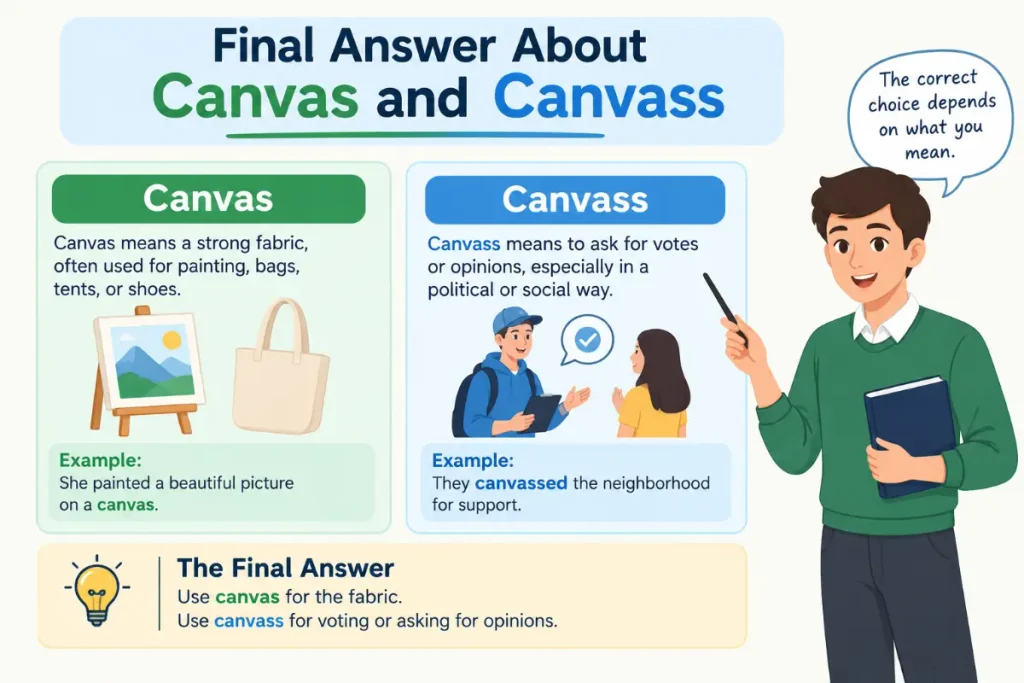
Final answer about canvas and canvass
The difference between canvas and canvass is simple once you connect each word with its main meaning. Canvas refers to a strong fabric or a surface used for painting. Canvass means to contact people to gather opinions, information, votes, or support.
Remember the basic rule: canvas is a material or creative surface, while canvass is an action involving people.
If you are writing about an artist, painting, tent, bag, or fabric, choose canvas. If you are writing about voters, residents, customers, surveys, or community outreach, choose canvass. The extra s in canvass can help you remember that the word usually involves reaching out to a group of people.
Once you make that connection, canvas vs canvass becomes much easier to handle in emails, essays, resumes, reports, and everyday writing.
Conclusion
In conclusion, canvas vs canvass comes down to the difference between a material and an action. Canvas refers to strong fabric or a surface used for painting, while canvass means asking people for their opinions, votes, support, or information.
For example, an artist paints on a canvas, but campaign workers canvass a neighborhood before an election. Remember this simple rule: use canvas when talking about art, fabric, bags, or tents, and use canvass when describing efforts to contact people and gather information.
Both words sound similar, but their meanings and uses are different. By keeping this distinction in mind, you can avoid common spelling mistakes and choose the correct word in essays, emails, resumes, and everyday conversations.
Frequently Asked Questions
Is canvas or canvass correct for painting?
Canvas is correct for painting. A canvas is the surface or material an artist paints on.
What does canvass mean in simple English?
Canvass means to ask people for information, opinions, votes, or support, often as part of an organized effort.
Is canvas the same as fabric?
Canvas is a type of fabric, but fabric is a much broader term that includes many different materials.
Is canvass only used for politics?
No. Canvass is common in politics, but people can also canvass customers, residents, students, or community members to gather information or opinions.
What’s another way to say canvass?
Another way to say canvass can be survey, poll, consult, contact, ask around, or conduct outreach, depending on the situation.

Daniel Grammarfield — The Language Learner
Age: 28Occupation: ESL Learner & Digital Professional
Bio:Daniel is a non-native English speaker who wants to communicate more confidently at work and online. He uses Synotrench to improve grammar, understand confusing words, learn correct sentence structures, and build everyday English skills. He prefers simple explanations with practical examples.
Goals:
Master English grammar rules
Avoid common language mistakes
Improve professional communication
Learn English through real-life examples
Quote:“Learning English is not about memorizing rules — it’s about expressing ideas clearly.”
1 thought on “Canvas vs Canvass: Best Simple Guide to Get It Right”