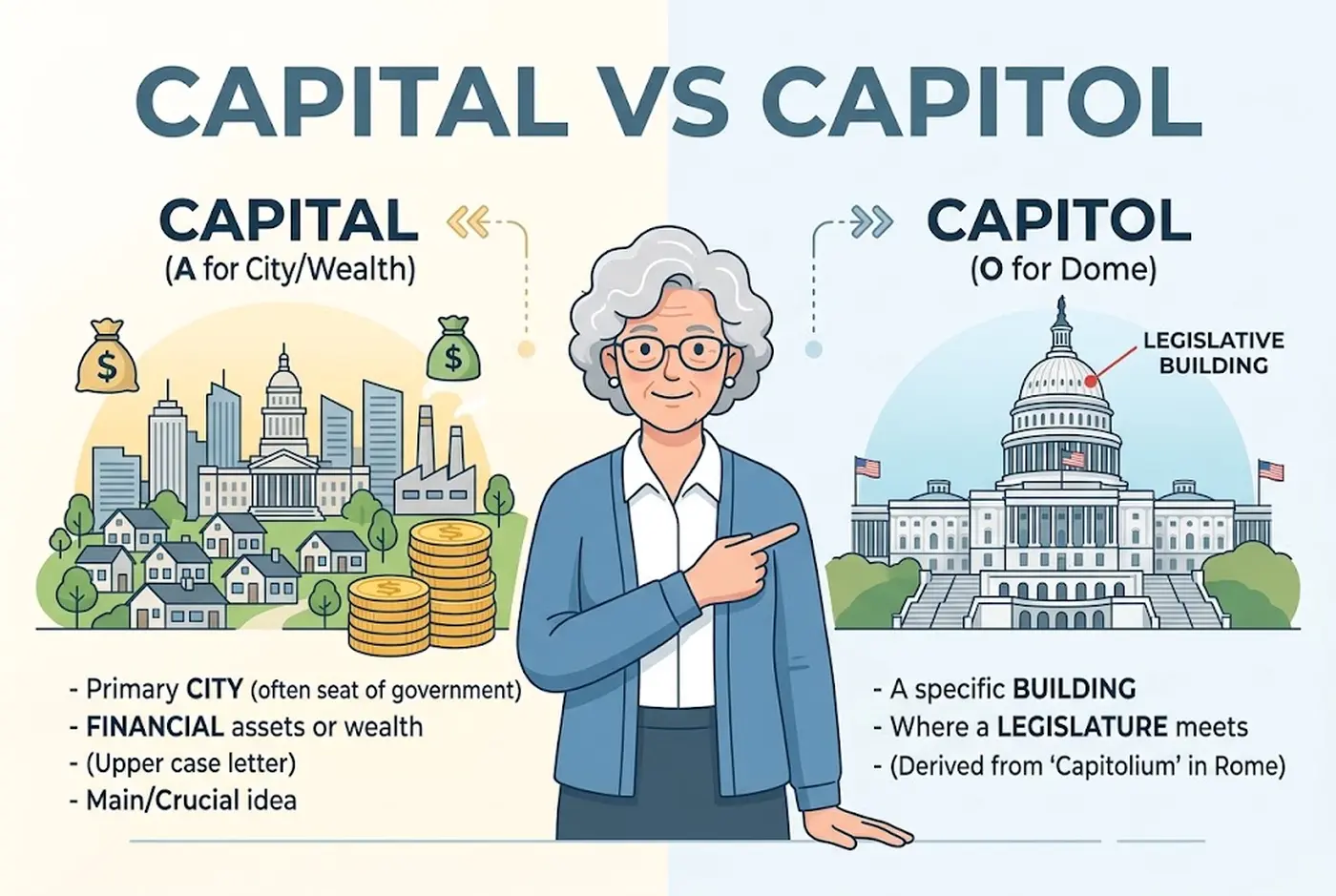
When you write Capital vs Capitol an essay about the U.S. government, send an email about a state legislature, or prepare a school report about Washington, D.C., you might pause over two similar words: capital and capitol. They sound alike, but using the wrong one can change the meaning of your sentence.
The confusion is understandable. Both words relate to government in certain situations, and both appear in American history, geography, and civics lessons. However, they do not mean the same thing. One has several meanings, including a city that serves as a seat of government. The other usually refers to a building where lawmakers meet.
Capital means a city that serves as a seat of government, money or wealth, or an uppercase letter. Capitol usually means a building where a legislature meets, such as the U.S. Capitol in Washington, D.C.
Once you understand what each word refers to, choosing the correct spelling becomes much easier. You do not need to memorize a long list of grammar rules. You simply need to identify the place, building, or idea you want to describe.
This guide explains the difference, explores the words’ origins, provides practical examples, and shows you how to choose the right word in schoolwork, professional writing, emails, and everyday conversation.
What Is the Difference Between Capital and Capitol?
The main difference is that capital has several meanings, while capitol refers primarily to a legislative building.
A capital can be a city where a government operates. It can also mean financial resources, an uppercase letter, or something that is extremely important. In the phrase capital city, the word identifies a city’s political role.
A capitol is a building used by a legislature. In the United States, state capitols house state legislative chambers, while the U.S. Capitol houses the U.S. Congress.
Consider these examples.
| Sentence | Correct word | Why it is correct |
|---|---|---|
| Sacramento is the capital of California. | Capital | Sacramento is the state’s seat of government. |
| The governor visited the state capitol. | Capitol | The sentence refers to a government building. |
| Washington, D.C., is the capital of the United States. | Capital | It is the nation’s seat of government. |
| The senators returned to the Capitol. | Capitol | The sentence refers to the building where Congress meets. |
| The company needs more capital to expand. | Capital | The word means money or financial resources. |
| Please write your name with a capital letter. | Capital | The word refers to an uppercase letter. |

Where Did the Words Capital and Capitol Come From?
The history of these words helps explain why they look so similar today.
What is the origin of capital?
The word capital comes through Latin capitalis, meaning related to the head. This Latin word comes from caput, meaning head.
The connection may seem unusual, but the head has long represented the top, chief, or most important part of something. Over time, capital developed several meanings connected to importance, leadership, money, and government.
For example, a capital city is the principal city associated with a country’s or state’s government. Capital letters are the larger forms of letters used at the beginning of sentences and in proper names. In finance, capital refers to money, property, or other resources used to support business activity.
What is the origin of capitol?
Capitol comes from the Latin name Capitolinus, associated with the Capitoline Hill in ancient Rome. This hill was an important religious and political center.
The English word became associated with government buildings, particularly through the historical influence of the Roman Capitol. In the United States, the term came to refer to buildings where legislative bodies meet.
That connection remains clear today. The U.S. Capitol is the building in Washington, D.C., where members of Congress meet to conduct legislative business.
What Does Capital Mean in Simple English?
Capital has several meanings, so the correct definition depends on the sentence. The most common meanings involve government, money, and writing.
Capital as a government city
A capital is a city where a national or regional government is based. It often contains major government offices and official residences.
Examples include:
- Washington, D.C., is the capital of the United States.
- Austin is the capital of Texas.
- Ottawa is the capital of Canada.
A capital city may contain a capitol building, but the city and the building are not the same thing.
For example, Washington, D.C., is the capital of the United States. The U.S. Capitol is a specific building located within that city.
Capital as money or resources
In business and finance, capital means money or resources available for investment, production, or growth.
Examples:
- The small business needs more capital to hire employees.
- The owner invested personal capital in the new store.
- The company raised capital to develop its product.
In these examples, capital does not refer to a city or a government building. It refers to resources used to accomplish a financial goal.
Capital as an uppercase letter
A capital letter is an uppercase letter, such as A, B, or C, rather than a lowercase letter, such as a, b, or c.
Examples:
- Start every sentence with a capital letter.
- Write the name Maria with a capital M.
- The word Monday begins with a capital letter.
This meaning appears frequently in school assignments, editing instructions, and writing lessons.
What Does Capitol Mean in Simple English?
A capitol is a building where a legislative body meets. A legislature is a group of elected or appointed representatives who make laws.
In the United States, capitol most often refers to a building used by a state legislature or the national Congress.
What is the U.S. Capitol?
The U.S. Capitol is the building in Washington, D.C., where the United States Congress meets. Congress consists of the Senate and the House of Representatives.
The building is a major landmark and an important symbol of American government. It is not the same as the White House, where the president lives and works.
Compare these sentences:
- Washington, D.C., is the capital of the United States.
- Congress meets in the U.S. Capitol.
- The White House is the president’s official residence and workplace.
Each sentence refers to a different place or type of place.
What is a state capitol?
A state capitol is the building where a state legislature meets. Many state capitols also contain offices used by state officials.
For example:
- The California State Capitol is in Sacramento.
- The Texas State Capitol is in Austin.
- The Florida State Capitol is in Tallahassee.
The city names identify the state capitals. The buildings are the state capitols.
This distinction is especially useful when writing about state government, American history, public policy, or travel destinations.
Can capitol refer to a government building outside the United States?
In American English, capitol is strongly associated with legislative buildings in the United States. Other countries may use terms such as parliament building, legislative assembly, or national assembly building.
The exact term depends on the country and institution. When writing about a foreign government, use the official name of the building whenever possible.
For example, the Parliament House in Canberra is Australia’s federal parliamentary building. Calling it a capitol may confuse readers because that is not its usual official name.
How Can You Remember Capital vs Capitol?
A short memory trick can prevent most spelling mistakes.
Think of the word capitol as the name for a government building. Think of capital as the word for a city, money, or an uppercase letter.
Here are three quick ways to remember the distinction.
Use the building test
Ask yourself, “Am I talking about a building where lawmakers meet?”
If the answer is yes, capitol is usually correct in American English.
Example: The visitors took photographs outside the state capitol.
If you are talking about the city where the government is based, use capital.
Example: Visitors spent three days exploring the state capital.
Use the money test
If the sentence discusses investments, business funding, or financial resources, use capital.
Example: The startup needs additional capital before launching its new service.
Capitol would be incorrect because the sentence does not refer to a legislative building.
Use the letter test
If you mean an uppercase letter, use capital.
Example: Write the first letter of your last name as a capital.
The spelling capitol has no standard role in this writing context.
What Are Useful Alternatives to Capital and Capitol?
Capital and capitol are not interchangeable, but you can use related words to make your meaning clearer. The best alternative depends on the context.
Because capital has several meanings, there is no single synonym that works in every sentence. A word that fits a discussion about government may not fit a business report or a grammar lesson.
The following table groups useful alternatives by purpose and tone.
Simple alternatives for everyday writing
| Word | Meaning | Tone | Example |
|---|---|---|---|
| City | A large or important urban area | Simple | The city is home to many government offices. |
| Town | A populated place, often smaller than a city | Simple | The town hosts the regional council. |
| Building | A constructed structure | Simple | The building houses the state legislature. |
| Center | A place where activity is concentrated | Simple | The city is a center of government. |
| Money | Funds used to pay for things | Simple | The business needs more money. |
| Funds | Money available for a purpose | Everyday | The project received additional funds. |
| Letter | A written character | Simple | Start the name with an uppercase letter. |
| Main city | The principal city in an area | Everyday | The main city serves as the administrative center. |
These words are useful when the context already makes the meaning clear. However, city and building are broader terms than capital and capitol. Use them only when they accurately describe what you mean.
Everyday alternatives for government and business
| Word | Meaning | Tone | Example |
|---|---|---|---|
| Seat of government | The place where a government is based | Everyday | The city is the seat of government. |
| Administrative center | A place where official administration takes place | Everyday | The region’s administrative center is nearby. |
| Government center | A place containing major government offices | Everyday | The government center attracts visitors. |
| Legislative building | A building where lawmakers meet | Everyday | The legislative building is open for tours. |
| Assembly building | A building used by an assembly | Everyday | The assembly building stands near the river. |
| Parliament building | A building where parliament meets | Everyday | The parliament building is a national landmark. |
| Investment | Money or resources committed for future benefit | Everyday | The company increased its investment. |
| Funding | Money provided for a project or activity | Everyday | The program received new funding. |
| Assets | Resources or property with economic value | Business | The company reviewed its assets. |
| Principal city | The leading city in a region | Formal everyday | The principal city has several government agencies. |
Some alternatives describe an institution or function rather than the exact place. For example, funding and capital overlap in financial contexts, but capital can include more than money provided for a single project.
Formal alternatives for academic and professional writing
| Word | Meaning | Tone | Example |
|---|---|---|---|
| Metropolis | A large, important city | Formal | The metropolis serves as a regional hub. |
| Provincial capital | The main government city of a province | Formal | The provincial capital contains major offices. |
| Municipal seat | The place where a municipal government operates | Formal | The municipal seat is located downtown. |
| Legislative chamber | A room or body where lawmakers meet | Formal | The bill was debated in the legislative chamber. |
| Legislature | The lawmaking body itself | Formal | The legislature approved the proposal. |
| Treasury | A government department or place associated with public funds | Formal | The treasury manages public finances. |
| Financial resources | Money and other resources available for use | Formal | The organization lacks sufficient financial resources. |
| Equity | Ownership value or an ownership interest in an asset | Financial | The owner built equity in the business. |
| Capitalization | The use of capital letters or the financial structure of a business, depending on context | Technical | The editor checked capitalization throughout the report. |
These alternatives are useful when you need greater precision. For instance, legislature refers to lawmakers or the lawmaking institution, while capitol refers to the building in which lawmakers meet.

Which Word Should You Use in Different Writing Situations?
The correct choice depends on what you want to describe. In most cases, identifying the subject of the sentence is more helpful than looking for a synonym.
Which word is best for a resume?
Use capital when discussing financial resources, investments, or capital management. Use capitol only if you are describing relevant experience involving a legislative building.
Examples:
- Managed capital investments for a growing business.
- Coordinated public events at the state capitol.
- Prepared financial reports to track available capital.
For a resume, choose the term that accurately describes your responsibilities. Do not use capitol to make financial experience sound more formal.
Which word is best for an essay?
Use capital when writing about a country’s or state’s main government city. Use capitol when discussing the legislative building itself.
Examples:
- Washington, D.C., became the capital of the United States under the federal government’s established system.
- The U.S. Capitol serves as the meeting place of Congress.
In a history or civics essay, the distinction can make your explanation more accurate. It also helps readers understand the difference between a political location and a physical structure.
Which word should you use in a text message?
Use the spelling that matches your meaning, even in a casual message.
Examples:
- “We’re visiting the state capital tomorrow.”
- “The tour includes the state capitol.”
- “I need more capital to start my business.”
Short messages still benefit from correct word choice. You can keep your writing casual without confusing a city with a building.
What Are Some Example Sentences Using Capital and Capitol?
Examples make the distinction easier to apply in real situations. Notice what each sentence describes before choosing the spelling.
Examples using capital
- Austin is the capital of Texas.
- The students learned why Washington, D.C., serves as the nation’s capital.
- The company raised enough capital to open a second location.
- Please use a capital letter at the beginning of your name.
- The government moved some offices to the country’s new capital.
In these examples, capital refers to a government city, financial resources, or uppercase letters and related writing conventions.
Examples using capitol
- The students toured the U.S. Capitol during their school trip.
- The state legislature met inside the capitol.
- Visitors took photographs of the Capitol dome.
- The protest took place outside the state capitol building.
- The senator walked into the Capitol for a meeting.
These sentences use capitol because they refer to a legislative building rather than a city or a financial concept.
Examples using both words in one sentence
Using both words together is a useful way to check your understanding.
- The state capital is home to a historic capitol building.
- Visitors traveled to the nation’s capital to tour the U.S. Capitol.
- The capital city announced plans to restore its capitol.
What Common Mistakes Should You Avoid?
Even experienced writers sometimes confuse these words because they sound alike. The following mistakes are easy to correct once you identify the intended meaning.
Mistake 1. Calling a city a capitol
Incorrect: Denver is the capitol of Colorado.
Correct: Denver is the capital of Colorado.
Denver is a city that serves as Colorado’s seat of government. The Colorado State Capitol is the legislative building located there.
Mistake 2. Calling a legislative building a capital
Incorrect: The lawmakers met inside the state capital.
Correct: The lawmakers met inside the state capitol.
The first sentence could mean that lawmakers met somewhere in the capital city. It does not specifically identify their meeting place as the legislative building.
Mistake 3. Using capitol when discussing money
Incorrect: The business needs more capitol to expand.
Correct: The business needs more capital to expand.
Financial capital supports activities such as purchasing equipment, hiring employees, and developing products. Capitol has no standard financial meaning.
What Are the Antonyms of Capital and Capitol?
Neither word has one direct antonym that works in every context. The opposite depends on the meaning you intend.
| Word or meaning | Possible opposite or contrast | Example |
|---|---|---|
| Capital city | Noncapital city | The town is not the state’s capital. |
| Capital as an uppercase letter | Lowercase letter | Use a lowercase letter in this part of the word. |
| Financial capital | Debt or a shortage of funds, depending on context | The business has more debt than available capital. |
| Capitol as a legislative building | No exact antonym | A courthouse is a different kind of public building, not an opposite of a capitol. |
Be careful when using the word antonym. A related contrast is not always a true opposite. For example, a noncapital city contrasts with a capital city, but it does not oppose the word capital in its financial meaning.

What Are the Best Tips for Choosing the Right Word?
Use these practical checks when editing an essay, email, report, or social media post.
- Identify the subject. If you mean a city, money, or an uppercase letter, capital is usually correct.
- Check for a legislative building. If the sentence refers to the building where lawmakers meet, use capitol in American English.
- Replace the word with a simple definition. Try replacing capital with city or money. Try replacing capitol with legislative building. If the sentence still makes sense, you probably have the right word.
- Look at the official name. Write U.S. Capitol or Texas State Capitol when referring to those specific buildings.
- Do not rely on pronunciation. The two words sound alike in American English, so listening alone will not help you distinguish them.
- Read the complete sentence. A sentence about a government building needs a different word from a sentence about the city around it.
- Use precise terms in formal writing. Legislature, courthouse, city hall, and parliament building each have specific meanings.
- Proofread common phrases. Expressions such as state capital, capital city, capitol building, and U.S. Capitol are worth checking before you submit your work.
A quick substitution test is often all you need. Ask whether the sentence refers to a city or concept, or to the physical building where lawmakers meet.
Conclusion
The difference between capital and capitol becomes simple once you focus on meaning instead of spelling. Capital can describe a city’s role as a seat of government, money used for business, or an uppercase letter. Capitol usually describes a legislative building, such as the U.S. Capitol or a state capitol.
When you write about a government city, choose capital. When you describe the building where lawmakers meet, choose capitol. If the sentence concerns investments or writing rules, capital is the appropriate choice.
The distinction matters most in essays, news reports, school assignments, and professional communication, where precise language helps readers understand your point. Before choosing a spelling, identify what the sentence describes. With a little practice, you will be able to use both words confidently and correctly.
Frequently Asked Questions
What is the main difference between capital and capitol?
Capital can mean a government city, financial resources, or an uppercase letter. Capitol usually means a building where lawmakers meet.
Is Washington, D.C., a capital or a capitol?
Washington, D.C., is the capital of the United States. The U.S. Capitol is the legislative building located in the city.
Is it state capital or state capitol?
Both expressions are correct, but they refer to different things. State capital means the city where the state government is based, while state capitol means the legislative building.
How do you spell the building where Congress meets?
The correct spelling is Capitol, as in the U.S. Capitol. It is the building where the Senate and House of Representatives meet.
What’s another way to say capital city?
You can use seat of government, principal city, or administrative center, depending on the context. These phrases describe a city’s government role, although their precise meanings can vary.

Daniel Grammarfield — The Language Learner
Age: 28Occupation: ESL Learner & Digital Professional
Bio:Daniel is a non-native English speaker who wants to communicate more confidently at work and online. He uses Synotrench to improve grammar, understand confusing words, learn correct sentence structures, and build everyday English skills. He prefers simple explanations with practical examples.
Goals:
Master English grammar rules
Avoid common language mistakes
Improve professional communication
Learn English through real-life examples
Quote:“Learning English is not about memorizing rules — it’s about expressing ideas clearly.”
1 thought on “Capital vs Capitol: The Simple Guide to the Difference (2026)”