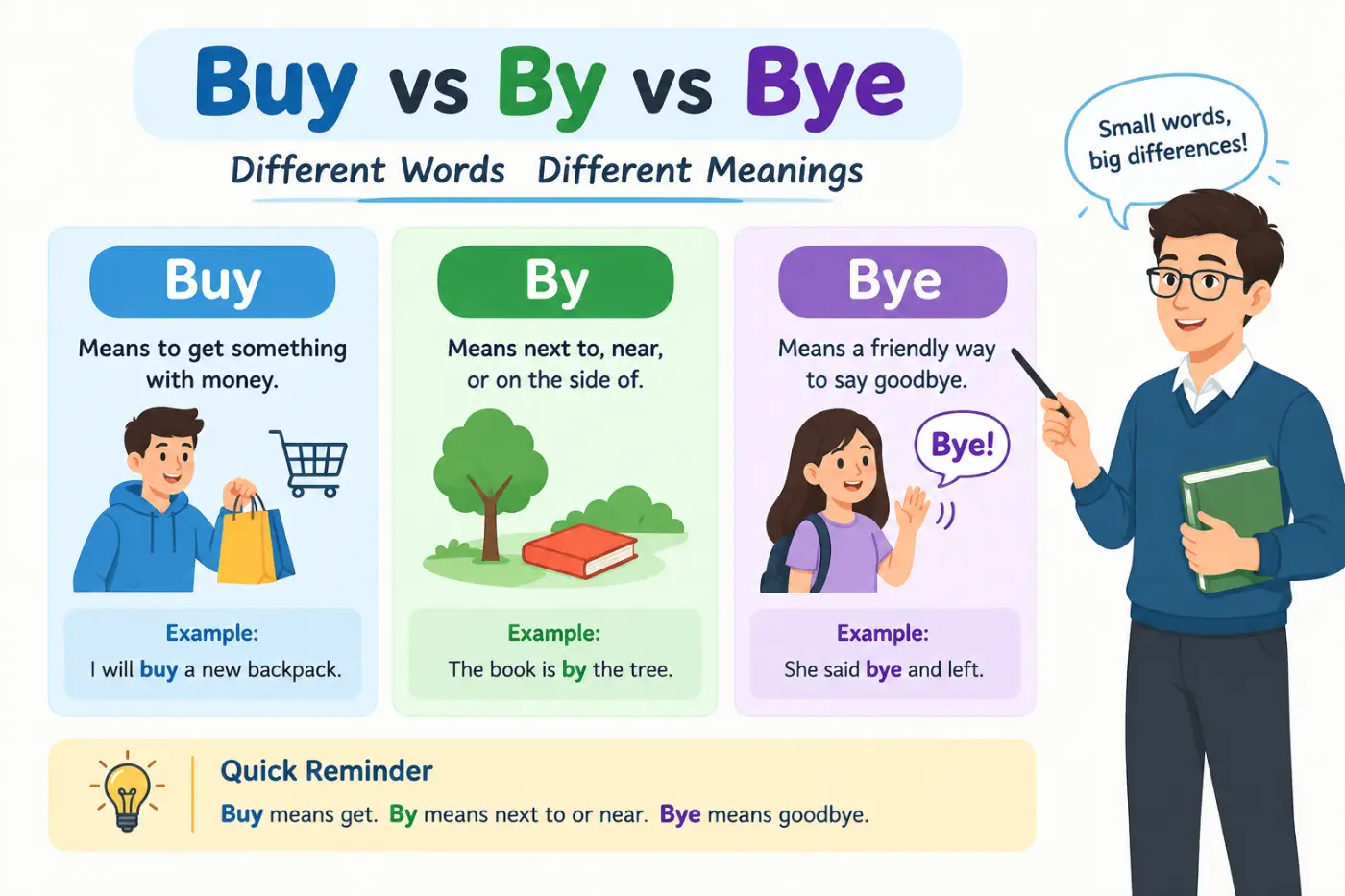
When you’re writing an email, essay, resume, or quick text, three small words can cause a surprisingly big problem: Buy vs By vs Bye. They sound almost exactly the same in standard English, but they have completely different meanings and jobs in a sentence. If you type the wrong one, your sentence can become confusing or simply incorrect.
The easiest way to remember them is this: buy is connected with getting something by paying for it, by usually shows a method, person, place, time, or relationship, and bye is used when someone is leaving.
Answer: Buy means to purchase something, by has several meanings such as near, through, or no later than a certain time, and bye is a word used when saying goodbye.
These words are homophones, which means they sound alike but have different spellings and meanings. This guide explains their origins, meanings, common uses, related words, examples, mistakes, context specific choices, and easy memory tricks. By the end, you should be able to choose the right word without stopping to think twice.
What do buy by and bye mean
The three words may sound the same, but they do different work.
| Word | Main meaning | Example |
|---|---|---|
| Buy | To get something by paying for it | I want to buy a new laptop. |
| By | Near, through, using, before a deadline, or identifying who did something | The report was written by Maria. |
| Bye | A way to say goodbye | Bye, see you tomorrow. |
The most important distinction is simple.
Buy is an action involving a purchase.
By is usually a preposition or adverb. It can describe location, time, method, means, or the person responsible for an action.
Bye is an informal expression used when someone leaves or ends a conversation.
Consider these three sentences:
I need to buy some groceries.
Please send the form by Friday.
Bye, have a safe trip.
The pronunciation is similar, but the meaning tells you which spelling belongs in the sentence.

Where do buy by and bye come from
The history of these words helps explain why their spellings are so different.
Buy comes from Old English bycgan, which meant to acquire or obtain something by payment. Over time, the spelling changed into the modern English word buy.
By has a different history. It comes from Old English bi, meaning near, beside, or around. Its meaning expanded over centuries. Modern English uses by in many ways, including location, time, method, authorship, and means.
Bye developed from the expression goodbye. Goodbye itself comes from the older phrase God be with you. Bye later became a shorter and more casual way to say goodbye.
Although the words developed from different sources, their pronunciations eventually became close enough that modern English speakers treat them as homophones.
Their shared sound is one reason spelling mistakes are so common.
Why are buy by and bye confusing
These words are difficult because English spelling does not always match pronunciation.
If you hear someone say, “I’ll buy it,” you cannot identify the spelling from sound alone. The same is true when someone says, “I’ll be there by six,” or simply, “Bye!”
The sentence gives you the clue.
Ask yourself what the word is doing.
If it gives information about time, place, method, distance, authorship, or another relationship, by may be correct.
If someone is leaving and the word means goodbye, use bye.
This meaning based approach is much more reliable than trying to remember the spelling by sound.
What is the easiest way to remember them
Use three simple memory connections.
Buy = purchase.
Think about money, shopping, stores, prices, and products.
By = connection.
Think about phrases such as written by, near the house, by Friday, by car, or by hand.
Bye = goodbye.
Think about leaving, ending a phone call, or saying goodbye.
A quick mental test works well.
Can you replace the word with purchase? Use buy.
Can you replace it with near, through, before, using, or written by someone? Use by.
Can you replace it with goodbye? Use bye.
Are there synonyms for buy by and bye
These three words are not synonyms of one another. They are homophones. That distinction matters.
Still, each word has related words and expressions that can help you understand its meaning. Some can replace the word in certain contexts, while others are closely connected but cannot replace it in every sentence.
Simple alternatives for buy
| Word or phrase | Meaning | Tone | Example |
|---|---|---|---|
| Purchase | Get something by paying | Formal | She purchased a new phone. |
| Get | Obtain something | Simple | I need to get some food. |
| Pay for | Give money for something | Everyday | I’ll pay for dinner. |
| Shop for | Look for something to purchase | Everyday | We went to shop for shoes. |
| Obtain | Get something | Formal | He obtained the equipment. |
| Acquire | Get or gain possession | Formal | The company acquired new software. |
| Order | Request something for purchase | Everyday | I ordered a new keyboard. |
| Pick up | Buy or collect something | Casual | I’ll pick up some milk. |
Everyday alternatives and related expressions
| Word or phrase | Meaning | Tone | Example |
|---|---|---|---|
| Purchase | Buy something | Formal | We purchased the tickets online. |
| Get | Obtain something | Everyday | I’ll get a new charger. |
| Grab | Get something quickly | Casual | I’ll grab some snacks. |
| Pick up | Buy or collect | Casual | Can you pick up bread? |
| Shop | Look for things to buy | Everyday | We shopped for furniture. |
| Order | Request a product or meal | Everyday | She ordered a dress online. |
| Spend | Use money to obtain something | Everyday | He spent $50 on books. |
| Invest in | Spend money on something valuable or useful | Formal | The business invested in new equipment. |
Formal words related to by
By has too many meanings to have one single replacement. Depending on the sentence, related words can include near, beside, through, using, before, via, and through the work of.
| Word or phrase | Meaning | Tone | Example |
|---|---|---|---|
| Near | Close to a place | Everyday | The store is near the bank. |
| Beside | Next to | Everyday | She sat beside me. |
| Next to | Immediately adjacent | Everyday | Park next to the building. |
| Before | No later than a time | Everyday | Finish it before Friday. |
| Through | By means of something | Everyday | We learned through practice. |
| Via | Using a route or method | Formal | Send it via email. |
| Using | With a particular method | Everyday | He paid using a card. |
| Through the work of | Identifies the person responsible | Formal | The project succeeded through the work of the team. |
Which word is mild and which is strong
Intensity is not really the main issue with these three words. They do not form a scale from weak to strong.
However, some related expressions have different levels of formality or emotional force.
For buying:
Get is very general.
Buy is neutral.
Purchase is more formal.
Acquire can sound professional or businesslike.
For saying goodbye:
Bye is casual.
Goodbye is neutral.
Take care sounds warm and friendly.
Farewell can sound formal, emotional, literary, or dramatic.
For by, the choice depends on its specific meaning rather than intensity.
Near and beside describe location.
Before describes time.
Via and using describe method.
Written by identifies the person responsible for writing something.
Buy vs by — what is the difference
Buy and by are easy to confuse because they have similar sounds but completely different meanings.
| Buy | By |
|---|---|
| Means purchase | Has several meanings |
| Usually a verb | Usually a preposition |
| Connects to money or obtaining something | Connects to time, place, method, or relationship |
| I will buy a ticket. | I will arrive by noon. |
Try this test:
I need to ___ a ticket.
The correct answer is buy because you are purchasing a ticket.
I need to finish the assignment ___ Friday.
The correct answer is by because the sentence gives a deadline.
The key is not pronunciation. The key is meaning.
Buy vs purchase — what is different
Buy and purchase are close in meaning, but their tone differs.
Purchase is more formal.
For example:
I want to buy a new car.
I want to purchase a new vehicle.
Both sentences are correct. The first sounds more natural in everyday conversation. The second may fit better in a business document or formal notice.
Use buy when you want natural, simple English.
Use purchase when the setting is formal or professional.
Bye vs goodbye — what is different
Bye and goodbye both signal that a conversation or meeting is ending.
Goodbye is slightly more complete and neutral.
For example:
Bye! See you tomorrow.
Goodbye. It was nice meeting you.
In a text message to a friend, bye is perfectly natural. In a formal speech, goodbye may sound more appropriate.
Buy vs by vs bye in US English
In standard American English, buy, by, and bye are normally pronounced alike.
Their spelling does not change based on standard US pronunciation.
American English speakers use buy for purchasing, by for its many grammatical meanings, and bye as a casual farewell.
Regional accents can affect the exact sound of these words. However, the spelling distinction remains the same.
You should not choose the spelling based on how strongly the vowel sounds in a particular accent. Use the meaning and grammar of the sentence instead.
Buy vs by vs bye in British English
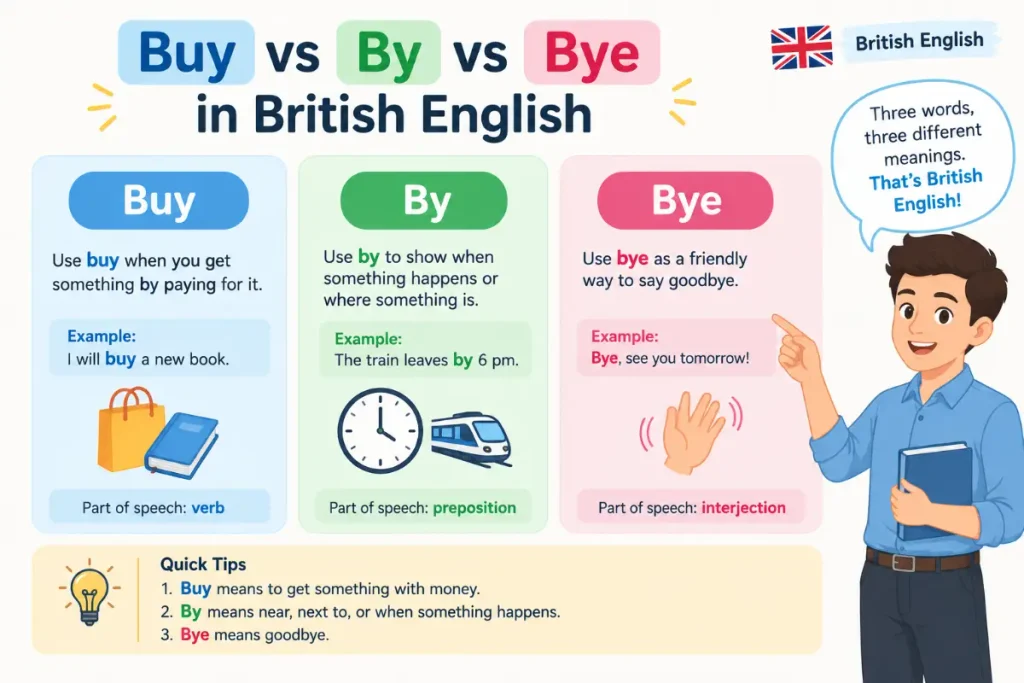
British English also uses all three spellings with the same basic meanings.
Buy means purchase.
By has its usual meanings involving time, place, method, and relationships.
Bye means goodbye.
The main differences you may notice are in vocabulary, pronunciation, and style rather than in the basic meanings of these three words.
For international writing, the same spelling rules work well in both American and British English.
What word should you use in a resume
A resume usually needs clear and professional language.
Buy is appropriate when describing purchasing responsibilities.
Example:
Managed a budget and bought office supplies for a team of 20 employees.
However, purchase may sound more professional in some resume contexts.
Example:
Managed vendor relationships and purchased office supplies within an annual budget.
By is also extremely common in resumes.
Example:
Prepared monthly reports by using company financial data.
Another example:
Improved customer satisfaction by responding to support requests quickly.
Bye usually does not belong in a resume because a resume is not normally a conversation or farewell message.
What word should you use in an essay
In an academic essay, buy is correct when discussing purchasing.
Example:
Consumers often buy products because of convenience.
By can appear in many normal academic constructions.
Example:
The study was conducted by a team of researchers.
Bye is generally inappropriate unless the essay is discussing dialogue, language, or a farewell.
Example:
The character says bye before leaving the house.
In formal essays, avoid replacing by with casual wording if it changes the intended meaning.
What word should you use in texting
All three words can appear in texts, but they have different jobs.
Use buy when talking about shopping or purchases.
Example:
Can you buy some milk on your way home?
Use by when talking about time, location, method, or another relationship.
Example:
I’ll be there by 7.
Use bye when ending the conversation.
Example:
I have to go now. Bye!
Texting often uses shorter language, but the spelling difference still matters.
What word should you use in email
Email requires you to think about the relationship with the reader.
Use buy for purchases.
Example:
I’d like to buy the annual software plan.
Use by for deadlines, methods, and authorship.
Example:
Please send the completed form by Thursday.
Use bye only in casual emails or messages to people you know well.
Example:
Bye for now. I’ll talk to you tomorrow.
For professional email, a closing such as Best, Thanks, or Sincerely is usually more appropriate than bye.
Real examples of buy
Here are several everyday examples.
- I need to buy a birthday gift for my sister.
- We decided to buy a used car instead of a new one.
- Can you buy some eggs while you’re at the store?
- She wants to buy a ticket for the concert.
- The company plans to buy new computers next year.
- I forgot to buy coffee this morning.
- They saved money for months to buy their first home.
- He used his card to buy the book online.
- You can buy fresh vegetables at the market.
- I’m not sure which laptop to buy.
In each sentence, the word refers to obtaining something through a purchase.
Real examples of by
By has many more uses.
- Please finish the report by Monday.
- We walked by the old school.
- The house is by the lake.
- The novel was written by an American author.
- She traveled by train.
- He paid by credit card.
- I learned about the event by email.
- We passed by the restaurant on our way home.
- The project must be completed by noon.
- She improved her English by reading every day.
Notice how different these meanings are. By is a flexible word, so you must look at the entire sentence.
Real examples of bye
Bye is mainly used when someone is leaving.
- Bye! I’ll call you tonight.
- She waved and said bye.
- I have to go now. Bye!
- He said bye to his friends before leaving.
- Bye for now. See you tomorrow.
- The children shouted bye as the bus drove away.
- She sent a quick bye before closing the chat.
- He smiled, said bye, and walked out.
- Okay, bye! Talk to you later.
- Everyone said bye before the meeting ended.
These examples show why bye should not be used when you mean purchase or a deadline.
Common mistakes with buy by and bye
The most common errors happen when writers choose the word from sound instead of meaning.
Writing by when you mean buy
Incorrect:
I need to by a new phone.
Correct:
I need to buy a new phone.
The phone is being purchased, so buy is required.
Writing buy when you mean by
Incorrect:
Please finish the assignment buy Friday.
Correct:
Please finish the assignment by Friday.
Friday is a deadline, so by is correct.
Writing bye when you mean buy
Incorrect:
I want to bye a new jacket.
Correct:
I want to buy a new jacket.
The sentence describes a purchase.
Writing buy when you mean bye
Incorrect:
Okay, buy! See you tomorrow.
Correct:
Okay, bye! See you tomorrow.
The speaker is ending the conversation.
Using bye in formal writing
A sentence such as “Bye, everyone” may be fine in dialogue, but it usually does not belong in a formal report or academic essay.
Choose language that matches the situation.
When should you not use buy
Do not use buy when the sentence is about a deadline, location, method, or farewell.
Incorrect:
Please arrive buy 8 a.m.
Correct:
Please arrive by 8 a.m.
Incorrect:
The office is buy the station.
Correct:
The office is by the station.
Incorrect:
Bye a ticket online.
Correct:
Buy a ticket online.
If the meaning is not purchase, buy is probably not the right choice.
When should you not use by
Do not use by when you mean purchase or goodbye.
Incorrect:
I want to by a new shirt.
Correct:
I want to buy a new shirt.
Incorrect:
Bye 5 p.m., please submit the form.
Correct:
By 5 p.m., please submit the form.
The second example gives a deadline.
When should you not use bye
Do not use bye for shopping, deadlines, or methods.
Incorrect:
I need to bye groceries.
Correct:
I need to buy groceries.
Incorrect:
Send the document bye Friday.
Correct:
Send the document by Friday.
Bye is mainly connected to leaving or ending a conversation.
What are the antonyms of buy by and bye
These words do not have one simple set of direct antonyms.
For buy, possible opposites depend on the context.
Buy can contrast with sell.
Example:
I want to buy the car.
The dealer wants to sell the car.
For by, there is no single opposite because by has many meanings. In a location context, far from might contrast with by. In a deadline context, after may provide a contrasting idea.
For bye, a natural opposite is hello when talking about starting and ending a conversation.
Hello = beginning a greeting.
Bye = ending a conversation.
How do you remember the spelling
A visual memory trick can make the distinction easier.
Buy contains u, which can remind you of you buying something.
By is the shortest spelling and appears in many short phrases such as by me, by you, by car, and by noon.
Bye contains an e, which can remind you of ending a conversation.
These tricks are not grammar rules. They are simply memory aids.
The best long term method is still to connect each spelling with its meaning.
Why context matters more than pronunciation
Homophones create a special problem because sound alone cannot tell you the spelling.
Imagine someone says:
“I’ll meet you by the store.”
You hear the sound, but you need the context to know that the speaker means near the store.
Now imagine:
“I’ll buy the book.”
The context tells you that the person plans to purchase something.
Finally:
“Bye!”
The meaning is clear because the person is ending the interaction.
This is why reading the whole sentence is often enough to solve a spelling question.
What are the most useful phrases with buy
Learning common phrases can make the correct spelling automatic.
Buy a car.
Buy a house.
These phrases all involve purchasing.
What are the most useful phrases with by
By is used in many common expressions.
By Monday.
Written by.
Made by.
These examples show why by cannot be replaced with one single synonym in every sentence.
What are the most useful phrases with bye
Bye appears in familiar conversational expressions.
Bye for now.
Okay, bye.
Goodbye.
Say bye.
Wave bye.
A quick bye.
Say bye to your friends.
Bye until next time.
Most of these expressions are informal and conversational.
Final tips for choosing between the three
Remember these rules when proofreading.
- Use buy when someone gets something by paying for it.
- Use by for deadlines such as by Friday or by noon.
- Use by for location such as by the door or by the river.
- Use by for methods such as by car or by email.
- Use by when identifying who performed an action, such as written by Sarah.
- Use bye when someone is leaving.
- Do not choose the spelling based only on pronunciation.
- Read the whole sentence and identify the meaning first.
- Use purchase instead of buy when a more formal tone fits the context.
- Use goodbye instead of bye when you need a more neutral or formal farewell.
Conclusion
The key to mastering these three homophones is to focus on meaning rather than sound. Buy refers to purchasing something. By has several grammatical uses, including showing time, location, method, and the person responsible for an action. Bye is a casual way to say goodbye.
When you see or hear these words, ask what the sentence is trying to say. If money or a purchase is involved, choose buy. If the sentence gives information about a deadline, place, method, or relationship, choose by.
Once you connect each spelling with its main idea, these words become much easier to use. A little attention during proofreading can prevent a very common spelling mistake.
Frequently Asked Questions
What is the difference between buy by and bye?
Buy means to purchase something, by has several meanings related to time, place, method, and relationships, and bye means goodbye.
Is it buy a ticket or by a ticket?
The correct phrase is buy a ticket because you purchase a ticket.
Is it by Friday or buy Friday?
The correct phrase is by Friday because by introduces a deadline.
Is bye the same as goodbye?
Yes, bye is a shorter and more casual way to say goodbye.
What’s another way to say buy?
Purchase is the most direct formal alternative to buy, while get, acquire, obtain, and purchase can work in different contexts.
Can by mean near?
Yes, by can mean near or beside, as in “The restaurant is by the river.”
Is buy formal or informal?
Buy is neutral and natural in both everyday and professional English, although purchase can sound more formal.
How can I remember buy by and bye?
Think of buy as purchase, by as connection or position, and bye as goodbye. Linking each spelling to its meaning is easier than relying on pronunciation.

Daniel Grammarfield — The Language Learner
Age: 28Occupation: ESL Learner & Digital Professional
Bio:Daniel is a non-native English speaker who wants to communicate more confidently at work and online. He uses Synotrench to improve grammar, understand confusing words, learn correct sentence structures, and build everyday English skills. He prefers simple explanations with practical examples.
Goals:
Master English grammar rules
Avoid common language mistakes
Improve professional communication
Learn English through real-life examples
Quote:“Learning English is not about memorizing rules — it’s about expressing ideas clearly.”