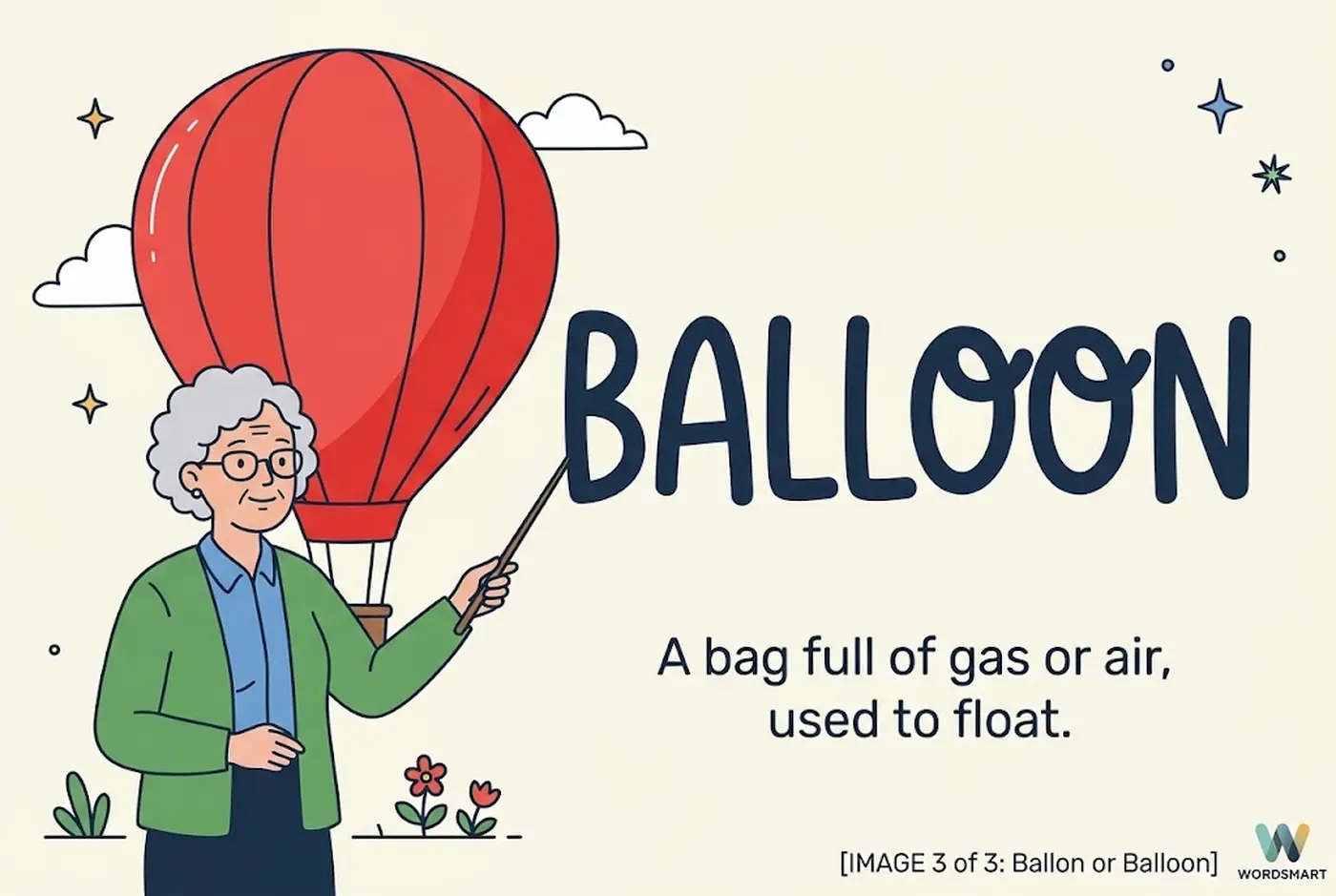
Have you ever typed a quick text, email, or school assignment and stopped at a word that suddenly looks wrong? You may have wondered if the correct spelling is “ballon” or “balloon.” This is a common spelling question because both forms look believable at first glance.
The correct English spelling is balloon. The word ballon is usually a spelling mistake when you mean the colorful object that floats in the air or the large inflatable object used in sports, decoration, and science. In English, balloon has two l’s and two o’s.
Answer: Balloon is the standard English spelling for the inflatable object filled with air or gas. Ballon is generally not the correct English spelling for this meaning.
In this guide, you’ll learn where balloon comes from, what it means, how to remember its spelling, how it differs from related words, and which alternatives work best in formal and casual writing. You’ll also see examples, common mistakes, regional notes, and answers to the questions people often ask about this spelling.
What is the correct spelling of ballon or balloon?
The correct spelling is balloon.
Balloon is the standard English word for an inflatable object that is usually made from rubber, latex, plastic, or another flexible material. It can be filled with air, helium, or another gas.
For example:
- The children played with colorful balloons.
- She tied a balloon to the chair.
- We released several balloons at the celebration.
- The scientist used a weather balloon to collect information.
The spelling ballon is not normally used as the English word for this object.
A simple way to remember the correct form is to notice that balloon contains two l’s and two o’s:
balloon
You can divide it visually like this:
ball + oon
The double letters are part of the standard spelling.
There are situations where a similar looking word may appear in another language or in a proper name. However, when you’re writing ordinary American English, use balloon.
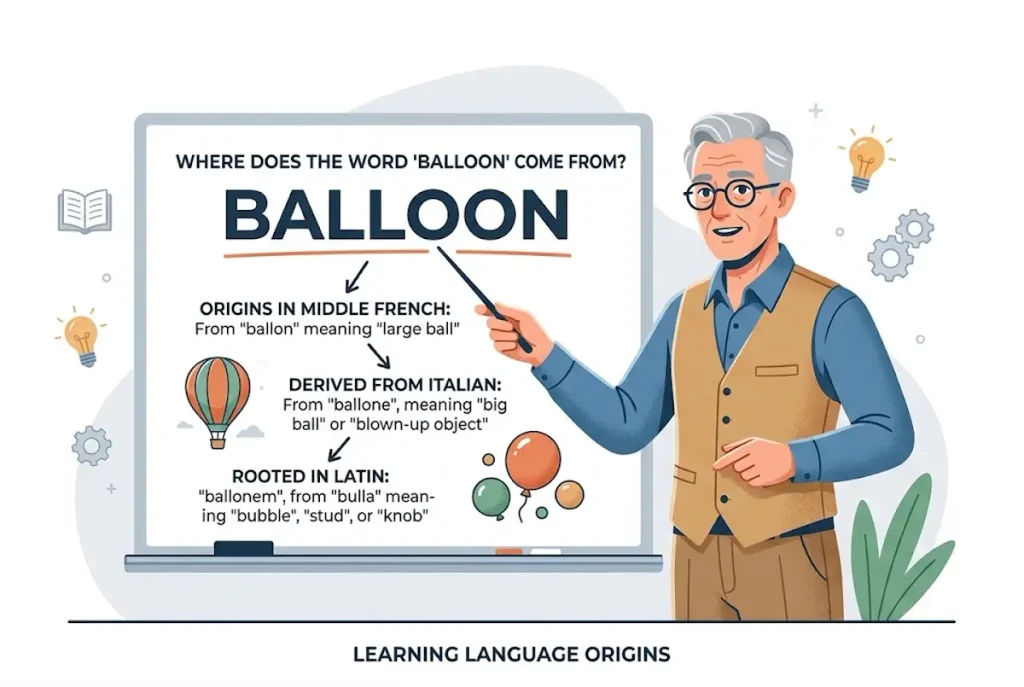
Where does the word balloon come from?
The history of balloon helps explain why the spelling looks unusual.
The English word came through French ballon, which referred to a large ball or an inflated object. The French word itself is connected to Italian ballone, meaning a large ball. The history of the word is tied to the idea of something round, inflated, or ball shaped.
English eventually adopted the word as balloon.
Over time, balloon developed several meanings. The most familiar one is the inflatable object used for parties, decorations, toys, and experiments. The word also became connected with early flying machines and aircraft.
The spelling is worth remembering because English often keeps parts of the spelling found in words borrowed from other languages. That does not mean you need to know French or Italian to spell balloon correctly. It simply explains why the word has its distinctive double l and double o pattern.
The word also has a long connection with flight. During the development of early aviation, balloons were used to carry people through the air. Today, hot air balloons remain a popular form of recreational flight.
Balloon can also work as a verb. To balloon means to increase or expand quickly.
For example:
- The company’s expenses ballooned during the project.
- The crowd ballooned to several thousand people.
- The budget has ballooned beyond the original estimate.
In these sentences, balloon doesn’t describe an actual inflatable object. It describes something becoming larger, often quickly.
What does balloon mean in simple English?
Balloon is a noun when it means an inflatable object that expands when filled with air or gas.
A simple definition is:
A balloon is a flexible container that becomes larger when it is filled with air or gas.
A balloon can be small enough to hold in your hand or large enough to carry people.
The word can also describe certain aircraft. A hot air balloon uses heated air to rise, while a gas balloon uses a gas such as helium or hydrogen to provide lift.
Balloon can also be a verb.
As a verb, balloon means to grow, expand, or increase greatly.
For example:
- The balloon floated above the crowd.
- The balloon rose into the sky.
- The cost of the project ballooned.
The first two examples describe an actual object. The third uses balloon in a figurative way.
Balloon synonyms by intensity
Balloon has different meanings, so its alternatives can also vary in strength.
When you’re talking about physical size, you can choose words that describe a gradual increase or a dramatic expansion.
Mild increase
Use these words when something becomes somewhat larger:
- grow
- expand
- increase
- rise
- enlarge
Example:
The company expanded its operations last year.
Noticeable increase
These words suggest a clearer change:
- swell
- build
- increase rapidly
- grow quickly
- spread
Example:
The crowd swelled as the concert began.
Strong or dramatic increase
These choices suggest a major or unexpected change:
- balloon
- surge
- explode
- skyrocket
- soar
Example:
Housing costs skyrocketed in the area.
The verb balloon often suggests that something has become much larger than expected, especially a cost, number, budget, or problem.
Balloon as a noun and verb
Balloon is unusual because it works naturally as both a noun and a verb.
As a noun, it describes the object.
Example:
The red balloon floated toward the ceiling.
As a verb, it means to expand or increase quickly.
Example:
The repair bill ballooned after the mechanic found another problem.
This difference is important because you may need a completely different synonym depending on the sentence.
| Use | Meaning | Example |
|---|---|---|
| Noun | An inflatable object | The balloon popped. |
| Noun | An aircraft using buoyancy | The balloon rose into the air. |
| Verb | To expand greatly | Costs ballooned. |
| Verb | To become much larger | The crowd ballooned overnight. |
Is balloon used differently in the US and UK?
The spelling balloon is standard in both American and British English.
There is no major US versus UK spelling difference for this word.
American English:
The balloon popped.
British English:
The balloon popped.
The word is spelled the same way in both varieties.
Other words in the same general topic can vary by region. For example, people may have different preferences for terms connected with decorations, aircraft, or sporting events. However, the spelling balloon itself remains stable.
So if you’re writing for an American audience, use balloon. If you’re writing for a British audience, use balloon too.
Best word for a resume
Balloon is rarely the best word for a resume unless you’re describing an actual balloon, an aircraft, or a documented increase.
If you’re describing growth in a professional setting, stronger choices may include:
- increased
- expanded
- grew
- scaled
- developed
- accelerated
- improved
- strengthened
For example:
Weak:
Revenue ballooned under my management.
Better:
Revenue increased significantly under my management.
Even better when you have a measurable result:
Revenue increased by 28 percent during my first year.
A resume should usually favor precise language over dramatic language. If you have a number, use it.
Best word for an essay
Balloon can work well in an essay when you’re discussing a literal object, aviation, science, history, or rapid growth.
For example:
The researchers launched a weather balloon to study atmospheric conditions.
If you’re writing a formal essay about rising costs, you might use increased, expanded, or rose instead.
Example:
The cost of housing increased sharply over the following decade.
Balloon is not wrong in every formal essay. It simply has a more vivid tone. Choose it when you want to emphasize rapid and substantial growth.
Best word for texting
In casual texting, balloon is perfectly natural when you’re talking about the object.
Example:
I bought some balloons for the party.
You can also use balloon as a verb in casual conversation.
Example:
The price has totally ballooned.
Texting doesn’t require formal alternatives. The key is making your meaning clear.
Best word for email
The right choice depends on the purpose of the email.
For a casual email:
The number of guests has ballooned since we first planned the event.
For a professional email:
The number of attendees has increased significantly since the original estimate.
Both sentences communicate growth, but the second sounds more neutral and professional.
If you’re emailing a client, manager, teacher, or business partner, increased or risen may sound more controlled than ballooned.
Best word for speaking
Balloon is common in everyday speech.
You might say:
The budget ballooned after we added the new features.
Or:
Look at that balloon!
The best choice depends on your subject. In conversation, ballooned often sounds natural when you’re describing a cost, number, or problem that grew unexpectedly.
Example sentences with balloon
Learning a spelling rule becomes easier when you see the word in different situations.
- The blue balloon floated near the ceiling.
- Maya carried a yellow balloon to the birthday party.
- The balloon popped when it touched the sharp edge.
- We watched a hot air balloon rise above the hills.
- The children released the balloons after the ceremony.
- The weather balloon collected information about the atmosphere.
- A large balloon was tied to the front gate.
- He accidentally let go of the balloon.
- The balloon drifted across the playground.
- The company saw its expenses balloon during the expansion.
- The crowd ballooned after the announcement spread online.
- The project’s budget ballooned because of unexpected costs.
- She drew a small balloon on the birthday card.
- The scientist attached equipment to the balloon.
- Several colorful balloons decorated the classroom.
- The hot air balloon moved slowly across the valley.
- The child laughed when the balloon bounced off the wall.
- The cost of the repairs ballooned after additional damage was discovered.
- We bought a pack of balloons for the school event.
- The balloon disappeared behind the trees.
Notice how the same word can describe a physical object or an increase in size, cost, or number.
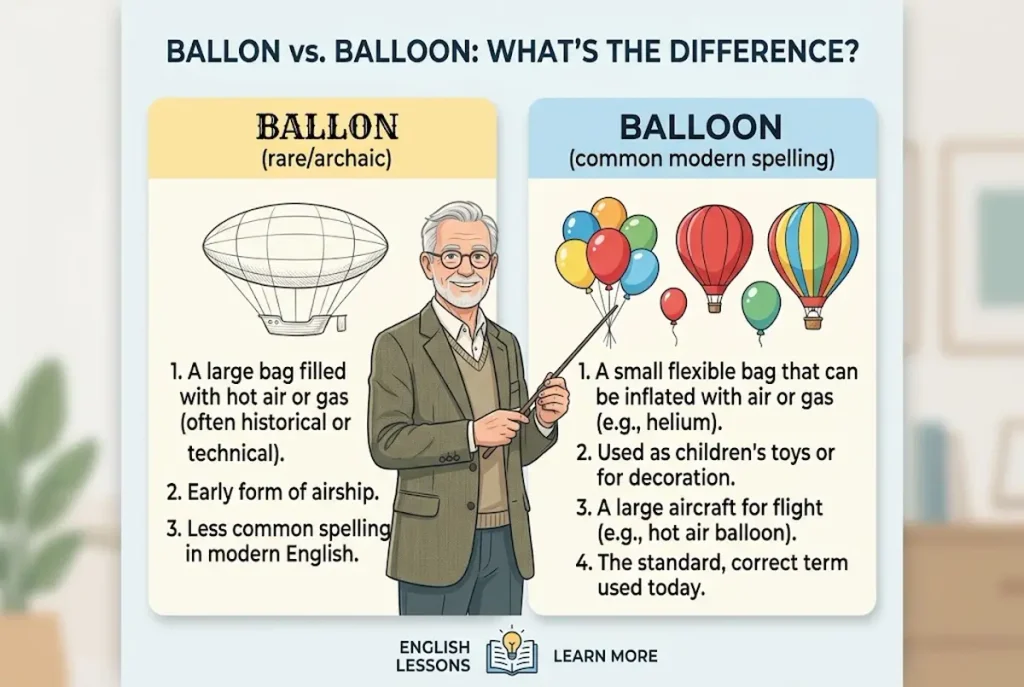
Ballon vs balloon: what’s different?
The main difference is spelling and standard English usage.
| Form | Standard English spelling? | Common meaning |
|---|---|---|
| ballon | No, for the ordinary English word | Usually a spelling mistake |
| balloon | Yes | An inflatable object or rapid expansion |
If you are writing in English and mean the object used for parties, decorations, toys, or flight, write balloon.
The extra letters matter.
Correct:
The balloon is red.
Incorrect:
The ballon is red.
A useful memory trick is to think of balloon as having a repeated pattern:
ll + oo
You don’t need to memorize a complicated spelling rule. Just remember the visual shape of the word.
Balloon vs inflatable: what’s different?
Balloon and inflatable are related but aren’t exact replacements.
A balloon is a specific kind of inflatable object. An inflatable is a broader term for something that expands when filled with air or another gas.
For example:
The child held a balloon.
This tells you exactly what kind of object it was.
The child played with an inflatable.
This could refer to a balloon, inflatable toy, pool float, or another object.
So balloon is more specific, while inflatable is broader.
Balloon vs blimp: what’s different?
A balloon and a blimp both relate to lighter than air flight, but they aren’t the same thing.
A balloon is generally carried by wind or controlled through its design and operating system. A blimp is a powered airship that can be steered.
A birthday balloon is obviously not a blimp.
For example:
The blimp flew above the stadium.
The balloon floated toward the ceiling.
Using blimp when you mean a party balloon would make the sentence inaccurate.
Balloon vs airship: what’s different?
Airship is a broad term for a powered aircraft that gets lift from a gas that is less dense than the surrounding air.
A balloon is a broader or different category depending on the technical context, and a hot air balloon is not normally called an airship.
In everyday writing, don’t replace balloon with airship unless you’re actually discussing aviation.
For example:
The hot air balloon rose above the field.
The airship traveled over the city.
Both can fly, but they work differently.
Common spelling mistakes with balloon
The most common problem is leaving out one of the repeated letters.
Incorrect:
ballon
Correct:
balloon
Another common mistake is writing too many letters:
ballooon
The correct form has:
- two l’s
- two o’s
- one n
The word begins with b and ends with n.
A simple letter count can help:
B A L L O O N
That’s seven letters.
If you remember the structure, you’re less likely to leave out one of the repeated letters.
When should you not use balloon?
You should not use balloon when you simply mean that something increased unless the sentence benefits from the idea of rapid or excessive expansion.
For example:
The number of students ballooned.
This suggests a significant increase.
But in a formal report, you might prefer:
The number of students increased.
The second version is more neutral.
Avoid balloon when you need a precise technical term.
For example, if you’re talking about a specific aircraft, use the correct aviation term instead of calling everything a balloon.
Also avoid using balloon as a synonym for every round object. A ball, sphere, bubble, orb, and balloon have different meanings.
Common grammar mistakes with balloon
Balloon is countable when you’re talking about individual inflatable objects.
You can say:
- one balloon
- two balloons
- several balloons
- many balloons
Example:
We bought ten balloons.
You can also use balloon as a verb.
Correct:
The costs ballooned.
Incorrect:
The costs balloon.
The present tense balloon can be correct when you’re describing something that regularly or currently expands:
Costs balloon when demand rises sharply.
For a completed increase, ballooned is usually appropriate:
Costs ballooned last year.
Antonyms for balloon
The opposite of balloon depends on which meaning you have in mind.
If balloon means to expand or grow rapidly, possible opposites include:
- shrink
- decrease
- reduce
- contract
- decline
- fall
- drop
- diminish
Examples:
The budget ballooned.
The budget shrank.
The population increased.
The population declined.
If balloon refers to an object, there isn’t one exact antonym. The opposite depends on the context. Deflate can work when you’re talking about something filled with air.
Example:
The balloon inflated.
The balloon deflated.
Inflate and deflate are especially useful opposites for the physical object.
How to remember the spelling of balloon
Try a few simple memory tricks.
Remember the double letters
Think:
LL + OO
Balloon contains two l’s followed by two o’s.
Think of the word ball
The beginning of balloon looks like ball:
ball + oon
This is not a complete spelling rule, but it can help you remember the first part.
Say the word slowly
When you’re checking your writing, pronounce the word carefully and look at the spelling at the same time.
Create a visual sentence
You can remember:
A balloon has two loops and two round o’s.
The two l’s look like a pair of upright lines, while the two o’s look round like little balloons.
Type it correctly several times
Writing or typing the correct form repeatedly can make it easier to recognize later.
Quick tips for choosing the right word
Use these tips when you’re unsure about the word.
- Use balloon for the common inflatable object.
- Remember that balloon has two l’s.
- Remember that balloon has two o’s.
- Use balloon as a verb when something grows or expands quickly.
- Use increased for a neutral formal description of growth.
- Use expanded when you’re describing growth in size, scope, or activity.
- Use blimp for a powered airship.
- Use hot air balloon for the aircraft that rises because of heated air.
- Use weather balloon for a balloon used to gather atmospheric information.
- Use deflate when an inflatable object loses air or gas.
- Don’t use ballon as the normal English spelling of the word.
- Check the context before choosing a synonym.
- In professional writing, prefer precise terms over dramatic ones.
- If you’re describing a literal party decoration, balloon is usually the simplest choice.
A quick spelling test
Can you choose the correct word in each sentence?
- We bought ten ______ for the party.
- The company’s costs began to ______ after the expansion.
- The ______ floated toward the ceiling.
- The weather ______ collected atmospheric data.
The correct answer in all four cases is balloon.
The word changes grammatical function in sentence two, but the spelling remains the same.
That is one useful feature of English spelling: once you know the correct form, you can use it as both a noun and a verb.
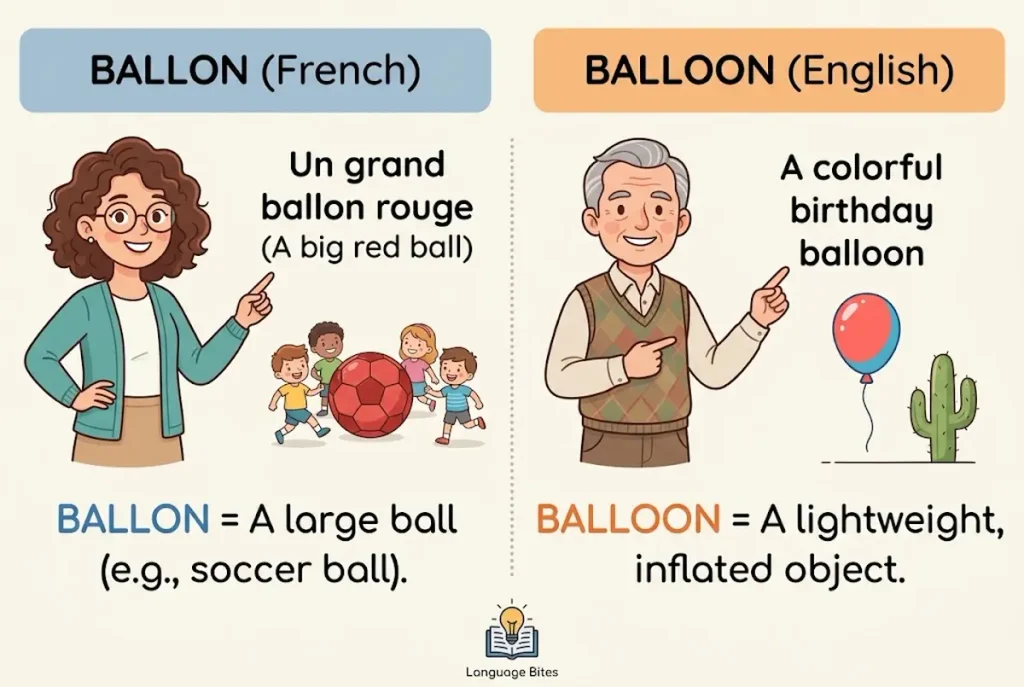
Final answer about ballon or balloon
The correct English spelling is balloon. Use it when you’re talking about an inflatable object, a type of lighter than air aircraft, or something that grows rapidly when the word is used as a verb. The spelling ballon is generally incorrect for these meanings in standard English.
The easiest way to remember the spelling is to focus on the repeated letters. Balloon has two l’s followed by two o’s. If you’re describing a party decoration, a weather balloon, or a rapid increase in cost, size, or number, balloon is the form you want.
Once you notice the LL and OO pattern, the spelling becomes much easier to recognize. When the context is formal, also think about precision. Increased, expanded, or rose may sometimes communicate an idea more clearly than ballooned.
Conclusion
When you’re deciding between ballon or balloon, the correct English spelling is balloon. It has two l’s and two o’s, making the spelling easy to recognize once you remember the pattern.
Balloon can describe an inflatable object, such as a party decoration or weather balloon, and it can also be used as a verb when something grows or increases quickly. In formal writing, words like increased or expanded may sometimes be more precise.
The key is to match the word to your meaning and audience. If you remember the simple LL and OO pattern, you’ll have a much easier time spelling balloon correctly in emails, essays, texts, and everyday writing.
Frequently Asked Questions
Is ballon or balloon the correct spelling?
Balloon is the correct standard English spelling for the inflatable object. Ballon is generally a spelling mistake in English when used with this meaning.
Why does balloon have two l’s and two o’s?
Balloon developed through French ballon and related words meaning a large ball or inflated object. Modern English spelling uses two l’s and two o’s.
Can balloon be used as a verb?
Yes, balloon can be a verb meaning to increase or expand rapidly. For example, “The project’s costs ballooned.”
What’s another way to say balloon?
Another word depends on the context. Inflatable can describe the object, while increase, expand, swell, or surge can describe rapid growth.
How do you spell balloon correctly?
Spell it B A L L O O N. Remember the two l’s and two o’s.
Is balloon spelled differently in British English?
No. Balloon has the same standard spelling in American and British English.
Can I use balloon in a formal essay?
Yes, but choose it based on context. For rapid or unexpectedly large growth, balloon can be effective, while increased or expanded may sound more neutral.
Why do people write ballon instead of balloon?
People often leave out one of the repeated letters when spelling the word from memory. Remembering the LL and OO pattern can prevent this common error.

Daniel Grammarfield — The Language Learner
Age: 28Occupation: ESL Learner & Digital Professional
Bio:Daniel is a non-native English speaker who wants to communicate more confidently at work and online. He uses Synotrench to improve grammar, understand confusing words, learn correct sentence structures, and build everyday English skills. He prefers simple explanations with practical examples.
Goals:
Master English grammar rules
Avoid common language mistakes
Improve professional communication
Learn English through real-life examples
Quote:“Learning English is not about memorizing rules — it’s about expressing ideas clearly.”
1 thought on “Ballon or Balloon: The Simple Correct Spelling Guide (2026)”