When you’re writing an email, essay, resume, or even a quick text, one small spelling difference can change the meaning of your sentence. Allusion vs Illusion is a common example. The two words look almost the same, but they describe completely different ideas.
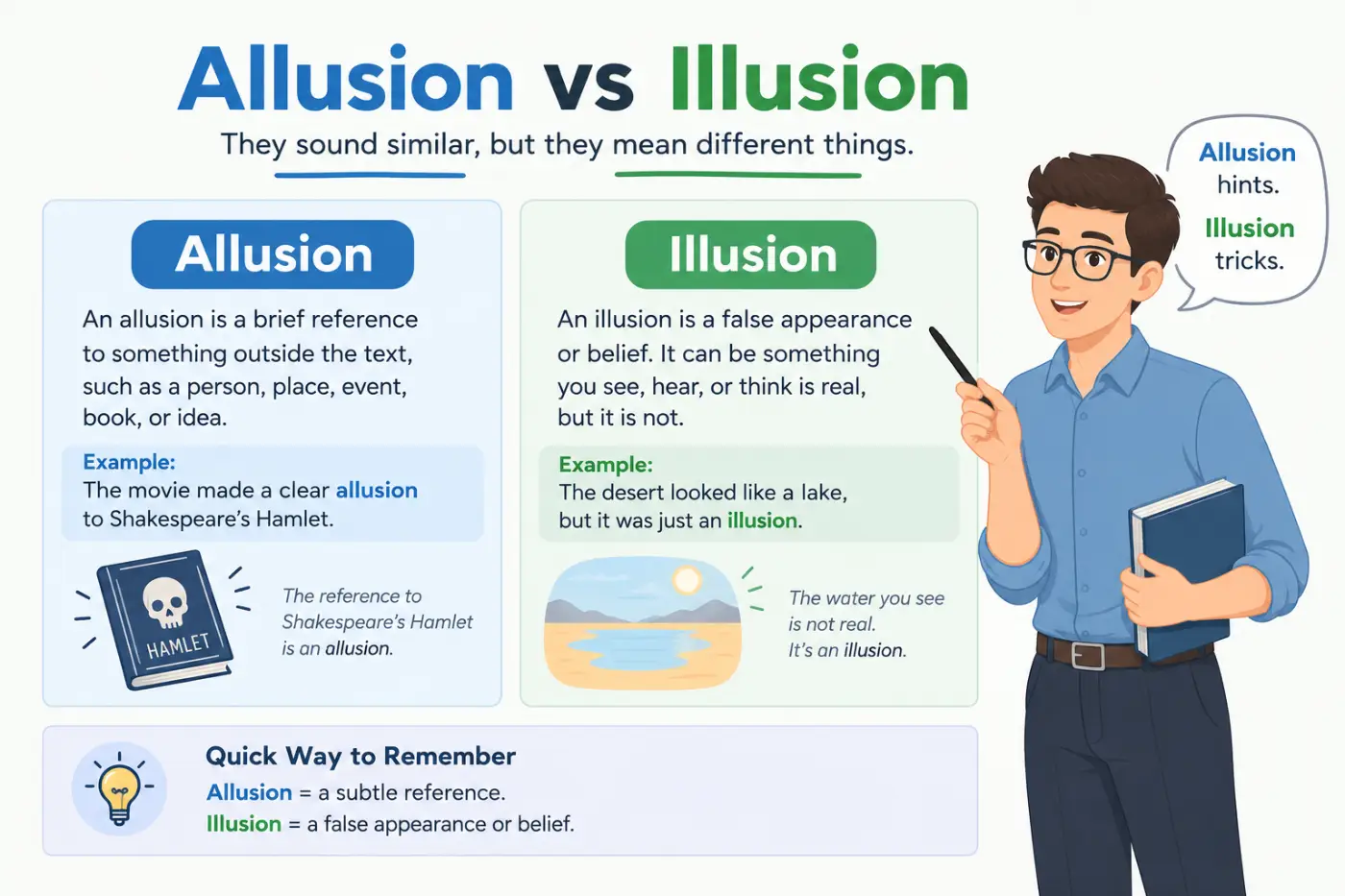
An allusion is an indirect reference to a person, place, event, book, story, or idea. An illusion is something that appears real or true but isn’t what it seems.
Answer: An allusion is an indirect reference, while an illusion is a false appearance or mistaken belief. Think allusion = reference and illusion = appearance.
This guide explains their meanings, origins, related words, intensity, common mistakes, regional usage, examples, and practical ways to choose the right word every time.
What is the difference between allusion and illusion?
The simplest way to understand Allusion vs Illusion is to focus on the first letter.
Allusion contains allude, which means to refer to something indirectly.
Illusion is connected with the idea of deception or something that looks different from reality.
| Word | Basic meaning | Simple memory clue |
|---|---|---|
| Allusion | An indirect reference | Allusion = allude = refer |
| Illusion | A false or misleading appearance | Illusion = looks real but isn’t |
Consider these examples:
The author makes an allusion to Greek mythology.
This means the author indirectly refers to Greek mythology.
The magician created an illusion of a floating ball.
This means the ball appeared to float, but the appearance was deceptive.
The words can sound similar when spoken quickly, so spelling mistakes are common. Their meanings, however, are clearly different.
Where did allusion come from?
The word allusion comes from the Latin word alludere, meaning to play with, make reference to, or allude to something. It entered English through French and developed into the modern meaning of an indirect reference.
The connection with allude is especially useful for remembering the word.
If you allude to something, you mention it indirectly.
If a writer makes an allusion, the writer gives a clue or reference without explaining everything directly.
For example:
The novel contains an allusion to Shakespeare’s Romeo and Juliet.
The writer doesn’t have to say that the characters are exactly like Romeo and Juliet. A small reference may be enough for readers to recognize the connection.
Allusions are common in literature, journalism, speeches, advertising, movies, songs, and everyday conversation.
A person might say:
He acted like Sherlock Holmes and quickly solved the mystery.
That sentence can be an allusion to Sherlock Holmes because the speaker indirectly connects someone’s behavior with the famous detective.
Where did illusion come from?
The word illusion has roots in Latin illusio, which is related to illudere, meaning to mock, deceive, or play with.
Over time, illusion developed into a word for something that deceives the senses or creates a false impression.
An illusion doesn’t have to be a magic trick.
It can be visual, mental, emotional, or social.
For example:
The mirror created the illusion that the room was larger.
The room isn’t actually larger. The mirror simply creates that appearance.
You might also hear:
He lived under the illusion that everyone supported his plan.
Here, illusion means a mistaken belief or false idea.
This gives you an important distinction. An illusion can involve what you see, what you believe, or what you think is true.
How can you remember allusion and illusion?
A simple memory trick can make this difference much easier.
Think:
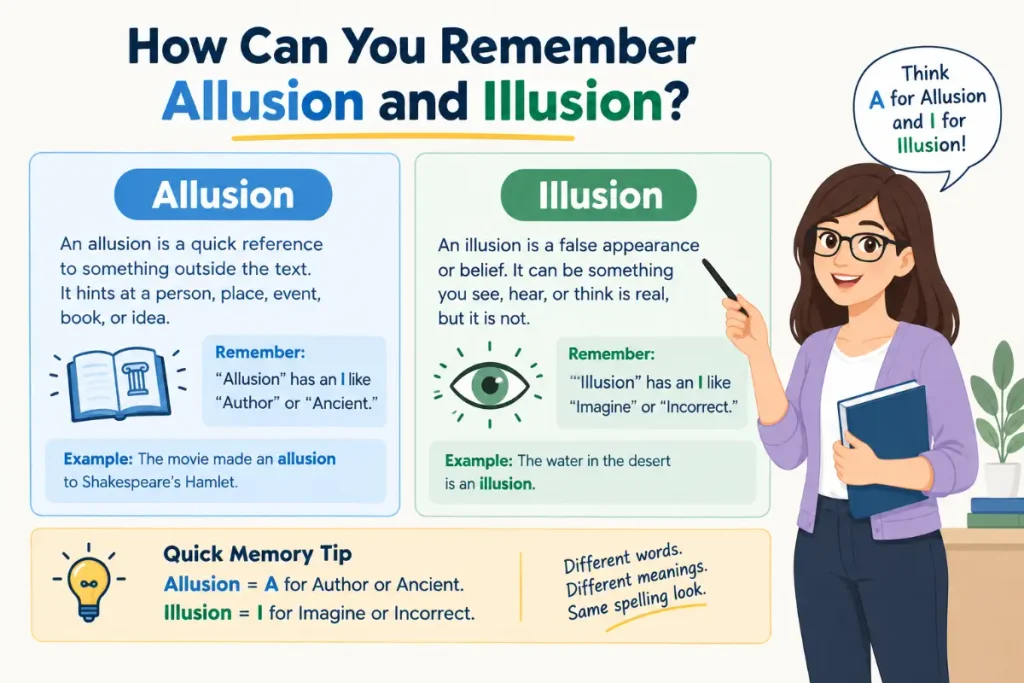
Allusion = allude = reference.
Illusion = image or appearance.
Another trick is to connect the first letters with the meanings.
The A in allusion can remind you of allude.
The I in illusion can remind you of an imagined appearance.
These aren’t formal rules, but they’re useful memory aids.
Ask yourself:
“Am I referring to something?”
If yes, you probably need allusion.
Ask:
“Does something only appear real or true?”
If yes, you probably need illusion.
What are synonyms for allusion from mild to strong?
The strength of an indirect reference can change depending on the word you choose.
A mild reference might simply remind someone of another idea.
A stronger reference may clearly point toward a particular person, event, or story.
Mild references
These words usually suggest a small or subtle connection.
- Hint.
- Nod.
- Echo.
- Suggestion.
- Reminder.
- Mention.
Example:
The movie gives a small nod to an older comedy.
This sounds subtle.
Medium strength references
These words make the connection clearer.
- Reference.
- Indication.
- Implication.
- Callback.
- Invocation.
- Allusion.
Example:
The speech contains an allusion to the American Revolution.
The reader or listener is expected to recognize the connection.
Stronger or more direct references
These words often make the connection much more obvious.
- Citation.
- Explicit reference.
- Direct mention.
- Quotation.
- Identification.
- Statement.
An allusion is usually indirect. Once a writer names the source directly, you’re moving away from an allusion and toward a direct reference or citation.
What are synonyms for illusion from mild to strong?
The strength of a false appearance can also vary.
Mild false appearance
These words can describe something that merely seems different from reality.
- Appearance.
- Impression.
- Misperception.
- Mistaken idea.
- False impression.
Example:
The lighting created the impression that the wall was blue.
Stronger false belief
These words suggest a deeper misunderstanding.
- Misunderstanding.
- Misconception.
- False belief.
- Delusion.
- Deception.
Example:
He had the mistaken belief that the meeting had been canceled.
The word delusion is much stronger and can carry a serious psychological meaning, so it shouldn’t be used casually when you only mean “mistaken idea.”
Visual illusion
When something tricks the eyes, these expressions are especially useful:
- Optical illusion.
- Visual trick.
- Mirage.
- Distortion.
- Visual effect.
For example:
The artist used shadows to create an optical illusion.
How do allusion and illusion work as different parts of speech?
Both allusion and illusion are nouns.
Their related forms, however, include other parts of speech.
| Word | Part of speech | Example |
|---|---|---|
| Allusion | Noun | The poem contains an allusion to the Bible. |
| Allude | Verb | The writer alludes to an earlier event. |
| Illusion | Noun | The magician created an illusion. |
| Illusory | Adjective | The sense of safety was illusory. |
| Illude | Verb, rare | The older form is uncommon in modern English. |
The most useful pair to remember is:
allusion → allude
illusion → illusory
You can say:
The author alludes to a famous historical event.
You can also say:
The author makes an allusion to a famous historical event.
But you wouldn’t normally replace allusion with illusion because the meanings are unrelated.
Is allusion or illusion used differently in the US and UK?
There is no major US versus UK difference in the basic meanings of allusion and illusion.
American and British English use both words in essentially the same ways.
The pronunciation may have small regional differences, as happens with many English words, but the core distinction stays the same.
American writers, British writers, Canadian writers, and Australian writers can all use allusion for an indirect reference and illusion for a false appearance or belief.
Spelling is also the same.
So this isn’t a situation where you need one spelling for American English and another for British English.
The bigger issue is simply remembering the meaning.
Which word should you use in a resume?
A resume rarely needs the word allusion or illusion.
Professional resumes usually work better with direct language.
If you need to describe a reference, use reference, mention, connection, or example, depending on the context.
For example:
Weak:
My resume makes an allusion to my leadership experience.
Better:
My resume highlights my leadership experience.
If you’re discussing something that only appears to be true, illusion may be appropriate in a professional explanation, but it would still be uncommon on a resume.
For example:
The impressive sales numbers created an illusion of long term growth.
This is grammatically correct, but it belongs more naturally in an analysis or report than in a standard resume.
Which word should you use in an essay?
An essay is one of the places where allusion is especially useful.
Literary essays often discuss references to historical events, mythology, religion, politics, other books, or famous people.
For example:
The poet uses an allusion to Greek mythology to show the character’s pride.
You can also write:
The novel contains several allusions to Shakespeare.
For an academic essay, reference, allusion, and citation don’t always mean the same thing.
A citation normally identifies a source formally.
An allusion is usually indirect.
A reference can be either direct or general.
That distinction matters in academic writing.
Which word should you use in an email?
In most emails, reference or mention will sound more natural than allusion.
For example:
I mentioned our previous meeting in the email.
I referred to the report we discussed.
Using allusion isn’t necessarily wrong, but it can sound more literary or formal than the situation requires.
Illusion is useful when you’re explaining a mistaken impression.
For example:
The chart may create the illusion that sales increased every month.
That sentence sounds natural in a business email.
Which word should you use in a text message?
Texting usually favors simple language.
Instead of saying:
That was an allusion to the movie.
You might say:
That was a reference to the movie.
Or:
I was hinting at the movie.
Still, allusion is perfectly correct if the speaker knows the word and the context calls for it.
For illusion, texting might use:
It just looked real.
It was an illusion.
The best choice depends on your audience.
Which word should you use when speaking?
In everyday speech, reference, hint, and mention are more common than allusion.
For example:
I was referring to your earlier comment.
She hinted at the problem.
He mentioned the movie.
But allusion is common in conversations about books, movies, art, history, and literature.
For example:
I think that’s an allusion to Shakespeare.
The movie makes an allusion to an old horror film.
The word illusion is also common in ordinary conversation.
For example:
It was just an illusion.
The magician created an illusion.
I had the illusion that everything was fine.
What are some real examples of allusion?
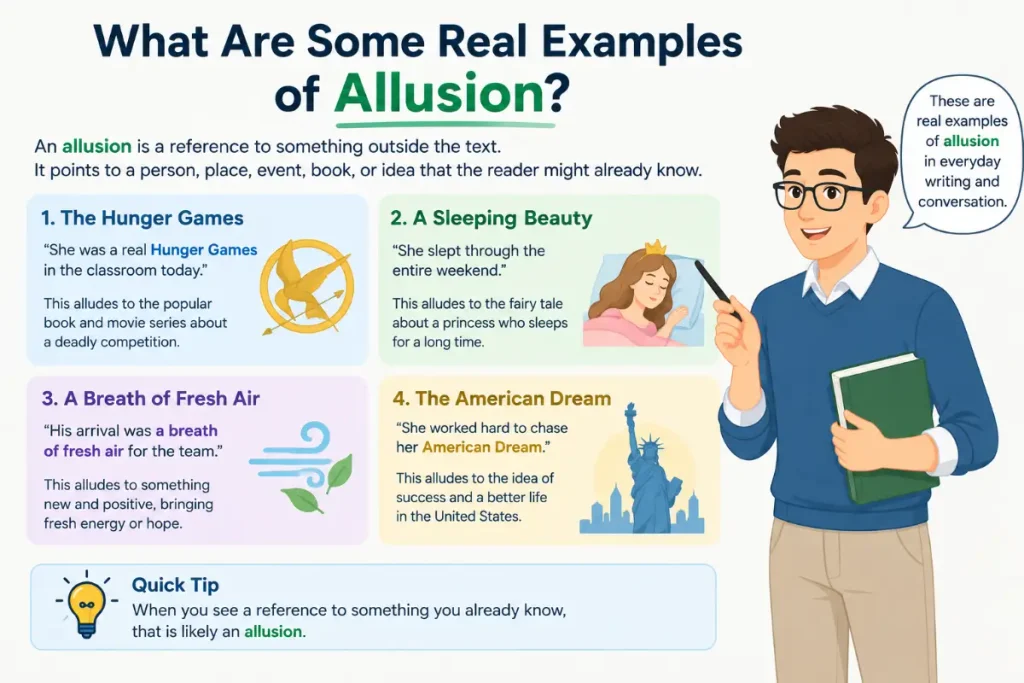
Here are original examples showing how allusion works in different situations.
Literature
The writer doesn’t have to retell the entire myth. A brief reference can remind readers of Icarus and his dangerous ambition.
History
The politician’s speech included an allusion to the American Revolution.
The historical reference helps create a connection between the present issue and the past.
Movies
The director added an allusion to a famous science fiction film.
Fans who know the older movie may recognize the connection.
Advertising
The advertisement makes an allusion to a famous fairy tale.
The company uses the familiar story to create a certain feeling.
Everyday conversation
Her comment was an allusion to our argument last week.
She didn’t mention the argument directly, but I understood what she meant.
School
The teacher explained the allusion before discussing the poem.
Students needed to understand the outside reference to understand the poem fully.
Music
The song contains an allusion to a well known historical event.
Listeners familiar with that event may notice the deeper meaning.
What are some real examples of illusion?
Now compare those examples with illusion.
Magic
The magician created the illusion that the coin disappeared.
The coin didn’t actually vanish. The trick created that appearance.
Visual art
The painting creates an illusion of depth.
The canvas is flat, but the artist makes it look three dimensional.
Mirrors
The large mirror created the illusion of a bigger room.
The room stayed the same size.
Weather
The heat created an illusion of water on the road.
This can describe a mirage.
Personal beliefs
He lived under the illusion that success would solve every problem.
Here, the illusion is a mistaken belief rather than a visual trick.
Business
The temporary increase in sales created an illusion of steady growth.
The numbers looked positive, but the larger situation was different.
Social media
A carefully edited profile can create an illusion of a perfect life.
The appearance may not reflect the person’s real experience.
Relationships
She had the illusion that everyone agreed with her.
The reality was different from what she believed.
When should you choose reference?
Choose reference when clarity matters most.
For example:
The report includes a reference to the new law.
This is clear and professional.
When should you choose allusion?
Choose allusion when the indirect nature of the reference matters.
For example:
The poem’s allusion to the Garden of Eden adds a sense of temptation to the scene.
The reader is expected to recognize the outside story and connect it with the poem.
What is the difference between illusion and deception?
Illusion and deception are also related but different.
An illusion is a false appearance or mistaken impression.
Deception is the act of deliberately causing someone to believe something false.
For example:
The mirror created an illusion of extra space.
There is no deliberate liar here. The mirror simply changes what the viewer sees.
Now compare:
The company used deception to hide its financial problems.
This sentence suggests intentional misleading behavior.
A magician can create an illusion as part of entertainment. That doesn’t necessarily mean the magician is committing harmful deception.
This distinction helps you choose a more precise word.
What is the difference between illusion and misconception?
A misconception is an incorrect idea or belief.
An illusion can also describe a mistaken belief, but it often has a stronger sense of a false appearance or unrealistic belief.
Compare:
It is a common misconception that bats are blind.
This means people have an incorrect idea.
He had the illusion that his plan could never fail.
This suggests a false or unrealistic belief.
For neutral educational writing, misconception is often the better choice when you’re simply correcting an incorrect idea.
What are common mistakes with allusion and illusion?
The most common mistake is using illusion when you mean allusion.
For example:
Incorrect meaning:
The author makes an illusion to Shakespeare.
If you mean an indirect reference, use:
The author makes an allusion to Shakespeare.
Another common mistake is assuming that allusion means something mysterious.
It doesn’t necessarily mean mysterious. It simply means an indirect reference.
A third mistake is treating every reference as an allusion.
A direct mention isn’t automatically an allusion.
For example:
The article mentions Abraham Lincoln.
That’s a mention or reference.
If the article indirectly compares a modern leader to Lincoln without directly naming him, that may be an allusion.
When should you not use allusion?
Don’t use allusion simply because you want a more sophisticated word for “mention.”
If the reference is direct and straightforward, reference or mention may be clearer.
For example:
I mentioned the meeting in my email.
This is better than:
I made an allusion to the meeting in my email.
The second sentence sounds unnecessarily formal because the meeting was directly mentioned.
Also avoid using allusion when you mean “illusion.”
If something looks real but isn’t, you’re talking about an illusion.
What are the antonyms of allusion and illusion?
The best antonym depends on the exact meaning.
For allusion, possible contrasts include:
- Direct statement.
- Explicit reference.
- Direct mention.
- Clear identification.
- Full explanation.
An allusion is indirect, so its opposite is often something direct and explicit.
For illusion, possible contrasts include:
- Reality.
- Truth.
- Fact.
- Certainty.
- Reality-based understanding.
- Accurate perception.
For example:
The illusion disappeared when she discovered the truth.
The contrast between appearance and reality is central to the meaning.
How can you choose the right word quickly?
Use this five second test.
Ask if you’re referring to something
If you’re indirectly pointing to a person, story, event, book, movie, or idea, choose allusion.
Example:
The writer makes an allusion to Greek mythology.
Ask if something only appears real
If something looks or seems real but isn’t, choose illusion.
Example:
The painting creates an illusion of movement.
Ask if you’re talking about a false belief
Illusion can also work when someone believes something that isn’t true.
Example:
He was under the illusion that the job was guaranteed.
Ask if the reference is direct
If you’re simply mentioning something, reference or mention may be better.
Example:
The report mentions the new policy.
Remember the verb connection
Allude means to refer indirectly.
So:
Allude → allusion.
This is one of the strongest memory tricks for this pair.
A quick comparison table for allusion and illusion
| Feature | Allusion | Illusion |
|---|---|---|
| Part of speech | Noun | Noun |
| Main idea | Indirect reference | False appearance or belief |
| Related verb | Allude | No common everyday verb form |
| Related adjective | Allusive | Illusory |
| Often used in literature | Yes | Yes |
| Can involve a visual effect | Not usually | Yes |
| Can involve a false belief | Not usually | Yes |
| Can refer to another story | Yes | No |
| Common related word | Reference | Appearance |
| Memory clue | Allude = refer | Looks real but isn’t |
How do you use illusion correctly in a sentence?
Use illusion when something appears different from reality.
Common patterns include:
Create the illusion of + noun
The lighting created the illusion of depth.
Under the illusion that + clause
He was under the illusion that the meeting was canceled.
An illusion of + noun
The mirror created an illusion of extra space.
A visual illusion
The image is a visual illusion.
An optical illusion
The drawing is an optical illusion.
These structures cover most everyday uses.
Why do people confuse allusion and illusion?
The confusion is understandable.
Both words have similar endings.
Both contain several of the same letters.
Their pronunciation is similar enough that a listener may not immediately notice the difference.
But their meanings come from different word families.
Allusion connects with allude and indirect reference.
Illusion connects with false appearance, deception, and something that seems different from reality.
The key isn’t memorizing a complicated rule. It’s learning the central idea behind each word.
For example:
The teacher explained the biblical allusion in the poem.
The film contains a subtle allusion to an older movie.
What are useful phrases with illusion?
Here are common combinations with illusion.
- An optical illusion.
- A visual illusion.
- A false illusion.
- An illusion of control.
- An illusion of safety.
- An illusion of freedom.
- An illusion of success.
- An illusion of wealth.
- Create an illusion.
- Maintain an illusion.
- Break an illusion.
- Destroy an illusion.
- Live under an illusion.
- Be under the illusion.
- Create the illusion that.
- Create the illusion of.
- A convincing illusion.
- A powerful illusion.
For example:
The clever design creates the illusion of more space.
He lived under the illusion that everyone trusted him.
Can allusion and illusion ever mean the same thing?
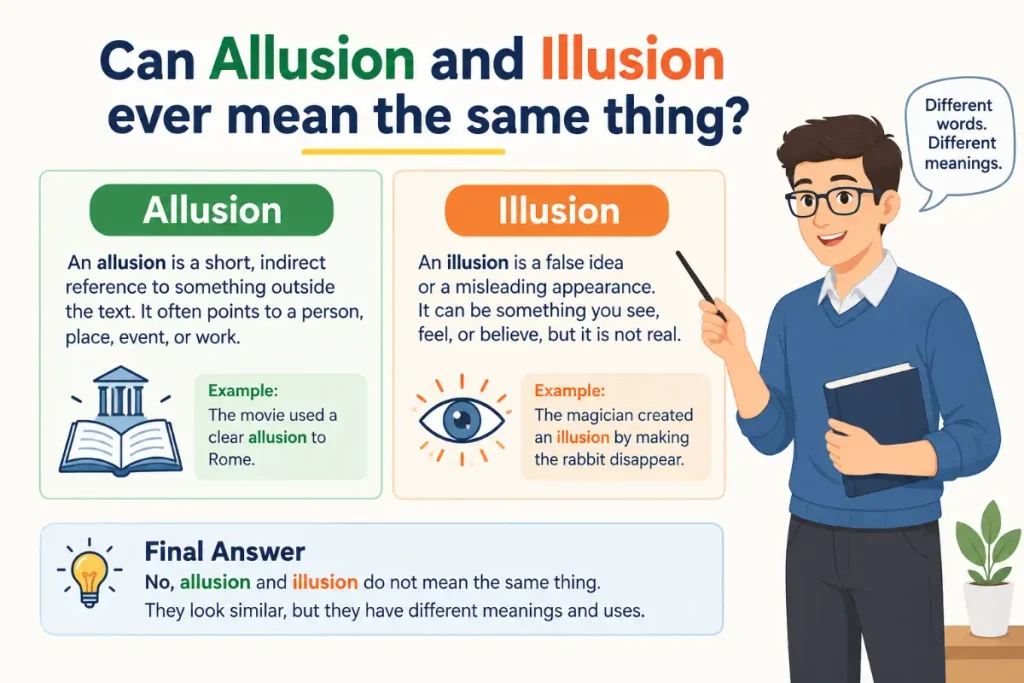
No. Allusion and illusion have different core meanings and aren’t interchangeable.
An allusion points toward something else.
An illusion makes something seem different from reality.
For example:
The writer’s allusion to the moon landing adds historical meaning.
The special effects create the illusion that the spaceship is moving.
The first sentence is about a reference.
The second is about appearance.
Even though both words can appear in creative writing, they perform different jobs.
Conclusion
The difference between Allusion vs Illusion comes down to reference versus appearance. An allusion is an indirect reference to something familiar, such as a person, story, historical event, book, or cultural idea. An illusion is something that seems real or true but isn’t, such as a visual trick, false impression, or mistaken belief.
For everyday writing, remember the useful connection between allusion and allude. If you’re indirectly referring to something, you’re likely using allusion. If something only seems real, illusion is the better choice.
You don’t need to memorize dozens of rules. Focus on the central meaning, check the context, and choose the simpler word when a direct reference is enough. With a little practice, you’ll be able to spot and use these two words correctly in essays, emails, conversations, and professional writing.
Frequently Asked Questions
What is the simple difference between allusion and illusion?
Allusion means an indirect reference, while illusion means a false appearance or belief.
Is an allusion a reference?
Yes. An allusion is a type of indirect reference to something such as a person, story, event, or idea.
Is an illusion something that is not real?
Usually, yes. An illusion is something that appears real or true but differs from reality.
How do I remember allusion and illusion?
Connect allusion with allude, which means to refer indirectly. Connect illusion with something that looks or seems real but isn’t.
What’s another way to say allusion?
Another way to say allusion is reference, hint, nod, mention, implication, or indirect reference, depending on the context.
Can I use illusion instead of allusion?
No. Illusion and allusion have different meanings. Use allusion for an indirect reference and illusion for a false appearance or belief.
What is an example of an allusion and an illusion?
“The poem contains an allusion to Shakespeare” uses allusion for an indirect reference. “The mirror creates an illusion of a larger room” uses illusion for a misleading appearance.

Daniel Grammarfield — The Language Learner
Age: 28Occupation: ESL Learner & Digital Professional
Bio:Daniel is a non-native English speaker who wants to communicate more confidently at work and online. He uses Synotrench to improve grammar, understand confusing words, learn correct sentence structures, and build everyday English skills. He prefers simple explanations with practical examples.
Goals:
Master English grammar rules
Avoid common language mistakes
Improve professional communication
Learn English through real-life examples
Quote:“Learning English is not about memorizing rules — it’s about expressing ideas clearly.”