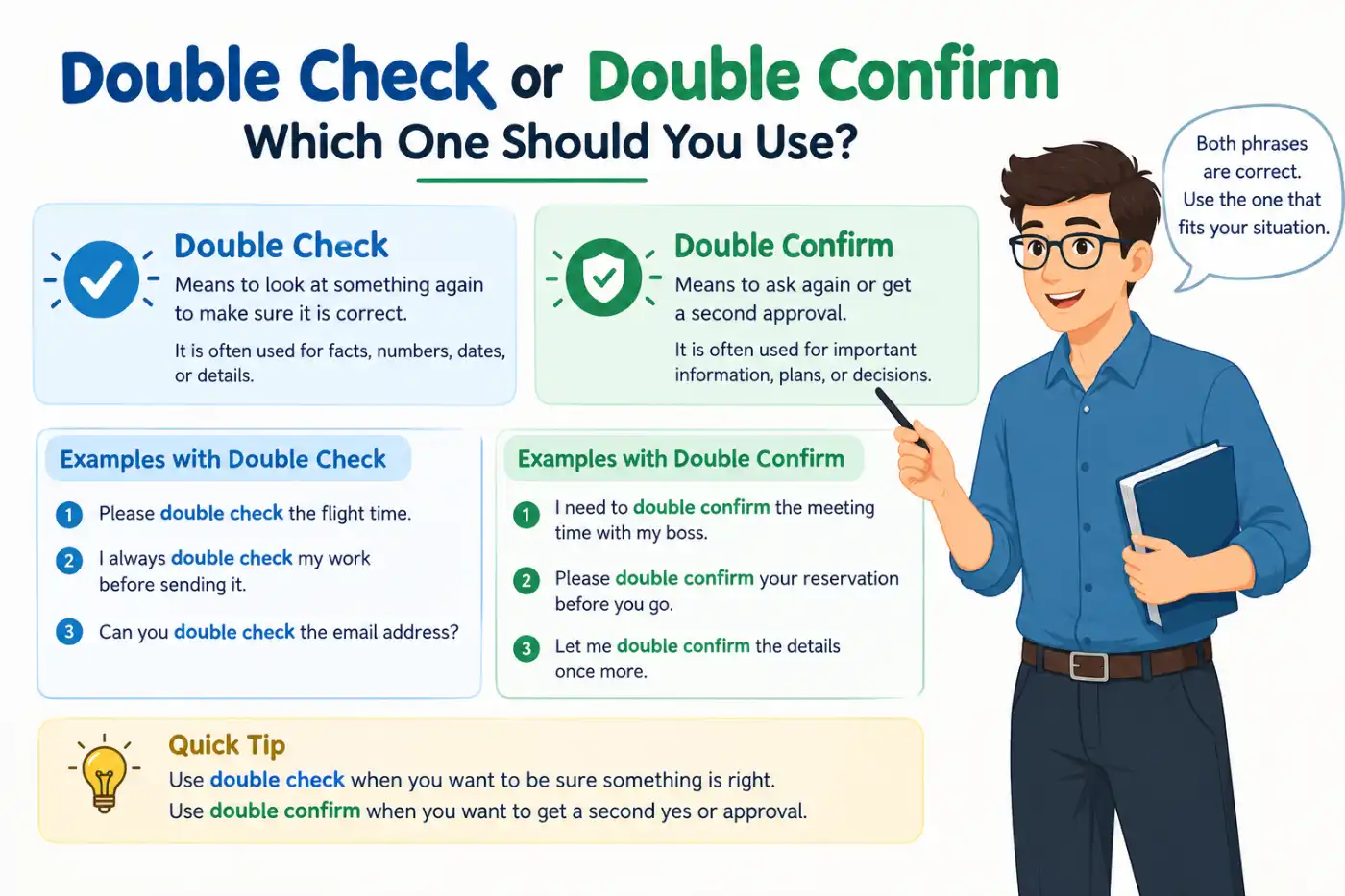
You’re writing an important email to your manager. Before sending it, you want to make sure the meeting date is correct. Should you say, “I’ll double check the date” or “I’ll double confirm the date”?
Both expressions may sound similar, but they aren’t equally natural in English. Choosing the wrong one can make an otherwise clear sentence sound awkward, especially in professional writing.
This guide explains their meanings, word origins, grammar rules, synonyms, common mistakes, and practical examples. You’ll also learn which expression works best in emails, essays, resumes, text messages, and everyday conversations.
What Does Double Check or Double Confirm Mean?
Although both expressions relate to making sure something is correct, they don’t work in exactly the same way.
Understanding their individual meanings makes choosing the right expression much easier.
What Does Double Check Mean?
Double check means to check something again to make sure there are no mistakes.
People use this expression when reviewing information, checking facts, examining documents, or making sure an action was completed correctly.
Examples:
- Please double check your answers before submitting the test.
- I need to double check the meeting schedule.
- She double checked the address before leaving.
- Can you double check these calculations?
- Always double check your spelling before sending an email.
What Does Double Confirm Mean?
Double confirm is an uncommon expression in standard English. Some speakers use it informally when they want extra reassurance or another confirmation.
However, it can sound repetitive or unnatural to many native English speakers.
Examples of less natural wording:
- Please double confirm your appointment.
- I want to double confirm the payment.
- Can you double confirm the booking?
More natural alternatives include:
- Please confirm your appointment again.
- I’d like to verify the payment details.
- Could you reconfirm the booking?
The word confirm already means establishing that something is correct, true, or definite.
Adding double isn’t usually necessary.
Quick Difference Between Both Expressions
| Feature | Double Check | Double Confirm |
|---|---|---|
| Main meaning | Check something again | Seek additional confirmation |
| Natural English | Yes | Less common |
| Common purpose | Prevent mistakes | Request extra reassurance |
| Professional writing | Recommended | Usually avoid |
| Common alternative | Verify again | Reconfirm |
| Example | Double check the address. | Reconfirm the booking. |
Where Do Double Check and Double Confirm Come From?
Understanding word origins helps explain why one expression sounds more natural than the other.
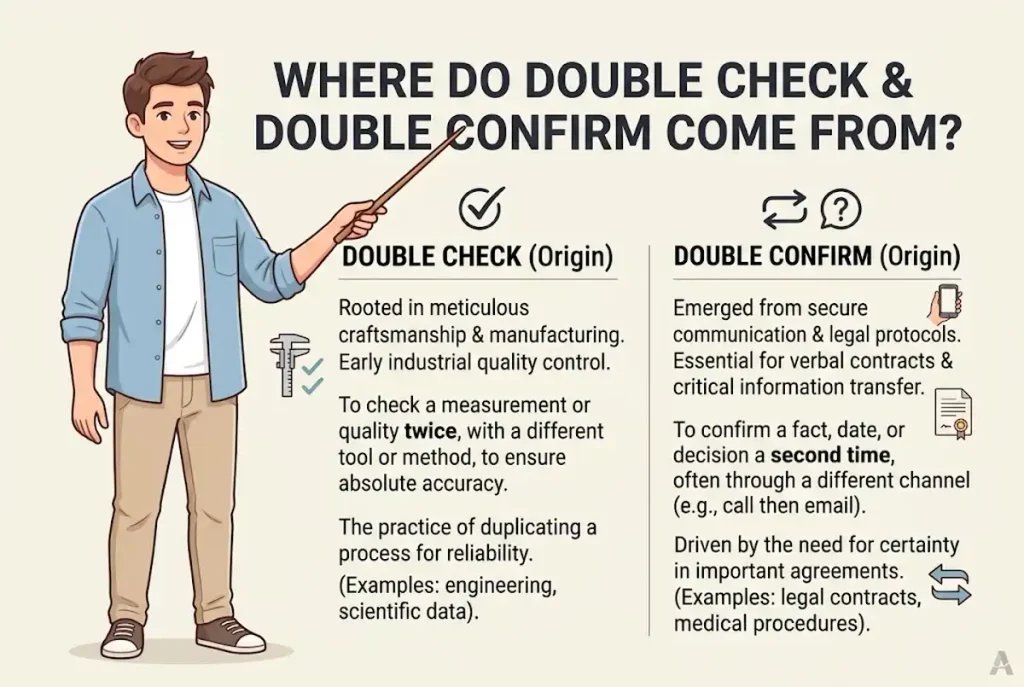
Origin of Double Check
The word double comes from the Latin word duplus, meaning twofold.
Check entered English through Old French and has developed several meanings over time, including examining, controlling, and verifying something.
The combination double check developed as a practical way to describe checking something a second time.
Today, it appears frequently in American English, British English, business communication, education, and everyday speech.
You may also see it written as double-check, especially when used as a verb.
For example:
- I will double-check the report.
- She double-checked the numbers.
- A quick double-check prevented an error.
Origin of Double Confirm
Confirm comes from the Latin word confirmare, meaning to strengthen, establish, or make firm.
In modern English, confirm means to establish that information is correct or that an arrangement is definite.
The combination double confirm isn’t a widely established standard expression.
It may appear in informal communication, regional English, or situations where someone wants to emphasize repeated confirmation.
However, reconfirm is generally the more natural choice when another confirmation is needed.
For example:
Less natural: Please double confirm the reservation.
Better: Please reconfirm the reservation.
What Are the Best Synonyms for Double Check?
English offers many alternatives for checking, reviewing, and confirming information.
The best synonym depends on the situation. Some words describe a quick review, while others suggest careful investigation or official verification.
The following tables include more than 30 useful words and expressions, grouped by tone and everyday usage.
Simple Synonyms
These words are easy to understand and work well in everyday English.
| Word | Meaning | Tone | Example |
|---|---|---|---|
| Check | Examine something | Simple | Check your answers. |
| Recheck | Check again | Simple | Recheck the total. |
| Review | Look over something | Neutral | Review your notes. |
| Verify | Make sure it’s correct | Neutral | Verify the address. |
| Confirm | Establish that it’s correct | Neutral | Confirm the date. |
| Inspect | Examine carefully | Neutral | Inspect the package. |
| Examine | Look at closely | Neutral | Examine the results. |
| Look over | Review briefly | Casual | Look over my essay. |
Everyday Synonyms
These expressions sound natural in conversations, messages, and workplace communication.
| Word or Phrase | Meaning | Tone | Example |
|---|---|---|---|
| Make sure | Ensure correctness | Everyday | Make sure the door is locked. |
| Check again | Repeat a check | Everyday | Check the time again. |
| Look again | Examine another time | Casual | Look again at the instructions. |
| Go over | Review carefully | Everyday | Go over the details. |
| Take another look | Review once more | Friendly | Take another look at this. |
| Check twice | Examine two times | Everyday | Check twice before paying. |
| Cross-check | Compare information | Neutral | Cross-check both lists. |
| Follow up | Seek further information | Workplace | Follow up with the client. |
| Reconfirm | Confirm again | Neutral | Reconfirm your appointment. |
| Check back | Return for updated information | Casual | Check back tomorrow. |
Formal Synonyms
Formal alternatives work well in academic writing, business reports, official documents, and professional emails.
| Word or Phrase | Meaning | Tone | Example |
|---|---|---|---|
| Validate | Establish accuracy or validity | Formal | Validate the results. |
| Authenticate | Establish that something is genuine | Formal | Authenticate the document. |
| Corroborate | Support with other evidence | Formal | Corroborate the statement. |
| Substantiate | Support with proof | Formal | Substantiate the claim. |
| Audit | Examine records systematically | Formal | Audit the accounts. |
| Scrutinize | Examine very closely | Formal | Scrutinize the proposal. |
| Reevaluate | Assess again | Formal | Reevaluate the findings. |
| Reexamine | Examine again | Formal | Reexamine the evidence. |
| Establish accuracy | Prove correctness | Formal | Establish the accuracy of the figures. |
| Seek confirmation | Request verification | Professional | Seek confirmation from management. |
Which Synonyms Show Different Levels of Certainty?
Not every checking word communicates the same amount of effort.
Some suggest a quick glance. Others describe a careful investigation supported by evidence.
Understanding these differences helps you choose more precise language.
Synonyms From Mild to Strong
| Intensity | Expression | What It Suggests |
|---|---|---|
| Mild | Take a look | A quick examination |
| Mild | Look over | A general review |
| Moderate | Check | Examine for correctness |
| Moderate | Recheck | Repeat an examination |
| Moderate | Review carefully | Give closer attention |
| Strong | Verify | Establish accuracy |
| Strong | Cross-check | Compare separate information |
| Strong | Validate | Establish validity |
| Very strong | Scrutinize | Examine every detail closely |
| Very strong | Audit | Conduct a systematic examination |
These levels describe the usual strength of the action, not fixed dictionary rankings.
For example, checking a grocery receipt may take more effort than verifying a simple phone number.
The actual situation determines how careful the process needs to be.
How to Choose the Right Intensity
Use check when the task is simple.
Use recheck when you’ve already examined something but want to look again.
How Do You Use These Expressions in Different Parts of Speech?
Double-check can function as a verb or noun. Its spelling changes depending on how it appears in a sentence.
Double Check as a Verb
As a verb, double-check describes the action of examining something again.
Examples:
- I need to double-check the figures.
- Please double-check your work.
- She double-checked the document yesterday.
The hyphenated spelling is widely preferred in edited American English.
Double Check as a Noun
As a noun, double-check means an additional examination.
Examples:
- Give the document a quick double-check.
- One final double-check caught the mistake.
- The report needs another double-check.
Related Verb and Noun Forms
| Verb | Related Noun | Example |
|---|---|---|
| Check | Check | Perform a final check. |
| Verify | Verification | Verification is required. |
| Confirm | Confirmation | Send your confirmation. |
| Review | Review | Complete the review. |
| Validate | Validation | Validation takes time. |
| Inspect | Inspection | The inspection found damage. |
| Reassess | Reassessment | A reassessment is necessary. |
Notice that reconfirm is a verb, while reconfirmation is its related noun.
Example:
“We requested reconfirmation of the booking.”
This is more natural in formal communication than using double confirmation.
Is Double Check American or British English?
Double-check is standard in both American and British English.
Its meaning stays essentially the same across these varieties.
However, spelling conventions and sentence preferences may differ slightly between writers and style guides.
American English Examples
- Please double-check the schedule.
- I’ll verify the payment information.
- Can you confirm the appointment?
- Let’s review the details again.
British English Examples
- Please double-check the timetable.
- Could you confirm the booking?
- I’ll check the figures again.
- We need to reconfirm the arrangement.
The differences in these examples mainly involve surrounding vocabulary, not the meaning of double-check itself.
Some speakers in South Asian business English use double confirm to request extra reassurance. Readers familiar with that usage may understand it, but confirm again or reconfirm is usually clearer for an international audience.
When Should You Use Double Check or Double Confirm?
The right expression depends on the purpose of your sentence.
A resume, academic essay, business email, and text message don’t always require the same vocabulary.
Which Word Is Best for a Resume?
A resume should describe your work clearly and professionally.
Words such as verified, reviewed, validated, and cross-checked often sound more specific than double-checked.
Examples:
- Verified customer information to maintain accurate records.
- Reviewed financial documents for errors.
- Cross-checked inventory reports against warehouse records.
- Validated data before preparing monthly reports.
Compare these sentences:
Basic: I double-checked company records.
Stronger: Verified company records to identify and correct errors.
The second sentence describes a professional responsibility more clearly.
However, don’t replace a simple checking task with a stronger term unless it accurately describes what you did.
Which Word Is Best for an Essay?
Academic essays benefit from precise language.
Verify, examine, review, and corroborate are useful choices, depending on the evidence involved.
Examples:
- Researchers verified the accuracy of the collected data.
- The author examined the available evidence.
- The findings were cross-checked against previous studies.
- Additional sources corroborated the original claim.
Avoid using double confirm in formal academic writing.
It may sound unnatural and doesn’t explain the verification process clearly.
Which Word Is Best for Texting?
Text messages allow more relaxed language.
You can use check again, make sure, or double-check without sounding overly formal.
Examples:
- Let me double-check the time.
- Can you check the address again?
- Just making sure we’re meeting at six.
- I’ll confirm with Sarah and text you.
A message such as “Let me double confirm” may be understood in some communities, but “Let me confirm again” is more widely natural.
Which Word Is Best for an Email?
In professional emails, clarity matters more than complicated vocabulary.
Use double-check when you’re reviewing information and confirm when requesting an acknowledgment.
Examples:
- Could you please double-check the attached figures?
- I’d like to confirm our meeting time.
- Please verify the shipping address.
- Could you reconfirm your availability for Monday?
When contacting clients, avoid expressions that could create uncertainty about what you’re requesting.
Which Word Is Best for Everyday Speaking?
In conversation, double-check and make sure are among the most natural options.
Examples:
- Let me double-check before I answer.
- I just want to make sure.
- Can you confirm that for me?
- I’ll check with my manager again.
- Give me a minute to verify the details.
You don’t need formal words such as authenticate or substantiate for ordinary situations.
Choose the simplest expression that communicates your meaning.
What Are Some Real Life Examples of Double Check?
Looking at practical situations makes the difference easier to understand.
The following examples show how checking and confirmation work in daily communication.
| Situation | Natural Example Sentence |
|---|---|
| School | Double-check your answers before submitting the exam. |
| Office | I’ll review the report once more. |
| Shopping | Please verify the delivery address. |
| Travel | We should reconfirm our hotel reservation. |
| Banking | Double-check the account details before transferring money. |
| Healthcare | The nurse verified the patient’s information. |
| Education | The teacher reviewed the final grades. |
| Technology | Cross-check the entered data against the original file. |
| Events | Please confirm your attendance by Friday. |
| Employment | The recruiter verified the applicant’s qualifications. |
| Personal plans | Let me check the restaurant’s closing time again. |
| Customer service | Could you confirm your order number? |
Examples That Show Two Different Actions
Sometimes a sentence needs both checking and confirmation.
Consider these examples:
- Please review the payment details before confirming the transaction.
- She verified the information and sent a confirmation email.
- We checked the reservation again before asking the hotel to reconfirm it.
These sentences show an important distinction.
Checking involves examining information. Confirmation involves establishing or acknowledging that something is correct or agreed upon.
The two actions often work together, but they aren’t identical.
Double Check vs Recheck: What’s the Difference?
Double-check and recheck are close synonyms.
Both describe examining something again, but their emphasis can differ slightly.
| Double-check | Recheck |
|---|---|
| Often suggests an extra check for accuracy | Directly means checking again |
| Common in everyday communication | Common in everyday and technical contexts |
| Often emphasizes avoiding mistakes | Often emphasizes repeating an examination |
| Example: Double-check the address. | Example: Recheck the test results. |
Imagine you’re sending a package.
You check the address and then examine it once more to prevent delivery problems. You’re double-checking it.
Now imagine a machine produces an unusual reading. You repeat the examination to see if the result changes. You’re rechecking it.
In many situations, either expression works.
Double Check vs Reconfirm: What’s the Difference?
This comparison is especially useful because the expressions can describe different stages of the same task.
| Double-check | Reconfirm |
|---|---|
| Examine something again | Confirm something again |
| Focuses on accuracy | Focuses on renewed confirmation |
| Can involve personal review | Often involves another person or organization |
| Common with numbers and documents | Common with appointments and arrangements |
Examples:
“I’ll double-check the flight details.”
This means you’ll review the information.
“I’ll reconfirm the flight reservation with the airline.”
This means you’ll seek confirmation of an existing arrangement again.
You can also combine both:
“I’ll double-check the flight details and reconfirm the reservation.”
The sentence is clear because each expression has a separate purpose.
Are They the Same: Verify vs Confirm?
Verify and confirm overlap, but they aren’t always interchangeable.
Verify often involves checking information against evidence or a reliable source.
Confirm can mean establishing that something is true, definite, or agreed upon.
| Verify | Confirm |
|---|---|
| Focuses on establishing accuracy | Focuses on establishing or acknowledging certainty |
| Often involves checking evidence | May involve an acknowledgment or verification |
| Useful for documents and identities | Useful for bookings and arrangements |
| Example: Verify your identity. | Example: Confirm your attendance. |
Consider these examples:
“The bank needs to verify your identity.”
The bank must establish that you are who you claim to be.
“Please confirm your attendance.”
Someone wants to know that you plan to attend.
Using the correct word makes your request more precise.
What Common Mistakes Should You Avoid?
Small wording mistakes can make an otherwise professional sentence sound unnatural.
Here are several common problems and their corrections.
Mistake 1: Using Double Confirm Everywhere
Less natural: Please double confirm the meeting.
Better: Please confirm the meeting again.
You can also say:
“Please reconfirm the meeting time.”
Mistake 2: Adding Unnecessary Words
Awkward: I want to double check again.
Better: I want to double-check.
Double-check already expresses an additional examination, so again is often unnecessary.
However, it can be appropriate if you genuinely mean another check beyond the previous ones.
Mistake 3: Confusing Checking With Confirmation
Incorrect meaning: I confirmed the document for spelling mistakes.
Better: I checked the document for spelling mistakes.
Use check when examining something for errors.
Mistake 4: Using Formal Synonyms Incorrectly
Awkward: I authenticated my homework answers.
Better: I checked my homework answers.
Authenticate usually means establishing that something is genuine, not simply looking for mistakes.
Mistake 5: Using the Wrong Verb Form
Incorrect: She double-check the report yesterday.
Correct: She double-checked the report yesterday.
The past tense requires checked.
When Should You Avoid Double Check?
Although double-check is widely useful, it isn’t the best expression for every situation.
Avoid it when a more precise verb communicates your meaning better.
For example, use authenticate when establishing that a document is genuine.
Use audit when describing a systematic examination of financial records.
Use confirm when requesting an acknowledgment of an arrangement.
Also, avoid suggesting that a second check guarantees perfect accuracy.
A person can double-check information and still overlook a mistake.
When accuracy is critical, explain the actual verification method rather than relying on a general expression.
What Are the Opposites of Double Check?
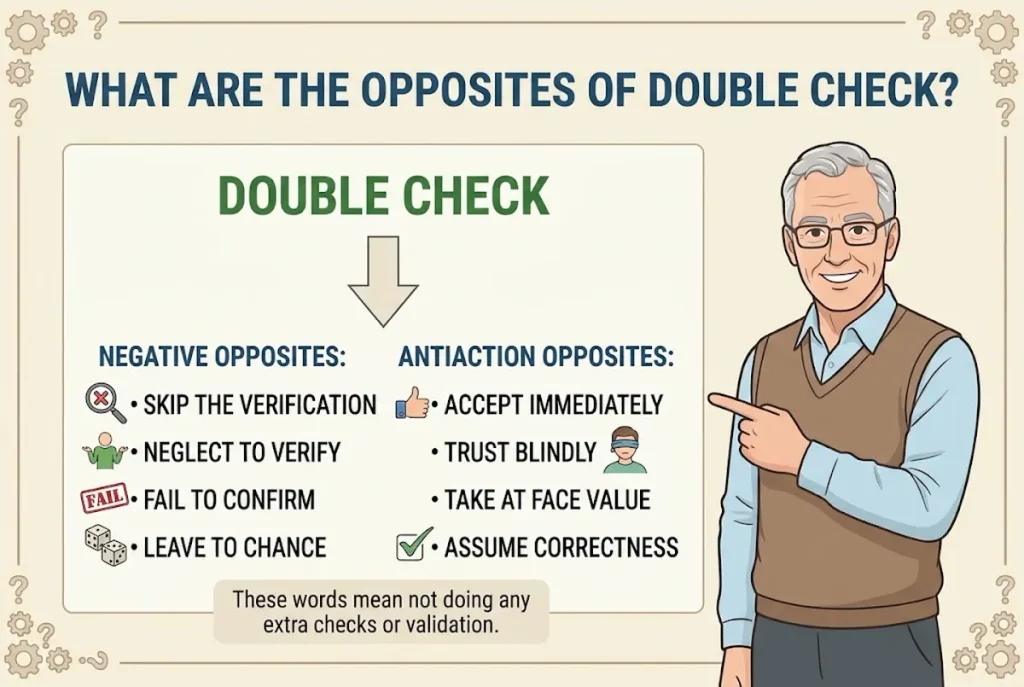
Antonyms help explain the meaning of an expression by showing the opposite action.
Because double-check describes careful examination, its opposites generally involve failing to examine something or paying insufficient attention.
| Opposite | Meaning | Example |
|---|---|---|
| Ignore | Give no attention | He ignored the warning. |
| Overlook | Fail to notice | She overlooked the error. |
| Neglect | Fail to give proper attention | They neglected the details. |
| Skip | Leave something out | Don’t skip the final review. |
| Assume | Accept without checking | Never assume the figures are correct. |
| Disregard | Pay no attention | He disregarded the instructions. |
Conclusion
Choosing between Words becomes easier once you understand the purpose of each expression.
Double-check is the natural choice when you want to examine information again and prevent mistakes. It works well in everyday conversations, professional emails, academic settings, and workplace communication.
Double confirm may be understood in some regional or informal contexts, but it isn’t the preferred expression in standard English. Reconfirm or confirm again usually communicates the intended meaning more clearly.
Remember that checking and confirming can describe separate actions. You might check an appointment date yourself and then ask someone else to confirm it.
The best approach is to choose words based on the action you’re describing. Clear, familiar language makes your writing sound more natural and helps readers understand exactly what you mean.
Frequently Asked Questions
What’s Another Way to Say Double Check?
You can say recheck, verify, review again, look over, or check once more. The best alternative depends on the situation and the level of formality.
Is Double Confirm Grammatically Correct?
Double confirm is understandable, but it’s not a widely established standard expression. Reconfirm is generally the more natural choice when requesting another confirmation.
Can I Use Double Check in a Professional Email?
Yes. Double-check is appropriate in professional emails when asking someone to review information again. For example, “Could you please double-check the attached figures?”
What Is the Difference Between Verify and Confirm?
Verify usually means establishing accuracy through checking or evidence. Confirm means establishing or acknowledging that something is true, correct, or definite.
Is Double Check One Word or Two Words?
The conventional spelling is double-check with a hyphen when used as a verb or noun. Double check also appears in informal writing, but the hyphenated spelling is preferred in edited English.
Can I Say Please Double Confirm the Booking?
People may understand the request, but “Please reconfirm the booking” sounds more natural. You can also say, “Could you please confirm the booking again?”

Daniel Grammarfield — The Language Learner
Age: 28Occupation: ESL Learner & Digital Professional
Bio:Daniel is a non-native English speaker who wants to communicate more confidently at work and online. He uses Synotrench to improve grammar, understand confusing words, learn correct sentence structures, and build everyday English skills. He prefers simple explanations with practical examples.
Goals:
Master English grammar rules
Avoid common language mistakes
Improve professional communication
Learn English through real-life examples
Quote:“Learning English is not about memorizing rules — it’s about expressing ideas clearly.”
2 thoughts on “Double Check or Double Confirm: Simple Usage Guide (2026)”