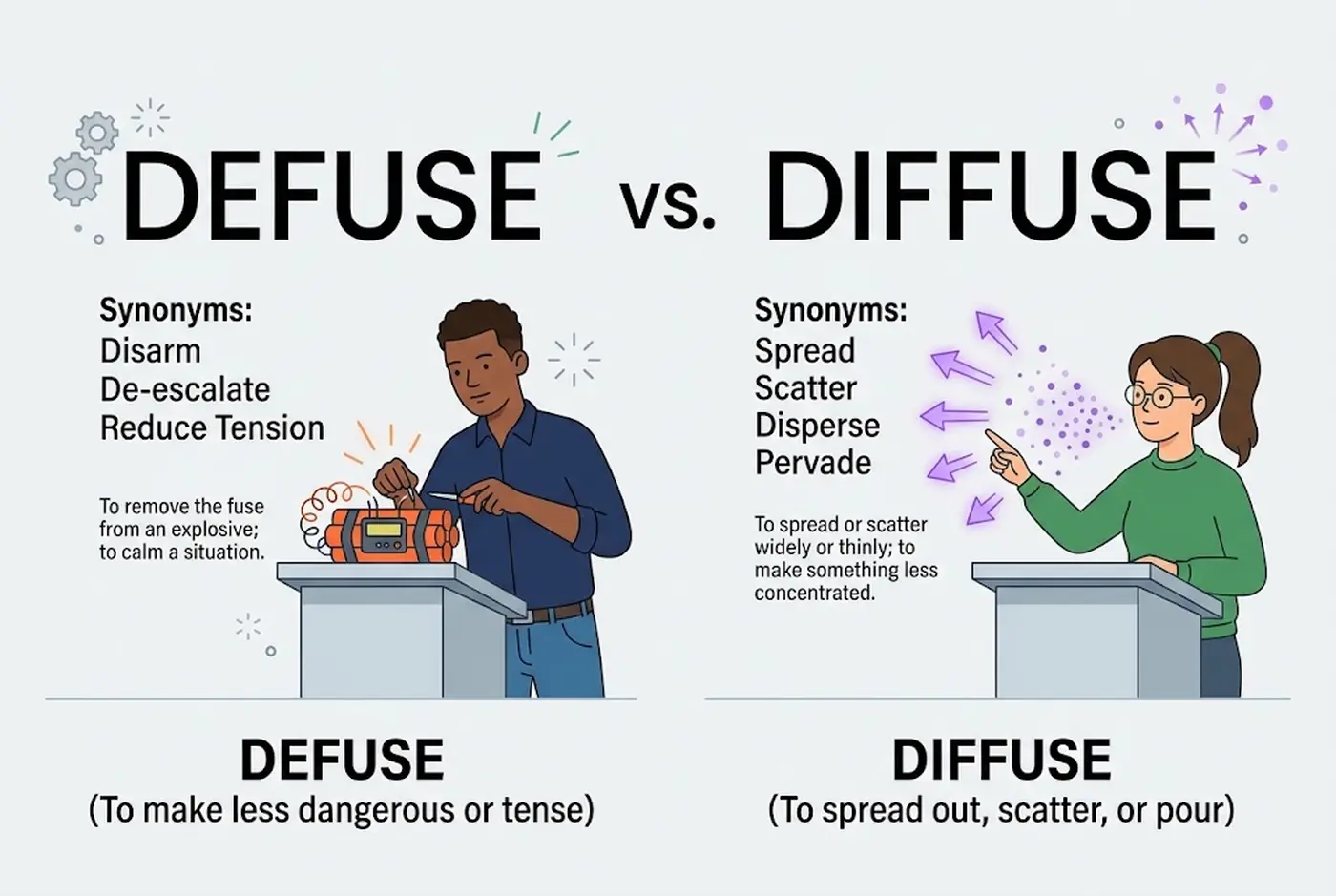
This is where the confusion between defuse vs diffuse begins. Both words look similar, sound somewhat alike, and can appear in discussions about difficult situations. However, they have different meanings.
Defuse means to make a dangerous or tense situation less harmful. Diffuse means to spread something across a wider area or in different directions.
Knowing this difference helps you choose the correct word in emails, essays, workplace reports, and everyday conversations. This guide explains their meanings, origins, synonyms, examples, common mistakes, and simple ways to remember each word.

What Is the Difference Between Defuse and Diffuse?
The main difference is that defuse means to remove danger or reduce tension, while diffuse means to spread something out.
Both words are verbs, but they describe different actions.
| Word | Meaning | Example |
|---|---|---|
| Defuse | Make something less dangerous or tense | She defused the argument. |
| Diffuse | Spread something over a wider area | The fan diffused the scent. |
Think about two different situations.
If two coworkers are arguing and their manager helps them calm down, the manager defuses the argument.
If someone sprays perfume and its scent spreads throughout the room, the perfume diffuses through the air.
The easiest way to remember the difference is to connect defuse with reducing danger and diffuse with spreading.
What Does Defuse Mean in Simple English?
Defuse means to make a dangerous, stressful, or difficult situation safer or calmer.
It often describes stopping a problem before it becomes worse.
For example:
- The teacher defused the argument between two students.
- Her friendly response helped defuse the tension.
- The manager tried to defuse an angry conversation.
- His apology helped defuse the situation.
- The negotiator worked to defuse the conflict.
In these examples, defuse describes an action that reduces emotional pressure, disagreement, or danger.
Where Does the Word Defuse Come From?
The word defuse comes from the prefix de, meaning to remove or reverse, and fuse, which refers to a device used to start an explosion.
Its original meaning relates to removing or disabling a fuse from an explosive device.
Over time, people began using the word in a figurative sense.
For example, a heated argument can feel like a bomb waiting to explode. Someone who calms the people involved can defuse the situation before it becomes worse.
Today, defuse is common in workplace communication, conflict management, politics, and everyday English.
When Should You Use Defuse?
Use defuse when someone reduces danger, anger, disagreement, or emotional tension.
Common expressions include:
- Defuse a situation.
- Defuse an argument.
- Defuse tension.
- Defuse a conflict.
- Defuse a crisis.
- Defuse a confrontation.
Example: Her calm explanation helped defuse the misunderstanding before it became a serious disagreement.
What Does Diffuse Mean in Simple English?
Diffuse means to spread something across a larger area or in different directions.
It can describe light, heat, gases, liquids, smells, information, and ideas.
For example:
- The curtains helped diffuse the bright sunlight.
- The scent of fresh bread diffused throughout the house.
- Heat slowly diffused through the metal.
- The organization worked to diffuse knowledge across different communities.
- The message diffused through several social networks.
In these sentences, diffuse describes movement or distribution rather than reducing danger.
Where Does the Word Diffuse Come From?
Diffuse comes from the Latin word diffundere, meaning to pour out or spread in different directions.
The word entered English through Latin and French influences.
Its original meaning explains why it appears so often in science, communication, and descriptions of physical movement.
For example, scientists use diffusion to describe how particles spread from an area of higher concentration to an area of lower concentration.
In everyday English, diffuse can describe how light, smells, information, or ideas spread.
Can Diffuse Be an Adjective?
Yes. Unlike defuse, diffuse can also work as an adjective.
As an adjective, diffuse means spread out, not concentrated, or lacking a clear focus.
Examples:
- The lamp produced a soft, diffuse light.
- His explanation was too diffuse to follow easily.
- The organization has a diffuse network of volunteers.
When describing writing, diffuse can suggest that the message is too wordy or unfocused.
Defuse vs Diffuse Synonyms With Meanings and Examples
Choosing a synonym becomes easier when you understand the action you want to describe.
Some alternatives express calming, while others describe spreading or distribution. They aren’t interchangeable in every sentence.
The following tables include 32 useful alternatives grouped by tone and everyday usage.
Simple Synonyms
These words work well in everyday writing and conversation.
| Word | Meaning | Tone | Example |
|---|---|---|---|
| Calm | Make someone less upset | Simple | She calmed the angry customer. |
| Ease | Make something less severe | Simple | His explanation eased the tension. |
| Settle | Bring a disagreement to an end | Simple | They settled their argument. |
| Reduce | Make something smaller or weaker | Simple | The changes reduced the pressure. |
| Spread | Move across a wider area | Simple | The smell spread through the kitchen. |
| Share | Give information to others | Simple | She shared the news with everyone. |
| Scatter | Move in different directions | Simple | The wind scattered the leaves. |
| Soften | Make something less harsh | Simple | The curtains softened the sunlight. |
Everyday Synonyms
These alternatives sound natural in emails, conversations, and general writing.
| Word | Meaning | Tone | Example |
|---|---|---|---|
| Soothe | Make someone feel calmer | Everyday | Her words soothed the worried child. |
| Resolve | Find a solution to a problem | Everyday | They resolved the disagreement. |
| Disperse | Spread or move apart | Everyday | The smoke dispersed into the air. |
| Circulate | Move among people or places | Everyday | The announcement circulated online. |
| Distribute | Give or spread among several places | Everyday | They distributed the materials. |
| Relax | Become or make less tense | Everyday | The conversation helped everyone relax. |
| Cool down | Become less angry or intense | Everyday | Both teams needed time to cool down. |
| Smooth over | Make a disagreement less serious | Everyday | She smoothed over the misunderstanding. |
Formal Synonyms
Formal alternatives are useful in academic essays, professional reports, and technical writing.
| Word | Meaning | Tone | Example |
|---|---|---|---|
| De-escalate | Reduce the intensity of conflict | Formal | The officer de-escalated the confrontation. |
| Mitigate | Make harmful effects less severe | Formal | The policy mitigated the risks. |
| Alleviate | Reduce discomfort or difficulty | Formal | The changes alleviated public concerns. |
| Neutralize | Remove or counteract a threat | Formal | The team neutralized the immediate threat. |
| Disseminate | Spread information widely | Formal | The university disseminated its findings. |
| Propagate | Spread or reproduce | Formal | The signal propagated through the network. |
| Radiate | Spread outward from a source | Formal | Heat radiated from the fireplace. |
| Decentralize | Distribute control away from one center | Formal | The company decentralized decision-making. |
Informal and Slang Alternatives
These expressions are common in casual American English. Some are idioms rather than exact replacements.
| Word or Phrase | Meaning | Tone | Example |
|---|---|---|---|
| Chill out | Become calmer | Slang | Everyone needed to chill out. |
| Take the heat off | Reduce pressure or criticism | Informal | His explanation took the heat off the team. |
| Break the ice | Reduce initial social awkwardness | Informal | Her joke helped break the ice. |
| Patch things up | Repair a damaged relationship | Informal | The friends finally patched things up. |
| Pass around | Share among several people | Informal | They passed around the photos. |
| Get the word out | Spread information | Informal | We need to get the word out quickly. |
| Fan out | Move outward in different directions | Informal | The volunteers fanned out across the park. |
| Go viral | Spread rapidly online | Informal | The short video went viral overnight. |
Which Synonyms Are Stronger or Weaker?
Some words describe a small change, while others suggest a much stronger action.
Choosing the right level of intensity makes your writing more accurate.
Synonyms for Defuse From Mild to Strong
| Intensity | Word | Best Use |
|---|---|---|
| Very mild | Ease | Reducing slight discomfort |
| Mild | Calm | Lowering emotional tension |
| Moderate | Soothe | Helping someone feel less upset |
| Moderate | Defuse | Preventing tension from becoming worse |
| Strong | De-escalate | Reducing an active conflict |
| Strong | Mitigate | Limiting harmful effects |
| Very strong | Neutralize | Removing or counteracting a threat |
Synonyms for Diffuse From Mild to Strong
Diffuse doesn’t have a fixed intensity scale because spreading depends on distance, speed, and concentration.
However, related words can suggest different degrees of distribution.
| Degree | Word | Meaning |
|---|---|---|
| Limited | Share | Give to selected people |
| Moderate | Circulate | Move among several people or places |
| Moderate | Diffuse | Spread outward or through an area |
| Broad | Disperse | Spread across different directions |
| Widespread | Disseminate | Distribute information widely |
| Rapid and widespread | Go viral | Spread quickly through online sharing |
How Do Defuse and Diffuse Change by Part of Speech?
Understanding word forms helps you build accurate sentences.
Verb Forms
| Base Form | Past Tense | Present Participle |
|---|---|---|
| Defuse | Defused | Defusing |
| Diffuse | Diffused | Diffusing |
Examples:
- The mediator is defusing the conflict.
- The scent diffused throughout the room.
- The team successfully defused the crisis.
Related Nouns and Adjectives
| Word | Part of Speech | Meaning |
|---|---|---|
| Defusing | Gerund or verbal noun | The act of reducing danger or tension |
| Defusal | Noun | The act of making something less dangerous |
| Diffusion | Noun | The process of spreading |
| Diffuse | Adjective | Spread out or lacking focus |
| Diffused | Adjective | Spread or softened |
| Diffuser | Noun | A device that spreads or softens something |
Is Defuse or Diffuse Different in American and British English?
Both American and British English use defuse and diffuse with the same basic meanings.
There is no major regional spelling difference.
| Usage | American English | British English |
|---|---|---|
| Reduce tension | Defuse | Defuse |
| Spread something | Diffuse | Diffuse |
| Noun for spreading | Diffusion | Diffusion |
| Past tense of defuse | Defused | Defused |
One pronunciation detail is worth knowing.
Defuse has a final z sound. Diffuse also has a final z sound when used as a verb, but its adjective form commonly ends with an s sound.
These differences don’t change the spelling rules.
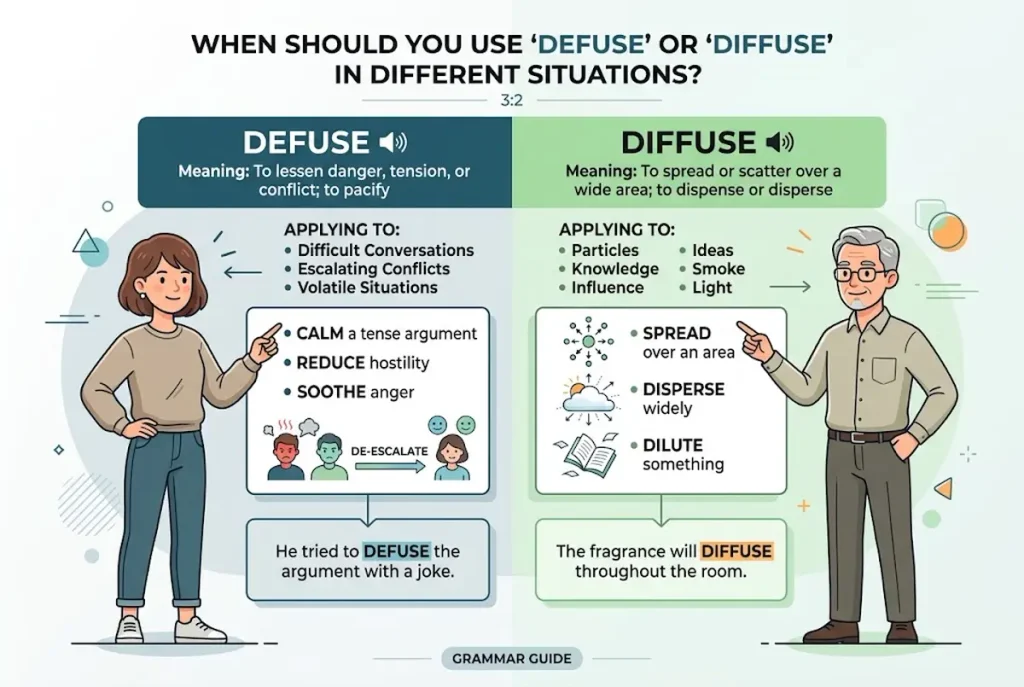
When Should You Use Defuse or Diffuse in Different Situations?
The best word depends on what you’re trying to communicate.
Here are five common situations where choosing the correct term matters.
Which Word Should You Use on a Resume?
Use defuse when describing conflict resolution, customer service, or workplace communication.
Example: Successfully defused customer complaints through active listening and clear communication.
This wording shows that you helped prevent difficult situations from becoming worse.
If you’re describing the distribution of information, diffuse may be grammatically possible, but distribute or share usually sounds more natural on a resume.
Example: Distributed training materials across five departments.
For professional achievements, choose specific action verbs that clearly explain what you accomplished.
Which Word Is Better for an Academic Essay?
Both words are appropriate, depending on your subject.
Use defuse when discussing conflict, diplomacy, disagreement, or political tension.
Example: The agreement helped defuse tensions between the neighboring countries.
Use diffuse when describing scientific processes, communication, or the movement of ideas.
Example: Cultural practices can diffuse across communities through migration and trade.
Academic writing benefits from precise language. Don’t replace one term with the other simply to avoid repetition.
Which Word Should You Use When Texting?
In casual messages, defuse works when talking about calming an argument or awkward situation.
Example: I tried to defuse the argument before everyone got upset.
Diffuse is less common in everyday texting, but it still works when describing something spreading.
Example: The smell of your cooking has diffused through the whole apartment!
In casual conversation, spread may sound more natural than diffuse.
Which Word Works Best in a Professional Email?
Use defuse when explaining how someone managed tension or prevented a disagreement from becoming worse.
Example: Thank you for helping defuse the tension during yesterday’s meeting.
Use diffuse when discussing the distribution of something, especially in a technical context.
Example: The updated system helps diffuse heat more evenly across the equipment.
For sharing documents or announcements, distribute, circulate, or share will often be clearer.
Which Word Sounds More Natural When Speaking?
Defuse is common when discussing arguments, emergencies, and difficult conversations.
Example: I made a joke to defuse the tension.
Diffuse is natural when talking about light, heat, smells, or scientific processes.
Example: The shade helps diffuse the sunlight.
In everyday speech, many people prefer spread when no technical meaning is needed.
Example: The smell spread throughout the room.
Examples of Defuse and Diffuse in Real Situations
Seeing the words in different settings makes their meanings easier to remember.
The following examples show how each word works in natural American English.
Examples Using Defuse
- The teacher quickly defused the disagreement between two classmates.
- A sincere apology helped defuse the tension at dinner.
- The police officer tried to defuse the confrontation peacefully.
- Her calm voice helped defuse an uncomfortable conversation.
- The manager defused the conflict before it affected the entire department.
Examples Using Diffuse
- The white curtains diffuse sunlight throughout the bedroom.
- The pleasant scent slowly diffused through the hallway.
- Heat diffuses from warmer areas toward cooler areas.
- The photographer used a screen to diffuse the harsh light.
- The new communication system helped diffuse information across the organization.
Notice that the first group focuses on reducing danger or tension, while the second focuses on spreading or distribution.
Defuse vs Diffuse Compared With Similar Words
Several related words can create confusion because their meanings overlap.
Understanding the small differences helps you choose more accurate language.
Defuse vs De-escalate
Both words describe reducing tension, but they emphasize slightly different actions.
| Defuse | De-escalate |
|---|---|
| Prevents or reduces a dangerous situation | Reduces the intensity of an existing conflict |
| Often suggests stopping a problem before it worsens | Often suggests bringing an already heated situation under control |
| Common in everyday conversation | Common in professional conflict management |
Examples:
Defuse: Her apology helped defuse a potentially serious argument.
De-escalate: The trained officer used communication skills to de-escalate the confrontation.
Both words can describe the same event, but de-escalate often emphasizes a gradual reduction in intensity.
Diffuse vs Disperse
Both words describe spreading, but their meanings aren’t identical.
| Diffuse | Disperse |
|---|---|
| Spread through or across an area | Scatter or move apart |
| Common with light, heat, gases, and liquids | Common with crowds, clouds, smoke, and groups |
| Often emphasizes gradual distribution | Often emphasizes separation in different directions |
Examples:
Diffuse: The fragrance slowly diffused through the room.
Disperse: The crowd began to disperse after the event.
A scent can diffuse through the air without being scattered in the same way that a group of people disperses.
Defuse vs Resolve
Defuse means reducing immediate danger or tension. Resolve means finding a solution or bringing a problem to an end.
Example: The manager defused the argument, but the team still needed another meeting to resolve the disagreement.
This distinction matters in professional writing.
A person can successfully calm a situation without solving the original problem.
What Are the Most Common Mistakes With Defuse and Diffuse?
The most common error is using diffuse when the intended meaning is reducing tension.
This happens because the two words look similar and share a few pronunciation features.
Mistake 1: Writing Diffuse the Situation
Incorrect: The manager tried to diffuse the situation.
Correct: The manager tried to defuse the situation.
When you mean calming a difficult situation, defuse is the standard choice.
Although diffuse can suggest spreading something out, it isn’t the usual word for reducing conflict.
Mistake 2: Using Defuse for Light or Heat
Incorrect: The curtains helped defuse the sunlight.
Correct: The curtains helped diffuse the sunlight.
Sunlight isn’t an argument or dangerous device that needs to be defused.
The curtains spread and soften the incoming light.
Mistake 3: Confusing Diffusion With Defusal
These nouns describe different processes.
| Incorrect Usage | Correct Usage |
|---|---|
| The diffusion of the argument | The defusal of the argument |
| The defusal of heat through metal | The diffusion of heat through metal |
| The defusal of particles | The diffusion of particles |
Use diffusion for spreading and defusal for reducing or removing danger.
When Should You Avoid Using Defuse or Diffuse?
Even when a word is grammatically correct, it may not be the clearest choice.
Avoid defuse when you’re describing the physical movement of substances, light, or heat.
Avoid diffuse when you’re describing an apology, negotiation, or action intended to calm an argument.
Also, don’t use diffuse simply because something becomes weaker.
For example, saying that someone’s anger diffused may suggest that the feeling spread rather than disappeared. Saying that their anger eased is clearer.
In formal writing, use precise alternatives when they better describe your intended meaning.
What Are the Opposites of Defuse and Diffuse?
It can make the difference between these words easier to understand.
Antonyms of Defuse
| Antonym | Meaning |
|---|---|
| Escalate | Make a situation more intense |
| Aggravate | Make a problem worse |
| Provoke | Cause anger or a reaction |
| Intensify | Increase strength or severity |
| Inflame | Make feelings or conflict stronger |
Antonyms of Diffuse
| Antonym | Meaning |
|---|---|
| Concentrate | Gather into one area |
| Collect | Bring things together |
| Gather | Move toward one place |
| Localize | Limit something to a specific area |
| Focus | Direct toward one point |
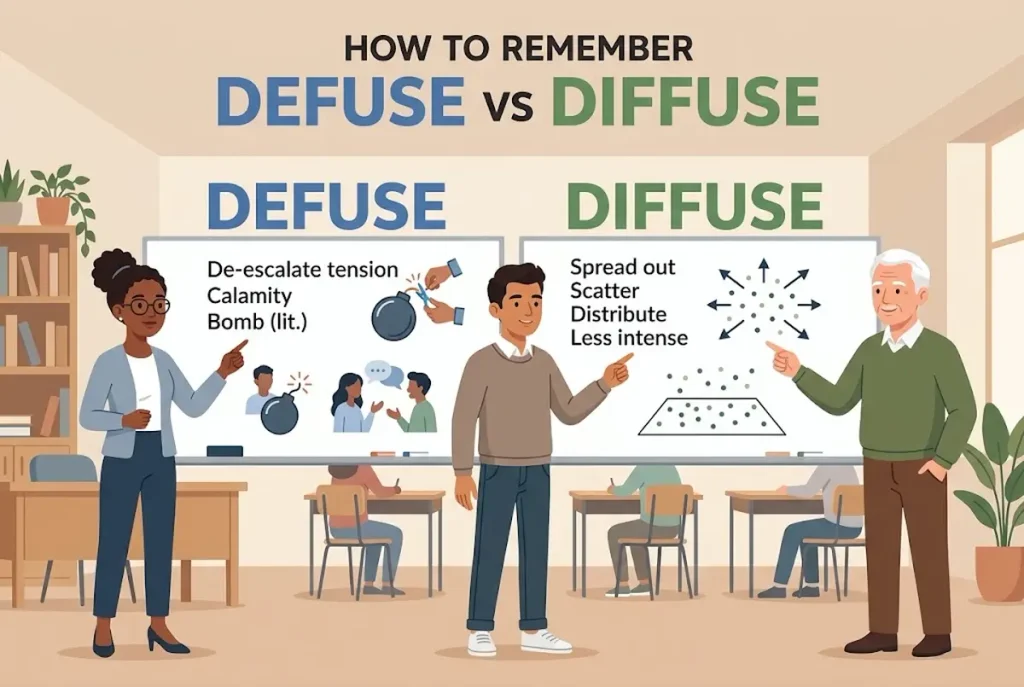
How Can You Remember Defuse and Diffuse Easily?
You don’t need to memorize complicated grammar rules to remember these words.
A few simple associations can help.
Remember Defuse With a Bomb
Think about someone removing the fuse from a bomb.
Removing the fuse prevents an explosion.
In the same way, defusing an argument helps prevent an emotional explosion.
Memory trick: Defuse means remove the danger.
Try This Quick Grammar Test
Choose the correct word
1. The counselor helped ___ the argument.defusediffuse
2. The fragrance began to ___ through the room.defusediffuse
3. The curtains helped ___ the harsh light.defusediffuse
Conclusion
The difference between defuse vs diffuse becomes much easier to remember when you focus on the action each word describes.
Use defuse when someone removes danger, reduces tension, or prevents a difficult situation from becoming worse. Use diffuse when something spreads through an area or moves in different directions.
These meanings also help you choose better alternatives. Calm, ease, and de-escalate relate to reducing tension, while spread, disperse, and distribute describe different forms of movement or sharing.
Before writing either word, check the meaning of your sentence. Are you describing a problem becoming calmer or something spreading outward? That simple question will help you make the correct choice in emails, essays, professional reports, and everyday conversations.
Frequently Asked Questions
Is it correct to say defuse or diffuse a situation?
Defuse a situation is the standard expression when you mean reducing danger or tension. Diffuse describes spreading something rather than calming a conflict.
What is the difference between defuse vs diffuse in English?
Defuse means to reduce danger or tension, while diffuse means to spread something across an area. Their meanings are different even though their spellings look similar.
Can you say diffuse the tension?
Defuse the tension is the standard and clearer expression. Use diffuse when describing something spreading rather than an action that reduces emotional pressure.
What’s another way to say defuse a situation?
You can say calm the situation, ease the tension, de-escalate the conflict, or smooth things over. Choose the expression that best matches the seriousness of the problem.
Is diffuse a verb or an adjective?
Diffuse can be both a verb and an adjective. As a verb, it means to spread. As an adjective, it describes something spread out or lacking a clear focus.
What is the past tense of defuse and diffuse?
The past tense of defuse is defused, and the past tense of diffuse is diffused. Both are regular verbs.
How can I remember defuse vs diffuse easily?
Connect defuse with removing a bomb’s fuse and diffuse with an essential oil diffuser spreading fragrance. These simple images help you remember the difference.
Should I write defuse the bomb or diffuse the bomb?
Write defuse the bomb. It means making an explosive device safe by disabling its firing mechanism. Diffuse the bomb is incorrect when describing this action.

Daniel Grammarfield — The Language Learner
Age: 28Occupation: ESL Learner & Digital Professional
Bio:Daniel is a non-native English speaker who wants to communicate more confidently at work and online. He uses Synotrench to improve grammar, understand confusing words, learn correct sentence structures, and build everyday English skills. He prefers simple explanations with practical examples.
Goals:
Master English grammar rules
Avoid common language mistakes
Improve professional communication
Learn English through real-life examples
Quote:“Learning English is not about memorizing rules — it’s about expressing ideas clearly.”
1 thought on “Defuse vs Diffuse: Simple Guide With Examples (2026)”